Transmission LINCOLN MKZ 2017 Repair Manual
[x] Cancel search | Manufacturer: LINCOLN, Model Year: 2017, Model line: MKZ, Model: LINCOLN MKZ 2017Pages: 564, PDF Size: 5.54 MB
Page 281 of 564
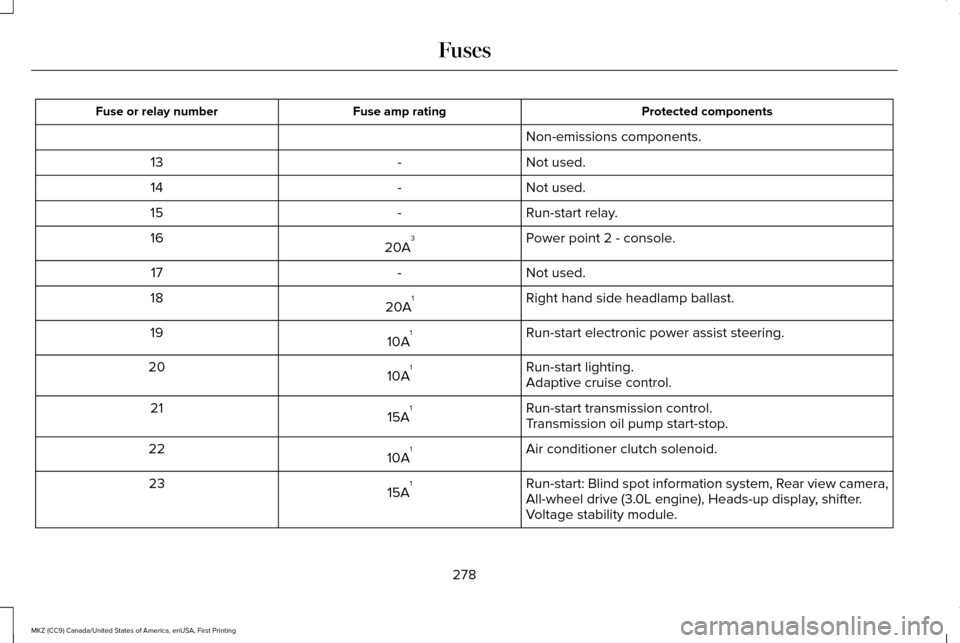
Protected components
Fuse amp rating
Fuse or relay number
Non-emissions components.
Not used.
-
13
Not used.
-
14
Run-start relay.
-
15
Power point 2 - console.
20A 3
16
Not used.
-
17
Right hand side headlamp ballast.
20A 1
18
Run-start electronic power assist steering.
10A 1
19
Run-start lighting.
10A 1
20
Adaptive cruise control.
Run-start transmission control.
15A 1
21
Transmission oil pump start-stop.
Air conditioner clutch solenoid.
10A 1
22
Run-start: Blind spot information system, Rear view camera,
All-wheel drive (3.0L engine), Heads-up display, shifter.
15A 1
23
Voltage stability module.
278
MKZ (CC9) Canada/United States of America, enUSA, First Printing Fuses
Page 288 of 564
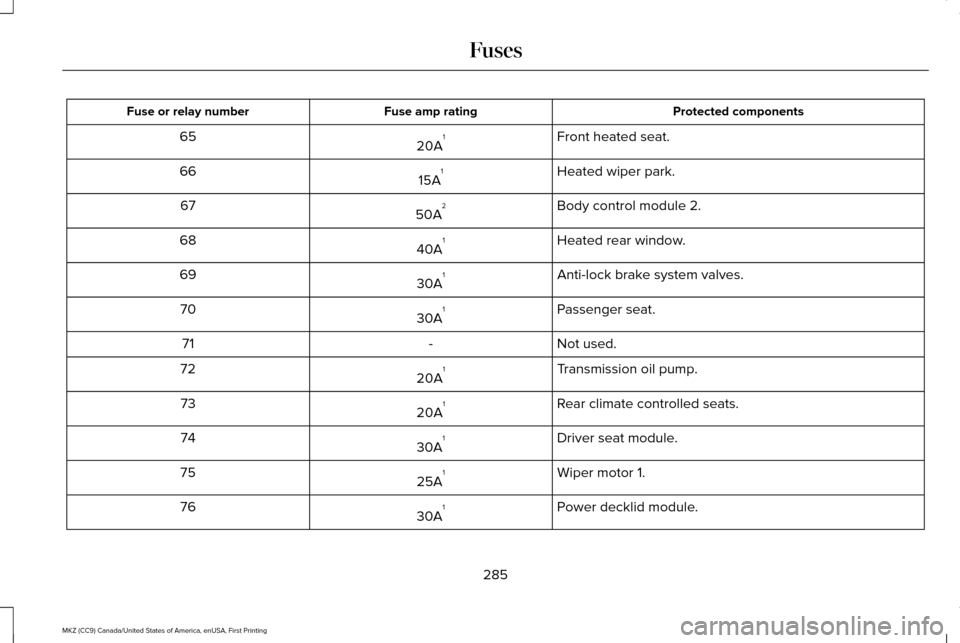
Protected components
Fuse amp rating
Fuse or relay number
Front heated seat.
20A 1
65
Heated wiper park.
15A 1
66
Body control module 2.
50A 2
67
Heated rear window.
40A 1
68
Anti-lock brake system valves.
30A 1
69
Passenger seat.
30A 1
70
Not used.
-
71
Transmission oil pump.
20A 1
72
Rear climate controlled seats.
20A 1
73
Driver seat module.
30A 1
74
Wiper motor 1.
25A 1
75
Power decklid module.
30A 1
76
285
MKZ (CC9) Canada/United States of America, enUSA, First Printing Fuses
Page 289 of 564
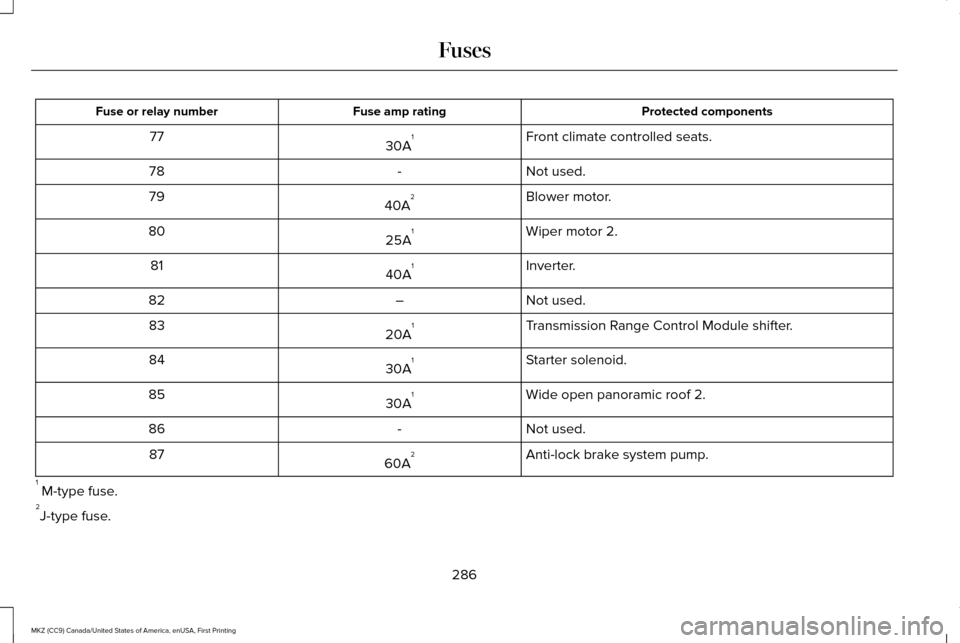
Protected components
Fuse amp rating
Fuse or relay number
Front climate controlled seats.
30A 1
77
Not used.
-
78
Blower motor.
40A 2
79
Wiper motor 2.
25A 1
80
Inverter.
40A 1
81
Not used.
–
82
Transmission Range Control Module shifter.
20A 1
83
Starter solenoid.
30A 1
84
Wide open panoramic roof 2.
30A 1
85
Not used.
-
86
Anti-lock brake system pump.
60A 2
87
1 M-type fuse.
2 J-type fuse.
286
MKZ (CC9) Canada/United States of America, enUSA, First Printing Fuses
Page 303 of 564
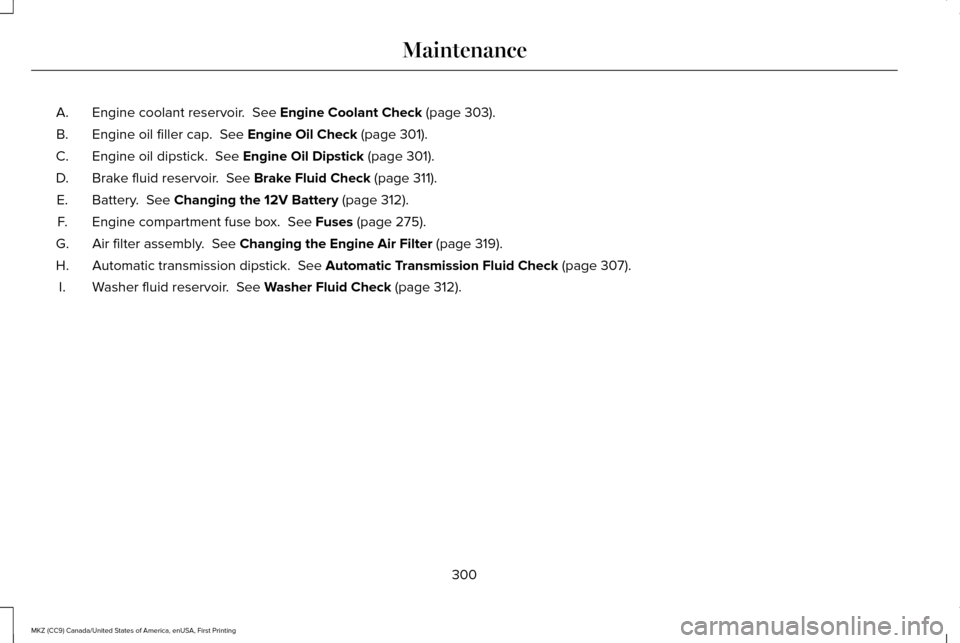
Engine coolant reservoir. See Engine Coolant Check (page 303).
A.
Engine oil filler cap.
See Engine Oil Check (page 301).
B.
Engine oil dipstick.
See Engine Oil Dipstick (page 301).
C.
Brake fluid reservoir.
See Brake Fluid Check (page 311).
D.
Battery.
See Changing the 12V Battery (page 312).
E.
Engine compartment fuse box.
See Fuses (page 275).
F.
Air filter assembly.
See Changing the Engine Air Filter (page 319).
G.
Automatic transmission dipstick.
See Automatic Transmission Fluid Check (page 307).
H.
Washer fluid reservoir.
See Washer Fluid Check (page 312).
I.
300
MKZ (CC9) Canada/United States of America, enUSA, First Printing Maintenance
Page 304 of 564
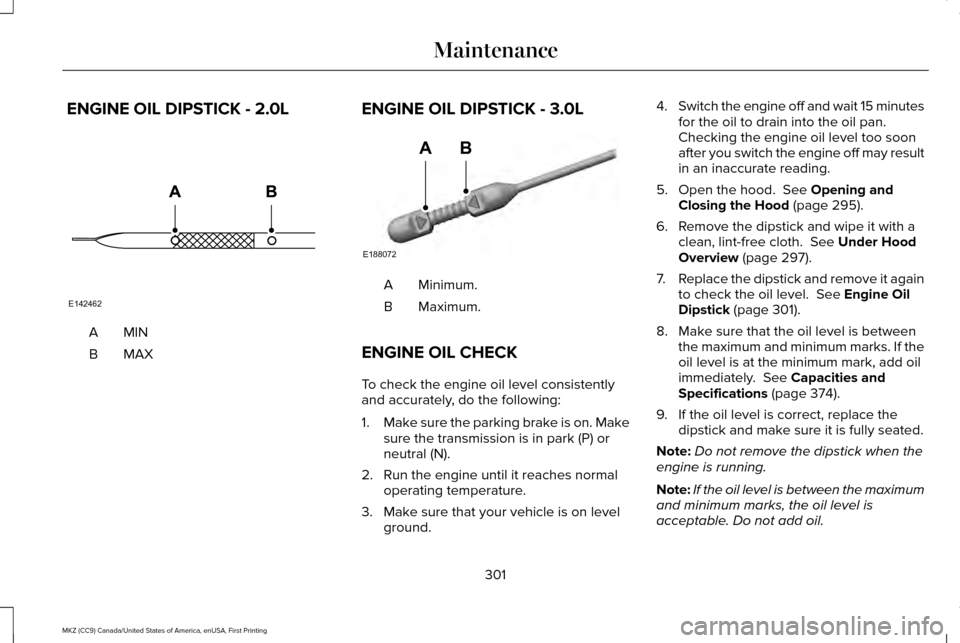
ENGINE OIL DIPSTICK - 2.0L
MINA
MAXB
ENGINE OIL DIPSTICK - 3.0L Minimum.
A
Maximum.
B
ENGINE OIL CHECK
To check the engine oil level consistently
and accurately, do the following:
1. Make sure the parking brake is on. Make
sure the transmission is in park (P) or
neutral (N).
2. Run the engine until it reaches normal operating temperature.
3. Make sure that your vehicle is on level ground. 4.
Switch the engine off and wait 15 minutes
for the oil to drain into the oil pan.
Checking the engine oil level too soon
after you switch the engine off may result
in an inaccurate reading.
5. Open the hood. See Opening and
Closing the Hood (page 295).
6. Remove the dipstick and wipe it with a clean, lint-free cloth.
See Under Hood
Overview (page 297).
7. Replace the dipstick and remove it again
to check the oil level.
See Engine Oil
Dipstick (page 301).
8. Make sure that the oil level is between the maximum and minimum marks. If the
oil level is at the minimum mark, add oil
immediately.
See Capacities and
Specifications (page 374).
9. If the oil level is correct, replace the dipstick and make sure it is fully seated.
Note: Do not remove the dipstick when the
engine is running.
Note: If the oil level is between the maximum
and minimum marks, the oil level is
acceptable. Do not add oil.
301
MKZ (CC9) Canada/United States of America, enUSA, First Printing MaintenanceE142462 E188072
AB
Page 310 of 564
If you tow a trailer with your vehicle, the
engine may temporarily reach higher a
temperature during severe operating
conditions, for example ascending a long or
steep grade in high ambient temperatures.
At this time, you may notice the coolant
temperature gauge moves toward the red
zone and a message may appear in the
information display.
You may notice a reduction in vehicle speed
caused by reduced engine power. In order
to manage the engine coolant temperature.
Your vehicle may enter this mode if certain
high-temperature and high-load conditions
take place. The amount of speed reduction
depends on vehicle loading, grade and
ambient temperature. If this occurs, there is
no need to pull off the road. You can
continue to drive your vehicle.
The air conditioning may automatically turn
on and off during severe operating
conditions to protect the engine from
overheating. When the coolant temperature
decreases to the normal operating
temperature, the air conditioning turns on.
If the coolant temperature gauge moves fully
into the red zone, or if the coolant
temperature warning or service engine soon
messages appear in your information display,
do the following:
1. Pull off the road as soon as safely
possible and shift the transmission into
park (P).
2. Leave the engine running until the coolant temperature gauge needle
returns to the normal position. After
several minutes, if the temperature does
not drop, follow the remaining steps.
3. Switch the engine off and wait for it to cool. Check the coolant level.
4. If the coolant level is at or below the minimum mark, add prediluted coolant
immediately.
5. If the coolant level is normal, restart the engine and continue. AUTOMATIC TRANSMISSION
FLUID CHECK
6F35/HF35 transmission
(If Equipped)
Note: Transmission fluid should be checked
by an authorized dealer. If required, fluid
should be added by an authorized dealer.
The automatic transmission does not have
a transmission fluid dipstick.
Refer to your scheduled maintenance
information for scheduled intervals for fluid
checks and changes. Your transmission does
not consume fluid. However, the fluid level
should be checked if the transmission is not
working properly, (For example: if the
transmission slips or shifts slowly) or if you
notice some sign of fluid leakage.
See
Scheduled Maintenance (page 495).
Do not use supplemental transmission fluid
additives, treatments or cleaning agents. The
use of these materials may affect
transmission operation and result in damage
to internal transmission components.
307
MKZ (CC9) Canada/United States of America, enUSA, First Printing Maintenance
Page 311 of 564
6F50/6F55 Transmission (If Equipped)
WARNINGS
The dipstick cap and surrounding
components may be hot; gloves are
recommended. Use gloves when moving the air filter
assembly. Components will be hot.
Note:
Automatic transmission fluid expands
when warmed. To obtain an accurate fluid
check, drive the vehicle until it is warmed up
(approximately 20 miles [30 kilometers]). If
your vehicle has been operated for an
extended period at high speeds, in city traffic
during hot weather or pulling a trailer, the
vehicle should be turned off until normal
operating temperatures are reached to allow
the fluid to cool before checking. Depending
on vehicle use, cooling times could take up
to 30 minutes or longer. Refer to your scheduled maintenance
information for scheduled intervals for fluid
checks and changes. Your transmission does
not consume fluid. However, the fluid level
should be checked if the transmission is not
working properly. For example, if the
transmission slips or shifts slowly or if you
notice some sign of fluid leakage.
1.
Drive the vehicle 20 miles (30 kilometers)
or until it reaches normal operating
temperature
2. Park the vehicle on a level surface and engage the parking brake.
3. With the parking brake engaged and your
foot on the brake pedal, start the engine
and move the gearshift lever through all
of the gear ranges. Allow a minimum of
10 seconds for each gear to engage.
4. Put the gearshift lever in
P (Park) and
leave the engine running.
Note: You will need to move the air filter
assembly to access the transmission
dipstick. 5.
Remove the dipstick, wiping it clean with
a clean, dry lint free rag. If necessary,
refer to Under hood overview in this
chapter for the location of the dipstick.
6. Install the dipstick making sure it is fully seated in the filler tube by turning it to
the locked position.
7. Remove the dipstick and inspect the fluid
level. The fluid should be in the
designated areas for normal operating
temperature.
Moving the Air Filter Assembly (Accessing
the Dipstick) WARNING
Do not run engine with the air filter
disconnected.
308
MKZ (CC9) Canada/United States of America, enUSA, First Printing Maintenance
Page 312 of 564
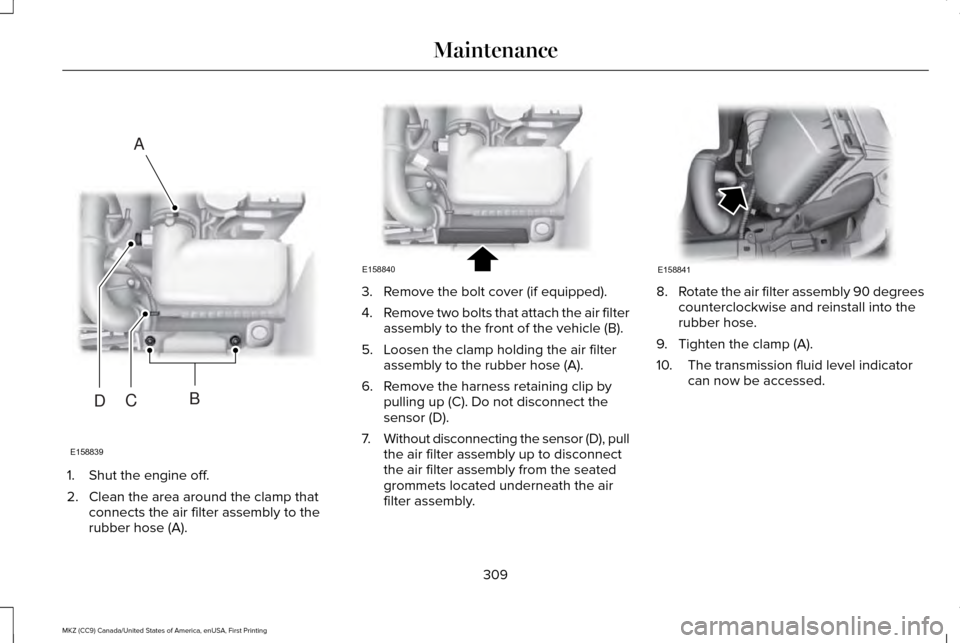
1. Shut the engine off.
2. Clean the area around the clamp that
connects the air filter assembly to the
rubber hose (A). 3. Remove the bolt cover (if equipped).
4.
Remove two bolts that attach the air filter
assembly to the front of the vehicle (B).
5. Loosen the clamp holding the air filter assembly to the rubber hose (A).
6. Remove the harness retaining clip by pulling up (C). Do not disconnect the
sensor (D).
7. Without disconnecting the sensor (D), pull
the air filter assembly up to disconnect
the air filter assembly from the seated
grommets located underneath the air
filter assembly. 8.
Rotate the air filter assembly 90 degrees
counterclockwise and reinstall into the
rubber hose.
9. Tighten the clamp (A).
10. The transmission fluid level indicator can now be accessed.
309
MKZ (CC9) Canada/United States of America, enUSA, First Printing MaintenanceE158839
A
BCD E158840 E158841
Page 313 of 564
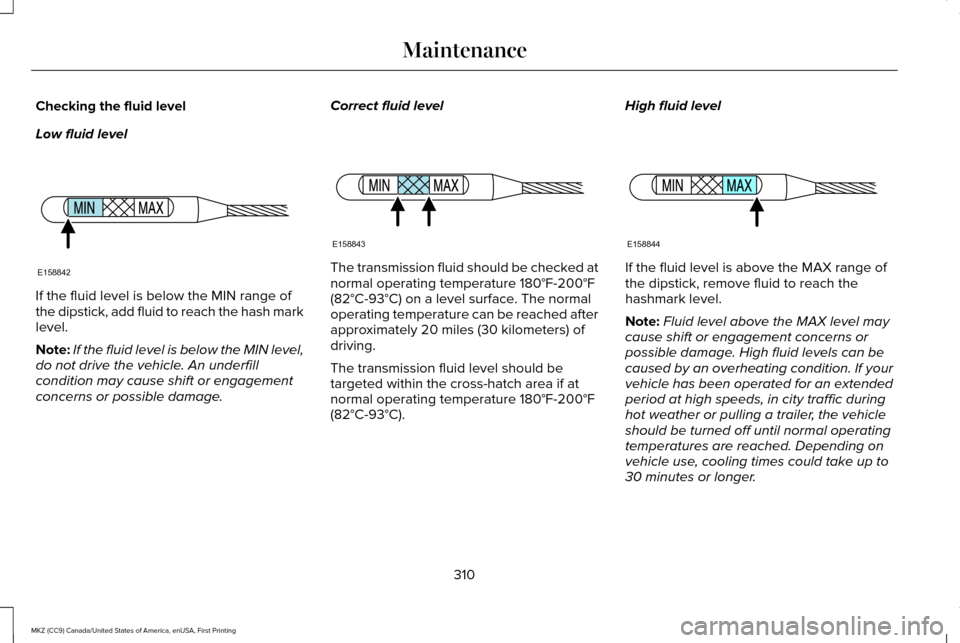
Checking the fluid level
Low fluid level
If the fluid level is below the MIN range of
the dipstick, add fluid to reach the hash mark
level.
Note:
If the fluid level is below the MIN level,
do not drive the vehicle. An underfill
condition may cause shift or engagement
concerns or possible damage. Correct fluid level The transmission fluid should be checked at
normal operating temperature 180°F-200°F
(82°C-93°C) on a level surface. The normal
operating temperature can be reached after
approximately 20 miles (30 kilometers) of
driving.
The transmission fluid level should be
targeted within the cross-hatch area if at
normal operating temperature 180°F-200°F
(82°C-93°C).
High fluid level If the fluid level is above the MAX range of
the dipstick, remove fluid to reach the
hashmark level.
Note:
Fluid level above the MAX level may
cause shift or engagement concerns or
possible damage. High fluid levels can be
caused by an overheating condition. If your
vehicle has been operated for an extended
period at high speeds, in city traffic during
hot weather or pulling a trailer, the vehicle
should be turned off until normal operating
temperatures are reached. Depending on
vehicle use, cooling times could take up to
30 minutes or longer.
310
MKZ (CC9) Canada/United States of America, enUSA, First Printing MaintenanceE158842 E158843 E158844
Page 314 of 564
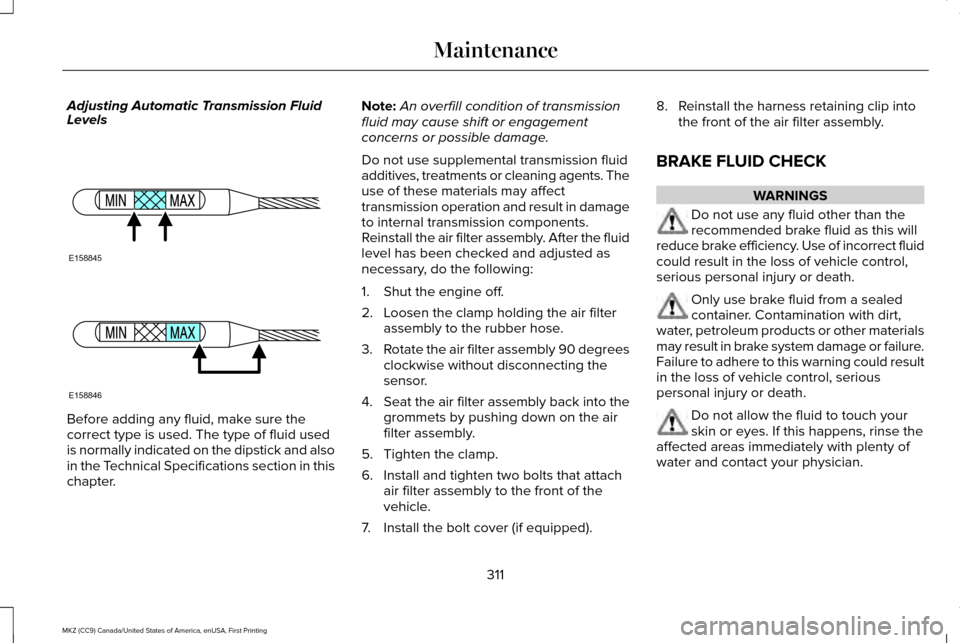
Adjusting Automatic Transmission Fluid
Levels
Before adding any fluid, make sure the
correct type is used. The type of fluid used
is normally indicated on the dipstick and also
in the Technical Specifications section in this
chapter. Note:
An overfill condition of transmission
fluid may cause shift or engagement
concerns or possible damage.
Do not use supplemental transmission fluid
additives, treatments or cleaning agents. The
use of these materials may affect
transmission operation and result in damage
to internal transmission components.
Reinstall the air filter assembly. After the fluid
level has been checked and adjusted as
necessary, do the following:
1. Shut the engine off.
2. Loosen the clamp holding the air filter assembly to the rubber hose.
3. Rotate the air filter assembly 90 degrees
clockwise without disconnecting the
sensor.
4. Seat the air filter assembly back into the
grommets by pushing down on the air
filter assembly.
5. Tighten the clamp.
6. Install and tighten two bolts that attach air filter assembly to the front of the
vehicle.
7. Install the bolt cover (if equipped). 8. Reinstall the harness retaining clip into
the front of the air filter assembly.
BRAKE FLUID CHECK WARNINGS
Do not use any fluid other than the
recommended brake fluid as this will
reduce brake efficiency. Use of incorrect fluid
could result in the loss of vehicle control,
serious personal injury or death. Only use brake fluid from a sealed
container. Contamination with dirt,
water, petroleum products or other materials
may result in brake system damage or failure.
Failure to adhere to this warning could result
in the loss of vehicle control, serious
personal injury or death. Do not allow the fluid to touch your
skin or eyes. If this happens, rinse the
affected areas immediately with plenty of
water and contact your physician.
311
MKZ (CC9) Canada/United States of America, enUSA, First Printing MaintenanceE158845 E158846