fuel filter LINCOLN MKZ 2017 Owners Manual
[x] Cancel search | Manufacturer: LINCOLN, Model Year: 2017, Model line: MKZ, Model: LINCOLN MKZ 2017Pages: 564, PDF Size: 5.54 MB
Page 7 of 564
Towing
Towing a Trailer.............................................249
Recommended Towing Weights..............250
Essential Towing Checks...........................252
Towing the Vehicle on Four Wheels
.......254
Driving Hints
Breaking-In....................................................256
Economical Driving
......................................256
Driving Through Water
...............................256
Floor Mats
.......................................................257
Roadside Emergencies
Roadside Assistance
...................................259
Hazard Warning Flashers...........................260
Fuel Shutoff...................................................260
Jump Starting the Vehicle...........................261
Post-Crash Alert System.............................264
Transporting the Vehicle............................264
Towing Points
................................................265
Customer Assistance
Getting the Services You Need
................267 In California (U.S. Only)...............................268
The Better Business Bureau (BBB) Auto
Line Program (U.S. Only)........................269
Utilizing the Mediation/Arbitration Program (Canada Only)...........................................270
Getting Assistance Outside the U.S. and Canada.........................................................271
Ordering Additional Owner's Literature....................................................272
Reporting Safety Defects (U.S. Only).......273
Reporting Safety Defects (Canada Only)............................................................273
Fuses
Fuse Specification Chart
............................275
Changing a Fuse..........................................292
Maintenance
General Information
....................................295
Opening and Closing the Hood...............295
Under Hood Overview - 2.0L
....................297
Under Hood Overview - 3.0L....................299
Engine Oil Dipstick - 2.0L............................301
Engine Oil Dipstick - 3.0L............................301 Engine Oil Check..........................................301
Oil Change Indicator Reset.......................302
Engine Coolant Check................................303
Automatic Transmission Fluid Check......307
Brake Fluid Check..........................................311
Washer Fluid Check......................................312
Fuel Filter
.........................................................312
Changing the 12V Battery...........................312
Checking the Wiper Blades........................314
Changing the Wiper Blades........................314
Adjusting the Headlamps............................315
Changing a Bulb
............................................316
Bulb Specification Chart..............................316
Changing the Engine Air Filter..................319
Vehicle Care
General Information.....................................320
Cleaning Products
.......................................320
Cleaning the Exterior
....................................321
Waxing............................................................322
Cleaning the Engine....................................322
Cleaning the Windows and Wiper Blades.........................................................323
4
MKZ (CC9) Canada/United States of America, enUSA, First Printing Table of Contents
Page 11 of 564
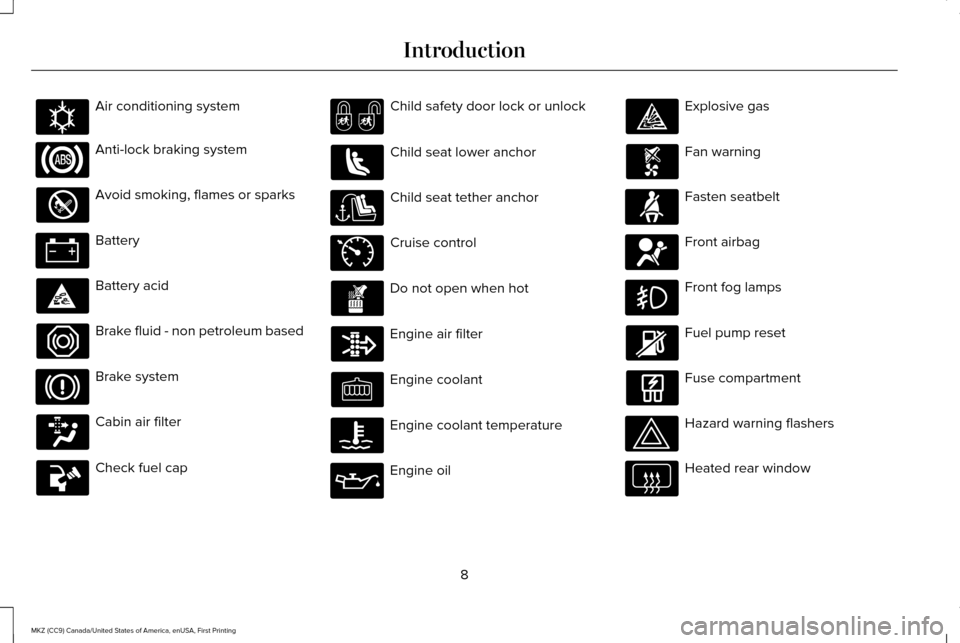
Air conditioning system
Anti-lock braking system
Avoid smoking, flames or sparks
Battery
Battery acid
Brake fluid - non petroleum based
Brake system
Cabin air filter
Check fuel cap Child safety door lock or unlock
Child seat lower anchor
Child seat tether anchor
Cruise control
Do not open when hot
Engine air filter
Engine coolant
Engine coolant temperature
Engine oil Explosive gas
Fan warning
Fasten seatbelt
Front airbag
Front fog lamps
Fuel pump reset
Fuse compartment
Hazard warning flashers
Heated rear window
8
MKZ (CC9) Canada/United States of America, enUSA, First Printing IntroductionE162384 E71340
Page 259 of 564
BREAKING-IN
You need to break in new tires for
approximately 300 miles (480 kilometers).
During this time, your vehicle may exhibit
some unusual driving characteristics.
Avoid driving too fast during the first 1000
miles (1600 kilometers). Vary your speed
frequently and change up through the gears
early. Do not labor the engine.
Do not tow during the first 1000 miles (1600
kilometers).
ECONOMICAL DRIVING
Fuel economy is affected by several things
such as how you drive, the conditions you
drive under and how you maintain your
vehicle.
There are some things to keep in mind that
may improve your fuel economy:
•
Accelerate and slow down in a smooth,
moderate fashion.
• Drive at steady speeds. •
Anticipate stops; slowing down may
eliminate the need to stop.
• Combine errands and minimize
stop-and-go driving (When running
errands, go to the furthest destination
first and then work your way back home).
• Close the windows for high-speed
driving.
• Drive at reasonable speeds.
• Keep the tires properly inflated and use
only the recommended size.
• Use the recommended engine oil.
• Perform all regularly scheduled
maintenance.
There are also some things you may want to
avoid doing because they reduce your fuel
economy:
• Avoid sudden or hard accelerations.
• Avoid revving the engine before turning
off the car.
• Avoid long idle periods.
• Do not warm up your vehicle on cold
mornings. •
Reduce the use of air conditioning and
heat.
• Avoid using speed control in hilly terrain.
• Do not rest your foot on the brake pedal
while driving.
• Avoid carrying unnecessary weight.
• Avoid adding particular accessories to
your vehicle (e.g. bug deflectors,
rollbars/light bars, running boards, ski
racks).
• Avoid driving with the wheels out of
alignment.
DRIVING THROUGH WATER WARNING
Do not drive through flowing or deep
water as you may lose control of your
vehicle. Note:
Driving through standing water can
cause vehicle damage.
Note: Engine damage can occur if water
enters the air filter.
256
MKZ (CC9) Canada/United States of America, enUSA, First Printing Driving Hints
Page 315 of 564
WARNINGS
A fluid level between the MAX and
MIN lines is within the normal
operating range and there is no need to add
fluid. A fluid level not in the normal operating
range could compromise the performance
of the system. Have your vehicle checked
immediately. To avoid fluid contamination, the reservoir
cap must remain in place and fully tight,
unless you are adding fluid.
Only use fluid that meets Ford specifications.
See
Capacities and Specifications (page
367).
WASHER FLUID CHECK WARNING
If you operate your vehicle in
temperatures below 40°F (5°C), use
washer fluid with antifreeze protection.
Failure to use washer fluid with antifreeze
protection in cold weather could result in
impaired windshield vision and increase the
risk of injury or accident. Note:
The front and rear washer systems
are supplied from the same reservoir.
Add fluid to fill the reservoir if the level is low.
Only use a washer fluid that meets Ford
specifications.
See Capacities and
Specifications (page 367).
State or local regulations on volatile organic
compounds may restrict the use of methanol,
a common windshield washer antifreeze
additive. Washer fluids containing
non-methanol antifreeze agents should be
used only if they provide cold weather
protection without damaging the vehicle ’s
paint finish, wiper blades or washer system.
FUEL FILTER
Your vehicle is equipped with a lifetime fuel
filter that is integrated with the fuel tank.
Regular maintenance or replacement is not
needed. CHANGING THE 12V BATTERY WARNINGS
Batteries normally produce explosive
gases which can cause personal injury.
Therefore, do not allow flames, sparks or
lighted substances to come near the battery.
When working near the battery, always shield
your face and protect your eyes. Always
provide correct ventilation. When lifting a plastic-cased battery,
excessive pressure on the end walls
could cause acid to flow through the vent
caps, resulting in personal injury and damage
to the vehicle or battery. Lift the battery with
a battery carrier or with your hands on
opposite corners.
312
MKZ (CC9) Canada/United States of America, enUSA, First Printing Maintenance
Page 331 of 564
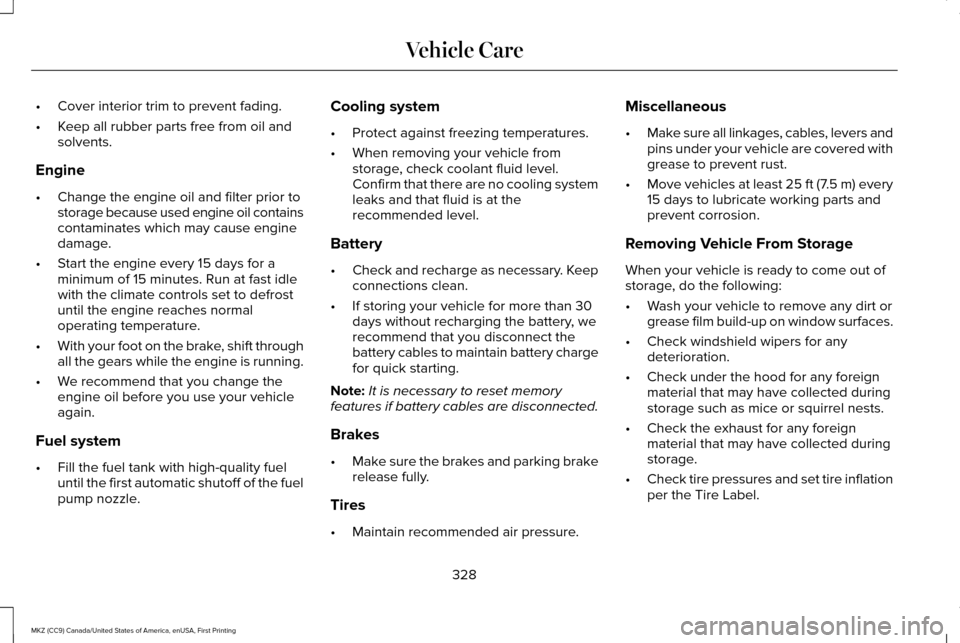
•
Cover interior trim to prevent fading.
• Keep all rubber parts free from oil and
solvents.
Engine
• Change the engine oil and filter prior to
storage because used engine oil contains
contaminates which may cause engine
damage.
• Start the engine every 15 days for a
minimum of 15 minutes. Run at fast idle
with the climate controls set to defrost
until the engine reaches normal
operating temperature.
• With your foot on the brake, shift through
all the gears while the engine is running.
• We recommend that you change the
engine oil before you use your vehicle
again.
Fuel system
• Fill the fuel tank with high-quality fuel
until the first automatic shutoff of the fuel
pump nozzle. Cooling system
•
Protect against freezing temperatures.
• When removing your vehicle from
storage, check coolant fluid level.
Confirm that there are no cooling system
leaks and that fluid is at the
recommended level.
Battery
• Check and recharge as necessary. Keep
connections clean.
• If storing your vehicle for more than 30
days without recharging the battery, we
recommend that you disconnect the
battery cables to maintain battery charge
for quick starting.
Note: It is necessary to reset memory
features if battery cables are disconnected.
Brakes
• Make sure the brakes and parking brake
release fully.
Tires
• Maintain recommended air pressure. Miscellaneous
•
Make sure all linkages, cables, levers and
pins under your vehicle are covered with
grease to prevent rust.
• Move vehicles at least 25 ft (7.5 m) every
15 days to lubricate working parts and
prevent corrosion.
Removing Vehicle From Storage
When your vehicle is ready to come out of
storage, do the following:
• Wash your vehicle to remove any dirt or
grease film build-up on window surfaces.
• Check windshield wipers for any
deterioration.
• Check under the hood for any foreign
material that may have collected during
storage such as mice or squirrel nests.
• Check the exhaust for any foreign
material that may have collected during
storage.
• Check tire pressures and set tire inflation
per the Tire Label.
328
MKZ (CC9) Canada/United States of America, enUSA, First Printing Vehicle Care
Page 377 of 564

CAPACITIES AND SPECIFICATIONS - 2.0L
Capacities
WARNING
The air conditioning refrigerant system contains refrigerant under high \
pressure. Only qualified personnel should service the air
conditioning refrigerant system. Opening the air conditioning refrigeran\
t system can cause personal injury.
Capacity
Item
5.7 qt (5.4 L)
Engine oil (with oil filter).
8.5 qt (8 L)
Engine coolant.
Between MIN/MAX on brake fluid reservoir
Brake fluid.
16.0–20.8 fl oz (473–615 ml)
Rear differential fluid (All Wheel Drive).
15.2 fl oz (450 ml)*
Power Transfer Unit fluid (All Wheel Drive).
9.0 qt (8.5 L)
**
Automatic transmission fluid.
Fill as required
Windshield washer fluid.
16.5 gal (62.5 L)
Fuel tank (Front Wheel Drive).
18.0 gal (68.1 L)
Fuel tank (All Wheel Drive).
374
MKZ (CC9) Canada/United States of America, enUSA, First Printing Capacities and Specifications
Page 382 of 564
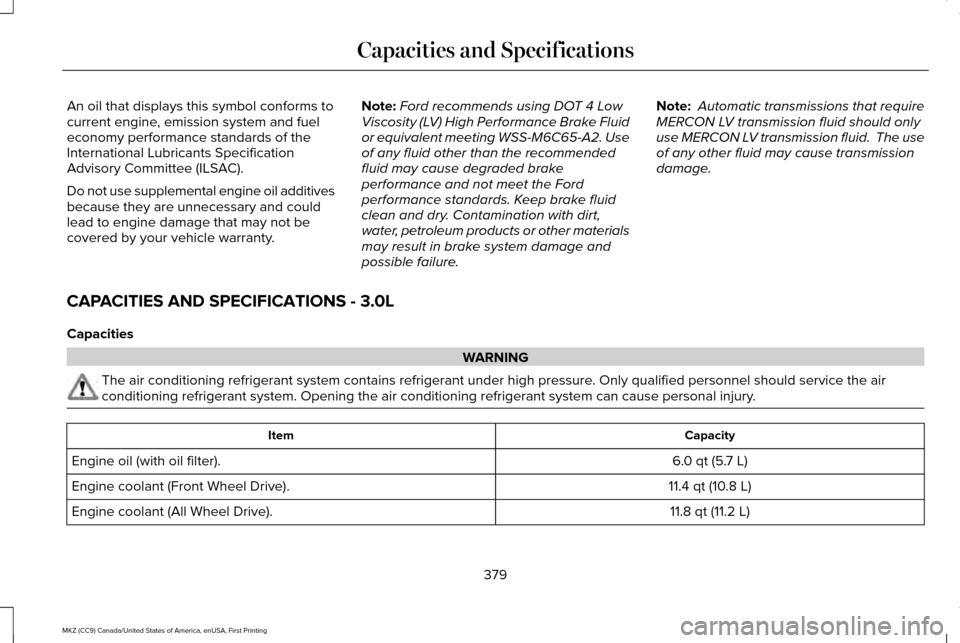
An oil that displays this symbol conforms to
current engine, emission system and fuel
economy performance standards of the
International Lubricants Specification
Advisory Committee (ILSAC).
Do not use supplemental engine oil additives
because they are unnecessary and could
lead to engine damage that may not be
covered by your vehicle warranty.
Note:
Ford recommends using DOT 4 Low
Viscosity (LV) High Performance Brake Fluid
or equivalent meeting WSS-M6C65-A2. Use
of any fluid other than the recommended
fluid may cause degraded brake
performance and not meet the Ford
performance standards. Keep brake fluid
clean and dry. Contamination with dirt,
water, petroleum products or other materials
may result in brake system damage and
possible failure. Note:
Automatic transmissions that require
MERCON LV transmission fluid should only
use MERCON LV transmission fluid. The use
of any other fluid may cause transmission
damage.
CAPACITIES AND SPECIFICATIONS - 3.0L
Capacities WARNING
The air conditioning refrigerant system contains refrigerant under high \
pressure. Only qualified personnel should service the air
conditioning refrigerant system. Opening the air conditioning refrigeran\
t system can cause personal injury.
Capacity
Item
6.0 qt (5.7 L)
Engine oil (with oil filter).
11.4 qt (10.8 L)
Engine coolant (Front Wheel Drive).
11.8 qt (11.2 L)
Engine coolant (All Wheel Drive).
379
MKZ (CC9) Canada/United States of America, enUSA, First Printing Capacities and Specifications
Page 505 of 564
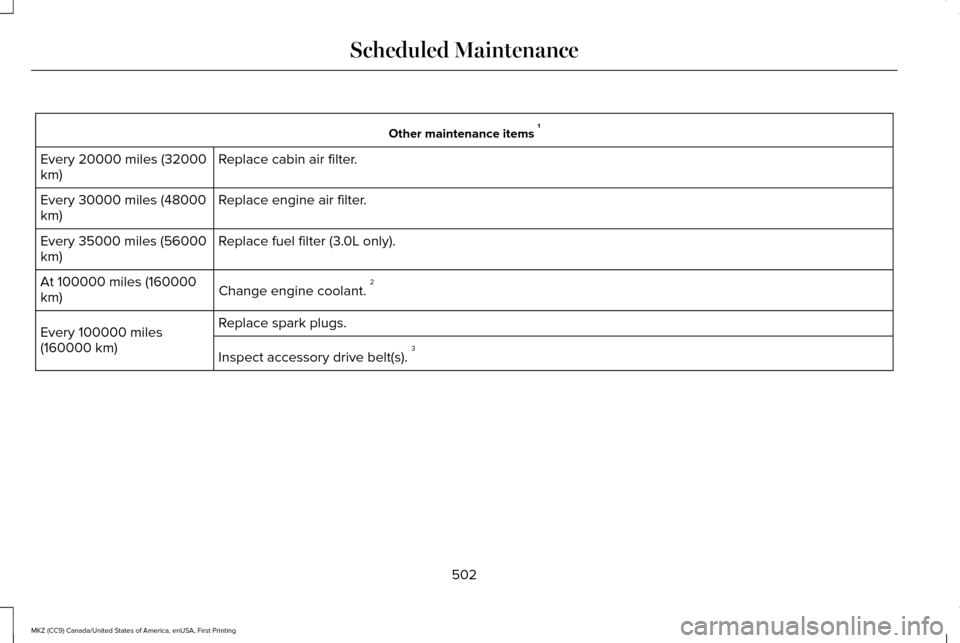
Other maintenance items
1
Replace cabin air filter.
Every 20000 miles (32000
km)
Replace engine air filter.
Every 30000 miles (48000
km)
Replace fuel filter (3.0L only).
Every 35000 miles (56000
km)
Change engine coolant. 2
At 100000 miles (160000
km)
Replace spark plugs.
Every 100000 miles
(160000 km)
Inspect accessory drive belt(s). 3
502
MKZ (CC9) Canada/United States of America, enUSA, First Printing Scheduled Maintenance
Page 509 of 564
\
Perform multi-point inspection.
Change automatic transmission fluid.
Every 30000 miles (48000
km)
* Reset your Intelligent Oil")
Operating in dusty or sandy conditions (such as unpaved or dusty roads)\
Perform multi-point inspection.
Change automatic transmission fluid.
Every 30000 miles (48000
km)
* Reset your Intelligent Oil-Life Monitor after engine oil and filter chang\
es. See Engine Oil Check (page 301). Exclusive use of E85 (flex fuel vehicles only)
If ran exclusively on E85, fill the fuel tank full with regular unleaded fuel.
Every oil change
Exceptions
There are several exceptions to the Normal
Schedule:
Rear Axle and PTU Maintenance
The Power Transfer Unit (PTU) and rear axle
(AWD only) in your vehicle does not require
any normal scheduled maintenance unless
the unit shows signs of leakage. Contact an
authorized dealer for service. California Fuel Filter Replacement
If you register your vehicle in California, the
California Air Resources Board has
determined that the failure to perform this
maintenance item does not nullify the
emission warranty or limit recall liability
before the completion of your vehicle's
useful life. Ford Motor Company, however,
urges you to have all recommended
maintenance services performed at the
specified intervals and to record all vehicle
service.Hot Climate Oil Change Intervals
Vehicles operating in the Middle East, North
Africa, Sub-Saharan Africa or locations with
similar climates using an American Petroleum
Institute (API) Certified for Gasoline Engines
(Certification mark) oil of SM or SN quality,
the normal oil change interval is 3000 miles
(5000 kilometers).
If the available API SM or SN oils are not
available, then the oil change interval is 1800
miles (3000 kilometers).
506
MKZ (CC9) Canada/United States of America, enUSA, First Printing Scheduled Maintenance
Page 557 of 564
Engine Oil Check..........................................301
Adding Engine Oil..............................................302
Engine Oil Dipstick - 2.0L............................301
Engine Oil Dipstick - 3.0L............................301
Engine Specifications - 2.0L......................367 Drivebelt Routing................................................368
Engine Specifications - 3.0L......................368 Drivebelt Routing................................................369
Entertainment.................................................419 AM/FM Radio........................................................421
Apps.......................................................................432
Bluetooth Stereo or USB..................................430
CD (If equipped)..................................................429
HD Radio ™ Information (If Available)..............425
SIRIUS® Satellite Radio (If Activated)..............421
Sources.................................................................420
Supported Media Players, Formats and Metadata Information....................................432
USB Ports.............................................................432
Environment......................................................16
EPB See: Electric Parking Brake..............................189
Essential Towing Checks...........................252 Before Towing a Trailer.....................................253
Hitches..................................................................252
Launching or Retrieving a Boat or Personal
Watercraft (PWC)............................................253
Safety Chains......................................................252 Trailer Brakes......................................................252
Trailer Lamps.......................................................252
When Towing a Trailer.......................................253
Event Data Recording See: Data Recording..............................................9
Export Unique Options...................................14
Exterior Mirrors
................................................94
Auto-Dimming Feature........................................96
Auto-Folding Mirrors............................................95
Blind Spot Monitor................................................97
Fold-Away Exterior Mirrors.................................
95
Heated Exterior Mirrors.......................................96
Integrated Blind Spot Mirrors............................96
Lincoln Welcome Mat..........................................96
Memory Mirrors.....................................................96
Power Exterior Mirrors.........................................94
Signal Indicator Mirrors.......................................
96
F
Fastening the Seatbelts................................35 Rear Inflatable Seatbelt.......................................37
Seatbelt Locking Modes.....................................36
Using Seatbelts During Pregnancy..................35
Flat Tire Inflation See: Tire Sealant and Inflator Kit....................330
Floor Mats
.......................................................257 Front Parking Aid
.........................................200
Obstacle Distance Indicator.............................201
Front Passenger Sensing System...............47
Fuel and Refueling
........................................164
Fuel Consumption.........................................169
Calculating Fuel Economy................................170
Filling the Tank.....................................................169
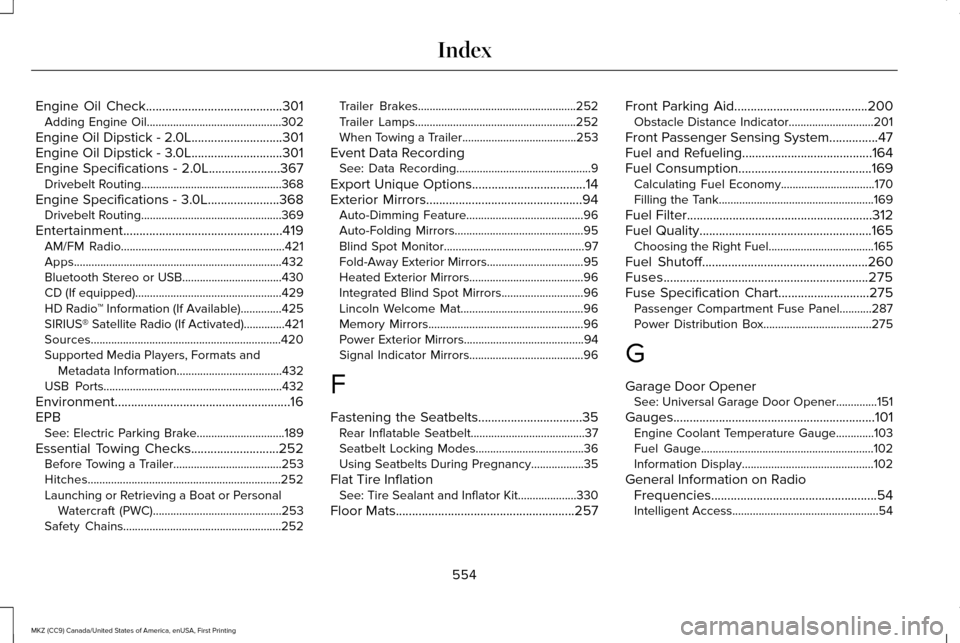
Fuel Filter
.........................................................312
Fuel Quality.....................................................165
Choosing the Right Fuel....................................165
Fuel Shutoff...................................................260
Fuses...............................................................275
Fuse Specification Chart
............................275
Passenger Compartment Fuse Panel...........287
Power Distribution Box.....................................275
G
Garage Door Opener See: Universal Garage Door Opener..............151
Gauges..............................................................101 Engine Coolant Temperature Gauge.............103
Fuel Gauge...........................................................102
Information Display.............................................102
General Information on Radio Frequencies...................................................54
Intelligent Access..................................................54
554
MKZ (CC9) Canada/United States of America, enUSA, First Printing Index