seatbelt LINCOLN MKZ 2017 Owners Manual
[x] Cancel search | Manufacturer: LINCOLN, Model Year: 2017, Model line: MKZ, Model: LINCOLN MKZ 2017Pages: 564, PDF Size: 5.54 MB
Page 4 of 564
Introduction
About This Manual............................................7
Symbols Glossary
..............................................7
Data Recording
..................................................9
California Proposition 65
...............................12
Perchlorate........................................................12
Lincoln Automotive Financial Services
.........................................................12
Replacement Parts Recommendation........13
Special Notices
.................................................13
Mobile Communications Equipment
...........14
Export Unique Options...................................14
Environment
Protecting the Environment..........................16
Child Safety
General Information
........................................17
Installing Child Restraints
..............................19
Booster Seats
..................................................28
Child Restraint Positioning
............................31
Child Safety Locks..........................................32 Seatbelts
Principle of Operation....................................34
Fastening the Seatbelts................................35
Seatbelt Height Adjustment.........................38
Seatbelt Warning Lamp and Indicator
Chime
............................................................39
Seatbelt Reminder..........................................40
Child Restraint and Seatbelt Maintenance.................................................41
Seatbelt Extension
.........................................42
Personal Safety System ™
Personal Safety System ™
..............................43
Supplementary Restraints System
Principle of Operation
....................................44
Driver and Passenger Airbags....................45
Front Passenger Sensing System...............47
Side Airbags
.....................................................49
Driver and Passenger Knee Airbags.........50
Safety Canopy™................................................51
Crash Sensors and Airbag Indicator
..........52 Airbag Disposal
...............................................53
Keys and Remote Controls
General Information on Radio Frequencies.................................................54
Remote Control...............................................55
Replacing a Lost Key or Remote Control..........................................................59
MyKey™
Principle of Operation...................................60
Creating a MyKey............................................61
Clearing All MyKeys
.......................................62
Checking MyKey System Status.................62
Using MyKey With Remote Start Systems.........................................................63
MyKey Troubleshooting
................................63
Locks
Locking and Unlocking
.................................65
Keyless Entry.....................................................71
Interior Luggage Compartment Release..........................................................73
1
MKZ (CC9) Canada/United States of America, enUSA, First Printing Table of Contents
Page 11 of 564
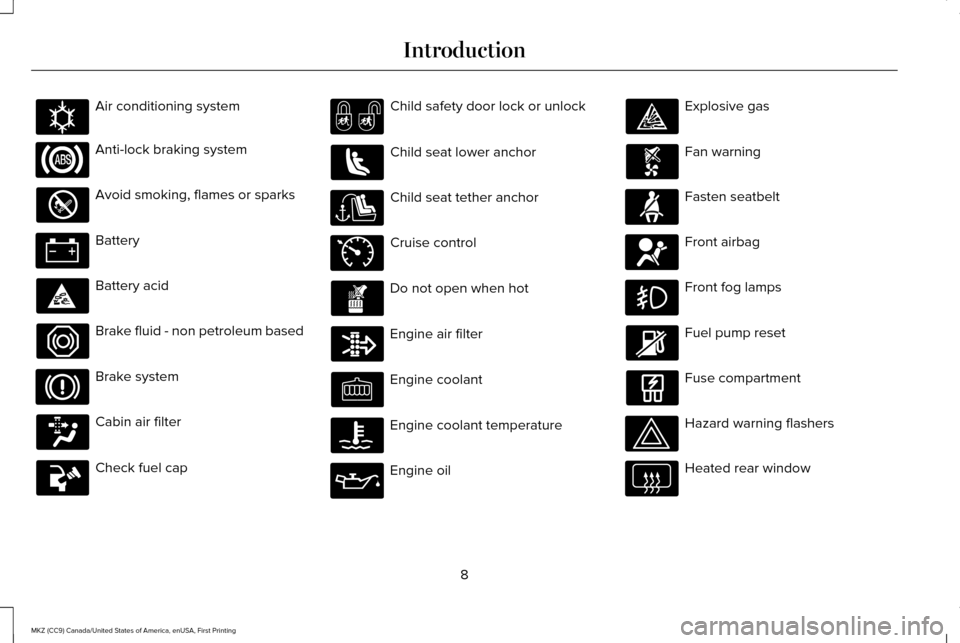
Air conditioning system
Anti-lock braking system
Avoid smoking, flames or sparks
Battery
Battery acid
Brake fluid - non petroleum based
Brake system
Cabin air filter
Check fuel cap Child safety door lock or unlock
Child seat lower anchor
Child seat tether anchor
Cruise control
Do not open when hot
Engine air filter
Engine coolant
Engine coolant temperature
Engine oil Explosive gas
Fan warning
Fasten seatbelt
Front airbag
Front fog lamps
Fuel pump reset
Fuse compartment
Hazard warning flashers
Heated rear window
8
MKZ (CC9) Canada/United States of America, enUSA, First Printing IntroductionE162384 E71340
Page 15 of 564
Additionally, when you connect to Traffic,
Directions and Information (if equipped,
U.S. only), the service uses GPS technology
and advanced vehicle sensors to collect
the vehicle
’s current location, travel
direction, and speed (“vehicle travel
information ”), only to help provide you with
the directions, traffic reports, or business
searches that you request. If you do not
want Ford or its vendors to receive this
information, do not activate the service. For
more information, see Traffic, Directions
and Information, Terms and Conditions.
See SYNC™ 3 (page 390).
CALIFORNIA PROPOSITION 65 WARNINGS
Some constituents of engine exhaust,
certain vehicle components, certain
fluids contained in vehicles and certain
products of component wear contain or emit
chemicals known to the State of California
to cause cancer and birth defects or other
reproductive harm. WARNINGS
Battery posts, terminals and related
accessories contain lead and lead
compounds, chemicals known to the State
of California to cause cancer and
reproductive harm. Batteries also contain
other chemicals known to the State of
California to cause cancer. Wash your hands
after handling. PERCHLORATE
Certain components in your vehicle such as
airbag modules, seatbelt pretensioners and
remote control batteries may contain
perchlorate material. Special handling may
apply for service or vehicle end of life
disposal.
For more information visit: Web Address
www.dtsc.ca.gov/hazard- ouswaste/perchlorate
LINCOLN AUTOMOTIVE
FINANCIAL SERVICES
Lincoln Automotive Financial Services offers
a full range of financing and lease plans to
help you acquire your vehicle. We are
dedicated to providing answers, information
and a truly extraordinary experience.
Use the options below to contact us with
questions about your account or financing
and we will respond promptly: Web Address
www.LincolnAFS.com
Phone: 1-888-498-8801
Mail: Lincoln Automotive Financial Services
12
MKZ (CC9) Canada/United States of America, enUSA, First Printing Introduction
Page 37 of 564
PRINCIPLE OF OPERATION
WARNINGS
Always drive and ride with your
seatback upright and the lap belt snug
and low across the hips. To reduce the risk of injury, make sure
children sit where they can be properly
restrained. Never let a passenger hold a child on
his or her lap while the vehicle is
moving. The passenger cannot protect the
child from injury in a crash. All occupants of your vehicle, including
the driver, should always properly wear
their seatbelts, even when an airbag
supplemental restraint system is provided.
Failure to properly wear your seatbelt could
seriously increase the risk of injury or death. WARNINGS
It is extremely dangerous to ride in a
cargo area, inside or outside of a
vehicle. In a crash, people riding in these
areas are more likely to be seriously injured
or killed. Do not allow people to ride in any
area of your vehicle that is not equipped with
seats and seatbelts. Be sure everyone in
your vehicle is in a seat and using a seatbelt
properly. In a rollover crash, an unbelted person
is significantly more likely to die than
a person wearing a seatbelt. Each seating position in your vehicle
has a specific seatbelt assembly which
is made up of one buckle and one tongue
that are designed to be used as a pair. 1) Use
the shoulder belt on the outside shoulder
only. Never wear the shoulder belt under the
arm. 2) Never swing the seatbelt around your
neck over the inside shoulder. 3) Never use
a single belt for more than one person. Airbags can kill or injure a child in a
child restraint. Properly restrain
children 12 and under in the rear seat
whenever possible. WARNINGS
Seatbelts and seats can become hot
in a vehicle that has been closed up in
sunny weather. They could burn a small child.
Check seat covers and buckles before you
place a child anywhere near them. Front and rear seat occupants,
including pregnant women, should
wear seatbelts for optimum protection in an
accident. All seating positions in your vehicle have lap
and shoulder seatbelts. All occupants of the
vehicle should always properly wear their
seatbelts, even when an airbag supplemental
restraint system is provided.
The seatbelt system consists of:
•
Lap and shoulder seatbelts.
• Shoulder seatbelt with automatic locking
mode, (except driver seatbelt).
• Height adjuster at the front outboard
seating positions.
• Seatbelt pretensioner at the front
outboard seating positions.
34
MKZ (CC9) Canada/United States of America, enUSA, First Printing Seatbelts
Page 38 of 564
•
Seatbelt warning light and chime. •
Crash sensors and monitoring system
with readiness indicator.
The seatbelt pretensioners at the front
seating positions are designed to tighten the
seatbelts when activated. In frontal and
near-frontal crashes, the seatbelt
pretensioners may be activated alone or, if
the crash is of sufficient severity, together
with the front airbags. The pretensioners may
also activate when the Safety Canopy is
deployed.
FASTENING THE SEATBELTS
Standard belts shown, inflatable belts
similar
The front outboard and rear safety restraints
in the vehicle are combination lap and
shoulder belts. 1. Insert the belt tongue into the proper
buckle (the buckle closest to the direction
the tongue is coming from) until you hear
a snap and feel it latch. Make sure you
securely fasten the tongue in the buckle. 2. To unfasten, press the release button
and remove the tongue from the buckle.
Using Seatbelts During Pregnancy WARNING
Always ride and drive with your
seatback upright and the belt properly
fastened. The lap portion of the seatbelt
should fit snug and be positioned low across
the hips. The shoulder portion of the seatbelt
should be positioned across the chest.
Pregnant women should also follow this
practice. See the following figure. 35
MKZ (CC9) Canada/United States of America, enUSA, First Printing Seatbelts E142587 E142588
Page 39 of 564
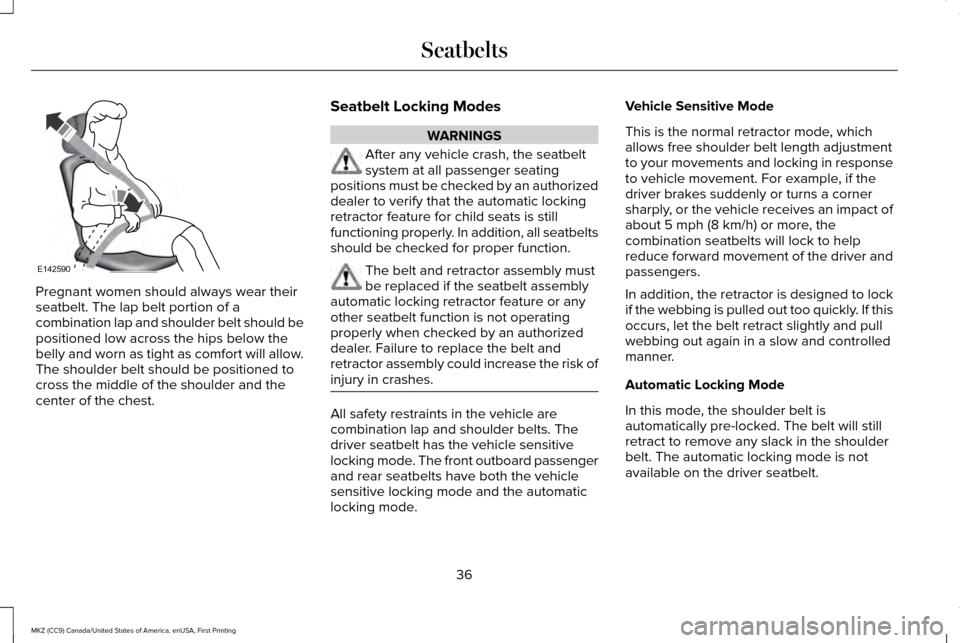
Pregnant women should always wear their
seatbelt. The lap belt portion of a
combination lap and shoulder belt should be
positioned low across the hips below the
belly and worn as tight as comfort will allow.
The shoulder belt should be positioned to
cross the middle of the shoulder and the
center of the chest.
Seatbelt Locking Modes WARNINGS
After any vehicle crash, the seatbelt
system at all passenger seating
positions must be checked by an authorized
dealer to verify that the automatic locking
retractor feature for child seats is still
functioning properly. In addition, all seatbelts
should be checked for proper function. The belt and retractor assembly must
be replaced if the seatbelt assembly
automatic locking retractor feature or any
other seatbelt function is not operating
properly when checked by an authorized
dealer. Failure to replace the belt and
retractor assembly could increase the risk of
injury in crashes. All safety restraints in the vehicle are
combination lap and shoulder belts. The
driver seatbelt has the vehicle sensitive
locking mode. The front outboard passenger
and rear seatbelts have both the vehicle
sensitive locking mode and the automatic
locking mode.Vehicle Sensitive Mode
This is the normal retractor mode, which
allows free shoulder belt length adjustment
to your movements and locking in response
to vehicle movement. For example, if the
driver brakes suddenly or turns a corner
sharply, or the vehicle receives an impact of
about 5 mph (8 km/h) or more, the
combination seatbelts will lock to help
reduce forward movement of the driver and
passengers.
In addition, the retractor is designed to lock
if the webbing is pulled out too quickly. If this
occurs, let the belt retract slightly and pull
webbing out again in a slow and controlled
manner.
Automatic Locking Mode
In this mode, the shoulder belt is
automatically pre-locked. The belt will still
retract to remove any slack in the shoulder
belt. The automatic locking mode is not
available on the driver seatbelt.
36
MKZ (CC9) Canada/United States of America, enUSA, First Printing SeatbeltsE142590
Page 40 of 564
When to Use the Automatic Locking Mode
This mode should be used any time a child
safety seat, except a booster, is installed in
passenger front or rear seating positions.
Children 12 years old and under should be
properly restrained in a rear seating position
whenever possible. See Child Safety (page
17).
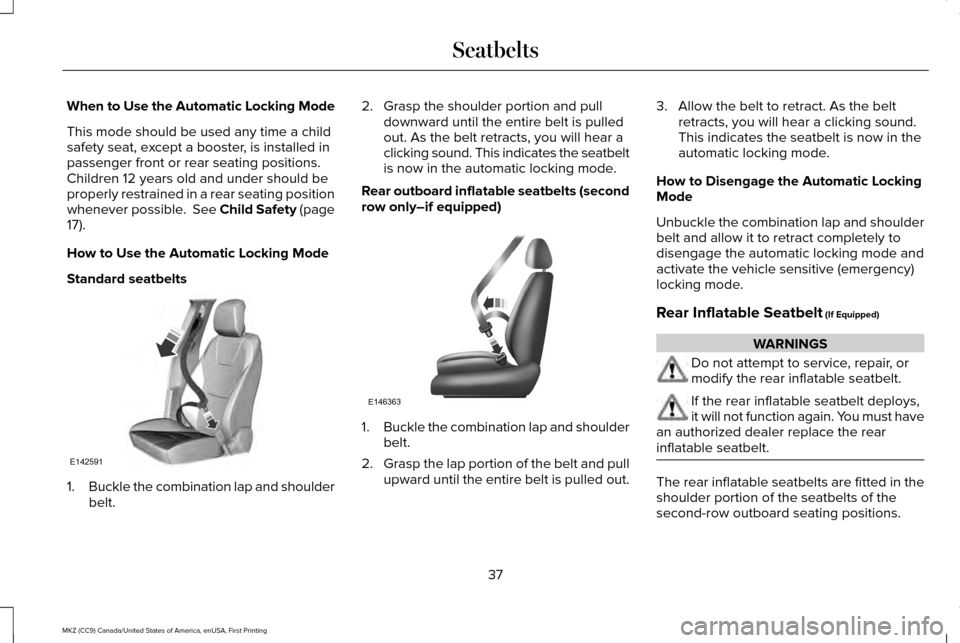
How to Use the Automatic Locking Mode
Standard seatbelts 1.
Buckle the combination lap and shoulder
belt. 2. Grasp the shoulder portion and pull
downward until the entire belt is pulled
out. As the belt retracts, you will hear a
clicking sound. This indicates the seatbelt
is now in the automatic locking mode.
Rear outboard inflatable seatbelts (second
row only–if equipped) 1.
Buckle the combination lap and shoulder
belt.
2. Grasp the lap portion of the belt and pull
upward until the entire belt is pulled out. 3. Allow the belt to retract. As the belt
retracts, you will hear a clicking sound.
This indicates the seatbelt is now in the
automatic locking mode.
How to Disengage the Automatic Locking
Mode
Unbuckle the combination lap and shoulder
belt and allow it to retract completely to
disengage the automatic locking mode and
activate the vehicle sensitive (emergency)
locking mode.
Rear Inflatable Seatbelt
(If Equipped) WARNINGS
Do not attempt to service, repair, or
modify the rear inflatable seatbelt.
If the rear inflatable seatbelt deploys,
it will not function again. You must have
an authorized dealer replace the rear
inflatable seatbelt. The rear inflatable seatbelts are fitted in the
shoulder portion of the seatbelts of the
second-row outboard seating positions.
37
MKZ (CC9) Canada/United States of America, enUSA, First Printing SeatbeltsE142591 E146363
Page 41 of 564
Note:
The rear inflatable seatbelts are
compatible with most infant and child safety
car seats and belt positioning booster seats
when properly installed. This is because they
are designed to fill with a cooled gas at a
lower pressure and at a slower rate than
traditional airbags. After inflation, the
shoulder portion of the seatbelt remains cool
to the touch.
The rear inflatable seatbelt consists of the
following:
• An inflatable bag located in the shoulder
seatbelt webbing.
• Lap seatbelt webbing with automatic
locking mode.
• The same warning light, electronic
control and diagnostic unit as used for
the front seatbelts.
• Impact sensors located in various parts
of the vehicle.
How does the rear inflatable seatbelt
system work?
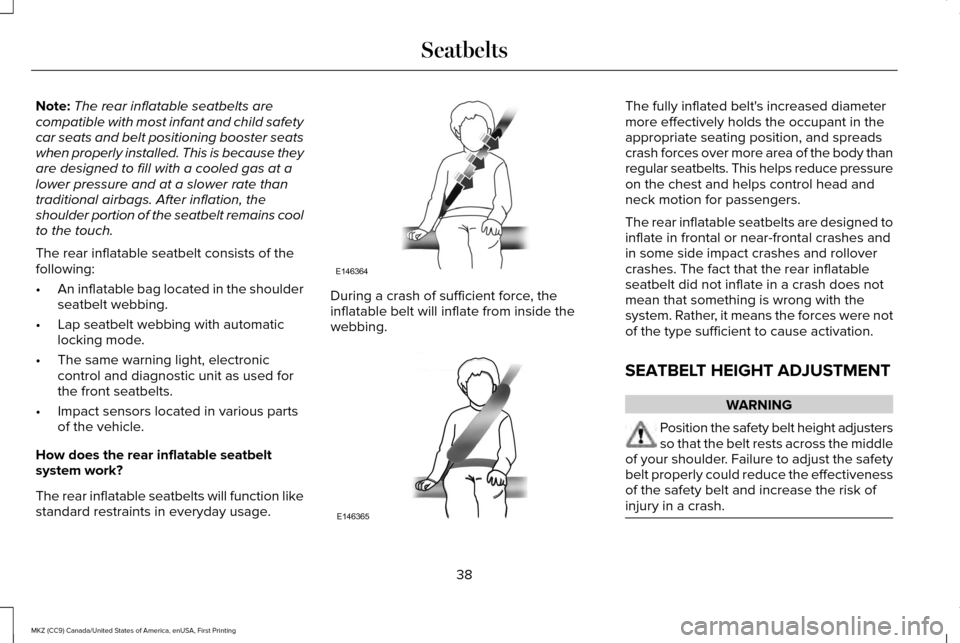
The rear inflatable seatbelts will function like
standard restraints in everyday usage. During a crash of sufficient force, the
inflatable belt will inflate from inside the
webbing. The fully inflated belt's increased diameter
more effectively holds the occupant in the
appropriate seating position, and spreads
crash forces over more area of the body than
regular seatbelts. This helps reduce pressure
on the chest and helps control head and
neck motion for passengers.
The rear inflatable seatbelts are designed to
inflate in frontal or near-frontal crashes and
in some side impact crashes and rollover
crashes. The fact that the rear inflatable
seatbelt did not inflate in a crash does not
mean that something is wrong with the
system. Rather, it means the forces were not
of the type sufficient to cause activation.
SEATBELT HEIGHT ADJUSTMENT
WARNING
Position the safety belt height adjusters
so that the belt rests across the middle
of your shoulder. Failure to adjust the safety
belt properly could reduce the effectiveness
of the safety belt and increase the risk of
injury in a crash. 38
MKZ (CC9) Canada/United States of America, enUSA, First Printing SeatbeltsE146364 E146365
Page 42 of 564
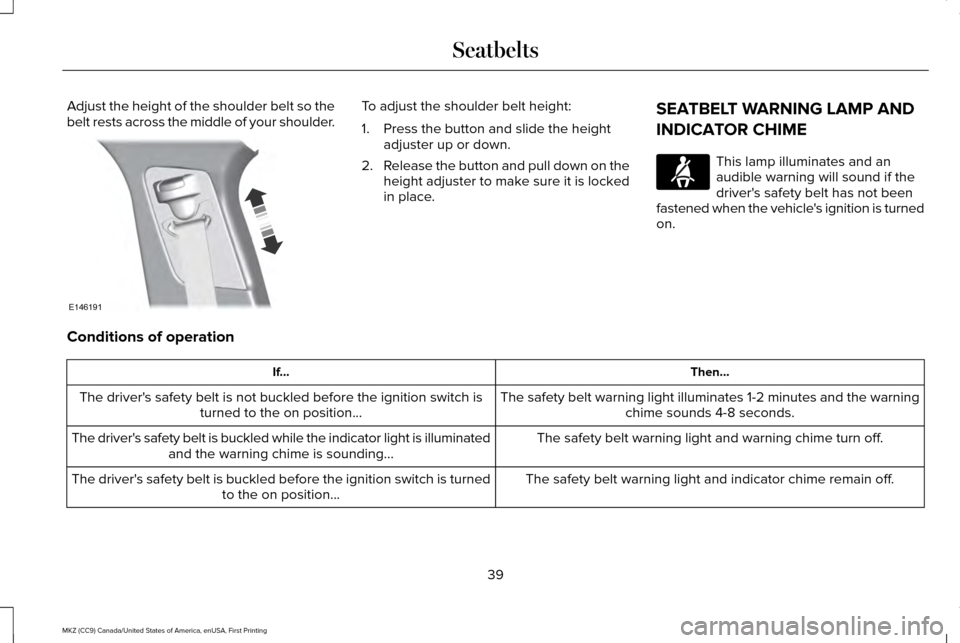
Adjust the height of the shoulder belt so the
belt rests across the middle of your shoulder. To adjust the shoulder belt height:
1. Press the button and slide the height
adjuster up or down.
2. Release the button and pull down on the
height adjuster to make sure it is locked
in place. SEATBELT WARNING LAMP AND
INDICATOR CHIME This lamp illuminates and an
audible warning will sound if the
driver's safety belt has not been
fastened when the vehicle's ignition is turned
on.
Conditions of operation Then...
If...
The safety belt warning light illuminates 1-2 minutes and the warningchime sounds 4-8 seconds.
The driver's safety belt is not buckled before the ignition switch is
turned to the on position...
The safety belt warning light and warning chime turn off.
The driver's safety belt is buckled while the indicator light is illuminated
and the warning chime is sounding...
The safety belt warning light and indicator chime remain off.
The driver's safety belt is buckled before the ignition switch is turned
to the on position...
39
MKZ (CC9) Canada/United States of America, enUSA, First Printing SeatbeltsE146191
Page 43 of 564
SEATBELT REMINDER
Belt-Minder™
This feature supplements the safety belt
warning function by providing additional
reminders that intermittently sound a tone
and illuminate the safety belt warning light
when you are in the driver seat or you have
a front seat passenger and a safety belt is
unbuckled.
The system uses information from the front
passenger sensing system to determine if a
front seat passenger is present and therefore
potentially in need of a warning. To avoid
activating the Belt-Minder feature for objects
you place in the front passenger seat, only
the front seat passengers receive warnings
as determined by the front passenger
sensing system.If the Belt-Minder warnings expire (warnings
for about five minutes) for one passenger
(driver or front passenger), the other
passenger can still cause the Belt-Minder
feature to turn on. Then...
If...
The Belt-Minder feature will not activate.
You and the front seat passenger buckle your safety belts before you
switch the ignition on or less than 1-2 minutes elapse after you switch
the ignition on...
The Belt-Minder feature activates, the safety belt warning light illumin\
-ates and a warning tone sounds for 6 seconds every 25 seconds,
repeating for about 5 minutes or until you and the front seat passenger buckle your safety belts.
You or the front seat passenger do not buckle your safety belts before
your vehicle reaches at least 6 mph (9.7 km/h) and 1-2 minutes elapse
after you switch the ignition on...
The Belt-Minder feature activates, the safety belt warning light illumin\
-ates and a warning tone sounds for 6 seconds every 25 seconds,
repeating for about 5 minutes or until you and the front seat passenger buckle your safety belts.
The safety belt for the driver or front passenger is unbuckled for about\
1 minute while the vehicle is traveling at least 6 mph (9.7 km/h) and more than 1-2 minutes elapse after you switch the ignition on...
40
MKZ (CC9) Canada/United States of America, enUSA, First Printing Seatbelts