Oil LINCOLN MKZ HYBRID 2013 User Guide
[x] Cancel search | Manufacturer: LINCOLN, Model Year: 2013, Model line: MKZ HYBRID, Model: LINCOLN MKZ HYBRID 2013Pages: 475, PDF Size: 3.89 MB
Page 299 of 475
To clean these items, follow these
tips:
•
You can clean the windows with a
non-abrasive cleaner such as
Motorcraft Ultra-Clear Spray Glass
Cleaner.
• You can clean the wiper blades
with isopropyl rubbing-alcohol or
Motorcraft Premium Windshield
Wash Concentrates in the U.S., or
Premium Quality Windshield
Washer Fluid in Canada. Be sure
to replace wiper blades when they
appear worn or do not function
properly.
• Do not use abrasives, as they may
cause scratches.
• Do not use fuel, kerosene, or paint
thinner to clean any parts.
If you cannot remove those streaks
after cleaning with the glass cleaner
or if the wipers chatter and move in a
jerky motion, clean the outer surface
of the windshield and the wiper
blades using a sponge or soft cloth
with a neutral detergent or
mild-abrasive cleaning solution. After
cleaning, rinse the windshield and
wiper blades with clean water. The
windshield is clean if beads do not
form when you rinse the windshield
with water.
Note: Do not use sharp objects, such
as a razorblade, to clean the inside of
the rear window or to remove decals,
as this may cause damage to the rear
window defroster ’s heated grid lines. CLEANING THE INTERIOR WARNINGS
Do not use cleaning solvents,
bleach or dye on the vehicle
’s
safety belts, as these actions may
weaken the belt webbing. On vehicles equipped with
seat-mounted airbags, do not
use chemical solvents or strong
detergents. Such products could
contaminate the side airbag system
and affect performance of the side
airbag in a collision. For fabric, carpets, cloth seats, safety
belts and seats equipped with side
airbags:
•
Remove dust and loose dirt with a
vacuum cleaner.
• Remove light stains and soil with
Motorcraft Professional Strength
Carpet & Upholstery Cleaner.
• If grease or tar is present on the
material, spot-clean the area first
with Motorcraft Spot and Stain
Remover. In Canada, use
Motorcraft Multi-Purpose Cleaner.
• If a ring forms on the fabric after
spot cleaning, clean the entire area
immediately (but do not
oversaturate) or the ring will set.
• Do not use household cleaning
products or glass cleaners, which
can stain and discolor the fabric
and affect the flame retardant
abilities of the seat materials.
297
MKZ (CC9) Vehicle Care
Page 300 of 475
CLEANING THE
INSTRUMENT PANEL AND
INSTRUMENT CLUSTER
LENS
WARNING
Do not use chemical solvents or
strong detergents when cleaning
the steering wheel or instrument panel
to avoid contamination of the airbag
system. Clean the instrument panel and
cluster lens with a clean, damp, white
cotton cloth, then use a clean and dry
white cotton cloth to dry these areas.
•
Avoid cleaners or polishes that
increase the gloss of the upper
portion of the instrument panel.
The dull finish in this area helps
protect you from undesirable
windshield reflection.
• Be certain to wash or wipe your
hands clean if you have been in
contact with certain products such
as insect repellent and suntan
lotion in order to avoid possible
damage to the interior painted
surfaces.
• Do not use household or glass
cleaners as these may damage the
finish of the instrument panel,
interior trim and cluster lens.
• Do not allow air fresheners and
hand sanitizers to spill onto interior
surfaces. If a spill occurs, wipe off
immediately. Damage may not be
covered by your warranty. If a staining liquid like coffee or juice
has been spilled on the instrument
panel or on interior trim surfaces,
clean as follows:
1. Wipe up spilled liquid using a
clean, white, cotton cloth.
2. Wipe the surface with a damp, clean, white cotton cloth. For more
thorough cleaning, use a mild soap
and water solution. If the spot
cannot be completely cleaned by
this method, the area may be
cleaned using a commercially
available cleaning product
designed for automotive interiors.
3. If necessary, apply more soap and
water solution or cleaning product
to a clean, white, cotton cloth and
press the cloth onto the soiled
area. Allow this to set at room
temperature for 30 minutes.
4. Remove the soaked cloth and if it is not soiled badly, use this cloth
to clean the area by using a
rubbing motion for 60 seconds.
5. Following this, wipe area dry with a clean, white, cotton cloth.
CLEANING LEATHER SEATS
(IF EQUIPPED)
For routine cleaning, wipe the surface
with a soft, damp cloth. For more
thorough cleaning, wipe the surface
with a mild soap and water solution.
Dry the area with a soft cloth. In
Canada, use Motorcraft® Vinyl
Cleaner.
298
MKZ (CC9) Vehicle Care
Page 301 of 475
If the leather cannot be completely
cleaned using a mild soap and water
solution, the leather may be cleaned
using a commercially available leather
cleaning product designed for
automotive interiors.
Note:
To check for compatibility, first
test any cleaner or stain remover on an
inconspicuous part of the leather.
You should:
• remove dust and loose dirt with a
vacuum cleaner.
• clean spills and stains as quickly
as possible.
• check for compatibility by first
testing any cleaner or stain
remover on an inconspicuous part
of the leather.
Do not use the following products as
these may damage the leather:
• oil/petroleum-based leather
conditioners.
• household cleaners.
• alcohol solutions.
• solvents or cleaners intended
specifically for rubber, vinyl and
plastics.
CLEANING THE ALLOY
WHEELS
Note: Do not apply a cleaning
chemical to warm or hot wheel rims
and covers.
Note: Some automatic car washes
may cause damage to the finish on
your wheel rims and covers. Note:
Industrial-strength or
heavy-duty cleaners in combination
with brush agitation to remove brake
dust and dirt, could wear away the
clear coat finish over a period time.
Note: Do not use hydrofluoric
acid-based or high caustic-based
wheel cleaners, steel wool, fuels or
strong household detergents.
Note: If you intend parking your vehicle
for an extended period after cleaning
the wheels with a wheel cleaner, drive
your vehicle for a few minutes before
doing so. This will reduce the risk of
increased corrosion of the brake discs.
Alloy wheels and wheel covers are
coated with a clear coat paint finish.
To maintain their condition we
recommend that you:
• Clean the wheels weekly using
Motorcraft Wheel and Tire Cleaner.
Apply using manufacturer's
instructions.
• Use a sponge to remove heavy
deposits of dirt and brake dust
accumulation.
• Rinse thoroughly with a strong
stream of water when you have
completed the cleaning process.
• To remove tar and grease, use
Motorcraft Bug and Tar Remover.
299
MKZ (CC9) Vehicle Care
Page 302 of 475
VEHICLE STORAGE
If you plan on storing your vehicle for
an extended period of time (30 days
or more), read the following
maintenance recommendations to
make sure your vehicle stays in good
operating condition.
All motor vehicles and their
components were engineered and
tested for reliable, regular driving.
Long term storage under various
conditions may lead to component
degradation or failure unless specific
precautions are taken to preserve the
components.
General
•
Store all vehicles in a dry,
ventilated place.
• Protect from sunlight, if possible.
• If vehicles are stored outside, they
require regular maintenance to
protect against rust and damage.
Body
• Wash your vehicle thoroughly to
remove dirt, grease, oil, tar or mud
from exterior surfaces, rear-wheel
housing and underside of front
fenders.
• Periodically wash your vehicle
stored in exposed locations.
• Touch-up exposed or primed
metal to prevent rust. •
Cover chrome and stainless steel
parts with a thick coat of auto wax
to prevent discoloration. Re-wax
as necessary when your vehicle is
washed.
• Lubricate all hood, door and trunk
lid hinges, and latches with a light
grade oil.
• Cover interior trim to prevent
fading.
• Keep all rubber parts free from oil
and solvents.
Engine
• The engine oil and filter should be
changed prior to storage, as used
engine oil contain contaminates
that may cause engine damage.
• Start the engine every 15 days. Run
at fast idle until it reaches normal
operating temperature
• With your foot on the brake, shift
through all the gears while the
engine is running.
Fuel system
• Fill the fuel tank with high-quality
fuel until the first automatic
shutoff of the fuel pump nozzle.
300
MKZ (CC9) Vehicle Care
Page 304 of 475
•
Check fluid levels (including
coolant, oil and gas) to make sure
there are no leaks, and fluids are
at recommended levels.
• If the battery was removed, clean
the battery cable ends and inspect.
Contact your authorized dealer if you
have any concerns or issues.
302
MKZ (CC9) Vehicle Care
Page 332 of 475
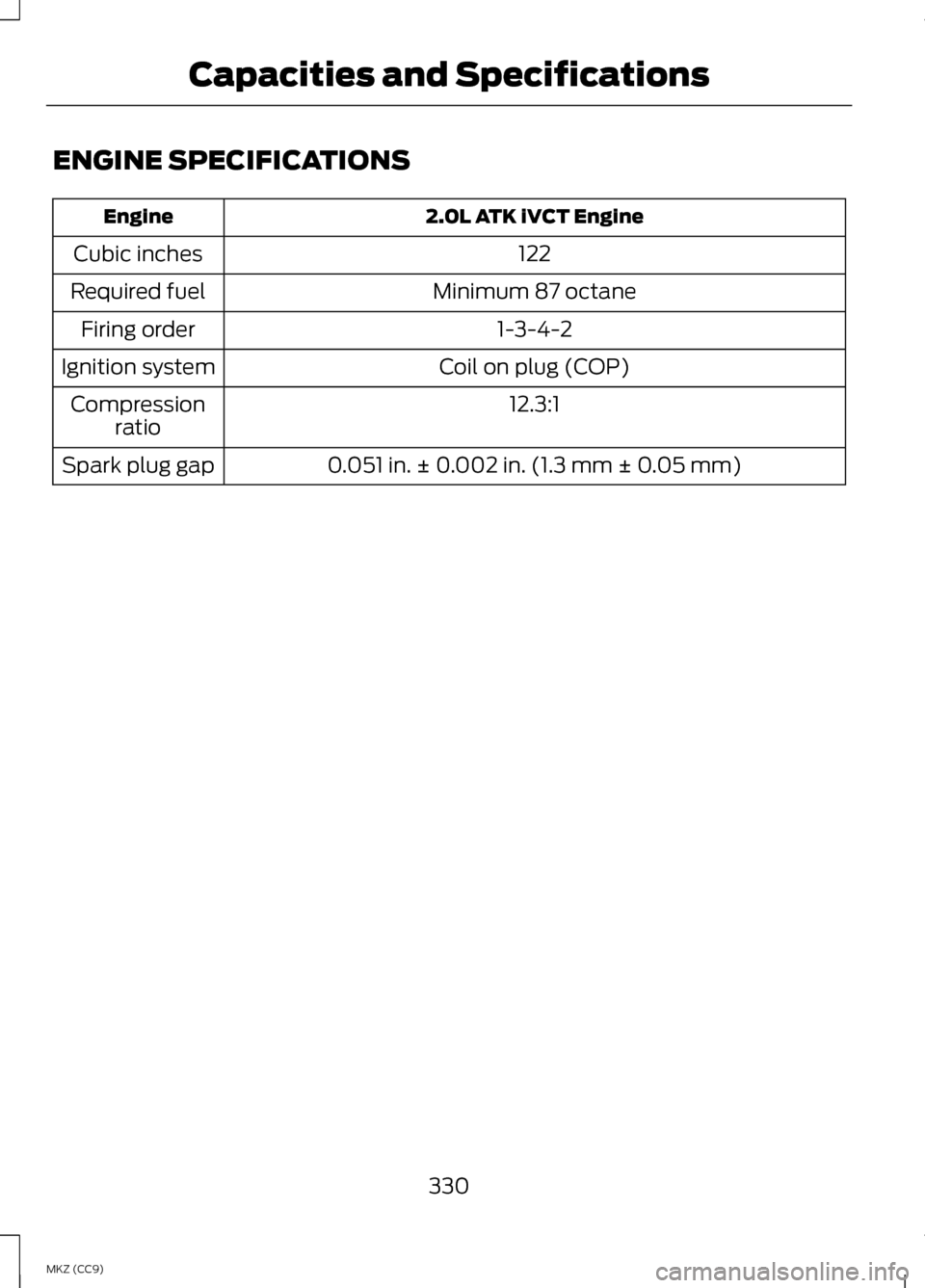
ENGINE SPECIFICATIONS
2.0L ATK iVCT Engine
Engine
122
Cubic inches
Minimum 87 octane
Required fuel
1-3-4-2
Firing order
Coil on plug (COP)
Ignition system
12.3:1
Compression
ratio
0.051 in. ± 0.002 in. (1.3 mm ± 0.05 mm)
Spark plug gap
330
MKZ (CC9) Capacities and Specifications
Page 333 of 475
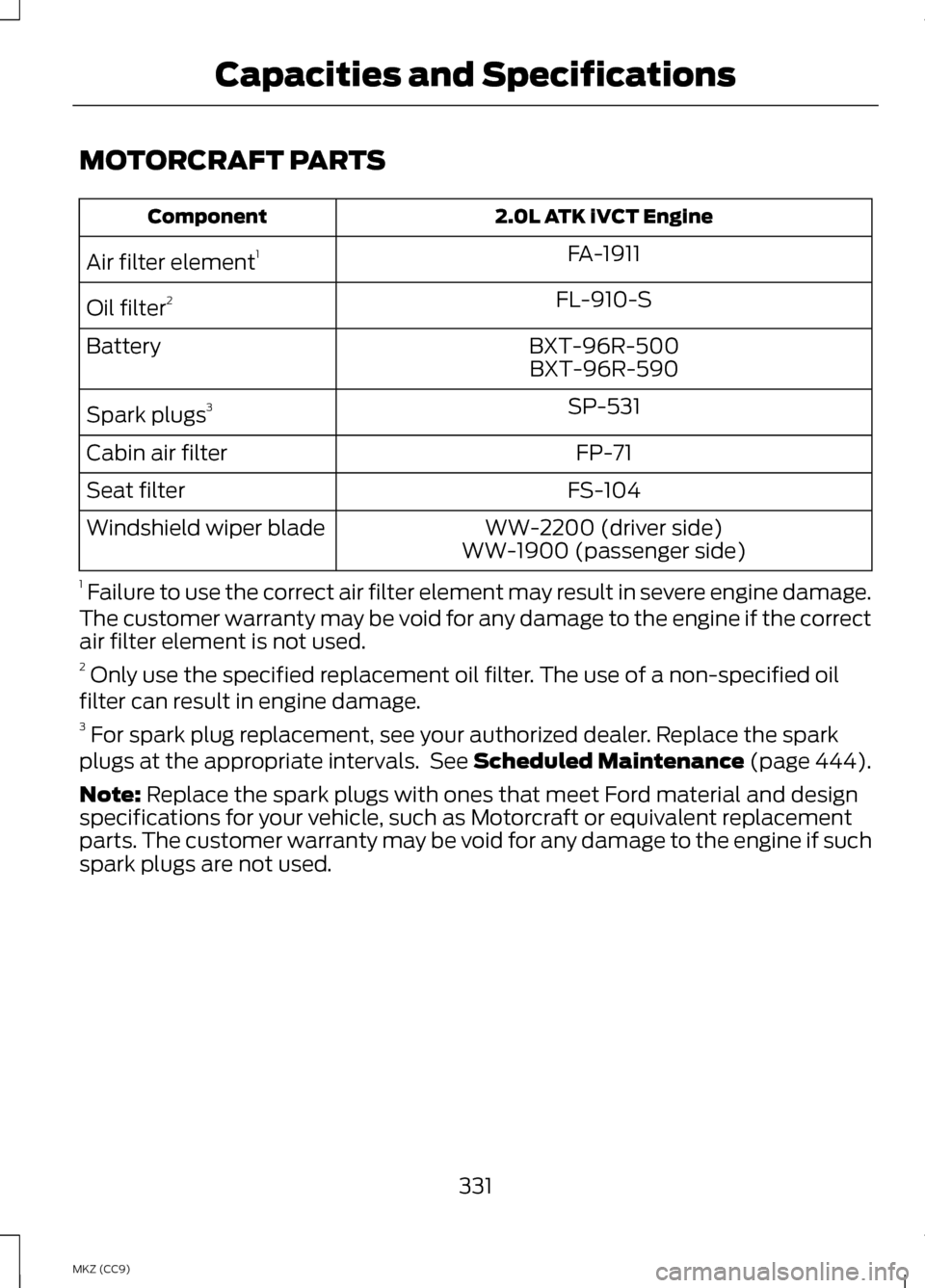
MOTORCRAFT PARTS
2.0L ATK iVCT Engine
Component
FA-1911
Air filter element 1
FL-910-S
Oil filter 2
BXT-96R-500
Battery
BXT-96R-590
SP-531
Spark plugs 3
FP-71
Cabin air filter
FS-104
Seat filter
WW-2200 (driver side)
Windshield wiper blade
WW-1900 (passenger side)
1 Failure to use the correct air filter element may result in severe engine damage.
The customer warranty may be void for any damage to the engine if the correct
air filter element is not used.
2 Only use the specified replacement oil filter. The use of a non-specified oil
filter can result in engine damage.
3 For spark plug replacement, see your authorized dealer. Replace the spark
plugs at the appropriate intervals. See Scheduled Maintenance (page 444).
Note: Replace the spark plugs with ones that meet Ford material and design
specifications for your vehicle, such as Motorcraft or equivalent replacement
parts. The customer warranty may be void for any damage to the engine if such
spark plugs are not used.
331
MKZ (CC9) Capacities and Specifications
Page 337 of 475
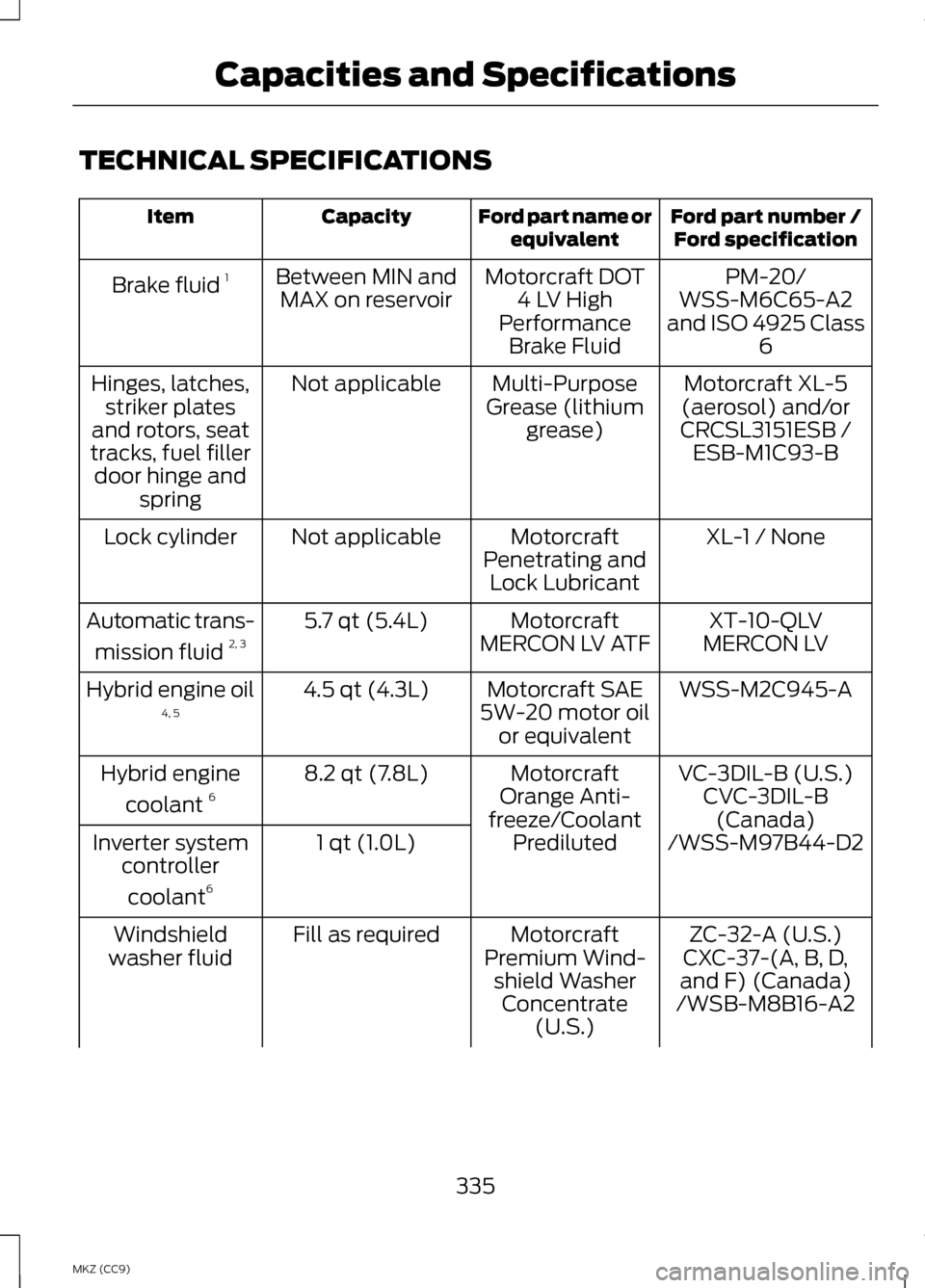
TECHNICAL SPECIFICATIONS
Ford part number /
Ford specification
Ford part name or
equivalent
Capacity
Item
PM-20/
Motorcraft DOT
4 LV High
Performance Brake Fluid
Between MIN and
MAX on reservoir
Brake fluid
1
WSS-M6C65-A2
and ISO 4925 Class 6
Motorcraft XL-5
(aerosol) and/or
CRCSL3151ESB /
Multi-Purpose
Grease (lithium grease)
Not applicable
Hinges, latches,
striker plates
and rotors, seat
tracks, fuel filler door hinge and spring ESB-M1C93-B
XL-1 / None
Motorcraft
Penetrating and Lock Lubricant
Not applicable
Lock cylinder
XT-10-QLV
MERCON LV
Motorcraft
MERCON LV ATF
5.7 qt (5.4L)
Automatic trans-
mission fluid 2, 3
WSS-M2C945-A
Motorcraft SAE
5W-20 motor oil or equivalent
4.5 qt (4.3L)
Hybrid engine oil
4, 5
VC-3DIL-B (U.S.)
Motorcraft
Orange Anti-
freeze/Coolant Prediluted
8.2 qt (7.8L)
Hybrid engine
coolant 6
CVC-3DIL-B
(Canada)
/WSS-M97B44-D2
1 qt (1.0L)
Inverter system
controller
coolant 6
ZC-32-A (U.S.)
Motorcraft
Premium Wind- shield WasherConcentrate (U.S.)
Fill as required
Windshield
washer fluid CXC-37-(A, B, D,
and F) (Canada)
/WSB-M8B16-A2
335
MKZ (CC9) Capacities and Specifications
Page 339 of 475
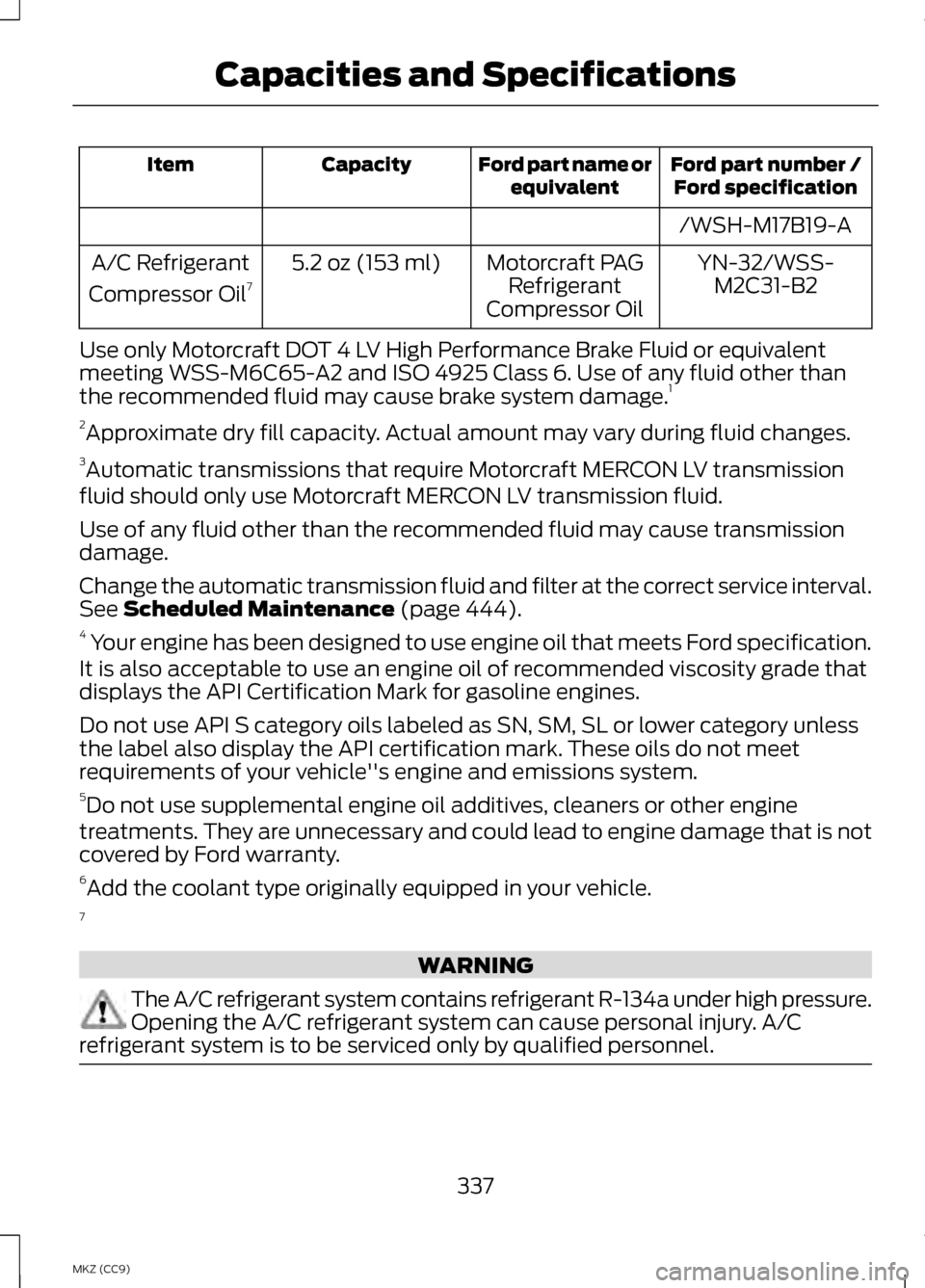
Ford part number /
Ford specification
Ford part name or
equivalent
Capacity
Item
/WSH-M17B19-AYN-32/WSS-M2C31-B2
Motorcraft PAG
Refrigerant
Compressor Oil
5.2 oz (153 ml)
A/C Refrigerant
Compressor Oil 7
Use only Motorcraft DOT 4 LV High Performance Brake Fluid or equivalent
meeting WSS-M6C65-A2 and ISO 4925 Class 6. Use of any fluid other than
the recommended fluid may cause brake system damage. 1
2 Approximate dry fill capacity. Actual amount may vary during fluid changes.
3 Automatic transmissions that require Motorcraft MERCON LV transmission
fluid should only use Motorcraft MERCON LV transmission fluid.
Use of any fluid other than the recommended fluid may cause transmission
damage.
Change the automatic transmission fluid and filter at the correct service interval.
See Scheduled Maintenance (page 444).
4 Your engine has been designed to use engine oil that meets Ford specification.
It is also acceptable to use an engine oil of recommended viscosity grade that
displays the API Certification Mark for gasoline engines.
Do not use API S category oils labeled as SN, SM, SL or lower category unless
the label also display the API certification mark. These oils do not meet
requirements of your vehicle''s engine and emissions system.
5 Do not use supplemental engine oil additives, cleaners or other engine
treatments. They are unnecessary and could lead to engine damage that is not
covered by Ford warranty.
6 Add the coolant type originally equipped in your vehicle.
7 WARNING
The A/C refrigerant system contains refrigerant R-134a under high pressure.
Opening the A/C refrigerant system can cause personal injury. A/C
refrigerant system is to be serviced only by qualified personnel. 337
MKZ (CC9) Capacities and Specifications
Page 447 of 475
Protecting Your Investment
Maintenance is an investment that
pays dividends in the form of
improved reliability, durability and
resale value. To maintain the proper
performance of your vehicle and its
emission control systems, make sure
you have scheduled maintenance
performed at the designated intervals.
Your vehicle is equipped with an
information display, which indicates
the proper oil change interval. This
interval may be up to one year or
10000 miles (16000 kilometers).
When ENGINE OIL CHANGE DUE or
OIL CHANGE REQUIRED appears in
the information display, it is time for
an oil change. Make sure you perform
the oil change within two weeks or
500 miles (800 kilometers) of the
ENGINE OIL CHANGE DUE
or OIL
CHANGE REQUIRED message
appearing. Make sure you reset the oil
monitoring system after each oil
change. See Engine Oil Check (page
280
).
If your information display resets
prematurely, becomes inoperative or
the vehicle battery becomes
discharged or disconnected, the oil
monitoring system resets to 100% oil
life. You should change your engine
oil one year or 10000 miles (16000
kilometers) from the previous oil
change. Never exceed one year or
10000 miles (16000 kilometers)
between oil change intervals. Your vehicle is very sophisticated and
built with multiple, complex,
performance systems. Every
manufacturer develops these systems
using different specifications and
performance features. That is why it
is important to rely upon your
dealership to properly diagnose and
repair your vehicle.
Ford Motor Company has
recommended maintenance intervals
for various parts and component
systems based upon engineering
testing. Ford Motor Company relies
upon this testing to determine the
most appropriate mileage for
replacement of oils and fluids to
protect your vehicle at the lowest
overall cost to you and recommends
against maintenance schedules that
deviate from the scheduled
maintenance information.
We strongly recommend the use of
only genuine Ford, Motorcraft or
Ford-authorized re-manufactured
replacement parts engineered for your
vehicle.
Additives and Chemicals
This owner's manual and the Ford
Workshop Manual list the
recommended additives and
chemicals for your vehicle. We do not
recommend using chemicals or
additives not approved by us as part
of your vehicle
’s normal maintenance.
Please consult your warranty
information.
445
MKZ (CC9) Scheduled Maintenance