climate control LINCOLN MKZ HYBRID 2013 User Guide
[x] Cancel search | Manufacturer: LINCOLN, Model Year: 2013, Model line: MKZ HYBRID, Model: LINCOLN MKZ HYBRID 2013Pages: 475, PDF Size: 3.89 MB
Page 168 of 475
HYBRID ELECTRIC VEHICLE
This hybrid vehicle combines electric
and gasoline propulsion to provide
performance and efficiency. It requires
no special fuels and you never have
to plug it in.
Note:
You may notice higher engine
speeds upon start-up. This temporary
condition is normal and necessary to
heat up the cabin and minimize
emissions. Starting: Switch the ignition
on while your transmission
selector is in position P. The
green ready indicator light will appear
in the instrument cluster, letting you
know that the vehicle is ready for
driving.
The engine may not start because this
vehicle is equipped with silent key
start. This fuel saving feature allows
your vehicle to be ready to drive
without requiring the gas engine to be
running. This indicator will remain on
while the vehicle is on, whether the
engine is running or not to indicate the
vehicle is capable of movement (using
its electric motor, engine, or both).
Typically, the engine will not start
unless the vehicle is cold, you make a
climate control change, or you press
the accelerator. Driving:
The gas engine
automatically starts and stops to
provide power when needed and to
save fuel when not needed. While
coasting at low speeds, coming to a
stop, or standing, the gas engine
normally shuts down and the vehicle
operates in electric-only mode.
Conditions that may cause the engine
to start up or remain running include:
• Considerable vehicle acceleration
• Vehicle speed above 85 mph (137
km/h) However, the maximum
speed for electric –only operation
may be lower while driving in hot
temperatures or on hilly terrain.
• Ascending a hill
• Charge level of high voltage
battery is low
• Very high or low outside
temperature (to provide system
cooling or heating)
• Engine not warm enough to
provide passenger requested cabin
temperature.
Stopping:
The gas engine may shut
off to conserve fuel as you come to a
stop. Restarting the vehicle is not
required. Simply step on the
accelerator when you are ready to
drive.
Transmission Operation: Due to the
technologically advanced,
electronically-controlled continuously
variable transaxle, you will not feel
shift changes like those of a
non-hybrid vehicle.
166
MKZ (CC9) Unique Driving CharacteristicsE144692
Page 172 of 475
Answer
Question
In order to ensure that the climate
control system can begin heating the cabin or defrosting the windshield as
soon as a driver requests it, the engine coolant temperature has to be kept
sufficiently hot. Keeping the engine on is required to maintain the correct minimum temperature.
Why does my engine stay on when it
is extremely cold outside?
Your vehicle's engine and transmissionare designed to deliver the power you need at the most efficient enginespeed. This may be higher than
expected during heavy accelerations,
and may fluctuate during steady state driving. These are characteristics ofthe Atkinson engine cycle and the
transmission technology that help
maximize your hybrid's fuel economy.
Why does my engine rev up so high
sometimes when I accelerate?
The fan noise comes from a fan
located outside the high voltage
battery. This fan turns on when the
battery requires cooling air. The fan
speed, and associated noise level, will change according to the amount of
What is the fan noise I hear from the
rear of my hybrid?
cooling required to maintain good
performance. Maintaining the battery temperature at optimal conditionsalso prolongs the useful life of the
battery and helps to achieve better fuel economy.
Running out of gas is not recom-
mended. However, you may be able to go about one mile, driving at 30 mph
(48 km/h), if the battery has a normal state of charge.
How far can I go in Electric Drive if I run
out of gas?
170
MKZ (CC9) Unique Driving Characteristics
Page 247 of 475
TOWING THE VEHICLE ON
FOUR WHEELS
Emergency Towing
In the event your vehicle becomes
disabled (without access to wheel
dollies, car-hauling trailer, or flatbed
transport vehicle), it can be
flat-towed (all wheels on the ground,
regardless of the
powertrain/transmission
configuration) under the following
conditions:
•
The vehicle is facing forward so
that it is towed in a forward
direction.
• The transmission gear shift lever
is placed in position N. If the
transmission gear shift lever
cannot be moved to position
N, it
may need to be overridden. See
Automatic Transmission
(page
185).
• Maximum speed is 35 mph (56
km/h).
• Maximum distance is 50 miles (80
kilometers).
Recreational Towing
Note: Put your climate control system
in recirculated air mode to prevent
exhaust fumes from entering the
vehicle. See
Climate Control (page
138). Follow these guidelines if you have a
need for recreational (RV) towing. An
example of recreational towing would
be towing your vehicle behind a
motorhome. These guidelines are
designed to ensure that your
transmission is not damaged.
Your vehicle can be towed with all
four wheels on the ground using the
Neutral Tow feature, or with all four
wheels off the ground using a vehicle
transport trailer. If you are using a
vehicle transport trailer, follow the
instruction specified by the equipment
provider.
Neutral Tow
If you tow your vehicle with all four
wheels on the ground:
•
Tow only in the forward direction.
• Release the parking brake.
245
MKZ (CC9) Towing
Page 274 of 475
Protected components
Fuse amp rating
Fuse or relay
number
Front heated seat
20A 1
65
Not used
-
66
Body control module 2
50A 2
67
Heated rear window
40A 1
68
Anti-lock brake system valves
30A 1
69
Passenger seat
30A 1
70
Not used
-
71
Panoramic roof #1
30A 1
72
Rear climate controlled seats
20A 1
73
Driver seat module
30A 1
74
Not used
-
75
iShifter
20A 1
76
Front climate controlled seats
30A 1
77
Not used
-
78
Blower motor
40A 1
79
Power trunk
30A 1
80
Inverter
40A 1
81
Anti-lock brake system pump
60A 2
82
Wiper motor #1
25A 1
83
272
MKZ (CC9) Fuses
Page 276 of 475
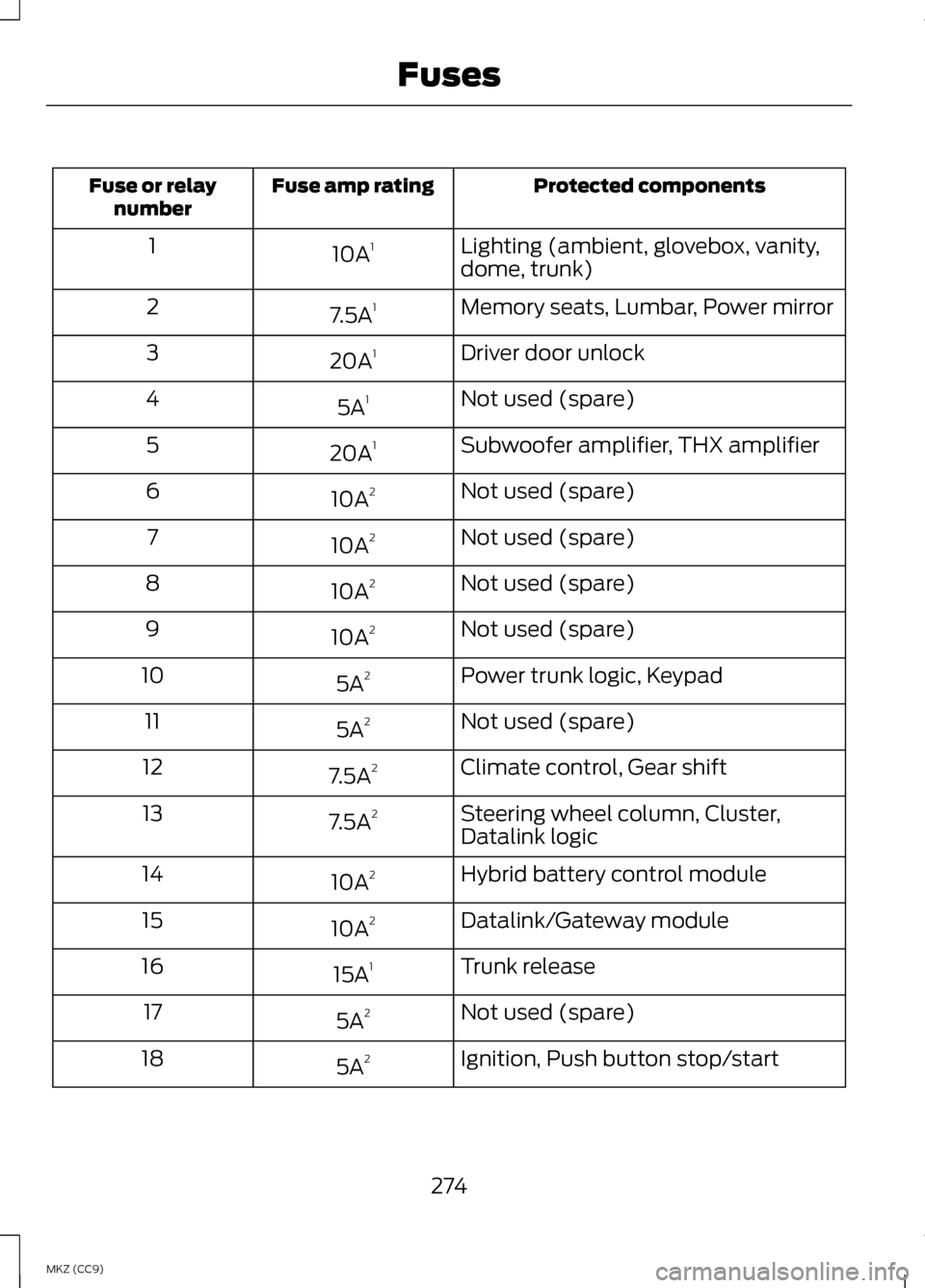
Protected components
Fuse amp rating
Fuse or relay
number
Lighting (ambient, glovebox, vanity,
dome, trunk)
10A
1
1
Memory seats, Lumbar, Power mirror
7.5A 1
2
Driver door unlock
20A 1
3
Not used (spare)
5A 1
4
Subwoofer amplifier, THX amplifier
20A 1
5
Not used (spare)
10A 2
6
Not used (spare)
10A 2
7
Not used (spare)
10A 2
8
Not used (spare)
10A 2
9
Power trunk logic, Keypad
5A 2
10
Not used (spare)
5A 2
11
Climate control, Gear shift
7.5A 2
12
Steering wheel column, Cluster,
Datalink logic
7.5A
2
13
Hybrid battery control module
10A 2
14
Datalink/Gateway module
10A 2
15
Trunk release
15A 1
16
Not used (spare)
5A 2
17
Ignition, Push button stop/start
5A 2
18
274
MKZ (CC9) Fuses
Page 277 of 475
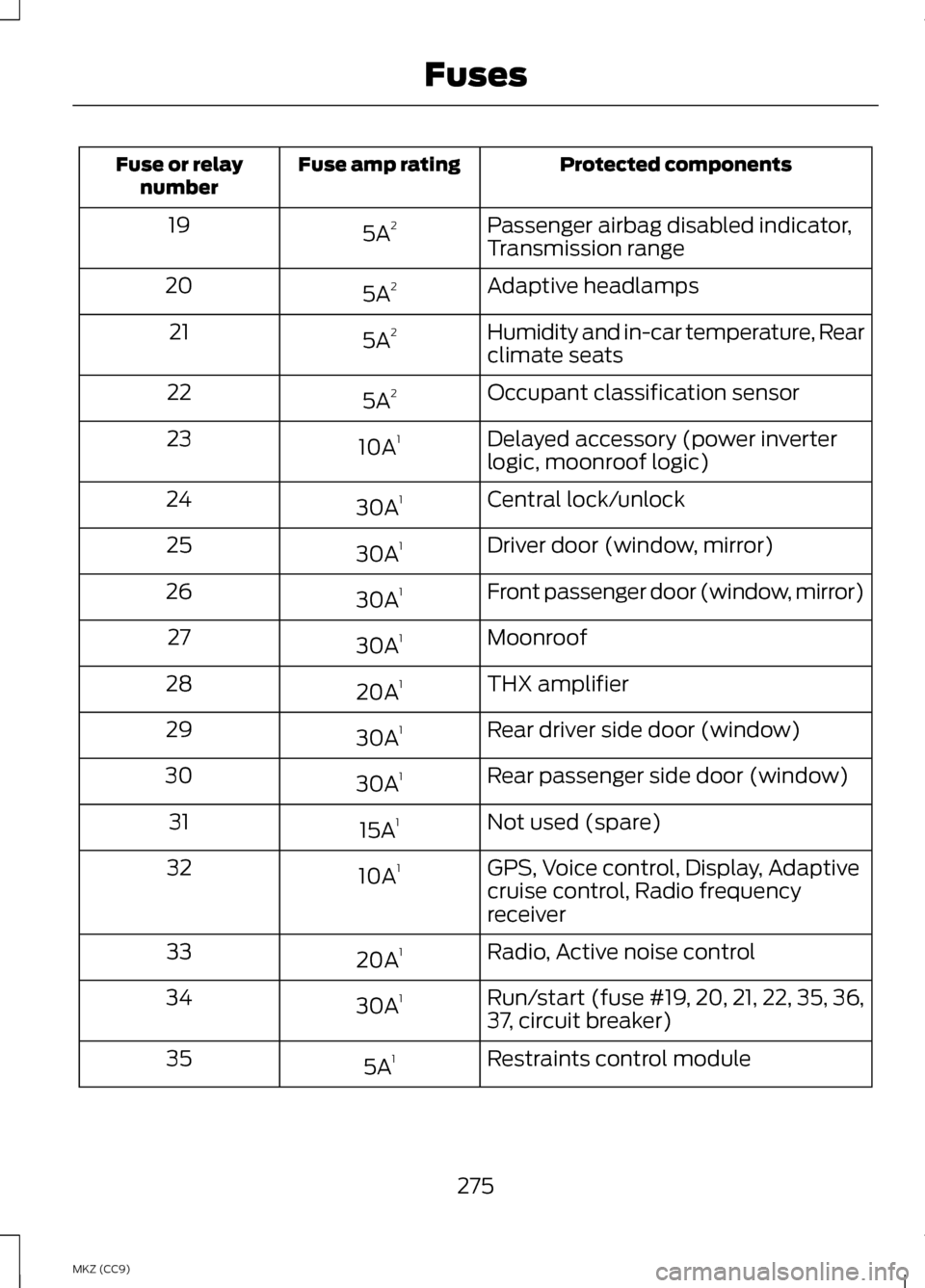
Protected components
Fuse amp rating
Fuse or relay
number
Passenger airbag disabled indicator,
Transmission range
5A
2
19
Adaptive headlamps
5A 2
20
Humidity and in-car temperature, Rear
climate seats
5A
2
21
Occupant classification sensor
5A 2
22
Delayed accessory (power inverter
logic, moonroof logic)
10A
1
23
Central lock/unlock
30A 1
24
Driver door (window, mirror)
30A 1
25
Front passenger door (window, mirror)
30A 1
26
Moonroof
30A 1
27
THX amplifier
20A 1
28
Rear driver side door (window)
30A 1
29
Rear passenger side door (window)
30A 1
30
Not used (spare)
15A 1
31
GPS, Voice control, Display, Adaptive
cruise control, Radio frequency
receiver
10A
1
32
Radio, Active noise control
20A 1
33
Run/start (fuse #19, 20, 21, 22, 35, 36,
37, circuit breaker)
30A
1
34
Restraints control module
5A 1
35
275
MKZ (CC9) Fuses
Page 286 of 475
Adding Inverter System
Controller Coolant
1. Open the inverter system
controller coolant reservoir cap.
2. Use a funnel to add prediluted coolant to the inverter system
controller coolant reservoir. Make
sure that the level is between the
MIN and MAX marks on the
inverter system controller coolant
reservoir. Use prediluted coolant
meeting the Ford specification.
See Capacities and
Specifications (page 330).
3. Close the inverter system controller coolant reservoir cap.
Whenever you add coolant, check the
coolant level in the inverter system
controller coolant reservoir the next
few times you drive the vehicle. If
necessary, add enough prediluted
coolant to bring the inverter system
controller coolant level to the proper
level.
Recycled Engine Coolant
Ford Motor Company does not
recommend the use of recycled
engine coolant since a Ford-approved
recycling process is not yet available.
Used engine coolant should be
disposed of in an appropriate manner.
Follow your community ’s regulations
and standards for recycling and
disposing of automotive fluids. Severe Climates
If you drive in extremely cold climates:
•
It may be necessary to have an
authorized Ford dealer increase
the coolant concentration above
50%.
• A coolant concentration of 60%
will provide improved freeze point
protection. Engine coolant
concentrations above 60% will
decrease the overheat protection
characteristics of the engine
coolant and may cause engine
damage.
If you drive in extremely hot climates:
• It may be necessary to have an
authorized Ford dealer decrease
the coolant concentration to 40%.
• A coolant concentration of 40%
will provide improved overheat
protection. Engine coolant
concentrations below 40% will
decrease the corrosion/freeze
protection characteristics of the
engine coolant and may cause
engine damage.
Vehicles driven year-round in
non-extreme climates should use
prediluted coolant meeting the Ford
specification for optimum cooling
system and engine protection.
284
MKZ (CC9) Maintenance
Page 316 of 475
Tire Quality Grades apply to new
pneumatic passenger car tires.
They do not apply to deep tread,
winter-type snow tires,
space-saver or temporary use
spare tires, light truck or LT type
tires, tires with nominal rim
diameters of 10 to 12 inches or
limited production tires as defined
in Title 49 Code of Federal
Regulations Part 575.104 (c)(2).
U.S. Department of
Transportation Tire quality
grades: The U.S. Department of
Transportation requires Ford
Motor Company to give you the
following information about tire
grades exactly as the government
has written it.
Treadwear
The treadwear grade is a
comparative rating based on the
wear rate of the tire when tested
under controlled conditions on a
specified government test course.
For example, a tire graded 150
would wear one and one-half (1
½) times as well on the
government course as a tire
graded 100. The relative
performance of tires depends
upon the actual conditions of their
use, however, and may depart
significantly from the norm due to
variations in driving habits, service
practices, and differences in road
characteristics and climate. Traction AA A B C WARNING
The traction grade assigned
to this tire is based on
straight-ahead braking traction
tests, and does not include
acceleration, cornering,
hydroplaning or peak traction
characteristics. The traction grades, from highest
to lowest are AA, A, B, and C. The
grades represent the tire
’s ability
to stop on wet pavement as
measured under controlled
conditions on specified
government test surfaces of
asphalt and concrete. A tire
marked C may have poor traction
performance.
Temperature A B C WARNING
The temperature grade for
this tire is established for a
tire that is properly inflated and
not overloaded. Excessive speed,
underinflation, or excessive
loading, either separately or in
combination, can cause heat
buildup and possible tire failure. The temperature grades are A
(the highest), B and C,
representing the tire
’s resistance
to the generation of heat and its
ability to dissipate heat when
tested under controlled conditions
on a specified indoor laboratory
314
MKZ (CC9) Wheels and Tires
Page 345 of 475
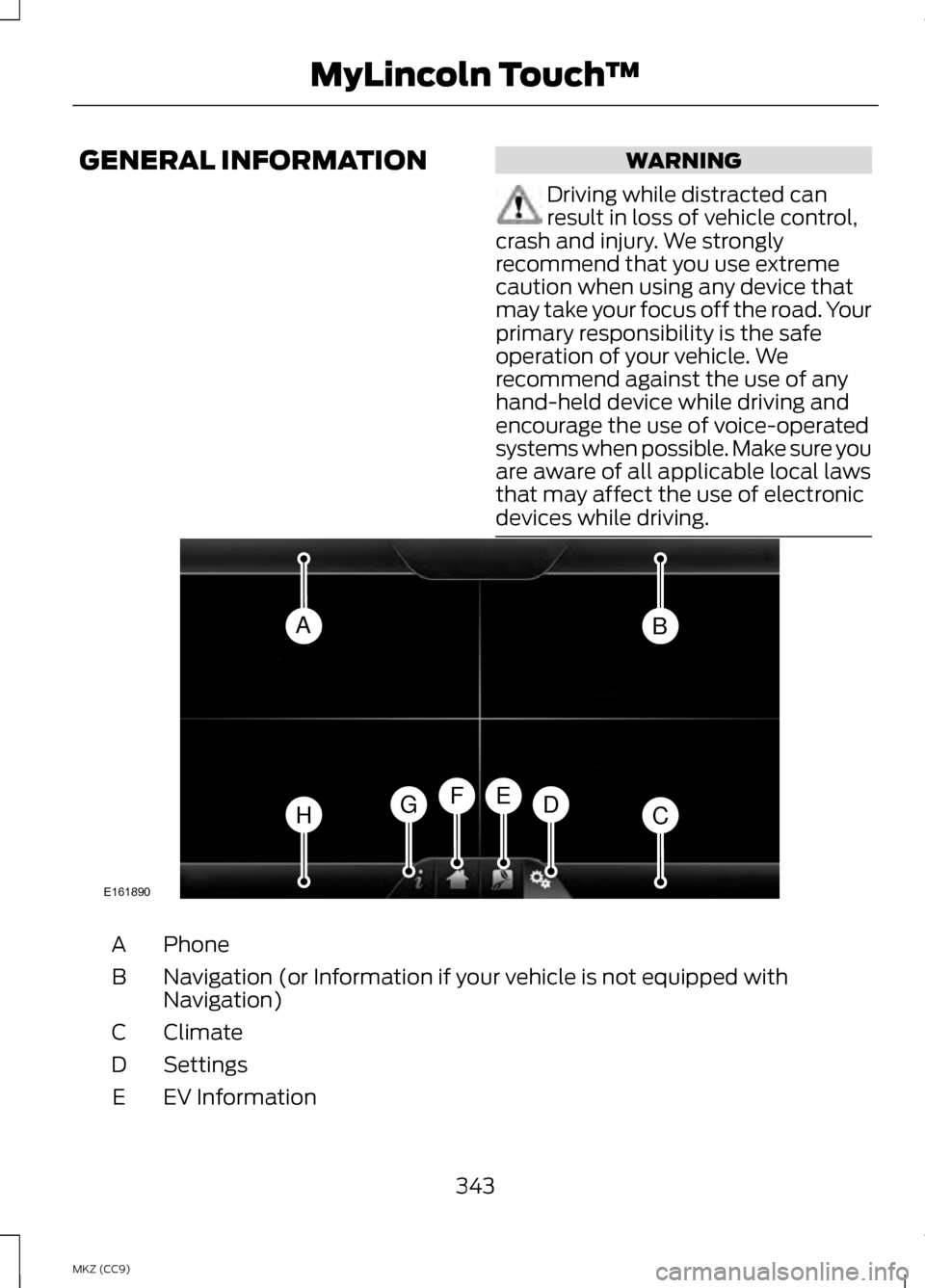
GENERAL INFORMATION WARNING
Driving while distracted can
result in loss of vehicle control,
crash and injury. We strongly
recommend that you use extreme
caution when using any device that
may take your focus off the road. Your
primary responsibility is the safe
operation of your vehicle. We
recommend against the use of any
hand-held device while driving and
encourage the use of voice-operated
systems when possible. Make sure you
are aware of all applicable local laws
that may affect the use of electronic
devices while driving. Phone
A
Navigation (or Information if your vehicle is not equipped with
Navigation)
B
Climate
C
Settings
D
EV Information
E
343
MKZ (CC9) MyLincoln Touch
™AB
HCDGEF
E161890
Page 346 of 475
Home
F
Information
G
Entertainment
H
This system uses a four-corner
strategy to provide quick access to
several vehicle features and settings.
The touchscreen provides easy
interaction with your cellular phone,
multimedia, climate control and
navigation system. The corners
display any active modes within those
menus, such as phone status or the
climate temperature.
Note: Some features are not available
while your vehicle is moving.
Note: Your system is equipped with a
feature that allows you to access and
control audio features for 30 minutes
after you switch the ignition off (and
no doors open).
PHONE
Press to select any of the following:
• Phone
• Quick Dial
• Phonebook
• History
• Messaging
• Settings
NAVIGATION
Press to select any of the following:
• My Home
• Favorites
• Previous Destinations
• Point of Interest •
Emergency
• Street Address
• Intersection
• City Center
• Map
• Edit Route Cancel Route
CLIMATE
Press to select any of the following:
• Driver Settings
• Recirculated Air
• Auto
• Dual
• Passenger Settings
• A/C
• Defrost SETTINGS
Press to select any of the following:
• Clock
• Display
• Sound
• Vehicle
• Settings
• Help EV Information
Press to access features
specific to your hybrid or
plug-in hybrid electric
vehicle.
344
MKZ (CC9) MyLincoln Touch
™E142607 E161716