cooling LINCOLN MKZ HYBRID 2013 User Guide
[x] Cancel search | Manufacturer: LINCOLN, Model Year: 2013, Model line: MKZ HYBRID, Model: LINCOLN MKZ HYBRID 2013Pages: 475, PDF Size: 3.89 MB
Page 285 of 475
•
Do not mix different colors or types
of coolant in your vehicle. Make
sure the correct coolant is used.
Mixing of coolants may harm your
cooling system. The use of an
improper coolant may harm the
engine, inverter system controller,
and cooling system components
and may void the warranty.
• In case of emergency, a large
amount of water without engine
coolant may be added to the
engine cooling system only in order
to reach a vehicle service location.
In this instance, the engine cooling
system must be drained,
chemically cleaned with
Motorcraft Premium Cooling
System Flush, and refilled with
prediluted engine coolant as soon
as possible. Water alone (without
engine coolant) can cause engine
damage from corrosion,
overheating, or freezing. DO NOT
use this method for the inverter
system controller cooling system.
The inverter system controller
cooling system operates close to
ambient temperature, and is
susceptible to freezing in any
subfreezing environment in the
absence of coolant. •
Do not use alcohol, methanol,
brine or any engine coolants mixed
with alcohol or methanol
antifreeze (coolant). Alcohol and
other liquids can cause engine
damage from overheating or
freezing.
• Do not add extra inhibitors or
additives to the coolant. These can
be harmful and compromise the
corrosion protection of the engine
coolant.
Adding Engine Coolant
1. Unscrew the engine coolant reservoir cap slowly. Any pressure
will escape as you unscrew the
cap.
2. Use a funnel to add prediluted engine coolant to the engine
coolant reservoir. Make sure that
the level is between the MIN and
MAX marks on the engine coolant
reservoir. Use prediluted engine
coolant meeting the Ford
specification. See Capacities and
Specifications (page 330).
3. Close the engine coolant reservoir
cap.
Whenever you add coolant, check the
coolant level in the engine coolant
reservoir the next few times you drive
the vehicle. If necessary, add enough
prediluted engine coolant to bring the
engine coolant level to the proper
level.
283
MKZ (CC9) Maintenance
Page 286 of 475
Adding Inverter System
Controller Coolant
1. Open the inverter system
controller coolant reservoir cap.
2. Use a funnel to add prediluted coolant to the inverter system
controller coolant reservoir. Make
sure that the level is between the
MIN and MAX marks on the
inverter system controller coolant
reservoir. Use prediluted coolant
meeting the Ford specification.
See Capacities and
Specifications (page 330).
3. Close the inverter system controller coolant reservoir cap.
Whenever you add coolant, check the
coolant level in the inverter system
controller coolant reservoir the next
few times you drive the vehicle. If
necessary, add enough prediluted
coolant to bring the inverter system
controller coolant level to the proper
level.
Recycled Engine Coolant
Ford Motor Company does not
recommend the use of recycled
engine coolant since a Ford-approved
recycling process is not yet available.
Used engine coolant should be
disposed of in an appropriate manner.
Follow your community ’s regulations
and standards for recycling and
disposing of automotive fluids. Severe Climates
If you drive in extremely cold climates:
•
It may be necessary to have an
authorized Ford dealer increase
the coolant concentration above
50%.
• A coolant concentration of 60%
will provide improved freeze point
protection. Engine coolant
concentrations above 60% will
decrease the overheat protection
characteristics of the engine
coolant and may cause engine
damage.
If you drive in extremely hot climates:
• It may be necessary to have an
authorized Ford dealer decrease
the coolant concentration to 40%.
• A coolant concentration of 40%
will provide improved overheat
protection. Engine coolant
concentrations below 40% will
decrease the corrosion/freeze
protection characteristics of the
engine coolant and may cause
engine damage.
Vehicles driven year-round in
non-extreme climates should use
prediluted coolant meeting the Ford
specification for optimum cooling
system and engine protection.
284
MKZ (CC9) Maintenance
Page 287 of 475
What You Should Know About
Fail-Safe Cooling
If the engine coolant supply is
depleted, this feature allows the
vehicle to be driven temporarily before
incremental component damage is
incurred. The
“fail-safe” distance
depends on ambient temperatures,
vehicle load and terrain.
How Fail-Safe Cooling Works
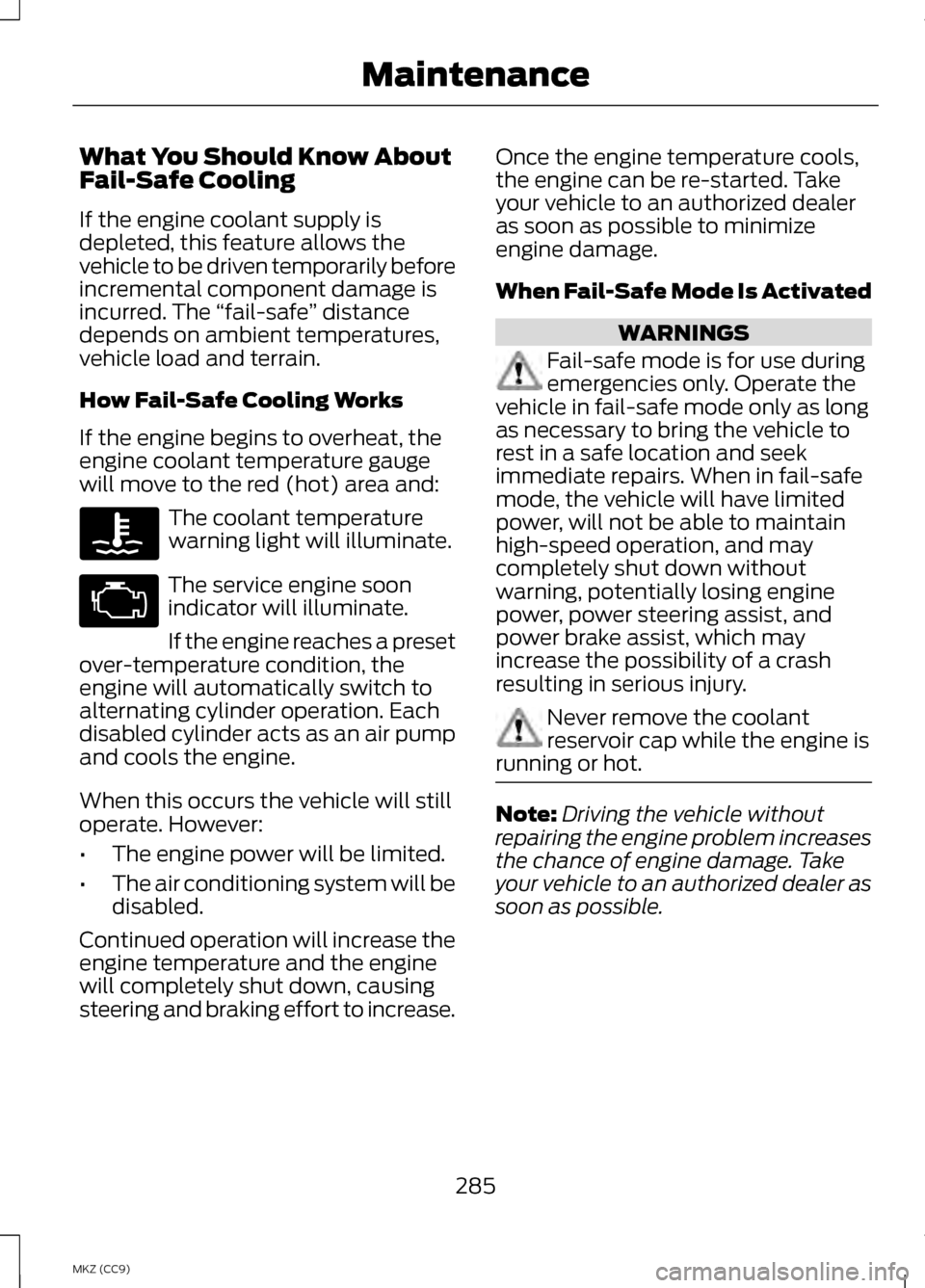
If the engine begins to overheat, the
engine coolant temperature gauge
will move to the red (hot) area and: The coolant temperature
warning light will illuminate.
The service engine soon
indicator will illuminate.
If the engine reaches a preset
over-temperature condition, the
engine will automatically switch to
alternating cylinder operation. Each
disabled cylinder acts as an air pump
and cools the engine.
When this occurs the vehicle will still
operate. However:
• The engine power will be limited.
• The air conditioning system will be
disabled.
Continued operation will increase the
engine temperature and the engine
will completely shut down, causing
steering and braking effort to increase. Once the engine temperature cools,
the engine can be re-started. Take
your vehicle to an authorized dealer
as soon as possible to minimize
engine damage.
When Fail-Safe Mode Is Activated WARNINGS
Fail-safe mode is for use during
emergencies only. Operate the
vehicle in fail-safe mode only as long
as necessary to bring the vehicle to
rest in a safe location and seek
immediate repairs. When in fail-safe
mode, the vehicle will have limited
power, will not be able to maintain
high-speed operation, and may
completely shut down without
warning, potentially losing engine
power, power steering assist, and
power brake assist, which may
increase the possibility of a crash
resulting in serious injury. Never remove the coolant
reservoir cap while the engine is
running or hot. Note:
Driving the vehicle without
repairing the engine problem increases
the chance of engine damage. Take
your vehicle to an authorized dealer as
soon as possible.
285
MKZ (CC9) Maintenance
Page 303 of 475
Note:
During extended periods of
vehicle storage (30 days or more), fuel
may deteriorate due to oxidation. Add
a quality gas stabilizer product to your
vehicle's fuel system whenever actual
or expected storage periods exceed 30
days. Follow the instructions on the
additive label. your vehicle should then
be operated at idle speed to circulate
the additive throughout the fuel
system.
Cooling system
• Protect against freezing
temperatures.
• When removing your vehicle from
storage, check coolant fluid level.
Confirm there are no cooling
system leaks, and fluid is at the
recommended level.
Battery
• Check and recharge as necessary.
Keep connections clean.
• If storing your vehicle for more
than 30 days without recharging
the battery, it may be advisable to
disconnect the battery cables to
ensure battery charge is
maintained for quick starting.
Note: If battery cables are
disconnected, it will be necessary to
reset memory features.
Brakes
• Make sure brakes and parking
brake are fully released. Tires
•
Maintain recommended air
pressure.
Miscellaneous
• Make sure all linkages, cables,
levers and pins under your vehicle
are covered with grease to prevent
rust.
• Move vehicles at least 25 feet (8
meters) every 15 days to lubricate
working parts and prevent
corrosion.
Removing Vehicle From
Storage
When your vehicle is ready to come
out of storage, do the following:
• Wash your vehicle to remove any
dirt or grease film build-up on
window surfaces.
• Check windshield wipers for any
deterioration.
• Check under the hood for any
foreign material that may have
collected during storage
(mice/squirrel nests).
• Check the exhaust for any foreign
material that may have collected
during storage.
• Check tire pressures and set tire
inflation per the Tire Label.
• Check brake pedal operation. Drive
your vehicle 15 feet (4.5 meters)
back and forth to remove rust
build-up.
301
MKZ (CC9) Vehicle Care
Page 415 of 475
Fan speed: Touch + or - to increase or decrease the volume of air
circulated in your vehicle.
C
Recirculated air: Touch the button to switch between outside air and
recirculated air. When you select recirculated air, the button illuminates
and the air currently in the passenger compartment recirculates. This
may reduce the time needed to cool the interior (when used with A/C)
and may reduce unwanted odors from entering your vehicle.
Recirculated air may turn off automatically in all airflow modes except
MAX A/C to reduce the possibility of fogging.
D
MAX A/C: Touch to switch on. The system distributes recirculated air
through the instrument panel air vents, air conditioning automatically
turns on and fan speed adjusts to the highest speed. This re-cooling
of the interior is more economical and efficient than normal A/C.
E
A/C:
Touch to turn air conditioning on or off. To improve air
conditioning when starting your vehicle, drive with the windows slightly
open for two to three minutes. Use A/C with recirculated air to improve
cooling performance and efficiency.
F
AUTO:
Touch to turn on fully automatic operation. Select the desired
temperature using the temperature control. The system automatically
adjusts fan speed, air distribution, A/C operation, and outside or
recirculated air, to heat or cool the vehicle to maintain the selected
temperature.
G
Rear defroster:
Touch to turn the rear window defroster and heated
mirrors (if equipped).
H
413
MKZ (CC9) MyLincoln Touch
™
Page 448 of 475
Oils, Fluids and Flushing
In many cases, fluid discoloration is a
normal operating characteristic and,
by itself, does not necessarily indicate
a concern or that the fluid needs to be
changed. However, a qualified expert,
such as the factory-trained
technicians at your dealership, should
inspect discolored fluids that also
show signs of overheating or foreign
material contamination immediately.
Make sure to change your vehicle
’s
oils and fluids at the specified
intervals or in conjunction with a
repair. Flushing is a viable way to
change fluid for many vehicle
sub-systems during scheduled
maintenance. It is critical that systems
are flushed only with new fluid that is
the same as that required to fill and
operate the system or using a
Ford-approved flushing chemical.
Owner Checks and Services
Make sure you perform the following
basic maintenance checks and
inspections every month or at
six-month intervals. Check every month
Engine oil level.
Function of all interior and exterior lights.
Tires (including spare) for wear and proper pressure. Windshield washer fluid level. Check every six months
Battery connections. Clean if necessary.
Body and door drain holes for obstructions. Clean if necessary. Cooling system fluid level and coolant strength.
Door weatherstrips for wear. Lubricate if necessary.
Hinges, latches and outside locks for proper operation. Lubricate if necessary. Parking brake for proper operation.
446
MKZ (CC9) Scheduled Maintenance
Page 450 of 475
Be sure to ask your dealership service
advisor or technician about the
multi-point vehicle inspection. It is a
comprehensive way to perform a
thorough inspection of your vehicle.
Your checklist gives you immediate
feedback on the overall condition of
your vehicle.
Normal Scheduled Maintenance Normal scheduled maintenance
1, 2
Change engine oil and filter. 3
Every 12 months or
10000 miles (16000
km). The oil monitoring
system displays a
message in the informa-
tion display. Rotate tires, inspect tire wear and measure tread
depth.
Inspect automatic transmission fluid level. Consult
dealer for requirements.
Inspect brake pads, shoes, rotors, drums, brake
linings, hoses and parking brake.
Inspect engine cooling system and motor/elec-
tronics cooling system strength and hoses.
Inspect exhaust system and heat shields.
Inspect half-shaft boots.
Inspect steering linkage, ball joints, suspension and
tie-rod ends.
Inspect wheels and related components for
abnormal noise, wear, looseness or drag.
1 Do not exceed one year or 10000 miles (16000 kilometers) between service
intervals.
2 Perform multi-point inspection (recommended).
3 Reset the oil monitoring system after engine oil and filter changes. See Engine
Oil Check (page 280).
448
MKZ (CC9) Scheduled Maintenance
Page 465 of 475
D
Data Recording........................................9
Event Data Recording................................10
Service Data Recording..............................9
Daytime Running Lamps...................83
Direction Indicators..............................85
Drive Control........................................234 LINCOLN DRIVE CONTROL.................234
Driver Alert
.............................................219
Using Driver Alert......................................219
Driver and Passenger Airbags..........43 Children and Airbags................................44
Proper Driver and Front Passenger
Seating Adjustment..............................44
Driving Aids
............................................219
Driving Hints..........................................247
Driving Through Water......................247
DRL See: Daytime Running Lamps...............83
E
Economical Driving............................247
Electric Parking Brake........................192 Applying the electric parking
brake......................................................... 193
Applying the electric parking brake when the vehicle is moving..............193
Battery With No Charge.........................194
Releasing the electric parking brake......................................................... 194
Electric Vehicle Information
...........395
Power........................................................... 396
Emission Control System.................179 On-Board Diagnostics (OBD-II).........180
Readiness for Inspection/Maintenance
(I/M) Testing.........................................180
End User License Agreement........426 SYNC® End User License Agreement
(EULA).................................................... 426Engine Block Heater...........................164
Using the Engine Block Heater............165
Engine Coolant Check
.......................281
Adding Coolant.........................................282
Adding Engine Coolant..........................283
Adding Inverter System Controller
Coolant................................................... 284
Checking the Engine Coolant...............281
Checking the Inverter System Controller Coolant...............................281
Engine Coolant and Inverter System Controller Coolant...............................281
Recycled Engine Coolant.....................284
Severe Climates.......................................284
What You Should Know About Fail-Safe Cooling.................................285
Engine Immobilizer See: Passive Anti-Theft System...........72
Engine Oil Check................................280 Adding Engine Oil....................................280
Engine Oil Dipstick............................280
Engine Specifications.......................330
Entertainment.....................................367 A/V Inputs.................................................. 386
AM/FM Radio............................................ 369
Bluetooth Audio.......................................386
Browsing Device Content......................367
CD................................................................. 380
SD Card Slot and USB Port..................381
Sirius® Satellite Radio (If Activated)............................................... 375
Supported Media Players, Formats and Metadata Information......................386
EPB See: Electric Parking Brake...................192
Event Data Recording See: Data Recording....................................9
Export Unique Options........................13
463
MKZ Hybrid (CC9) Index
Page 467 of 475
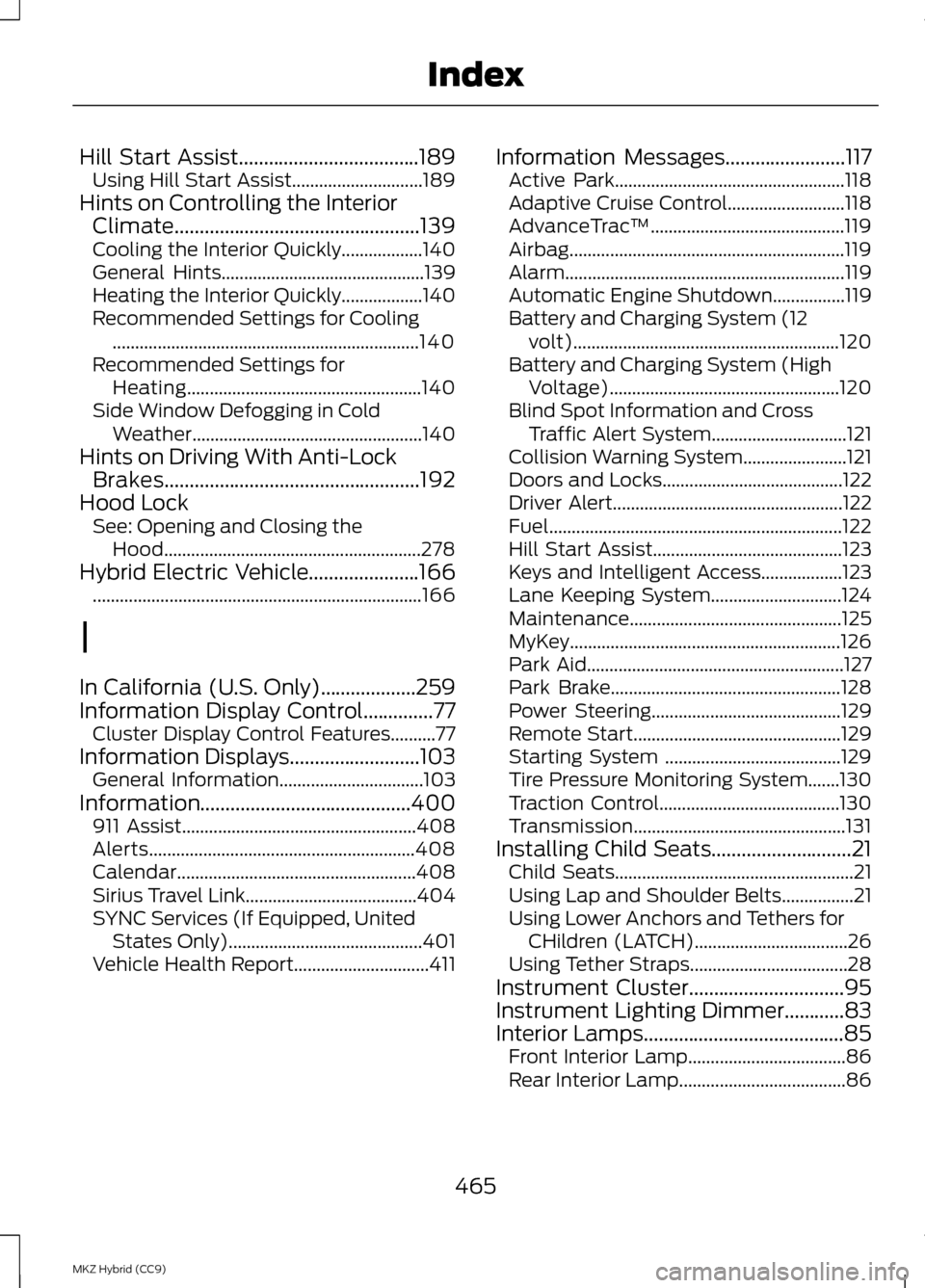
Hill Start Assist....................................189
Using Hill Start Assist.............................189
Hints on Controlling the Interior Climate.................................................139
Cooling the Interior Quickly..................140
General Hints............................................. 139
Heating the Interior Quickly..................140
Recommended Settings for Cooling .................................................................... 140
Recommended Settings for Heating.................................................... 140
Side Window Defogging in Cold Weather................................................... 140
Hints on Driving With Anti-Lock Brakes...................................................192
Hood Lock See: Opening and Closing the
Hood......................................................... 278
Hybrid Electric Vehicle......................166 ........................................................................\
. 166
I
In California (U.S. Only)...................259
Information Display Control..............77 Cluster Display Control Features..........77
Information Displays..........................103
General Information................................103
Information..........................................400 911 Assist.................................................... 408
Alerts........................................................... 408
Calendar..................................................... 408
Sirius Travel Link......................................404
SYNC Services (If Equipped, United States Only)........................................... 401
Vehicle Health Report..............................411 Information Messages
........................117
Active Park................................................... 118
Adaptive Cruise Control..........................118
AdvanceTrac ™........................................... 119
Airbag............................................................. 119
Alarm.............................................................. 119
Automatic Engine Shutdown................119
Battery and Charging System (12 volt)........................................................... 120
Battery and Charging System (High Voltage)................................................... 120
Blind Spot Information and Cross Traffic Alert System..............................121
Collision Warning System.......................121
Doors and Locks........................................122
Driver Alert................................................... 122
Fuel................................................................. 122
Hill Start Assist.......................................... 123
Keys and Intelligent Access..................123
Lane Keeping System.............................124
Maintenance............................................... 125
MyKey............................................................ 126
Park Aid......................................................... 127
Park Brake................................................... 128
Power Steering.......................................... 129
Remote Start.............................................. 129
Starting System .......................................129
Tire Pressure Monitoring System.......130
Traction Control........................................130
Transmission............................................... 131
Installing Child Seats
............................21
Child Seats..................................................... 21
Using Lap and Shoulder Belts................21
Using Lower Anchors and Tethers for CHildren (LATCH)..................................26
Using Tether Straps...................................28
Instrument Cluster...............................95
Instrument Lighting Dimmer............83
Interior Lamps
........................................85
Front Interior Lamp...................................86
Rear Interior Lamp.....................................86
465
MKZ Hybrid (CC9) Index
Page 472 of 475
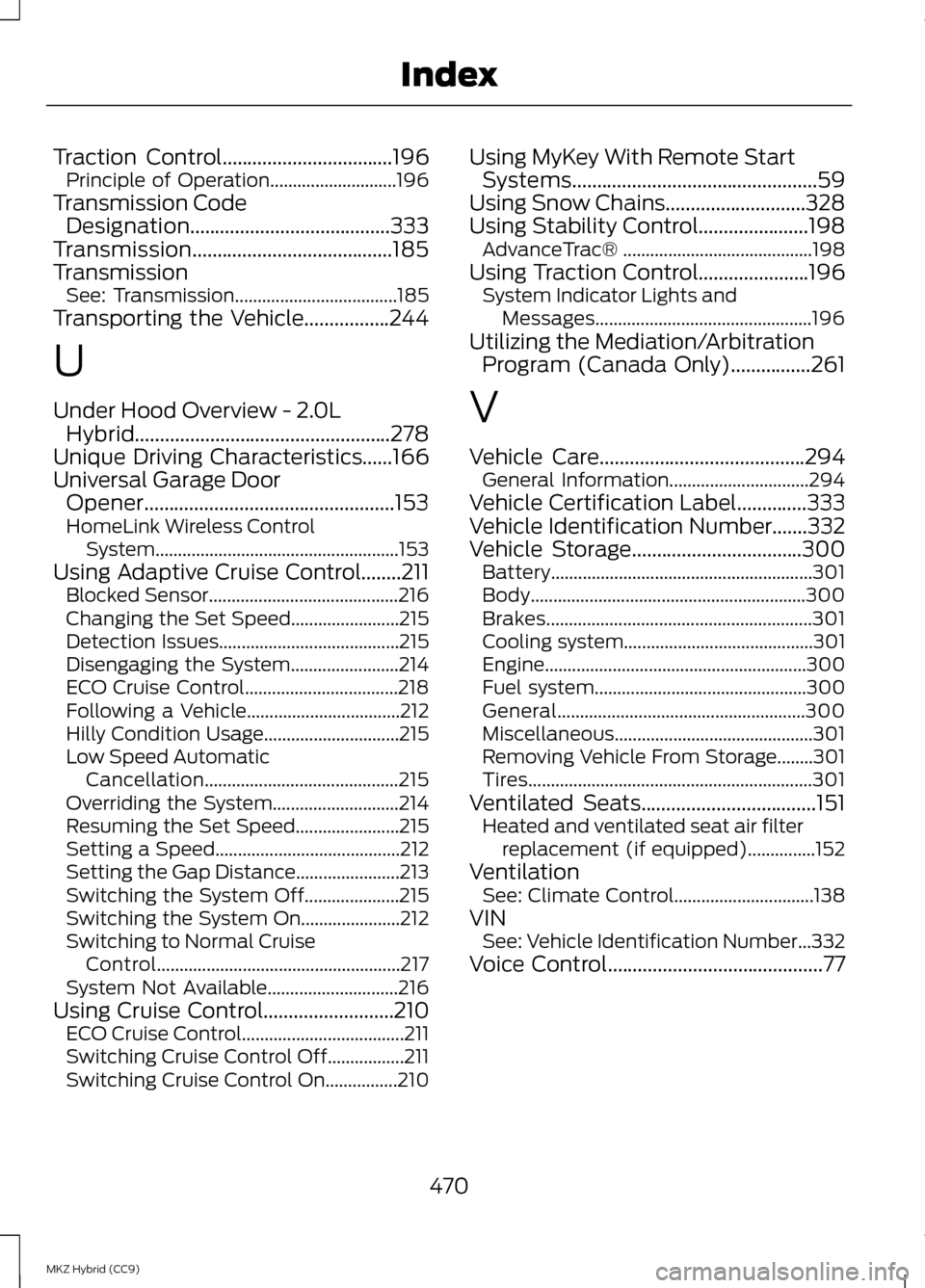
Traction Control..................................196
Principle of Operation............................196
Transmission Code Designation........................................333
Transmission........................................185
Transmission See: Transmission....................................185
Transporting the Vehicle.................244
U
Under Hood Overview - 2.0L Hybrid...................................................278
Unique Driving Characteristics......166
Universal Garage Door Opener..................................................153
HomeLink Wireless Control System...................................................... 153
Using Adaptive Cruise Control........211 Blocked Sensor.......................................... 216
Changing the Set Speed........................215
Detection Issues........................................215
Disengaging the System........................214
ECO Cruise Control..................................218
Following a Vehicle..................................212
Hilly Condition Usage..............................215
Low Speed Automatic Cancellation........................................... 215
Overriding the System............................214
Resuming the Set Speed.......................215
Setting a Speed......................................... 212
Setting the Gap Distance.......................213
Switching the System Off.....................215
Switching the System On......................212
Switching to Normal Cruise Control...................................................... 217
System Not Available.............................216
Using Cruise Control..........................210 ECO Cruise Control....................................211
Switching Cruise Control Off.................211
Switching Cruise Control On................210 Using MyKey With Remote Start
Systems.................................................59
Using Snow Chains............................328
Using Stability Control......................198 AdvanceTrac® .......................................... 198
Using Traction Control......................196 System Indicator Lights and
Messages................................................ 196
Utilizing the Mediation/Arbitration Program (Canada Only)................261
V
Vehicle Care.........................................294
General Information...............................294
Vehicle Certification Label
..............333
Vehicle Identification Number.......332
Vehicle Storage..................................300
Battery.......................................................... 301
Body............................................................. 300
Brakes........................................................... 301
Cooling system.......................................... 301
Engine.......................................................... 300
Fuel system............................................... 300
General....................................................... 300
Miscellaneous............................................ 301
Removing Vehicle From Storage........301
Tires............................................................... 301
Ventilated Seats
...................................151
Heated and ventilated seat air filter
replacement (if equipped)...............152
Ventilation See: Climate Control...............................138
VIN See: Vehicle Identification Number...332
Voice Control
...........................................77
470
MKZ Hybrid (CC9) Index