automatic LINCOLN MKZ HYBRID 2013 Owners Manual
[x] Cancel search | Manufacturer: LINCOLN, Model Year: 2013, Model line: MKZ HYBRID, Model: LINCOLN MKZ HYBRID 2013Pages: 475, PDF Size: 3.89 MB
Page 4 of 475
Security
Passive Anti-Theft System................72
Anti-Theft Alarm
...................................73
Steering Wheel
Adjusting the Steering Wheel...........75
Audio Control
.........................................76
Voice Control
...........................................77
Cruise Control
.........................................77
Information Display Control..............77
Heated Steering Wheel......................78
Wipers and Washers
Windshield Wipers
...............................79
Autowipers..............................................79
Windshield Washers
...........................80
Lighting
Lighting Control
.....................................82
Autolamps...............................................82
Instrument Lighting Dimmer............83
Headlamp Exit Delay...........................83
Daytime Running Lamps...................83
Automatic High Beam Control
........84
Direction Indicators
..............................85
Interior Lamps
........................................85
Adaptive Headlamps
..........................86
Windows and Mirrors
Power Windows
....................................88
Global Opening and Closing............89
Exterior Mirrors......................................89
Interior Mirror...........................................91
Sun Visors................................................92 Sun Shades
.............................................92
Moonroof.................................................92
Instrument Cluster
Gauges......................................................95
Warning Lamps and Indicators.......98
Audible Warnings and Indicators...........................................102
Information Displays
General Information..........................103
Information Messages
........................117
Audio System
General Information...........................134
Audio unit - Vehicles With: Premium AM/FM/CD........................................135
Media Hub
..............................................136
Climate Control
Automatic Climate Control
.............138
Hints on Controlling the Interior Climate...............................................139
Heated Windows and Mirrors
........140
Cabin Air Filter.......................................141
Remote Start
.........................................141
Seats
Sitting in the Correct Position.........143
Head Restraints...................................143
Power Seats..........................................145
Memory Function
................................147
Rear Seats
.............................................149
Heated Seats........................................150
Ventilated Seats
...................................151
2
MKZ Hybrid (CC9) Table of Contents
Page 5 of 475
Rear Seat Armrest...............................152
Universal Garage Door Opener
Universal Garage Door Opener......153
Auxiliary Power Points
Auxiliary Power Points......................158
Storage Compartments
Center Console....................................160
Overhead Console
..............................160
Starting and Stopping the Engine
General Information............................161
Keyless Starting
....................................161
Starting a Gasoline Engine..............162
Engine Block Heater...........................164
Unique Driving Character- istics
Hybrid Electric Vehicle......................166
Fuel and Refueling
Safety Precautions
..............................172
Fuel Quality
............................................173
Running Out of Fuel............................173
Refueling
.................................................175
Fuel Consumption
..............................178
Emission Control System.................179
High Voltage Battery
General Information...........................182 High Voltage Battery Cut-Off
Switch.................................................183
Transmission
Automatic Transmission
..................185
Hill Start Assist....................................189
Brakes
General Information............................191
Hints on Driving With Anti-Lock Brakes..................................................192
Electric Parking Brake........................192
Traction Control
Principle of Operation
.......................196
Using Traction Control......................196
Stability Control
Principle of Operation........................197
Using Stability Control......................198
Parking Aids
Parking Aid
............................................199
Active Park Assist................................201
Rear View Camera.............................206
Cruise Control
Principle of Operation.......................210
Using Cruise Control..........................210
Using Adaptive Cruise Control........211
Driving Aids
Driver Alert
.............................................219
Lane Keeping System
.......................220
Blind Spot Monitor.............................225
3
MKZ Hybrid (CC9) Table of Contents
Page 6 of 475
Collision Warning System...............230
Steering..................................................233
Drive Control........................................234
Load Carrying
Load Limit.............................................236
Towing
Towing a Trailer...................................244
Transporting the Vehicle.................244
Towing the Vehicle on Four Wheels...............................................245
Driving Hints
Breaking-In............................................247
Economical Driving............................247
Driving Through Water
......................247
Floor Mats
.............................................248
Roadside Emergencies
Roadside Assistance........................250
Hazard Warning Flashers
.................251
Jump-Starting the Vehicle...............251
Collision, Damage or Fire Event.....255
Post-Crash Alert System.................257
Customer Assistance
Getting the Services You Need
......258
In California (U.S. Only)...................259
The Better Business Bureau (BBB) Auto Line Program (U.S.
Only)...................................................260
Utilizing the Mediation/Arbitration Program (Canada Only)...............261
Getting Assistance Outside the U.S. and Canada
......................................262 Ordering Additional Owner's
Literature...........................................263
Reporting Safety Defects (U.S. Only)...................................................264
Reporting Safety Defects (Canada Only)...................................................264
Fuses
Changing a Fuse.................................265
Fuse Specification Chart.................266
Maintenance
General Information...........................277
Opening and Closing the Hood......278
Under Hood Overview - 2.0L Hybrid.................................................278
Engine Oil Dipstick............................280
Engine Oil Check................................280
Oil Change Indicator Reset............280
Engine Coolant Check
.......................281
Automatic Transmission Fluid Check.................................................286
Brake Fluid Check
..............................286
Power Steering Fluid Check...........286
Fuel Filter
...............................................287
Washer Fluid Check...........................287
Changing the 12V Battery................287
Checking the Wiper Blades............289
Changing the Wiper Blades...........289
Changing the Engine Air Filter.......290
Adjusting the Headlamps................291
Changing a Bulb.................................292
Bulb Specification Chart.................293
Vehicle Care
General Information
..........................294
4
MKZ Hybrid (CC9) Table of Contents
Page 24 of 475
WARNINGS
Depending on where you secure
a child restraint, and depending
on the child restraint design, you may
block access to certain safety belt
buckle assemblies and LATCH lower
anchors, rendering those features
potentially unusable. To avoid risk of
injury, occupants should only use
seating positions where they are able
to be properly restrained. When installing a child safety seat
with combination lap and shoulder
belts:
•
Use the correct safety belt buckle
for that seating position.
• Insert the belt tongue into the
proper buckle until you hear a snap
and feel it latch. Make sure the
tongue is securely fastened in the
buckle.
• Keep the buckle release button
pointing up and away from the
safety seat, with the tongue
between the child seat and the
release button, to prevent
accidental unbuckling.
• Place the vehicle seat upon which
the child seat will be installed in
the upright position.
• Put the safety belt in the
automatic locking mode. See Step
5. This vehicle does not require the
use of a locking clip.
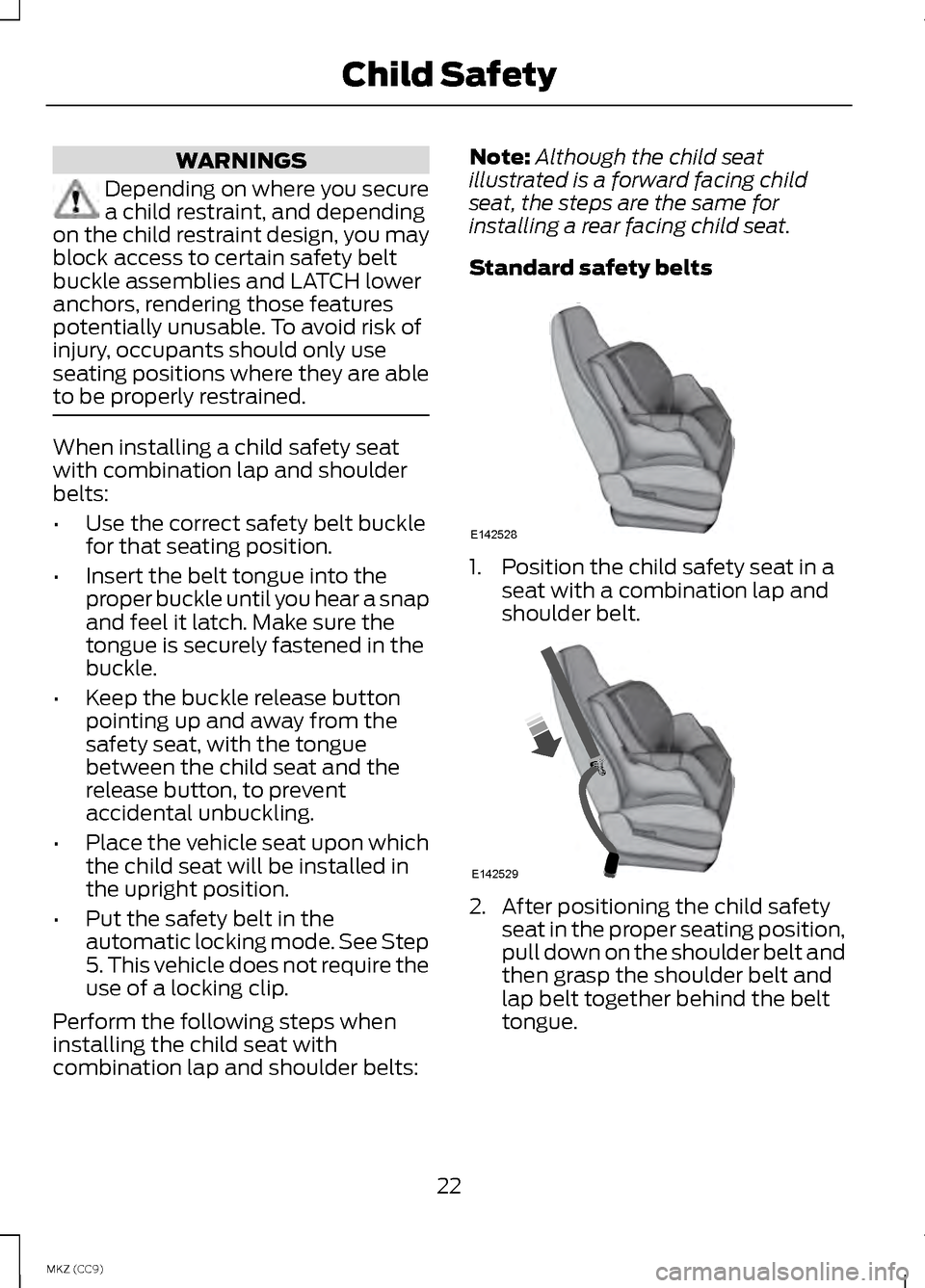
Perform the following steps when
installing the child seat with
combination lap and shoulder belts: Note:
Although the child seat
illustrated is a forward facing child
seat, the steps are the same for
installing a rear facing child seat.
Standard safety belts 1. Position the child safety seat in a
seat with a combination lap and
shoulder belt. 2. After positioning the child safety
seat in the proper seating position,
pull down on the shoulder belt and
then grasp the shoulder belt and
lap belt together behind the belt
tongue.
22
MKZ (CC9) Child SafetyE142528 E142529
Page 25 of 475
3.
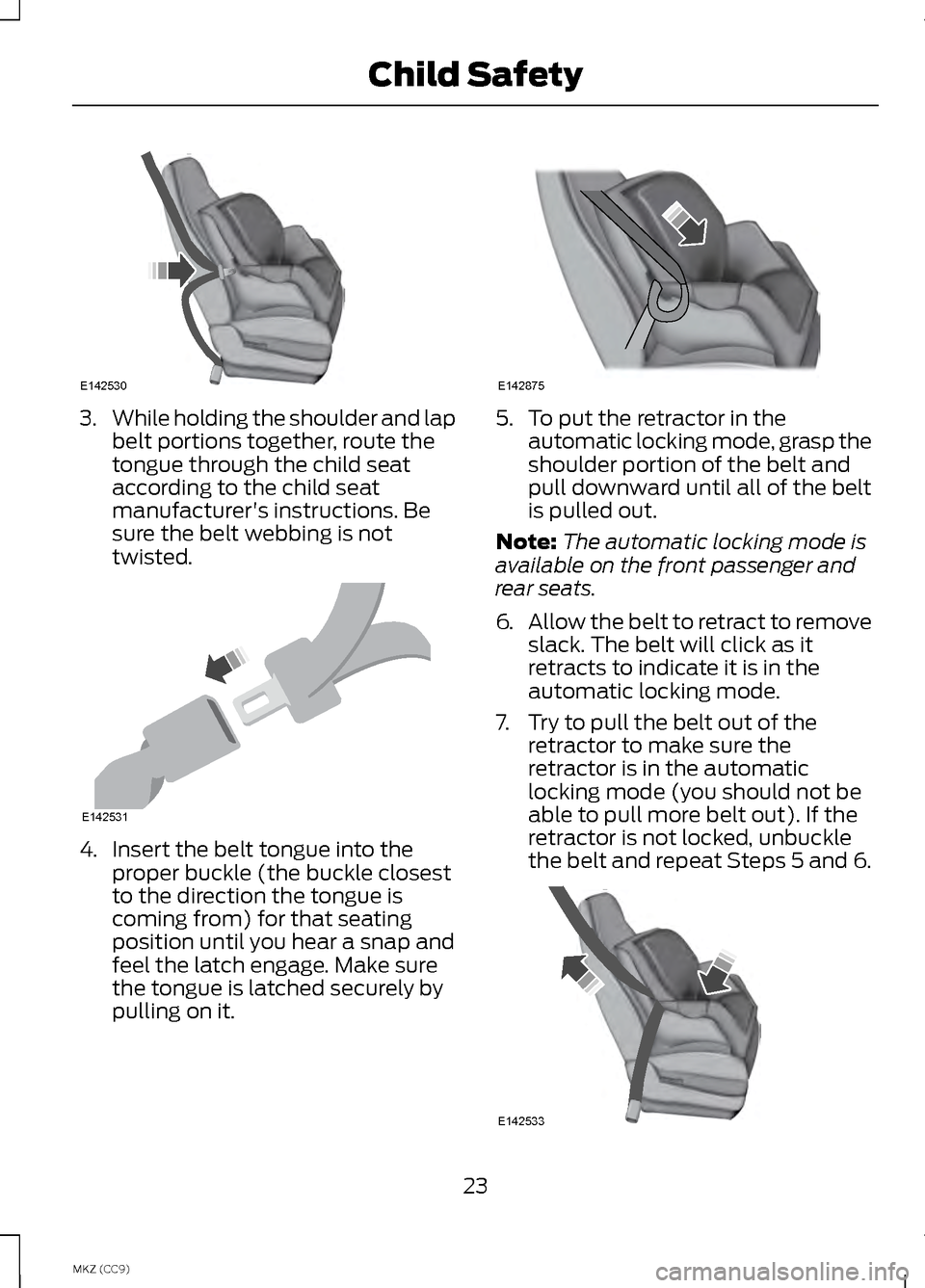
While holding the shoulder and lap
belt portions together, route the
tongue through the child seat
according to the child seat
manufacturer's instructions. Be
sure the belt webbing is not
twisted. 4. Insert the belt tongue into the
proper buckle (the buckle closest
to the direction the tongue is
coming from) for that seating
position until you hear a snap and
feel the latch engage. Make sure
the tongue is latched securely by
pulling on it. 5. To put the retractor in the
automatic locking mode, grasp the
shoulder portion of the belt and
pull downward until all of the belt
is pulled out.
Note: The automatic locking mode is
available on the front passenger and
rear seats.
6. Allow the belt to retract to remove
slack. The belt will click as it
retracts to indicate it is in the
automatic locking mode.
7. Try to pull the belt out of the retractor to make sure the
retractor is in the automatic
locking mode (you should not be
able to pull more belt out). If the
retractor is not locked, unbuckle
the belt and repeat Steps 5 and 6. 23
MKZ (CC9) Child SafetyE142530 E142531 E142875 E142533
Page 27 of 475
3.
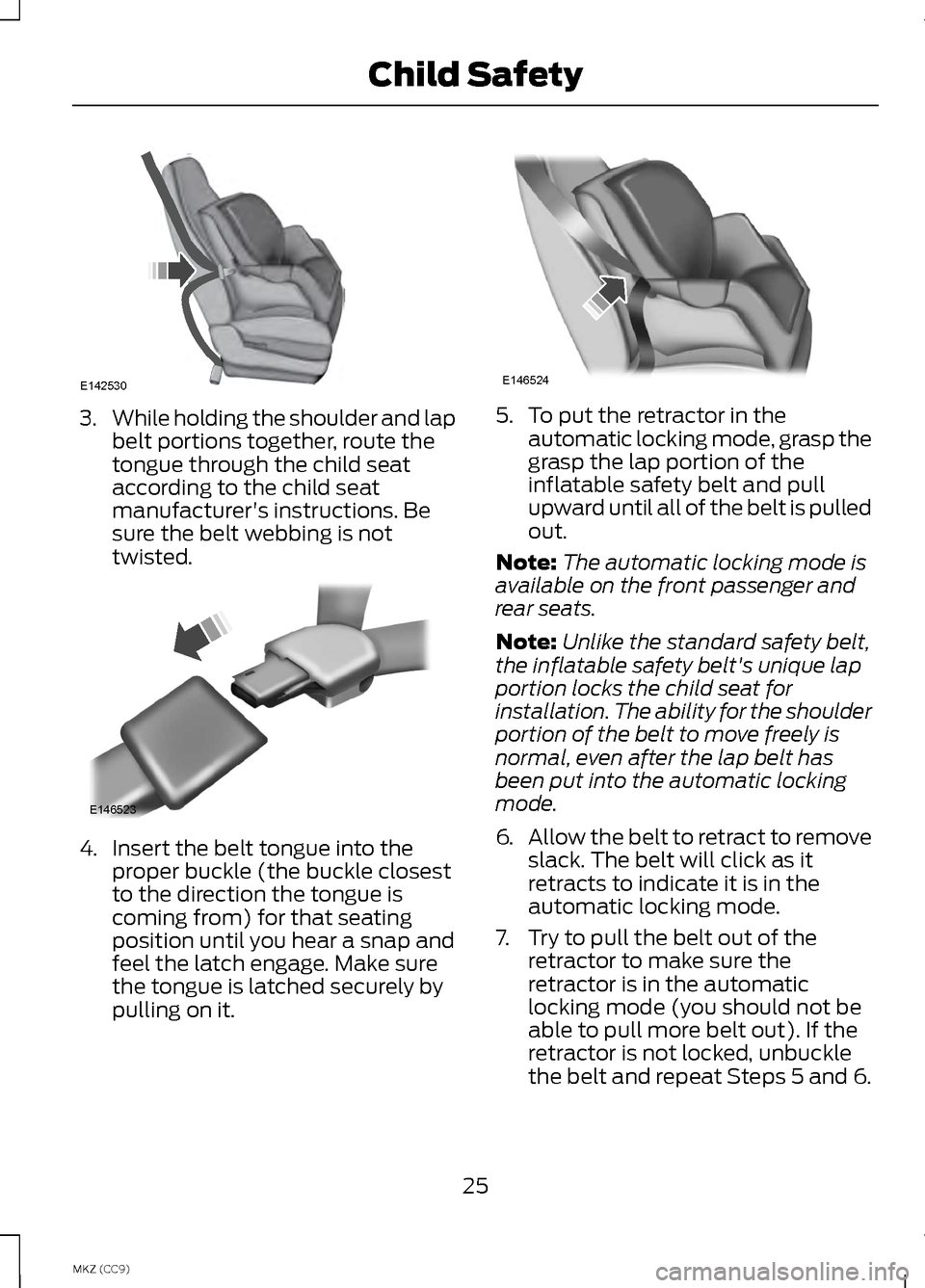
While holding the shoulder and lap
belt portions together, route the
tongue through the child seat
according to the child seat
manufacturer's instructions. Be
sure the belt webbing is not
twisted. 4. Insert the belt tongue into the
proper buckle (the buckle closest
to the direction the tongue is
coming from) for that seating
position until you hear a snap and
feel the latch engage. Make sure
the tongue is latched securely by
pulling on it. 5. To put the retractor in the
automatic locking mode, grasp the
grasp the lap portion of the
inflatable safety belt and pull
upward until all of the belt is pulled
out.
Note: The automatic locking mode is
available on the front passenger and
rear seats.
Note: Unlike the standard safety belt,
the inflatable safety belt's unique lap
portion locks the child seat for
installation. The ability for the shoulder
portion of the belt to move freely is
normal, even after the lap belt has
been put into the automatic locking
mode.
6. Allow the belt to retract to remove
slack. The belt will click as it
retracts to indicate it is in the
automatic locking mode.
7. Try to pull the belt out of the retractor to make sure the
retractor is in the automatic
locking mode (you should not be
able to pull more belt out). If the
retractor is not locked, unbuckle
the belt and repeat Steps 5 and 6.
25
MKZ (CC9) Child SafetyE142530 E146523 E146524
Page 34 of 475
The safety belt system consists of:
•
lap and shoulder safety belts.
• shoulder safety belt with
automatic locking mode, (except
driver safety belt).
• height adjuster at the front
outboard seating positions.
• safety belt pretensioner at the
front outboard seating positions.
• belt tension sensor at the front
outboard passenger seating
position. •
Safety belt warning light and
chime. •
Crash sensors and monitoring
system with readiness indicator.
The safety belt pretensioners at the
front seating positions are designed
to tighten the safety belts when
activated. In frontal and near-frontal
crashes, the safety belt pretensioners
may be activated alone or, if the crash
is of sufficient severity, together with
the front airbags. The pretensioners
may also activate when a side curtain
airbag is deployed.
FASTENING THE SAFETY
BELTS
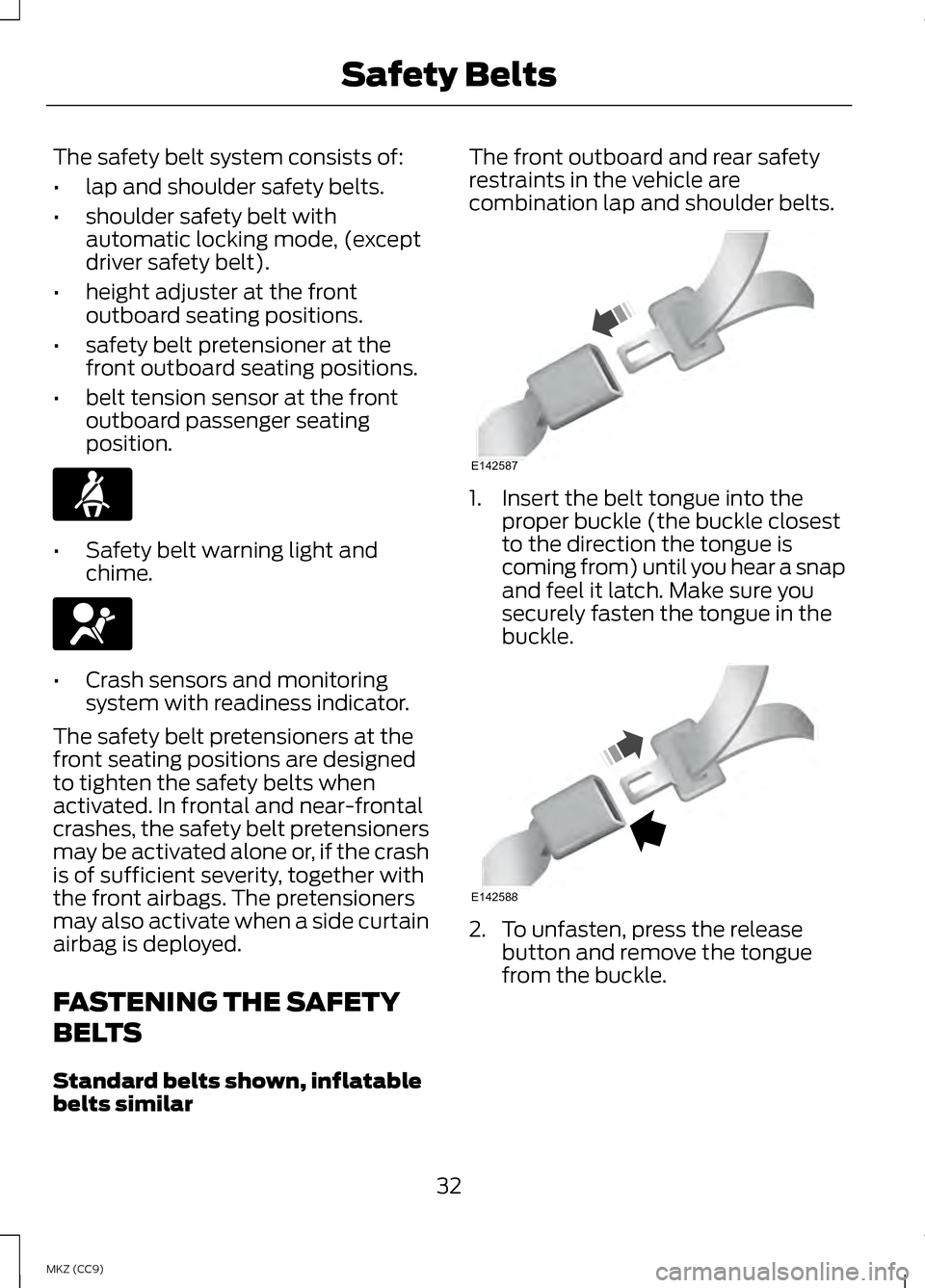
Standard belts shown, inflatable
belts similar The front outboard and rear safety
restraints in the vehicle are
combination lap and shoulder belts.
1. Insert the belt tongue into the
proper buckle (the buckle closest
to the direction the tongue is
coming from) until you hear a snap
and feel it latch. Make sure you
securely fasten the tongue in the
buckle. 2. To unfasten, press the release
button and remove the tongue
from the buckle.
32
MKZ (CC9) Safety Belts E142587 E142588
Page 35 of 475
Restraint of Pregnant Women
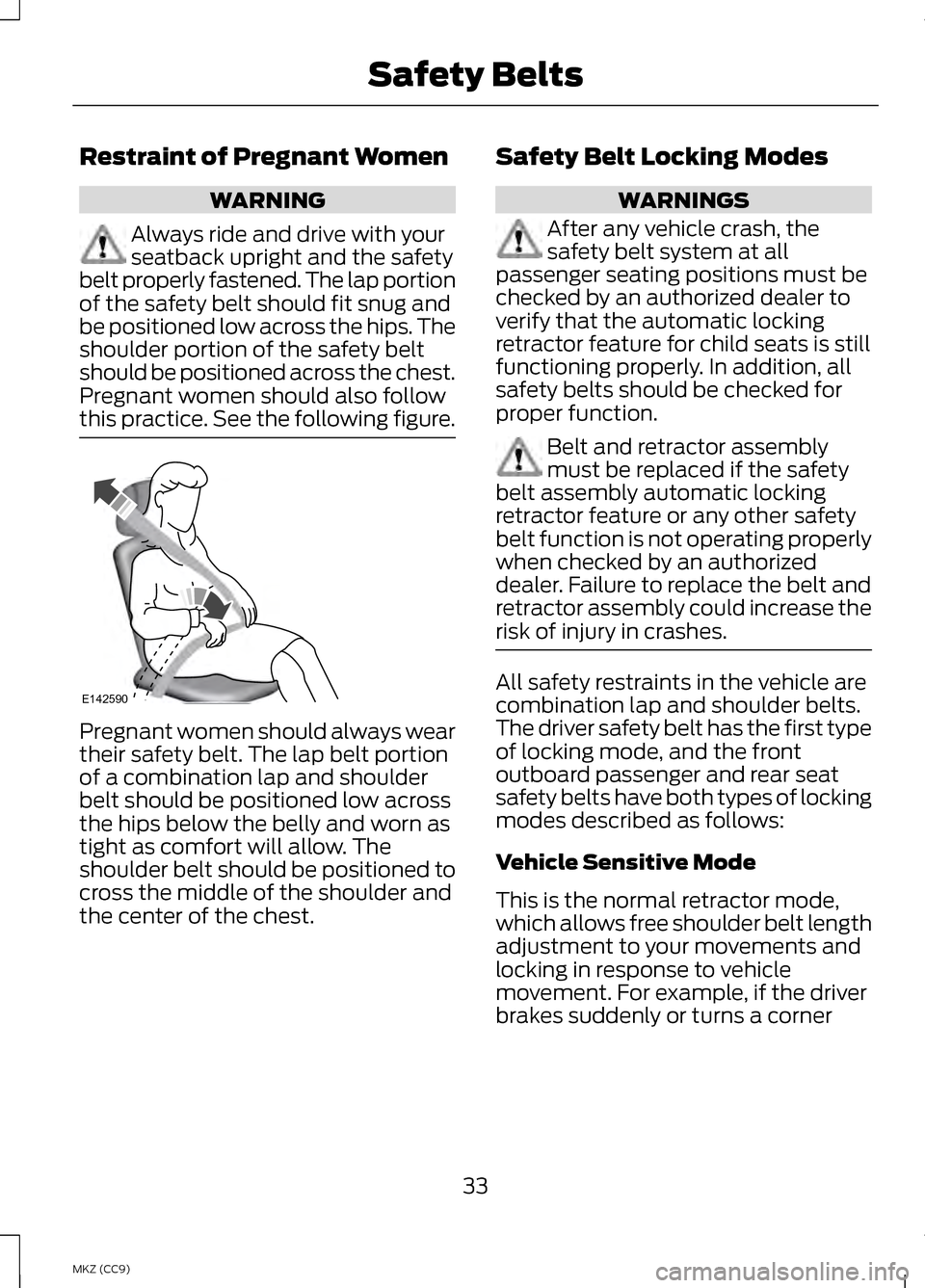
WARNING
Always ride and drive with your
seatback upright and the safety
belt properly fastened. The lap portion
of the safety belt should fit snug and
be positioned low across the hips. The
shoulder portion of the safety belt
should be positioned across the chest.
Pregnant women should also follow
this practice. See the following figure. Pregnant women should always wear
their safety belt. The lap belt portion
of a combination lap and shoulder
belt should be positioned low across
the hips below the belly and worn as
tight as comfort will allow. The
shoulder belt should be positioned to
cross the middle of the shoulder and
the center of the chest. Safety Belt Locking Modes WARNINGS
After any vehicle crash, the
safety belt system at all
passenger seating positions must be
checked by an authorized dealer to
verify that the automatic locking
retractor feature for child seats is still
functioning properly. In addition, all
safety belts should be checked for
proper function. Belt and retractor assembly
must be replaced if the safety
belt assembly automatic locking
retractor feature or any other safety
belt function is not operating properly
when checked by an authorized
dealer. Failure to replace the belt and
retractor assembly could increase the
risk of injury in crashes. All safety restraints in the vehicle are
combination lap and shoulder belts.
The driver safety belt has the first type
of locking mode, and the front
outboard passenger and rear seat
safety belts have both types of locking
modes described as follows:
Vehicle Sensitive Mode
This is the normal retractor mode,
which allows free shoulder belt length
adjustment to your movements and
locking in response to vehicle
movement. For example, if the driver
brakes suddenly or turns a corner
33
MKZ (CC9) Safety BeltsE142590
Page 36 of 475
sharply, or the vehicle receives an
impact of approximately 5 mph (8
km/h) or more, the combination
safety belts will lock to help reduce
forward movement of the driver and
passengers.
In addition, the retractor is designed
to lock if the webbing is pulled out too
quickly. If this occurs, let the belt
retract slightly and pull webbing out
again in a slow and controlled
manner.
Automatic Locking Mode
In this mode, the shoulder belt is
automatically pre-locked. The belt
will still retract to remove any slack in
the shoulder belt. The automatic
locking mode is not available on the
driver safety belt.
When to Use the Automatic
Locking Mode
This mode should be used any time a
child safety seat, except a booster, is
installed in passenger front or rear
seating positions. Children 12 years old
and under should be properly
restrained in a rear seating position
whenever possible. See Child Safety
(page 15).
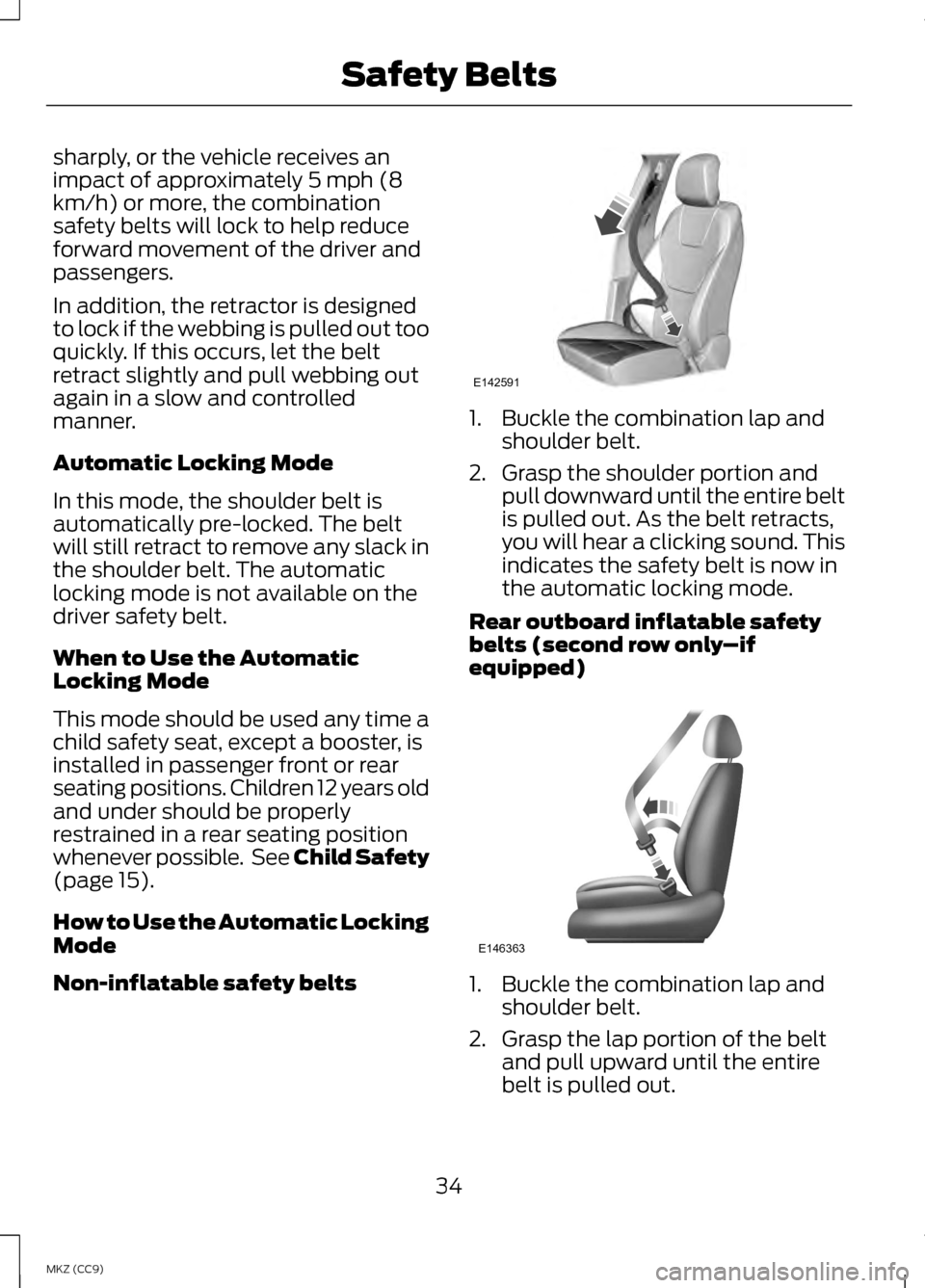
How to Use the Automatic Locking
Mode
Non-inflatable safety belts 1. Buckle the combination lap and
shoulder belt.
2. Grasp the shoulder portion and pull downward until the entire belt
is pulled out. As the belt retracts,
you will hear a clicking sound. This
indicates the safety belt is now in
the automatic locking mode.
Rear outboard inflatable safety
belts (second row only –if
equipped) 1. Buckle the combination lap and
shoulder belt.
2. Grasp the lap portion of the belt and pull upward until the entire
belt is pulled out.
34
MKZ (CC9) Safety BeltsE142591 E146363
Page 37 of 475
3. Allow the belt to retract. As the
belt retracts, you will hear a
clicking sound. This indicates the
safety belt is now in the automatic
locking mode.
How to Disengage the Automatic
Locking Mode
Unbuckle the combination lap and
shoulder belt and allow it to retract
completely to disengage the
automatic locking mode and activate
the vehicle sensitive (emergency)
locking mode.
Rear Inflatable Safety Belt (If
Equipped) WARNING
Do not attempt to service, repair,
or modify the rear inflatable
safety belt. The rear inflatable safety belts are
fitted in the shoulder portion of the
safety belts of the second-row
outboard seating positions.
Note:
The rear inflatable safety belts
are compatible with most infant and
child safety car seats and belt
positioning booster seats when
properly installed. This is because they
are designed to fill with a cooled gas
at a lower pressure and at a slower rate
than traditional airbags. After inflation,
the shoulder portion of the safety belt
remains cool to the touch. The rear inflatable safety belt consists
of the following:
•
An inflatable bag located in the
shoulder safety belt webbing.
• Lap safety belt webbing with
automatic locking mode.
• The same warning light, electronic
control and diagnostic unit as used
for the front safety belts.
• Impact sensors located in various
parts of the vehicle.
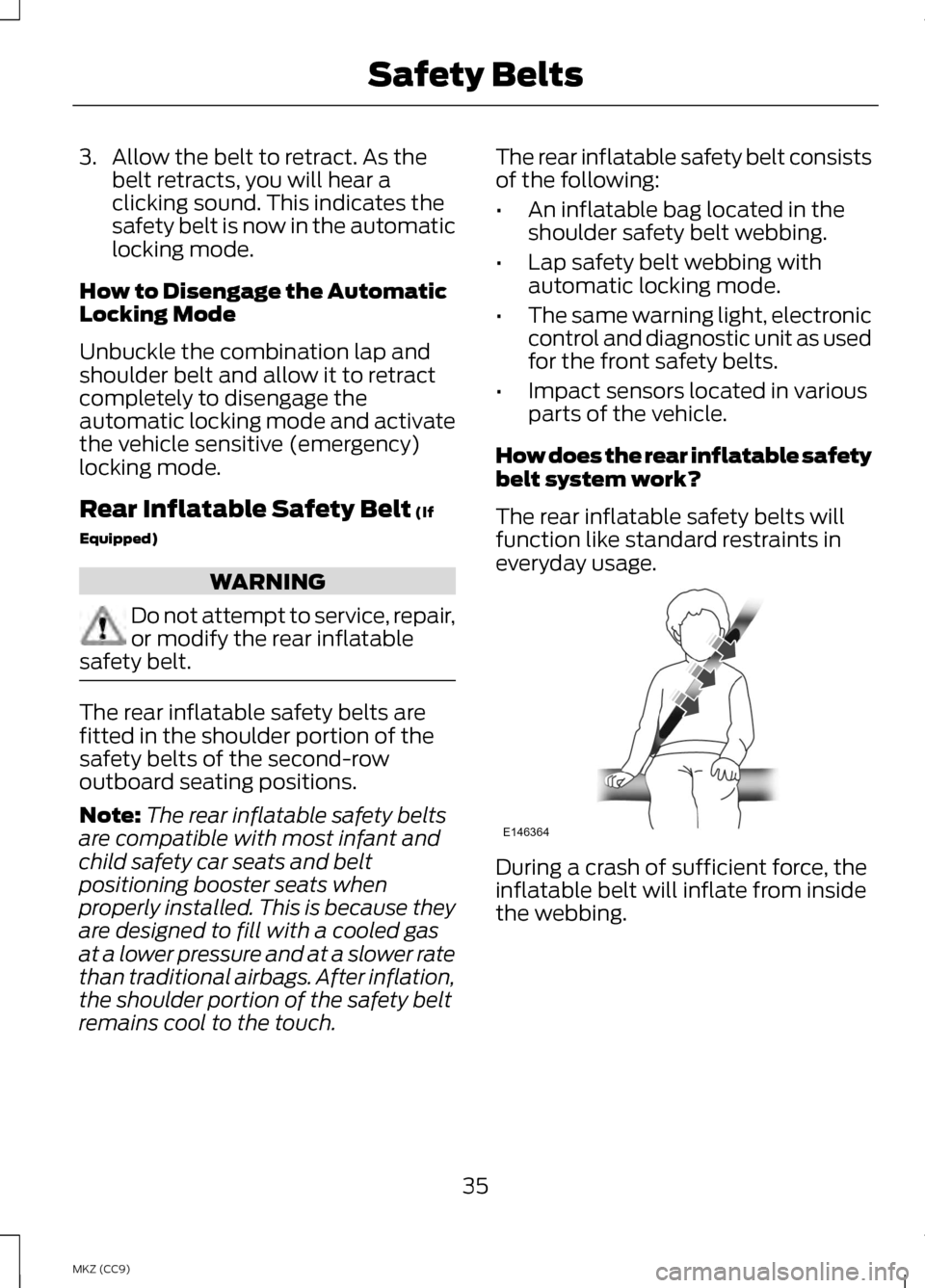
How does the rear inflatable safety
belt system work?
The rear inflatable safety belts will
function like standard restraints in
everyday usage. During a crash of sufficient force, the
inflatable belt will inflate from inside
the webbing.
35
MKZ (CC9) Safety BeltsE146364