fuel LINCOLN NAUTILUS 2021 Owners Manual
[x] Cancel search | Manufacturer: LINCOLN, Model Year: 2021, Model line: NAUTILUS, Model: LINCOLN NAUTILUS 2021Pages: 579, PDF Size: 6.9 MB
Page 8 of 579
Exterior Mirrors
Adjusting the Exterior Mirrors
...................133
Folding the Exterior Mirrors - Vehicles With: Manual Folding Mirrors ................
133
Folding the Exterior Mirrors - Vehicles With: Power Folding Mirrors ..................
133
Auto-Dimming Exterior Mirror ...................
134
Moonroof
Opening and Closing the Sun Shade ......
135
Opening and Closing the Moonroof .......
135
Venting the Moonroof .................................
136
Moonroof Bounce-Back .............................
136
Instrument Cluster
Instrument Cluster Overview .....................
137
What Is the Tachometer .............................
138
What Is the Speedometer ..........................
138
Fuel Gauge ....................................................
138
What Is the Engine Coolant Temperature Gauge .........................................................
139
What Is the Engine Oil Pressure Gauge .......................................................................
139 What Is the Transmission Fluid
Temperature Gauge ................................
139
What Is the 12V Battery Gauge .................
139
What Are the Instrument Cluster Warning Lamps ..........................................................
139
Instrument Cluster Warning Lamps .........
139
What Are the Instrument Cluster Indicators ........................................................................\
141
Instrument Cluster Indicators .....................
141
Instrument Cluster Display
Using the Instrument Cluster Display Controls ......................................................
143
Instrument Cluster Display Main Menu .......................................................................
144
Trip Computer ...............................................
145
Customizing the Instrument Cluster Display .......................................................................
147
Personalized Settings .................................
148
Remote Start
What Is Remote Start ....................................
151
Remote Start Precautions ...........................
151
Remote Start Limitations .............................
151Enabling Remote Start
.................................
151
Remotely Starting and Stopping the Vehicle .........................................................
151
Extending the Remote Start Duration .......................................................................
152
Remote Start Remote Control Indicators .......................................................................
152
Remote Start Settings .................................
152
Climate Control
Identifying the Climate Control Unit ........
154
Switching Climate Control On and Off .......................................................................
154
Switching Recirculated Air On and Off .......................................................................
154
Switching Air Conditioning On and Off .......................................................................
154
Switching Maximum Defrost On and Off .......................................................................
154
Switching Maximum Cooling On and Off .......................................................................
154
Switching the Heated Rear Window On and Off ........................................................
155
Switching the Heated Mirrors On and Off .......................................................................
155
4
2021 Nautilus (CD9) Canada/United States of America, enUSA, Edition date: 202011, First-Printing Table of Contents
Page 10 of 579
Power Outlet - Vehicles With:
110V Power Outlet
What Is the Power Outlet ...........................180
Power Outlet Precautions ..........................
180
Locating the Power Outlet .........................
180
Power Outlet Indicators ..............................
180
Power Outlet - Vehicles With: 12V Power Outlet
What Is the Power Outlet ............................
181
Power Outlet Precautions ...........................
181
Locating the Power Outlet ..........................
181
Wireless Accessory Charger
What Is the Wireless Accessory Charger .......................................................................
182
Wireless Accessory Charger Precautions .......................................................................
182
Locating the Wireless Accessory Charger .......................................................................
183
Charging a Wireless Device ......................
183
Storage
Cup Holders ..................................................
184Under Floor Storage
....................................
184
Glasses Holder .............................................
185
Starting and Stopping the Engine
Starting and Stopping the Engine – Precautions ...............................................
186
Push Button Ignition Switch ......................
186
Starting the Engine ......................................
187
Engine Block Heater ...................................
188
Stopping the Engine ....................................
189
Automatic Engine Stop ...............................
189
Accessing the Passive Key Backup Position .......................................................
190
Starting and Stopping the Engine – Troubleshooting ........................................
191
Auto-Start-Stop
What Is Auto-Start-Stop ..............................
194
Auto-Start-Stop Precautions ......................
194
Switching Auto-Start-Stop On and Off .......................................................................
194
Stopping the Engine ....................................
194
Restarting the Engine ..................................
194Auto-Start-Stop Indicators
..........................
194
Auto-Start-Stop – Troubleshooting .........
195
Fuel and Refueling
Fuel and Refueling Precautions ...............
197
Fuel Quality ....................................................
198
Locating the Fuel Filler Funnel .................
198
Running Out of Fuel ....................................
199
Refueling .......................................................
200
Fuel Tank Capacity .....................................
202
Fuel and Refueling – Troubleshooting ......................................................................
203
Catalytic Converter
What Is the Catalytic Converter ..............
204
Catalytic Converter Precautions .............
204
Catalytic Converter – Troubleshooting ......................................................................
204
Automatic Transmission
Automatic Transmission Precautions .....
206
Automatic Transmission Positions ..........
206
Shifting Your Vehicle Into Gear ................
207
6
2021 Nautilus (CD9) Canada/United States of America, enUSA, Edition date: 202011, First-Printing Table of Contents
Page 15 of 579
Recreationally Towing Your Vehicle - 2.0L,
FWD .............................................................314
Recreationally Towing Your Vehicle - 2.7L .......................................................................
314
Emergency Towing ......................................
315
Fuses
Fuse Precautions ..........................................
316
Under Hood Fuse Box ................................
316
Body Control Module Fuse Box ..............
326
Identifying Fuse Types ................................
331
Fuses – Troubleshooting ...........................
331
Maintenance
Maintenance Precautions .........................
332
Opening and Closing the Hood ..............
332
Under Hood Overview - 2.0L ...................
334
Under Hood Overview - 2.7L ...................
336
Engine Oil ......................................................
338
Checking the Coolant ................................
340
Changing the Engine Air Filter .................
344
Changing the Fuel Filter ............................
344
Drive Belt Routing Overview - 2.0L ........
345Drive Belt Routing Overview - 2.7L
.........
345
Changing the 12V Battery .........................
345
Adjusting the Headlamps ..........................
348
Exterior Bulbs ...............................................
350
Interior Bulbs ................................................
353
Vehicle Care
Cleaning Products .......................................
354
Cleaning the Exterior .................................
355
Waxing ............................................................
357
Cleaning the Interior ...................................
357
Repairing Minor Paint Damage ................
359
Body Styling Kits
Body Styling Kit Precautions ....................
360
Storing Your Vehicle
Preparing Your Vehicle for Storage .........
361
Removing Your Vehicle From Storage ......................................................................
362
Wheel and Tire Information
Locating the Tire label ...............................
363Department of Transportation Uniform Tire
Quality Grades .........................................
363
Information on the Tire Sidewall .............
364
Glossary of Tire Terminology ...................
369
Tire Replacement Requirements ............
369
Using Snow Chains .....................................
372
Tire Care
Checking the Tire Pressures ....................
374
Inflating the Tires .........................................
374
Inspecting the Tire for Wear .....................
375
Inspecting the Tire for Damage ...............
375
Inspecting the Wheel Valve Stems .........
376
Tire Rotation .................................................
376
Tire Sealant and Inflator Kit
What Is the Tire Sealant and Inflator Kit ......................................................................
378
Tire Sealant and Inflator Kit Precautions ......................................................................
378
Locating the Tire Sealant and Inflator Kit ......................................................................
378
Tire Sealant and Inflator Kit Components ......................................................................
379
11
2021 Nautilus (CD9) Canada/United States of America, enUSA, Edition date: 202011, First-Printing Table of Contents
Page 16 of 579
Using the Tire Sealant and Inflator Kit
......................................................................379
Tire Pressure Monitoring System
What Is the Tire Pressure Monitoring System .......................................................
385
Tire Pressure Monitoring System Overview ......................................................................
385
Tire Pressure Monitoring System Precautions ..............................................
386
Tire Pressure Monitoring System Limitations .................................................
387
Viewing the Tire Pressures .......................
387
Resetting Tire Pressure Monitoring System ......................................................................
387
Tire Pressure Monitoring System – Troubleshooting ......................................
388
Changing a Road Wheel
Changing a Flat Tire ....................................
391
Wheel Nuts ...................................................
396
Capacities and Specifications
Engine Specifications - 2.0L .....................
398Engine Specifications - 2.7L
.....................
399
Motorcraft Parts - 2.0L ...............................
400
Motorcraft Parts - 2.7L .................................
401
Engine Oil Capacity and Specification - 2.0L .............................................................
402
Engine Oil Capacity and Specification - 2.7L .............................................................
404
Cooling System Capacity and Specification - 2.0L ..........................................................
407
Cooling System Capacity and Specification - 2.7L ...........................................................
408
Fuel Tank Capacity .....................................
409
Air Conditioning System Capacity and Specification - 2.0L ..................................
410
Air Conditioning System Capacity and Specification - 2.7L ..................................
412
Washer Fluid Specification ........................
413
Brake Fluid Specification ...........................
414
Vehicle Identification
Vehicle Identification Number ..................
416
Connected Vehicle
What Is a Connected Vehicle ....................
417Connected Vehicle Requirements
...........
417
Connected Vehicle Limitations .................
417
Connecting the Vehicle to a Mobile Network ......................................................
417
Connecting the Vehicle to a Wi-Fi Network .......................................................................
417
Connected Vehicle – Troubleshooting .......................................................................
418
Vehicle Wi-Fi Hotspot
Creating a Vehicle Wi-Fi Hotspot .............
421
Changing the Vehicle Wi-Fi Hotspot Name or Password ...............................................
421
Audio System
Audio System Precautions ........................
423
Switching the Audio Unit On and Off ......
423
Selecting the Audio Source .....................
423
Playing or Pausing the Audio Source .....
423
Adjusting the Volume .................................
423
Switching Shuffle Mode On and Off ......
424
Switching Repeat Mode On and Off ......
424
Setting a Memory Preset ...........................
424
Muting the Audio .........................................
424
12
2021 Nautilus (CD9) Canada/United States of America, enUSA, Edition date: 202011, First-Printing Table of Contents
Page 23 of 579
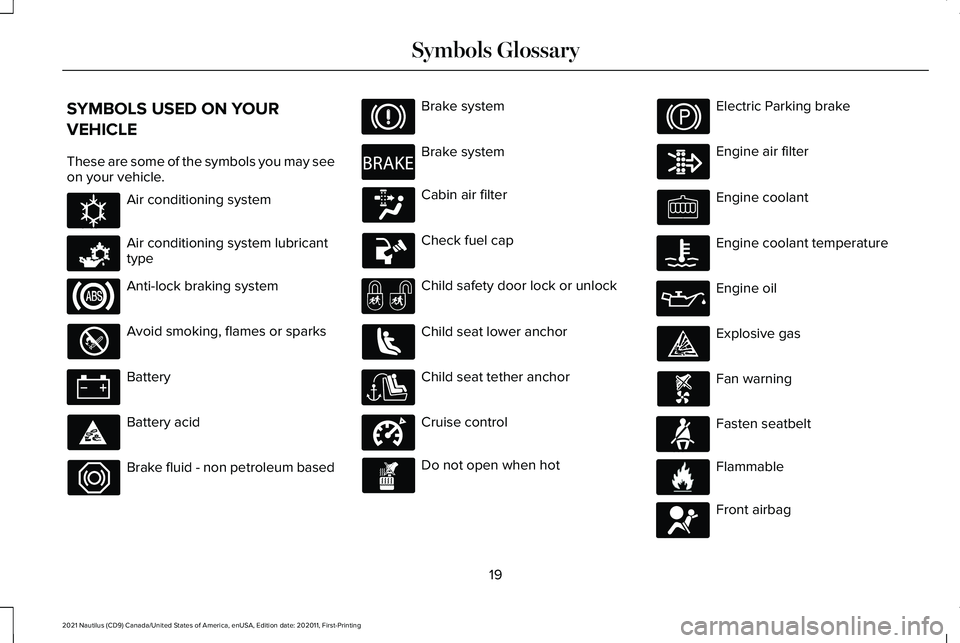
SYMBOLS USED ON YOUR
VEHICLE
These are some of the symbols you may see
on your vehicle.
Air conditioning system
Air conditioning system lubricant
type
Anti-lock braking system
Avoid smoking, flames or sparks
Battery
Battery acid
Brake fluid - non petroleum based Brake system
Brake system
Cabin air filter
Check fuel cap
Child safety door lock or unlock
Child seat lower anchor
Child seat tether anchor
Cruise control
Do not open when hot Electric Parking brake
Engine air filter
Engine coolant
Engine coolant temperature
Engine oil
Explosive gas
Fan warning
Fasten seatbelt
Flammable
Front airbag
19
2021 Nautilus (CD9) Canada/United States of America, enUSA, Edition date: 202011, First-Printing Symbols GlossaryE162384 E231157 E270480 E332905 E71880 E231160 E67017
Page 24 of 579
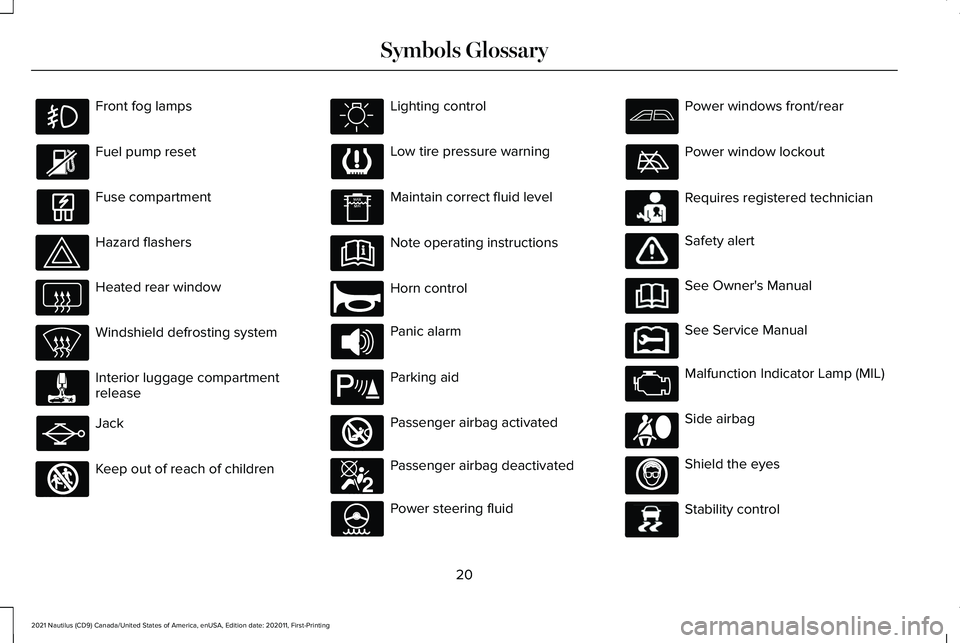
Front fog lamps
Fuel pump reset
Fuse compartment
Hazard flashers
Heated rear window
Windshield defrosting system
Interior luggage compartment
release
Jack
Keep out of reach of children Lighting control
Low tire pressure warning
Maintain correct fluid level
Note operating instructions
Horn control
Panic alarm
Parking aid
Passenger airbag activated
Passenger airbag deactivated
Power steering fluid Power windows front/rear
Power window lockout
Requires registered technician
Safety alert
See Owner's Manual
See Service Manual
Malfunction Indicator Lamp (MIL)
Side airbag
Shield the eyes
Stability control
20
2021 Nautilus (CD9) Canada/United States of America, enUSA, Edition date: 202011, First-Printing Symbols Glossary E161353 E270945 E139213 E270849 E270850 E231159 E231158 E167012 E138639
Page 26 of 579
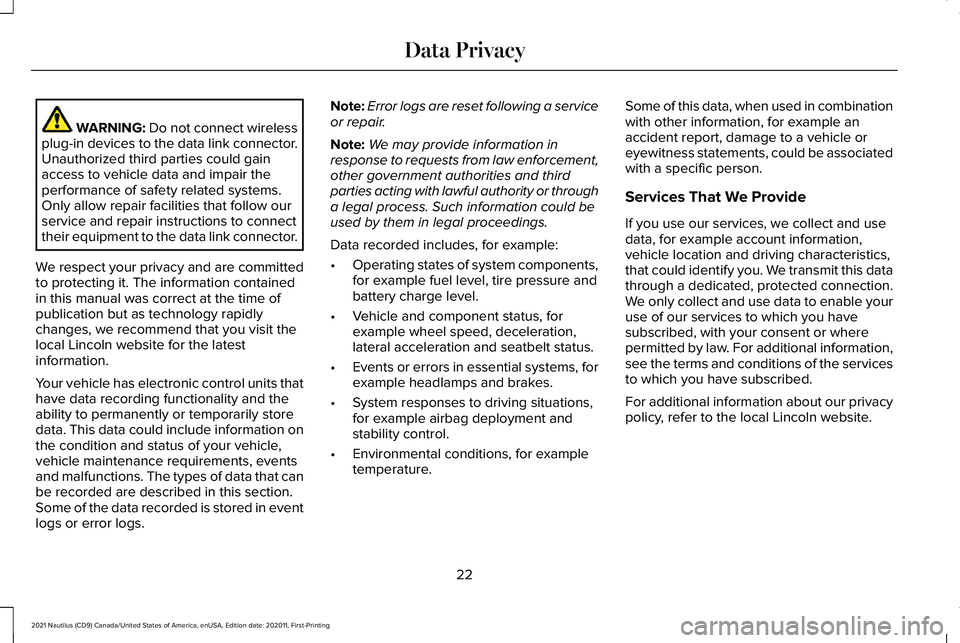
WARNING: Do not connect wireless
plug-in devices to the data link connector.
Unauthorized third parties could gain
access to vehicle data and impair the
performance of safety related systems.
Only allow repair facilities that follow our
service and repair instructions to connect
their equipment to the data link connector.
We respect your privacy and are committed
to protecting it. The information contained
in this manual was correct at the time of
publication but as technology rapidly
changes, we recommend that you visit the
local Lincoln website for the latest
information.
Your vehicle has electronic control units that
have data recording functionality and the
ability to permanently or temporarily store
data. This data could include information on
the condition and status of your vehicle,
vehicle maintenance requirements, events
and malfunctions. The types of data that can
be recorded are described in this section.
Some of the data recorded is stored in event
logs or error logs. Note:
Error logs are reset following a service
or repair.
Note: We may provide information in
response to requests from law enforcement,
other government authorities and third
parties acting with lawful authority or through
a legal process. Such information could be
used by them in legal proceedings.
Data recorded includes, for example:
• Operating states of system components,
for example fuel level, tire pressure and
battery charge level.
• Vehicle and component status, for
example wheel speed, deceleration,
lateral acceleration and seatbelt status.
• Events or errors in essential systems, for
example headlamps and brakes.
• System responses to driving situations,
for example airbag deployment and
stability control.
• Environmental conditions, for example
temperature. Some of this data, when used in combination
with other information, for example an
accident report, damage to a vehicle or
eyewitness statements, could be associated
with a specific person.
Services That We Provide
If you use our services, we collect and use
data, for example account information,
vehicle location and driving characteristics,
that could identify you. We transmit this data
through a dedicated, protected connection.
We only collect and use data to enable your
use of our services to which you have
subscribed, with your consent or where
permitted by law. For additional information,
see the terms and conditions of the services
to which you have subscribed.
For additional information about our privacy
policy, refer to the local Lincoln website.
22
2021 Nautilus (CD9) Canada/United States of America, enUSA, Edition date: 202011, First-Printing Data Privacy
Page 30 of 579
System data cannot be accessed without
special equipment and access to your
vehicle's module.
For additional information about our privacy
policy, refer to the local Lincoln website.
Note:
To find out if your vehicle has
connectivity technology, visit
www.ConnectedLincoln.com.
EMERGENCY CALL SYSTEM DATA
When the emergency call system is active,
it may disclose to emergency services that
your vehicle has been in a crash involving
the deployment of an airbag or activation of
the fuel pump shut-off. Certain versions or
updates to the emergency call system may
also be capable of electronically or verbally
disclosing to emergency services operators
your vehicle location or other details about
your vehicle or crash to assist emergency
services operators to provide the most
appropriate emergency services. If you do
not want to disclose this information, do not
activate the emergency call system. Note:
You cannot deactivate emergency call
systems that are required by law.
26
2021 Nautilus (CD9) Canada/United States of America, enUSA, Edition date: 202011, First-Printing Data Privacy
Page 77 of 579
HOW DOES 911 ASSIST WORK
If a crash deploys an airbag, excluding knee
airbags and rear inflatable seatbelts, or
activates the fuel pump shut-off, your vehicle
may be able to contact emergency services
by dialing 911 through a paired and
connected Bluetooth-enabled phone.
Not all crashes will deploy an airbag or
activate the fuel pump shut-off. If a
connected cell phone sustains damage or
loses its connection to SYNC during a crash,
SYNC will search for and try to connect to a
previously paired cell phone. SYNC will then
attempt to call the emergency services.
Before making the call:
•
SYNC provides about 10 seconds to
cancel the call. If you fail to cancel the
call, SYNC attempts to dial 911.
• SYNC says the following, or a similar
message: "SYNC will attempt to call 911,
to cancel the call, press Cancel on your
screen or press and hold the phone
button on your steering wheel." If you do not cancel the call and SYNC makes
a successful call a pre-recorded message
plays for the 911 operator. The occupants in
your vehicle are able to talk with the
operator. Be prepared to provide your name,
phone number and location immediately
because not all 911 systems are capable of
receiving this information electronically.
During an emergency call the system
transmits vehicle data to the emergency
service.
EMERGENCY CALL
REQUIREMENTS
WARNING: Do not wait for 911 Assist
to make an emergency call if you can do
it yourself. Dial emergency services
immediately to avoid delayed response
time which could increase the risk of
serious injury or death after a crash. If you
do not hear 911 Assist within five seconds
of the crash, the system or phone may be
damaged or non-functional. WARNING: Always place your phone
in a secure location in your vehicle so it
does not become a projectile or get
damaged in a crash. Failure to do so may
cause serious injury to someone or
damage the phone which could prevent
911 Assist from working properly. WARNING: Unless the 911 Assist
setting is set on before a crash, the system
will not dial for help which could delay
response time, potentially increasing the
risk of serious injury or death after a crash.
• SYNC must be powered and working
properly at the time of the incident and
throughout feature activation and use.
• The 911 Assist feature must be set on
before the incident.
• You must pair and connect a Bluetooth
enabled and compatible cell phone to
SYNC.
• A connected Bluetooth enabled phone
must have the ability to make and
maintain an outgoing call at the time of
the incident.
73
2021 Nautilus (CD9) Canada/United States of America, enUSA, Edition date: 202011, First-Printing 911 Assist
Page 88 of 579
PRINCIPLE OF OPERATION
MyKey allows you to program keys with
restricted driving modes to promote good
driving habits. All but one of the keys can be
activated with these restricted modes.
Any keys that remain unprogrammed are
referred to as administrator keys or admin
keys. They can be used to:
•
Create a MyKey.
• Program configurable MyKey settings.
• Clear all MyKey features.
When you have created a MyKey, you can
access the following information by using
the information display to determine:
• How many admin keys and MyKeys are
programmed to your vehicle.
• The total distance your vehicle traveled
with a MyKey.
Note: Switch the vehicle on to use the
system.
Note: All MyKeys are programmed to the
same settings. You cannot program them
individually. Note:
For vehicles with push-button start,
when both a MyKey and an admin key are
present, the vehicle will recognize the admin
key when you switch the vehicle on.
Non-Configurable Settings
The following settings cannot be changed
by an admin key user:
• Seatbelt reminder. You cannot disable
this feature. The audio system will mute
when the driver and front-seat passenger
seatbelts are not fastened.
• Early low fuel or charge. The low-fuel or
low charge warning activates earlier,
giving the MyKey user more time to refuel
or recharge.
• Restricted touchscreen operation in some
markets. For example, MyKey may
prevent manual navigation destination
input when the vehicle is in any gear
other than park (P), or when the vehicle
reaches a certain rate of speed.
• Satellite radio adult content restrictions,
if available on your vehicle. Note:
If a phone is connected using Apple
CarPlay or Android Auto when driving with
a MyKey, the driver can receive phone calls
and text messages even if the do not disturb
restriction is on. If the vehicle comes with
satellite radio, the adult content is not
restricted.
Note: The audio system may not mute with
a basic AM/FM radio.
Note: You may be able to turn the lane
departure warning feature off, but the
feature will automatically re-activate with
every new key cycle.
Configurable Settings
With an admin key, you can configure certain
MyKey settings when you first create a
MyKey and before you restart the vehicle.
You can also change the settings afterward
with an admin key.
Note: Available vehicle features will appear
in your information display, providing you
with choices to switch them on or off, or to
select a more specific setting.
84
2021 Nautilus (CD9) Canada/United States of America, enUSA, Edition date: 202011, First-Printing MyKey™