heating LINCOLN NAUTILUS 2022 User Guide
[x] Cancel search | Manufacturer: LINCOLN, Model Year: 2022, Model line: NAUTILUS, Model: LINCOLN NAUTILUS 2022Pages: 586, PDF Size: 13.97 MB
Page 352 of 586
It is very important to use prediluted coolantapproved to the correct specification in orderto avoid plugging the small passageways inthe engine cooling system. See Capacitiesand Specifications (page 404). Do not mixdifferent colors or types of coolant in yourvehicle. Mixing of engine coolants or usingan incorrect coolant may harm the engine orcooling system components and could voidthe vehicle Warranty.
Note:If prediluted coolant is not available,use the approved concentrated coolantdiluting it to 50/50 with deionized or distilledwater. See Capacities and Specifications(page 404). Using water that has not beendeionized may contribute to depositformation, corrosion and plugging of thesmall cooling system passageways.
To top up the coolant level do the following:
1.Unscrew the cap slowly. Any pressureescapes as you unscrew the cap.
2.Add enough prediluted coolant to reachthe correct level.
Note:We do not recommend the use ofrecycled coolant.
3.Replace the coolant reservoir cap. Turnthe cap clockwise until it contacts thehard stop.
4.Check the coolant level in the coolantreservoir the next few times you driveyour vehicle. If necessary, repeat step 2.
If you have to add more than 1.1 qt (1 L) ofengine coolant per month, have your vehiclechecked as soon as possible. Operating anengine with a low level of coolant can resultin engine overheating and possible enginedamage.
In case of emergency, you can add a largeamount of water without engine coolant inorder to reach a vehicle service location.Service your vehicle as soon as possible.
Water alone, without engine coolant, cancause engine damage from corrosion,overheating or freezing.
Do not use the following as a coolantsubstitute, as they can cause engine damagefrom overheating or freezing:
•Alcohol.
•Methanol.
•Brine.
•Any coolant mixed with alcohol ormethanol antifreeze.
Do not add extra inhibitors or additives tothe coolant. These can be harmful andcompromise the corrosion protection of thecoolant.
Severe Climates
If you drive in extremely cold climates, youmay need to increase the coolantconcentration above 50%.
Note:A coolant concentration of 60%provides improved freeze point protection.Coolant concentrations above 60% decreasethe overheat protection characteristics ofthe coolant and could cause enginedamage.
If you drive in extremely hot climates, youmay need to decrease the coolantconcentration to 40%.
348
2022 Nautilus (CD9) Canada/United States of America, enUSA, Edition date: 202108, First-PrintingMaintenance
Page 354 of 586
WARNING: Do not remove thecoolant reservoir cap when the engine ison or the cooling system is hot. Wait 10minutes for the cooling system to cooldown. Cover the coolant reservoir cap witha thick cloth to prevent the possibility ofscalding and slowly remove the cap.Failure to follow this instruction could resultin personal injury.
Your vehicle has limited engine power whenin the fail-safe mode, drive your vehicle withcaution. Your vehicle does not maintainhigh-speed operation and the engine couldoperate poorly.
Remember that the engine is capable ofautomatically shutting down to preventengine damage. In this situation:
1.Pull off the road as soon as safelypossible and switch the engine off.
2.If you are a member of a roadsideassistance program, we recommend thatyou contact your roadside assistanceservice provider.
3.If this is not possible, wait for a shortperiod of time for the engine to cool.
4.Check the coolant level. If the coolantlevel is at or below the minimum mark,add prediluted coolant immediately.
5.When the engine temperature cools, youcan re-start the engine. Have your vehiclechecked as soon as possible to minimizeengine damage.
Note:Driving your vehicle without repairincreases the chance of engine damage.
Engine Coolant TemperatureManagement (If Equipped)
WARNING: To reduce the risk ofcrash and injury, be prepared that thevehicle speed may reduce and the vehiclemay not be able to accelerate with fullpower until the coolant temperaturereduces.
If you tow a trailer with your vehicle, theengine may temporarily reach a highertemperature during severe operatingconditions, for example ascending a long orsteep grade in high ambient temperatures.
At this time, you may notice the coolanttemperature gauge moves toward the redzone and a message may appear in theinformation display.
You may notice a reduction in vehicle speedcaused by reduced engine power in orderto manage the engine coolant temperature. Your vehicle may enter this mode if certainhigh-temperature and high-load conditionstake place. The amount of speed reductiondepends on vehicle loading, grade andambient temperature. If this occurs, there isno need to stop your vehicle. You cancontinue to drive.
The air conditioning may automatically turnon and off during severe operatingconditions to protect the engine fromoverheating. When the coolant temperaturedecreases to the normal operatingtemperature, the air conditioning turns on.
350
2022 Nautilus (CD9) Canada/United States of America, enUSA, Edition date: 202108, First-PrintingMaintenance
Page 390 of 586
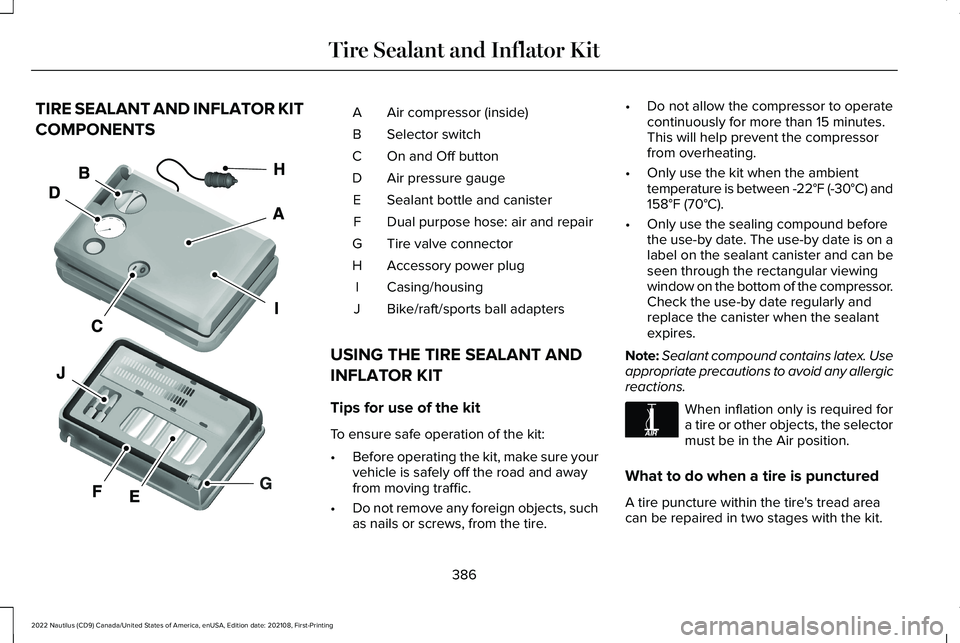
TIRE SEALANT AND INFLATOR KIT
COMPONENTS
Air compressor (inside)A
Selector switchB
On and Off buttonC
Air pressure gaugeD
Sealant bottle and canisterE
Dual purpose hose: air and repairF
Tire valve connectorG
Accessory power plugH
Casing/housingI
Bike/raft/sports ball adaptersJ
USING THE TIRE SEALANT AND
INFLATOR KIT
Tips for use of the kit
To ensure safe operation of the kit:
•Before operating the kit, make sure yourvehicle is safely off the road and awayfrom moving traffic.
•Do not remove any foreign objects, suchas nails or screws, from the tire.
•Do not allow the compressor to operatecontinuously for more than 15 minutes.This will help prevent the compressorfrom overheating.
•Only use the kit when the ambienttemperature is between -22°F (-30°C) and158°F (70°C).
•Only use the sealing compound beforethe use-by date. The use-by date is on alabel on the sealant canister and can beseen through the rectangular viewingwindow on the bottom of the compressor.Check the use-by date regularly andreplace the canister when the sealantexpires.
Note:Sealant compound contains latex. Useappropriate precautions to avoid any allergicreactions.
When inflation only is required fora tire or other objects, the selectormust be in the Air position.
What to do when a tire is punctured
A tire puncture within the tire's tread areacan be repaired in two stages with the kit.
386
2022 Nautilus (CD9) Canada/United States of America, enUSA, Edition date: 202108, First-PrintingTire Sealant and Inflator KitE175977 E175978
Page 468 of 586
If your information display resets prematurelyor becomes inoperative, you should performthe oil change interval at six months or5,000 mi (8,000 km) from your last oilchange. Never exceed one year or 10,000 mi(16,000 km) between oil change intervals.
You can drive high performance vehicles insuch a way that may lead to higher oilconsumption including extended time at highengine speeds, high loads, engine braking,hard cornering maneuvers, track and off-roadusage. Under these conditions, oilconsumption of approximately 1 quart per500 miles (1 liter per 800 km) is possible.Check the engine oil level at every refuelingand adjust to maintain proper levels to avoidengine damage.
It is important to rely upon your dealershipto properly diagnose and repair your vehicle.
We strongly recommend only using ourgenuine or our authorized re-manufacturedreplacement parts engineered for yourvehicle.
Additives and Chemicals
We do not recommend using chemicals oradditives not approved by us as part of yourvehicle’s normal maintenance. Please consultyour warranty information.
Oils, Fluids and Flushing
In many cases, fluid discoloration is a normaloperating characteristic and, by itself, doesnot necessarily indicate a concern or that thefluid needs to be changed. Have discoloredfluids that also show signs of overheating orforeign material contamination checkedimmediately.
Make sure to change the vehicle’s oils andfluids at the specified intervals or inconjunction with a repair. Flushing is a viableway to change fluid for many vehiclesub-systems during scheduled maintenance.It is critical that systems are flushed only withnew fluid that is the same as that requiredto fill and operate the system or using ourapproved flushing chemical.
Owner Checks and Services
Make sure you perform the following basicmaintenance checks and inspections.
Check Every Month
The air filter restriction gauge.1
The engine oil level.
Function of all interior and the exterior lights.
464
2022 Nautilus (CD9) Canada/United States of America, enUSA, Edition date: 202108, First-PrintingScheduled Maintenance
Page 573 of 586
Headlamps.......................................................121Headlamp Indicators...........................................121Switching Headlamp Exit Delay On andOff........................................................................121Using the High Beam Headlamps...................121
Headlamps – Troubleshooting..................122Headlamps – Frequently AskedQuestions..........................................................122
Heated Seats..................................................166Heated Seat Precautions..................................166Switching the Heated Seats On and Off.......166
HeatingSee: Climate Control..........................................156
Hill Start Assist..............................................227Hill Start Assist – Troubleshooting.................227
Hill Start Assist Precautions.......................227Hill Start Assist – Troubleshooting...........227Hill Start Assist – InformationMessages.........................................................227
Hood LockSee: Opening and Closing the Hood............339
Horn...................................................................115How Does 911 Assist Work...........................74How Does Active Park Assist Work.........249How Does Adaptive Cruise Control WithStop and Go Work.....................................256How Does All-Wheel Drive Work..............218How Does Auto Hold Work.......................228
How Does Blind Spot Information SystemWork..............................................................277How Does Cross Traffic Alert Work.........280How Does Drive Mode ControlWork..............................................................268How Does Driver Alert Work......................291How Does Easy Entry and Exit Work........101How Does Hill Start Assist Work..............227How Does Pre-Collision Assist Work......283How Does Stability Control Work.............231How Does the 360 Degree CameraWork..............................................................245How Does the Garage Door OpenerWork...............................................................176How Does the Lane Keeping SystemWork..............................................................269How Does the Memory FunctionWork...............................................................174How Does the Personal Safety SystemWork................................................................63How Does the Rear Occupant Alert SystemWork...............................................................172How Does the Safety Canopy™ Work........66How Does Traction Control Work............230How Does Trailer Sway ControlWork..............................................................309How Do Personal Profiles Work...............452How Do the Front Airbags Work................64
How Do the Knee Airbags Work................65How Do the Side Airbags Work..................64
I
Identifying Fuse Types................................338Identifying the Audio Unit..........................429Identifying the Climate Control Unit.........156Inflating the Tires..........................................382Information On Demand Screen..............438Information on the Tire Sidewall..............372Inspecting the Tire for Damage................383Inspecting the Tire for Wear......................382Inspecting the Wheel Valve Stems..........384Installing and Removing the LuggageCompartment Cargo Net.........................300Installing and Removing the LuggageCompartment Cover.................................300Installing Child Restraints..............................44Combining the Seatbelt and Lower Anchorsfor Attaching Child Restraints........................47Installing a Child Restraint in a CenterSeat......................................................................47Using Lower Anchors and Tethers forChildren..............................................................46Using Seatbelts.....................................................44Using Tether Straps..............................................48
569
2022 Nautilus (CD9) Canada/United States of America, enUSA, Edition date: 202108, First-PrintingIndex