tires LINCOLN NAVIGATOR 2004 Owner's Guide
[x] Cancel search | Manufacturer: LINCOLN, Model Year: 2004, Model line: NAVIGATOR, Model: LINCOLN NAVIGATOR 2004Pages: 368, PDF Size: 8.21 MB
Page 344 of 368
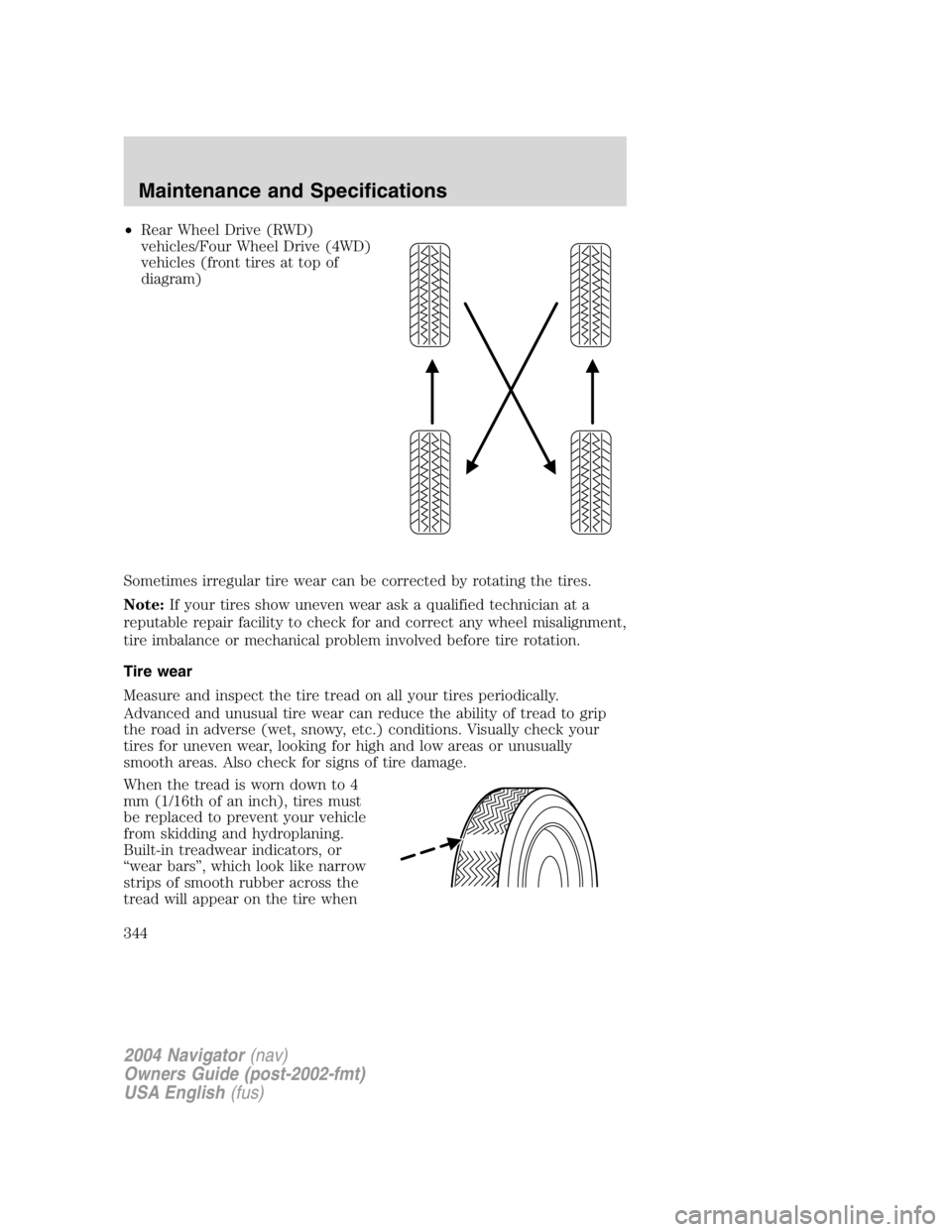
• Rear Wheel Drive (RWD)
vehicles/Four Wheel Drive (4WD)
vehicles (front tires at top of
diagram)
Sometimes irregular tire wear can be corrected by rotating the tires.
Note: If your tires show uneven wear ask a qualified technician at a
reputable repair facility to check for and correct any wheel misalignment,
tire imbalance or mechanical problem involved before tire rotation.
Tire wear
Measure and inspect the tire tread on all your tires periodically.
Advanced and unusual tire wear can reduce the ability of tread to grip
the road in adverse (wet, snowy, etc.) conditions. Visually check your
tires for uneven wear, looking for high and low areas or unusually
smooth areas. Also check for signs of tire damage.
When the tread is worn down to 4
mm (1/16th of an inch), tires must
be replaced to prevent your vehicle
from skidding and hydroplaning.
Built-in treadwear indicators, or
“ wear bars ” , which look like narrow
strips of smooth rubber across the
tread will appear on the tire when
2004 Navigator (nav)
Owners Guide (post-2002-fmt)
USA English (fus)Maintenance and Specifications
344
Page 345 of 368
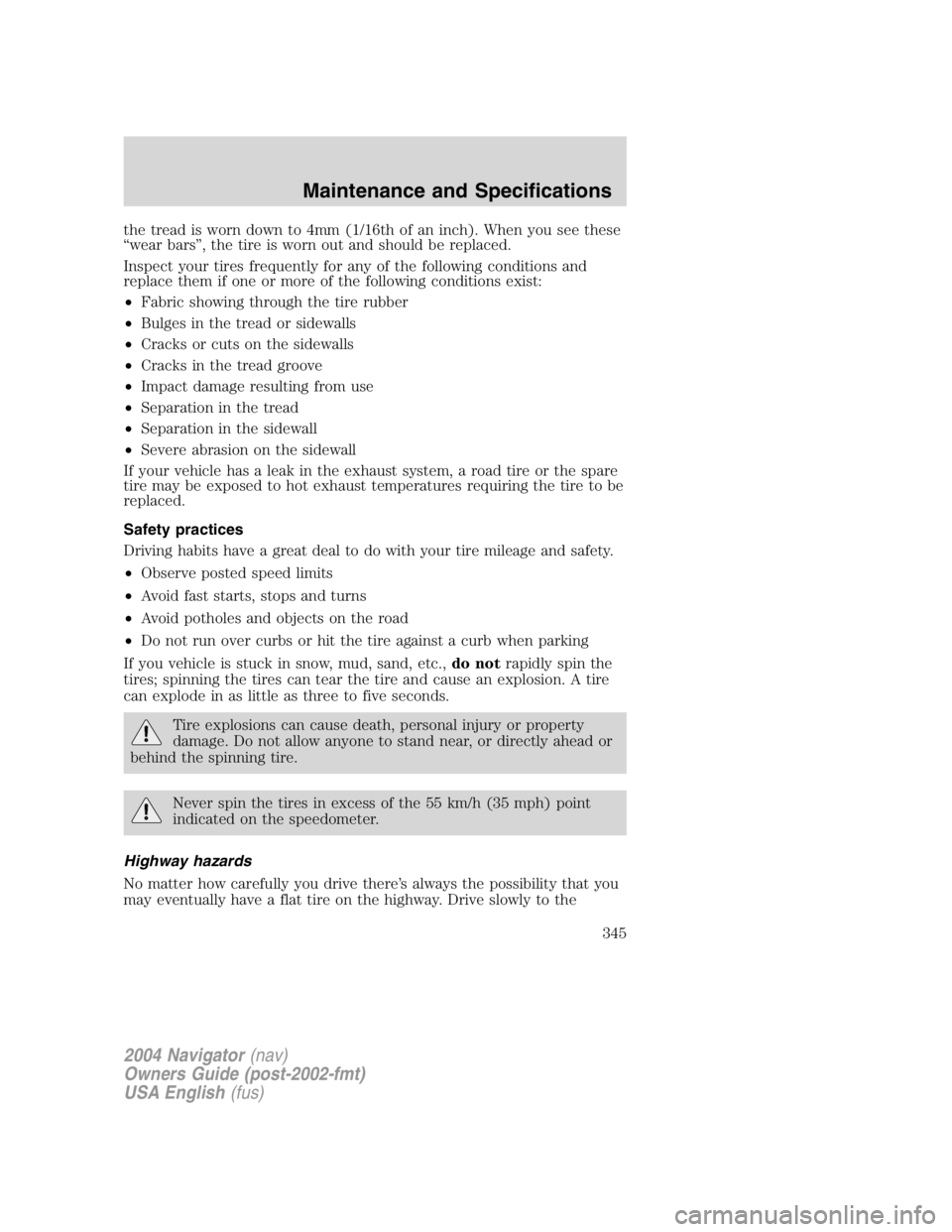
the tread is worn down to 4mm (1/16th of an inch). When you see these
“ wear bars ” , the tire is worn out and should be replaced.
Inspect your tires frequently for any of the following conditions and
replace them if one or more of the following conditions exist:
• Fabric showing through the tire rubber
• Bulges in the tread or sidewalls
• Cracks or cuts on the sidewalls
• Cracks in the tread groove
• Impact damage resulting from use
• Separation in the tread
• Separation in the sidewall
• Severe abrasion on the sidewall
If your vehicle has a leak in the exhaust system, a road tire or the spare
tire may be exposed to hot exhaust temperatures requiring the tire to be
replaced.
Safety practices
Driving habits have a great deal to do with your tire mileage and safety.
• Observe posted speed limits
• Avoid fast starts, stops and turns
• Avoid potholes and objects on the road
• Do not run over curbs or hit the tire against a curb when parking
If you vehicle is stuck in snow, mud, sand, etc., do not rapidly spin the
tires; spinning the tires can tear the tire and cause an explosion. A tire
can explode in as little as three to five seconds.
Tire explosions can cause death, personal injury or property
damage. Do not allow anyone to stand near, or directly ahead or
behind the spinning tire.
Never spin the tires in excess of the 55 km/h (35 mph) point
indicated on the speedometer.
Highway hazards
No matter how carefully you drive there ’ s always the possibility that you
may eventually have a flat tire on the highway. Drive slowly to the
2004 Navigator (nav)
Owners Guide (post-2002-fmt)
USA English (fus) Maintenance and Specifications
345
Page 346 of 368
closest safe area out of traffic. This may further damage the flat tire, but
your safety is more important.
If you feel a sudden vibration or ride disturbance while driving or you
suspect your tire or vehicle has been damaged, immediately reduce your
speed. Drive with caution until you can safely pull off the road. Stop and
inspect the tire for damage. If the tire is under-inflated or damaged,
deflate it, remove wheel and replace it with your spare tire and wheel. If
you cannot detect a cause, have the vehicle towed to the nearest repair
facility or tire dealer to have the vehicle inspected.
Tire pressure monitoring system (TPMS)(if equipped)
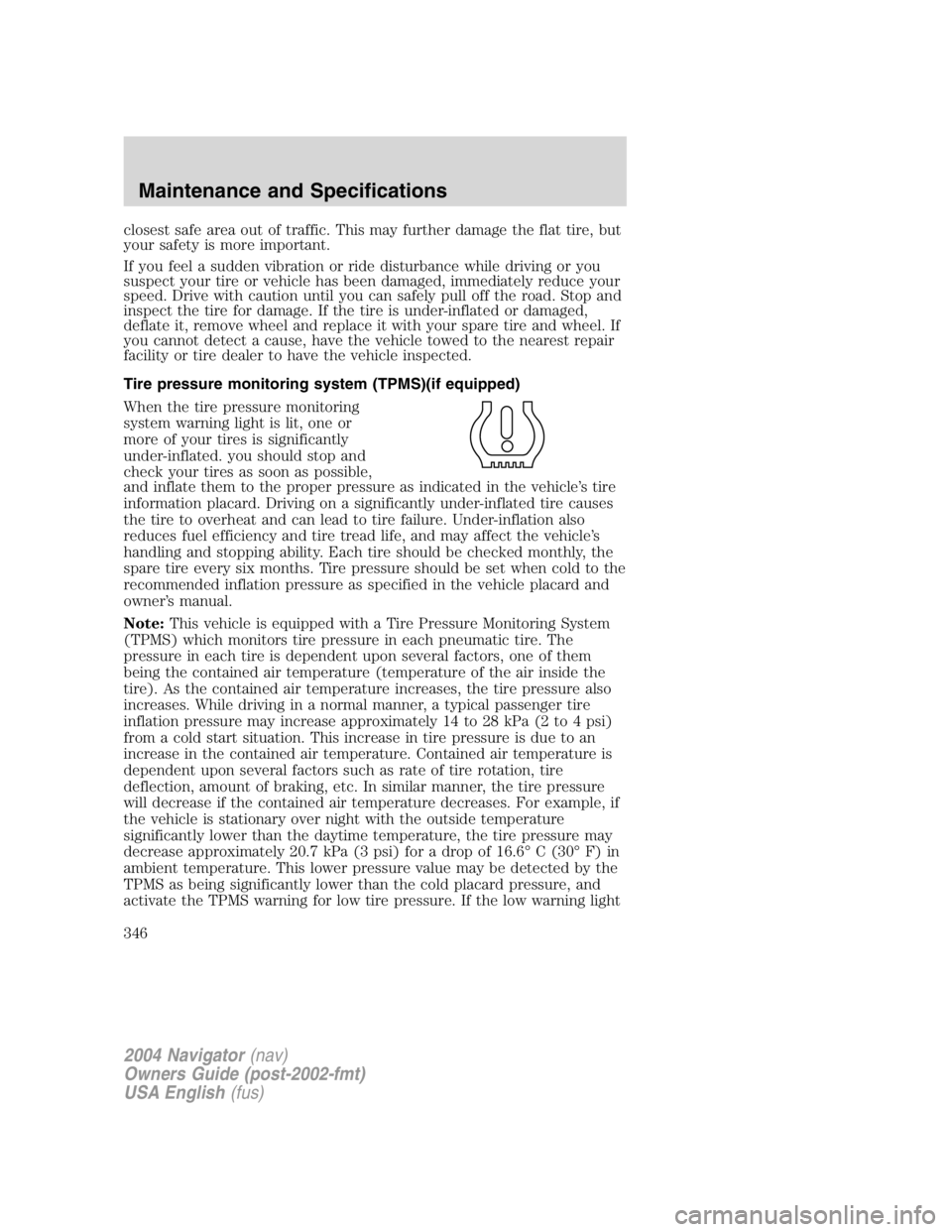
When the tire pressure monitoring
system warning light is lit, one or
more of your tires is significantly
under-inflated. you should stop and
check your tires as soon as possible,
and inflate them to the proper pressure as indicated in the vehicle ’ s tire
information placard. Driving on a significantly under-inflated tire causes
the tire to overheat and can lead to tire failure. Under-inflation also
reduces fuel efficiency and tire tread life, and may affect the vehicle ’ s
handling and stopping ability. Each tire should be checked monthly, the
spare tire every six months. Tire pressure should be set when cold to the
recommended inflation pressure as specified in the vehicle placard and
owner ’ s manual.
Note: This vehicle is equipped with a Tire Pressure Monitoring System
(TPMS) which monitors tire pressure in each pneumatic tire. The
pressure in each tire is dependent upon several factors, one of them
being the contained air temperature (temperature of the air inside the
tire). As the contained air temperature increases, the tire pressure also
increases. While driving in a normal manner, a typical passenger tire
inflation pressure may increase approximately 14 to 28 kPa (2 to 4 psi)
from a cold start situation. This increase in tire pressure is due to an
increase in the contained air temperature. Contained air temperature is
dependent upon several factors such as rate of tire rotation, tire
deflection, amount of braking, etc. In similar manner, the tire pressure
will decrease if the contained air temperature decreases. For example, if
the vehicle is stationary over night with the outside temperature
significantly lower than the daytime temperature, the tire pressure may
decrease approximately 20.7 kPa (3 psi) for a drop of 16.6 ° C (30 ° F) in
ambient temperature. This lower pressure value may be detected by the
TPMS as being significantly lower than the cold placard pressure, and
activate the TPMS warning for low tire pressure. If the low warning light
2004 Navigator (nav)
Owners Guide (post-2002-fmt)
USA English (fus)Maintenance and Specifications
346
Page 347 of 368
is on, visually check each tire to verify that no tire is flat. If one or more
tires are flat, repair of fix as necessary. If all tires appear to be inflated,
carefully drive the vehicle to the nearest location where air can be added
to the tires. Turn the ignition to the “ off ” position. Inflate all the tires to
the recommended cold pressure.
The system uses radio-frequency to monitor the tire pressure on all tires
excluding the spare tire. The sensors transmit the tire pressure readings
to the receiver module located in the vehicle. The receiver module then
electronically transmits the status to the message center. For more tire
warning information, refer to the Message Center in the Driver controls
chapter.
This device complies with part 15 of the FCC rules and with RS-210 of
Industry Canada. Operation is subject to the following two conditions:
(1) This device may not cause harmful interference, and (2) This device
must accept any interference received, including interference that may
cause undesired operation.
The tire pressure monitoring system is NOT a substitute for
manually checking tire pressure. The tire pressure should be
checked periodically (at least monthly) using a tire gauge, see
Checking the tire pressure in this chapter. Failure to properly
maintain your tire pressure could increase the risk of tire failure, loss
of control, vehicle rollover and personal injury.
Changing tires with TPMS
It is recommended that you always
have your tires serviced by a dealer
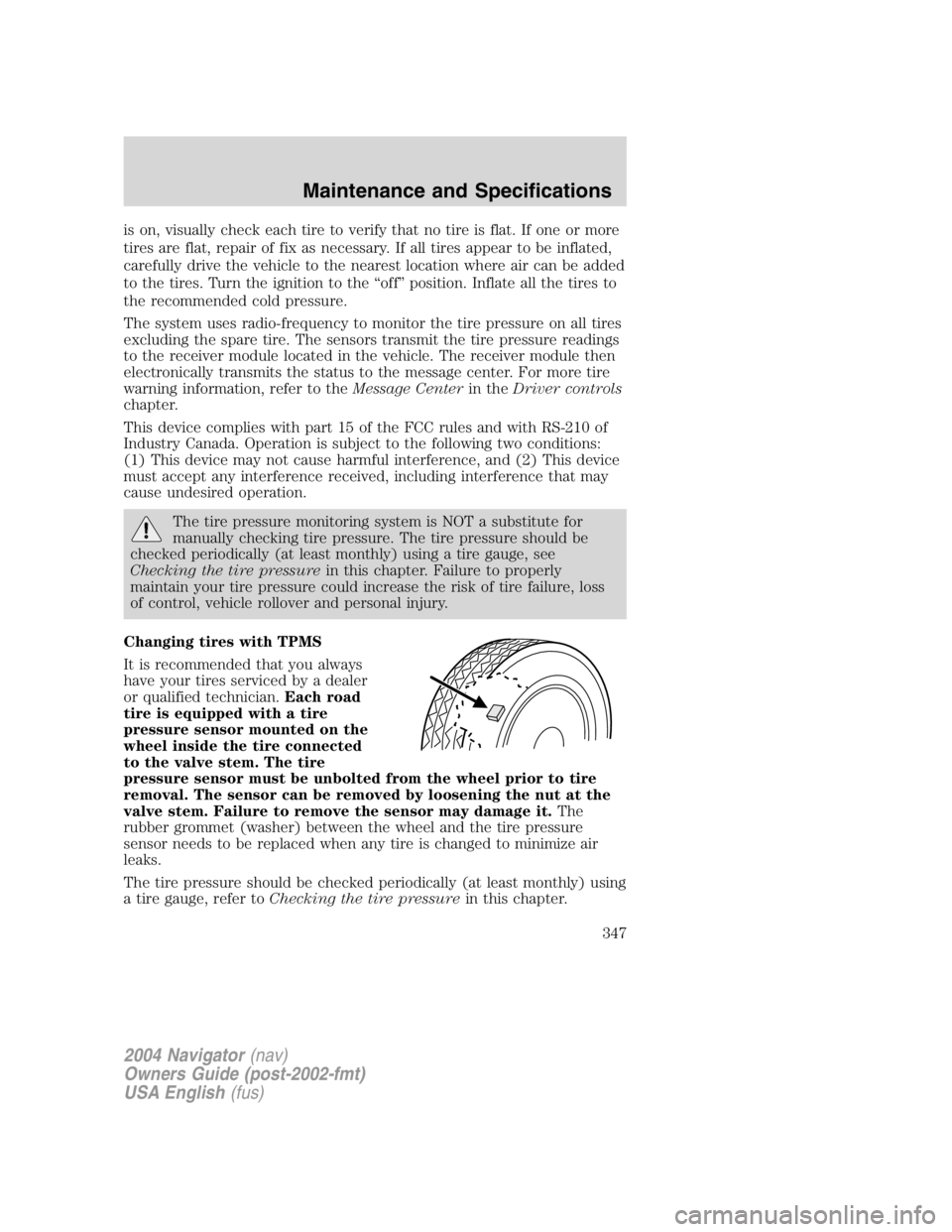
or qualified technician. Each road
tire is equipped with a tire
pressure sensor mounted on the
wheel inside the tire connected
to the valve stem. The tire
pressure sensor must be unbolted from the wheel prior to tire
removal. The sensor can be removed by loosening the nut at the
valve stem. Failure to remove the sensor may damage it. The
rubber grommet (washer) between the wheel and the tire pressure
sensor needs to be replaced when any tire is changed to minimize air
leaks.
The tire pressure should be checked periodically (at least monthly) using
a tire gauge, refer to Checking the tire pressure in this chapter.
2004 Navigator (nav)
Owners Guide (post-2002-fmt)
USA English (fus) Maintenance and Specifications
347
Page 348 of 368
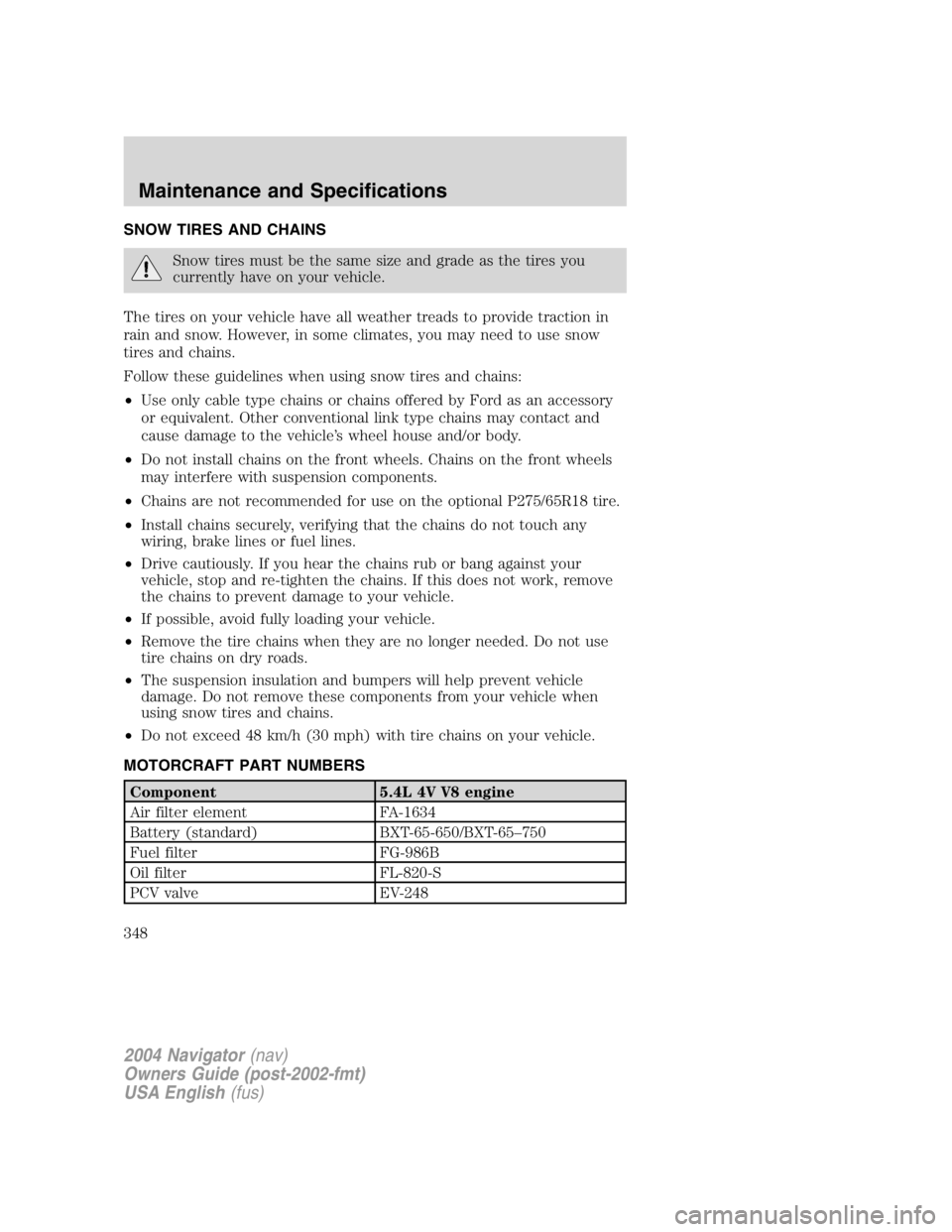
SNOW TIRES AND CHAINS
Snow tires must be the same size and grade as the tires you
currently have on your vehicle.
The tires on your vehicle have all weather treads to provide traction in
rain and snow. However, in some climates, you may need to use snow
tires and chains.
Follow these guidelines when using snow tires and chains:
• Use only cable type chains or chains offered by Ford as an accessory
or equivalent. Other conventional link type chains may contact and
cause damage to the vehicle ’ s wheel house and/or body.
• Do not install chains on the front wheels. Chains on the front wheels
may interfere with suspension components.
• Chains are not recommended for use on the optional P275/65R18 tire.
• Install chains securely, verifying that the chains do not touch any
wiring, brake lines or fuel lines.
• Drive cautiously. If you hear the chains rub or bang against your
vehicle, stop and re-tighten the chains. If this does not work, remove
the chains to prevent damage to your vehicle.
• If possible, avoid fully loading your vehicle.
• Remove the tire chains when they are no longer needed. Do not use
tire chains on dry roads.
• The suspension insulation and bumpers will help prevent vehicle
damage. Do not remove these components from your vehicle when
using snow tires and chains.
• Do not exceed 48 km/h (30 mph) with tire chains on your vehicle.
MOTORCRAFT PART NUMBERS
Component 5.4L 4V V8 engine
Air filter element FA-1634
Battery (standard) BXT-65-650/BXT-65 – 750
Fuel filter FG-986B
Oil filter FL-820-S
PCV valve EV-248
2004 Navigator (nav)
Owners Guide (post-2002-fmt)
USA English (fus)Maintenance and Specifications
348
Page 366 of 368

climate control ........................171
memory seat ...................158, 171
SecuriLock passive
anti-theft system ...............166 – 167
Servicing your vehicle ..............305
Snowplowing .................................7
Spare tire (see Changing the
Tire) ...........................................275
Spark plugs,
specifications .....................348, 354
Special notice
utility-type vehicles ....................7
Specification chart,
lubricants ...........................351, 354
Speed control ............................126
Starting your vehicle ........217 – 219
jump starting ..........................282
Steering
speed sensitive .......................224
Steering wheel
controls ....................................129
T
Tire Pressure Monitoring
System (TPMS)
Driving .....................................247
Roadside Emergencies ...........275
Warning Displays ......................14
Tires ...........................275, 333 – 334
changing ..................275 – 276, 281
snow tires and chains ............348
tire grades ...............................334
treadwear ................................333
Tonneau cover ...........................117
Towing .......................................254 recreational towing .................261
trailer towing ..........................254
wrecker ....................................288
Transmission .............................231
brake-shift interlock (BSI) ....231
fluid, checking and adding
(automatic) .............................330
fluid, refill capacities ..............349
lubricant
specifications ..................351, 354
Trunk .................................156 – 157
Turn signal ................................102
V
Vehicle dimensions ...................354
Vehicle Identification Number
(VIN) ..........................................356
Vehicle loading ..........................252
Ventilating your vehicle ...........221
W
Warning lights (see Lights) .......10
Washer fluid ..............................308
Water, Driving through .............251
Windows
power .......................................119
rear wiper/washer ...................113
Windshield washer fluid and
wipers ........................................112
checking and adding fluid .....308
liftgate reservoir .....................308
replacing wiper blades ...........113
Wrecker towing .........................288
2004 Navigator (nav)
Owners Guide (post-2002-fmt)
USA English (fus)Index
366