lock LINCOLN NAVIGATOR 2004 Repair Manual
[x] Cancel search | Manufacturer: LINCOLN, Model Year: 2004, Model line: NAVIGATOR, Model: LINCOLN NAVIGATOR 2004Pages: 368, PDF Size: 8.21 MB
Page 220 of 368
fails to start, press the accelerator to the floor and try again; this will
allow the engine to crank with the fuel shut off in case the engine is
flooded with fuel.
Using the engine block heater (if equipped)
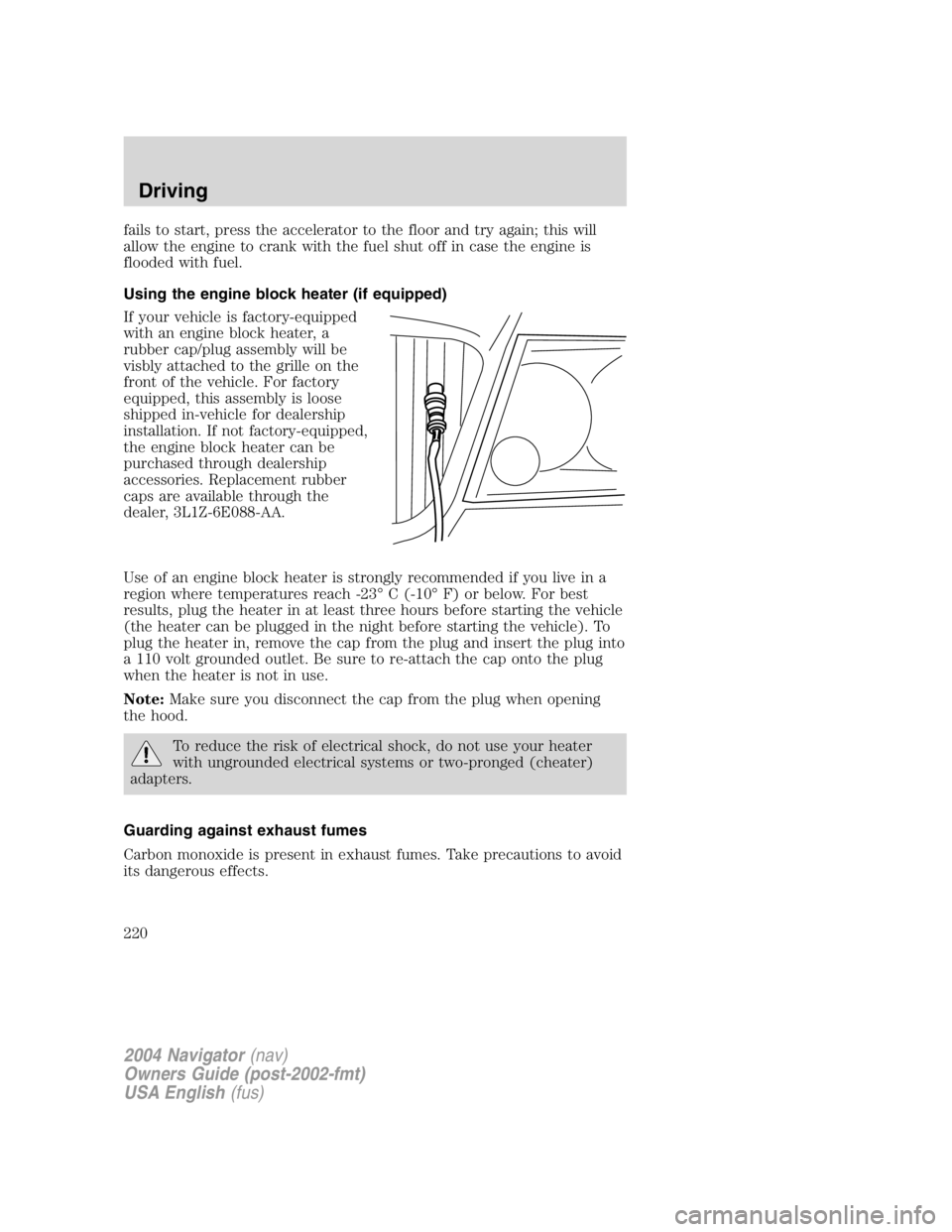
If your vehicle is factory-equipped
with an engine block heater, a
rubber cap/plug assembly will be
visbly attached to the grille on the
front of the vehicle. For factory
equipped, this assembly is loose
shipped in-vehicle for dealership
installation. If not factory-equipped,
the engine block heater can be
purchased through dealership
accessories. Replacement rubber
caps are available through the
dealer, 3L1Z-6E088-AA.
Use of an engine block heater is strongly recommended if you live in a
region where temperatures reach -23 ° C (-10 ° F) or below. For best
results, plug the heater in at least three hours before starting the vehicle
(the heater can be plugged in the night before starting the vehicle). To
plug the heater in, remove the cap from the plug and insert the plug into
a 110 volt grounded outlet. Be sure to re-attach the cap onto the plug
when the heater is not in use.
Note: Make sure you disconnect the cap from the plug when opening
the hood.
To reduce the risk of electrical shock, do not use your heater
with ungrounded electrical systems or two-pronged (cheater)
adapters.
Guarding against exhaust fumes
Carbon monoxide is present in exhaust fumes. Take precautions to avoid
its dangerous effects.
2004 Navigator (nav)
Owners Guide (post-2002-fmt)
USA English (fus)Driving
220
Page 221 of 368
If you smell exhaust fumes inside your vehicle, have your dealer
inspect your vehicle immediately. Do not drive if you smell
exhaust fumes.
Important ventilating information
If the engine is idling while the vehicle is stopped for a long period of
time, open the windows at least 2.5 cm (one inch) or adjust the heating
or air conditioning to bring in fresh air.
BRAKES
Your service brakes are self-adjusting. Refer to the scheduled
maintenance guide for scheduled maintenance.
Occasional brake noise is normal and often does not indicate a
performance concern with the vehicle ’ s brake system. In normal
operation, automotive brake systems may emit occasional or intermittent
squeal or groan noises when the brakes are applied. Such noises are
usually heard during the first few brake applications in the morning;
however, they may be heard at any time while braking and can be
aggravated by environmental conditions such as cold, heat, moisture,
road dust, salt or mud. If a “ metal-to-metal, ”“ continuous grinding ” or
“ continuous squeal ” sound is present while braking, the brake linings
may be worn-out and should be inspected by a qualified service
technician.
If you are driving down a long or steep hill, shift to a lower gear.
Do not apply your brakes continuously, as they may overheat
and become less effective.
Anti-lock brake system (ABS)
On ABS-equipped vehicles, a noise from the hydraulic pump motor and
pulsation in the pedal may be observed during ABS braking events. Pedal
pulsation coupled with noise while braking under panic conditions or on
loose gravel, bumps, wet or snowy roads is normal and indicates proper
functioning of the vehicle ’ s anti-lock brake system. The ABS performs a
self-check after you start the engine and begin to drive away. A brief
mechanical noise may be heard during this test. This is normal. If a
malfunction is found, the ABS warning light will come on. If the vehicle
has continuous vibration or shudder in the steering wheel while braking,
the vehicle should be inspected by a qualified service technician.
2004 Navigator (nav)
Owners Guide (post-2002-fmt)
USA English (fus) Driving
221
Page 222 of 368

The ABS operates by detecting the onset of wheel lockup during brake
applications and compensates for this tendency. The wheels are
prevented from locking even when the brakes are firmly applied.
Using ABS
• In an emergency or when maximum efficiency from the four-wheel
ABS is required, apply continuous force on the brake. The four wheel
ABS will be activated immediately, thus allowing you to retain steering
control of your vehicle and, providing there is sufficient space, will
enable you to avoid obstacles and bring the vehicle to a controlled
stop.
• The anti-lock system does not always reduce stopping distance.
Always leave enough room between your vehicle and the vehicle in
front of you to stop.
• We recommend that you familiarize yourself with this braking
technique. However, avoid taking any unnecessary risks.
ABS warning lamp ABS
The ABS
warning lamp in the instrument cluster momentarily illuminates
when the ignition is turned to the ON position. If the light does not
illuminate momentarily at start up, remains on or continues to flash, the
ABS needs to be serviced.
With the ABS light on, the anti-lock
brake system is disabled and normal
braking is still effective unless the
brake warning light also remains
illuminated with parking brake
released. (If your brake warning lamp illuminates, have your vehicle
serviced immediately.)
Brake Assist (if equipped)
The Brake Assist system provides full braking force during panic braking
situations. It detects a rapid application of the brake pedal and
maximizes the amount of brake booster assist, helping the driver to
achieve maximum braking pressure. Once a panic brake application is
detected, the system will remain activated as long as the brake pedal is
depressed. The system is deactivated by releasing the brake pedal.
When the system activates, the brake pedal will travel with very little
effort; this is normal. P!BRAKE
2004 Navigator (nav)
Owners Guide (post-2002-fmt)
USA English (fus)Driving
222
Page 225 of 368
AIR SUSPENSION SYSTEM
The air suspension system is designed to improve ride comfort, vehicle
handling and general vehicle performance by adjusting the vehicle ’ s ride
height according to vehicle speed, weight added to or removed from the
vehicle and four-wheel drive (if equipped) operation. Normal vehicle
operation does not require any action by the driver.
When you enter the vehicle and the ignition is off, the air suspension will
have automatically lowered the vehicle to its lowest height to provide
easier entry. When a door or the liftgate is opened, the system
memorizes and maintains that height until either all doors are closed or
the vehicle ’ s speed exceeds 24 km/h (15 mph). The air suspension
system will then raise the vehicle ’ s height to its normal position when the
ignition is turned on, all doors are closed and the transmission is shifted
from P (Park).
When the vehicle is in motion, the air suspension will adjust the vehicle
ride height to normal operating position to maximize your ride comfort.
If your vehicle is equipped with four-wheel drive and you shift into 4WD
LOW, the air suspension will not move to it ’ s lowest position; instead, the
ride height is raised above the normal ride height position (at speeds
below 40 km/h [25 mph]) to improve ground clearance.
If a load is added to, or removed from the vehicle, the load leveling
feature of the air suspension system will adjust the suspension to keep
the vehicle at a constant level.
When exiting the vehicle, the air suspension will automatically lower the
vehicle to its lowest height to provide easier exit. You may hear a buzz or
click from the air suspension system when the ignition is turned off. The
air suspension system will stay active for 40 minutes after the ignition is
turned off to accommodate any load changes. (The air compressor may
run when the vehicle is off; this is normal.)
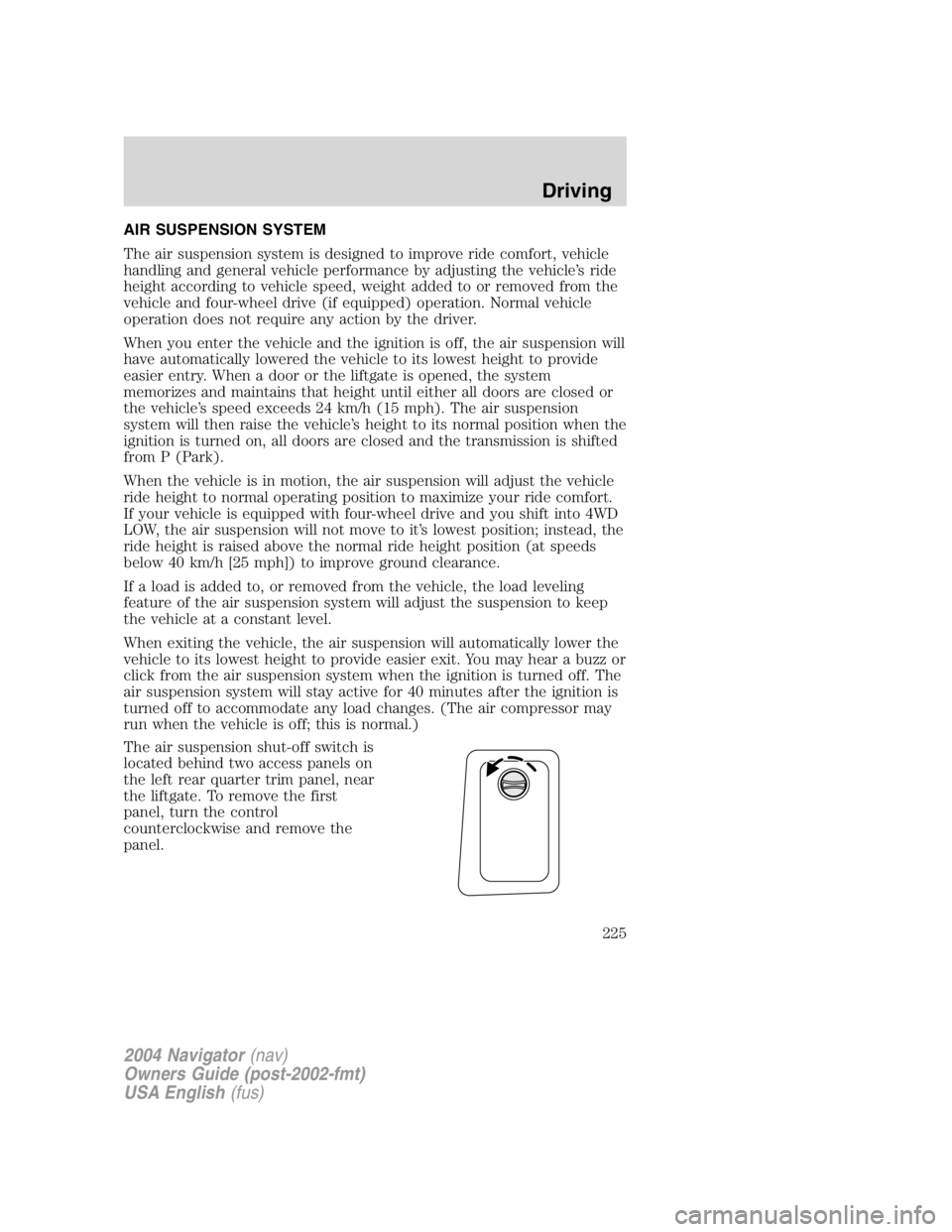
The air suspension shut-off switch is
located behind two access panels on
the left rear quarter trim panel, near
the liftgate. To remove the first
panel, turn the control
counterclockwise and remove the
panel.
2004 Navigator (nav)
Owners Guide (post-2002-fmt)
USA English (fus) Driving
225
Page 226 of 368
On vehicles equipped with air suspension, turn the air
suspension and the ignition switch off prior to jacking, hoisting
or towing your vehicle.
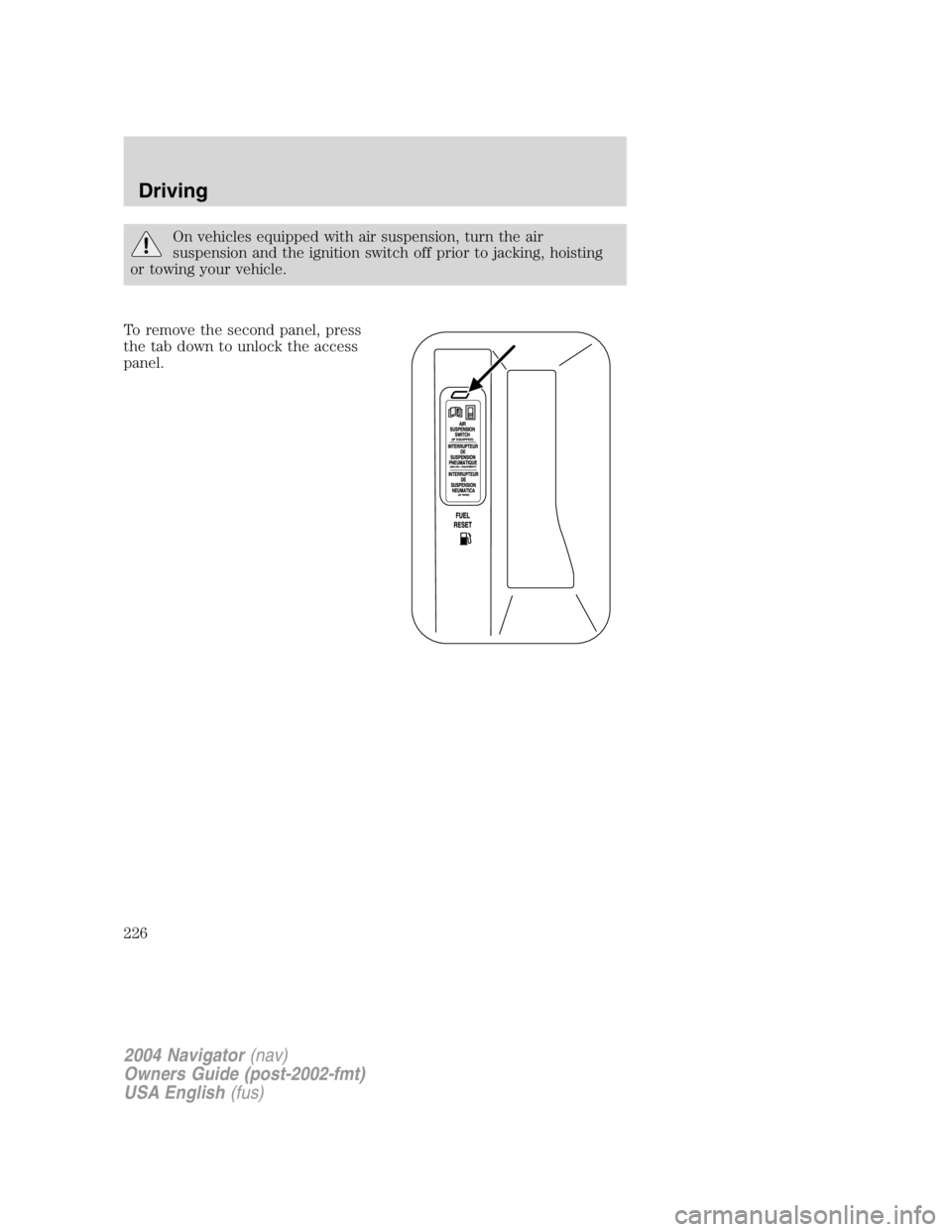
To remove the second panel, press
the tab down to unlock the access
panel.
2004 Navigator (nav)
Owners Guide (post-2002-fmt)
USA English (fus)Driving
226
Page 228 of 368
Vehicles with a higher center of gravity such as utility and
four-wheel drive vehicles handle differently than vehicles with a
lower center of gravity. Utility and four-wheel drive vehicles are not
designed for cornering at speeds as high as passenger cars any more
than low-slung sports cars are designed to perform satisfactorily under
off-road conditions. Avoid sharp turns, excessive speed and abrupt
maneuvers in these vehicles. Failure to drive cautiously could result in
an increased risk of loss of vehicle control, vehicle rollover, personal
injury and death.
Loaded vehicles, with a higher center of gravity, may handle
differently than unloaded vehicles. Extra precautions, such as
slower speeds and increased stopping distance, should be taken when
driving a heavily loaded vehicle.
Your vehicle has the capability to haul more cargo and people than most
passenger cars. Depending upon the type and placement of the load,
hauling people and cargo may raise the center of gravity of the vehicle.
Use extra caution while becoming familiar with your vehicle. Know the
capabilities and limitations of both you as a driver and your vehicle.
ROLL STABILITY CONTROL STABILITY ENHANCEMENT SYSTEM
(IF EQUIPPED)
The Roll Stability Control system provides a stability enhancement
feature as well as a traction enhancement feature. It helps your vehicle
maintain traction, when driving on slippery and/or hilly road surfaces, by
detecting and controlling wheel spin. Excessive wheel spin is controlled
by momentarily reducing engine power and rapidly applying the anti-lock
brakes. The system is a driver aid which makes your vehicle easier to
handle primarily on snow and ice-covered roads.
If your vehicle should become stuck in deep snow or mud, try switching
the Roll Stability Control system off by pressing the Roll Stability Control
button. This will allow your tires to “ dig ” for traction.
If the Roll Stability Control system is activated and deactivated
excessively in a short period of time, the brake portion of the system will
shut down to allow the brakes to cool down. A limited Roll Stability
Control function using only engine power reduction will still help control
the wheels from over-spinning. When the brakes have cooled down, the
system will again function normally. Anti-lock braking is not affected by
this condition and will function normally during the cool-down period.
2004 Navigator (nav)
Owners Guide (post-2002-fmt)
USA English (fus)Driving
228
Page 231 of 368
Do not alter or modify your vehicle ’ s suspension or steering; the
resulting changes to the vehicle ’ s handling can adversely affect
the Roll Stability Control system. Also, do not install a stereo
loudspeaker near the front center console or under either front
seat. The speaker vibrations can adversely affect the Roll
Stability Control sensors located in this area.
Note: Pressing the Roll Stability Control button will disable the Roll
Stability Control.
Aggressive driving in any road conditions can cause you to lose
control of your vehicle increasing the risk of severe personal
injury or property damage. The occurrence of an Roll Stability Control
event is an indication that at least some of the tires have exceeded
their ability to grip the road; this may lead to an increased risk of loss
of vehicle control, vehicle rollover, personal injury and death. If you
experience a severe road event, SLOW DOWN.
AUTOMATIC TRANSMISSION OPERATION
Brake-shift interlock
This vehicle is equipped with a brake-shift interlock feature that prevents
the gearshift lever from being moved from P (Park) when the ignition is
in the ON position unless brake pedal is depressed.
If you cannot move the gearshift lever out of P (Park) with ignition in
the ON position and the brake pedal depressed, it is possible that a fuse
has blown or the vehicle ’ s brakelamps are not operating properly. Refer
to Fuses and relays in the Roadside emergencies chapter.
If the fuse is not blown, perform the following procedure:
1. Apply the parking brake, turn the ignition to LOCK, then remove the
key.
2004 Navigator (nav)
Owners Guide (post-2002-fmt)
USA English (fus) Driving
231
Page 232 of 368
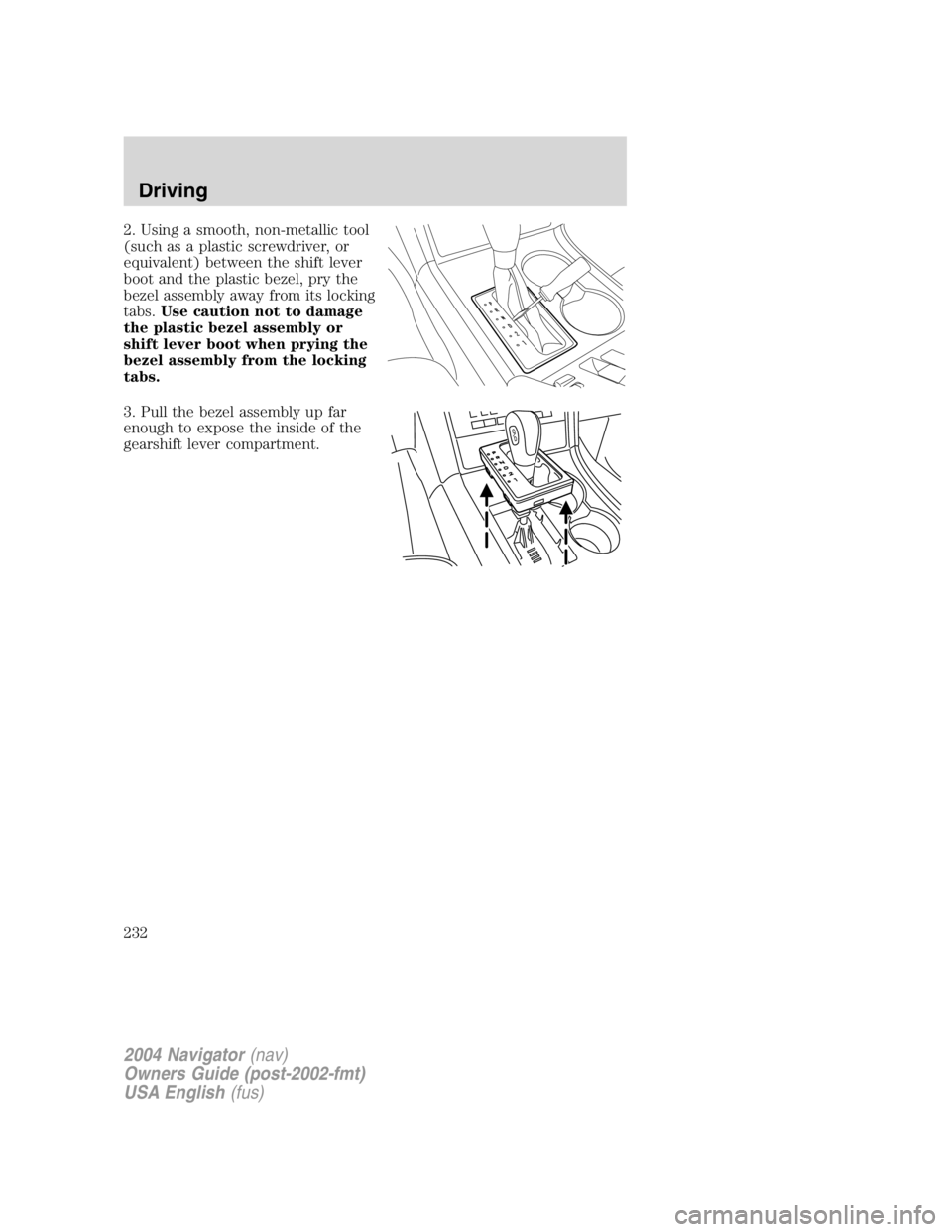
2. Using a smooth, non-metallic tool
(such as a plastic screwdriver, or
equivalent) between the shift lever
boot and the plastic bezel, pry the
bezel assembly away from its locking
tabs. Use caution not to damage
the plastic bezel assembly or
shift lever boot when prying the
bezel assembly from the locking
tabs.
3. Pull the bezel assembly up far
enough to expose the inside of the
gearshift lever compartment.
2004 Navigator (nav)
Owners Guide (post-2002-fmt)
USA English (fus)Driving
232
Page 233 of 368
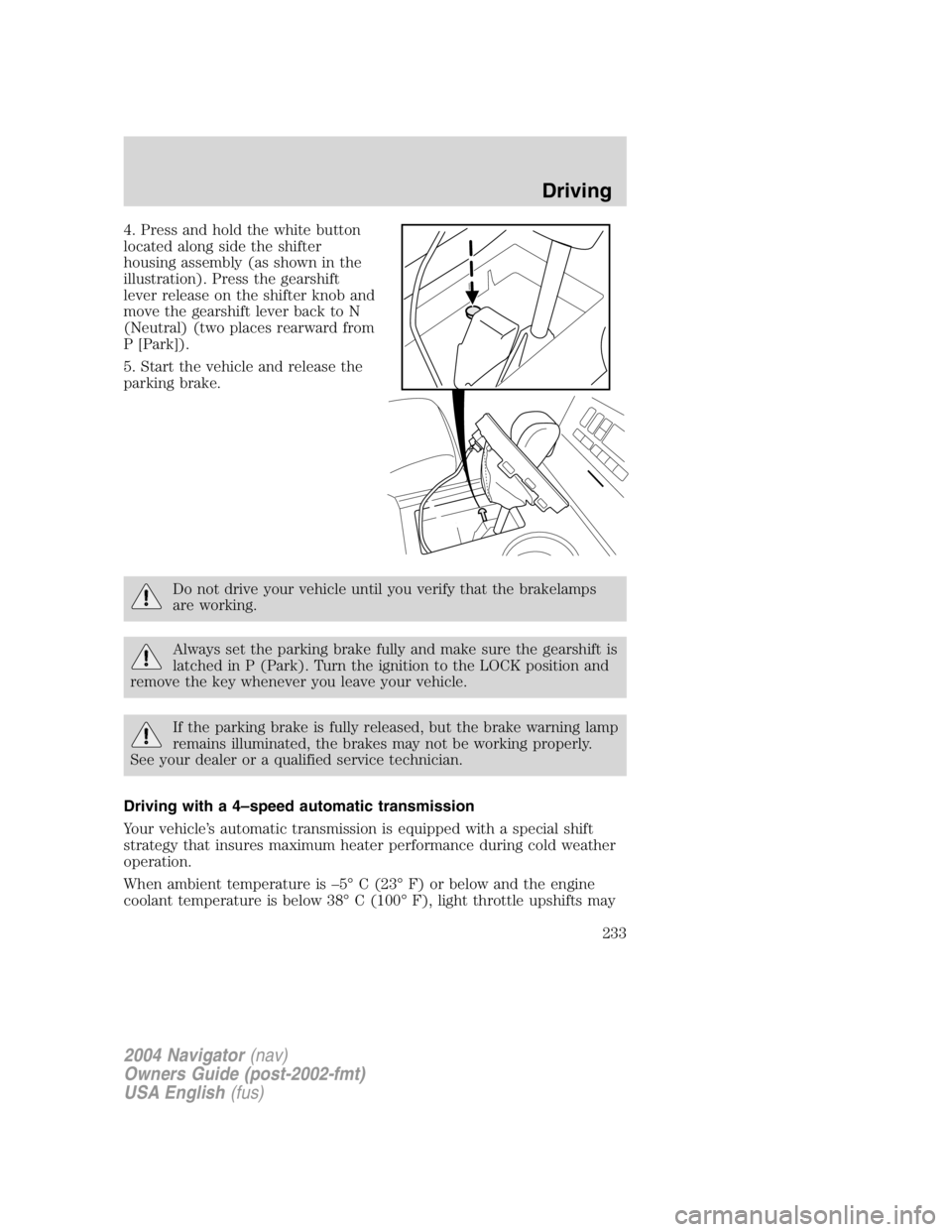
4. Press and hold the white button
located along side the shifter
housing assembly (as shown in the
illustration). Press the gearshift
lever release on the shifter knob and
move the gearshift lever back to N
(Neutral) (two places rearward from
P [Park]).
5. Start the vehicle and release the
parking brake.
Do not drive your vehicle until you verify that the brakelamps
are working.
Always set the parking brake fully and make sure the gearshift is
latched in P (Park). Turn the ignition to the LOCK position and
remove the key whenever you leave your vehicle.
If the parking brake is fully released, but the brake warning lamp
remains illuminated, the brakes may not be working properly.
See your dealer or a qualified service technician.
Driving with a 4 – speed automatic transmission
Your vehicle ’ s automatic transmission is equipped with a special shift
strategy that insures maximum heater performance during cold weather
operation.
When ambient temperature is – 5 ° C (23 ° F) or below and the engine
coolant temperature is below 38 ° C (100 ° F), light throttle upshifts may
2004 Navigator (nav)
Owners Guide (post-2002-fmt)
USA English (fus) Driving
233
Page 234 of 368
be slightly delayed. Once the engine coolant temperature reaches 71 ° C
(160 ° F) the normal shift strategy will resume. This is normal operation
and will not affect the function or the durability of the transmission.
If the normal shift strategy does not resume once the engine
coolant temperature reaches the normal operating temperature,
or if the downshifts and other throttle conditions do not function
normally, see your dealer or a qualified service technician as soon
as possible.
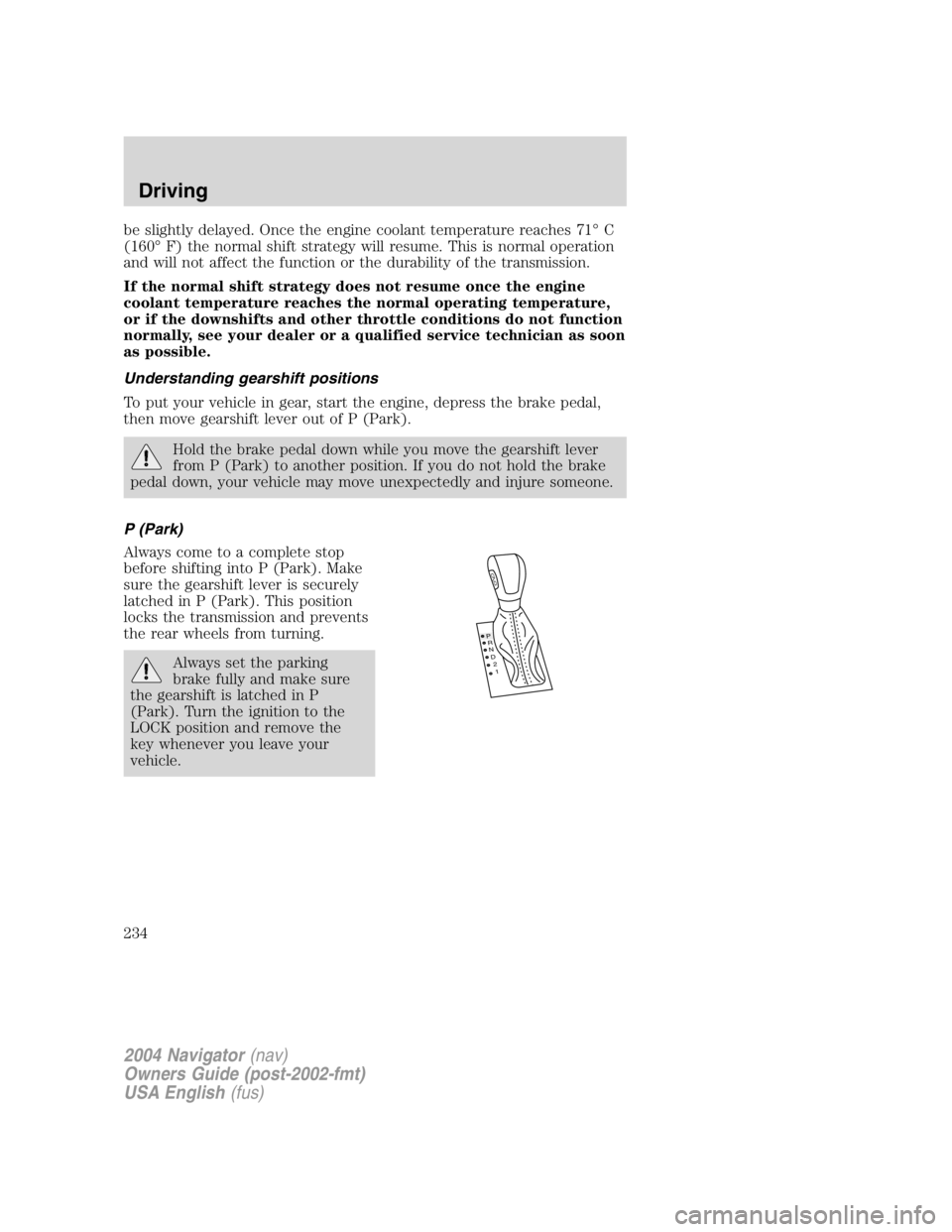
Understanding gearshift positions
To put your vehicle in gear, start the engine, depress the brake pedal,
then move gearshift lever out of P (Park).
Hold the brake pedal down while you move the gearshift lever
from P (Park) to another position. If you do not hold the brake
pedal down, your vehicle may move unexpectedly and injure someone.
P (Park)
Always come to a complete stop
before shifting into P (Park). Make
sure the gearshift lever is securely
latched in P (Park). This position
locks the transmission and prevents
the rear wheels from turning.
Always set the parking
brake fully and make sure
the gearshift is latched in P
(Park). Turn the ignition to the
LOCK position and remove the
key whenever you leave your
vehicle. P
R
N
D
2
1
O
D
2004 Navigator (nav)
Owners Guide (post-2002-fmt)
USA English (fus)Driving
234