wheel LINCOLN NAVIGATOR 2009 Owners Manual
[x] Cancel search | Manufacturer: LINCOLN, Model Year: 2009, Model line: NAVIGATOR, Model: LINCOLN NAVIGATOR 2009Pages: 375, PDF Size: 3.09 MB
Page 353 of 375
![LINCOLN NAVIGATOR 2009 Owners Manual •Sudden or hard accelerations may reduce fuel economy.
•Slow down gradually.
•Driving at reasonable speeds (traveling at 55 mph [88 km/h] uses 15%
less fuel than traveling at 65 mph [105 km/h]).](/img/15/7010/w960_7010-352.png "LINCOLN NAVIGATOR 2009 Owners Manual •Sudden or hard accelerations may reduce fuel economy.
•Slow down gradually.
•Driving at reasonable speeds (traveling at 55 mph [88 km/h] uses 15%
less fuel than traveling at 65 mph [105 km/h]).")
•Sudden or hard accelerations may reduce fuel economy.
•Slow down gradually.
•Driving at reasonable speeds (traveling at 55 mph [88 km/h] uses 15%
less fuel than traveling at 65 mph [105 km/h]).
•Revving the engine before turning it off may reduce fuel economy.
•Using the air conditioner or defroster may reduce fuel economy.
•You may want to turn off the speed control in hilly terrain if
unnecessary shifting between the top gears occurs. Unnecessary
shifting of this type could result in reduced fuel economy.
•Warming up a vehicle on cold mornings is not required and may
reduce fuel economy.
•Resting your foot on the brake pedal while driving may reduce fuel
economy.
•Combine errands and minimize stop-and-go driving.
Maintenance
•Keep tires properly inflated and use only recommended size.
•Operating a vehicle with the wheels out of alignment will reduce fuel
economy.
•Use recommended engine oil. Refer toMaintenance product
specifications and capacitiesin this chapter.
•Perform all regularly scheduled maintenance items. Follow the
recommended maintenance schedule and owner maintenance checks
found inscheduled maintenance information.
Conditions
•Heavily loading a vehicle or towing a trailer may reduce fuel economy
at any speed.
•Carrying unnecessary weight may reduce fuel economy (as much as
1 mpg [0.4 km/L] is lost for every 400 lb [180 kg] of weight carried).
•Adding certain accessories to your vehicle (for example; bug
deflectors, rollbars/light bars, running boards, ski/luggage racks) may
reduce fuel economy.
•Using fuel blended with alcohol may lower fuel economy.
•Fuel economy may decrease with lower temperatures during the first
8–10 miles (12–16 km) of driving.
•Driving on flat terrain offers improved fuel economy as compared to
driving on hilly terrain.
2009 Navigator(nav)
Owners Guide, 1st Printing
USA(fus)
Maintenance and Specifications
353
Page 354 of 375
•Transmissions give their best fuel economy when operated in the top
cruise gear and with steady pressure on the gas pedal.
•Four-wheel-drive operation (if equipped) is less fuel efficient than
two-wheel-drive operation.
•Close windows for high speed driving.
EPA fuel economy estimates
Every new vehicle should have a window sticker containing EPA fuel
economy estimates. Contact your authorized dealer if the window sticker
is not supplied with your vehicle. The EPA fuel economy estimates
should be your guide for the fuel economy comparisons with other
vehicles. Your fuel economy may vary depending upon the method of
operation and conditions.
EMISSION CONTROL SYSTEM
Your vehicle is equipped with various emission control components and a
catalytic converter which will enable your vehicle to comply with
applicable exhaust emission standards. To make sure that the catalytic
converter and other emission control components continue to work
properly:
•Use only the specified fuel listed.
•Avoid running out of fuel.
•Do not turn off the ignition while your vehicle is moving, especially at
high speeds.
•Have the items listed inscheduled maintenance information
performed according to the specified schedule.
The scheduled maintenance items listed inscheduled maintenance
informationare essential to the life and performance of your vehicle
and to its emissions system.
If other than Ford, Motorcraft or Ford-authorized parts are used for
maintenance replacements or for service of components affecting
emission control, such non-Ford parts should be equivalent to genuine
Ford Motor Company parts in performance and durability.
WARNING:Do not park, idle, or drive your vehicle in dry grass
or other dry ground cover. The emission system heats up the
engine compartment and exhaust system, which can start a fire.
2009 Navigator(nav)
Owners Guide, 1st Printing
USA(fus)
Maintenance and Specifications
354
Page 357 of 375
Allow the vehicle to sit for at least eight hours without starting the
engine. Then, start the engine and complete the above driving cycle. The
engine must warm up to its normal operating temperature. Once started,
do not turn off the engine until the above driving cycle is complete. If
the vehicle is still not ready for I/M testing, the above driving cycle will
have to be repeated.
POWER STEERING FLUID
Check the power steering fluid. Refer to thescheduled maintenance
informationfor the service interval schedules.
1. Start the engine and let it run
until it reaches normal operating
temperature (the engine coolant
temperature gauge indicator will be
near the center of the normal area
between H and C).
2. While the engine idles, turn the
steering wheel left and right several
times.
3. Turn the engine off.
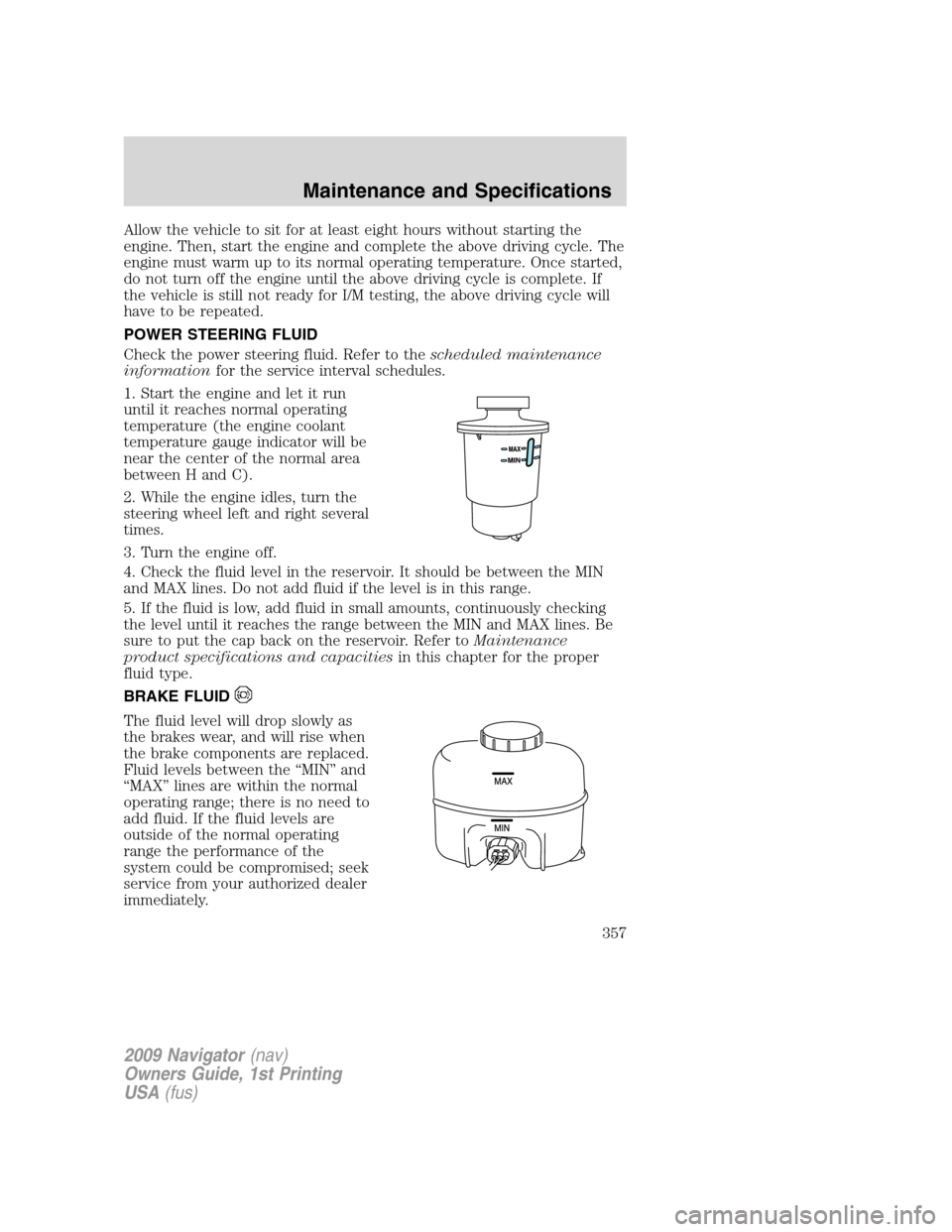
4. Check the fluid level in the reservoir. It should be between the MIN
and MAX lines. Do not add fluid if the level is in this range.
5. If the fluid is low, add fluid in small amounts, continuously checking
the level until it reaches the range between the MIN and MAX lines. Be
sure to put the cap back on the reservoir. Refer toMaintenance
product specifications and capacitiesin this chapter for the proper
fluid type.
BRAKE FLUID
The fluid level will drop slowly as
the brakes wear, and will rise when
the brake components are replaced.
Fluid levels between the “MIN” and
“MAX” lines are within the normal
operating range; there is no need to
add fluid. If the fluid levels are
outside of the normal operating
range the performance of the
system could be compromised; seek
service from your authorized dealer
immediately.
2009 Navigator(nav)
Owners Guide, 1st Printing
USA(fus)
Maintenance and Specifications
357
Page 361 of 375
Note:Failure to use the correct air filter element may result in severe
engine damage. The customer warranty may be void for any damage to
the engine if the correct air filter element is not used.
MOTORCRAFT PART NUMBERS
Component 5.4L 3V V8 engine
Air filter element FA-1883
BatteryBXT-65-650 or BXT-65-750 (if
equipped)
Fuel filter FG-1036
2
Oil filter FL-820-S
Spark plugs1
1
For spark plug replacement, see your authorized dealer. Refer to
scheduled maintenance informationfor the appropriate intervals for
changing the spark plugs.
2Long wheel base only
Replace the spark plugs with ones that meet Ford material and
design specifications for your vehicle, such as Motorcraft or
equivalent replacement parts. The customer warranty may be
void for any damage to the engine if such spark plugs are not
used.
2009 Navigator(nav)
Owners Guide, 1st Printing
USA(fus)
Maintenance and Specifications
361
Page 369 of 375
Vehicle security systems
Wheel locks
For maximum vehicle performance, keep the following information in
mind when adding accessories or equipment to your vehicle:
•When adding accessories, equipment, passengers and luggage to your
vehicle, do not exceed the total weight capacity of the vehicle or of
the front or rear axle (GVWR or GAWR as indicated on the Safety
Compliance Certification label). Consult your authorized dealer for
specific weight information.
•The Federal Communications Commission (FCC) and Canadian Radio
Telecommunications Commission (CRTC) regulate the use of mobile
communications systems — such as two-way radios, telephones and
theft alarms - that are equipped with radio transmitters. Any such
equipment installed in your vehicle should comply with FCC or CRTC
regulations and should be installed only by a qualified service
technician.
•Mobile communications systems may harm the operation of your
vehicle, particularly if they are not properly designed for automotive
use.
•To avoid interference with other vehicle functions, such as anti-lock
braking systems, amateur radio users who install radios and antennas
onto their vehicle should not locate the Amateur Radio Antennas in
the area of the driver’s side hood.
•Electrical or electronic accessories or components that are added to
the vehicle by the authorized dealer or the owner may adversely affect
battery performance and durability.
2009 Navigator(nav)
Owners Guide, 1st Printing
USA(fus)
Accessories
369
Page 371 of 375
Cleaning your vehicle
engine compartment ..............323
instrument panel ....................325
interior .............................325–326
plastic parts ............................324
washing ....................................321
waxing .....................................322
wheels
......................................322
wiper blades
............................324
Clock
............................................92
Compass, electronic
set zone adjustment
...............117
Console
........................................92
overhead
..............................90–91
Controls
power seat
...............................155
steering column
......................104
Coolant
checking and adding
..............338
refill capacities
................342, 362
specifications
..........................362
Cruise control
(see Speed control)
..................101
Customer Assistance
................285
Ford Extended Service
Plan
..........................................318
Getting assistance outside the
U.S. and Canada
.....................318
Getting roadside assistance
...285
Getting the service you
need
.........................................314
Ordering additional owner’s
literature
.................................319
Utilizing the
Mediation/Arbitration
Program
...................................317D
Daytime running lamps
(see Lamps) ................................77
Dipstick
automatic transmission
fluid ..........................................358
engine oil .................................333
Driving under special
conditions ..................270, 279, 282
sand .........................................281
snow and ice ...........................283
through water .................281, 284
DVD system .................................37
E
Electronic message center .......110
Emergencies, roadside
jump-starting ..........................305
running out of fuel .........305, 349
Emission control system ..........354
Engine ........................................365
cleaning ...................................323
coolant .....................................338
fail-safe cooling .......................342
idle speed control ...................336
lubrication specifications .......362
refill capacities ........................362
service points ..........................330
starting after a collision .........287
Engine block heater .................254
Engine oil ..................................333
change oil soon warning,
message center .......................333
checking and adding ..............333
dipstick ....................................333
filter, specifications ........335, 361
recommendations ...................335
refill capacities ........................362
Index
371
Page 372 of 375
specifications ..........................362
Event data recording ....................7
Exhaust fumes ..........................253
F
Fail safe cooling ........................342
Family entertainment system ....37
Flexible Fuel Vehicle (FFV) ....344
Floor mats .................................123
Fluid capacities .........................362
Fog lamps ....................................77
Four-Wheel Drive vehicles .......276
control trac .............................276
description ..............................276
driving off road .......................277
indicator light .........................276
preparing to drive your
vehicle .....................................265
Fuel ............................................344
calculating fuel
economy ..........................111, 351
cap ...........................................347
capacity ...................................362
choosing the right fuel ...........348
comparisons with EPA fuel
economy estimates .................354
detergent in fuel .....................349
filler funnel .............................349
filling your vehicle with
fuel ...........................344, 347, 351
filter, specifications ........344, 361
fuel pump shut-off switch .....287
improving fuel economy ........351
octane rating ...................348, 365
quality ......................................349
running out of fuel .........305, 349
safety information relating to
automotive fuels .....................344Fuel - flex fuel vehicle
(FFV) .................................344, 348
Fuses ..................................288–289
G
Gas cap (see Fuel cap) ............347
Gas mileage
(see Fuel economy) .................351
Gauges .........................................17
H
Hazard flashers .........................286
Headlamps ...................................76
aiming ........................................78
autolamp system .......................76
bulb specifications ....................82
daytime running lights .............77
flash to pass ..............................77
high beam .................................77
turning on and off ....................76
Homelink wireless control
system ........................................106
Hood ..........................................329
I
Ignition ...............................250, 365
Illuminated visor mirror .............89
Infant seats
(see Safety seats) .....................198
Inspection/maintenance (I/M)
testing ........................................356
Instrument panel
cleaning ...................................325
cluster ........................................12
J
Jack ............................................295
Index
372
Page 375 of 375
Starting your vehicle ........250–253
jump starting ..........................305
Steering wheel
controls ....................................104
tilting .........................................88
SYNC ............................................68
T
Tire Pressure Monitoring
System (TPMS)
Driving .....................................281
Tires, Wheels and Loading ....229
Warning Displays ..............12, 119
Tires ...........................214–216, 295
alignment ................................222
care ..........................................219
changing ..........................295, 299
checking the pressure ............219
inflating ...................................217
label .........................................228
replacing ..................................220
rotating ....................................223
safety practices .......................222
sidewall information ...............224
snow tires and chains ............234
spare tire .................................296
terminology .............................216
tire grades ...............................215
treadwear ........................215, 219
Towing .......................................241
recreational towing .................249
trailer towing ..........................241
wrecker ....................................312Transmission .............................266
brake-shift interlock (BSI) ....266
fluid, checking and adding
(automatic) .............................358
fluid, refill capacities ..............362
lubricant specifications ..........362
Turn signal ..................................80
U
USB port ......................................28
V
Vehicle Identification Number
(VIN) ..........................................366
Vehicle loading ..........................235
Ventilating your vehicle ...........254
W
Warning lights (see Lights) .......12
Washer fluid ..............................331
Water, Driving through .............284
Windows
power .........................................94
rear wiper/washer .....................88
Windshield washer fluid and
wipers ..........................................87
checking and adding fluid .....331
liftgate reservoir .....................331
replacing wiper blades ...........332
Wrecker towing .........................312
Index
375