four wheel drive LINCOLN NAVIGATOR 2013 User Guide
[x] Cancel search | Manufacturer: LINCOLN, Model Year: 2013, Model line: NAVIGATOR, Model: LINCOLN NAVIGATOR 2013Pages: 481, PDF Size: 5.29 MB
Page 212 of 481
Avoid sudden applications of power and quick changes of direction on
snow and ice. Apply the accelerator slowly and steadily when starting
from a full stop.
Avoid sudden braking as well. Although a 4WD vehicle may accelerate
better than a two-wheel drive vehicle in snow and ice, it won’t stop any
faster, because as in other vehicles, braking occurs at all four wheels. Do
not become overconfident as to road conditions.
Make sure you allow sufficient distance between you and other vehicles
for stopping. Drive slower than usual and consider using one of the lower
gears. In emergency stopping situations, apply the brake steadily. Do not
pump the brakes. Refer to theBrakessection of this chapter for
additional information on the operation of the Anti-lock Brake System
(ABS).
Maintenance and modifications
The suspension and steering systems on your vehicle have been designed
and tested to provide predictable performance whether loaded or empty
and durable load carrying capability. For this reason, Ford Motor
Company strongly recommends that you do not make modifications such
as adding or removing parts (such as lift kits or stabilizer bars) or by
using replacement parts not equivalent to the original factory equipment.
Any modifications to a vehicle that raise the center of gravity can make
it more likely the vehicle will roll over as a result of a loss of control.
Ford Motor Company recommends that caution be used with any vehicle
equipped with a high load or device (such as ladder racks or pickup box
cover).
Failure to maintain your vehicle properly may void the warranty, increase
your repair cost, reduce vehicle performance and operational capabilities
and adversely affect driver and passenger safety. Frequent inspection of
vehicle chassis components is recommended if the vehicle is subjected to
heavy off-road usage.
212Four-Wheel Drive (If Equipped)
2013 Navigator(nav)
Owners Guide gf, 1st Printing
USA(fus)
Page 247 of 481
WRECKER TOWING
Note:Vehicles equipped with air suspension must turn off the air
suspension control and ignition switch prior to towing. SeeAir
suspensionin theDriving Aidschapter.
If you need to have your vehicle towed, contact a professional towing
service or, if you are a member of a roadside assistance program, your
roadside assistance service provider.
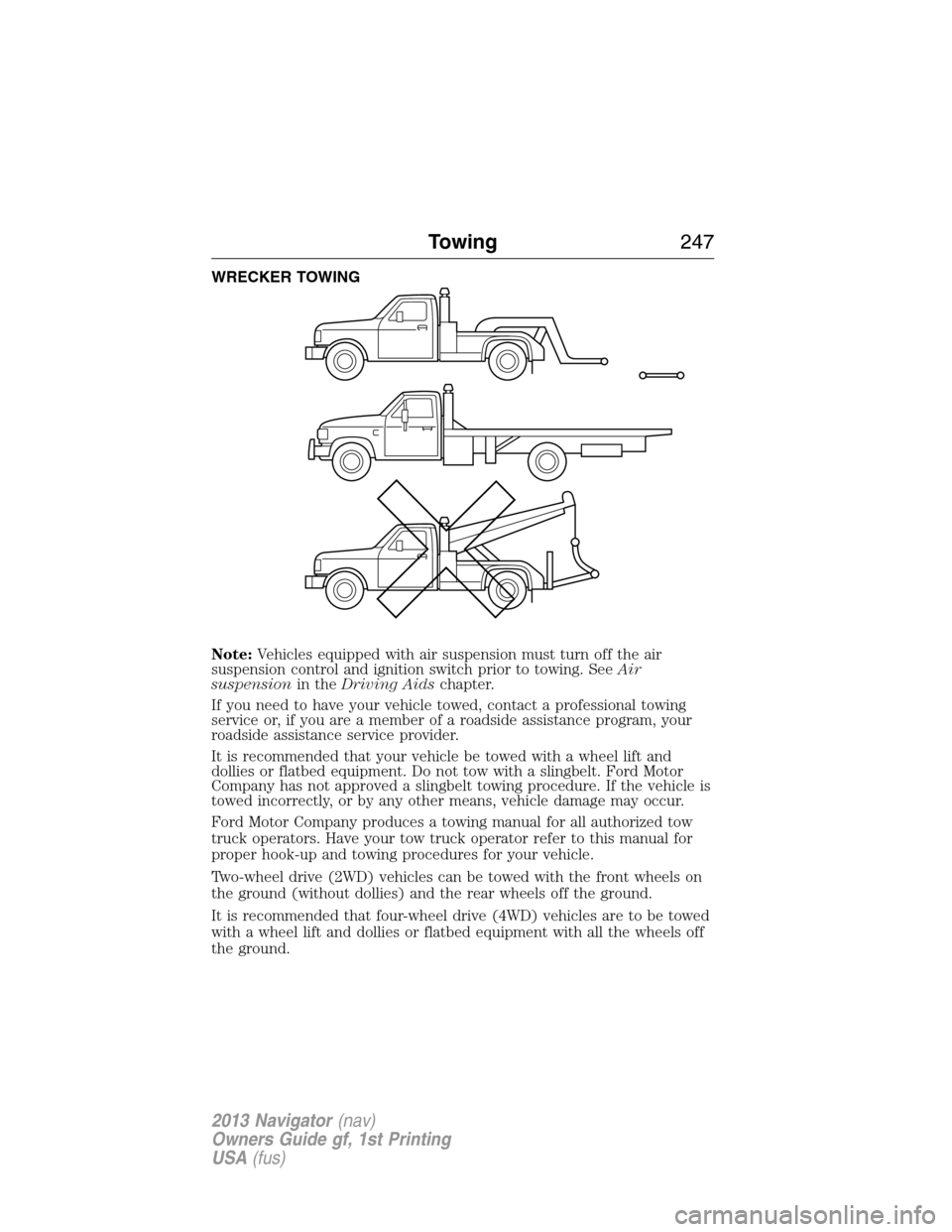
It is recommended that your vehicle be towed with a wheel lift and
dollies or flatbed equipment. Do not tow with a slingbelt. Ford Motor
Company has not approved a slingbelt towing procedure. If the vehicle is
towed incorrectly, or by any other means, vehicle damage may occur.
Ford Motor Company produces a towing manual for all authorized tow
truck operators. Have your tow truck operator refer to this manual for
proper hook-up and towing procedures for your vehicle.
Two-wheel drive (2WD) vehicles can be towed with the front wheels on
the ground (without dollies) and the rear wheels off the ground.
It is recommended that four-wheel drive (4WD) vehicles are to be towed
with a wheel lift and dollies or flatbed equipment with all the wheels off
the ground.
Towing247
2013 Navigator(nav)
Owners Guide gf, 1st Printing
USA(fus)
Page 308 of 481
Four-Wheel Drive (4WD) System (if equipped)
WARNING:Do not become overconfident in the ability of 4WD
vehicles. Although a 4WD vehicle may accelerate better than
two-wheel drive vehicle in low traction situations, it won’t stop any
faster than two-wheel drive vehicles. Always drive at a safe speed.
A vehicle equipped with four-wheel drive (when selected) has the ability
to use all four wheels to power itself. This increases traction which may
enable you to safely drive over terrain and road conditions that a
conventional two-wheel drive vehicle cannot.
Power is supplied to all four wheels through a transfer case or power
transfer unit. Four-wheel drive vehicles allow you to select different drive
modes as necessary. Information on transfer case operation and shifting
procedures can be found in theTransmissionchapter. Information on
transfer case maintenance can be found in theMaintenancechapter.
You should become thoroughly familiar with this information before you
operate your vehicle.
On some four-wheel drive models, the initial shift from two-wheel drive
to four-wheel drive while the vehicle is moving can cause a momentary
clunk and ratcheting sound. These sounds are normal as the front
drivetrain comes up to speed and is not cause for concern.
308Wheels and Tires
2013 Navigator(nav)
Owners Guide gf, 1st Printing
USA(fus)
Page 315 of 481
H.U.S. DOT Tire Identification Number (TIN):This begins with the
letters DOT and indicates that the tire meets all federal standards. The
next two numbers or letters are the plant code designating where it was
manufactured, the next two are the tire size code and the last four
numbers represent the week and year the tire was built. For example,
the numbers 317 mean the 31st week of 1997. After 2000 the numbers
go to four digits. For example, 2501 means the 25th week of 2001. The
numbers in between are identification codes used for traceability. This
information is used to contact customers if a tire defect requires a recall.
I.M+S or M/S:Mud and Snow, or
AT:All Terrain, or
AS:All Season.
J.Tire Ply Composition and Material Used:Indicates the number of
plies or the number of layers of rubber-coated fabric in the tire tread and
sidewall. Tire manufacturers also must indicate the ply materials in the
tire and the sidewall, which include steel, nylon, polyester, and others.
K.Maximum Load:Indicates the maximum load in kilograms and
pounds that can be carried by the tire. See the Safety Compliance
Certification Label (affixed to either the door hinge pillar, door-latch
post, or the door edge that meets the door-latch post, next to the
driver’s seating position), for the correct tire pressure for your vehicle.
L.Treadwear, Traction and Temperature Grades
•Treadwear:The treadwear grade is a comparative rating based on the
wear rate of the tire when tested under controlled conditions on a
specified government test course. For example, a tire graded 150
would wear one and one-half (1
12) times as well on the government
course as a tire graded 100.
•Traction:The traction grades, from highest to lowest are AA, A, B,
and C. The grades represent the tire’s ability to stop on wet pavement
as measured under controlled conditions on specified government test
surfaces of asphalt and concrete. A tire marked C may have poor
traction performance.
•Temperature:The temperature grades are A (the highest), B and C,
representing the tire’s resistance to the generation of heat and its
ability to dissipate heat when tested under controlled conditions on a
specified indoor laboratory test wheel.
Wheels and Tires315
2013 Navigator(nav)
Owners Guide gf, 1st Printing
USA(fus)
Page 316 of 481
M.Maximum Permissible Inflation Pressure:Indicates the tire
manufacturers’ maximum permissible pressure and/or the pressure at
which the maximum load can be carried by the tire. This pressure is
normally higher than the manufacturer’s recommended cold inflation
pressure which can be found on the Safety Compliance Certification
Label (affixed to either the door hinge pillar, door-latch post, or the door
edge that meets the door-latch post, next to the driver’s seating
position), or Tire Label which is located on the B-Pillar or the edge of
the driver’s door. The cold inflation pressure should never be set lower
than the recommended pressure on the vehicle label.
The tire suppliers may have additional markings, notes or warnings, such
as standard load, radial tubeless, etc.
Additional Information Contained on the Tire Sidewall for LT Type
Tires
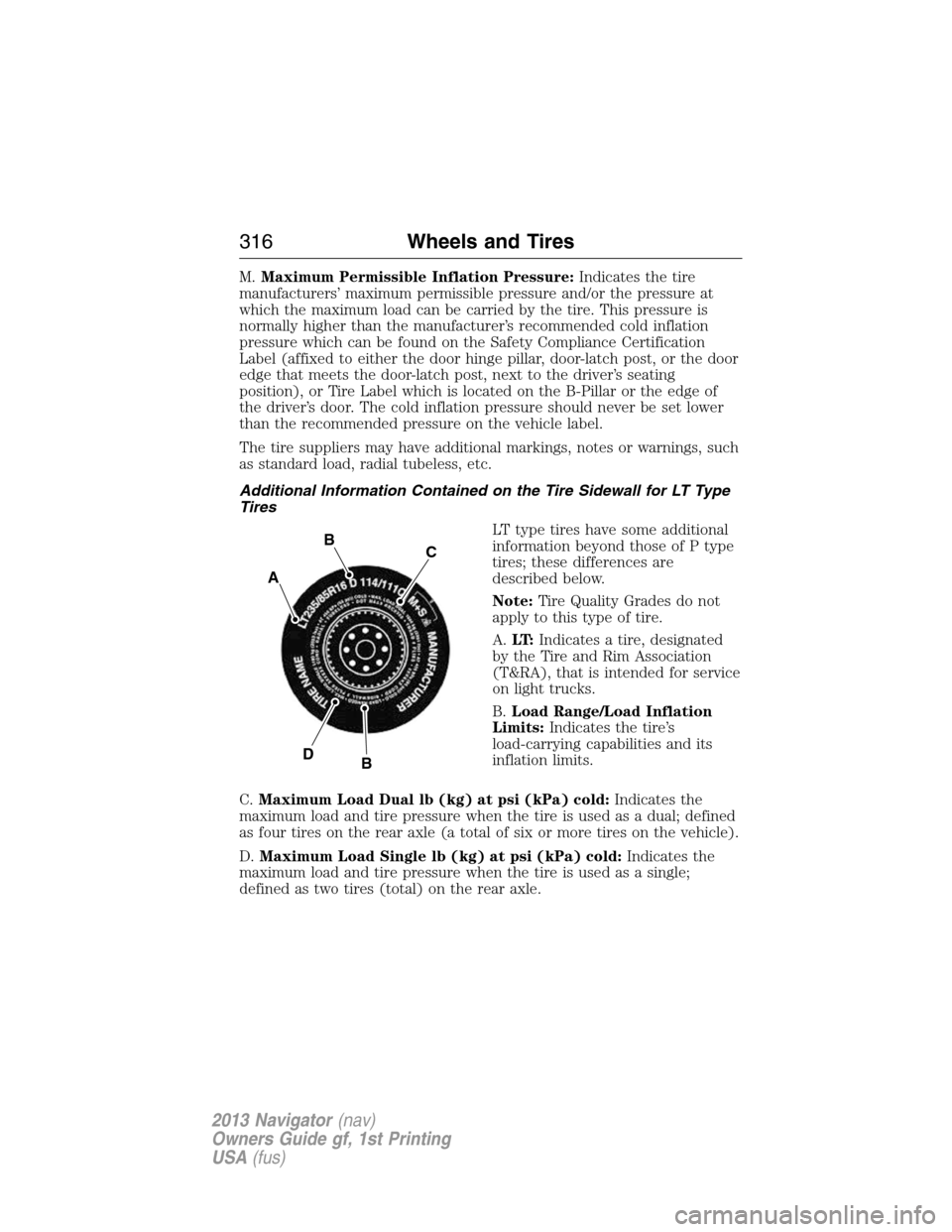
LT type tires have some additional
information beyond those of P type
tires; these differences are
described below.
Note:Tire Quality Grades do not
apply to this type of tire.
A.LT:Indicates a tire, designated
by the Tire and Rim Association
(T&RA), that is intended for service
on light trucks.
B.Load Range/Load Inflation
Limits:Indicates the tire’s
load-carrying capabilities and its
inflation limits.
C.Maximum Load Dual lb (kg) at psi (kPa) cold:Indicates the
maximum load and tire pressure when the tire is used as a dual; defined
as four tires on the rear axle (a total of six or more tires on the vehicle).
D.Maximum Load Single lb (kg) at psi (kPa) cold:Indicates the
maximum load and tire pressure when the tire is used as a single;
defined as two tires (total) on the rear axle.
A
BC
BD
316Wheels and Tires
2013 Navigator(nav)
Owners Guide gf, 1st Printing
USA(fus)
Page 324 of 481
Tire and Wheel Alignment
A bad jolt from hitting a curb or pothole can cause the front end of your
vehicle to become misaligned or cause damage to your tires. If your
vehicle seems to pull to one side when you are driving, the wheels may
be out of alignment. Have an authorized dealer check the wheel
alignment periodically.
Wheel misalignment in the front or the rear can cause uneven and rapid
treadwear of your tires and should be corrected by an authorized dealer.
Front-wheel drive vehicles and those with an independent rear
suspension (if equipped) may require alignment of all four wheels.
The tires should also be balanced periodically. An unbalanced tire and
wheel assembly may result in irregular tire wear.
Tire Rotation
Note:If your tires show uneven wear ask an authorized dealer to check
for and correct any wheel misalignment, tire imbalance or mechanical
problem involved before tire rotation.
Note:Your vehicle may be equipped with a dissimilar spare tire and
wheel assembly. A dissimilar spare tire/wheel is defined as a spare tire or
wheel that is different in brand, size or appearance from the road tires
and wheels. If you have a dissimilar spare tire and wheel assembly, it is
intended for temporary use only and should not be used in a tire
rotation.
Note:After having your tires rotated, inflation pressure must be checked
and adjusted to the vehicle requirements.
Rotating your tires at the recommended interval (as indicated in your
scheduled maintenance) will help your tires wear more evenly, providing
better tire performance and longer tire life.
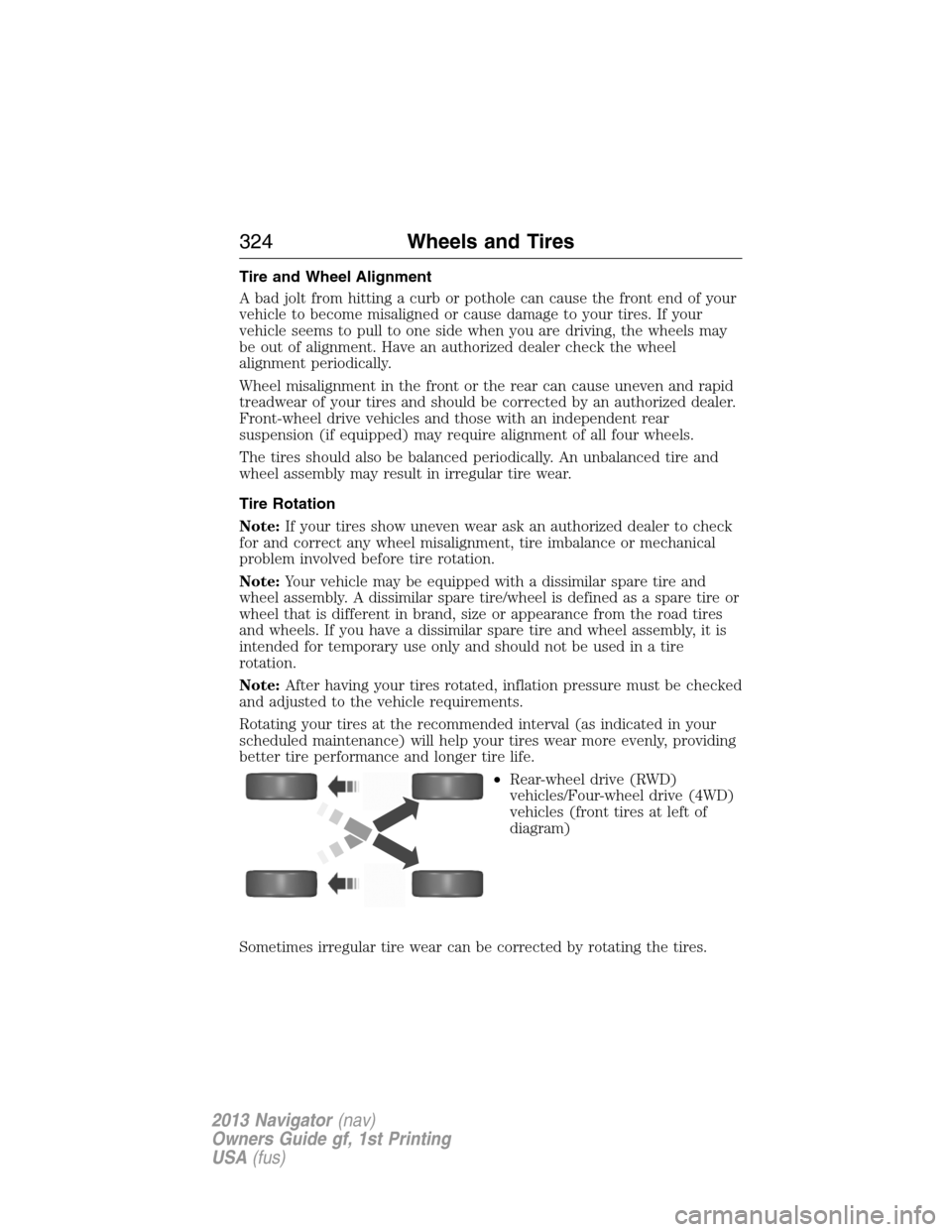
•Rear-wheel drive (RWD)
vehicles/Four-wheel drive (4WD)
vehicles (front tires at left of
diagram)
Sometimes irregular tire wear can be corrected by rotating the tires.
324Wheels and Tires
2013 Navigator(nav)
Owners Guide gf, 1st Printing
USA(fus)
Page 476 of 481
snow and ice ...........................211
through water .................210, 250
Dual automatic temperature
control (DATC) .................146, 148
DVD (if equipped) ....................127
DVD region coding ...................135
DVD system ...............................127
E
Electronic message center .......104
Electronic stability control ......217
Emergencies, roadside
jump-starting ..........................255
running out of fuel .................192
Emission control system ..........196
End user license agreement ....457
Engine ........................................339
cleaning ...................................300
coolant .....................................279
fail-safe cooling .......................282
idle speed control ...................285
lubrication specifications .......340
refill capacities ........................340
service points ..........................277
Engine block heater .................188
Engine oil
checking and adding ..............278
dipstick ....................................278
filter, specifications ................343
refill capacities ........................340
specifications ..........................340
Event data recording ..................12
Exhaust fumes ..........................188
F
Fail safe cooling ........................282Fleet MyKey programming ........58
Flexible Fuel Vehicle (FFV) ....190
Floor mats .................................251
Fluid capacities .........................340
Fog lamps ....................................87
Forward and reverse sensing
system ........................................219
Four-Wheel Drive vehicles .......205
description ..............................206
driving off road .......................207
indicator light .........................205
Fuel
cap ...........................................194
capacity ...................................340
choosing the right fuel ...........191
filler funnel .............................192
filling your vehicle with fuel ..194
filter, specifications ................284
fuel pump shut-off ..................254
octane rating ...................192, 339
quality ......................................191
running out of fuel .................192
safety information relating to
automotive fuels .....................190
Fuel - flex fuel vehicle
(FFV) .................................190–191
Fuses ..........................266–267, 271
G
Garage door opener ..........171, 175
Gas cap (see Fuel cap) ............194
Gauges .........................................97
H
Hazard flashers .........................254
HD Radio™ ...............................427
476Index
2013 Navigator(nav)
Owners Guide gf, 1st Printing
USA(fus)