transmission LINCOLN NAVIGATOR 2017 Owners Manual
[x] Cancel search | Manufacturer: LINCOLN, Model Year: 2017, Model line: NAVIGATOR, Model: LINCOLN NAVIGATOR 2017Pages: 532, PDF Size: 3.9 MB
Page 6 of 532
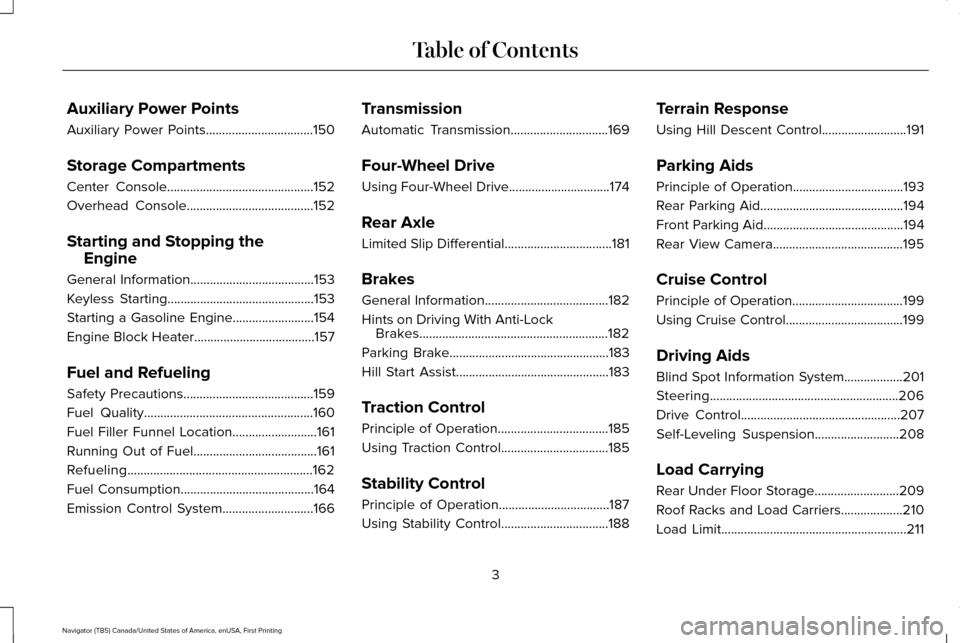
Auxiliary Power Points
Auxiliary Power Points.................................150
Storage Compartments
Center Console.............................................152
Overhead Console
.......................................152
Starting and Stopping the Engine
General Information......................................153
Keyless Starting.............................................153
Starting a Gasoline Engine.........................154
Engine Block Heater
.....................................157
Fuel and Refueling
Safety Precautions........................................159
Fuel Quality
....................................................160
Fuel Filler Funnel Location..........................161
Running Out of Fuel......................................161
Refueling.........................................................162
Fuel Consumption
.........................................164
Emission Control System
............................166 Transmission
Automatic Transmission..............................169
Four-Wheel Drive
Using Four-Wheel Drive
...............................174
Rear Axle
Limited Slip Differential
.................................181
Brakes
General Information
......................................182
Hints on Driving With Anti-Lock Brakes
..........................................................182
Parking Brake.................................................183
Hill Start Assist...............................................183
Traction Control
Principle of Operation..................................185
Using Traction Control.................................185
Stability Control
Principle of Operation..................................187
Using Stability Control.................................188 Terrain Response
Using Hill Descent Control..........................191
Parking Aids
Principle of Operation
..................................193
Rear Parking Aid............................................194
Front Parking Aid
...........................................194
Rear View Camera
........................................195
Cruise Control
Principle of Operation
..................................199
Using Cruise Control
....................................199
Driving Aids
Blind Spot Information System
..................201
Steering..........................................................206
Drive Control
.................................................207
Self-Leveling Suspension
..........................208
Load Carrying
Rear Under Floor Storage..........................209
Roof Racks and Load Carriers...................210
Load Limit
.........................................................211
3
Navigator (TB5) Canada/United States of America, enUSA, First Printing Table of Contents
Page 7 of 532
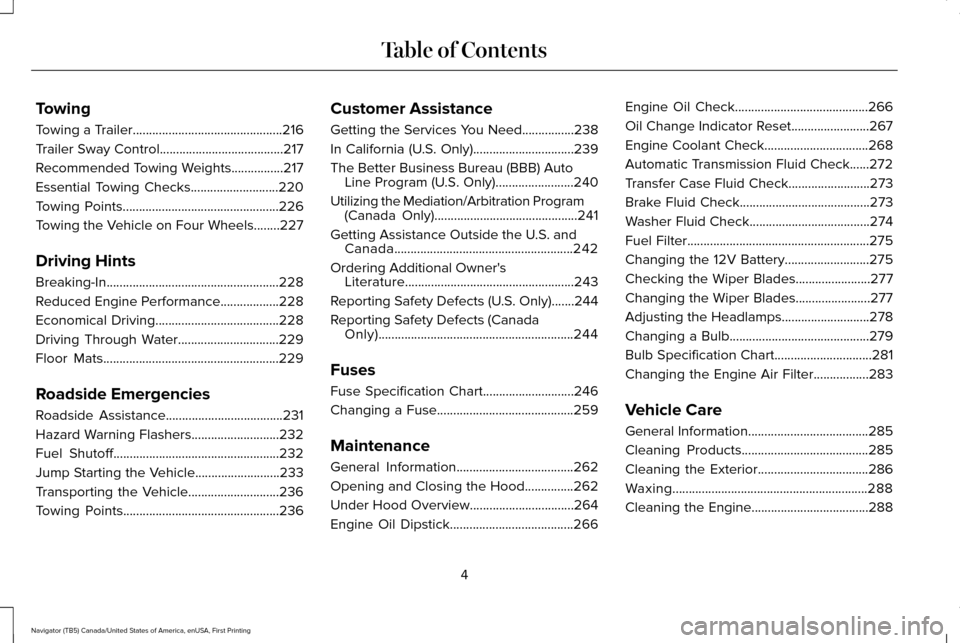
Towing
Towing a Trailer..............................................216
Trailer Sway Control
......................................217
Recommended Towing Weights
................217
Essential Towing Checks...........................220
Towing Points................................................226
Towing the Vehicle on Four Wheels........227
Driving Hints
Breaking-In.....................................................228
Reduced Engine Performance
..................228
Economical Driving
......................................228
Driving Through Water...............................229
Floor Mats......................................................229
Roadside Emergencies
Roadside Assistance
....................................231
Hazard Warning Flashers...........................232
Fuel Shutoff
...................................................232
Jump Starting the Vehicle..........................233
Transporting the Vehicle............................236
Towing Points
................................................236 Customer Assistance
Getting the Services You Need................238
In California (U.S. Only)...............................239
The Better Business Bureau (BBB) Auto
Line Program (U.S. Only)
........................240
Utilizing the Mediation/Arbitration Program (Canada Only)............................................241
Getting Assistance Outside the U.S. and Canada.......................................................242
Ordering Additional Owner's Literature....................................................243
Reporting Safety Defects (U.S. Only).......244
Reporting Safety Defects (Canada Only)............................................................244
Fuses
Fuse Specification Chart
............................246
Changing a Fuse..........................................259
Maintenance
General Information
....................................262
Opening and Closing the Hood...............262
Under Hood Overview................................264
Engine Oil Dipstick......................................266 Engine Oil Check.........................................266
Oil Change Indicator Reset........................267
Engine Coolant Check................................268
Automatic Transmission Fluid Check......272
Transfer Case Fluid Check.........................273
Brake Fluid Check
........................................273
Washer Fluid Check
.....................................274
Fuel Filter
........................................................275
Changing the 12V Battery
..........................275
Checking the Wiper Blades
.......................277
Changing the Wiper Blades.......................277
Adjusting the Headlamps...........................278
Changing a Bulb
...........................................279
Bulb Specification Chart
..............................281
Changing the Engine Air Filter.................283
Vehicle Care
General Information
.....................................285
Cleaning Products
.......................................285
Cleaning the Exterior..................................286
Waxing............................................................288
Cleaning the Engine....................................288
4
Navigator (TB5) Canada/United States of America, enUSA, First Printing Table of Contents
Page 8 of 532
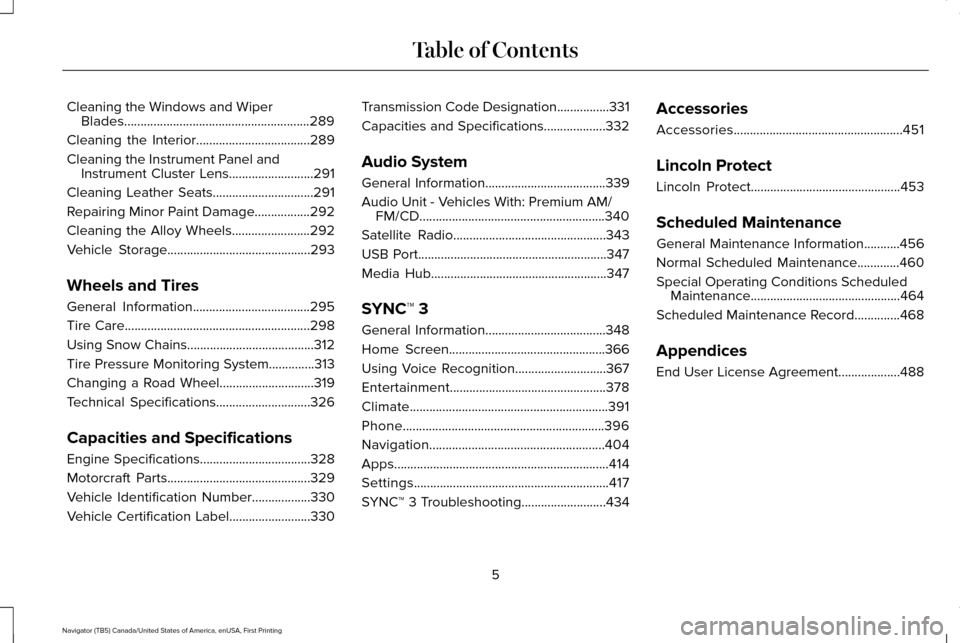
Cleaning the Windows and Wiper
Blades.........................................................289
Cleaning the Interior...................................289
Cleaning the Instrument Panel and Instrument Cluster Lens..........................291
Cleaning Leather Seats...............................291
Repairing Minor Paint Damage.................292
Cleaning the Alloy Wheels........................292
Vehicle Storage
............................................293
Wheels and Tires
General Information
....................................295
Tire Care
.........................................................298
Using Snow Chains.......................................312
Tire Pressure Monitoring System..............313
Changing a Road Wheel.............................319
Technical Specifications.............................326
Capacities and Specifications
Engine Specifications..................................328
Motorcraft Parts
............................................329
Vehicle Identification Number
..................330
Vehicle Certification Label
.........................330 Transmission Code Designation................331
Capacities and Specifications...................332
Audio System
General Information.....................................339
Audio Unit - Vehicles With: Premium AM/
FM/CD.........................................................340
Satellite Radio
...............................................343
USB Port
..........................................................347
Media Hub
......................................................347
SYNC™ 3
General Information
.....................................348
Home Screen
................................................366
Using Voice Recognition............................367
Entertainment................................................378
Climate.............................................................391
Phone..............................................................396
Navigation......................................................404
Apps..................................................................414
Settings............................................................417
SYNC™ 3 Troubleshooting
..........................434 Accessories
Accessories....................................................451
Lincoln Protect
Lincoln Protect..............................................453
Scheduled Maintenance
General Maintenance Information...........456
Normal Scheduled Maintenance.............460
Special Operating Conditions Scheduled
Maintenance..............................................464
Scheduled Maintenance Record..............468
Appendices
End User License Agreement...................488
5
Navigator (TB5) Canada/United States of America, enUSA, First Printing Table of Contents
Page 16 of 532
Collision Repairs
We hope that you never experience a
collision, but accidents do happen. Genuine
Ford replacement collision parts meet our
stringent requirements for fit, finish, structural
integrity, corrosion protection and dent
resistance. During vehicle development we
validate that these parts deliver the intended
level of protection as a whole system. A
great way to know for sure you are getting
this level of protection is to use genuine Ford
replacement collision parts.
Warranty on Replacement Parts
Genuine Ford and Motorcraft replacement
parts are the only replacement parts that
benefit from a Lincoln Warranty. Damage
caused to your vehicle as a result of the
failure of non-Ford parts may not be covered
by the Lincoln Warranty. For additional
information, refer to the terms and conditions
of the Lincoln Warranty.
SPECIAL NOTICES
New Vehicle Limited Warranty
For a detailed description of what is covered
and what is not covered by your vehicle
’s
New Vehicle Limited Warranty, refer to the
Warranty Manual that is provided to you
along with your Owner’ s Manual.
Special Instructions
For your added safety, your vehicle is fitted
with sophisticated electronic controls. WARNINGS
You risk death or serious injury to
yourself and others if you do not follow
the instruction highlighted by the warning
symbol. Failure to follow the specific
warnings and instructions could result in
personal injury. Never place front seat mounted
rear-facing child or infant seats in front
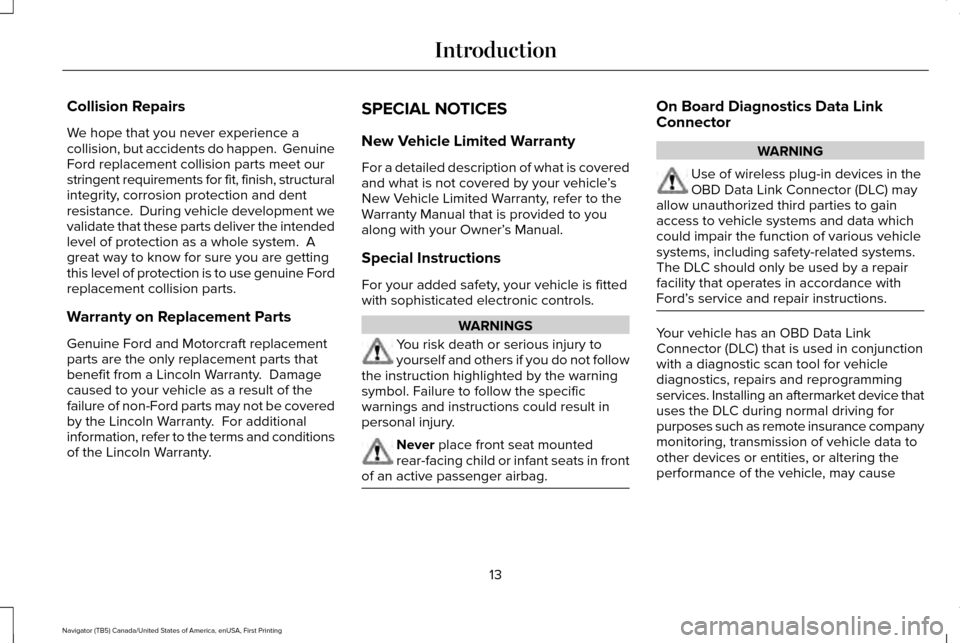
of an active passenger airbag. On Board Diagnostics Data Link
Connector
WARNING
Use of wireless plug-in devices in the
OBD Data Link Connector (DLC) may
allow unauthorized third parties to gain
access to vehicle systems and data which
could impair the function of various vehicle
systems, including safety-related systems.
The DLC should only be used by a repair
facility that operates in accordance with
Ford’ s service and repair instructions. Your vehicle has an OBD Data Link
Connector (DLC) that is used in conjunction
with a diagnostic scan tool for vehicle
diagnostics, repairs and reprogramming
services. Installing an aftermarket device that
uses the DLC during normal driving for
purposes such as remote insurance company
monitoring, transmission of vehicle data to
other devices or entities, or altering the
performance of the vehicle, may cause
13
Navigator (TB5) Canada/United States of America, enUSA, First Printing Introduction
Page 41 of 532
Then...
If...
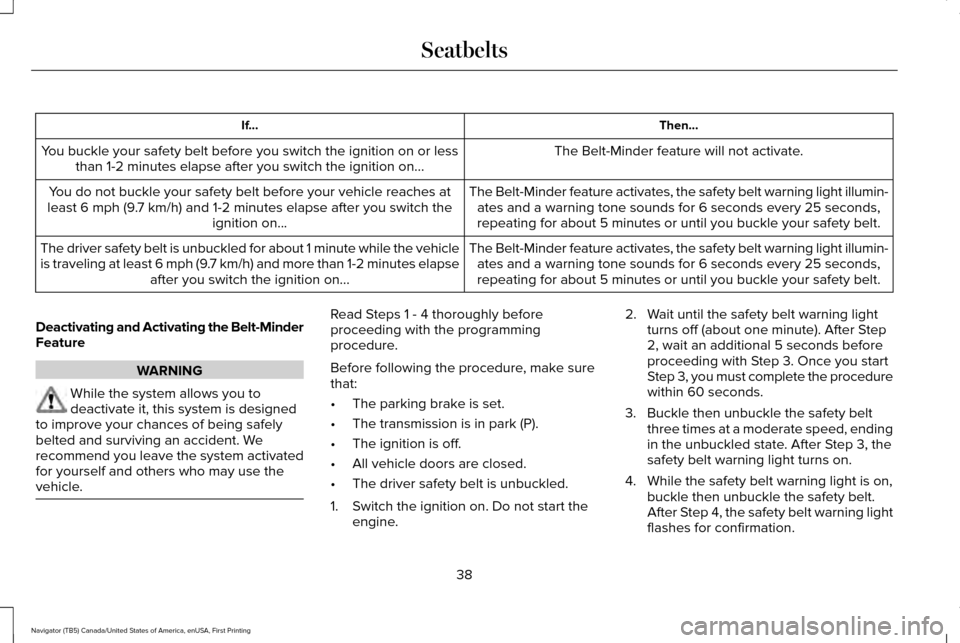
The Belt-Minder feature will not activate.
You buckle your safety belt before you switch the ignition on or less
than 1-2 minutes elapse after you switch the ignition on...
The Belt-Minder feature activates, the safety belt warning light illumin\
-ates and a warning tone sounds for 6 seconds every 25 seconds,
repeating for about 5 minutes or until you buckle your safety belt.
You do not buckle your safety belt before your vehicle reaches at
least 6 mph (9.7 km/h) and 1-2 minutes elapse after you switch the ignition on...
The Belt-Minder feature activates, the safety belt warning light illumin\
-ates and a warning tone sounds for 6 seconds every 25 seconds,
repeating for about 5 minutes or until you buckle your safety belt.
The driver safety belt is unbuckled for about 1 minute while the vehicle\
is traveling at least 6 mph (9.7 km/h) and more than 1-2 minutes elapse
after you switch the ignition on...
Deactivating and Activating the Belt-Minder
Feature WARNING
While the system allows you to
deactivate it, this system is designed
to improve your chances of being safely
belted and surviving an accident. We
recommend you leave the system activated
for yourself and others who may use the
vehicle. Read Steps 1 - 4 thoroughly before
proceeding with the programming
procedure.
Before following the procedure, make sure
that:
•
The parking brake is set.
• The transmission is in park (P).
• The ignition is off.
• All vehicle doors are closed.
• The driver safety belt is unbuckled.
1. Switch the ignition on. Do not start the engine. 2. Wait until the safety belt warning light
turns off (about one minute). After Step
2, wait an additional 5 seconds before
proceeding with Step 3. Once you start
Step 3, you must complete the procedure
within 60 seconds.
3. Buckle then unbuckle the safety belt three times at a moderate speed, ending
in the unbuckled state. After Step 3, the
safety belt warning light turns on.
4. While the safety belt warning light is on, buckle then unbuckle the safety belt.
After Step 4, the safety belt warning light
flashes for confirmation.
38
Navigator (TB5) Canada/United States of America, enUSA, First Printing Seatbelts
Page 54 of 532
3. Remove the old battery.
4. Insert a new battery with the + facing
downward. Press the battery down to
make sure it is fully in the housing.
5. Reinstall the battery housing cover onto the transmitter and install the key blade.
Car Finder Press the button twice within three
seconds.
The horn sounds and the direction indicators
flash. We recommend you use this method
to locate your vehicle, rather than using the
panic alarm. Note:
If any door or the liftgate is open, or if
the hood is open on vehicles with an
anti-theft alarm or remote start, the horn will
sound twice and the direction indicators will
not flash.
Sounding the Panic Alarm Press the button to sound the
panic alarm. Press the button
again or switch the ignition on to
turn it off.
Note: The panic alarm only operates when
the ignition is off.
Remote Start
(If Equipped) WARNING
To avoid exhaust fumes, do not use
remote start if your vehicle is parked
indoors or in areas that are not well
ventilated. Note:
Do not use remote start if your fuel
level is low. The remote start button is on the
transmitter.This feature allows you to start your vehicle
from the outside. The transmitter has an
extended operating range.
Vehicles with automatic climate control can
be configured to operate when the vehicle
is remote started.
See Automatic Climate
Control (page 122).
Many states and provinces have restrictions
for the use of remote start. Check your local
and state or provincial laws for specific
requirements regarding remote start
systems.
The remote start system does not work if any
of the following occur:
• The ignition is on.
• The anti-theft alarm triggers.
• You switch off the feature.
• The hood is open.
• The transmission is not in park (P).
• The battery voltage is below the
minimum operating voltage.
• The service engine soon indicator was
on the last time your vehicle was driven.
51
Navigator (TB5) Canada/United States of America, enUSA, First Printing Keys and Remote ControlsE138622 E138623 E138624 E138625
Page 65 of 532
Press and hold the unlock and lock buttons
on the remote control simultaneously for at
least four seconds with the ignition off. The
direction indicators flash twice to confirm the
change.
To return to the original unlocking function,
repeat the process.
Locking the Doors
Press the button to lock all doors.
The direction indicators will flash.
Press the button again within three seconds
to confirm that all the doors are closed. The
doors will lock again, the horn will sound and
the direction indicators will flash if all the
doors and the liftgate are closed.
Note: If the system does not function, use
the key blade to lock and unlock your
vehicle. Mislock
If any door or the liftgate is open, or if the
hood is open on vehicles with an anti-theft
alarm or remote start, the horn sounds twice
and the direction indicators do not flash. You
can switch this feature on or off in the
information display. See Information
Displays (page 102).
Opening the Liftgate Press twice within three seconds
to open the liftgate.
Activating Intelligent Access
The intelligent access key must be within 3 ft
(1 m)
of the driver door or liftgate.
At a Door
You can use the keyless entry keypad to lock
and unlock the doors.
See Keyless Entry
(page 68). At the Liftgate
The liftgate unlocks and opens automatically
when you press the liftgate release button.
See
Power Liftgate (page 64).
Smart Unlocks for Intelligent Access
Keys
This helps to prevent you from locking your
key inside the passenger compartment or
rear cargo area.
When you electronically lock your vehicle
with any door open, the transmission is in
park (P) and the ignition is off, the system
searches for an intelligent access key inside
your vehicle after you close the last door. If
the system finds a key, all of the doors will
immediately unlock and the horn will sound
twice, indicating that a key is inside.
You can override the smart unlock feature
and intentionally lock the intelligent access
key inside your vehicle.
62
Navigator (TB5) Canada/United States of America, enUSA, First Printing Doors and LocksE138623 E138630
Page 66 of 532
To do this, lock your vehicle after you have
closed all the doors by:
•
Using the keyless entry keypad.
• Pressing the lock button on another
intelligent access key.
When you open one of the front doors and
lock your vehicle using the power door lock
control, all doors will lock then unlock if:
• The ignition is on.
• The ignition is off and the transmission
is not in park (P).
Auto Relock
If you press the unlock button on the remote
control and do not open a door within 45
seconds, your vehicle will lock and the alarm
will arm. You can switch this feature on or off
in the information display. See Information
Displays (page 102). Autolock
(If Equipped)
Autolock locks all the doors when all of the
following occur:
• All doors are closed.
• The ignition is on.
• You shift into any gear putting your
vehicle in motion.
• Your vehicle's speed is greater than
12 mph (20 km/h)
.
Autolock repeats when:
• You open then close any door while the
ignition is on and your vehicle's speed is
less than
9 mph (15 km/h).
• Your vehicle's speed is greater than
12 mph (20 km/h)
. Autounlock
Autounlock unlocks all the doors when all of
the following occur:
•
The ignition is on, all the doors are
closed, and your vehicle has been
moving at a speed greater than
12 mph
(20 km/h).
• You stop your vehicle and switch the
ignition off or to accessory.
• You open the driver door within 10
minutes of switching the ignition off or to
accessory.
Note: The doors do not autounlock if you
electronically lock your vehicle after you
switch the ignition off and before you open
the driver door.
Enabling or Disabling Autolock and
Autounlock
You can enable or disable autolock and
autounlock in the information display or an
authorized dealer can do it for you.
See
General Information (page 102).
63
Navigator (TB5) Canada/United States of America, enUSA, First Printing Doors and Locks
Page 68 of 532
The liftgate only operates with the
transmission in park (P).
Three warning tones sound as the liftgate
begins to power close. If there is a problem
with the open or close request, one of the
following may occur:
•
One chime sounds if the ignition is on
and the transmission is not in park (P).
• Three chimes sound if the battery voltage
is below the minimum operating voltage.
• One chime sounds if the vehicle speed
is at or above 3 mph (5 km/h).
If the liftgate starts to close after it has fully
opened, this indicates there may be
excessive weight on the liftgate or a possible
strut failure. A repetitive tone sounds and
the liftgate closes under control. Remove any
excessive weight from the liftgate. If the
liftgate continues to close after opening,
have the system checked by an authorized
dealer. Opening and Closing the Liftgate WARNING
Make sure all persons are clear of the
power liftgate area before using the
power liftgate control. Note:
Make sure the area behind your
vehicle is free from obstruction and that
there is enough room for you to operate the
liftgate. Objects too close to your vehicle, for
example a wall, garage door or another
vehicle may come into contact with the
moving liftgate. This could damage the
liftgate and its components.
Note: Be careful when opening or closing
the liftgate in a garage or other enclosed
area to avoid damaging the liftgate.
Note: Do not leave the liftgate open while
driving. This could damage the liftgate and
its components.
From the Instrument Panel Press the button on the instrument
panel.With the Remote Control Press the button twice within three
seconds.
With the Outside Control Button
Opening the Liftgate
1. Unlock the liftgate with the remote control or power door unlock control. If
an intelligent access key is within
3 ft
(1 m) of the liftgate, the liftgate unlocks
when you press the liftgate release
button.
65
Navigator (TB5) Canada/United States of America, enUSA, First Printing Doors and Locks E138630
Page 90 of 532
Type 1 - Conventional (Non-
Configurable)
The daytime running lamps turn on when:
1. The ignition is switched to the on
position.
2. The transmission is not in park (P) for vehicles with automatic transmissions or
the parking brake is released for vehicles
with manual transmissions.
3. The lighting control is in the off, parking lamp or autolamps positions.
4. The headlamps are off.
Type 2 - Configurable
Switch the daytime running lamps on or off
using the information display controls. See
Information Displays (page 102).
The daytime running lamps turn on when:
1. They are switched on in the information display. See Information Displays (page
102
).
2. The ignition is switched to the on position. 3. The transmission is not in park (P) for
vehicles with automatic transmissions or
the parking brake is released for vehicles
with manual transmissions.
4. The lighting control is in the autolamps position.
5. The headlamps are off.
The other lighting control switch positions
do not activate the daytime running lamps,
and you can use them to temporarily override
autolamp control.
When switched off in the information display,
the daytime running lamps are off in all
lighting control switch positions.
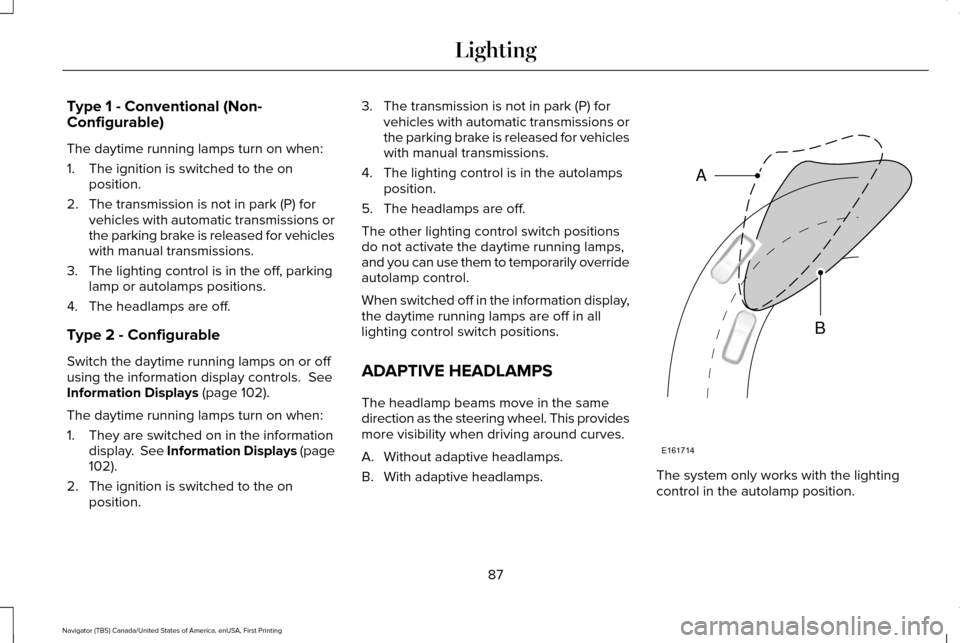
ADAPTIVE HEADLAMPS
The headlamp beams move in the same
direction as the steering wheel. This provides
more visibility when driving around curves.
A. Without adaptive headlamps.
B. With adaptive headlamps. The system only works with the lighting
control in the autolamp position.
87
Navigator (TB5) Canada/United States of America, enUSA, First Printing LightingE161714
B
A