check engine LINCOLN TOWN CAR 1997 User Guide
[x] Cancel search | Manufacturer: LINCOLN, Model Year: 1997, Model line: TOWN CAR, Model: LINCOLN TOWN CAR 1997Pages: 305, PDF Size: 2.68 MB
Page 230 of 305

228q
With the engine OFF and cool, remove the
pressure cap, located on the coolant reservoir.
Remove the heater hose and clamp, located on
the rear of the intake manifold.
q
Add a 50/50 mixture of specified coolant and
water to the coolant reservoir. Refer toRefill
Capacitieslater in this chapter for the correct
amount. Add coolant to the reservoir until the
coolant continuously flows out of the tube in
the rear of engine. Reattach hose and secure
clamp.
q
Reinstall the pressure cap to the fully installed
position.
q
Start and idle the engine until the radiator
upper hose is warm (this indicates the
thermostat is open and coolant is flowing
through the entire system).
q
Immediately shut off the engine and let cool.
Cautiously remove the pressure relief cap and
add a 50/50 mixture of specified coolant and
water until the coolant is at the COLD FILL
level in the coolant reservoir.
q
Reinstall the pressure cap securely.
q
Check for leaks at the draincock.
q
Recheck the engine coolant level, using the
recommended procedure, after one or two
occasions of vehicle use.
File:11fnmct.ex
Update:Mon Jun 17 13:54:56 1996
Page 231 of 305
229
Power Steering FluidCheck the level of the power steering fluid at least
twice a year (i.e., every Spring and Fall).Checking and Adding Power Steering
Fluid1. Start the engine and let it run until the power
steering fluid reaches normal operating
temperature. The power steering fluid will be at
the right temperature when the engine coolant
temperature gauge in the instrument cluster is
near the center of the NORMAL operating
temperature range.
2. While the engine idles, turn the steering wheel
back and forth several times. Make sure that
the cap assembly is installed at this time.
3. Turn the engine off and check the level on the
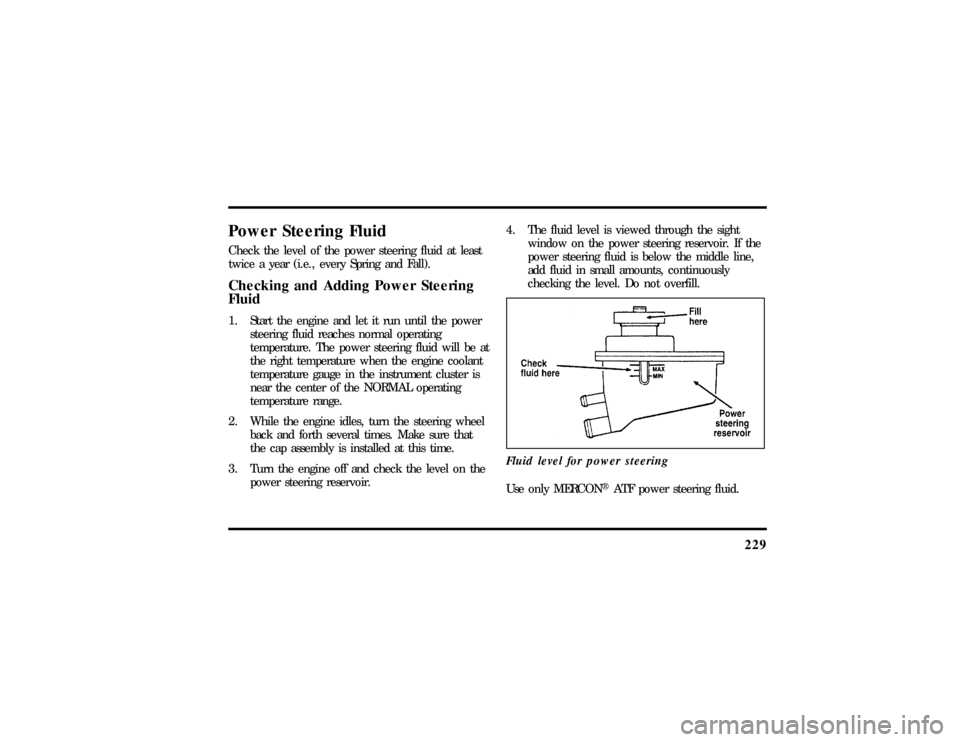
power steering reservoir.4. The fluid level is viewed through the sight
window on the power steering reservoir. If the
power steering fluid is below the middle line,
add fluid in small amounts, continuously
checking the level. Do not overfill.
Fluid level for power steering
Use only MERCONHATF power steering fluid.
File:11fnmct.ex
Update:Mon Jun 17 13:54:56 1996
Page 232 of 305

230If the power steering fluid is low, do not drive your
vehicle for a long period of time before adding fluid.
This can damage the power steering pump.Automatic Transmission FluidUnder normal circumstances, you do not need to
check the fluid level of the transmission, since your
vehicle does not use up transmission fluid. Refer to
theMaintenance Schedulebooklet for replacement
intervals. However, if the transmission is not
working properly Ð for instance, the transmission
may slip or shift slowly, or you may notice some
sign of fluid leakage Ð the fluid level should be
checked.
It is preferable to check the transmission fluid level
at normal operating temperature150ÊF-170ÊF
(66ÊC-77ÊC),after approximately 20 miles (30 km)
of driving. However, if necessary, you can check
the fluid level without having to drive 20 miles
(30 km) to obtain a normal operating temperature if
outside temperatures are above50ÊF(10ÊC).NOTE:If the vehicle has been operated for an
extended period at high speeds or in city traffic
during hot weather, or pulling a trailer, the vehicle
should be turned off for about 30 minutes to allow
the fluid to cool before checking.
Checking the Automatic Transmission
FluidWith the vehicle on a level surface and the brake
fully applied, start the engine and move the gear
shift selector through all of the gears allowing
sufficient time for each position to engage. Securely
latch the gear shift selector in the P (Park) position.
Fully set the parking brake and leave the engine
running.
NOTE:Your vehicle should not be driven if the
fluid level is below the bottom hole on the dipstick
and outside temperatures are above50ÊF(10ÊC).
Wipe off the dipstick cap and pull the dipstick out.
Wipe the indicator end clean. Put the dipstick back
into the filler tube and make sure it is fully seated.
File:11fnmct.ex
Update:Mon Jun 17 13:54:56 1996
Page 234 of 305
232BatteryYour vehicle may have a Motorcraft
maintenance-free battery. When the original
equipment battery is replaced under warranty it
may be replaced by a low-maintenance battery. See
Motorcraft Partsat the end of this chapter for the
proper replacement battery.
The low-maintenance battery has removable vent
caps for checking the electrolyte level and adding
water. The electrolyte level should be checked at
least every 24 months or 24,000 miles
(40,000 km) in temperatures up to90ÊF(32ÊC)
and more often in temperatures above90ÊF(32ÊC).
Keep the electrolyte level in each cell up to the
level indicator. Do not overfill.
If the level gets low, refill the battery with distilled
water. If necessary, you can add tap water to the
battery, provided the water is not hard or does not
have a high mineral or alkali content. If the battery
needs water quite often, have the charging system
checked for a possible malfunction.
Help Us Protect Our EnvironmentFord Motor Company strongly recommends that
used lead-acid batteries be returned to an
authorized recycling facility for disposal.
Battery recycling symbolBecause your vehicle's engine is electronically
controlled by a computer, some control conditions
are maintained by power from the battery. If you
ever disconnect the battery or install a new battery,
you must allow the computer to ªrelearnº its idle
conditions before your vehicle will drive properly.
To let the engine do this, put the gearshift in P
(Park), turn off all the accessories, and start the
File:11fnmct.ex
Update:Mon Jun 17 13:54:56 1996
Page 235 of 305

233
vehicle. Let the engine idle for at least one minute.
(Engine must be warm in order to ªlearn.º) Also,
allow approximately 10 miles (16 km) of stop and
go traffic for your vehicle's engine to completely
ªrelearnº its idle.
If you do not let the engine relearn its idle, the idle
quality of your vehicle may be adversely affected
until the idle is relearned. Your vehicle will
eventually relearn its idle while you drive it, but it
takes much longer than if you use the previous
procedure.Wiper BladesCheck the windshield wiper blades at least twice a
year. Also check them whenever they seem less
effective than usual. Substances such as tree sap
and some hot wax treatments used by commercial
car washes reduce the effectiveness of wiper blades.
If the blades do not wipe properly, clean both the
windshield and the wiper blades. Use undiluted
windshield washer solution or a mild detergent.Rinse thoroughly with clear water. Do not use fuel,
kerosene, paint thinner, or other solvents to clean
your wiper blades. These will damage your blades.
To make reaching the wiper blades easy, simply
turn the ignition to the ACC position and turn your
wipers on. Wait for them to reach a vertical
position and turn the ignition to the OFF position.
Do not move the wipers manually. Manually
moving the wipers across the windshield may
damage them.
Wiper blade replacementIf the wiper blades still do not work properly after
you clean them, you may need to replace the wiper
blade assembly or the blade element. When
replacing the wiper blade assembly, blade refill, or
wiper arm always use a Motorcraft part or
equivalent. To replace the blades, follow the
instructions that come with them.
File:11fnmct.ex
Update:Mon Jun 17 13:54:56 1996
Page 247 of 305

245
q
English: MPG = (total miles)/(gallons used).
q
Metric: L/100K = (liters used) x 100/(total
kilometers)
Comparisons With Environmental
Protection Agency (EPA) and Transport
Canada (TC) Fuel Economy EstimatesEPA fuel economy figures are obtained from
laboratory tests under simulated road conditions and
may not reflect the actual conditions you experience
or your style of driving. The EPA fuel economy
estimate is not a guarantee that you will achieve
the fuel economy shown.
The following decrease fuel economy:q
Lack of regular, scheduled maintenance
q
Rapid acceleration and excessive speed
q
Driving with your foot on the brake
q
Sudden stops
q
Extended engine idling
q
Using speed control in hilly terrain
q
Extended use of the A/C, defroster, rear
window defroster and other accessories
q
Underinflated tires
q
Heavy loads
q
Aftermarket add-ons such as bike, ski or luggage
racks, bug deflectors, etc.
Self-Service PointersIf you choose to do your own fueling, you should
also perform a few simple maintenance routines.
This extra effort will save you additional money and
contribute to the driving efficiency of your vehicle.
The following procedures require only a tire gauge,
a rag, an oil can spout and windshield washer fluid.q
Check the engine oil at every refueling stop
q
Clean the windshield, outside mirrors and
headlights
File:11fnmct.ex
Update:Mon Jun 17 13:54:56 1996
Page 250 of 305

248Information about your vehicle's emission control
system is on the Vehicle Emission Control
Information decal located on or near the engine.
This decal identifies engine displacement and gives
some tune-up specifications.How to Prepare Your Vehicle for
Inspection/Maintenance (I/M) TestingIn some localities it may become a legal
requirement to pass an Inspection/Maintenance
(I/M) test of the On-Board Diagnostic (OBD) II
system. If the vehicle's powertrain system or its
battery has just been serviced, the OBD II system is
reset to a not ready for I/M testing condition. To
prepare for I/M testing, the law specifies that
additional city and highway driving is necessary to
complete the check of the OBD II system.
The driving modes required to reach the ready
condition consist of a minimum of 30 minutes of
city and highway driving as described below:
q
At least twenty minutes driving in stop and go,
city type traffic with at least four idle periods.
q
At least ten minutes of driving on an
expressway or highway.
Before completing the above driving modes, the
engine must be warmed up and at operating
temperature. Once started, the vehicle must not be
turned off during these driving modes.
Lights and Bulb ReplacementIt is a good idea to check the operation of the
following lights frequently:q
headlamps
q
high-mount brakelamp
q
tail lamps
q
brakelamps
q
hazard flasher
File:11fnmct.ex
Update:Mon Jun 17 13:54:56 1996
Page 262 of 305

261
Engineq
Start engine every 15 days. Run at fast idle
until it reaches normal operating temperature.
q
With your foot on the brake, shift through all
the gears while the engine is running.
Fuel systemq
Fill fuel tank with high-quality, premium
unleaded fuel until the first automatic shutoff of
the fuel pump nozzle.
NOTE:During extended periods of vehicle storage
(60 days or more), fuel may deteriorate due to
oxidation. This can damage rubber and other
polymers in the fuel system and may also clog small
orifices.
Ford Gas Stabilizer should be added whenever
actual or expected storage periods exceed 60 days.
Follow the instructions on the label. The vehicle
should then be operated at idle speed to circulate
the additive throughout the fuel system.A volatile corrosion inhibitor added to the fuel
system will protect the fuel system's inner surfaces
from corrosion. Follow the instructions packaged
with the product.
Cooling systemq
Protect against freezing temperatures.
Batteryq
Check and recharge as necessary.
q
Keep connections clean and covered with a
light coat of grease.
q
If storing your vehicle for more than 30 days
without recharging the battery, disconnect the
battery cables to ensure battery charge is
maintained for quick starting. NOTE: If battery
cables are disconnected, it will be necessary to
reset any memory features (eg. radio presets).
File:12fncst.ex
Update:Thu Jun 20 15:16:56 1996
Page 290 of 305

299
Climate control system
air conditioning........... 55
electronic automatic temperature
control.............. 55
heating............... 55
Clock................. 72
Cold engine starting.......... 162
Combination lap and shoulder belts.... 126
Compact disc radio (see Electronic
sound system)............ 35
Controls, mirrors............ 89
Coolant (see Engine coolant)
checking and adding......... 224
preparing for storage......... 261
refill capacities............ 258
specifications............ 259
temperature gauge.......... 10Cooling fan.............. 214
Cupholder(s).............. 73
Customer Assistance Centre,
Ford of Canada............ 270
D
Daytime running light system...... 68
Defects, reporting............ 263
Defrost, windshield........... 63
Dipstick................ 219
automatic transmission fluid...... 230
engine oil.............. 219
power steering fluid......... 229
Disabled vehicle (see Towing)...... 209
Dispute Settlement Board........ 266
Doors................. 96
door ajar warning message....... 31
lubricant specifications........ 259
File:fnixt.ex
Update:Mon Jun 17 13:58:01 1996
Page 291 of 305

300Driving under special conditions
heavy load............. 177
towing a trailer........... 179
E
Electrical system
circuit breakers........... 191
fuses................ 190
power point outlet.......... 73
Electronic sound system
antenna............... 40
tuning the radio........... 36
warranty and service information.... 53
Electronic stereo cassette radio
(see Electronic sound system)..... 35
Electronic stereo radio (see Electronic
sound system)............ 35
Emergencies, roadside
fuel................ 243
jump-starting............ 204
towing............... 209Emergency brake (parking brake)..... 168
Emission control system......... 246
catalytic converter.......... 246
emissions warranty........ 3,246
Engine
check engine warning light...... 14
does not start.........163, 181
fuel injected engine, starting...... 161
fuel pump shut-off switch....... 181
preparing to start........... 161
refill capacities............ 258
service points............ 216
starting............... 162
starting after a collision........ 181
storing your vehicle......... 260
Engine block heater........... 164
File:fnixt.ex
Update:Mon Jun 17 13:58:01 1996