heater LINCOLN TOWN CAR 1998 Owners Manual
[x] Cancel search | Manufacturer: LINCOLN, Model Year: 1998, Model line: TOWN CAR, Model: LINCOLN TOWN CAR 1998Pages: 188, PDF Size: 1.29 MB
Page 18 of 188
Compass calibration adjustment
Perform this adjustment in an
open area free from steel
structures and high voltage lines.
For optimum calibration, turn off
all electrical accessories (heater/air
conditioning, wipers, etc.) and
make sure all vehicle doors are
shut.
1. Start the vehicle.
2. Locate the compass module
mounted on the center rear view
mirror post.
3. Press and hold the reset control
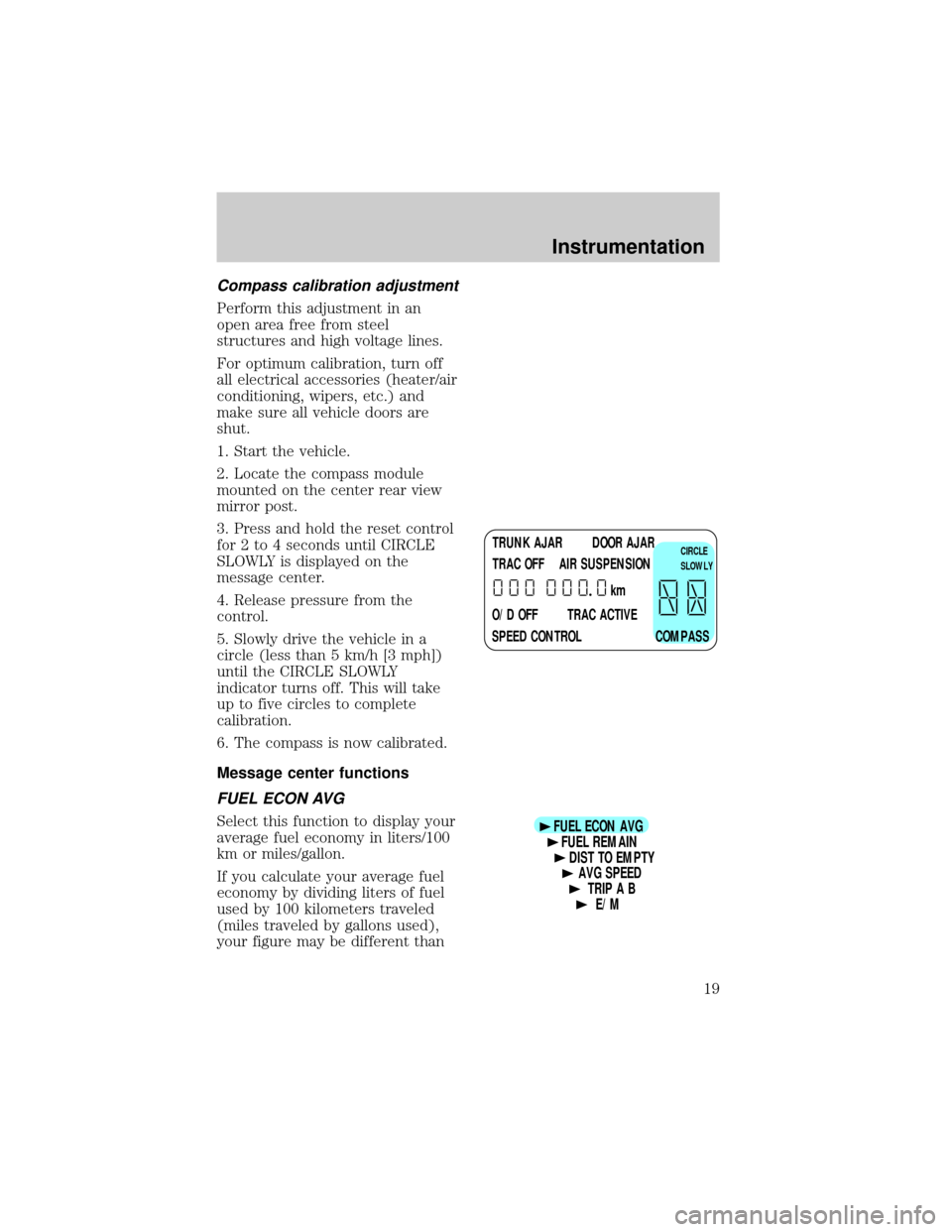
for 2 to 4 seconds until CIRCLE
SLOWLY is displayed on the
message center.
4. Release pressure from the
control.
5. Slowly drive the vehicle in a
circle (less than 5 km/h [3 mph])
until the CIRCLE SLOWLY
indicator turns off. This will take
up to five circles to complete
calibration.
6. The compass is now calibrated.
Message center functions
FUEL ECON AVG
Select this function to display your
average fuel economy in liters/100
km or miles/gallon.
If you calculate your average fuel
economy by dividing liters of fuel
used by 100 kilometers traveled
(miles traveled by gallons used),
your figure may be different than
TRUNK AJAR DOOR AJAR
TRAC OFF AIR SUSPENSION
O/D OFF TRAC ACTIVE
SPEED CONTROL COMPASSkmCIRCLE
SLOWLY
FUEL ECON AVG
FUEL REMAIN
DIST TO EMPTY
AVG SPEED
TRIP A B
E/M
Instrumentation
19
Page 92 of 188
Make sure the corresponding lights
illuminate briefly. If a light fails to
illuminate, have the vehicle
serviced.
²If the driver's safety belt is
fastened, the light (
) will not
illuminate.
STARTING THE ENGINE
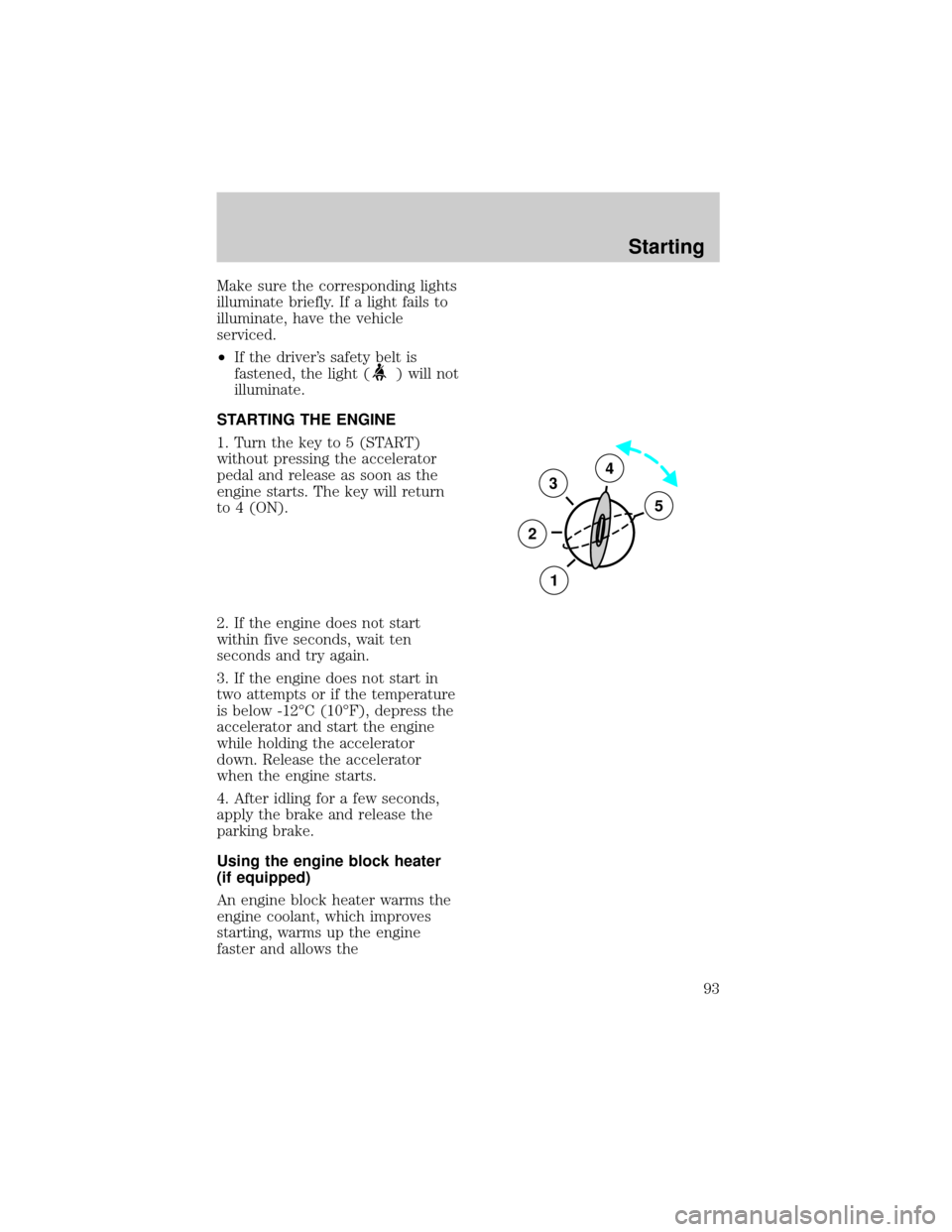
1. Turn the key to 5 (START)
without pressing the accelerator
pedal and release as soon as the
engine starts. The key will return
to 4 (ON).
2. If the engine does not start
within five seconds, wait ten
seconds and try again.
3. If the engine does not start in
two attempts or if the temperature
is below -12ÉC (10ÉF), depress the
accelerator and start the engine
while holding the accelerator
down. Release the accelerator
when the engine starts.
4. After idling for a few seconds,
apply the brake and release the
parking brake.
Using the engine block heater
(if equipped)
An engine block heater warms the
engine coolant, which improves
starting, warms up the engine
faster and allows the
3
2
1
5
4
Starting
93
Page 93 of 188
heater-defroster system to respond
quickly. They are strongly
recommended if you live in a
region where temperatures reach
-23ÉC (-10ÉF) or below.
For best results, plug the heater in
at least three hours before starting
the vehicle. Using the heater for
longer than three hours will not
harm the engine, so the heater can
be plugged in the night before
starting the vehicle.
To prevent electrical
shock, do not use your
heater with ungrounded
electrical systems or
two-pronged (cheater) adapters.
Guarding against exhaust
fumes
Although odorless and colorless,
carbon monoxide is present in
exhaust fumes. Take precautions
to avoid its dangerous effects.
If you ever smell exhaust
fumes of any kind inside
your vehicle, have your dealer
inspect and fix your vehicle
immediately. Do not drive if you
smell exhaust fumes. These
fumes are harmful and could kill
you.
Starting
94
Page 126 of 188
4. Check all battery terminals and
remove any excessive corrosion
before you attach the battery
cables.
5. Turn the heater fan on in both
vehicles to protect any electrical
surges. Turn all other accessories
off.
Connecting the jumper cables
1. Position the vehicles so that
they do not touch one another.
2. Switch off the engine. Switch off
any unnecessary electrical
equipment.
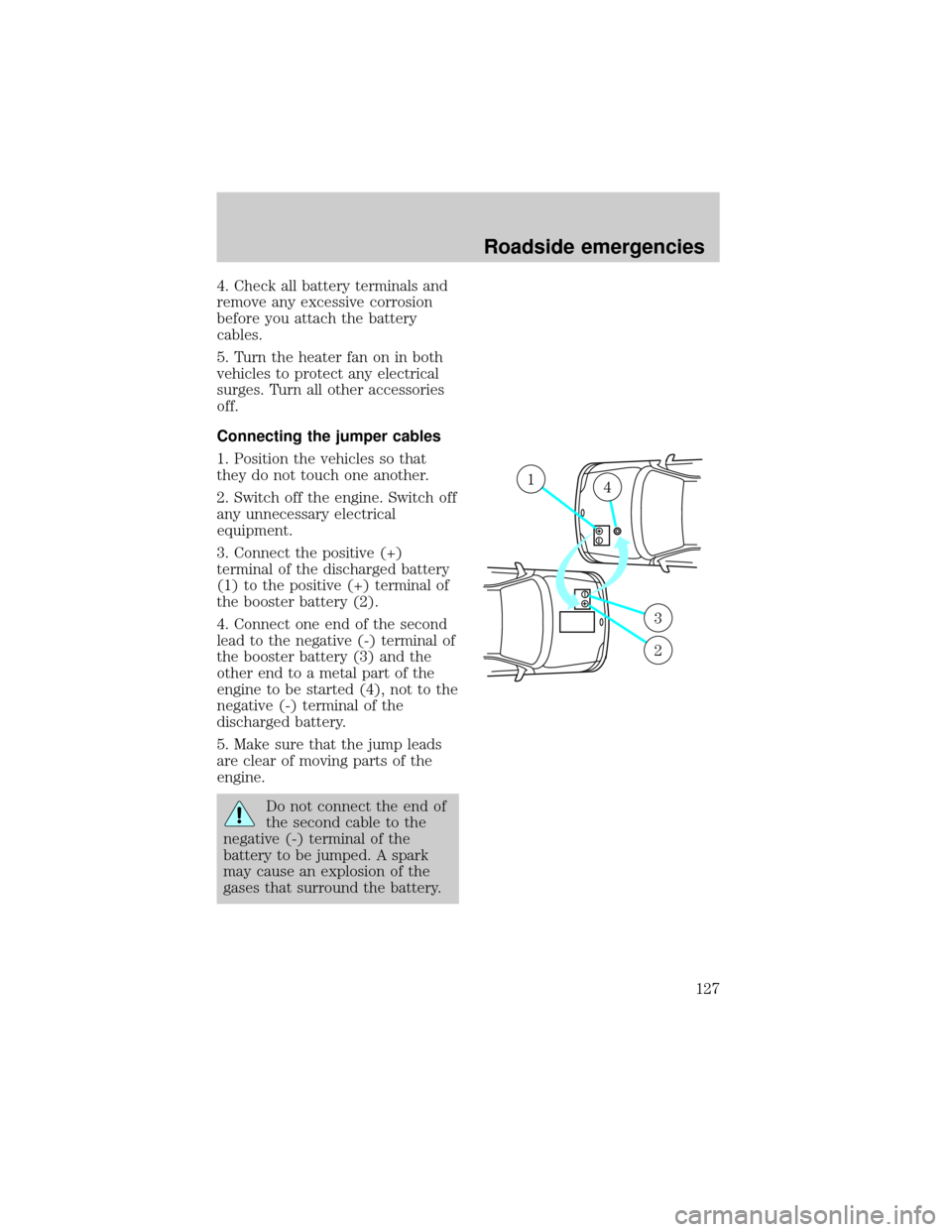
3. Connect the positive (+)
terminal of the discharged battery
(1) to the positive (+) terminal of
the booster battery (2).
4. Connect one end of the second
lead to the negative (-) terminal of
the booster battery (3) and the
other end to a metal part of the
engine to be started (4), not to the
negative (-) terminal of the
discharged battery.
5. Make sure that the jump leads
are clear of moving parts of the
engine.
Do not connect the end of
the second cable to the
negative (-) terminal of the
battery to be jumped. A spark
may cause an explosion of the
gases that surround the battery.
+–
+–
14
3
2
Roadside emergencies
127
Page 185 of 188

Aiming headlamps ....................169
Air bag supplemental restraint
system ..........................................76
and child safety seats ..............78
description ................................77
disposal ......................................81
indicator light ...........................80
passenger air bag .....................79
Air suspension
description ..............................102
Anti-lock brake system
(ABS)#$description
Battery .......................................149
Brake fluid
checking and adding ..............138
Brakes ..........................................96
anti-lock .....................................96
anti-lock brake system (ABS)
warning light .............................97
fluid, checking and adding ....138
traction control .........................99
Brake-shift interlock .................103
Break-in period .............................2
Bulbs, replacing ........................166
headlamps ...............................167
specifications ..........................171
Changing a tire .........................122
Child safety seats ........................84
Childproof locks ..........................51
Chime
headlamps on ............................13
Cleaning your vehicle ...............172
engine compartment ..............173
fabric ........................................175
instrument panel ....................175
plastic parts ............................174
safety belts ..............................176
tail lamps .................................175
washing ....................................172
waxing .....................................172
wheels ......................................173
windows ..................................178Climate control system
automatic temperature
control ..............26,27,28,29,32,33
Clock ............................................34
Compass, electronic
calibration .................................19
set zone adjustment .................18
Controls .......................................52
Daytime running light system ...25
Defrost
rear window ..............................34
Emission control system ..........163
Engine
service points ..........................134
Engine block heater ...................93
Engine coolant
checking and adding ..............140
disposal ....................................142
refill capacities ........................142
Engine oil ...........................135,137
changing oil and oil filter .......137
checking and adding .......135,136
Exhaust fumes ............................94
Fail safe cooling ........................143
Floor mats ...................................53
Fuel
calculating fuel economy .......162
improving fuel economy ........113
octane rating ...........................161
quality ......................................161
safety information relating to
automotive fuels .....................158
Fuel gauge ...................................14
Fuel pump shut-off switch .......114
Fuse panels
instrument panel ....................117
power distribution box ...........120
Fuses ...................................115,116
Gauges, Mechanical ....................14
engine coolant temperature
gauge .........................................15
Hazard flashers .........................114
Index
186