warning LINCOLN TOWN CAR 1999 User Guide
[x] Cancel search | Manufacturer: LINCOLN, Model Year: 1999, Model line: TOWN CAR, Model: LINCOLN TOWN CAR 1999Pages: 208, PDF Size: 1.59 MB
Page 109 of 208
BRAKES
Your service brakes are self-adjusting. Refer to the scheduled
maintenance guide for scheduled maintenance.
Occasional brake noise is normal and often does not indicate a
performance concern with the vehicle's brake system. In normal
operation, automotive brake systems may emit occasional or intermittent
squeal or groan noises when the brakes are applied. Such noises are
usually heard during the first few brake applications in the morning;
however, they may be heard at any time while braking and can be
aggravated by environmental conditions such as cold, heat, moisture,
road dust, salt or mud. If a ªmetal-to-metal,º ªcontinuous grindingº or
ªcontinuous squealº sound is present while braking, the brake linings
may be worn-out and should be inspected by a qualified service
technician.
Anti-lock brake system (ABS)
On vehicles equipped with an anti-lock braking system (ABS), a noise
from the hydraulic pump motor and pulsation in the pedal may be
observed during ABS braking events. Pedal pulsation coupled with noise
while braking under panic conditions or on loose gravel, bumps, wet or
snowy roads is normal and indicates proper functioning of the vehicle's
anti-lock brake system. The ABS performs a self-check at 17 km/h
(10 mph) after you start the engine and begin to drive away. A brief
mechanical noise may be heard during this test. This is normal. If a
malfunction is found, the ABS warning light will come on. If the vehicle
has continuous vibration or shudder in the steering wheel while braking,
the vehicle should be inspected by a qualified service technician.
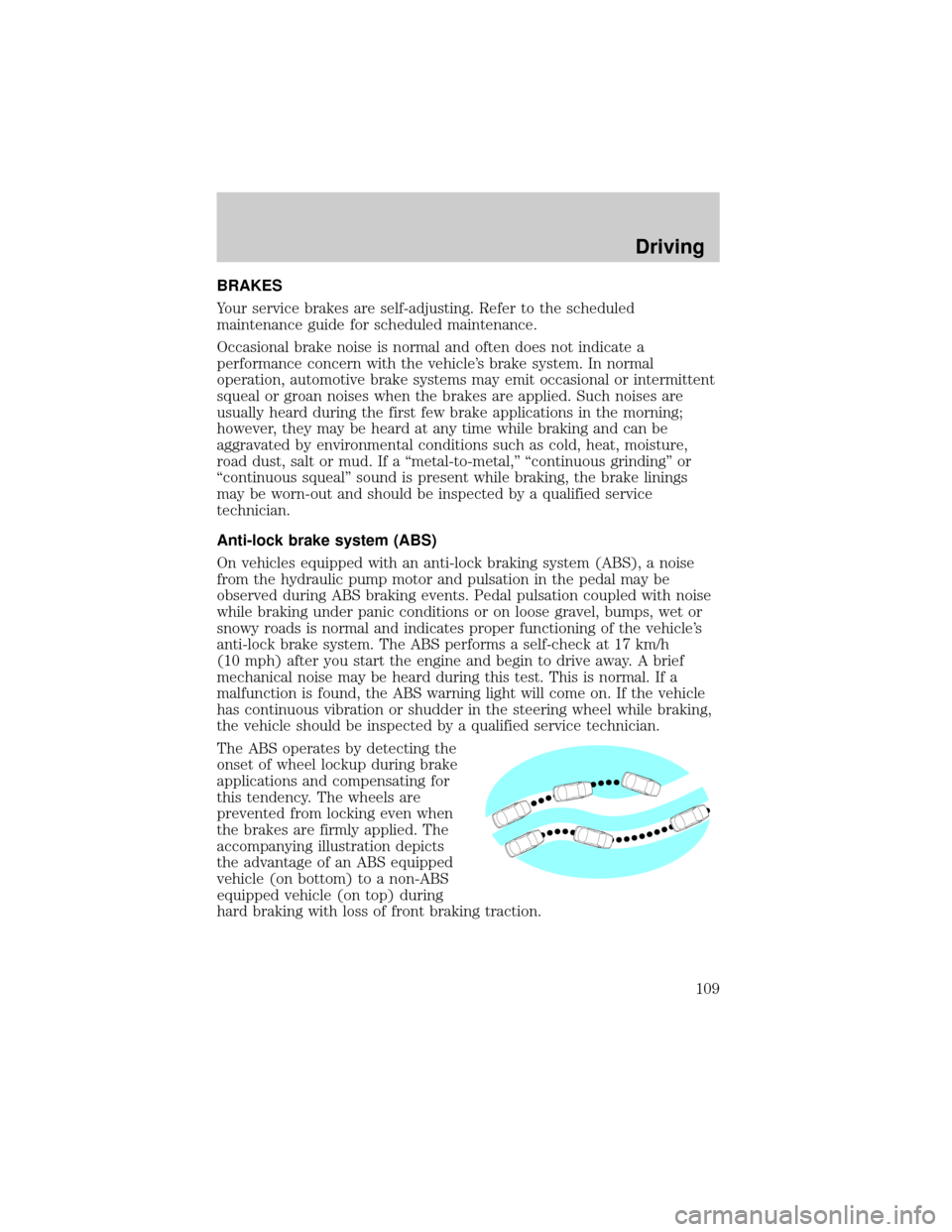
The ABS operates by detecting the
onset of wheel lockup during brake
applications and compensating for
this tendency. The wheels are
prevented from locking even when
the brakes are firmly applied. The
accompanying illustration depicts
the advantage of an ABS equipped
vehicle (on bottom) to a non-ABS
equipped vehicle (on top) during
hard braking with loss of front braking traction.
Driving
109
Page 110 of 208
ABS warning lamp
The
ABSwarning lamp in the instrument cluster momentarily illuminates
when the ignition is turned on and the engine is off. If the light does not
illuminate momentarily at start up, remains on or continues to flash, the
ABS needs to be serviced.
With the ABS light on, the anti-lock
brake system is disabled and normal
braking is still effective unless the
brake warning light also remains
illuminated with parking brake
released. (If your brake warning lamp illuminates, have your vehicle
serviced immediately).
Using ABS
²In an emergency or when maximum efficiency from the ABS is
required, apply continuous full force on the brake. The ABS will be
activated immediately, thus allowing you to retain full steering control
of your vehicle and, providing there is sufficient space, will enable you
to avoid obstacles and bring the vehicle to a controlled stop.
²The Anti-Lock system does not decrease the time necessary to apply
the brakes or always reduce stopping distance. Always leave enough
room between your vehicle and the vehicle in front of you to stop.
²We recommend that you familiarize yourself with this braking
technique. However, avoid taking any unnecessary risks.
Parking brake with auto-release
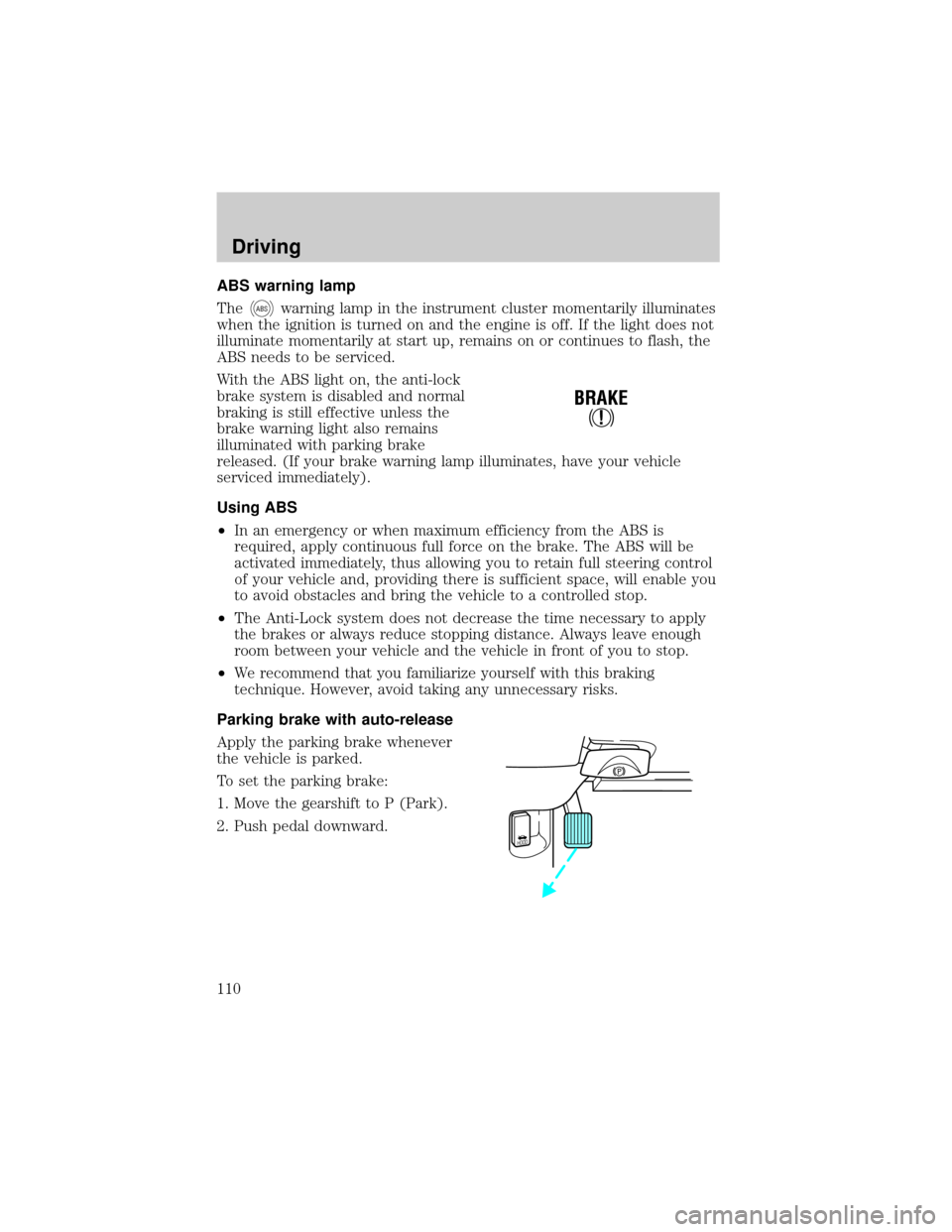
Apply the parking brake whenever
the vehicle is parked.
To set the parking brake:
1. Move the gearshift to P (Park).
2. Push pedal downward.
!
BRAKE
HOOD
Driving
110
Page 111 of 208
The BRAKE warning lamp in the
instrument cluster illuminates and
remains illuminated (when the
ignition is turned ON) until the
parking brake is fully released.
Always set the parking brake fully and make sure the gearshift is
latched in P (Park). Turn off the ignition whenever you leave
your vehicle.
The parking brake is not recommended to stop a moving vehicle.
However, if the normal brakes fail, the parking brake can be used to stop
your vehicle in an emergency. Since the parking brake applies only the
rear brakes, the vehicle's stopping distance will increase greatly and the
handling of your vehicle will be adversely affected.
Your vehicle has an automatic parking brake release. To release the
parking brake:
1. Turn the ignition to the RUN position.
2. Press the brake pedal.
3. Move the gearshift from the P (Park) position to one of the forward
gears (the parking brake will not release automatically when you shift
into reverse). The brake pedal must remain pressed while the gearshift is
moved.
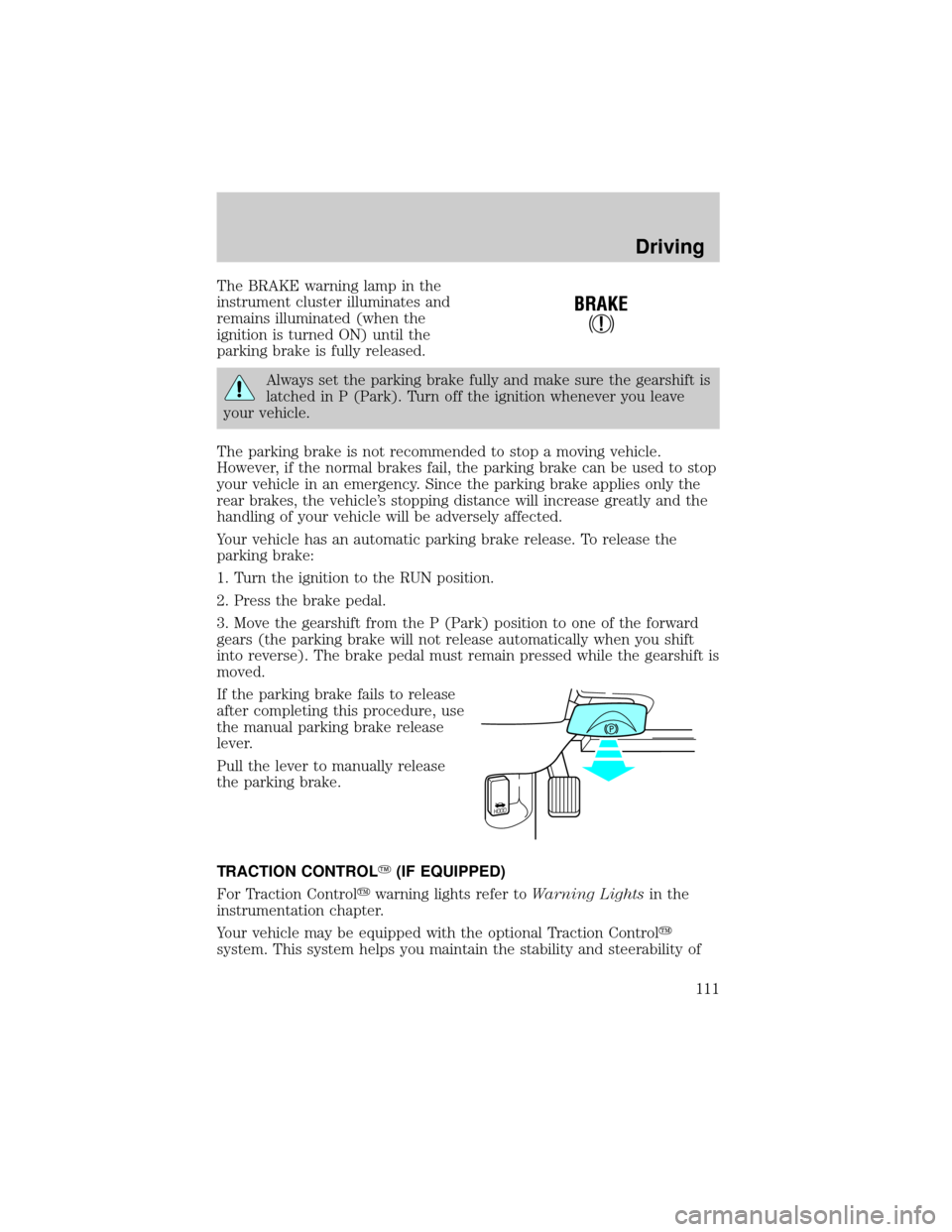
If the parking brake fails to release
after completing this procedure, use
the manual parking brake release
lever.
Pull the lever to manually release
the parking brake.
TRACTION CONTROLY(IF EQUIPPED)
For Traction Controlywarning lights refer toWarning Lightsin the
instrumentation chapter.
Your vehicle may be equipped with the optional Traction Controly
system. This system helps you maintain the stability and steerability of
!
BRAKE
HOOD
Driving
111
Page 114 of 208
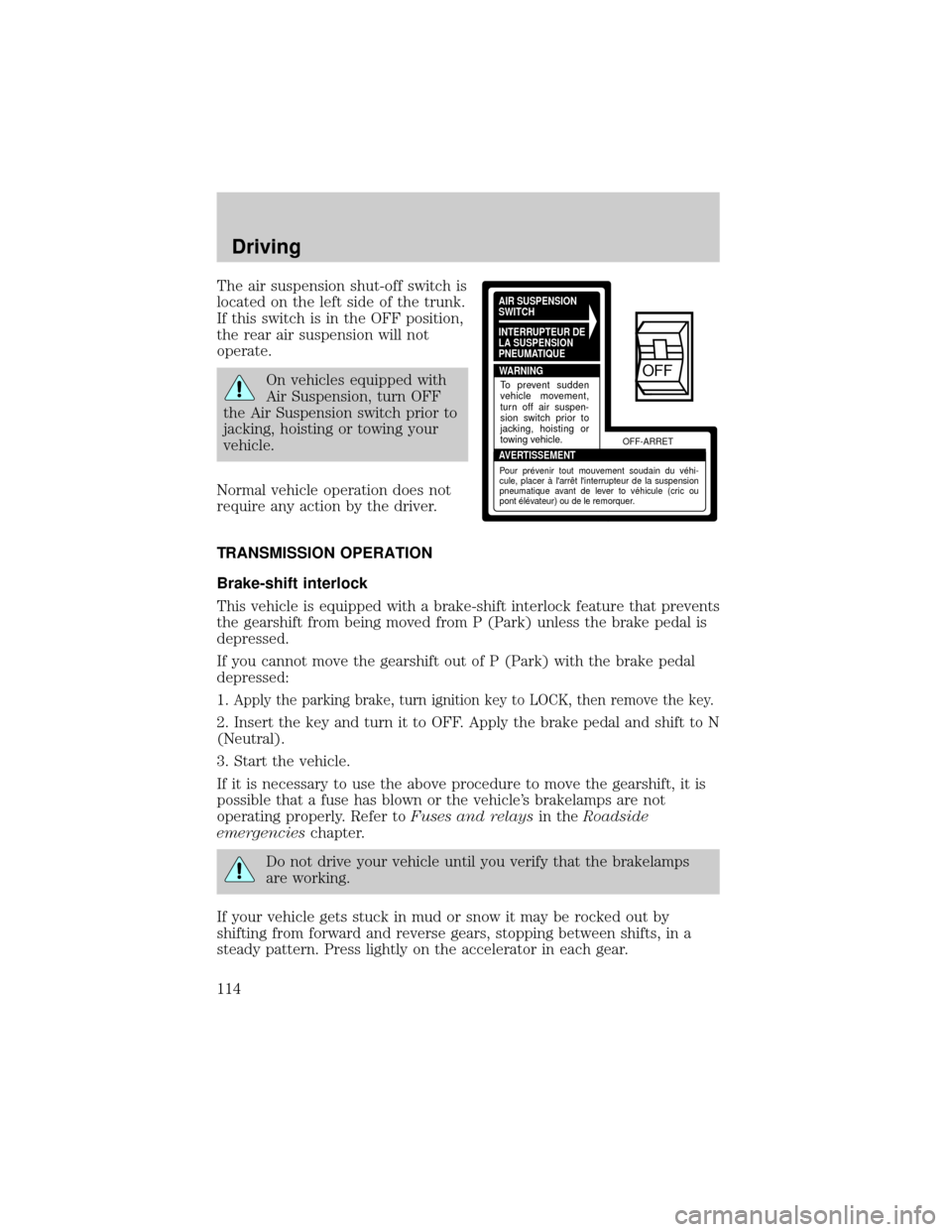
The air suspension shut-off switch is
located on the left side of the trunk.
If this switch is in the OFF position,
the rear air suspension will not
operate.
On vehicles equipped with
Air Suspension, turn OFF
the Air Suspension switch prior to
jacking, hoisting or towing your
vehicle.
Normal vehicle operation does not
require any action by the driver.
TRANSMISSION OPERATION
Brake-shift interlock
This vehicle is equipped with a brake-shift interlock feature that prevents
the gearshift from being moved from P (Park) unless the brake pedal is
depressed.
If you cannot move the gearshift out of P (Park) with the brake pedal
depressed:
1.
Apply the parking brake, turn ignition key to LOCK, then remove the key.
2. Insert the key and turn it to OFF. Apply the brake pedal and shift to N
(Neutral).
3. Start the vehicle.
If it is necessary to use the above procedure to move the gearshift, it is
possible that a fuse has blown or the vehicle's brakelamps are not
operating properly. Refer toFuses and relaysin theRoadside
emergencieschapter.
Do not drive your vehicle until you verify that the brakelamps
are working.
If your vehicle gets stuck in mud or snow it may be rocked out by
shifting from forward and reverse gears, stopping between shifts, in a
steady pattern. Press lightly on the accelerator in each gear.
AIR SUSPENSION
SWITCH
INTERRUPTEUR DE
LA SUSPENSION
PNEUMATIQUE
WARNING
AVERTISSEMENTOFF-ARRET
To prevent sudden
vehicle movement,
turn off air suspen-
sion switch prior to
jacking, hoisting or
towing vehicle.
Pour prévenir tout mouvement soudain du véhi-
cule, placer à l'arrêt l'interrupteur de la suspension
pneumatique avant de lever to véhicule (cric ou
pont élévateur) ou de le remorquer.
OFF
Driving
114
Page 115 of 208
Do not rock the vehicle for more than a few minutes. The
transmission and tires may be damaged or the engine may
overheat.
Always set the parking brake fully and make sure the gearshift is
latched in P (Park). Turn off the ignition whenever you leave
your vehicle.
If the parking brake is fully released, but the brake warning lamp
remains illuminated, the brakes may not be working properly.
See your dealer or a qualified service technician.
Driving with a 4±speed automatic transmission
Understanding gearshift positions
Pull the gearshift lever towards you and downward to move the
automatic gearshift.
Hold the brake pedal down while you move the gearshift lever
from P (Park) to another position. If you do not hold the brake
pedal down, your vehicle may move unexpectedly and injure someone.
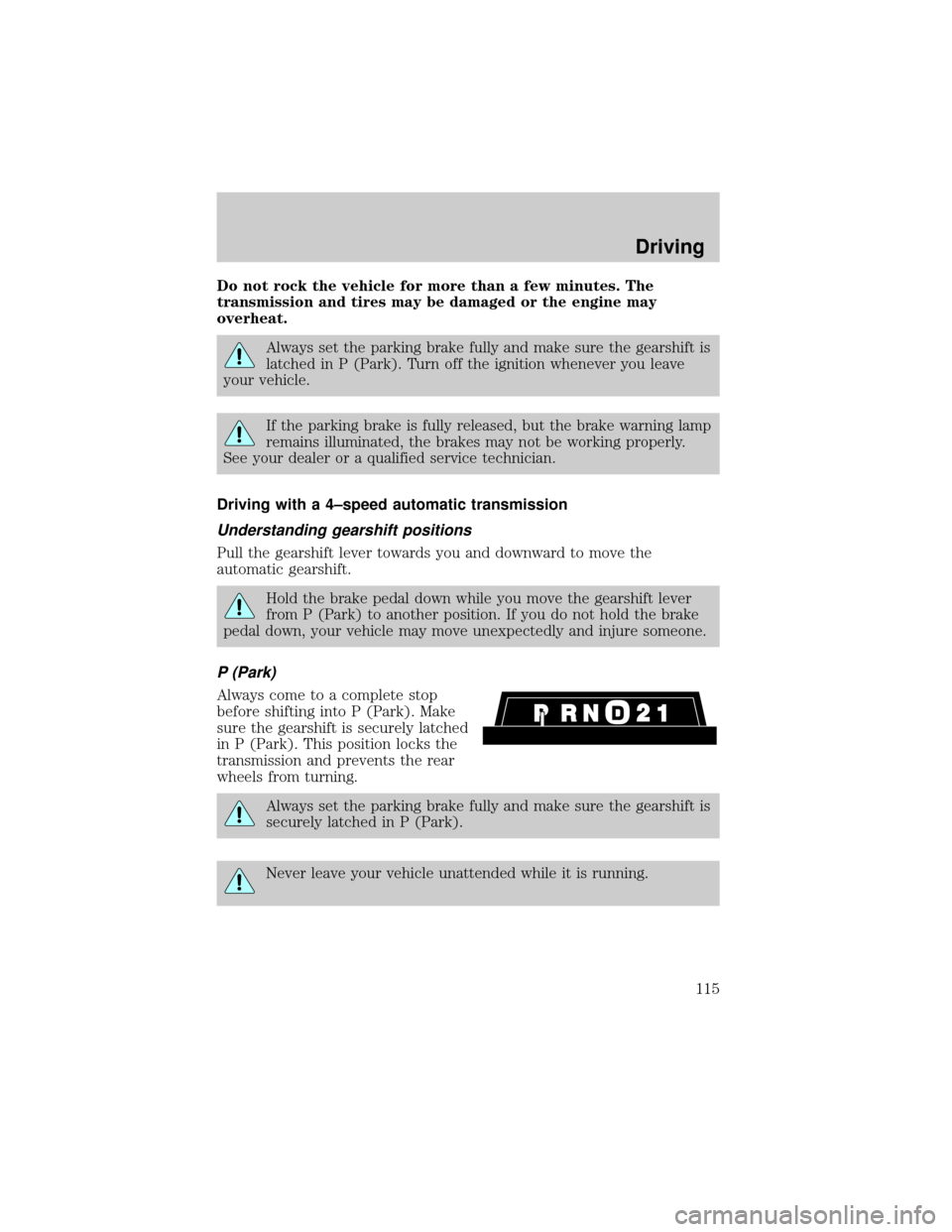
P (Park)
Always come to a complete stop
before shifting into P (Park). Make
sure the gearshift is securely latched
in P (Park). This position locks the
transmission and prevents the rear
wheels from turning.
Always set the parking brake fully and make sure the gearshift is
securely latched in P (Park).
Never leave your vehicle unattended while it is running.
Driving
115
Page 169 of 208
EMISSION CONTROL SYSTEM
Your vehicle is equipped with various emission control components and a
catalytic converter which will enable your vehicle to comply with
applicable exhaust emission standards. To make sure that the catalytic
converter and other emission control components continue to work
properly:
²Use only unleaded fuel.
²Avoid running out of fuel.
²Do not turn off the ignition while your vehicle is moving, especially at
high speeds.
²Have the items listed in your Scheduled Maintenance Guide performed
according to the specified schedule.
The scheduled maintenance items listed in the Scheduled Maintenance
Guide are essential to the life and performance of your vehicle and to its
emissions system.
If other than Ford, Motorcraft or Ford-authorized parts are used for
maintenance replacements or for service of components affecting
emission control, such non-Ford parts should be equivalent to genuine
Ford Motor Company parts in performance and durability.
Do not park, idle, or drive your vehicle in dry grass or other dry
ground cover. The emission system heats up the engine
compartment and exhaust system, which can start a fire.
Illumination of the charging system warning light, ªService Engine Soonº
light or the temperature warning light, fluid leaks, strange odors, smoke
or loss of oil pressure, could indicate that the emission control system is
not working properly.
Exhaust leaks may result in entry of harmful and potentially
lethal fumes into the passenger compartment.
Do not make any unauthorized changes to your vehicle or engine. By
law, vehicle owners and anyone who manufactures, repairs, services,
sells, leases, trades vehicles, or supervises a fleet of vehicles are not
permitted to intentionally remove an emission control device or prevent
it from working. Information about your vehicle's emission system is on
the Vehicle Emission Control Information Decal located on or near the
Maintenance and care
169
Page 170 of 208

engine. This decal identifies engine displacement and gives some tune up
specifications.
Please consult your ªWarranty Guideº for complete emission warranty
information.
Readiness for Inspection/Maintenance (I/M) testing
In some localities, it may be a legal requirement to pass an I/M test of
the on-board diagnostics system. If your ªCheck Engine/Service Engine
Soonº light is on, refer to the description in theWarning Lights and
Chimessection of theInstrumentationchapter. Your vehicle may not
pass the I/M test with the ªCheck Engine/Service Engine Soonº light on.
If the vehicle's powertrain system or its battery has just been serviced,
the on-board diagnostics system is reset to a ªnot ready for I/M testº
condition. To ready the on-board diagnostics system for I/M testing, a
minimum of 30 minutes of city and highway driving is necessary as
described below:
²First, at least 10 minutes of driving on an expressway or highway.
²Next, at least 20 minutes driving in stop-and-go, city-type traffic with
at least four idle periods.
Allow the vehicle to sit for at least eight hours without starting the
engine. Then, start the engine and complete the above driving cycle. The
engine must warm up to its normal operating temperature. Once started,
do not turn off the engine until the above driving cycle is complete.
EXTERIOR BULBS
Replacing exterior bulbs
Check the operation of the following lamps frequently:
²Headlamps
²Tail lamps
²Brakelamps
²High-mount brakelamp
²Turn signals
²Backup lamps
²License plate lamp
Maintenance and care
170
Page 200 of 208

Accessory delay ..........................67
Air bag supplemental
restraint system .....................91,95
and child safety seats ..............92
description ...........................91,95
disposal ......................................98
driver air bag .......................93,96
indicator light ...................7,94,97
operation ..............................93,96
passenger air bag ................93,96
Air cleaner filter .......................181
Air conditioning ..........................22
automatic temperature
control system ..........................22
Air suspension ...........................113
air leveling disabled warning,
message center .......................113
air ride switch off warning,
message center .......................113
check air ride system
warning, message center .......113
check air suspension warning,
message center .......................113
description ..............................113
warning light ...........................113
Anti-theft system ..............77,78,79
Automatic transmission
driving an automatic
overdrive .................................115
fluid, refill capacities ..............181
fluid, specification ..................184
Axle
lubricant specifications ..........184
refill capacities ........................181
traction lok ..............................117
Battery .......................................154
acid, treating emergencies .....154
jumping a disabled battery ....135
maintenance-free ....................154
replacement, specifications ...181
servicing ..................................154
Brakes ........................................109anti-lock ............................109,110
anti-lock brake system
(ABS) warning light ............8,110
brake warning light ....................8
fluid, checking and adding ....146
fluid, refill capacities ..............181
fluid, specifications ..........182,184
lubricant specifications ...182,184
shift interlock ..........................114
Break-in period .............................2
Capacities for refilling fluids ....181
CD changer .................................48
Child safety restraints ................98
child safety belts ......................98
child safety seats ......................99
Child safety seats ........................99
attaching with tether straps ..103
built-in child seat .....................99
in front seat ............................101
in rear seat ..............................101
tether anchorage hardware ...104
Cleaning your vehicle ...............176
engine compartment ..............178
exterior .............................177,180
exterior lamps .........................179
instrument panel ....................179
interior ..............................179,180
mirrors .....................................180
plastic parts ............................178
safety belts ..............................180
washing ....................................176
waxing .....................................177
wheels ......................................177
windows ..................................180
wiper blades ............................179
Clock ............................................52
Compass, electronic
calibration .................................17
set zone adjustment .................16
Controls ........................60,61,62,63
power seat ............................80,82
steering column ........................59
Index
200
Page 201 of 208

Coolant ...............................147,149
checking and adding ..............148
refill capacities .................149,181
specifications ...................182,184
Customer Assistance ................187
Ford accessories for your
vehicle .....................................194
Ford Extended
Service Plan ............................188
Getting assistance outside
the U.S. and Canada ..............193
Getting roadside assistance ...187
Getting the service
you need .................................189
Ordering additional
owner's literature ...................198
The Dispute Settlement
Board .......................................190
Defrost
rear window ..............................52
Dipstick
engine oil .................................144
Doors
door ajar warning .....................10
Driving under special
conditions
through water .........................122
Emergencies, roadside
jump-starting ..........................135
Emission control system ..........169
Engine ........................................184
check engine/
service engine soon light ...........6
coolant .....................................147
idle speed control ...................154
lubrication
specifications ...................182,184
refill capacities ........................181
service points ..........................143
starting after a collision .........123
Engine block heater .................107
Engine oil ..................................144checking and adding .......144,145
dipstick ....................................144
filter, specifications .........145,181
recommendations ...................145
refill capacities .................144,181
specifications .....144,145,182,184
Exhaust fumes ..........................108
Fail safe cooling ........................150
Floor mats ...................................69
Fluid capacities .........................181
Fuel ............................................161
calculating fuel economy .......165
cap ...........................................163
capacity ...................................181
choosing the right fuel ...........163
comparisons with EPA fuel
economy estimates .................168
detergent in fuel .....................165
filling your vehicle
with fuel ....................161,163,166
filter, specifications .........165,181
fuel filler door override ............66
fuel filler door release ..............65
fuel pump shut-off switch .....123
gauge .........................................13
improving fuel economy ........165
octane rating ....................164,184
quality ......................................164
running out of fuel .................165
safety information relating
to automotive fuels ................161
Fuses ...................................124,125
Gas cap (see Fuel cap) ............163
Gas mileage (see Fuel
economy) ...................................165
Gauges .........................................12
engine coolant
temperature gauge ...................14
fuel gauge ..................................13
odometer ...................................13
speedometer .............................13
Index
201
Page 202 of 208

GAWR
(Gross Axle Weight Rating) .....118
definition .................................118
driving with a heavy load ......118
location ....................................118
GVWR (Gross
Vehicle Weight Rating) .............118
calculating ...............................118
definition .................................118
driving with a heavy load ......118
location ....................................118
Hazard flashers .........................123
Head restraints ...........................80
Headlamps ...................................21
aiming ........................174,175,176
autolamp system .......................21
bulb specifications ..................174
daytime running lights .............21
flash to pass ..............................22
high beam ..............................8,22
turning on and off ....................21
warning chime ..........................12
Heating ........................................22
Hood ..........................................142
Ignition .......................................184
positions of the ignition ...........53
Infant seats
(see Safety seats) .......................99
Inspection/maintenance
(I/M) testing ..............................170
Instrument panel
cleaning ...................................179
lighting up panel
and interior ...............................21
location of components ..............6
Jump-starting your vehicle ......135
Keyless entry system .................75
autolock .....................................73
keypad .......................................75
programming entry code .........75
Keys .............................................54
key in ignition chime ...............12positions of the ignition ...........53
Lamps
autolamp system .......................21
cargo lamps ...............................21
daytime running light ...............21
headlamps .................................21
headlamps, flash to pass ..........22
instrument panel, dimming .....21
interior lamps ....................64,174
replacing bulbs ..170,171,173,174
Lane change indicator
(see Turn signal) ........................54
Lights, warning and indicator ......6
air bag ..........................................7
air suspension ...........................10
anti-lock brakes (ABS) .......8,110
brake ............................................8
charging system ..........................9
cruise indicator .........................11
door ajar ....................................10
high beam ...................................8
liftgate ajar ................................10
low coolant ..................................9
low washer fluid .......................11
oil pressure .................................9
safety belt ...................................7
service engine soon ....................6
speed control ............................58
traction control system .........9,11
turn signal indicator ...................8
Load limits .................................118
GAWR ......................................118
GVWR ......................................118
trailer towing ..........................118
Locks
childproof ..................................68
doors ..........................................67
Lubricant specifications ....182,184
Lumbar support, seats ...............83
Message center ...........................14
reset button ..............................15
select button .............................15
Index
202