Engine start LINCOLN TOWN CAR 2000 Owner's Guide
[x] Cancel search | Manufacturer: LINCOLN, Model Year: 2000, Model line: TOWN CAR, Model: LINCOLN TOWN CAR 2000Pages: 224, PDF Size: 1.73 MB
Page 177 of 224
be void for any damage to the fuel tank or fuel system if the
correct genuine Ford or Motorcraft fuel filler cap is not used.
The fuel system may be under pressure. If the fuel filler cap is
venting vapor or if you hear a hissing sound, wait until it stops
before completely removing the fuel filler cap. Otherwise, fuel may
spray out and injure you or others.
If you do not use the proper fuel filler cap, excessive pressure or
vacuum in the fuel tank may damage the fuel system or cause
the fuel system to work improperly in a collision, which may result in
possible personal injury.
Choosing the right fuel
Use only UNLEADED FUEL. The use of leaded fuel is prohibited by law
and could damage your vehicle.
Do not use fuel containing methanol. It can damage critical fuel system
components.
Your vehicle was not designed to use fuel or fuel additives with metallic
compounds, including manganese-based compounds containing MMT.
Repairs to correct the effects of using a fuel for which your vehicle was
not designed may not be covered by your warranty.
Octane recommendations
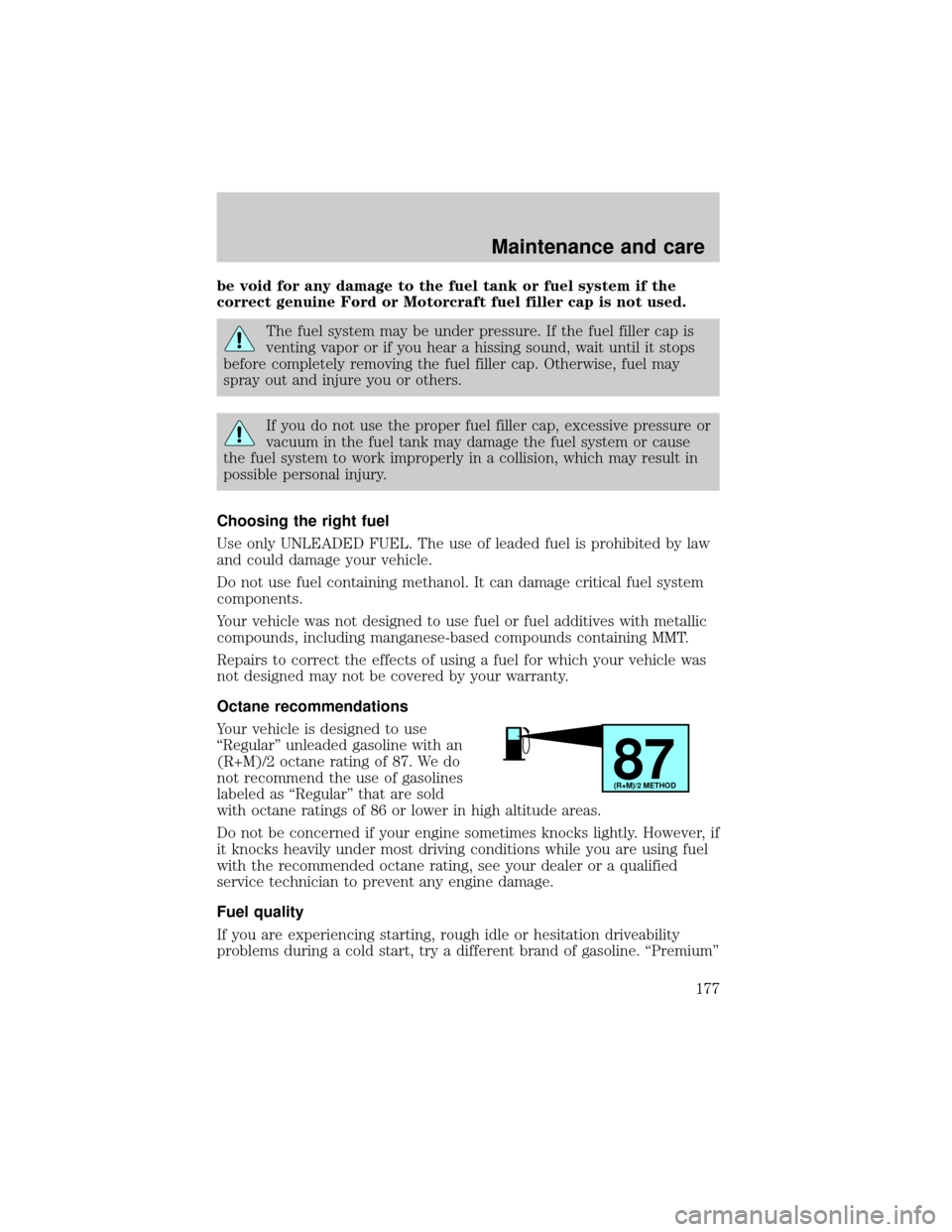
Your vehicle is designed to use
ªRegularº unleaded gasoline with an
(R+M)/2 octane rating of 87. We do
not recommend the use of gasolines
labeled as ªRegularº that are sold
with octane ratings of 86 or lower in high altitude areas.
Do not be concerned if your engine sometimes knocks lightly. However, if
it knocks heavily under most driving conditions while you are using fuel
with the recommended octane rating, see your dealer or a qualified
service technician to prevent any engine damage.
Fuel quality
If you are experiencing starting, rough idle or hesitation driveability
problems during a cold start, try a different brand of gasoline. ªPremiumº
87(R+M)/2 METHOD
Maintenance and care
177
Page 182 of 224
EPA window sticker
Every new vehicle should have the EPA window sticker. Contact your
dealer if the window sticker is not supplied with your vehicle. The EPA
window sticker should be your guide for the fuel economy comparisons
with other vehicles.
It is important to note the box in the lower left corner of the window
sticker. These numbers represent the Range of L/100 km (MPG)
expected on the vehicle under optimum conditions. Your fuel economy
may vary depending upon the method of operation and conditions.
EMISSION CONTROL SYSTEM
Your vehicle is equipped with various emission control components and a
catalytic converter which will enable your vehicle to comply with
applicable exhaust emission standards. To make sure that the catalytic
converter and other emission control components continue to work
properly:
²Use only the specified fuel listed.
²Avoid running out of fuel.
²Do not turn off the ignition while your vehicle is moving, especially at
high speeds.
²Have the items listed in your Scheduled Maintenance Guide performed
according to the specified schedule.
The scheduled maintenance items listed in the Scheduled Maintenance
Guide are essential to the life and performance of your vehicle and to its
emissions system.
If other than Ford, Motorcraft or Ford-authorized parts are used for
maintenance replacements or for service of components affecting
emission control, such non-Ford parts should be equivalent to genuine
Ford Motor Company parts in performance and durability.
Do not park, idle, or drive your vehicle in dry grass or other dry
ground cover. The emission system heats up the engine
compartment and exhaust system, which can start a fire.
Illumination of the ªService Engine Soonº light, charging system warning
light or the temperature warning light, fluid leaks, strange odors, smoke
or loss of engine power, could indicate that the emission control system
is not working properly.
Maintenance and care
182
Page 183 of 224
Exhaust leaks may result in entry of harmful and potentially
lethal fumes into the passenger compartment.
Do not make any unauthorized changes to your vehicle or engine. By
law, vehicle owners and anyone who manufactures, repairs, services,
sells, leases, trades vehicles, or supervises a fleet of vehicles are not
permitted to intentionally remove an emission control device or prevent
it from working. Information about your vehicle's emission system is on
the Vehicle Emission Control Information Decal located on or near the
engine. This decal identifies engine displacement and gives some tune up
specifications.
Please consult your ªWarranty Guideº for complete emission warranty
information.
Readiness for Inspection/Maintenance (I/M) testing
In some localities, it may be a legal requirement to pass an I/M test of
the on-board diagnostics system. If your ªCheck Engine/Service Engine
Soonº light is on, refer to the description in theWarning Lights and
Chimessection of theInstrumentationchapter. Your vehicle may not
pass the I/M test with the ªCheck Engine/Service Engine Soonº light on.
If the vehicle's powertrain system or its battery has just been serviced,
the on-board diagnostics system is reset to a ªnot ready for I/M testº
condition. To ready the on-board diagnostics system for I/M testing, a
minimum of 30 minutes of city and highway driving is necessary as
described below:
²First, at least 10 minutes of driving on an expressway or highway.
²Next, at least 20 minutes driving in stop-and-go, city-type traffic with
at least four idle periods.
Allow the vehicle to sit for at least eight hours without starting the
engine. Then, start the engine and complete the above driving cycle. The
engine must warm up to its normal operating temperature. Once started,
do not turn off the engine until the above driving cycle is complete.
Maintenance and care
183
Page 215 of 224

Compass, electronic
calibration .................................19
set zone adjustment ............18,19
Console
rear ............................................70
Controls
power seat ............................84,86
steering column ........................60
Coolant
checking and adding ..............157
coolant temperature light ........11
refill capacities .................160,195
specifications ...................197,198
Cruise control
(see Speed control) ....................56
Customer Assistance ................132
Ford accessories
for your vehicle ......................209
Ford Extended
Service Plan ............................202
Getting assistance outside
the U.S. and Canada ..............208
Getting roadside assistance ...132
Getting the
service you need ....................203
Ordering additional
owner's literature ...................212
The Dispute
Settlement Board ...................205
Utilizing the Mediation/
Arbitration Program ...............208
Daytime running lamps
(see Lamps) ................................23
Defrost
rear window ..............................53
Dipstick
automatic
transmission fluid ...................164
engine oil .................................153
Doors
door ajar warning .....................12
lubricant specifications ..........197Driving under special
conditions
through water .........................131
Emergencies, roadside
jump-starting ..........................144
Emission control system ..........182
Engine ........................................198
check engine/service engine
soon light ....................................8
cleaning ...................................193
coolant .....................................157
fail-safe coolant ......................161
idle speed control ...................166
lubrication
specifications ...................197,198
refill capacities ........................195
service points ..........................152
starting after a collision .........133
Engine block heater .................116
Engine oil ..................................153
change oil soon warning,
message center .......................153
checking and adding ..............153
dipstick ....................................153
filter, specifications .........155,195
recommendations ...................155
refill capacities ........................195
specifications ...................197,198
Exhaust fumes ..........................117
Fail safe cooling ........................161
Floor mats ...................................71
Fluid capacities .........................195
Fuel ............................................174
calculating fuel economy ..20,179
cap ...........................................176
capacity ...................................195
choosing the right fuel ...........177
comparisons with EPA fuel
economy estimates .................182
detergent in fuel .....................178
filling your
vehicle with fuel .......174,176,179
Index
215
Page 216 of 224

filter, specifications .........178,195
fuel filler door override ............67
fuel filler door release ..............66
fuel pump shut-off switch .....133
gauge .........................................15
improving fuel economy ........179
octane rating ....................177,198
quality ......................................177
running out of fuel .................178
safety information relating
to automotive fuels ................174
Fuses ...................................134,135
Garage door opener ....................61
Gas cap (see Fuel cap) ............176
Gas mileage
(see Fuel economy) .................179
Gauges .........................................15
engine coolant
temperature gauge ...................16
fuel gauge ..................................15
odometer ...................................15
speedometer .............................16
GAWR
(Gross Axle Weight Rating) .....127
definition .................................127
driving with a heavy load ......127
location ....................................127
GVWR (Gross Vehicle
Weight Rating) ..........................127
calculating ...............................127
definition .................................127
driving with a heavy load ......127
location ....................................127
Hazard flashers .........................133
Head restraints ...........................84
Headlamps ...................................23
aiming ........................188,189,190
autolamp system .......................23
bulb specifications ..................188
daytime running lights .............23
flash to pass ..............................24
high beam ............................10,24replacing bulbs .......................184
turning on and off ....................23
warning chime ..........................14
Heating ........................................24
HomeLink universal
transceiver (see
Garage door opener) ...61,62,63,64
Hood ..........................................151
Ignition .......................................198
positions of the ignition ...........54
Infant seats
(see Safety seats) .....................107
Inspection/maintenance
(I/M) testing ..............................183
Instrument panel
cleaning ...................................193
cluster ..........................................8
lighting up
panel and interior .....................23
location of components ..............8
Jump-starting your vehicle ......144
Keyless entry system .................77
autolock .....................................75
keypad .......................................77
programming entry code .........78
Keys .............................................55
key in ignition chime ...............14
positions of the ignition ...........54
Lamps
autolamp system .......................23
bulb replacement
specifications chart ................188
cargo lamps ...............................23
daytime running light ...............23
headlamps .................................23
headlamps, flash to pass ..........24
instrument panel, dimming .....23
interior lamps ....................65,188
replacing bulbs .........184,186,187
Lane change indicator
(see Turn signal) ........................55
Lights, warning and indicator ......8
Index
216