wheel LINCOLN TOWN CAR 2001 Owner's Guide
[x] Cancel search | Manufacturer: LINCOLN, Model Year: 2001, Model line: TOWN CAR, Model: LINCOLN TOWN CAR 2001Pages: 240, PDF Size: 1.92 MB
Page 189 of 240
Follow these guidelines when using snow tires and chains:
²Use only cable type chains offered by Ford as an accessory or
equivalent. Using SAE class S or other conventional link type chains
may cause damage to the vehicle's wheel house and/or body.
²Install chains securely, verifying that the chains do not touch any
wiring, brake lines or fuel lines.
²Drive cautiously. If you hear the chains rub or bang against your
vehicle, stop and re-tighten the chains. If this does not work, remove
the chains to prevent damage to your vehicle.
²If possible, avoid fully loading your vehicle.
²Remove the tire chains when they are no longer needed. Do not use
tire chains on dry roads.
²The suspension insulation and bumpers will help prevent vehicle
damage. Do not remove these components from your vehicle when
using snow tires and chains.
WHAT YOU SHOULD KNOW ABOUT AUTOMOTIVE FUELS
Important safety precautions
Do not overfill the fuel tank. The pressure in an overfilled tank
may cause leakage and lead to fuel spray and fire.
The fuel system may be under pressure. If the fuel filler cap is
venting vapor or if you hear a hissing sound, wait until it stops
before completely removing the fuel filler cap. Otherwise, fuel may
spray out and injure you or others.
If you do not use the proper fuel filler cap, excessive pressure or
vacuum in the fuel tank may damage the fuel system or cause
the fuel cap to disengage in a collision, which may result in possible
personal injury.
Automotive fuels can cause serious injury or death if misused or
mishandled.
Maintenance and care
189
Page 196 of 240

²Idling for long periods of time (greater than one minute) may waste
fuel.
²Anticipate stopping; slowing down may eliminate the need to stop.
²Sudden or hard accelerations may reduce fuel economy.
²Slow down gradually.
²Driving at reasonable speeds (traveling at 88 km/h [55 mph] uses 15%
less fuel than traveling at 105 km/h [65 mph]).
²Revving the engine before turning it off may reduce fuel economy.
²Using the air conditioner or defroster may reduce fuel economy.
²You may want to turn off the speed control in hilly terrain if
unnecessary shifting between third and fourth gear occurs.
Unnecessary shifting of this type could result in reduced fuel
economy.
²Warming up a vehicle on cold mornings is not required and may
reduce fuel economy.
²Resting your foot on the brake pedal while driving may reduce fuel
economy.
²Combine errands and minimize stop-and-go driving.
Maintenance
²Keep tires properly inflated and use only recommended size.
²Operating a vehicle with the wheels out of alignment will reduce fuel
economy.
²Perform all regularly scheduled maintenance items. Follow the
recommended maintenance schedule and owner maintenance checks
found in your vehicle scheduled maintenance guide.
Conditions
²Heavily loading a vehicle or towing a trailer may reduce fuel economy
at any speed.
²Carrying unnecessary weight may reduce fuel economy (approximately
0.4 km/L [1 mpg] is lost for every 180 kg [400 lb] of weight carried).
²Adding certain accessories to your vehicle (for example bug
deflectors, rollbars/light bars, running boards, ski/luggage racks) may
reduce fuel economy.
²Using fuel blended with alcohol may lower fuel economy.
Maintenance and care
196
Page 208 of 240

Remove particles such as bird droppings, tree sap, insect remains, tar
spots, road salt and industrial fallout immediately.
Cleaning the wheels
Wash with the same detergent as the body of your vehicle. Do not use
acid-based or alcohol-based wheel cleaners, steel wool, fuel or strong
detergents. Never use abrasives that will damage the finish of special
wheel surfaces. Use a tar remover to remove grease and tar.
The brushes used in some automatic car washes may damage the finish
on your wheels. Before going to a car wash, find out if the brushes are
abrasive.
Cleaning non-painted plastic exterior parts
Use vinyl cleaner for routine cleaning. Clean with a tar remover if
necessary. Do not clean plastic parts with thinners, solvents or
petroleum-based cleaners.
Cleaning mirrors
Do not clean your mirrors with a dry cloth or abrasive materials. Use a
soft cloth and mild detergent and water. Be careful when removing ice
from outside mirrors because you may damage the reflective surface.
Cleaning the exterior lamps
Wash with the same detergent as the exterior of your vehicle. If
necessary, use a tar remover such as Ford Extra Strength Tar and Road
Oil Remover (B7A-19520±AA).
To avoid scratching the lamps, do not use a dry paper towel, chemical
solvents or abrasive cleaners.
Cleaning the windshield, wiper blades and rear window
If the wiper blades do not wipe properly, clean the wiper blade rubber
element with undiluted windshield washer solution or a mild detergent.
To avoid damaging the blades, do not use fuel, kerosene, paint thinner or
other solvents.
If the wiper still does not wipe properly, this could be caused by
substances on the windshield or rear window such as tree sap and some
hot wax treatments used by commercial car washes. Clean the outside of
the windshield or rear window with a non-abrasive cleaner such as Ford
Ultra-Clear Spray Glass Cleaner, (E4AZ-19C507±AA), available from your
Maintenance and care
208
Page 210 of 240
Cleaning the instrument panel
Clean with a damp cloth, then dry with a dry cloth.
Avoid cleaner or polish that increases the gloss of the upper portion of
the instrument panel. The dull finish in this area helps protect the driver
from undesirable windshield reflection.
Do not use chemical solvents or strong detergents when cleaning
the steering wheel or instrument panel to avoid contamination of
the air bag system.
Cleaning the instrument cluster lens
Clean with a damp cloth, then dry with a dry cloth.
Do not use household or glass cleaners as these may damage the lens.
Cleaning seats equipped with side air bags
Remove dust and loose dirt with a whisk broom or a vacuum cleaner.
Remove fresh spots immediately. Follow the directions that come with
the cleaner. Do not saturate the seat cover with upholstery cleaner.
Do not use chemical solvents or strong detergents when cleaning
the seat mounted side air bag. Such products could contaminate
the side air bag system and affect performance of the side air bag in a
collision.
Woodtone trim
Wipe stains with a soft cloth and a multi-purpose cleaning solution.
Inside windows
Use Ultra-Clear Spray Glass Cleaner (E4AZ-19C507±AA) for the inside
windows if they become fogged.
Maintenance and care
210
Page 212 of 240
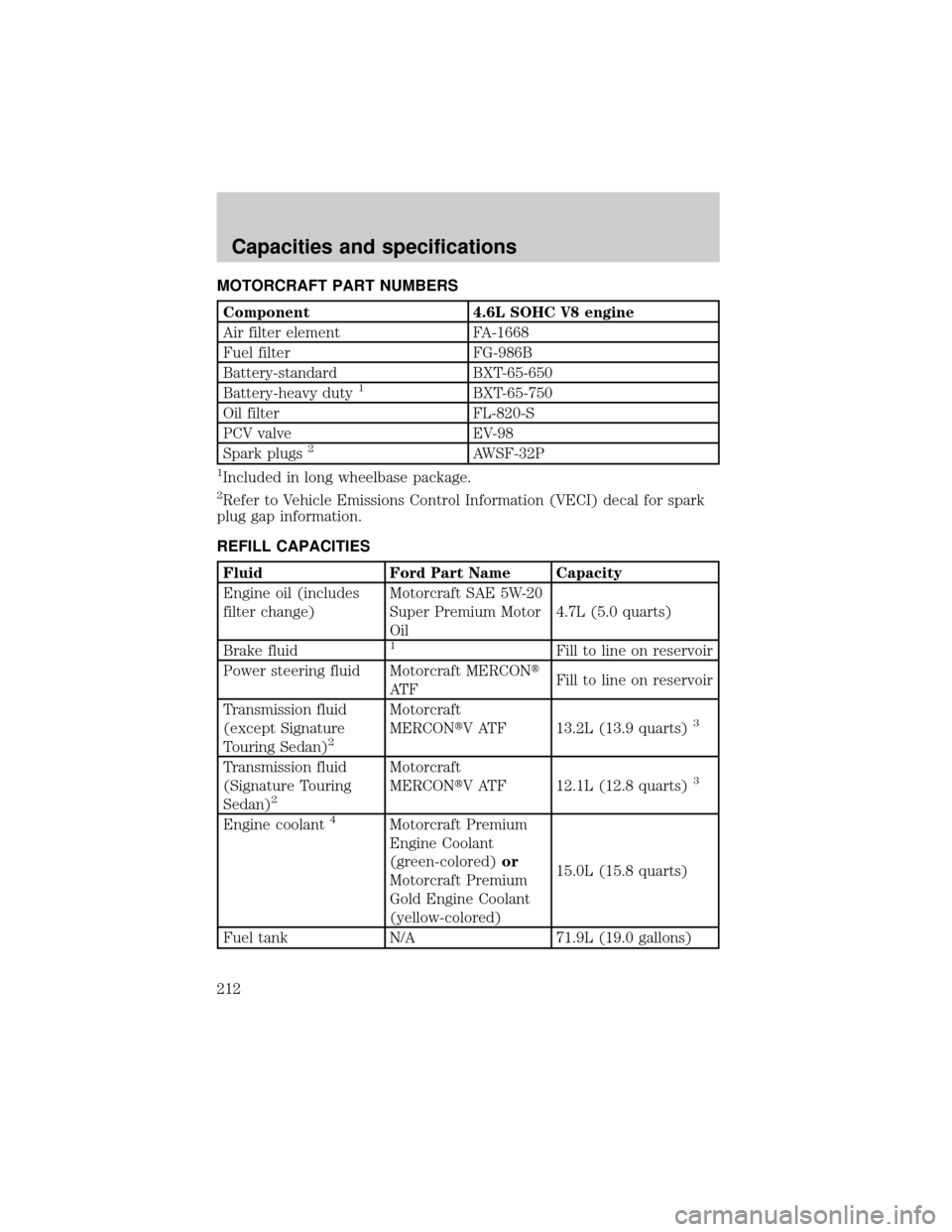
MOTORCRAFT PART NUMBERS
Component 4.6L SOHC V8 engine
Air filter element FA-1668
Fuel filter FG-986B
Battery-standard BXT-65-650
Battery-heavy duty
1BXT-65-750
Oil filter FL-820-S
PCV valve EV-98
Spark plugs
2AWSF-32P
1Included in long wheelbase package.
2Refer to Vehicle Emissions Control Information (VECI) decal for spark
plug gap information.
REFILL CAPACITIES
Fluid Ford Part Name Capacity
Engine oil (includes
filter change)Motorcraft SAE 5W-20
Super Premium Motor
Oil4.7L (5.0 quarts)
Brake fluid
1Fill to line on reservoir
Power steering fluid Motorcraft MERCONt
AT FFill to line on reservoir
Transmission fluid
(except Signature
Touring Sedan)
2
Motorcraft
MERCONtV ATF 13.2L (13.9 quarts)3
Transmission fluid
(Signature Touring
Sedan)
2
Motorcraft
MERCONtV ATF 12.1L (12.8 quarts)3
Engine coolant4Motorcraft Premium
Engine Coolant
(green-colored)or
Motorcraft Premium
Gold Engine Coolant
(yellow-colored)15.0L (15.8 quarts)
Fuel tank N/A 71.9L (19.0 gallons)
Capacities and specifications
212
Page 216 of 240
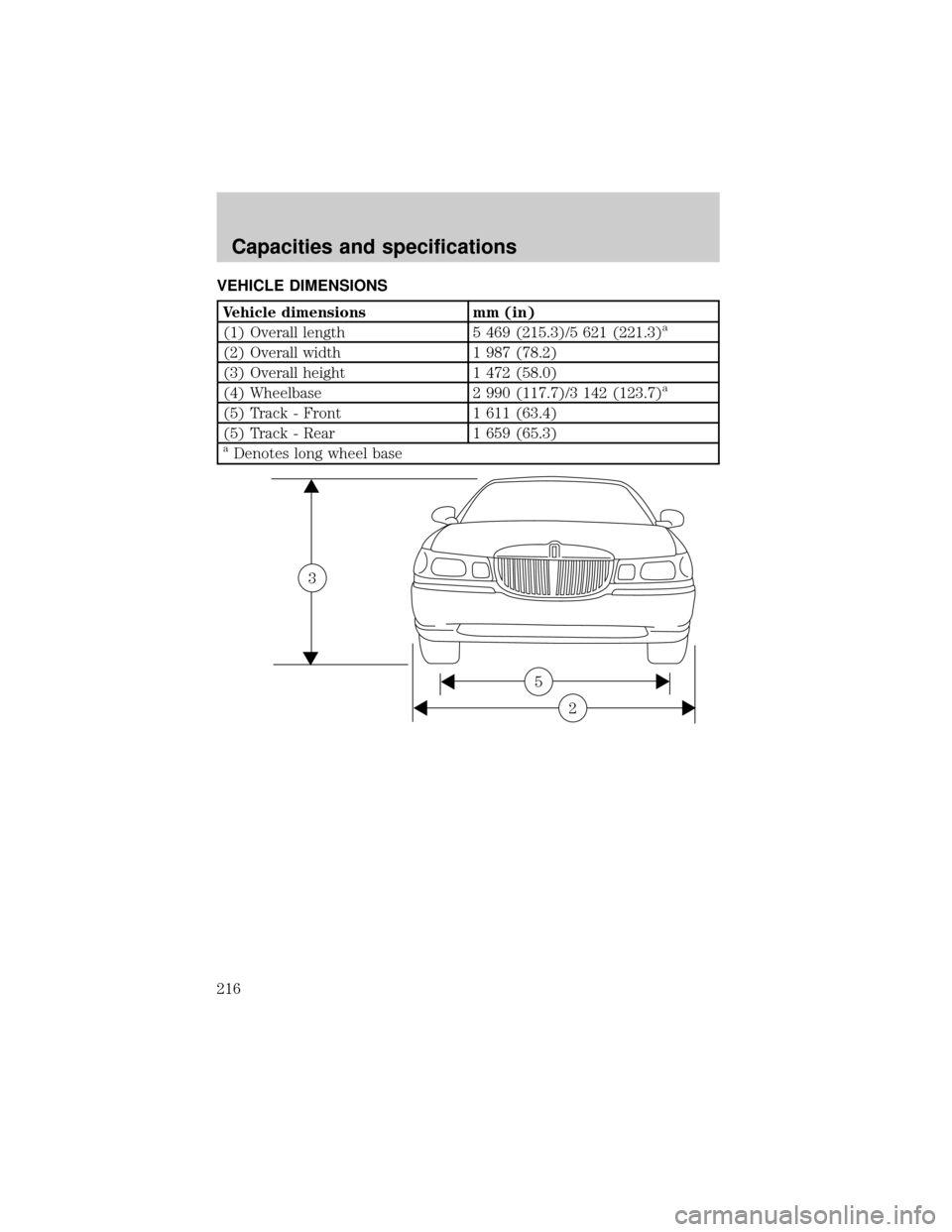
VEHICLE DIMENSIONS
Vehicle dimensions mm (in)
(1) Overall length 5 469 (215.3)/5 621 (221.3)a
(2) Overall width 1 987 (78.2)
(3) Overall height 1 472 (58.0)
(4) Wheelbase 2 990 (117.7)/3 142 (123.7)
a
(5) Track - Front 1 611 (63.4)
(5) Track - Rear 1 659 (65.3)
aDenotes long wheel base
2
5
3
Capacities and specifications
216
Page 227 of 240

Vehicle Security
Styled wheel locks
Vehicle security systems
Comfort and convenience
Cargo nets
Cargo organizers
Engine block heaters
Travel equipment
Cell phone holder
Floor mounted console organizer
Inside rear view mirror (Electrochromic with compass and temperature
display)
HomeLinkt
Protection and appearance equipment
Air bag anti-theft locks
Car covers
Carpet floor mats
Door edge guards
Emergency kit
First aid kit
Flat splash guards
Front end cover (full)
Molded splash guards
Styled hood deflector
Underbody lighting
Universal floor mats
For maximum vehicle performance, keep the following information in
mind when adding accessories or equipment to your vehicle:
²When adding accessories, equipment, passengers and luggage to your
vehicle, do not exceed the total weight capacity of the vehicle or of
Customer assistance
227
Page 232 of 240

engine compartment ..............209
exterior ....................................207
exterior lamps .........................208
instrument cluster lens ..........210
instrument panel ....................210
interior .............................210±211
mirrors .....................................208
plastic parts ............................208
safety belts ..............................211
washing ....................................206
waxing .....................................207
wheels ......................................208
windows ..................................210
wiper blades ............................208
woodtone trim ........................210
Climate control (see Air
conditioning or Heating) ............27
Clock ................................39, 53, 58
Compass, electronic
calibration .................................20
set zone adjustment ...........19±20
Console
rear ............................................76
Controls
power seat .................................92
steering column ........................65
Coolant
checking and adding ..............171
coolant temperature light ........12
refill capacities ................175, 212
specifications ..................214±215
Cruise control (see Speed
control) ........................................62
Customer Assistance ................145
Ford accessories for your
vehicle .....................................226
Ford Extended Service
Plan ..........................................219Getting assistance outside the
U.S. and Canada .....................225
Getting roadside assistance ...145
Getting the service
you need .................................219
Ordering additional owner's
literature .................................228
The Dispute Settlement
Board .......................................222
Utilizing the
Mediation/Arbitration
Program ...................................225
D
Daytime running lamps
(see Lamps) ................................26
Defrost
rear window ..............................33
Dipstick
automatic transmission
fluid ..........................................178
engine oil .................................167
Doors
door ajar warning .....................12
lubricant specifications ..........214
Driving under special
conditions
through water .........................144
E
Emergencies, roadside
jump-starting ..........................158
Emission control system ..........197
Engine ................................215±216
check engine/service engine
soon light ....................................8
cleaning ...................................209
Index
232
Page 236 of 240

extension assembly ................105
for adults .........................101±103
for children .............................118
lap belt ....................................104
Occupant Classification
Sensor ........................................98
warning light and
chime .....................9, 14, 105±106
Safety seats for children ..........119
Seat belts (see Safety
restraints) ....................................96
Seats ............................................92
child safety seats ....................119
cleaning ...........................210±211
easy access/easyout feature ....95
heated ........................................94
memory seat .................76, 84, 96
SecuriLock passive anti-theft
system ....................................88, 90
Servicing your vehicle ..............164
Spark plugs,
specifications .............212, 215±216
Specification chart,
lubricants ...........................214±215
Speed control ..............................62
Speedometer ...............................16
Starting your vehicle ........126, 128
jump starting ..........................158
Steering
speed sensitive .......................134
Steering wheel
controls ......................................65
tilting .........................................60T
Tires ...........................154, 185±187
changing ..................................154
checking the pressure ............187
replacing ..................................188
rotating ....................................187
snow tires and chains ............188
tire grades ...............................186
treadwear ................................186
Towing .......................................141
recreational towing .................143
trailer towing ..........................141
wrecker ....................................163
Traction control ..................59, 133
active light ................................14
how to enable/disable ............133
off light ......................................13
Traction-lok rear axle ...............139
Transmission .............................135
fluid, checking and adding
(automatic) .............................178
fluid, refill capacities ..............212
lubricant specifications ..214±215
Trunk ...........................................91
remote release ....................72, 81
Turn signal ......................11, 15, 60
V
Vehicle dimensions ...................216
Vehicle Identification Number
(VIN) ..........................................218
Vehicle loading ..........................139
Ventilating your vehicle ...........129
Index
236