sensor LINCOLN TOWN CAR 2002 User Guide
[x] Cancel search | Manufacturer: LINCOLN, Model Year: 2002, Model line: TOWN CAR, Model: LINCOLN TOWN CAR 2002Pages: 248, PDF Size: 1.9 MB
Page 126 of 248
Do not lean your head on the door. The side air bag could injure
you as it deploys from the side of the seatback.
Do not attempt to service, repair, or modify the air bag
supplemental restraint system, its fuses or the seat cover on a
seat containing an air bag. See your Ford or Lincoln Mercury dealer.
All occupants of the vehicle including the driver should always
wear their safety belts even when an air bag SRS is provided.
How does the side air bag system work?
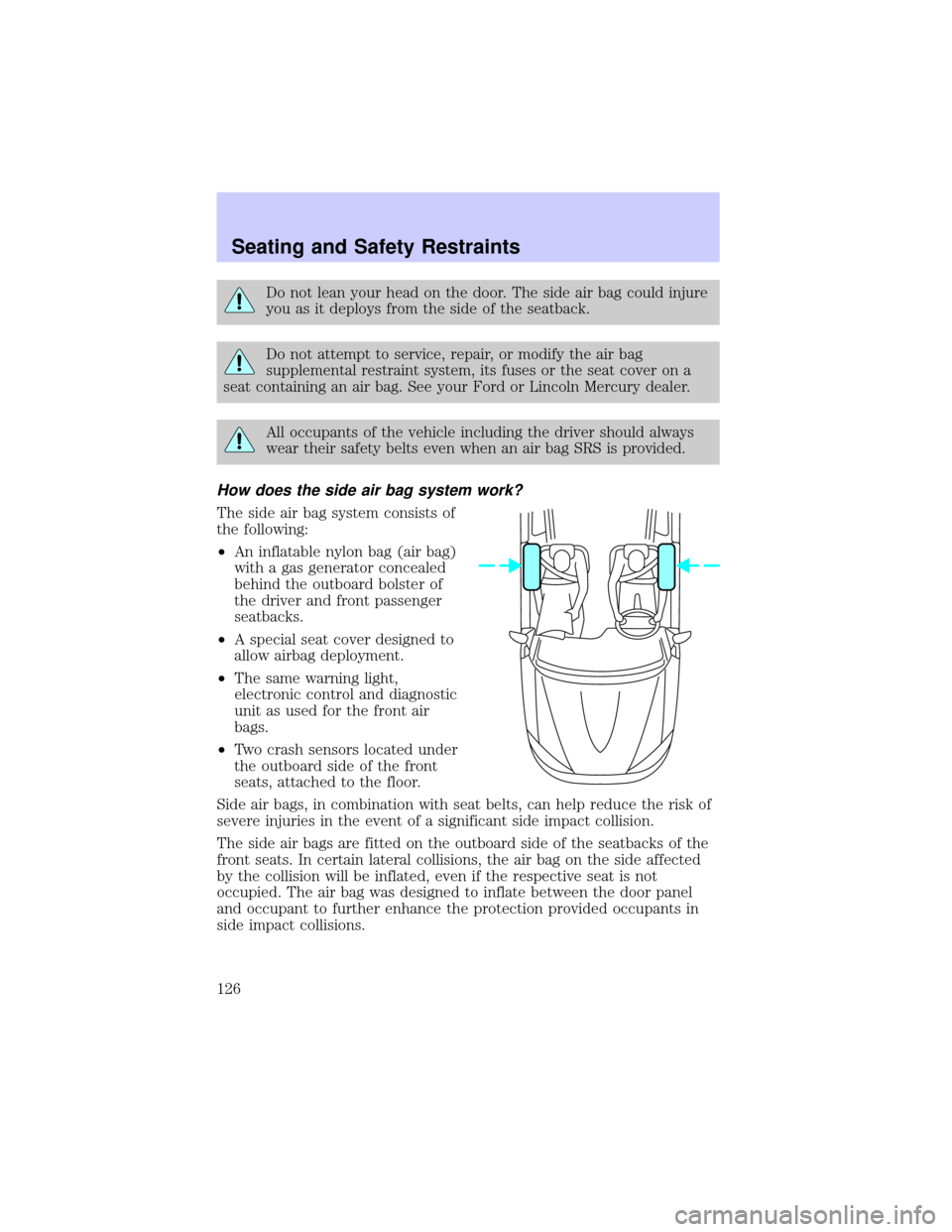
The side air bag system consists of
the following:
²An inflatable nylon bag (air bag)
with a gas generator concealed
behind the outboard bolster of
the driver and front passenger
seatbacks.
²A special seat cover designed to
allow airbag deployment.
²The same warning light,
electronic control and diagnostic
unit as used for the front air
bags.
²Two crash sensors located under
the outboard side of the front
seats, attached to the floor.
Side air bags, in combination with seat belts, can help reduce the risk of
severe injuries in the event of a significant side impact collision.
The side air bags are fitted on the outboard side of the seatbacks of the
front seats. In certain lateral collisions, the air bag on the side affected
by the collision will be inflated, even if the respective seat is not
occupied. The air bag was designed to inflate between the door panel
and occupant to further enhance the protection provided occupants in
side impact collisions.
Seating and Safety Restraints
126
Page 127 of 248
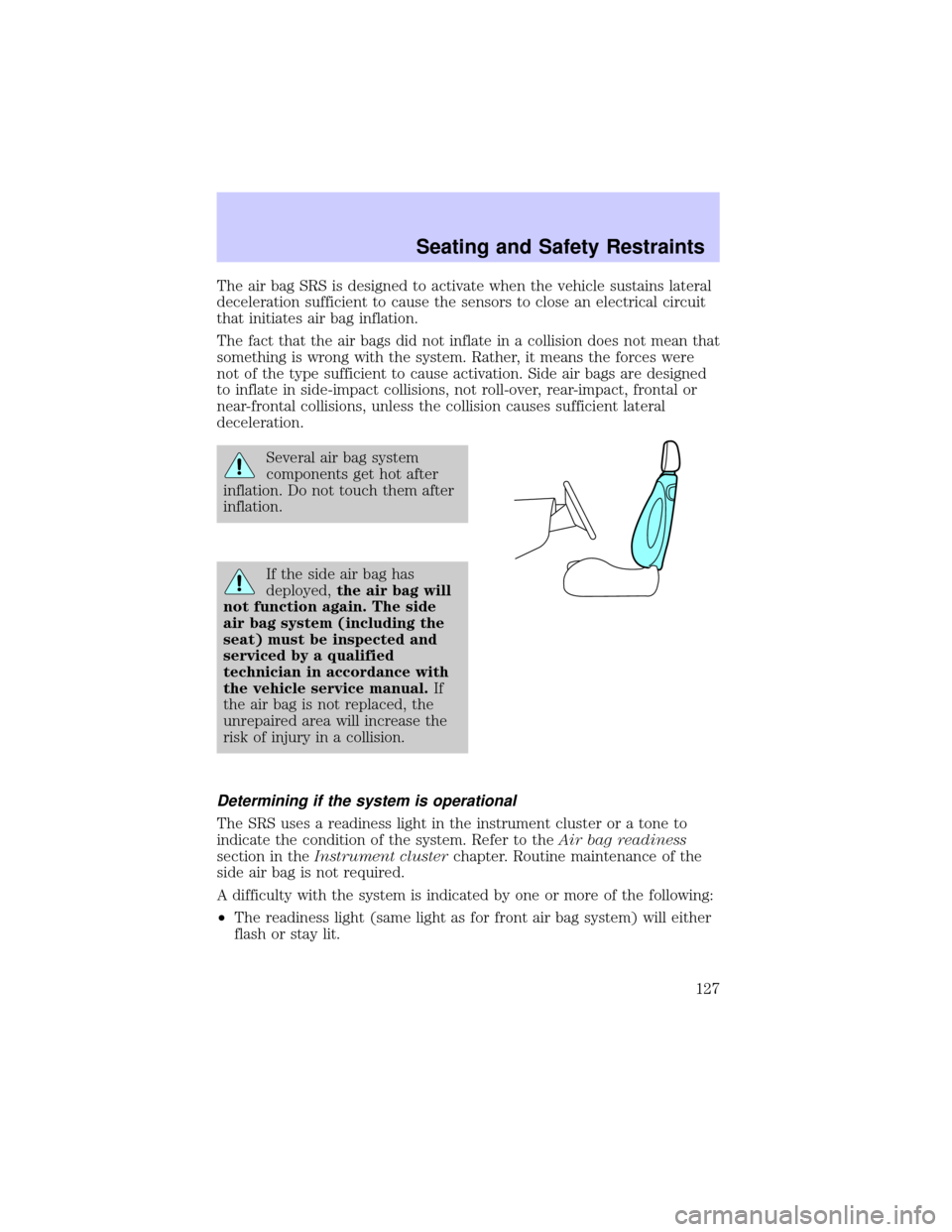
The air bag SRS is designed to activate when the vehicle sustains lateral
deceleration sufficient to cause the sensors to close an electrical circuit
that initiates air bag inflation.
The fact that the air bags did not inflate in a collision does not mean that
something is wrong with the system. Rather, it means the forces were
not of the type sufficient to cause activation. Side air bags are designed
to inflate in side-impact collisions, not roll-over, rear-impact, frontal or
near-frontal collisions, unless the collision causes sufficient lateral
deceleration.
Several air bag system
components get hot after
inflation. Do not touch them after
inflation.
If the side air bag has
deployed,the air bag will
not function again. The side
air bag system (including the
seat) must be inspected and
serviced by a qualified
technician in accordance with
the vehicle service manual.If
the air bag is not replaced, the
unrepaired area will increase the
risk of injury in a collision.
Determining if the system is operational
The SRS uses a readiness light in the instrument cluster or a tone to
indicate the condition of the system. Refer to theAir bag readiness
section in theInstrument clusterchapter. Routine maintenance of the
side air bag is not required.
A difficulty with the system is indicated by one or more of the following:
²The readiness light (same light as for front air bag system) will either
flash or stay lit.
Seating and Safety Restraints
127
Page 143 of 248
Your vehicle has an automatic parking brake release. To release the
parking brake:
1. Turn the ignition to the ON position.
2. Press the brake pedal.
3. Move the gearshift from the P (Park) position to one of the forward
gears (the parking brake will not release automatically when you shift
into reverse). The brake pedal must remain pressed while the gearshift is
moved.
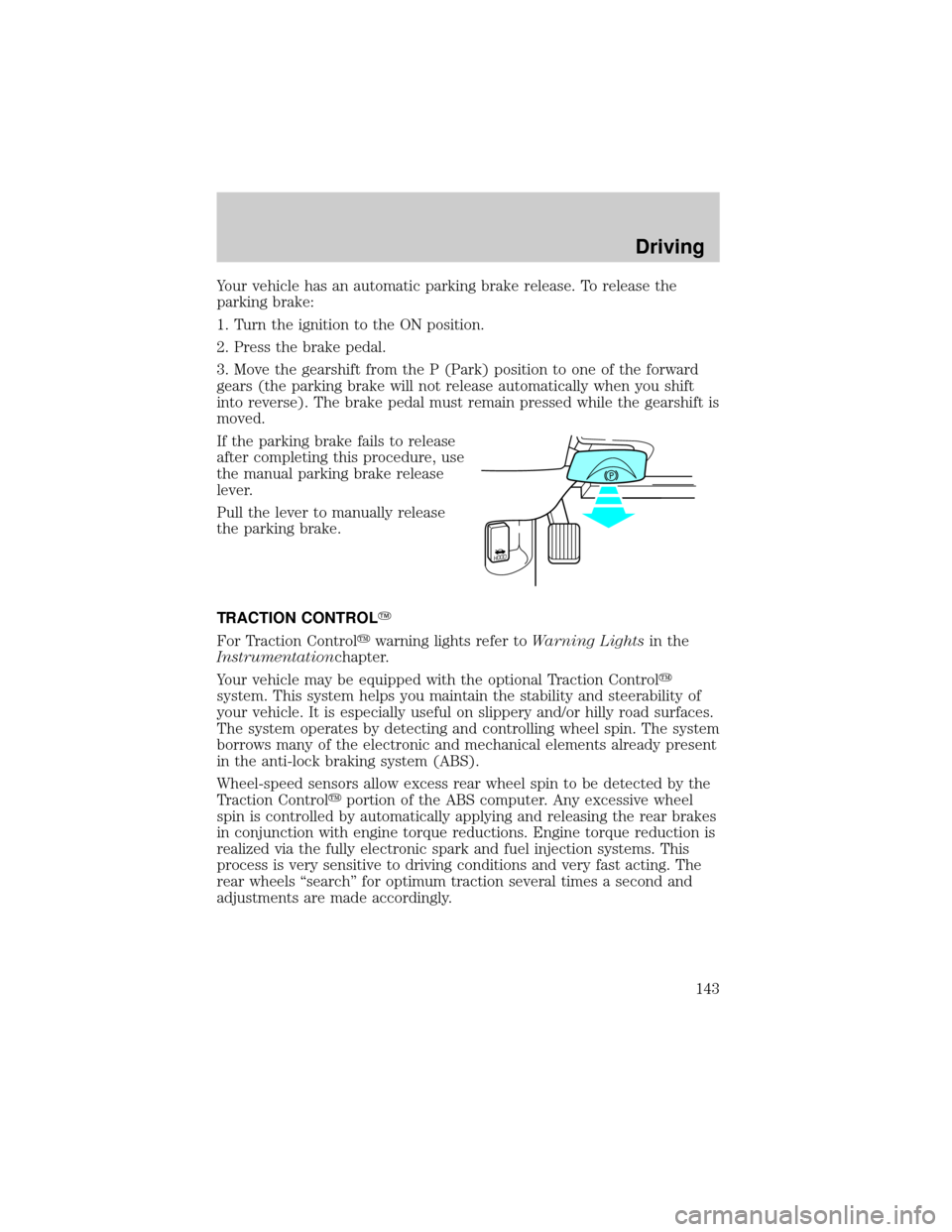
If the parking brake fails to release
after completing this procedure, use
the manual parking brake release
lever.
Pull the lever to manually release
the parking brake.
TRACTION CONTROLY
For Traction Controlywarning lights refer toWarning Lightsin the
Instrumentationchapter.
Your vehicle may be equipped with the optional Traction Controly
system. This system helps you maintain the stability and steerability of
your vehicle. It is especially useful on slippery and/or hilly road surfaces.
The system operates by detecting and controlling wheel spin. The system
borrows many of the electronic and mechanical elements already present
in the anti-lock braking system (ABS).
Wheel-speed sensors allow excess rear wheel spin to be detected by the
Traction Controlyportion of the ABS computer. Any excessive wheel
spin is controlled by automatically applying and releasing the rear brakes
in conjunction with engine torque reductions. Engine torque reduction is
realized via the fully electronic spark and fuel injection systems. This
process is very sensitive to driving conditions and very fast acting. The
rear wheels ªsearchº for optimum traction several times a second and
adjustments are made accordingly.
HOOD
Driving
143
Page 160 of 248
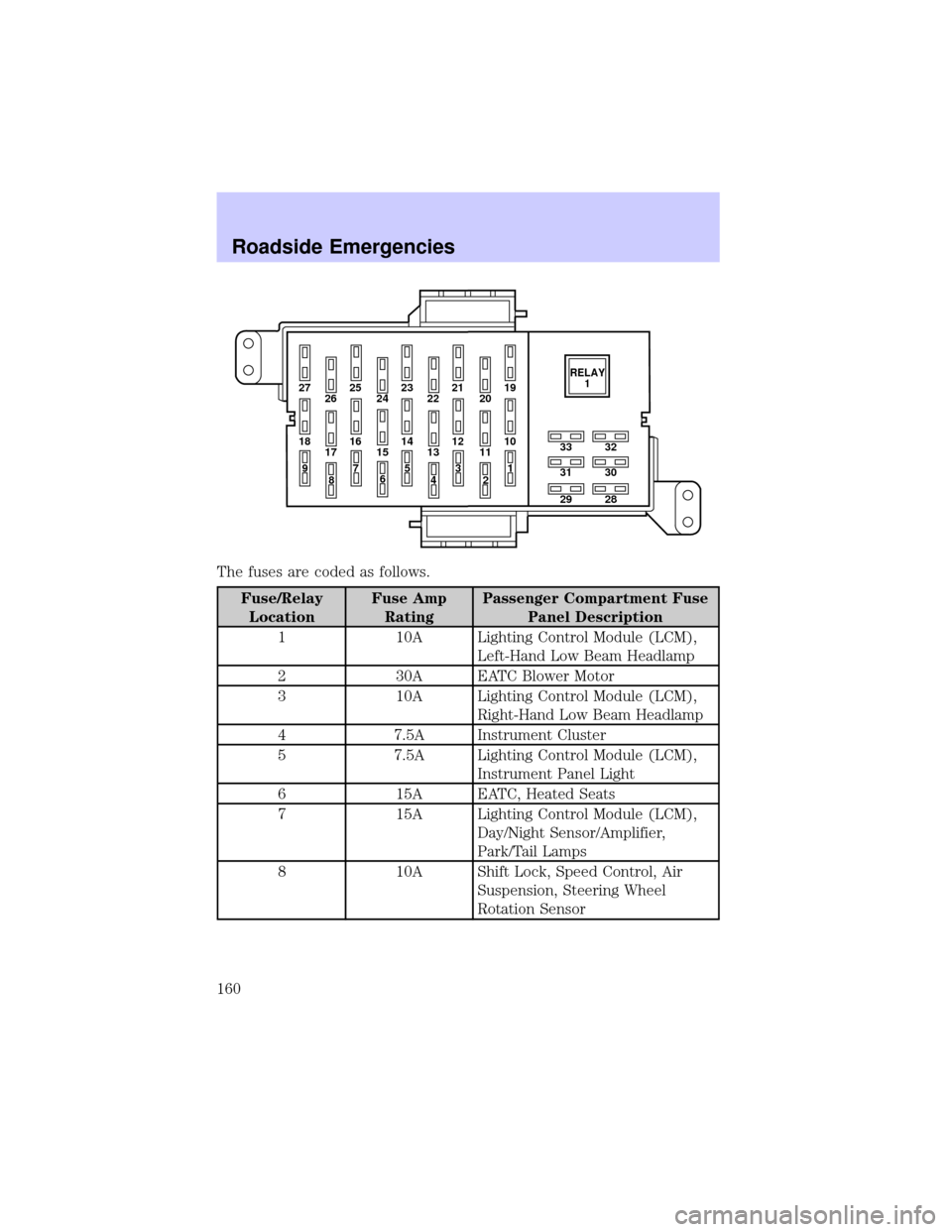
The fuses are coded as follows.
Fuse/Relay
LocationFuse Amp
RatingPassenger Compartment Fuse
Panel Description
1 10A Lighting Control Module (LCM),
Left-Hand Low Beam Headlamp
2 30A EATC Blower Motor
3 10A Lighting Control Module (LCM),
Right-Hand Low Beam Headlamp
4 7.5A Instrument Cluster
5 7.5A Lighting Control Module (LCM),
Instrument Panel Light
6 15A EATC, Heated Seats
7 15A Lighting Control Module (LCM),
Day/Night Sensor/Amplifier,
Park/Tail Lamps
8 10A Shift Lock, Speed Control, Air
Suspension, Steering Wheel
Rotation Sensor
27 25
26 2423 21
2219
20
18 16
17 1514 12
1310
33
31
2932
30
28 11
97
8653
41
2RELAY
1
Roadside Emergencies
160
Page 161 of 248
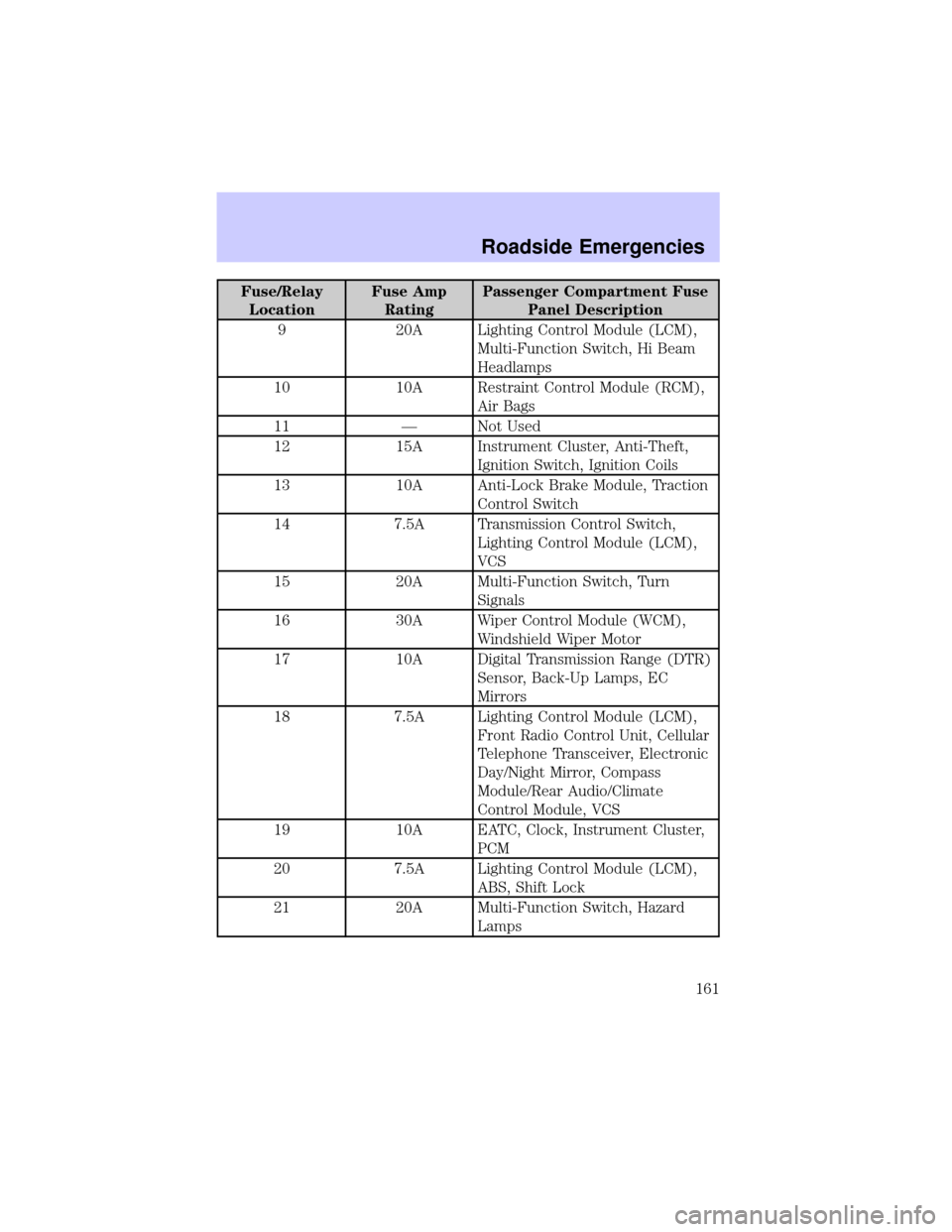
Fuse/Relay
LocationFuse Amp
RatingPassenger Compartment Fuse
Panel Description
9 20A Lighting Control Module (LCM),
Multi-Function Switch, Hi Beam
Headlamps
10 10A Restraint Control Module (RCM),
Air Bags
11 Ð Not Used
12 15A Instrument Cluster, Anti-Theft,
Ignition Switch, Ignition Coils
13 10A Anti-Lock Brake Module, Traction
Control Switch
14 7.5A Transmission Control Switch,
Lighting Control Module (LCM),
VCS
15 20A Multi-Function Switch, Turn
Signals
16 30A Wiper Control Module (WCM),
Windshield Wiper Motor
17 10A Digital Transmission Range (DTR)
Sensor, Back-Up Lamps, EC
Mirrors
18 7.5A Lighting Control Module (LCM),
Front Radio Control Unit, Cellular
Telephone Transceiver, Electronic
Day/Night Mirror, Compass
Module/Rear Audio/Climate
Control Module, VCS
19 10A EATC, Clock, Instrument Cluster,
PCM
20 7.5A Lighting Control Module (LCM),
ABS, Shift Lock
21 20A Multi-Function Switch, Hazard
Lamps
Roadside Emergencies
161
Page 162 of 248
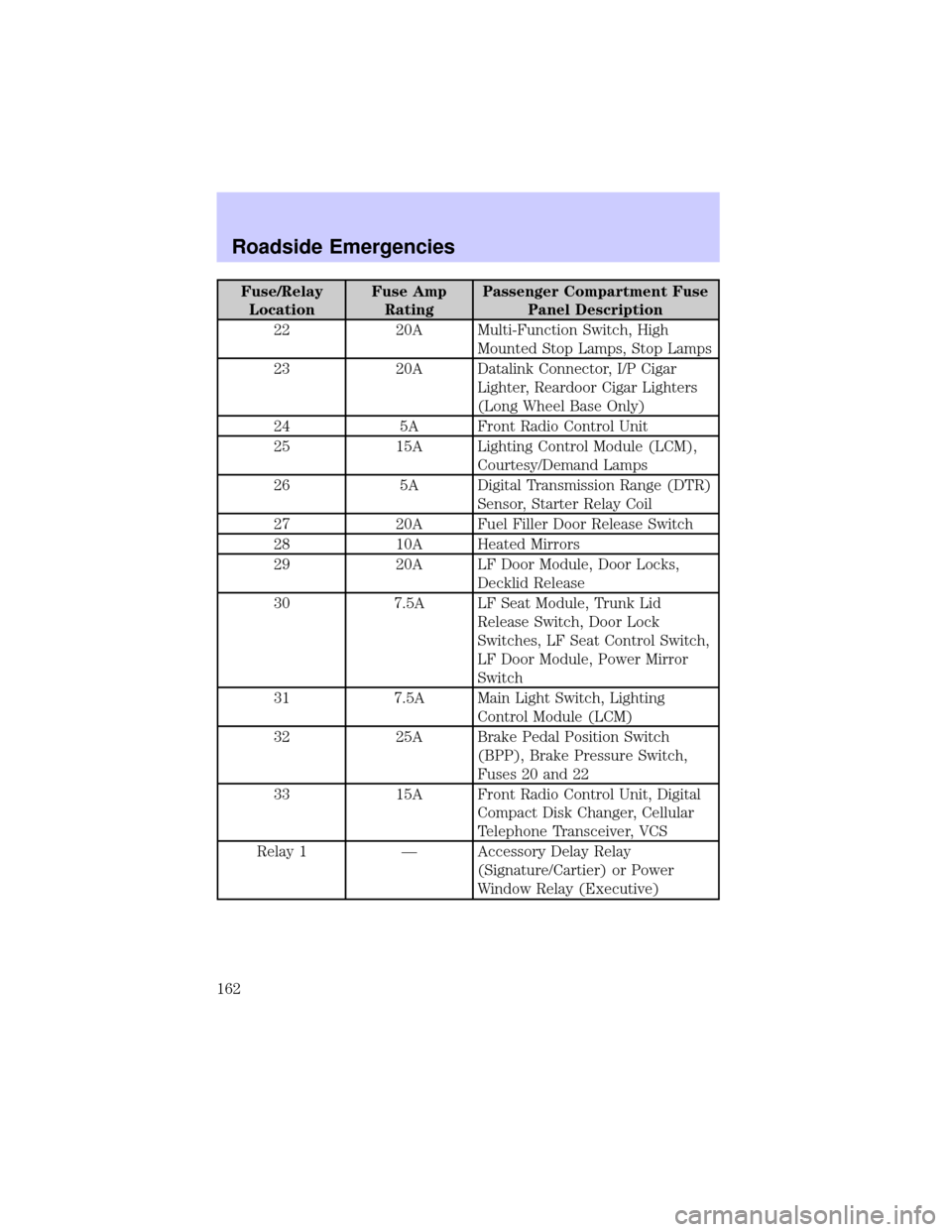
Fuse/Relay
LocationFuse Amp
RatingPassenger Compartment Fuse
Panel Description
22 20A Multi-Function Switch, High
Mounted Stop Lamps, Stop Lamps
23 20A Datalink Connector, I/P Cigar
Lighter, Reardoor Cigar Lighters
(Long Wheel Base Only)
24 5A Front Radio Control Unit
25 15A Lighting Control Module (LCM),
Courtesy/Demand Lamps
26 5A Digital Transmission Range (DTR)
Sensor, Starter Relay Coil
27 20A Fuel Filler Door Release Switch
28 10A Heated Mirrors
29 20A LF Door Module, Door Locks,
Decklid Release
30 7.5A LF Seat Module, Trunk Lid
Release Switch, Door Lock
Switches, LF Seat Control Switch,
LF Door Module, Power Mirror
Switch
31 7.5A Main Light Switch, Lighting
Control Module (LCM)
32 25A Brake Pedal Position Switch
(BPP), Brake Pressure Switch,
Fuses 20 and 22
33 15A Front Radio Control Unit, Digital
Compact Disk Changer, Cellular
Telephone Transceiver, VCS
Relay 1 Ð Accessory Delay Relay
(Signature/Cartier) or Power
Window Relay (Executive)
Roadside Emergencies
162
Page 165 of 248
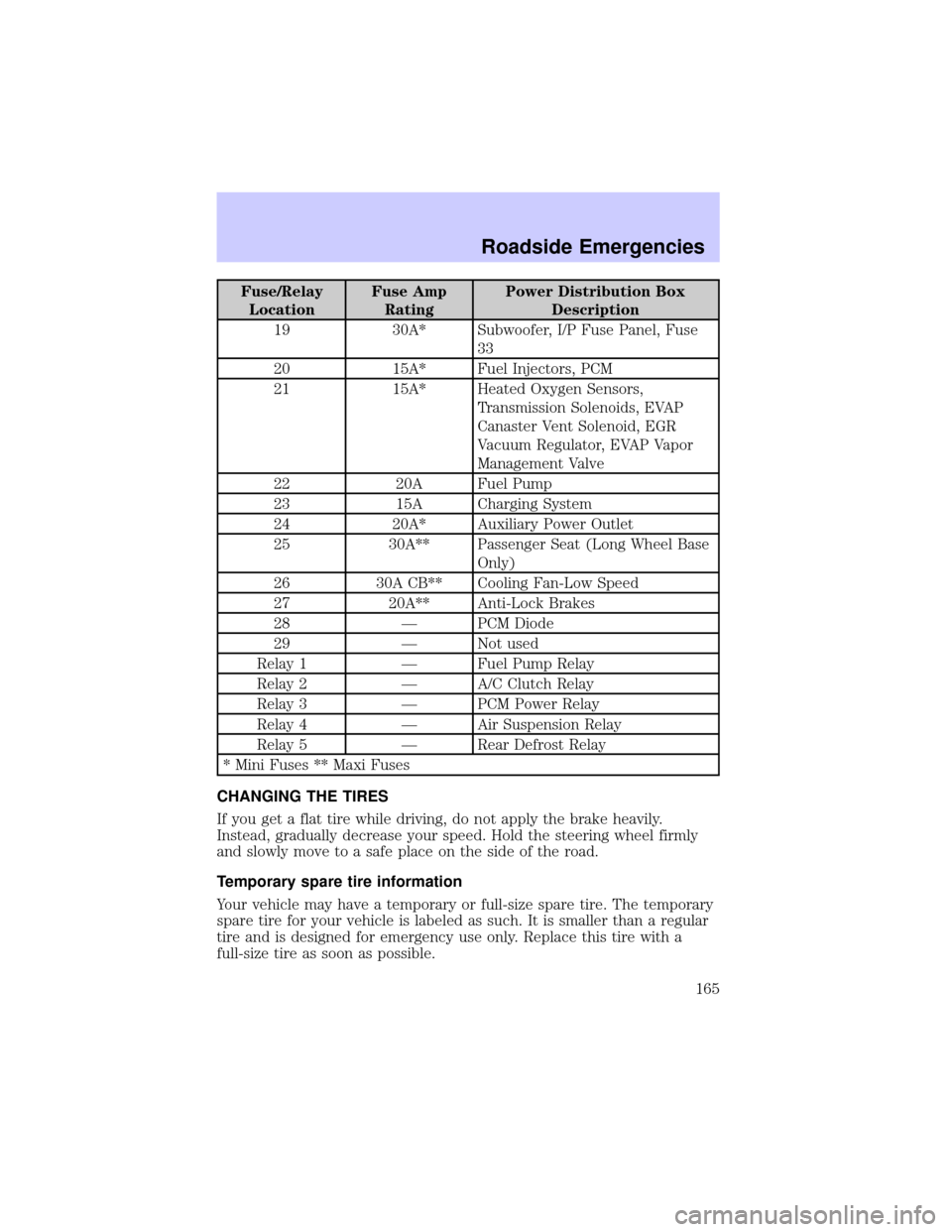
Fuse/Relay
LocationFuse Amp
RatingPower Distribution Box
Description
19 30A* Subwoofer, I/P Fuse Panel, Fuse
33
20 15A* Fuel Injectors, PCM
21 15A* Heated Oxygen Sensors,
Transmission Solenoids, EVAP
Canaster Vent Solenoid, EGR
Vacuum Regulator, EVAP Vapor
Management Valve
22 20A Fuel Pump
23 15A Charging System
24 20A* Auxiliary Power Outlet
25 30A** Passenger Seat (Long Wheel Base
Only)
26 30A CB** Cooling Fan-Low Speed
27 20A** Anti-Lock Brakes
28 Ð PCM Diode
29 Ð Not used
Relay 1 Ð Fuel Pump Relay
Relay 2 Ð A/C Clutch Relay
Relay 3 Ð PCM Power Relay
Relay 4 Ð Air Suspension Relay
Relay 5 Ð Rear Defrost Relay
* Mini Fuses ** Maxi Fuses
CHANGING THE TIRES
If you get a flat tire while driving, do not apply the brake heavily.
Instead, gradually decrease your speed. Hold the steering wheel firmly
and slowly move to a safe place on the side of the road.
Temporary spare tire information
Your vehicle may have a temporary or full-size spare tire. The temporary
spare tire for your vehicle is labeled as such. It is smaller than a regular
tire and is designed for emergency use only. Replace this tire with a
full-size tire as soon as possible.
Roadside Emergencies
165
Page 241 of 248

Load limits .................................150
GAWR ......................................150
GVWR ......................................150
trailer towing ..........................150
Locks
autolock .....................................94
childproof ..................................88
doors ..........................................88
Lubricant specifications ...228, 230
Lumbar support, seats .............103
M
Message center ...........................77
english/metric button ...............82
reset button ..............................78
Mirrors .........................................61
automatic dimming rearview
mirror ........................................63
heated ........................................64
programmable memory ............94
side view mirrors (power) .......63
Moon roof ....................................69
Motorcraft parts ................212, 226
O
Octane rating ............................211
Odometer .....................................18
Oil (see Engine oil) ..................195
Overdrive .............................83, 148
P
Panic alarm feature, remote
entry system ................................91
Parking brake ............................142Parts (see Motorcraft parts) ....226
Passenger Occupant
Classification Sensor .................108
Pedals (see Power adjustable
foot pedals) .................................64
Power distribution box
(see Fuses) ...............................163
Power door locks ........................88
Power steering ..................144±145
fluid, checking and adding ....217
fluid, refill capacity ................227
fluid, specifications .........228, 230
R
Rear window defroster ...............48
Relays ........................................158
Remote entry system ...........90±91
illuminated entry ......................93
locking/unlocking doors ...........90
opening the trunk .....................91
panic alarm ...............................91
replacement/additional
transmitters ...............................93
replacing the batteries .............92
S
Safety belts (see Safety
restraints) ............16, 106, 110±114
Safety defects, reporting ..........185
Safety restraints ........106, 110±114
belt minder .............................116
cleaning the safety
belts .................................120, 191
extension assembly ................120
for adults .........................111±113
for children .....................128±129
Index
241
Page 242 of 248

lap belt ....................................114
Occupant Classification
Sensor ......................................108
warning light and
chime ...................12, 16, 115±116
Safety seats for
children ..............................129±130
Seat belts (see Safety
restraints) ..................................106
Seats ..........................................102
child safety seats ............129±130
cleaning ...................................190
easy access/easyout feature ..105
heated ......................................105
memory seat ...............84, 94, 106
SecuriLock passive anti-theft
system ..................................98±100
Servicing your vehicle ..............193
Spark plugs,
specifications .....................226, 230
Specification chart,
lubricants ...........................228, 230
Speed control ..............................65
Speedometer ...............................18
Starting your vehicle ........136±138
jump starting ..........................169
Steering
speed sensitive .......................145
Steering wheel
controls ..........................60, 65, 68
tilting .........................................60
T
Tires ...........................165, 222±224changing ..........................165±166
checking the pressure ............224
replacing ..................................225
rotating ....................................224
snow tires and chains ............225
tire grades ...............................223
treadwear ................................223
Towing .......................................151
recreational towing .................154
trailer towing ..........................151
wrecker ....................................175
Traction control ........................143
active light ................................13
how to enable/disable ............144
off light ......................................14
Traction-lok rear axle ...............149
Transmission .............................146
fluid, checking and adding
(automatic) .............................219
fluid, refill capacities ..............227
lubricant
specifications ..................228, 230
Trunk ...........................................89
remote release ....................83, 91
Turn signal ......................15±16, 53
V
Vehicle Communication
System .........................................73
Vehicle dimensions ...................230
Vehicle Identification Number
(VIN) ..........................................232
Vehicle loading ..........................150
Ventilating your vehicle ...........140
Index
242