climate LINCOLN TOWN CAR 2005 User Guide
[x] Cancel search | Manufacturer: LINCOLN, Model Year: 2005, Model line: TOWN CAR, Model: LINCOLN TOWN CAR 2005Pages: 328, PDF Size: 3.44 MB
Page 224 of 328
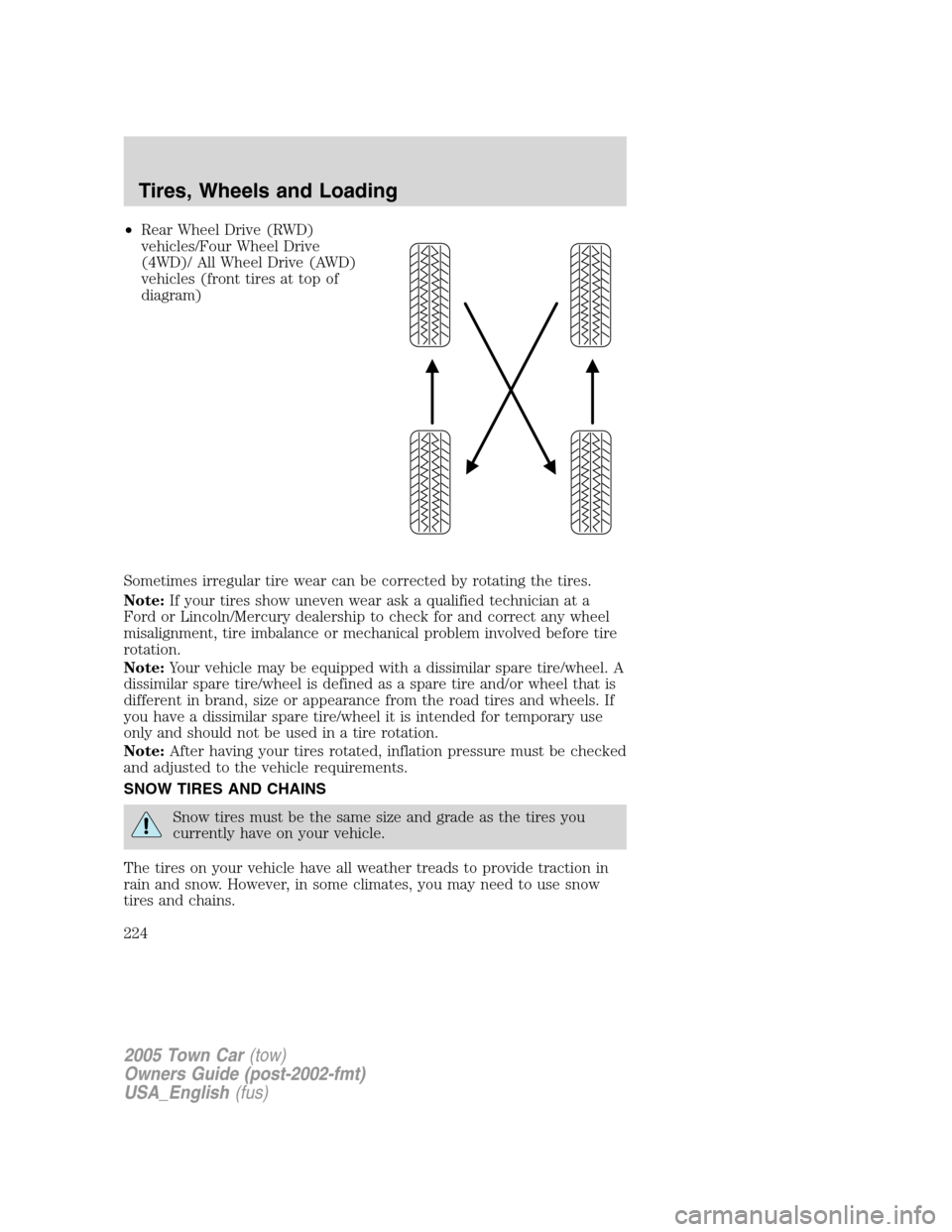
•Rear Wheel Drive (RWD)
vehicles/Four Wheel Drive
(4WD)/ All Wheel Drive (AWD)
vehicles (front tires at top of
diagram)
Sometimes irregular tire wear can be corrected by rotating the tires.
Note:If your tires show uneven wear ask a qualified technician at a
Ford or Lincoln/Mercury dealership to check for and correct any wheel
misalignment, tire imbalance or mechanical problem involved before tire
rotation.
Note:Your vehicle may be equipped with a dissimilar spare tire/wheel. A
dissimilar spare tire/wheel is defined as a spare tire and/or wheel that is
different in brand, size or appearance from the road tires and wheels. If
you have a dissimilar spare tire/wheel it is intended for temporary use
only and should not be used in a tire rotation.
Note:After having your tires rotated, inflation pressure must be checked
and adjusted to the vehicle requirements.
SNOW TIRES AND CHAINS
Snow tires must be the same size and grade as the tires you
currently have on your vehicle.
The tires on your vehicle have all weather treads to provide traction in
rain and snow. However, in some climates, you may need to use snow
tires and chains.
2005 Town Car(tow)
Owners Guide (post-2002-fmt)
USA_English(fus)
Tires, Wheels and Loading
224
Page 289 of 328
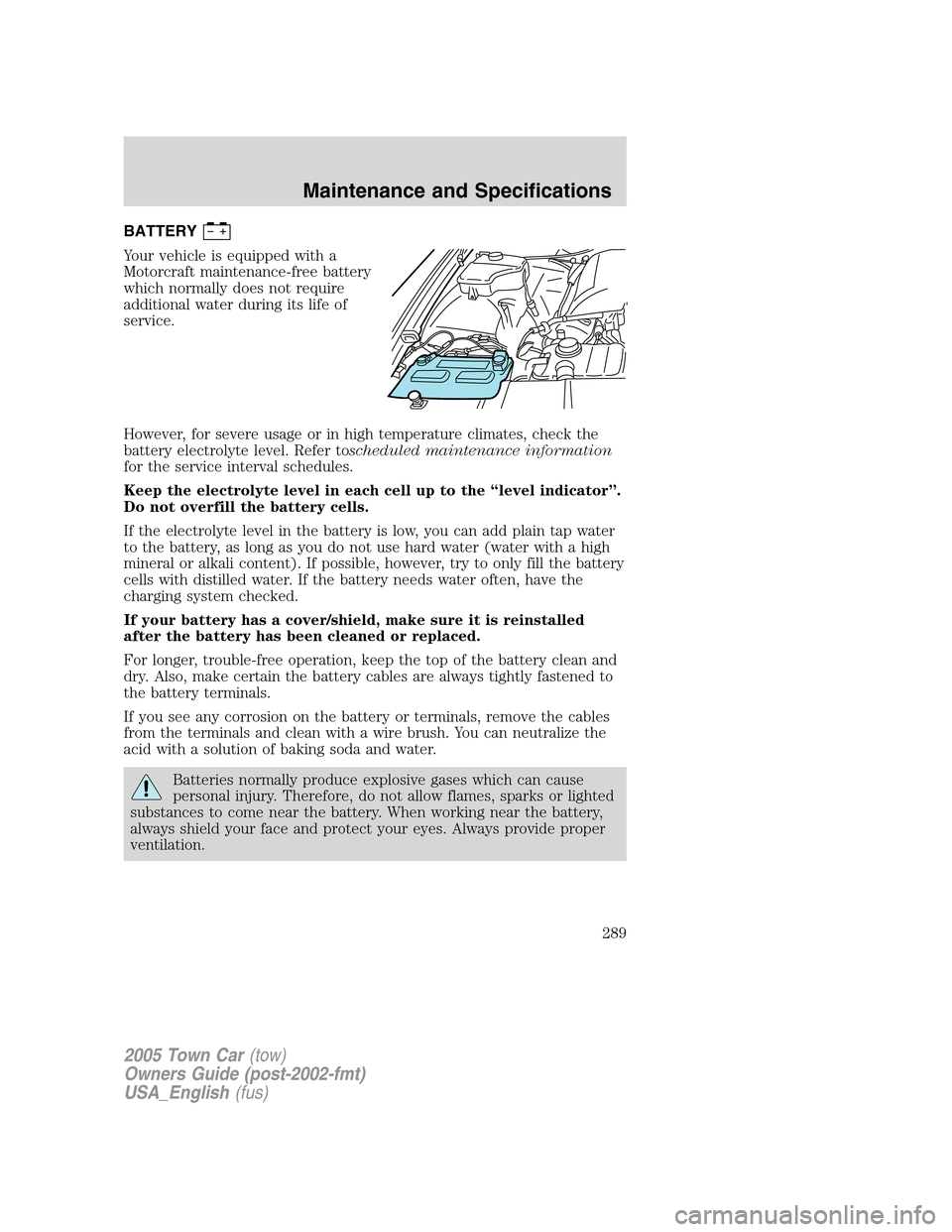
BATTERY
Your vehicle is equipped with a
Motorcraft maintenance-free battery
which normally does not require
additional water during its life of
service.
However, for severe usage or in high temperature climates, check the
battery electrolyte level. Refer toscheduled maintenance information
for the service interval schedules.
Keep the electrolyte level in each cell up to the “level indicator”.
Do not overfill the battery cells.
If the electrolyte level in the battery is low, you can add plain tap water
to the battery, as long as you do not use hard water (water with a high
mineral or alkali content). If possible, however, try to only fill the battery
cells with distilled water. If the battery needs water often, have the
charging system checked.
If your battery has a cover/shield, make sure it is reinstalled
after the battery has been cleaned or replaced.
For longer, trouble-free operation, keep the top of the battery clean and
dry. Also, make certain the battery cables are always tightly fastened to
the battery terminals.
If you see any corrosion on the battery or terminals, remove the cables
from the terminals and clean with a wire brush. You can neutralize the
acid with a solution of baking soda and water.
Batteries normally produce explosive gases which can cause
personal injury. Therefore, do not allow flames, sparks or lighted
substances to come near the battery. When working near the battery,
always shield your face and protect your eyes. Always provide proper
ventilation.
2005 Town Car(tow)
Owners Guide (post-2002-fmt)
USA_English(fus)
Maintenance and Specifications
289
Page 295 of 328
Used engine coolant should be disposed of in an appropriate
manner. Follow your community’s regulations and standards for recycling
and disposing of automotive fluids.
Coolant refill capacity
To find out how much fluid your vehicle’s cooling system can hold, refer
toRefill capacitiesin this section.
Fill your engine coolant reservoir as outlined inAdding engine coolant
in this section.
Severe climates
If you drive in extremely cold climates (less than –34° F [–36° C ]):
•It may be necessary to increase the coolant concentration
above 50%.
•NEVER increase the coolant concentration above 60%.
•Increased engine coolant concentrations above 60% will
decrease the overheat protection characteristics of the engine
coolant and may cause engine damage.
•Refer to the chart on the coolant container to ensure the
coolant concentration in your vehicle will provide adequate
freeze protection at the temperatures in which you drive in the
winter months.
If you drive in extremely hot climates:
•It is still necessary to maintain the coolant concentration
above 40%.
•NEVER decrease the coolant concentration below 40%.
•Decreased engine coolant concentrations below 40% will
decrease the corrosion protection characteristics of the engine
coolant and may cause engine damage.
•Decreased engine coolant concentrations below 40% will
decrease the freeze protection characteristics of the engine
coolant and may cause engine damage.
•Refer to the chart on the coolant container to ensure the
coolant concentration in your vehicle will provide adequate
protection at the temperatures in which you drive.
Vehicles driven year-round in non-extreme climates should use a 50/50
mixture of engine coolant and distilled water for optimum cooling system
and engine protection.
2005 Town Car(tow)
Owners Guide (post-2002-fmt)
USA_English(fus)
Maintenance and Specifications
295
Page 324 of 328
wiper blades ............................278
Climate control (see Air
conditioning or Heating) ..........101
Clock ..........................................128
Compass, electronic
set zone adjustment ...............118
Console
overhead ..................................117
rear ..................................136, 144
Controls
power seat ...............................163
steering column ......................135
Coolant
checking and adding ..............291
refill capacities ................295, 312
specifications ..................314, 316
Cruise control
(see Speed control) ..................132
Customer Assistance ................251
Ford accessories for your
vehicle .....................................280
Ford Extended Service
Plan ..........................................273
Getting assistance outside the
U.S. and Canada .....................274
Getting roadside assistance ...251
Getting the service you
need .........................................267
Ordering additional owner’s
literature .................................274
The Dispute Settlement
Board .......................................269
Utilizing the
Mediation/Arbitration
Program ...................................272
D
Daytime running lamps
(see Lamps) ..............................106Defrost
rear window ............................104
Dipstick
automatic transmission
fluid ..........................................308
engine oil .................................285
Doors
lubricant specifications ..........314
Driving under special
conditions ..................................247
through water .........................250
E
Emergencies, roadside
jump-starting ..........................260
Emergency Flashers .................252
Emission control system ..........305
Engine ........................................316
cleaning ...................................277
coolant .....................................291
fail-safe coolant ......................296
idle speed control ...................289
lubrication
specifications ..................314, 316
refill capacities ........................312
service points ..........................284
starting after a collision .........252
Engine block heater .................238
Engine oil ..................................285
change oil soon warning,
message center .......................285
checking and adding ..............285
dipstick ....................................285
filter, specifications ........288, 311
recommendations ...................288
refill capacities ........................312
specifications ..................314, 316
Exhaust fumes ..........................238
2005 Town Car(tow)
Owners Guide (post-2002-fmt)
USA_English(fus)
Index
324