light LINCOLN TOWN CAR 2006 Manual Online
[x] Cancel search | Manufacturer: LINCOLN, Model Year: 2006, Model line: TOWN CAR, Model: LINCOLN TOWN CAR 2006Pages: 328, PDF Size: 4.56 MB
Page 287 of 328
For vehicles with overflow coolant systems with a non-pressurized cap
on the coolant recovery system, add coolant to the coolant recovery
reservoir when the engine is cool. Add the proper mixture of coolant and
water to the “FULL COLD” level. For all other vehicles which have a
coolant degas system with a pressurized cap, or if it is necessary to
remove the coolant pressure relief cap on the radiator of a vehicle with
an overflow system, follow these steps to add engine coolant.
To reduce the risk of personal injury, make sure the engine is
cool before unscrewing the coolant pressure relief cap. The
cooling system is under pressure; steam and hot liquid can come out
forcefully when the cap is loosened slightly.
1. Before you begin, turn the engine off and let it cool.
2. When the engine is cool, wrap a thick cloth around the coolant
pressure relief cap on the coolant reservoir (a translucent plastic bottle).
Slowly turn cap counterclockwise (left) until pressure begins to release.
3. Step back while the pressure releases.
4. When you are sure that all the pressure has been released, use the
cloth to turn it counterclockwise and remove the cap.
5. Fill the coolant reservoir slowly with the proper coolant mixture (see
above), to within the “COLD FILL RANGE” or the “FULL COLD” level on
the reservoir. If you removed the radiator cap in an overflow system, fill
the radiator until the coolant is visible and radiator is almost full.
6. Replace the cap. Turn until tightly installed. (Cap must be tightly
installed to prevent coolant loss.)
After any coolant has been added, check the coolant concentration (refer
toChecking engine coolant). If the concentration is not 50/50
(protection to –34° F/–36° C), drain some coolant and adjust the
concentration. It may take several drains and additions to obtain a 50/50
coolant concentration.
Whenever coolant has been added, the coolant level in the coolant
reservoir should be checked the next few times you drive the vehicle. If
necessary, add enough 50/50 concentration of engine coolant and
distilled water to bring the liquid level to the proper level.
If you have to add more than 1.0 quart (1.0 liter) of engine coolant per
month, have your authorized dealer check the engine cooling system.
Your cooling system may have a leak. Operating an engine with a low
level of coolant can result in engine overheating and possible engine
damage.
2006 Town Car(tow)
Owners Guide (post-2002-fmt)
USA(fus)
Maintenance and Specifications
287
Page 289 of 328
•Refer to the chart on the coolant container to ensure the
coolant concentration in your vehicle will provide adequate
protection at the temperatures in which you drive.
Vehicles driven year-round in non-extreme climates should use a 50/50
mixture of engine coolant and distilled water for optimum cooling system
and engine protection.
What you should know about fail-safe cooling
If the engine coolant supply is depleted, this feature allows the vehicle to
be driven temporarily before incremental component damage is incurred.
The “fail-safe” distance depends on ambient temperatures, vehicle load
and terrain.
How fail-safe cooling works
If the engine begins to overheat:
•The engine coolant temperature gauge will move to the H (hot) area.
•The
symbol will display in the message center.
•The message center will display Coolant over temperature.
•A chime will sound.
•TheService engine soonindicator light will illuminate.
If the engine reaches a preset over-temperature condition, the engine
will automatically switch to alternating cylinder operation. Each disabled
cylinder acts as an air pump and cools the engine.
When this occurs the vehicle will still operate. However:
•The engine power will be limited.
•The air conditioning system will be disabled.
Continued operation will increase the engine temperature and the engine
will completely shut down, causing steering and braking effort to
increase.
Once the engine temperature cools, the engine can be re-started. Take
your vehicle to an authorized dealer as soon as possible to minimize
engine damage.
When fail-safe mode is activated
You have limited engine power when in the fail-safe mode, so drive the
vehicle with caution. The vehicle will not be able to maintain high-speed
operation and the engine will run rough. Remember that the engine is
capable of completely shutting down automatically to prevent engine
damage, therefore:
2006 Town Car(tow)
Owners Guide (post-2002-fmt)
USA(fus)
Maintenance and Specifications
289
Page 295 of 328
Octane recommendations
Do not be concerned if your engine
sometimes knocks lightly. However,
if it knocks heavily under most
driving conditions while you are
using fuel with the recommended
octane rating, see your authorized dealer to prevent any engine damage.
Unleaded Gasoline engines
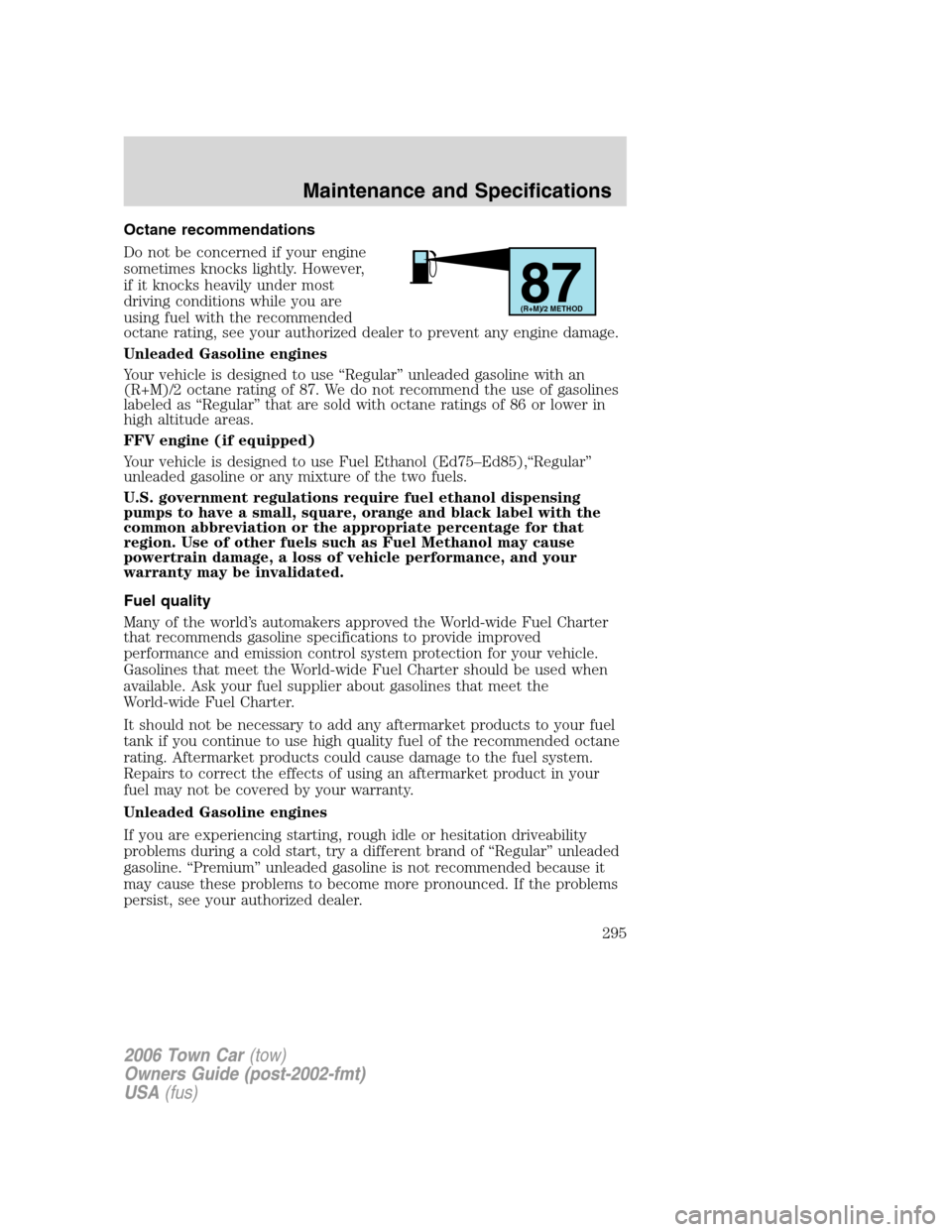
Your vehicle is designed to use “Regular” unleaded gasoline with an
(R+M)/2 octane rating of 87. We do not recommend the use of gasolines
labeled as “Regular” that are sold with octane ratings of 86 or lower in
high altitude areas.
FFV engine (if equipped)
Your vehicle is designed to use Fuel Ethanol (Ed75–Ed85),“Regular”
unleaded gasoline or any mixture of the two fuels.
U.S. government regulations require fuel ethanol dispensing
pumps to have a small, square, orange and black label with the
common abbreviation or the appropriate percentage for that
region. Use of other fuels such as Fuel Methanol may cause
powertrain damage, a loss of vehicle performance, and your
warranty may be invalidated.
Fuel quality
Many of the world’s automakers approved the World-wide Fuel Charter
that recommends gasoline specifications to provide improved
performance and emission control system protection for your vehicle.
Gasolines that meet the World-wide Fuel Charter should be used when
available. Ask your fuel supplier about gasolines that meet the
World-wide Fuel Charter.
It should not be necessary to add any aftermarket products to your fuel
tank if you continue to use high quality fuel of the recommended octane
rating. Aftermarket products could cause damage to the fuel system.
Repairs to correct the effects of using an aftermarket product in your
fuel may not be covered by your warranty.
Unleaded Gasoline engines
If you are experiencing starting, rough idle or hesitation driveability
problems during a cold start, try a different brand of “Regular” unleaded
gasoline. “Premium” unleaded gasoline is not recommended because it
may cause these problems to become more pronounced. If the problems
persist, see your authorized dealer.
87(R+M)/2 METHOD
2006 Town Car(tow)
Owners Guide (post-2002-fmt)
USA(fus)
Maintenance and Specifications
295
Page 296 of 328
FFV engine (if equipped)
Your FFV will operate well on ordinary “Regular” unleaded gasoline, but
only the highest quality fuel ethanol will provide the same level of
protection and performance. To identify if your vehicle is an FFV, check
your VIN or the label on the inside of your fuel filler door. When
checking the VIN, look for the engine type identifier (8th character). If
your vehicle is an FFV, then the character will be labeled as a “2”.
If you operate your vehicle 50% or more of the time on ethanol, you
should follow a different maintenance schedule. In addition to this it is
also recommended to fill the fuel tank with regular unleaded gasoline
once every 3,000 miles (4,828 km). Seescheduled maintenance
informationfor more information.
If you are experiencing a rough or rolling idle after start-up with the
outside temperature above 80° F (27° C), the idle should improve within
10 to 30 seconds. If the problems persist below this temperature, see
your authorized dealer.
Running out of fuel
Avoid running out of fuel because this situation may have an adverse
effect on powertrain components.
If you have run out of fuel:
•You may need to cycle the ignition from off to on several times after
refueling, to allow the fuel system to pump the fuel from the tank to
the engine.
•The
indicator may come on. For more information on the “check
engine” or the “service engine soon” indicator, refer toWarning lights
and chimesin theInstrument Clusterchapter.
ESSENTIALS OF GOOD FUEL ECONOMY
Measuring techniques
Your best source of information about actual fuel economy is you, the
driver. You must gather information as accurately and consistently as
possible. Fuel expense, frequency of fill-ups or fuel gauge readings are
NOT accurate as a measure of fuel economy. We do not recommend
taking fuel economy measurements during the first 1,000 miles (1,600
km) of driving (engine break-in period). You will get a more accurate
measurement after 2,000 miles-3,000 miles (3,000 km–5,000 km).
Filling the tank
The advertised fuel capacity of the fuel tank on your vehicle is equal to
the rated refill capacity of the fuel tank as listed in theRefill capacities
section of this chapter.
2006 Town Car(tow)
Owners Guide (post-2002-fmt)
USA(fus)
Maintenance and Specifications
296
Page 299 of 328
•Perform all regularly scheduled maintenance items. Follow the
recommended maintenance schedule and owner maintenance checks
found inscheduled maintenance information.
Conditions
•Heavily loading a vehicle or towing a trailer may reduce fuel economy
at any speed.
•Carrying unnecessary weight may reduce fuel economy (approximately
1 mpg [0.4 km/L] is lost for every 400 lb [180 kg] of weight carried).
•Adding certain accessories to your vehicle (for example bug
deflectors, rollbars/light bars, running boards, ski/luggage racks) may
reduce fuel economy.
•Using fuel blended with alcohol may lower fuel economy.
•Fuel economy may decrease with lower temperatures during the first
8–10 miles (12–16 km) of driving.
•Driving on flat terrain offers improved fuel economy as compared to
driving on hilly terrain.
•Transmissions give their best fuel economy when operated in the top
cruise gear and with steady pressure on the gas pedal.
•Close windows for high speed driving.
EPA window sticker
Every new vehicle should have the EPA window sticker. Contact your
authorized dealer if the window sticker is not supplied with your vehicle.
The EPA window sticker should be your guide for the fuel economy
comparisons with other vehicles.
It is important to note the box in the lower left corner of the window
sticker. These numbers represent the Range of MPG (L/100 km)
expected on the vehicle under optimum conditions. Your fuel economy
may vary depending upon the method of operation and conditions.
EMISSION CONTROL SYSTEM
Your vehicle is equipped with various emission control components and a
catalytic converter which will enable your vehicle to comply with
applicable exhaust emission standards. To make sure that the catalytic
converter and other emission control components continue to work
properly:
•Use only unleaded fuel (or E85, if equipped with the FFV engine).
•Avoid running out of fuel.
2006 Town Car(tow)
Owners Guide (post-2002-fmt)
USA(fus)
Maintenance and Specifications
299
Page 300 of 328
•Do not turn off the ignition while your vehicle is moving, especially at
high speeds.
•Have the items listed inscheduled maintenance information
performed according to the specified schedule.
The scheduled maintenance items listed inscheduled maintenance
informationare essential to the life and performance of your vehicle
and to its emissions system.
If other than Ford, Motorcraft or Ford-authorized parts are used for
maintenance replacements or for service of components affecting
emission control, such non-Ford parts should be equivalent to genuine
Ford Motor Company parts in performance and durability.
Do not park, idle, or drive your vehicle in dry grass or other dry
ground cover. The emission system heats up the engine
compartment and exhaust system, which can start a fire.
Illumination of the
indicator, charging system warning light or the
temperature warning light, fluid leaks, strange odors, smoke or loss of
engine power, could indicate that the emission control system is not
working properly.
An improperly operating or damaged exhaust system may allow exhaust
to enter the vehicle. Have a damaged or improperly operating exhaust
system inspected and repaired immediately.
Exhaust leaks may result in entry of harmful and potentially
lethal fumes into the passenger compartment.
Do not make any unauthorized changes to your vehicle or engine. By
law, vehicle owners and anyone who manufactures, repairs, services,
sells, leases, trades vehicles, or supervises a fleet of vehicles are not
permitted to intentionally remove an emission control device or prevent
it from working. Information about your vehicle’s emission system is on
the Vehicle Emission Control Information Decal located on or near the
engine. This decal identifies engine displacement and gives some tune up
specifications.
Please consult yourWarranty Guidefor complete emission warranty
information.
On board diagnostics (OBD-II)
Your vehicle is equipped with a computer that monitors the engine’s
emission control system. This system is commonly known as the On
2006 Town Car(tow)
Owners Guide (post-2002-fmt)
USA(fus)
Maintenance and Specifications
300
Page 301 of 328
Board Diagnostics System (OBD-II). This OBD-II system protects the
environment by ensuring that your vehicle continues to meet
government emission standards. The OBD-II system also assists your
authorized dealer in properly servicing your vehicle. When the
indicator illuminates, the OBD-II system has detected a malfunction.
Temporary malfunctions may cause the
indicator to illuminate.
Examples are:
1. The vehicle has run out of fuel—the engine may misfire or run poorly.
2. Poor fuel quality or water in the fuel.
3. The fuel cap may not have been securely tightened. SeeFuel filler
capin this chapter.
These temporary malfunctions can be corrected by filling the fuel tank
with good quality fuel and/or properly tightening the fuel cap. After three
driving cycles without these or any other temporary malfunctions
present, the
indicator should turn off—A driving cycle consists of a
cold engine startup followed by mixed city/highway driving. No additional
vehicle service is required.
If the
indicator remains on, have your vehicle serviced at the first
available opportunity.
Readiness for Inspection/Maintenance (I/M) testing
In some localities, it may be a legal requirement to pass an I/M test of
the on-board diagnostics system. If the
indicator is on, refer to the
description in theWarning lights and chimessection of the
Instrument Clusterchapter. Your vehicle may not pass the I/M test with
the
indicator on.
If the vehicle’s powertrain system or its battery has just been serviced,
the on-board diagnostics system is reset to a “not ready for I/M test”
condition. To ready the on-board diagnostics system for I/M testing, a
minimum of 30 minutes of city and highway driving is necessary as
described below:
•First, at least 10 minutes of driving on an expressway or highway.
•Next, at least 20 minutes driving in stop-and-go, city-type traffic with
at least four idle periods.
Allow the vehicle to sit for at least eight hours without starting the
engine. Then, start the engine and complete the above driving cycle. The
engine must warm up to its normal operating temperature. Once started,
do not turn off the engine until the above driving cycle is complete.
2006 Town Car(tow)
Owners Guide (post-2002-fmt)
USA(fus)
Maintenance and Specifications
301
Page 316 of 328
GENUINE LINCOLN ACCESSORIES FOR YOUR VEHICLE
A wide selection of Genuine Lincoln Accessories are available for your
vehicle through your local Lincoln or Ford of Canada dealer. These
quality accessories have been specifically engineered to fulfill your
automotive needs; they are custom designed to complement the style
and aerodynamic appearance of your vehicle. In addition, each accessory
is made from high quality materials and meets or exceeds Lincoln’s
rigorous engineering and safety specifications. Ford Motor Company will
repair or replace any properly dealer-installed Genuine Lincoln
Accessories found to be defective in factory-supplied materials or
workmanship during the warranty period, as well as any component
damaged by the defective accessories. The accessories will be warranted
for whichever provides you the greatest benefit:
•12 months or 12,000 miles (20,000 km) (whichever occurs first), or
•the remainder of your new vehicle limited warranty.
This means that Genuine Lincoln Accessories purchased along with your
new vehicle and installed by a dealer are covered for the full length of
your New Vehicle’s Limited Warranty — 4 years or 50,000 miles (80,000
km) (whichever occurs first). Contact your dealer for details and a copy
of the warranty.
Not all accessories are available for all models.
Following is a list of several Genuine Lincoln Accessories. Not all
accessories are available for all models. To find out what accessories are
available for your vehicle, please contact your dealer or visit our online
store at: www.lincolnaccessories.com.
Exterior style
Bug shields
Deflectors
Exterior trim kits
Front end covers
Headlamps, fog lights and Daytime Running Lamps (DRLs)
Splash guards
Wheels
Interior style
Electrochromatic compass/temperature interior mirrors
Floor mats
2006 Town Car(tow)
Owners Guide (post-2002-fmt)
USA(fus)
Accessories
316
Page 318 of 328
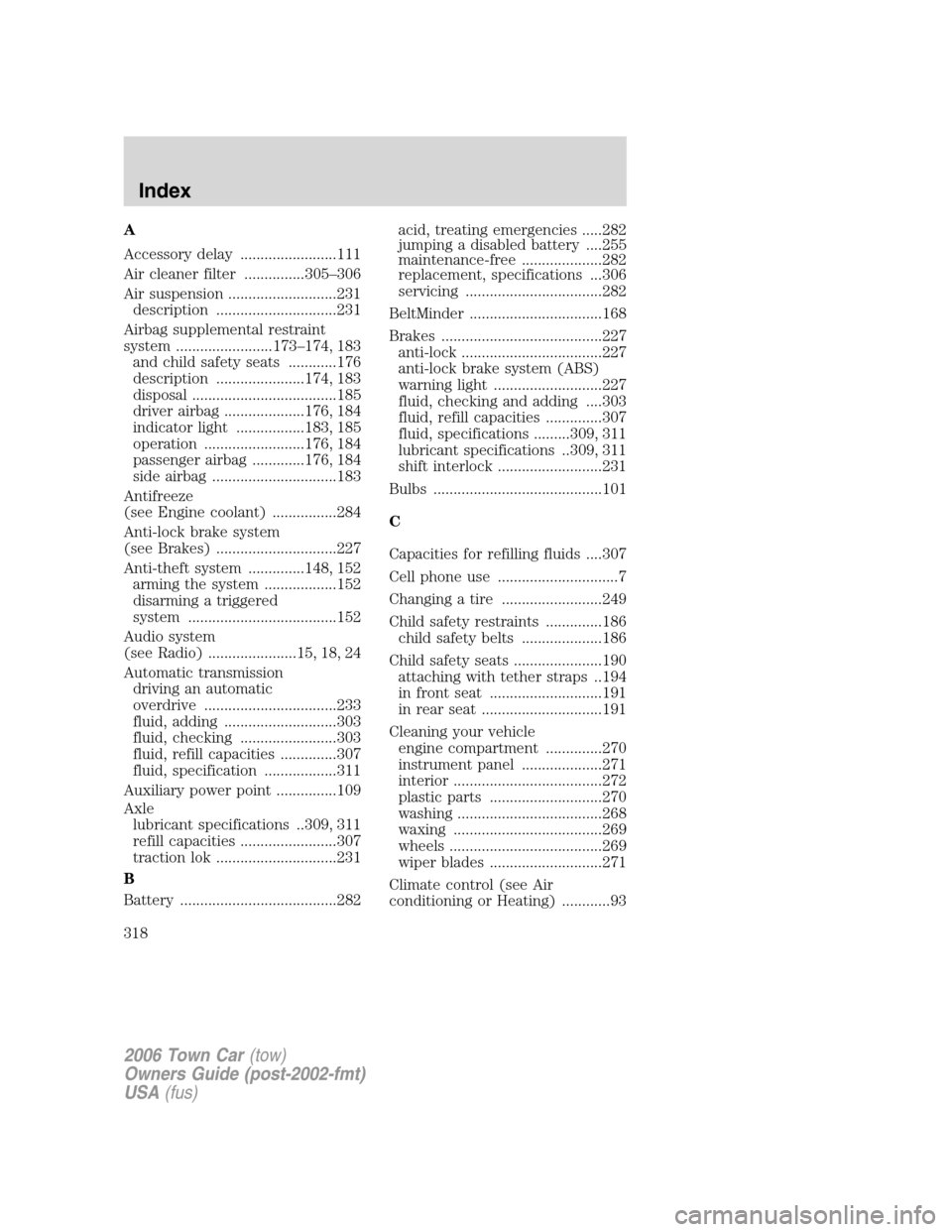
A
Accessory delay ........................111
Air cleaner filter ...............305–306
Air suspension ...........................231
description ..............................231
Airbag supplemental restraint
system ........................173–174, 183
and child safety seats ............176
description ......................174, 183
disposal ....................................185
driver airbag ....................176, 184
indicator light .................183, 185
operation .........................176, 184
passenger airbag .............176, 184
side airbag ...............................183
Antifreeze
(see Engine coolant) ................284
Anti-lock brake system
(see Brakes) ..............................227
Anti-theft system ..............148, 152
arming the system ..................152
disarming a triggered
system .....................................152
Audio system
(see Radio) ......................15, 18, 24
Automatic transmission
driving an automatic
overdrive .................................233
fluid, adding ............................303
fluid, checking ........................303
fluid, refill capacities ..............307
fluid, specification ..................311
Auxiliary power point ...............109
Axle
lubricant specifications ..309, 311
refill capacities ........................307
traction lok ..............................231
B
Battery .......................................282acid, treating emergencies .....282
jumping a disabled battery ....255
maintenance-free ....................282
replacement, specifications ...306
servicing ..................................282
BeltMinder .................................168
Brakes ........................................227
anti-lock ...................................227
anti-lock brake system (ABS)
warning light ...........................227
fluid, checking and adding ....303
fluid, refill capacities ..............307
fluid, specifications .........309, 311
lubricant specifications ..309, 311
shift interlock ..........................231
Bulbs ..........................................101
C
Capacities for refilling fluids ....307
Cell phone use ..............................7
Changing a tire .........................249
Child safety restraints ..............186
child safety belts ....................186
Child safety seats ......................190
attaching with tether straps ..194
in front seat ............................191
in rear seat ..............................191
Cleaning your vehicle
engine compartment ..............270
instrument panel ....................271
interior .....................................272
plastic parts ............................270
washing ....................................268
waxing .....................................269
wheels ......................................269
wiper blades ............................271
Climate control (see Air
conditioning or Heating) ............93
2006 Town Car(tow)
Owners Guide (post-2002-fmt)
USA(fus)
Index
318
Page 320 of 328
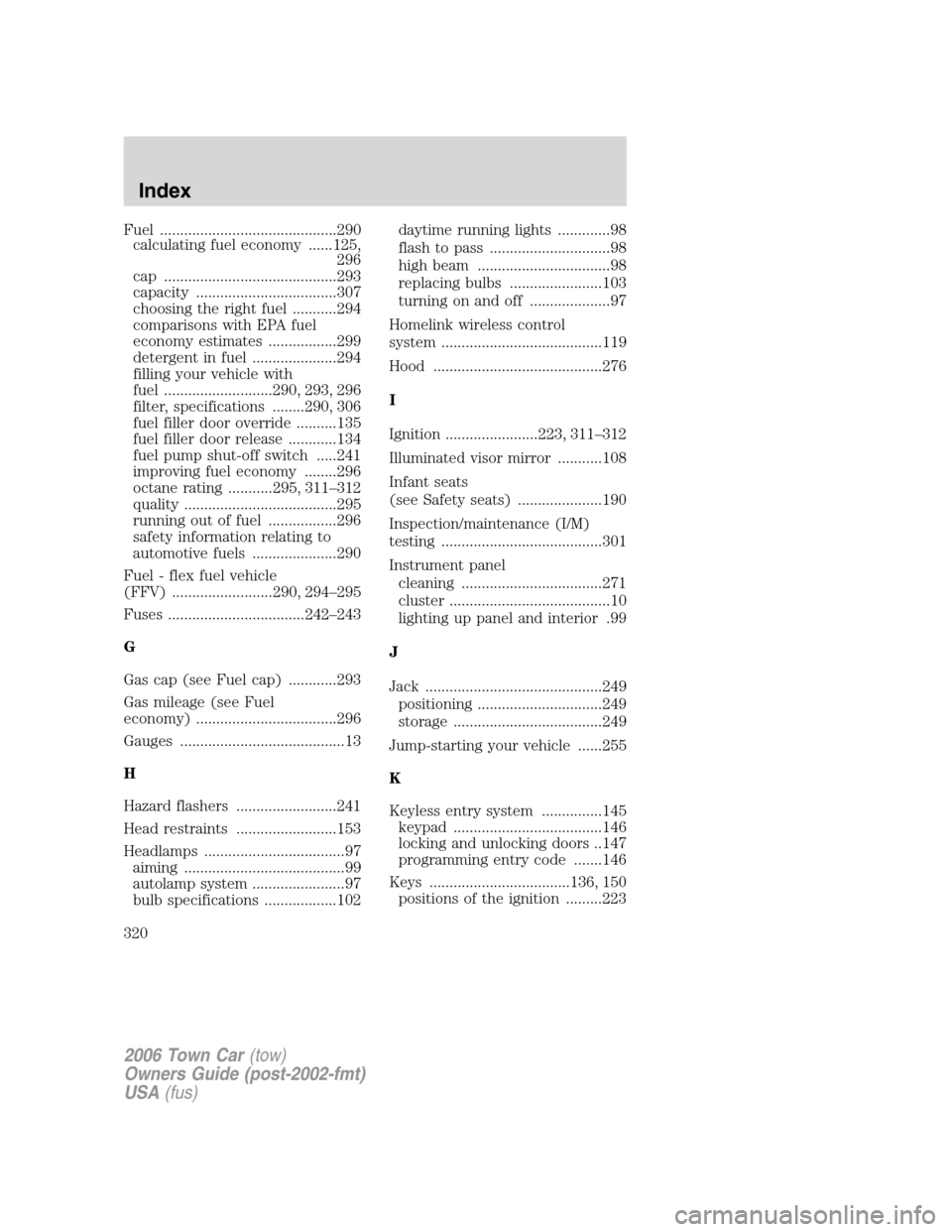
Fuel ............................................290
calculating fuel economy ......125,
296
cap ...........................................293
capacity ...................................307
choosing the right fuel ...........294
comparisons with EPA fuel
economy estimates .................299
detergent in fuel .....................294
filling your vehicle with
fuel ...........................290, 293, 296
filter, specifications ........290, 306
fuel filler door override ..........135
fuel filler door release ............134
fuel pump shut-off switch .....241
improving fuel economy ........296
octane rating ...........295, 311–312
quality ......................................295
running out of fuel .................296
safety information relating to
automotive fuels .....................290
Fuel - flex fuel vehicle
(FFV) .........................290, 294–295
Fuses ..................................242–243
G
Gas cap (see Fuel cap) ............293
Gas mileage (see Fuel
economy) ...................................296
Gauges .........................................13
H
Hazard flashers .........................241
Head restraints .........................153
Headlamps ...................................97
aiming ........................................99
autolamp system .......................97
bulb specifications ..................102daytime running lights .............98
flash to pass ..............................98
high beam .................................98
replacing bulbs .......................103
turning on and off ....................97
Homelink wireless control
system ........................................119
Hood ..........................................276
I
Ignition .......................223, 311–312
Illuminated visor mirror ...........108
Infant seats
(see Safety seats) .....................190
Inspection/maintenance (I/M)
testing ........................................301
Instrument panel
cleaning ...................................271
cluster ........................................10
lighting up panel and interior .99
J
Jack ............................................249
positioning ...............................249
storage .....................................249
Jump-starting your vehicle ......255
K
Keyless entry system ...............145
keypad .....................................146
locking and unlocking doors ..147
programming entry code .......146
Keys ...................................136, 150
positions of the ignition .........223
2006 Town Car(tow)
Owners Guide (post-2002-fmt)
USA(fus)
Index
320