ect LINCOLN TOWN CAR 2008 Owners Manual
[x] Cancel search | Manufacturer: LINCOLN, Model Year: 2008, Model line: TOWN CAR, Model: LINCOLN TOWN CAR 2008Pages: 273, PDF Size: 2.29 MB
Page 181 of 273
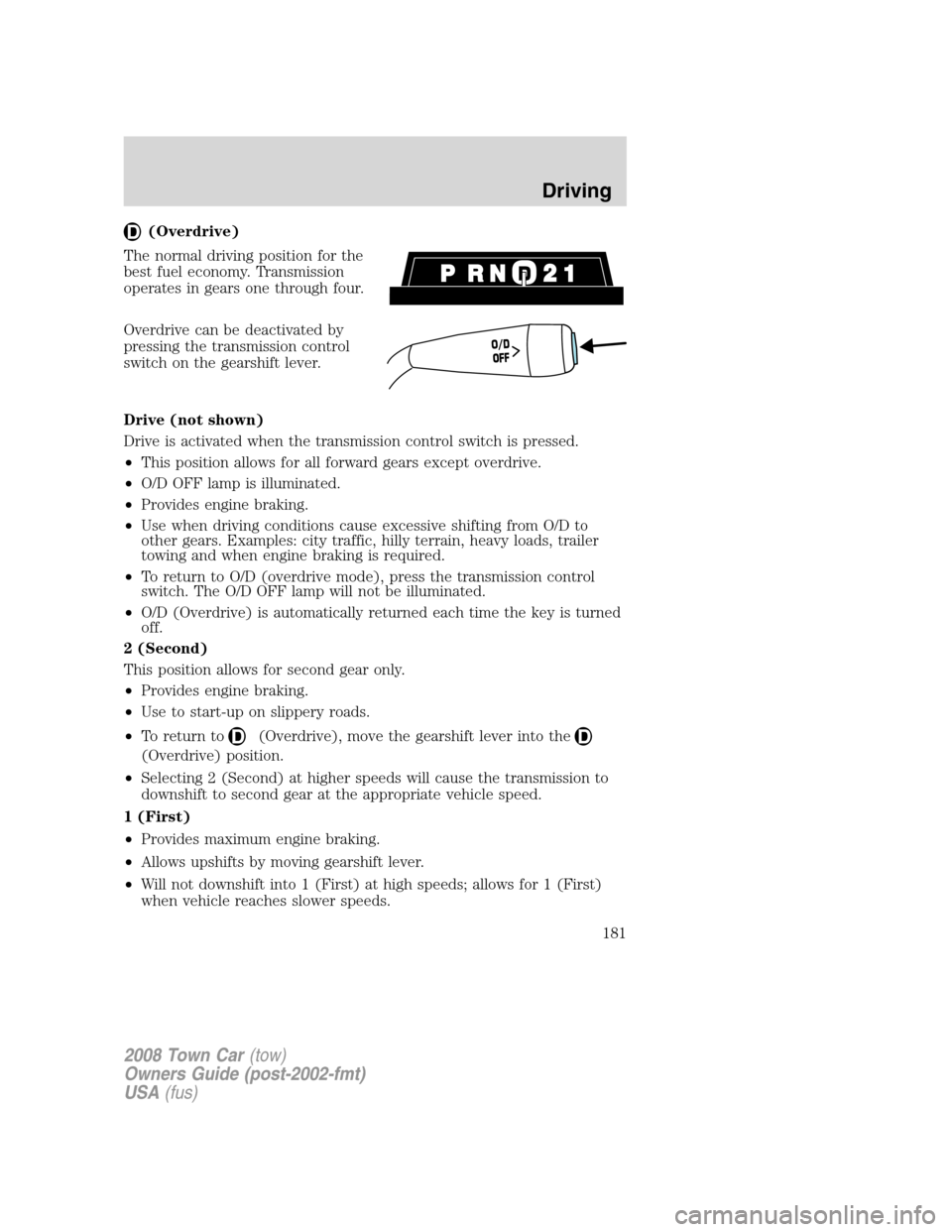
(Overdrive)
The normal driving position for the
best fuel economy. Transmission
operates in gears one through four.
Overdrive can be deactivated by
pressing the transmission control
switch on the gearshift lever.
Drive (not shown)
Drive is activated when the transmission control switch is pressed.
•This position allows for all forward gears except overdrive.
•O/D OFF lamp is illuminated.
•Provides engine braking.
•Use when driving conditions cause excessive shifting from O/D to
other gears. Examples: city traffic, hilly terrain, heavy loads, trailer
towing and when engine braking is required.
•To return to O/D (overdrive mode), press the transmission control
switch. The O/D OFF lamp will not be illuminated.
•O/D (Overdrive) is automatically returned each time the key is turned
off.
2 (Second)
This position allows for second gear only.
•Provides engine braking.
•Use to start-up on slippery roads.
•To return to
(Overdrive), move the gearshift lever into the
(Overdrive) position.
•Selecting 2 (Second) at higher speeds will cause the transmission to
downshift to second gear at the appropriate vehicle speed.
1 (First)
•Provides maximum engine braking.
•Allows upshifts by moving gearshift lever.
•Will not downshift into 1 (First) at high speeds; allows for 1 (First)
when vehicle reaches slower speeds.
O/D
OFF
2008 Town Car(tow)
Owners Guide (post-2002-fmt)
USA(fus)
Driving
181
Page 182 of 273
Forced downshifts
•Allowed in
(Overdrive) or Drive.
•Depress the accelerator to the floor.
•Allows transmission to select an appropriate gear.
If your vehicle gets stuck in mud or snow
If your vehicle gets stuck in mud or snow, it may be rocked out by
shifting between forward and reverse gears, stopping between shifts in a
steady pattern. Press lightly on the accelerator in each gear.
If necessary, try turning the Traction Control™ system off. This will
allow the wheels to spin, which may help to free your stuck vehicle. For
more information, refer toTraction Control™in this chapter.
Do not rock the vehicle if the engine is not at normal operating
temperature or damage to the transmission may occur.
Do not rock the vehicle for more than a minute or damage to the
transmission and tires may occur, or the engine may overheat.
REVERSE SENSING SYSTEM (IF EQUIPPED)
The reverse sensing system sounds a tone to warn the driver of obstacles
near the rear bumper when the R (Reverse) gear is selected.
WARNING:To help avoid personal injury, please read and
understand the limitations of the reverse sensing system as
contained in this section. The park assist is only an aid for some
(generally large and fixed) objects when moving in reverse on a flat
surface at “parking speeds”. Inclement weather may also affect the
function of the RSS; this may include reduced performance or a false
activation.
WARNING:To help avoid personal injury, always use caution
when in R (Reverse) and when using the reverse sensing system.
WARNING:This system is not designed to prevent contact with
small or moving objects. The system is designed to provide a
warning to assist the driver in detecting objects to avoid damaging the
vehicle. The system may not detect smaller objects, particularly those
close to the ground.
2008 Town Car(tow)
Owners Guide (post-2002-fmt)
USA(fus)
Driving
182
Page 183 of 273
WARNING:Certain add-on devices such as large trailer hitches,
bike or surfboard racks and any device that may block the
normal detection zone of the reverse sensing system may create false
beeps.
The system will assist the driver in detecting certain objects while the
vehicle moves in reverse at speeds less than 6 mph (10 km/h). The
system is not effective at speeds greater than 6 mph (10 km/h) and may
not detect certain angular or moving objects.
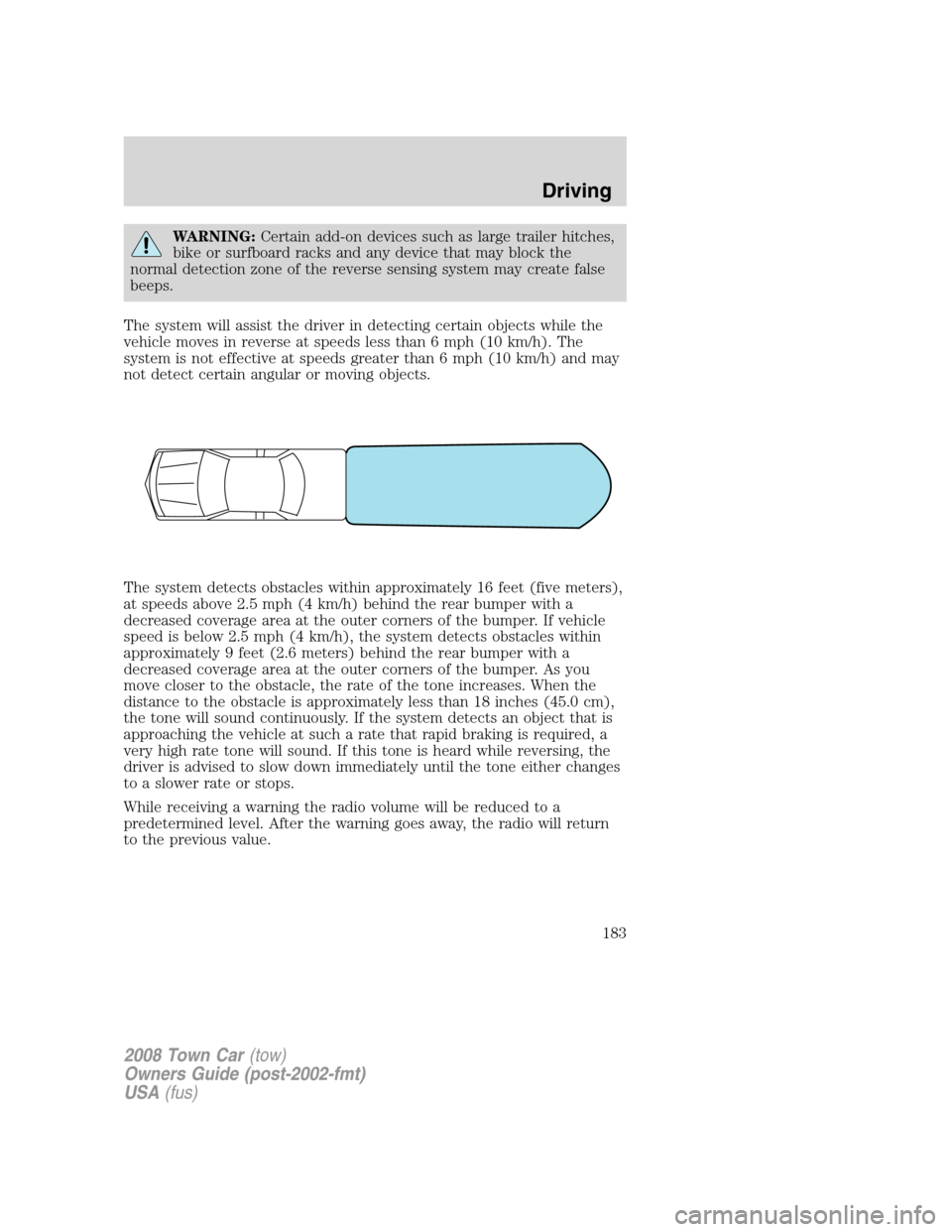
The system detects obstacles within approximately 16 feet (five meters),
at speeds above 2.5 mph (4 km/h) behind the rear bumper with a
decreased coverage area at the outer corners of the bumper. If vehicle
speed is below 2.5 mph (4 km/h), the system detects obstacles within
approximately 9 feet (2.6 meters) behind the rear bumper with a
decreased coverage area at the outer corners of the bumper. As you
move closer to the obstacle, the rate of the tone increases. When the
distance to the obstacle is approximately less than 18 inches (45.0 cm),
the tone will sound continuously. If the system detects an object that is
approaching the vehicle at such a rate that rapid braking is required, a
very high rate tone will sound. If this tone is heard while reversing, the
driver is advised to slow down immediately until the tone either changes
to a slower rate or stops.
While receiving a warning the radio volume will be reduced to a
predetermined level. After the warning goes away, the radio will return
to the previous value.
2008 Town Car(tow)
Owners Guide (post-2002-fmt)
USA(fus)
Driving
183
Page 184 of 273
Audible Warnings
Distance to Object Warning
Speed above 2.5 mph (4 km/h)
up to 1.6 feet (.5 meters) Solid
1.6 feet (.5 meters) to 3.1 feet
(1 meter)Fast beep
3.1 feet (1 meter) to 5.7 feet
(1.8 meters)Medium/fast beep
5.7 feet (1.8 meters) to 9 feet
(2.8 meters)Medium beep
9 feet (2.8 meters) to 13 feet
(4 meters)Medium/slow beep
13 feet (4 meters) to 19.6 feet
(6 meters)Slow beep
Speed below 2.5 mph (4 km/h)
up to 1.4 feet (.4 meters) Solid
1.4 feet (.4 meters) to 3 feet
(.9 meters)Fast beep
3 feet (.9 meters) to 4.5 feet
(1.4 meters)Medium beep
4.5 feet (1.4 meters) to
6.3 feet (1.9 meters)Medium/slow beep
6.3 feet (1.9 meters) to
8.7 feet (2.6 meters)Slow beep
8.7 feet (2.6 meters) to
16.4 feet (5 meters)No sound
The reverse sensing system is automatically enabled when the gear
selector is placed in R (Reverse) and the ignition is on. A control in the
message center allows the driver to disable the system only when the
ignition is on and the gear selector is in R (Reverse). Refer toMessage
centerin theDriver Controlschapter.
The message center will indicate the system is off and will not allow the
driver to switch the system on to indicate a failure of the reverse sensing
system.
2008 Town Car(tow)
Owners Guide (post-2002-fmt)
USA(fus)
Driving
184
Page 187 of 273
•towing of your disabled vehicle
•emergency travel expense reimbursement
•travel planning benefits
In Canada, for uninterrupted Roadside Assistance coverage, you may
purchase extended coverage prior to your Basic Warranty’s Roadside
Assistance expiring. For more information and enrollment, contact
1–877–294–2582 or visit our website at www.ford.ca.
Using roadside assistance
Complete the roadside assistance identification card and place it in your
wallet for quick reference. In the United States, this card is found in the
Owner Guide portfolio in the glove compartment. In Canada, the card is
found in theCustomer Information Guidein the glove compartment.
U.S. Ford, Mercury and Lincoln vehicle customers who require Roadside
Assistance, call 1-800-241-3673.
Canadian customers who require roadside assistance, call
1-800-665-2006.
If you need to arrange roadside assistance for yourself, Ford Motor
Company will reimburse a reasonable amount for towing to the nearest
dealership within 35 miles. To obtain reimbursement information, U.S.
Ford, Mercury and Lincoln vehicle customers call 1-800-241-3673.
Customers will be asked to submit their original receipts.
Canadian customers who need to obtain reimbursement information, call
1–800–665–2006.
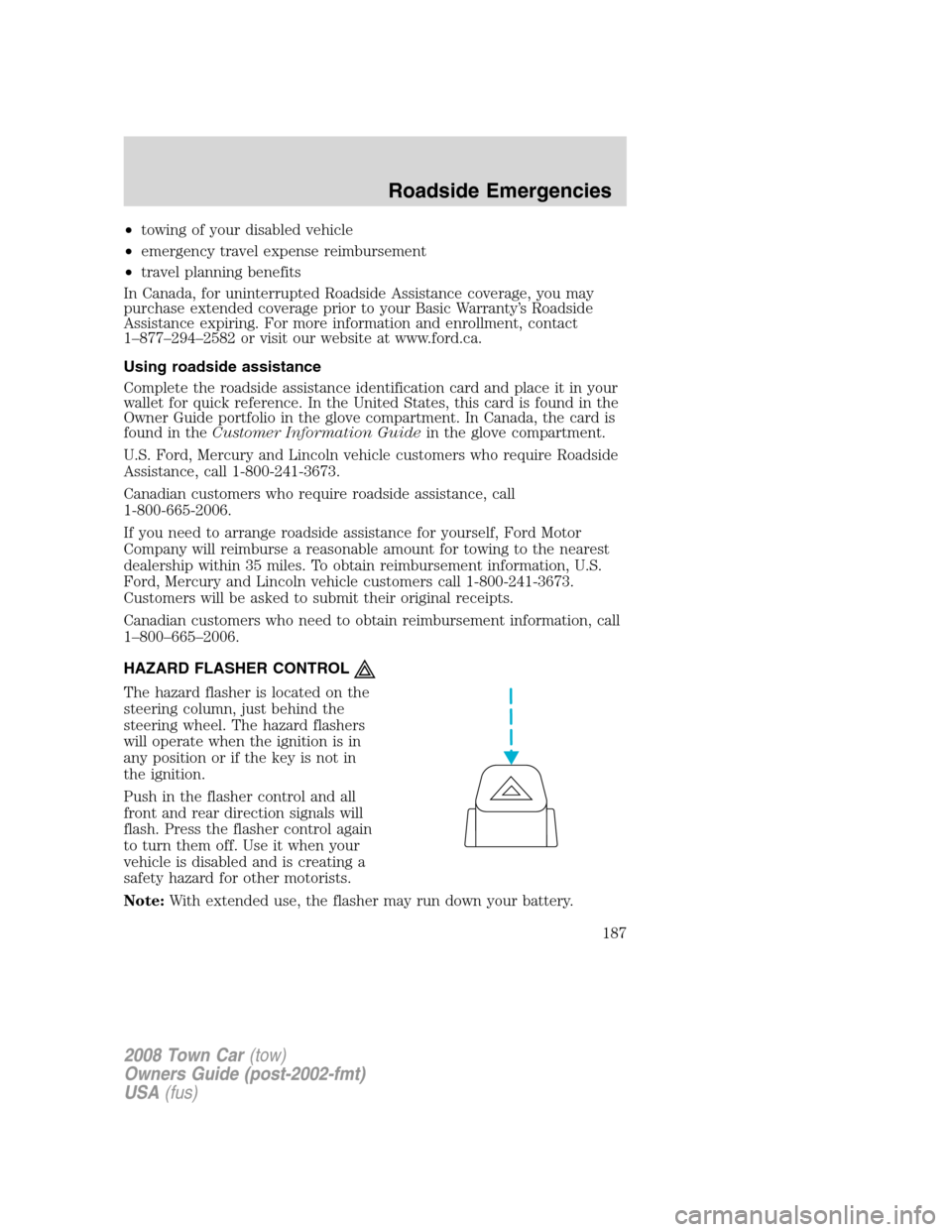
HAZARD FLASHER CONTROL
The hazard flasher is located on the
steering column, just behind the
steering wheel. The hazard flashers
will operate when the ignition is in
any position or if the key is not in
the ignition.
Push in the flasher control and all
front and rear direction signals will
flash. Press the flasher control again
to turn them off. Use it when your
vehicle is disabled and is creating a
safety hazard for other motorists.
Note:With extended use, the flasher may run down your battery.
2008 Town Car(tow)
Owners Guide (post-2002-fmt)
USA(fus)
Roadside Emergencies
187
Page 188 of 273
FUEL PUMP SHUT-OFF SWITCHFUEL
RESET
The fuel pump shut-off switch is a device intended to stop the electric
fuel pump when your vehicle has been involved in a substantial jolt.
After a collision, if the engine cranks but does not start, the fuel pump
shut-off switch may have been activated.
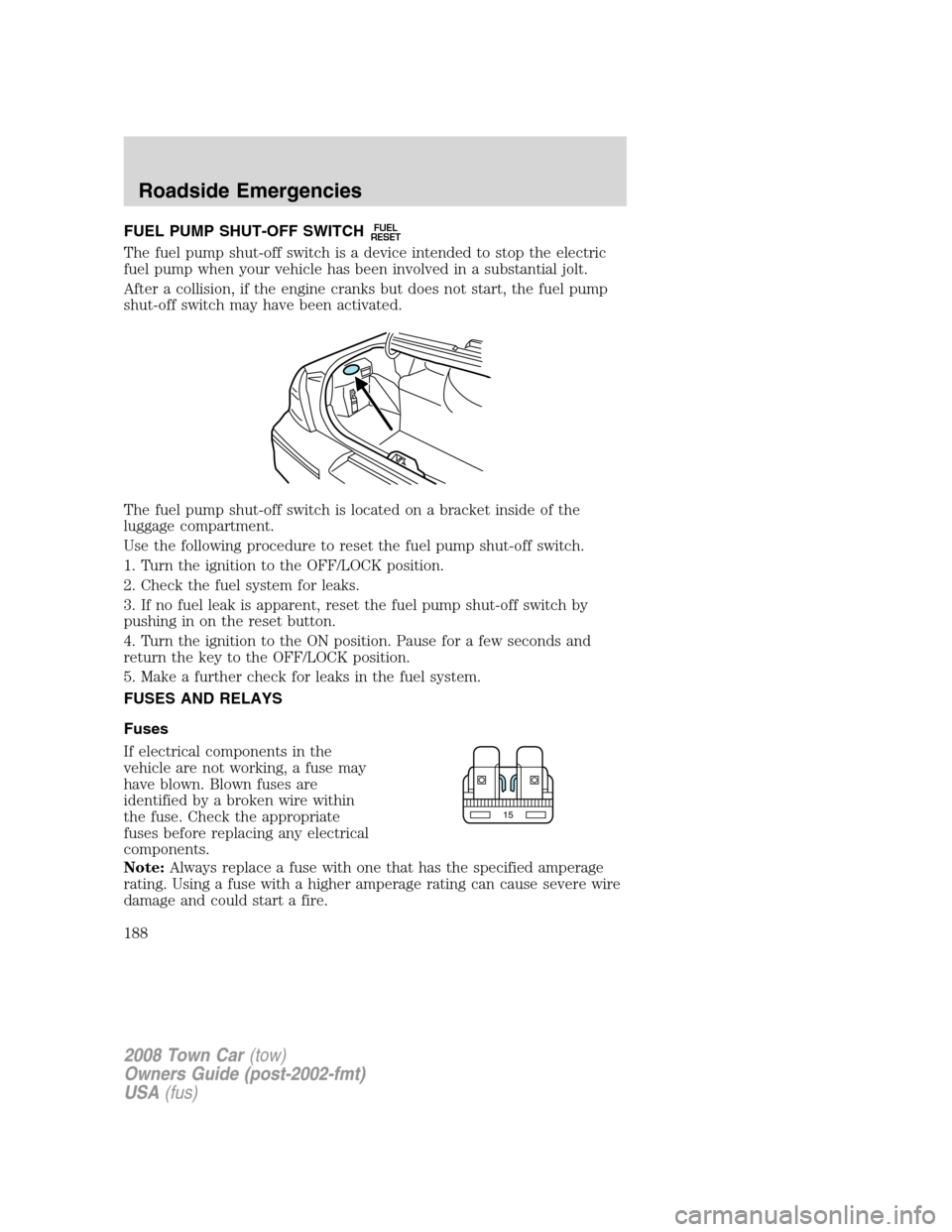
The fuel pump shut-off switch is located on a bracket inside of the
luggage compartment.
Use the following procedure to reset the fuel pump shut-off switch.
1. Turn the ignition to the OFF/LOCK position.
2. Check the fuel system for leaks.
3. If no fuel leak is apparent, reset the fuel pump shut-off switch by
pushing in on the reset button.
4. Turn the ignition to the ON position. Pause for a few seconds and
return the key to the OFF/LOCK position.
5. Make a further check for leaks in the fuel system.
FUSES AND RELAYS
Fuses
If electrical components in the
vehicle are not working, a fuse may
have blown. Blown fuses are
identified by a broken wire within
the fuse. Check the appropriate
fuses before replacing any electrical
components.
Note:Always replace a fuse with one that has the specified amperage
rating. Using a fuse with a higher amperage rating can cause severe wire
damage and could start a fire.
15
2008 Town Car(tow)
Owners Guide (post-2002-fmt)
USA(fus)
Roadside Emergencies
188
Page 191 of 273
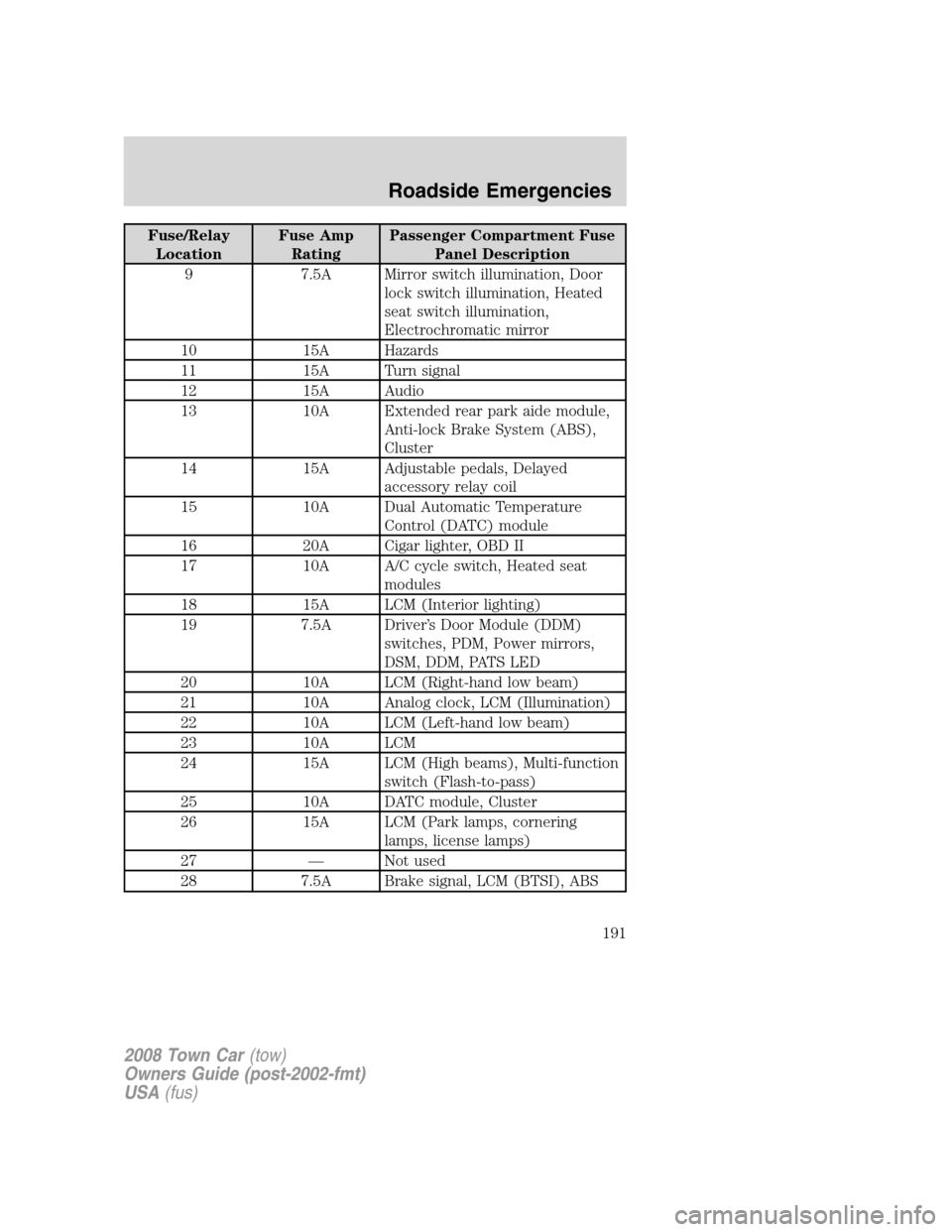
Fuse/Relay
LocationFuse Amp
RatingPassenger Compartment Fuse
Panel Description
9 7.5A Mirror switch illumination, Door
lock switch illumination, Heated
seat switch illumination,
Electrochromatic mirror
10 15A Hazards
11 15A Turn signal
12 15A Audio
13 10A Extended rear park aide module,
Anti-lock Brake System (ABS),
Cluster
14 15A Adjustable pedals, Delayed
accessory relay coil
15 10A Dual Automatic Temperature
Control (DATC) module
16 20A Cigar lighter, OBD II
17 10A A/C cycle switch, Heated seat
modules
18 15A LCM (Interior lighting)
19 7.5A Driver’s Door Module (DDM)
switches, PDM, Power mirrors,
DSM, DDM, PATS LED
20 10A LCM (Right-hand low beam)
21 10A Analog clock, LCM (Illumination)
22 10A LCM (Left-hand low beam)
23 10A LCM
24 15A LCM (High beams), Multi-function
switch (Flash-to-pass)
25 10A DATC module, Cluster
26 15A LCM (Park lamps, cornering
lamps, license lamps)
27 — Not used
28 7.5A Brake signal, LCM (BTSI), ABS
2008 Town Car(tow)
Owners Guide (post-2002-fmt)
USA(fus)
Roadside Emergencies
191
Page 192 of 273
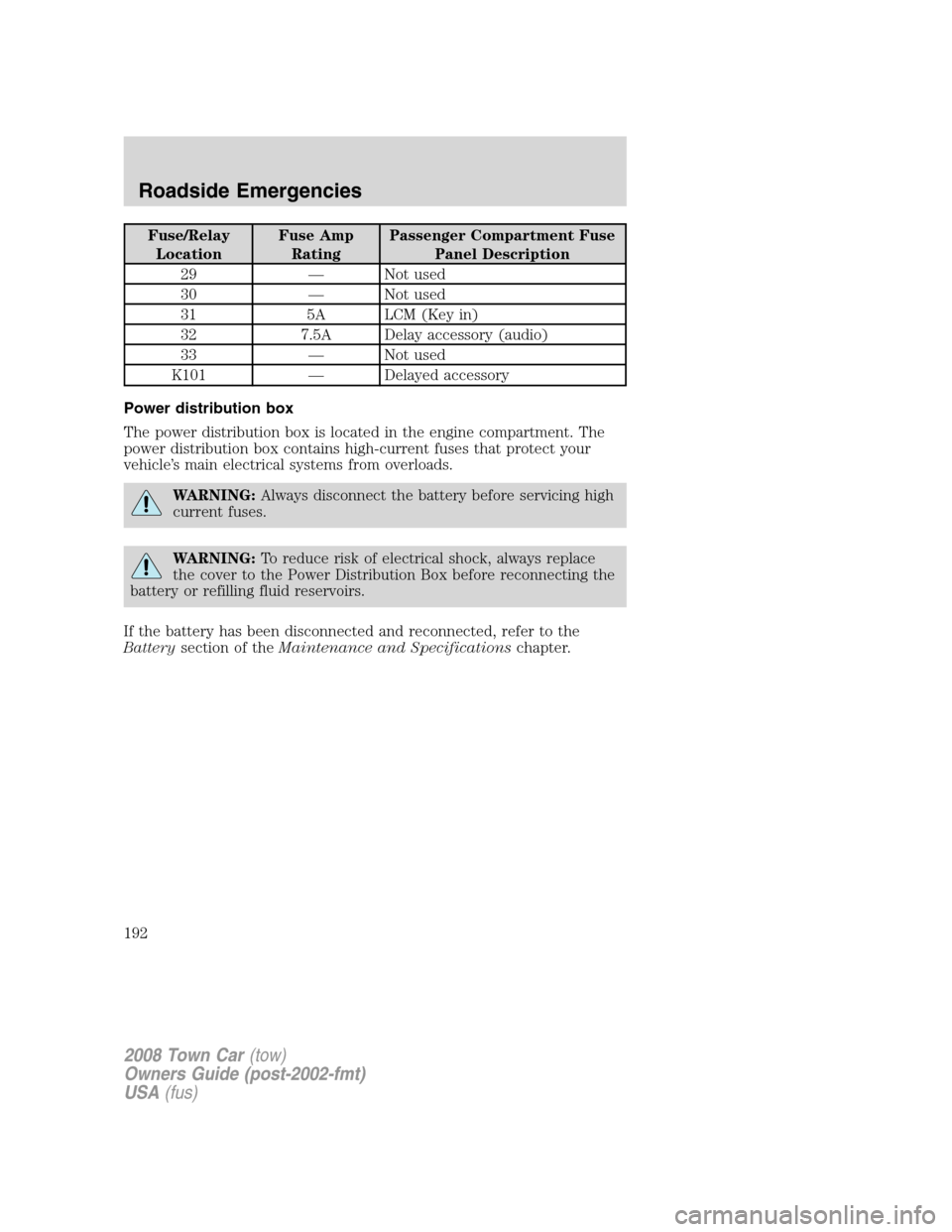
Fuse/Relay
LocationFuse Amp
RatingPassenger Compartment Fuse
Panel Description
29 — Not used
30 — Not used
31 5A LCM (Key in)
32 7.5A Delay accessory (audio)
33 — Not used
K101 — Delayed accessory
Power distribution box
The power distribution box is located in the engine compartment. The
power distribution box contains high-current fuses that protect your
vehicle’s main electrical systems from overloads.
WARNING:Always disconnect the battery before servicing high
current fuses.
WARNING:To reduce risk of electrical shock, always replace
the cover to the Power Distribution Box before reconnecting the
battery or refilling fluid reservoirs.
If the battery has been disconnected and reconnected, refer to the
Batterysection of theMaintenance and Specificationschapter.
2008 Town Car(tow)
Owners Guide (post-2002-fmt)
USA(fus)
Roadside Emergencies
192
Page 194 of 273
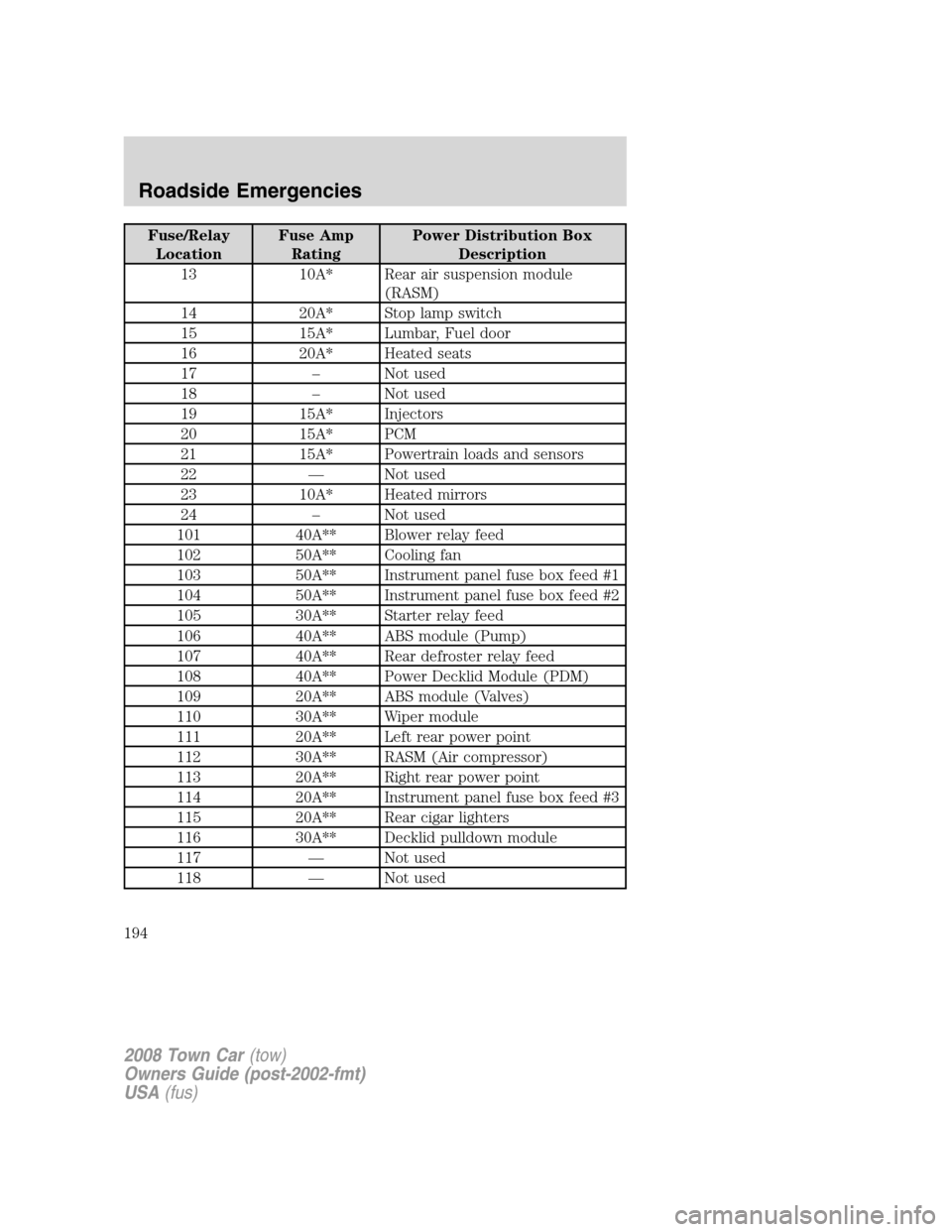
Fuse/Relay
LocationFuse Amp
RatingPower Distribution Box
Description
13 10A* Rear air suspension module
(RASM)
14 20A* Stop lamp switch
15 15A* Lumbar, Fuel door
16 20A* Heated seats
17 – Not used
18 – Not used
19 15A* Injectors
20 15A* PCM
21 15A* Powertrain loads and sensors
22 — Not used
23 10A* Heated mirrors
24 – Not used
101 40A** Blower relay feed
102 50A** Cooling fan
103 50A** Instrument panel fuse box feed #1
104 50A** Instrument panel fuse box feed #2
105 30A** Starter relay feed
106 40A** ABS module (Pump)
107 40A** Rear defroster relay feed
108 40A** Power Decklid Module (PDM)
109 20A** ABS module (Valves)
110 30A** Wiper module
111 20A** Left rear power point
112 30A** RASM (Air compressor)
113 20A** Right rear power point
114 20A** Instrument panel fuse box feed #3
115 20A** Rear cigar lighters
116 30A** Decklid pulldown module
117 — Not used
118 — Not used
2008 Town Car(tow)
Owners Guide (post-2002-fmt)
USA(fus)
Roadside Emergencies
194
Page 196 of 273
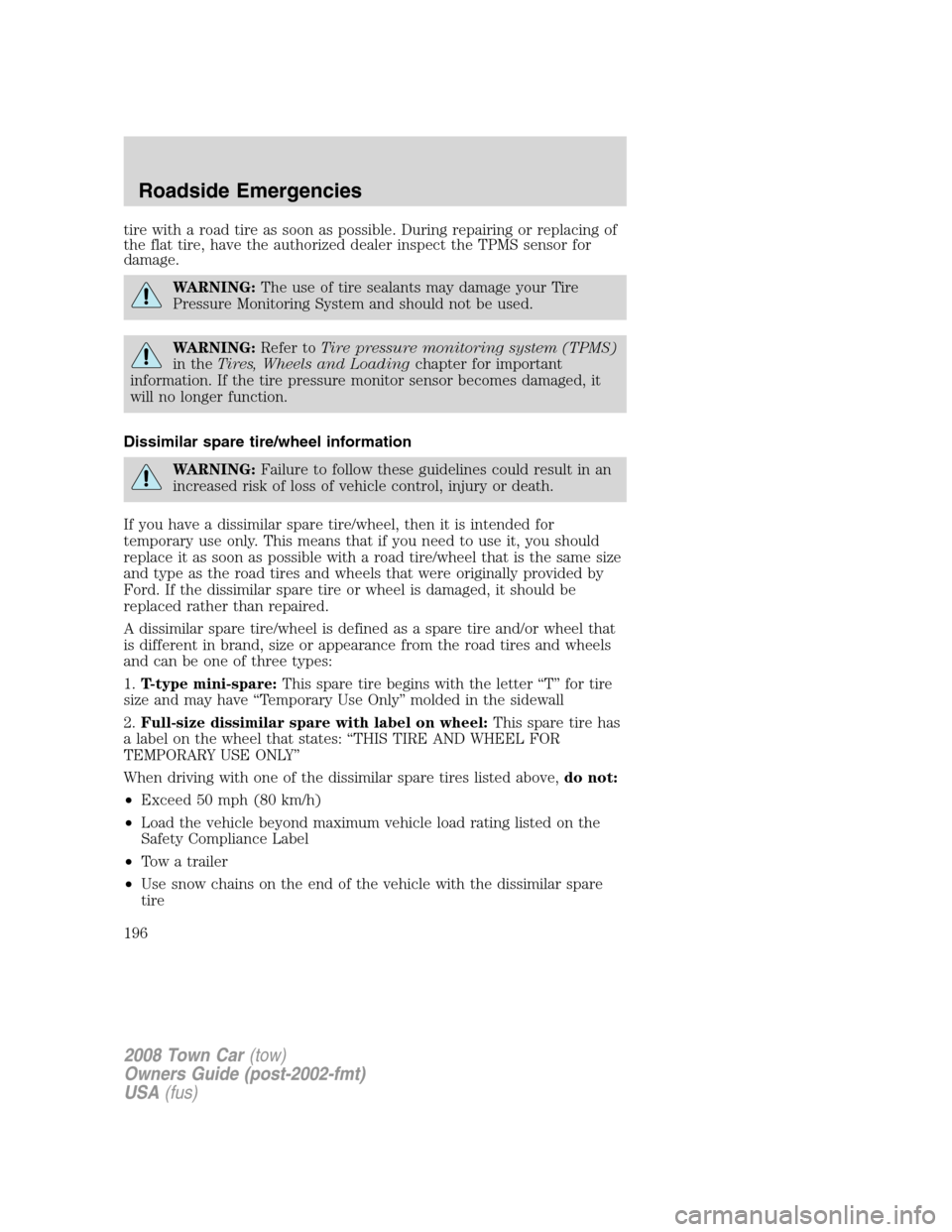
tire with a road tire as soon as possible. During repairing or replacing of
the flat tire, have the authorized dealer inspect the TPMS sensor for
damage.
WARNING:The use of tire sealants may damage your Tire
Pressure Monitoring System and should not be used.
WARNING:Refer toTire pressure monitoring system (TPMS)
in theTires, Wheels and Loadingchapter for important
information. If the tire pressure monitor sensor becomes damaged, it
will no longer function.
Dissimilar spare tire/wheel information
WARNING:Failure to follow these guidelines could result in an
increased risk of loss of vehicle control, injury or death.
If you have a dissimilar spare tire/wheel, then it is intended for
temporary use only. This means that if you need to use it, you should
replace it as soon as possible with a road tire/wheel that is the same size
and type as the road tires and wheels that were originally provided by
Ford. If the dissimilar spare tire or wheel is damaged, it should be
replaced rather than repaired.
A dissimilar spare tire/wheel is defined as a spare tire and/or wheel that
is different in brand, size or appearance from the road tires and wheels
and can be one of three types:
1.T-type mini-spare:This spare tire begins with the letter “T” for tire
size and may have “Temporary Use Only” molded in the sidewall
2.Full-size dissimilar spare with label on wheel:This spare tire has
a label on the wheel that states: “THIS TIRE AND WHEEL FOR
TEMPORARY USE ONLY”
When driving with one of the dissimilar spare tires listed above,do not:
•Exceed 50 mph (80 km/h)
•Load the vehicle beyond maximum vehicle load rating listed on the
Safety Compliance Label
•Tow a trailer
•Use snow chains on the end of the vehicle with the dissimilar spare
tire
2008 Town Car(tow)
Owners Guide (post-2002-fmt)
USA(fus)
Roadside Emergencies
196