ignition LINCOLN TOWN CAR 2008 Workshop Manual
[x] Cancel search | Manufacturer: LINCOLN, Model Year: 2008, Model line: TOWN CAR, Model: LINCOLN TOWN CAR 2008Pages: 273, PDF Size: 2.29 MB
Page 179 of 273
has blown or the vehicle’s brakelamps are not operating properly. Refer
toFuses and relaysin theRoadside Emergencieschapter.
If the fuse is not blown, perform the following procedure:
1. Apply the parking brake, turn the ignition to 2 (ACC).
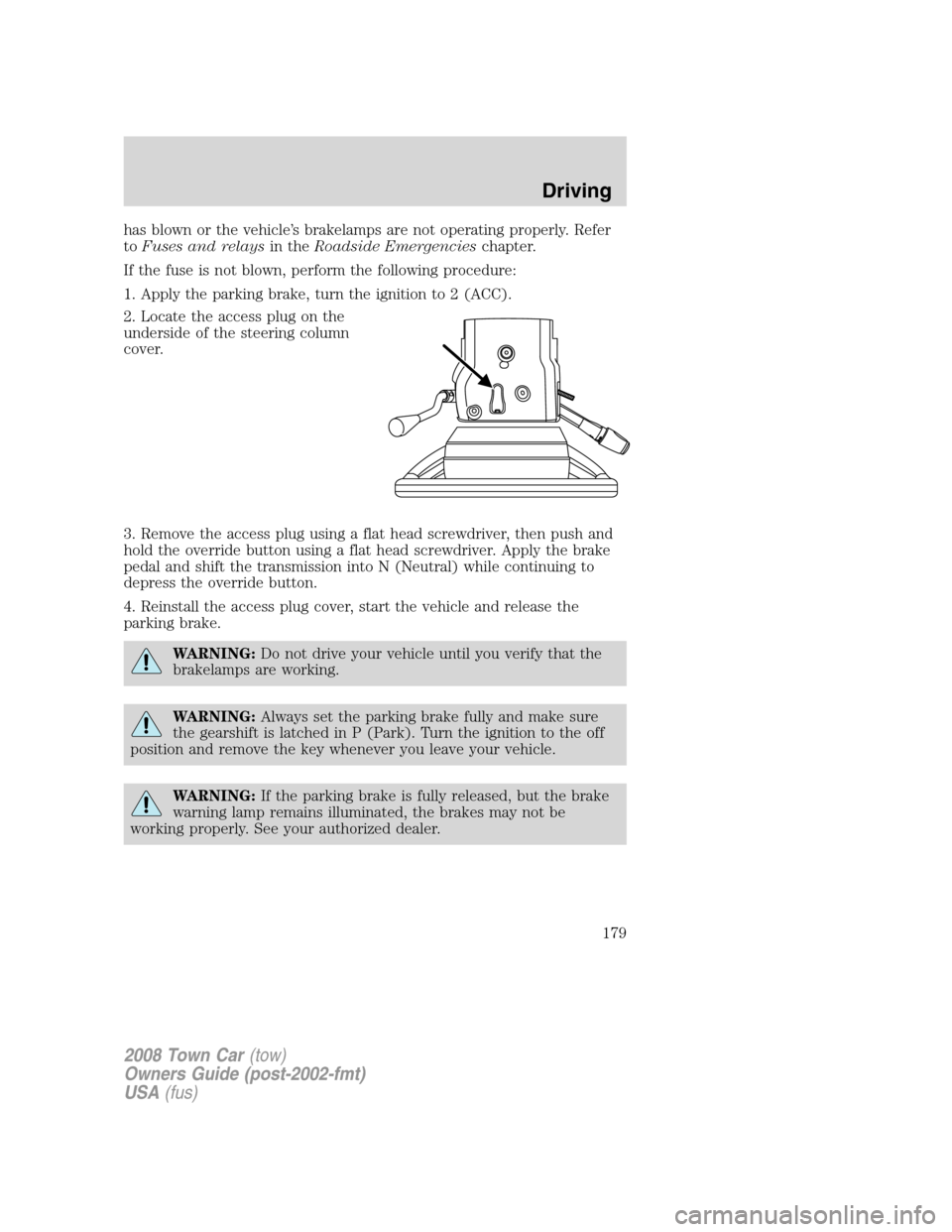
2. Locate the access plug on the
underside of the steering column
cover.
3. Remove the access plug using a flat head screwdriver, then push and
hold the override button using a flat head screwdriver. Apply the brake
pedal and shift the transmission into N (Neutral) while continuing to
depress the override button.
4. Reinstall the access plug cover, start the vehicle and release the
parking brake.
WARNING:Do not drive your vehicle until you verify that the
brakelamps are working.
WARNING:Always set the parking brake fully and make sure
the gearshift is latched in P (Park). Turn the ignition to the off
position and remove the key whenever you leave your vehicle.
WARNING:If the parking brake is fully released, but the brake
warning lamp remains illuminated, the brakes may not be
working properly. See your authorized dealer.
2008 Town Car(tow)
Owners Guide (post-2002-fmt)
USA(fus)
Driving
179
Page 180 of 273
Driving with a 4–speed automatic transmission
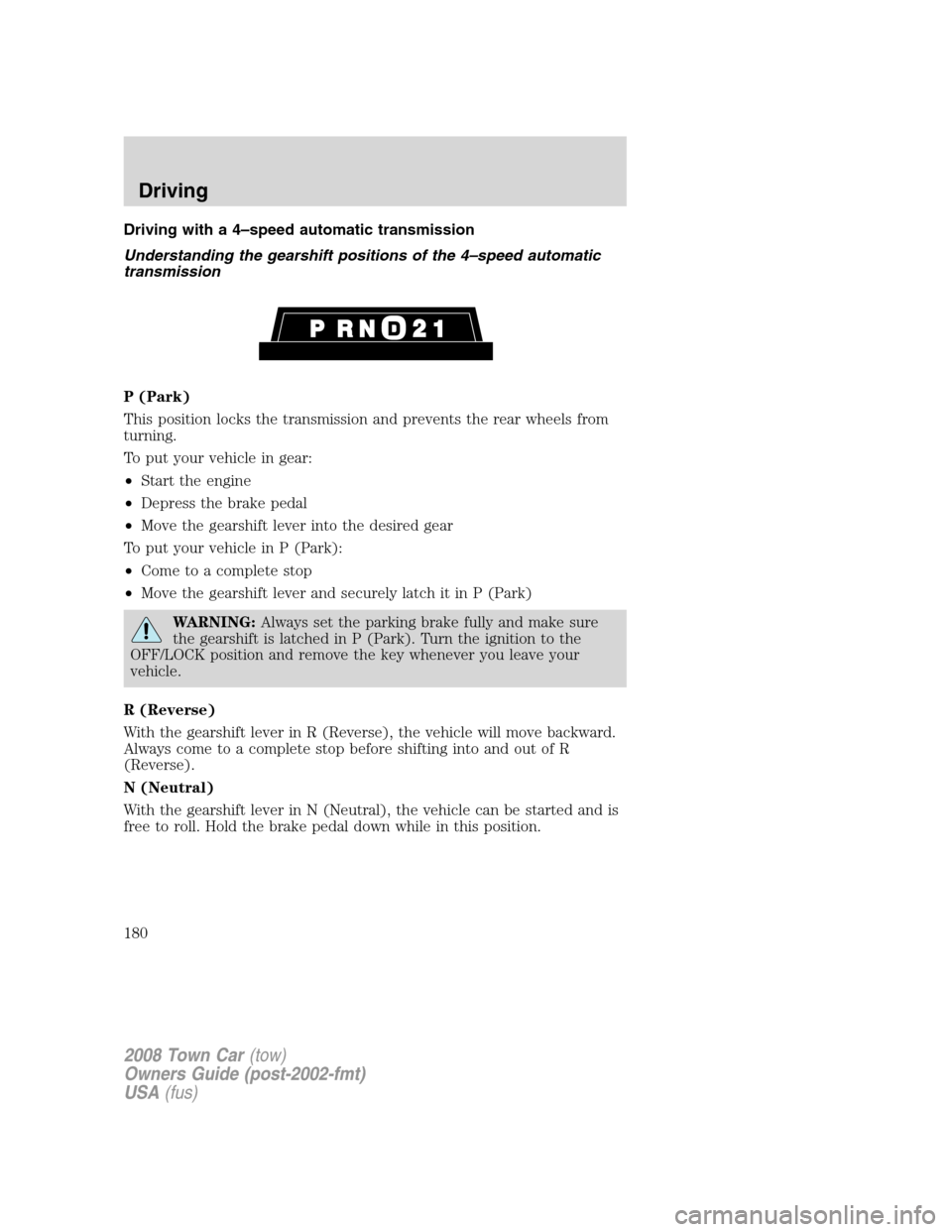
Understanding the gearshift positions of the 4–speed automatic
transmission
P (Park)
This position locks the transmission and prevents the rear wheels from
turning.
To put your vehicle in gear:
•Start the engine
•Depress the brake pedal
•Move the gearshift lever into the desired gear
To put your vehicle in P (Park):
•Come to a complete stop
•Move the gearshift lever and securely latch it in P (Park)
WARNING:Always set the parking brake fully and make sure
the gearshift is latched in P (Park). Turn the ignition to the
OFF/LOCK position and remove the key whenever you leave your
vehicle.
R (Reverse)
With the gearshift lever in R (Reverse), the vehicle will move backward.
Always come to a complete stop before shifting into and out of R
(Reverse).
N (Neutral)
With the gearshift lever in N (Neutral), the vehicle can be started and is
free to roll. Hold the brake pedal down while in this position.
2008 Town Car(tow)
Owners Guide (post-2002-fmt)
USA(fus)
Driving
180
Page 184 of 273
Audible Warnings
Distance to Object Warning
Speed above 2.5 mph (4 km/h)
up to 1.6 feet (.5 meters) Solid
1.6 feet (.5 meters) to 3.1 feet
(1 meter)Fast beep
3.1 feet (1 meter) to 5.7 feet
(1.8 meters)Medium/fast beep
5.7 feet (1.8 meters) to 9 feet
(2.8 meters)Medium beep
9 feet (2.8 meters) to 13 feet
(4 meters)Medium/slow beep
13 feet (4 meters) to 19.6 feet
(6 meters)Slow beep
Speed below 2.5 mph (4 km/h)
up to 1.4 feet (.4 meters) Solid
1.4 feet (.4 meters) to 3 feet
(.9 meters)Fast beep
3 feet (.9 meters) to 4.5 feet
(1.4 meters)Medium beep
4.5 feet (1.4 meters) to
6.3 feet (1.9 meters)Medium/slow beep
6.3 feet (1.9 meters) to
8.7 feet (2.6 meters)Slow beep
8.7 feet (2.6 meters) to
16.4 feet (5 meters)No sound
The reverse sensing system is automatically enabled when the gear
selector is placed in R (Reverse) and the ignition is on. A control in the
message center allows the driver to disable the system only when the
ignition is on and the gear selector is in R (Reverse). Refer toMessage
centerin theDriver Controlschapter.
The message center will indicate the system is off and will not allow the
driver to switch the system on to indicate a failure of the reverse sensing
system.
2008 Town Car(tow)
Owners Guide (post-2002-fmt)
USA(fus)
Driving
184
Page 187 of 273
•towing of your disabled vehicle
•emergency travel expense reimbursement
•travel planning benefits
In Canada, for uninterrupted Roadside Assistance coverage, you may
purchase extended coverage prior to your Basic Warranty’s Roadside
Assistance expiring. For more information and enrollment, contact
1–877–294–2582 or visit our website at www.ford.ca.
Using roadside assistance
Complete the roadside assistance identification card and place it in your
wallet for quick reference. In the United States, this card is found in the
Owner Guide portfolio in the glove compartment. In Canada, the card is
found in theCustomer Information Guidein the glove compartment.
U.S. Ford, Mercury and Lincoln vehicle customers who require Roadside
Assistance, call 1-800-241-3673.
Canadian customers who require roadside assistance, call
1-800-665-2006.
If you need to arrange roadside assistance for yourself, Ford Motor
Company will reimburse a reasonable amount for towing to the nearest
dealership within 35 miles. To obtain reimbursement information, U.S.
Ford, Mercury and Lincoln vehicle customers call 1-800-241-3673.
Customers will be asked to submit their original receipts.
Canadian customers who need to obtain reimbursement information, call
1–800–665–2006.
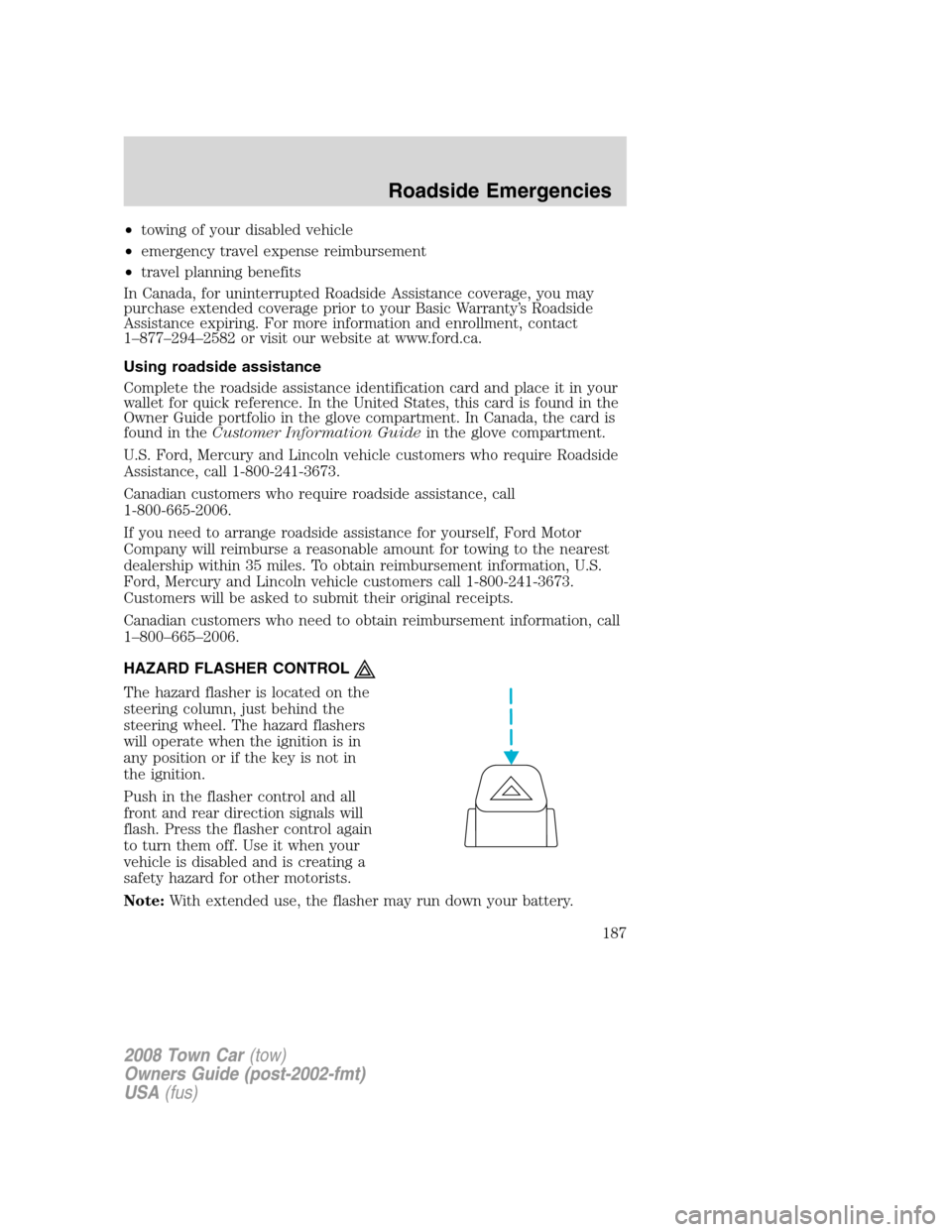
HAZARD FLASHER CONTROL
The hazard flasher is located on the
steering column, just behind the
steering wheel. The hazard flashers
will operate when the ignition is in
any position or if the key is not in
the ignition.
Push in the flasher control and all
front and rear direction signals will
flash. Press the flasher control again
to turn them off. Use it when your
vehicle is disabled and is creating a
safety hazard for other motorists.
Note:With extended use, the flasher may run down your battery.
2008 Town Car(tow)
Owners Guide (post-2002-fmt)
USA(fus)
Roadside Emergencies
187
Page 188 of 273
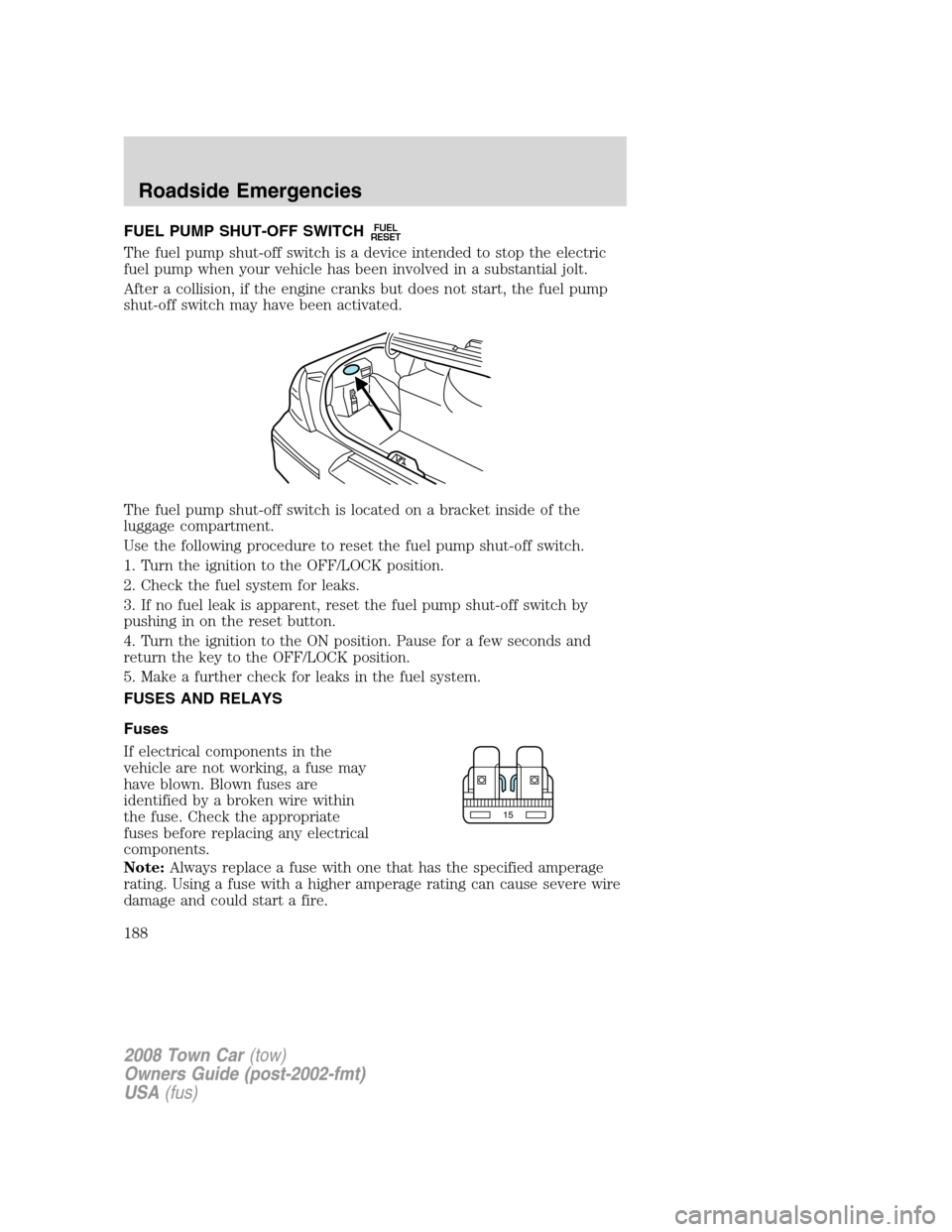
FUEL PUMP SHUT-OFF SWITCHFUEL
RESET
The fuel pump shut-off switch is a device intended to stop the electric
fuel pump when your vehicle has been involved in a substantial jolt.
After a collision, if the engine cranks but does not start, the fuel pump
shut-off switch may have been activated.
The fuel pump shut-off switch is located on a bracket inside of the
luggage compartment.
Use the following procedure to reset the fuel pump shut-off switch.
1. Turn the ignition to the OFF/LOCK position.
2. Check the fuel system for leaks.
3. If no fuel leak is apparent, reset the fuel pump shut-off switch by
pushing in on the reset button.
4. Turn the ignition to the ON position. Pause for a few seconds and
return the key to the OFF/LOCK position.
5. Make a further check for leaks in the fuel system.
FUSES AND RELAYS
Fuses
If electrical components in the
vehicle are not working, a fuse may
have blown. Blown fuses are
identified by a broken wire within
the fuse. Check the appropriate
fuses before replacing any electrical
components.
Note:Always replace a fuse with one that has the specified amperage
rating. Using a fuse with a higher amperage rating can cause severe wire
damage and could start a fire.
15
2008 Town Car(tow)
Owners Guide (post-2002-fmt)
USA(fus)
Roadside Emergencies
188
Page 190 of 273
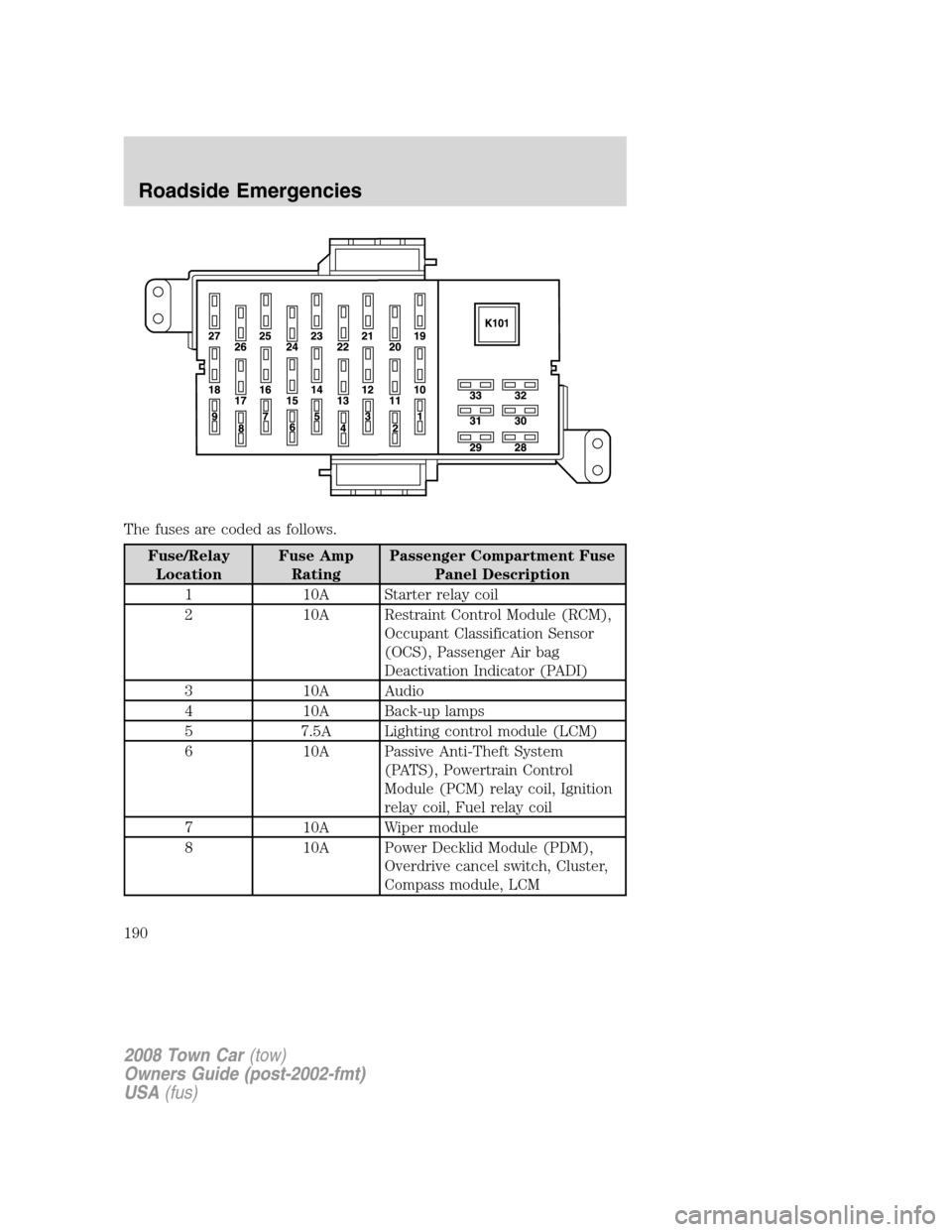
The fuses are coded as follows.
Fuse/Relay
LocationFuse Amp
RatingPassenger Compartment Fuse
Panel Description
1 10A Starter relay coil
2 10A Restraint Control Module (RCM),
Occupant Classification Sensor
(OCS), Passenger Air bag
Deactivation Indicator (PADI)
3 10A Audio
4 10A Back-up lamps
5 7.5A Lighting control module (LCM)
6 10A Passive Anti-Theft System
(PATS), Powertrain Control
Module (PCM) relay coil, Ignition
relay coil, Fuel relay coil
7 10A Wiper module
8 10A Power Decklid Module (PDM),
Overdrive cancel switch, Cluster,
Compass module, LCM
2008 Town Car(tow)
Owners Guide (post-2002-fmt)
USA(fus)
Roadside Emergencies
190
Page 193 of 273
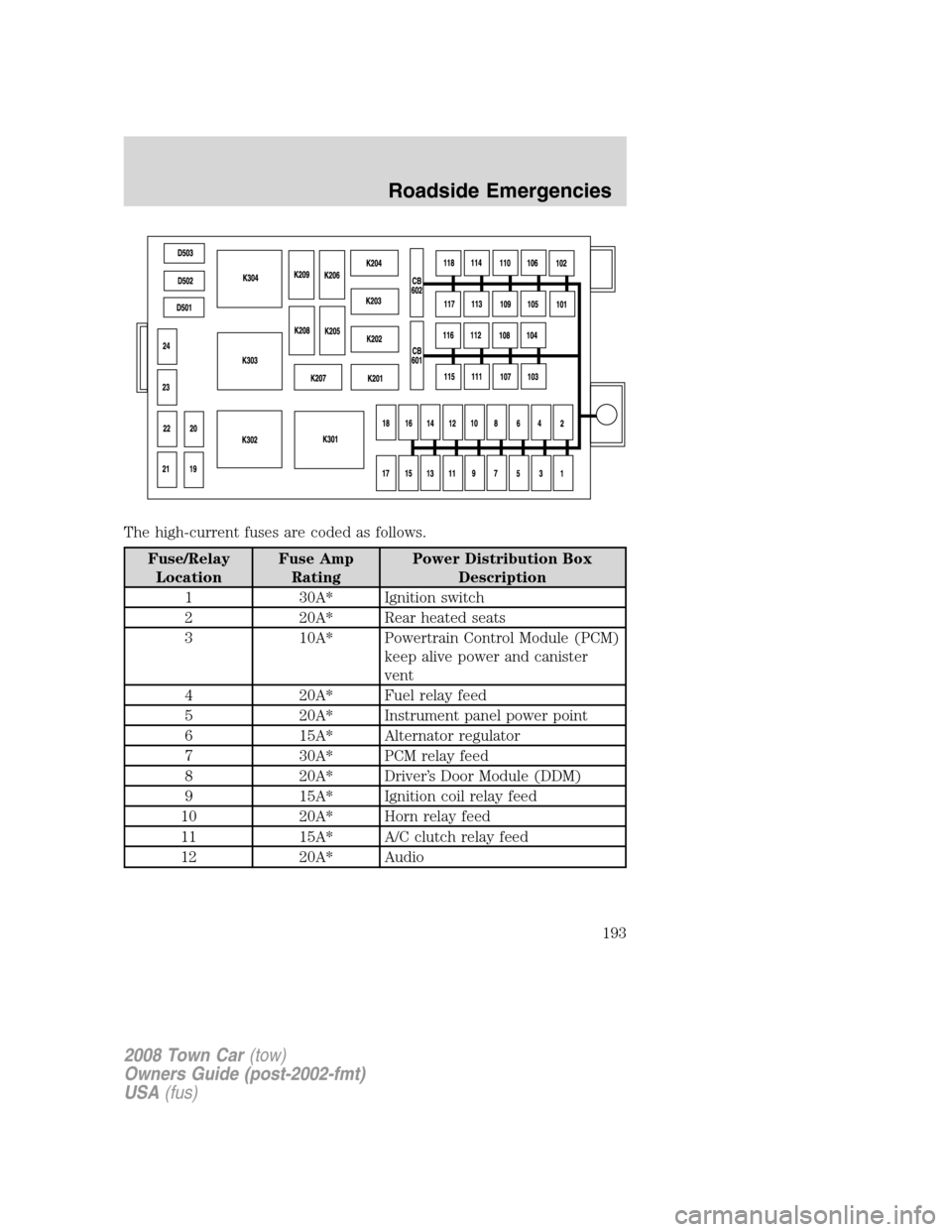
The high-current fuses are coded as follows.
Fuse/Relay
LocationFuse Amp
RatingPower Distribution Box
Description
1 30A* Ignition switch
2 20A* Rear heated seats
3 10A* Powertrain Control Module (PCM)
keep alive power and canister
vent
4 20A* Fuel relay feed
5 20A* Instrument panel power point
6 15A* Alternator regulator
7 30A* PCM relay feed
8 20A* Driver’s Door Module (DDM)
9 15A* Ignition coil relay feed
10 20A* Horn relay feed
11 15A* A/C clutch relay feed
12 20A* Audio
2008 Town Car(tow)
Owners Guide (post-2002-fmt)
USA(fus)
Roadside Emergencies
193
Page 195 of 273
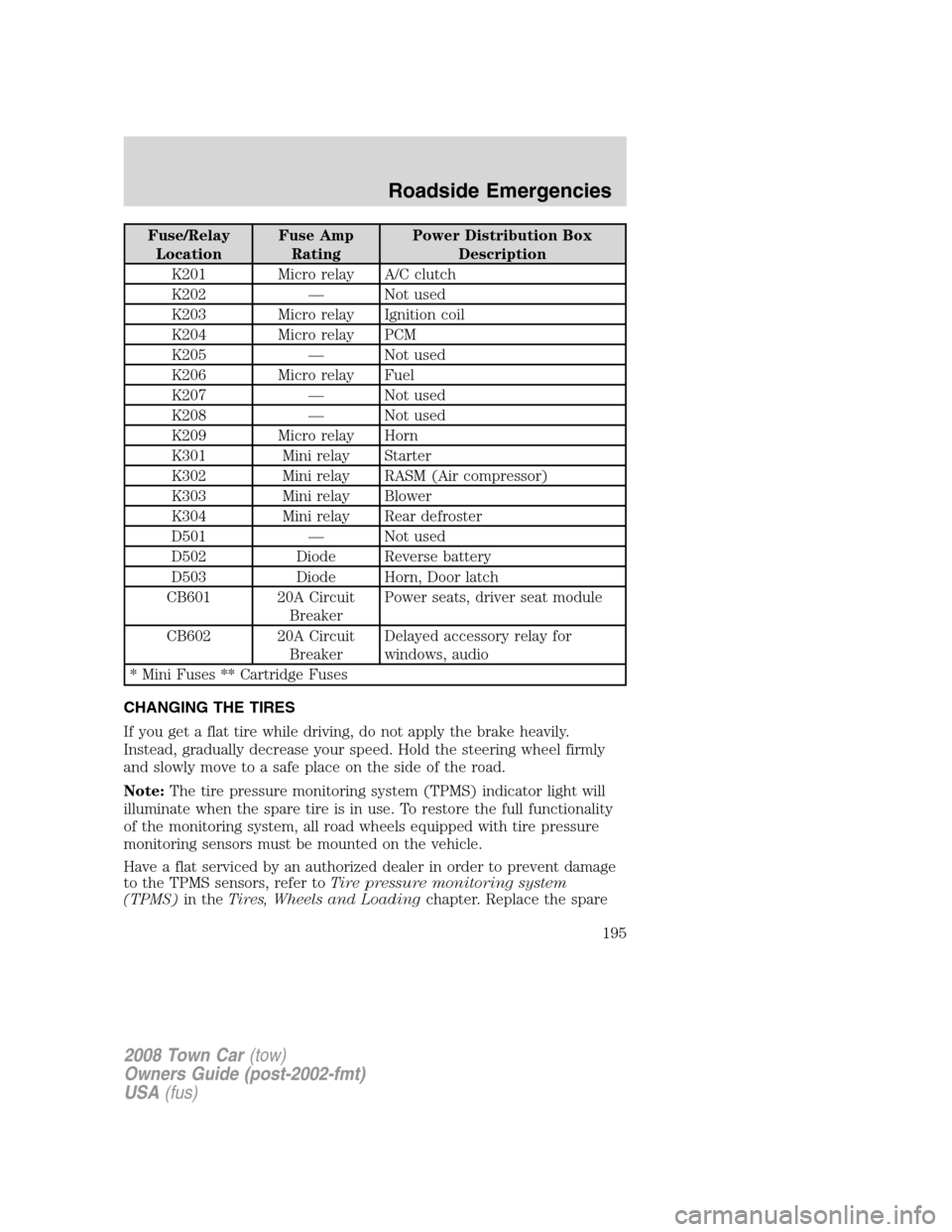
Fuse/Relay
LocationFuse Amp
RatingPower Distribution Box
Description
K201 Micro relay A/C clutch
K202 — Not used
K203 Micro relay Ignition coil
K204 Micro relay PCM
K205 — Not used
K206 Micro relay Fuel
K207 — Not used
K208 — Not used
K209 Micro relay Horn
K301 Mini relay Starter
K302 Mini relay RASM (Air compressor)
K303 Mini relay Blower
K304 Mini relay Rear defroster
D501 — Not used
D502 Diode Reverse battery
D503 Diode Horn, Door latch
CB601 20A Circuit
BreakerPower seats, driver seat module
CB602 20A Circuit
BreakerDelayed accessory relay for
windows, audio
* Mini Fuses ** Cartridge Fuses
CHANGING THE TIRES
If you get a flat tire while driving, do not apply the brake heavily.
Instead, gradually decrease your speed. Hold the steering wheel firmly
and slowly move to a safe place on the side of the road.
Note:The tire pressure monitoring system (TPMS) indicator light will
illuminate when the spare tire is in use. To restore the full functionality
of the monitoring system, all road wheels equipped with tire pressure
monitoring sensors must be mounted on the vehicle.
Have a flat serviced by an authorized dealer in order to prevent damage
to the TPMS sensors, refer toTire pressure monitoring system
(TPMS)in theTires, Wheels and Loadingchapter. Replace the spare
2008 Town Car(tow)
Owners Guide (post-2002-fmt)
USA(fus)
Roadside Emergencies
195
Page 247 of 273
could cause damage to the fuel system. Repairs to correct the effects of
using an aftermarket product in your fuel may not be covered by your
warranty.
Many of the world’s automakers approved the World-Wide Fuel Charter
that recommends gasoline specifications to provide improved
performance and emission control system protection for your vehicle.
Gasolines that meet the World-Wide Fuel Charter should be used when
available. Ask your fuel supplier about gasolines that meet the
World-Wide Fuel Charter.
Unleaded gasoline engines
If you are experiencing starting, rough idle or hesitation driveability
problems during a cold start, try a different brand of “Regular” unleaded
gasoline. “Premium” unleaded gasoline is not recommended because it
may cause these problems to become more pronounced. If the problems
persist, see your authorized dealer.
FFV engine (if equipped)
To identify if your vehicle is an FFV, it may be equipped with a yellow
fuel cap with the text “E85/Gasoline”, or check if there is a label on the
fuel filler door.
It is best not to alternate repeatedly between gasoline and E85. If you do
switch fuels, it is recommended that you add as much fuel as
possible—at least half a tank. Do not add less than five gallons (18.9 L)
when refueling. You should drive the vehicle immediately after refueling
for at least 5 miles (8 km) to allow the vehicle to adapt to the change in
ethanol concentration.
If you operate your vehicle 50% or more of the time on ethanol, you
should follow a different maintenance schedule. In addition to this, it is
also recommended to fill the fuel tank with regular unleaded gasoline
once every 3,000 miles (4,800 km). Seescheduled maintenance
informationfor more information.
Running out of fuel
Avoid running out of fuel because this situation may have an adverse
effect on powertrain components.
If you have run out of fuel:
•You may need to cycle the ignition from off to on several times after
refueling to allow the fuel system to pump the fuel from the tank to
the engine. On restarting, cranking time will take a few seconds longer
than normal.
2008 Town Car(tow)
Owners Guide (post-2002-fmt)
USA(fus)
Maintenance and Specifications
247
Page 248 of 273
•Normally, adding 1 gallon (3.8L) of fuel is enough to restart the
engine. If the vehicle is out of fuel and on a steep grade, more than
1 gallon (3.8L) may be required.
•TheService engine soon
indicator may come on. For more
information on theService engine soon
indicator, refer to
Warning lights and chimesin theInstrument Clusterchapter.
ESSENTIALS OF GOOD FUEL ECONOMY
Measuring techniques
Your best source of information about actual fuel economy is you, the
driver. You must gather information as accurately and consistently as
possible. Fuel expense, frequency of fill-ups or fuel gauge readings are
NOT accurate as a measure of fuel economy. We do not recommend taking
fuel economy measurements during the first 1,000 miles (1,600 km) of
driving (engine break-in period). You will get a more accurate
measurement after 2,000 miles–3,000 miles (3,000 km–5,000 km).
Filling the tank
The advertised fuel capacity of the fuel tank on your vehicle is equal to
the rated refill capacity of the fuel tank as listed in theMaintenance
product specifications and capacitiessection of this chapter.
The advertised capacity is the amount of the indicated capacity and the
empty reserve combined. Indicated capacity is the difference in the
amount of fuel in a full tank and a tank when the fuel gauge indicates
empty. Empty reserve is the small amount of fuel remaining in the fuel
tank after the fuel gauge indicates empty.
The amount of usable fuel in the empty reserve varies and should
not be relied upon to increase driving range. When refueling your
vehicle after the fuel gauge indicates empty, you might not be
able to refuel the full amount of the advertised capacity of the
fuel tank due to the empty reserve still present in the tank.
For consistent results when filling the fuel tank:
•Turn the engine/ignition switch to the off position prior to refueling,
an error in the reading will result if the engine is left running.
•Use the same filling rate setting (low — medium — high) each time
the tank is filled.
•Allow no more than two automatic click-offs when filling.
•Always use fuel with the recommended octane rating.
2008 Town Car(tow)
Owners Guide (post-2002-fmt)
USA(fus)
Maintenance and Specifications
248