lights LINCOLN TOWN CAR 2009 Owner's Manual
[x] Cancel search | Manufacturer: LINCOLN, Model Year: 2009, Model line: TOWN CAR, Model: LINCOLN TOWN CAR 2009Pages: 280, PDF Size: 2.01 MB
Page 164 of 280
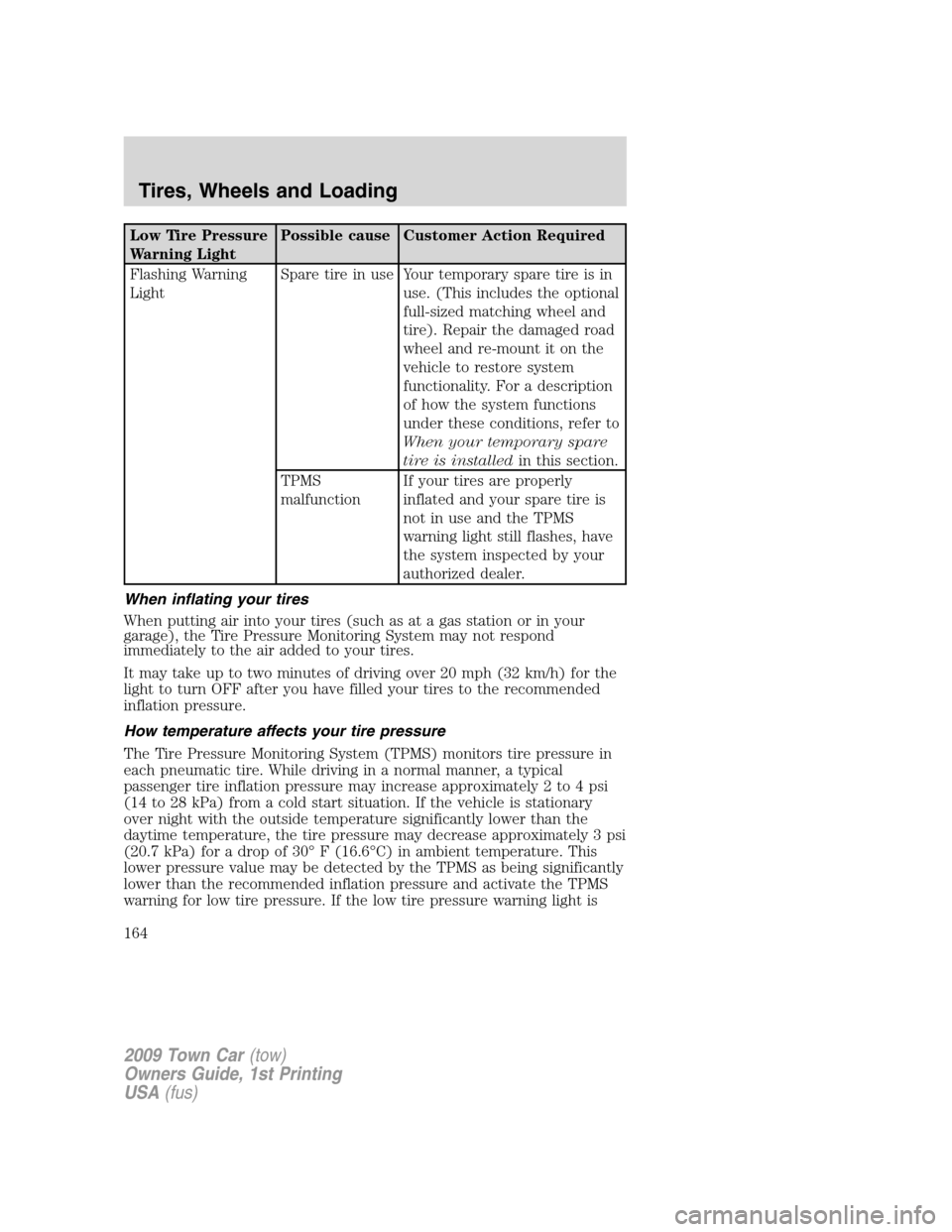
Low Tire Pressure
Warning LightPossible cause Customer Action Required
Flashing Warning
LightSpare tire in use Your temporary spare tire is in
use. (This includes the optional
full-sized matching wheel and
tire). Repair the damaged road
wheel and re-mount it on the
vehicle to restore system
functionality. For a description
of how the system functions
under these conditions, refer to
When your temporary spare
tire is installedin this section.
TPMS
malfunctionIf your tires are properly
inflated and your spare tire is
not in use and the TPMS
warning light still flashes, have
the system inspected by your
authorized dealer.
When inflating your tires
When putting air into your tires (such as at a gas station or in your
garage), the Tire Pressure Monitoring System may not respond
immediately to the air added to your tires.
It may take up to two minutes of driving over 20 mph (32 km/h) for the
light to turn OFF after you have filled your tires to the recommended
inflation pressure.
How temperature affects your tire pressure
The Tire Pressure Monitoring System (TPMS) monitors tire pressure in
each pneumatic tire. While driving in a normal manner, a typical
passenger tire inflation pressure may increase approximately 2 to 4 psi
(14 to 28 kPa) from a cold start situation. If the vehicle is stationary
over night with the outside temperature significantly lower than the
daytime temperature, the tire pressure may decrease approximately 3 psi
(20.7 kPa) for a drop of 30° F (16.6°C) in ambient temperature. This
lower pressure value may be detected by the TPMS as being significantly
lower than the recommended inflation pressure and activate the TPMS
warning for low tire pressure. If the low tire pressure warning light is
2009 Town Car(tow)
Owners Guide, 1st Printing
USA(fus)
Tires, Wheels and Loading
164
Page 172 of 280
Hitches
Do not use hitches that clamp onto the vehicle bumper. Use a load
carrying hitch. You must distribute the load in your trailer so that
10–15% of the total weight of the trailer is on the tongue.
Safety chains
Always connect the trailer’s safety chains to the frame or hook retainers
of the vehicle hitch. To connect the trailer’s safety chains, cross the
chains under the trailer tongue and allow slack for turning corners.
If you use a rental trailer, follow the instructions that the rental agency
gives to you.
Do not attach safety chains to the bumper.
Trailer brakes
Electric brakes and manual, automatic or surge-type trailer brakes are
safe if installed properly and adjusted to the manufacturer’s
specifications. The trailer brakes must meet local and Federal
regulations.
WARNING:Do not connect a trailer’s hydraulic brake system
directly to your vehicle’s brake system. Your vehicle may not
have enough braking power and your chances of having a collision
greatly increase.
The braking system of the tow vehicle is rated for operation at the
GVWR not GCWR.
Trailer lamps
Trailer lamps are required on most towed vehicles. Make sure all running
lights, brake lights, turn signals and hazard lights are working. See your
authorized dealer or trailer rental agency for proper instructions and
equipment for hooking up trailer lamps.
Driving while you tow
When towing a trailer:
•To ensure proper “break-in” of powertrain components, do not trailer
tow during the first 1,000 miles (1,600 km) of a new vehicle.
•To ensure proper “break-in” of powertrain components during the first
500 miles (800 km) of trailer towing, drive no faster than 70 mph
(113 km/h) with no full throttle starts.
2009 Town Car(tow)
Owners Guide, 1st Printing
USA(fus)
Tires, Wheels and Loading
172
Page 175 of 280
STARTING
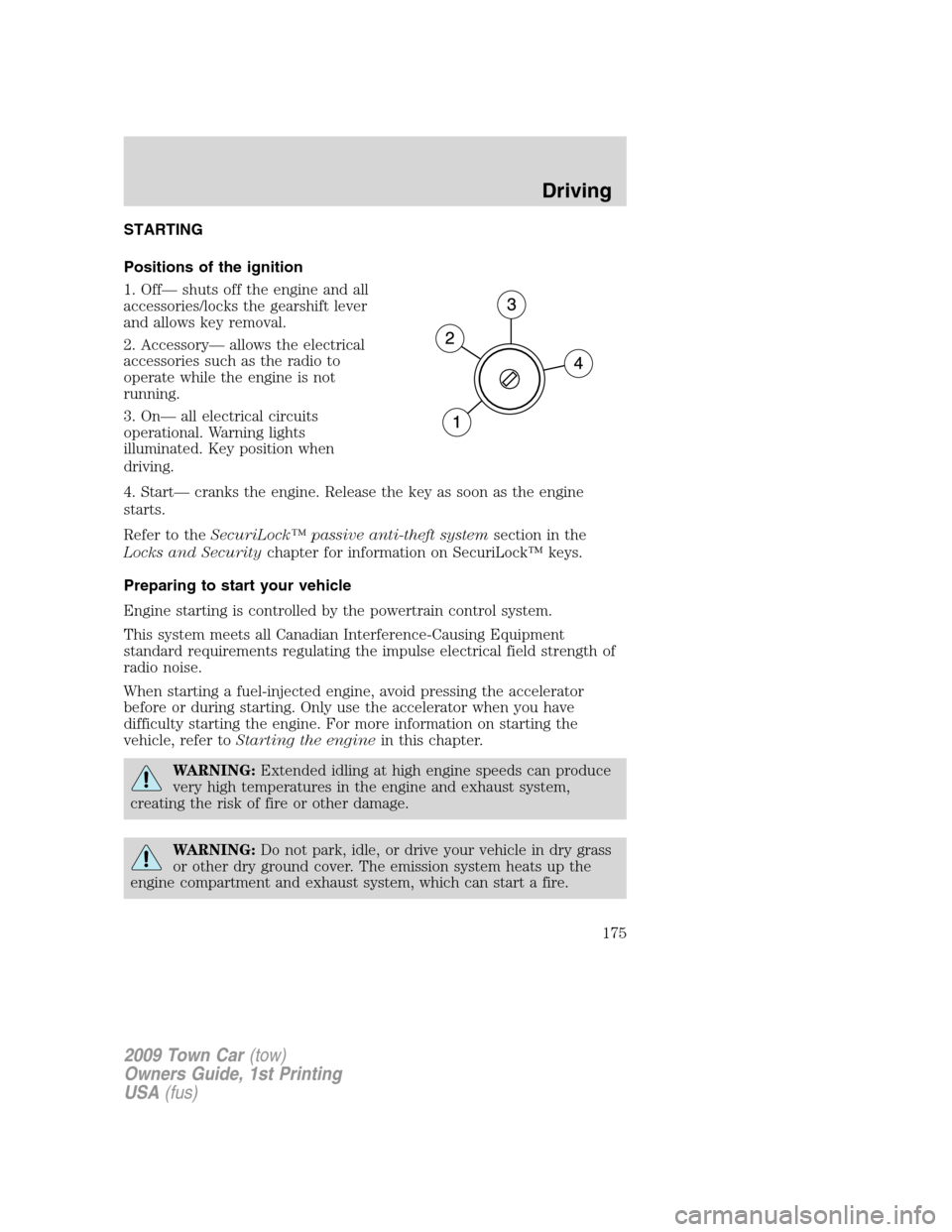
Positions of the ignition
1. Off— shuts off the engine and all
accessories/locks the gearshift lever
and allows key removal.
2. Accessory— allows the electrical
accessories such as the radio to
operate while the engine is not
running.
3. On— all electrical circuits
operational. Warning lights
illuminated. Key position when
driving.
4. Start— cranks the engine. Release the key as soon as the engine
starts.
Refer to theSecuriLock™ passive anti-theft systemsection in the
Locks and Securitychapter for information on SecuriLock™ keys.
Preparing to start your vehicle
Engine starting is controlled by the powertrain control system.
This system meets all Canadian Interference-Causing Equipment
standard requirements regulating the impulse electrical field strength of
radio noise.
When starting a fuel-injected engine, avoid pressing the accelerator
before or during starting. Only use the accelerator when you have
difficulty starting the engine. For more information on starting the
vehicle, refer toStarting the enginein this chapter.
WARNING:Extended idling at high engine speeds can produce
very high temperatures in the engine and exhaust system,
creating the risk of fire or other damage.
WARNING:Do not park, idle, or drive your vehicle in dry grass
or other dry ground cover. The emission system heats up the
engine compartment and exhaust system, which can start a fire.
2009 Town Car(tow)
Owners Guide, 1st Printing
USA(fus)
Driving
175
Page 177 of 280
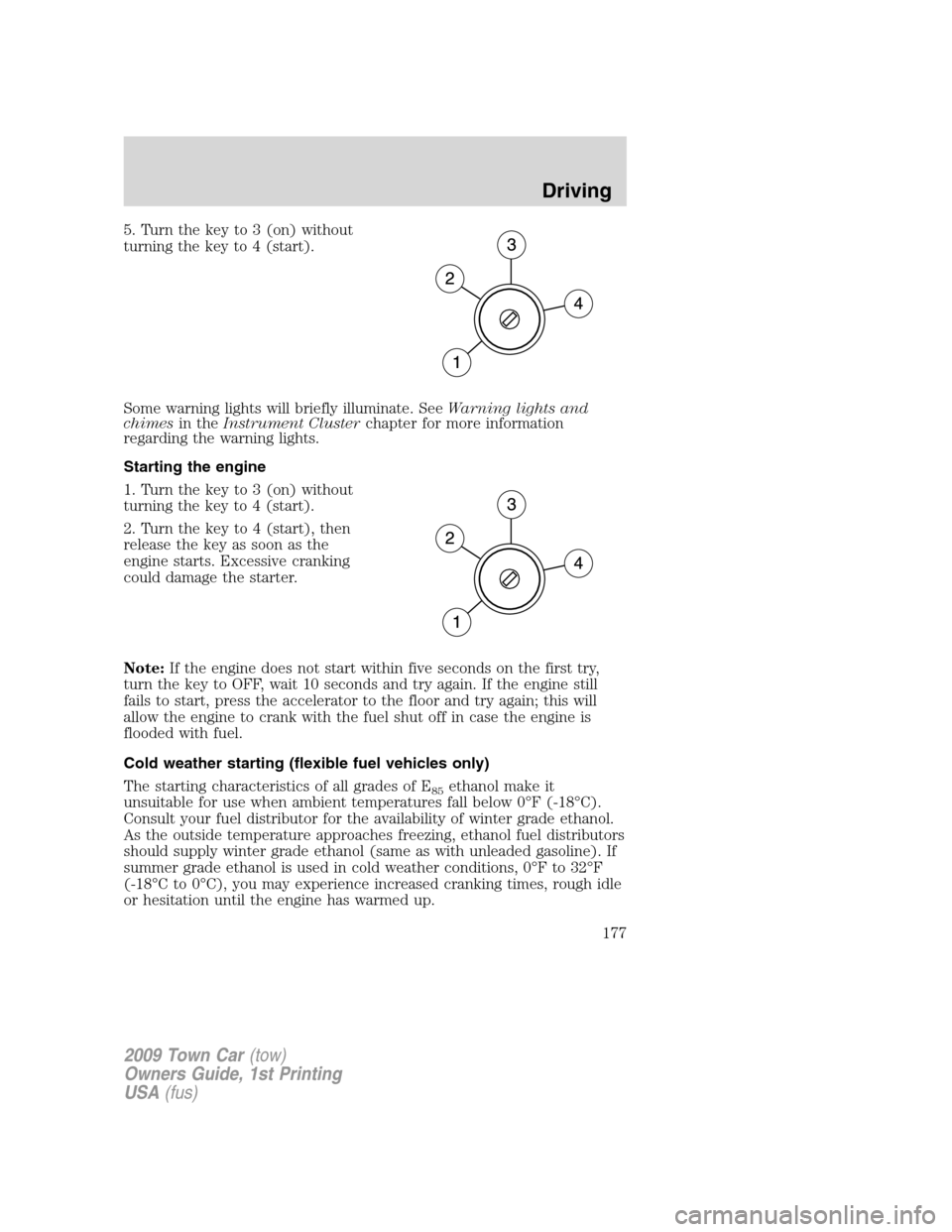
5. Turn the key to 3 (on) without
turning the key to 4 (start).
Some warning lights will briefly illuminate. SeeWarning lights and
chimesin theInstrument Clusterchapter for more information
regarding the warning lights.
Starting the engine
1. Turn the key to 3 (on) without
turning the key to 4 (start).
2. Turn the key to 4 (start), then
release the key as soon as the
engine starts. Excessive cranking
could damage the starter.
Note:If the engine does not start within five seconds on the first try,
turn the key to OFF, wait 10 seconds and try again. If the engine still
fails to start, press the accelerator to the floor and try again; this will
allow the engine to crank with the fuel shut off in case the engine is
flooded with fuel.
Cold weather starting (flexible fuel vehicles only)
The starting characteristics of all grades of E
85ethanol make it
unsuitable for use when ambient temperatures fall below 0°F (-18°C).
Consult your fuel distributor for the availability of winter grade ethanol.
As the outside temperature approaches freezing, ethanol fuel distributors
should supply winter grade ethanol (same as with unleaded gasoline). If
summer grade ethanol is used in cold weather conditions, 0°F to 32°F
(-18°C to 0°C), you may experience increased cranking times, rough idle
or hesitation until the engine has warmed up.
2009 Town Car(tow)
Owners Guide, 1st Printing
USA(fus)
Driving
177
Page 182 of 280
WARNING:Always set the parking brake fully and make sure
the gearshift is latched in P (Park). Turn the ignition to the
OFF/LOCK position and remove the key whenever you leave your
vehicle.
The parking brake is not recommended to stop a moving vehicle.
However, if the normal brakes fail, the parking brake can be used to stop
your vehicle in an emergency. Since the parking brake applies only the
rear brakes, the vehicle’s stopping distance will increase greatly and the
handling of your vehicle will be adversely affected.
Your vehicle has an automatic parking brake release. To release the
parking brake:
1. Start the vehicle.
2. Press the brake pedal.
3. Move the gearshift from the P (Park) position to one of the forward
gears (the parking brake will not release automatically when you shift
into reverse). The brake pedal must remain pressed while the gearshift is
moved.
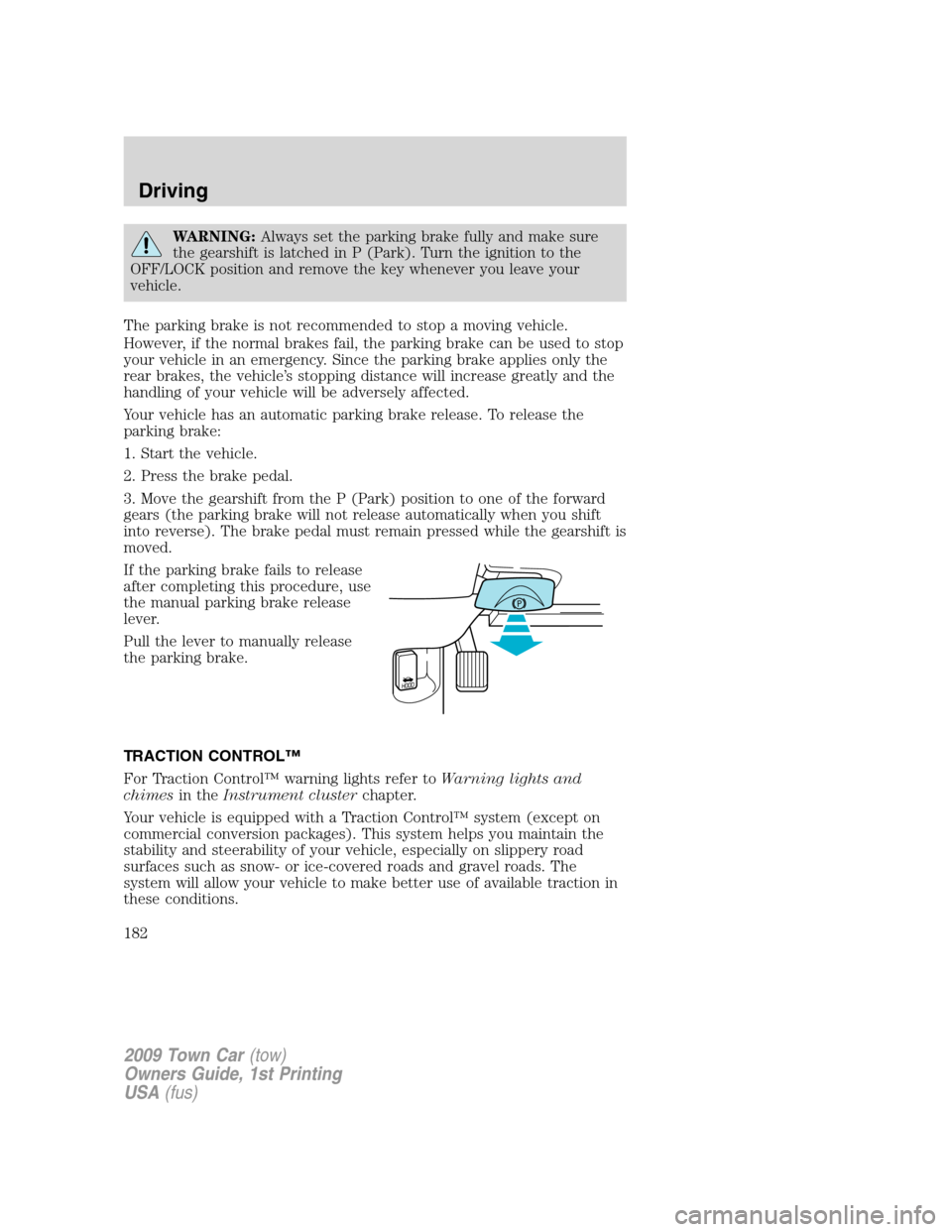
If the parking brake fails to release
after completing this procedure, use
the manual parking brake release
lever.
Pull the lever to manually release
the parking brake.
TRACTION CONTROL™
For Traction Control™ warning lights refer toWarning lights and
chimesin theInstrument clusterchapter.
Your vehicle is equipped with a Traction Control™ system (except on
commercial conversion packages). This system helps you maintain the
stability and steerability of your vehicle, especially on slippery road
surfaces such as snow- or ice-covered roads and gravel roads. The
system will allow your vehicle to make better use of available traction in
these conditions.
2009 Town Car(tow)
Owners Guide, 1st Printing
USA(fus)
Driving
182
Page 254 of 280
Unleaded gasoline engines
If you are experiencing starting, rough idle or hesitation driveability
problems during a cold start, try a different brand of “Regular” unleaded
gasoline. “Premium” unleaded gasoline is not recommended because it
may cause these problems to become more pronounced. If the problems
persist, see your authorized dealer.
FFV engine (if equipped)
To identify if your vehicle is an FFV, it may be equipped with a yellow
fuel cap with the text “E85/Gasoline”, or check if there is a label on the
fuel filler door.
It is best not to alternate repeatedly between gasoline and E85. If you do
switch fuels, it is recommended that you add as much fuel as
possible—at least half a tank. Do not add less than five gallons (18.9 L)
when refueling. You should drive the vehicle immediately after refueling
for at least 5 miles (8 km) to allow the vehicle to adapt to the change in
ethanol concentration.
If you operate your vehicle 50% or more of the time on ethanol, you
should follow a different maintenance schedule. In addition to this, it is
also recommended to fill the fuel tank with regular unleaded gasoline
once every 3,000 miles (4,800 km). Seescheduled maintenance
informationfor more information.
Running out of fuel
Avoid running out of fuel because this situation may have an adverse
effect on powertrain components.
If you have run out of fuel:
•You may need to cycle the ignition from off to on several times after
refueling to allow the fuel system to pump the fuel from the tank to
the engine. On restarting, cranking time will take a few seconds longer
than normal.
•Normally, adding 1 gallon (3.8L) of fuel is enough to restart the
engine. If the vehicle is out of fuel and on a steep grade, more than
1 gallon (3.8L) may be required.
•TheService engine soon
indicator may come on. For more
information on theService engine soon
indicator, refer to
Warning lights and chimesin theInstrument Clusterchapter.
ESSENTIALS OF GOOD FUEL ECONOMY
Measuring techniques
Your best source of information about actual fuel economy is you, the
driver. You must gather information as accurately and consistently as
2009 Town Car(tow)
Owners Guide, 1st Printing
USA(fus)
Maintenance and Specifications
254
Page 277 of 280
Fluid capacities .........................267
Fuel ............................................248
calculating fuel
economy ............................64, 254
cap ...........................................251
capacity ...................................267
choosing the right fuel ...........252
comparisons with EPA fuel
economy estimates .................257
detergent in fuel .....................253
filling your vehicle
with fuel ..................248, 251, 255
filter, specifications ........248, 265
fuel filler door override ............75
fuel filler door release ..............75
fuel pump shut-off switch .....195
improving fuel economy ........254
octane rating ...................253, 270
quality ..............................253–254
running out of fuel .................254
safety information relating to
automotive fuels .....................248
Fuel - flex fuel vehicle
(FFV) .........................248, 252–253
Fuses ..................................195–196
G
Gas cap (see Fuel cap) ............251
Gas mileage (see Fuel
economy) ...................................254
Gauges .........................................16
H
Hazard flashers .........................194
Head restraints ...........................93
Headlamps ...................................35
aiming ........................................37
autolamp system .......................35bulb specifications ....................40
daytime running lights .............36
flash to pass ..............................36
high beam .................................36
replacing bulbs .........................42
turning on and off ....................35
Homelink wireless control
system ..........................................58
Hood ..........................................234
I
Ignition ...............................175, 270
Illuminated visor mirror .............47
Infant seats (see Safety
seats) .........................................131
Inspection/maintenance (I/M)
testing ........................................260
Instrument panel
cleaning ...................................229
cluster ........................................12
lighting up panel and
interior .......................................37
J
Jack ............................................202
positioning ...............................202
storage .....................................202
Jump-starting your vehicle ......210
K
Keyless entry system .................86
keypad .......................................86
locking and unlocking doors ....87
programming entry code .........86
Keys .......................................76, 90
positions of the ignition .........175
2009 Town Car(tow)
Owners Guide, 1st Printing
USA(fus)
Index
277
Page 278 of 280
L
Lamps
autolamp system .......................35
bulb replacement
specifications chart ..................40
daytime running light ...............36
headlamps .................................35
headlamps, flash to pass ..........36
instrument panel, dimming .....37
interior lamps .....................39, 41
replacing bulbs .........................42
LATCH anchors .........................136
Lights, warning and indicator ....12
anti-lock brakes (ABS) ..........181
Load limits .................................165
Locks
childproof ..................................78
doors ..........................................76
Lubricant specifications ...........267
Lug nuts ....................................210
Lumbar support, seats ...............96
M
Message center ...........................62
english/metric button ...............67
system check button ................66
warning messages .....................70
Mirrors ...................................52–53
automatic dimming rearview
mirror ........................................52
fold away ...................................54
heated ........................................53
programmable memory ............82
side view mirrors (power) .......53
Motorcraft parts ........231, 248, 265
O
Octane rating ............................253Oil (see Engine oil) ..................237
P
Parking brake ............................181
Parts (see Motorcraft parts) ....265
Passenger Occupant
Classification Sensor .................102
Pedals (see Power adjustable
foot pedals) .................................54
Power adjustable foot pedals .....54
Power distribution box (see
Fuses) ........................................199
Power door locks ........................76
Power mirrors .............................53
Power point .................................48
Power steering ..........................183
fluid, checking and adding ....261
fluid, refill capacity ................267
Power trunk ..........................74–75
Power Windows ...........................50
R
Radio ......................................19, 24
Rear window defroster ...............34
Recommendations for
attaching safety restraints for
children ......................................129
Relays ........................................195
Remote entry system .................80
illuminated entry ......................85
locking/unlocking doors ...........81
opening the trunk .....................82
panic alarm ...............................82
replacement/additional
transmitters ...............................84
2009 Town Car(tow)
Owners Guide, 1st Printing
USA(fus)
Index
278
Page 280 of 280
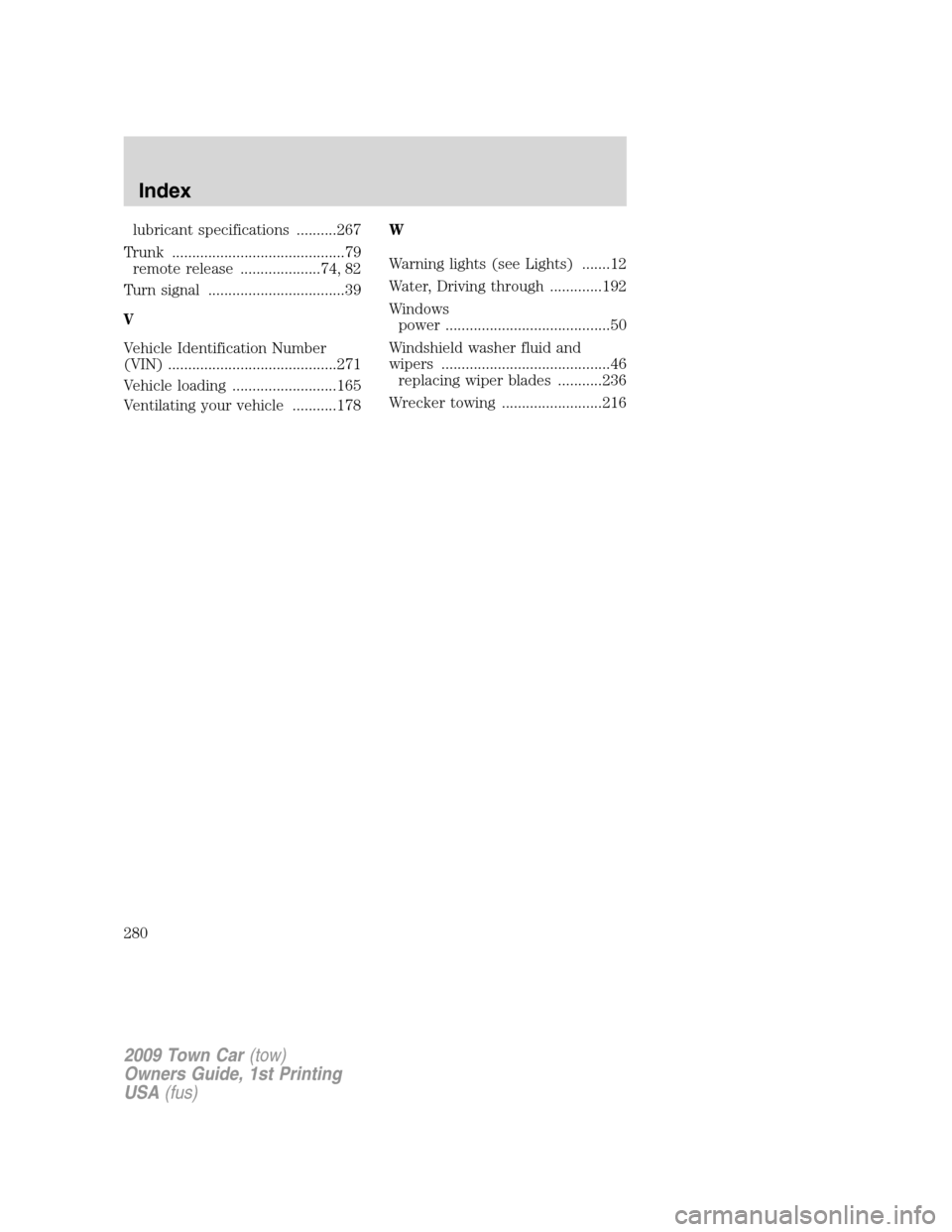
lubricant specifications ..........267
Trunk ...........................................79
remote release ....................74, 82
Turn signal ..................................39
V
Vehicle Identification Number
(VIN) ..........................................271
Vehicle loading ..........................165
Ventilating your vehicle ...........178W
Warning lights (see Lights) .......12
Water, Driving through .............192
Windows
power .........................................50
Windshield washer fluid and
wipers ..........................................46
replacing wiper blades ...........236
Wrecker towing .........................216
2009 Town Car(tow)
Owners Guide, 1st Printing
USA(fus)
Index
280