stop start LINCOLN TOWN CAR 2010 User Guide
[x] Cancel search | Manufacturer: LINCOLN, Model Year: 2010, Model line: TOWN CAR, Model: LINCOLN TOWN CAR 2010Pages: 285, PDF Size: 1.94 MB
Page 205 of 285
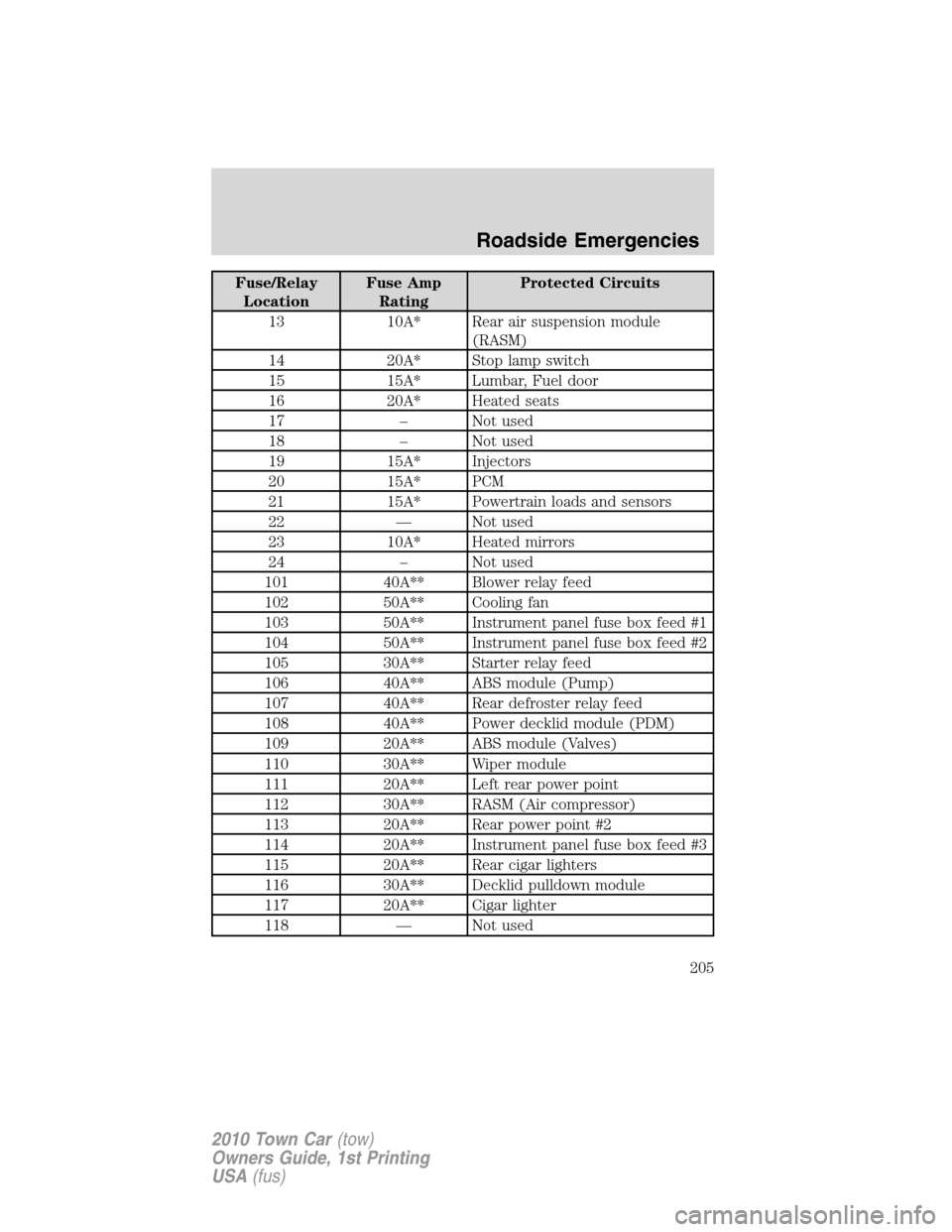
Fuse/Relay
LocationFuse Amp
RatingProtected Circuits
13 10A* Rear air suspension module
(RASM)
14 20A* Stop lamp switch
15 15A* Lumbar, Fuel door
16 20A* Heated seats
17 – Not used
18 – Not used
19 15A* Injectors
20 15A* PCM
21 15A* Powertrain loads and sensors
22 — Not used
23 10A* Heated mirrors
24 – Not used
101 40A** Blower relay feed
102 50A** Cooling fan
103 50A** Instrument panel fuse box feed #1
104 50A** Instrument panel fuse box feed #2
105 30A** Starter relay feed
106 40A** ABS module (Pump)
107 40A** Rear defroster relay feed
108 40A** Power decklid module (PDM)
109 20A** ABS module (Valves)
110 30A** Wiper module
111 20A** Left rear power point
112 30A** RASM (Air compressor)
113 20A** Rear power point #2
114 20A** Instrument panel fuse box feed #3
115 20A** Rear cigar lighters
116 30A** Decklid pulldown module
117 20A** Cigar lighter
118 — Not used
Roadside Emergencies
205
2010 Town Car(tow)
Owners Guide, 1st Printing
USA(fus)
Page 244 of 285
Note: Electrical or electronic accessories or components added to
the vehicle by the dealer or the owner may adversely affect
battery performance and durability.
WARNING:Batteries normally produce explosive gases which
can cause personal injury. Therefore, do not allow flames, sparks
or lighted substances to come near the battery. When working near the
battery, always shield your face and protect your eyes. Always provide
proper ventilation.
WARNING:When lifting a plastic-cased battery, excessive
pressure on the end walls could cause acid to flow through the
vent caps, resulting in personal injury and/or damage to the vehicle or
battery. Lift the battery with a battery carrier or with your hands on
opposite corners.
WARNING:Keep batteries out of reach of children. Batteries
contain sulfuric acid. Avoid contact with skin, eyes or clothing.
Shield your eyes when working near the battery to protect against
possible splashing of acid solution. In case of acid contact with skin or
eyes, flush immediately with water for a minimum of 15 minutes and
get prompt medical attention. If acid is swallowed, call a physician
immediately.
WARNING:Battery posts, terminals and related accessories
contain lead and lead compounds.Wash hands after handling.
Because your vehicle’s engine is electronically controlled by a computer,
some control conditions are maintained by power from the battery. When
the battery is disconnected or a new battery is installed, the engine must
relearn its idle and fuel trim strategy for optimum driveability and
performance. To begin this process:
1. With the vehicle at a complete stop, set the parking brake.
2. Put the gearshift in P (Park), turn off all accessories and start the
engine.
3. Run the engine until it reaches normal operating temperature.
4. Allow the engine to idle for at least one minute.
5. Turn the A/C on and allow the engine to idle for at least one minute.
Maintenance and Specifications
244
2010 Town Car(tow)
Owners Guide, 1st Printing
USA(fus)
Page 255 of 285
lightor CHECK FUEL CAP message may not reset immediately; it
may take several driving cycles for the check fuel cap light
or CHECK
FUEL CAP message to turn off. A driving cycle consists of an engine
start-up (after four or more hours with the engine off) followed by city
and highway driving.
Continuing to drive with the check fuel cap light
or CHECK FUEL
CAP message on may cause the
light to turn on as well.
If you must replace the fuel filler cap, replace it with a fuel filler
cap that is designed for your vehicle. The customer warranty may
be void for any damage to the fuel tank or fuel system if the
correct genuine Ford, Motorcraft or other certified fuel filler cap
is not used.
WARNING:The fuel system may be under pressure. If the fuel
filler cap is venting vapor or if you hear a hissing sound, wait
until it stops before completely removing the fuel filler cap. Otherwise,
fuel may spray out and injure you or others.
WARNING:If you do not use the proper fuel filler cap,
excessive vacuum in the fuel tank may damage the fuel system
or cause the fuel cap to disengage in a collision, which may result in
personal injury.
FFV (Flex Fuel Vehicle) fuel cap
If your vehicle is FFV capable, it will have a yellow colored fuel cap.
Choosing the right fuel
If your vehicle is a flexible fuel vehicle (FFV), use only UNLEADED
FUEL and FUEL ETHANOL (Ed75–Ed85).
If your vehicle is not a flexible fuel vehicle (FFV), then only use
UNLEADED fuel or UNLEADED fuel blended with a maximum of 10%
ethanol. Do not use fuel ethanol (E85), diesel, methanol, leaded fuel or
any other fuel.
The use of leaded fuel is prohibited by law and could damage your
vehicle.
Your vehicle was not designed to use fuel or fuel additives with metallic
compounds, including manganese-based additives.
Note:Use of any fuel other than those recommended may cause
powertrain damage, a loss of vehicle performance, and repairs may not
be covered under warranty.
Maintenance and Specifications
255
2010 Town Car(tow)
Owners Guide, 1st Printing
USA(fus)
Page 263 of 285
indicate that the vehicle is not ready for I/M testing. To determine if the
vehicle is ready for I/M testing, turn the ignition key to the on position
for 15 seconds without cranking the engine. If the service engine
soon
indicator blinks eight times, it means that the vehicle is not
ready for I/M testing; if the service engine soon
indicator stays on
solid, it means that the vehicle is ready for I/M testing.
The OBD-II system is designed to check the emission control system
during normal driving. A complete check may take several days. If the
vehicle is not ready for I/M testing, the following driving cycle consisting
of mixed city and highway driving may be performed:
15 minutes of steady driving on an expressway/highway followed by
20 minutes of stop-and-go driving with at least four 30-second idle
periods.
Allow the vehicle to sit for at least eight hours without starting the
engine. Then, start the engine and complete the above driving cycle. The
engine must warm up to its normal operating temperature. Once started,
do not turn off the engine until the above driving cycle is complete. If
the vehicle is still not ready for I/M testing, the above driving cycle will
have to be repeated.
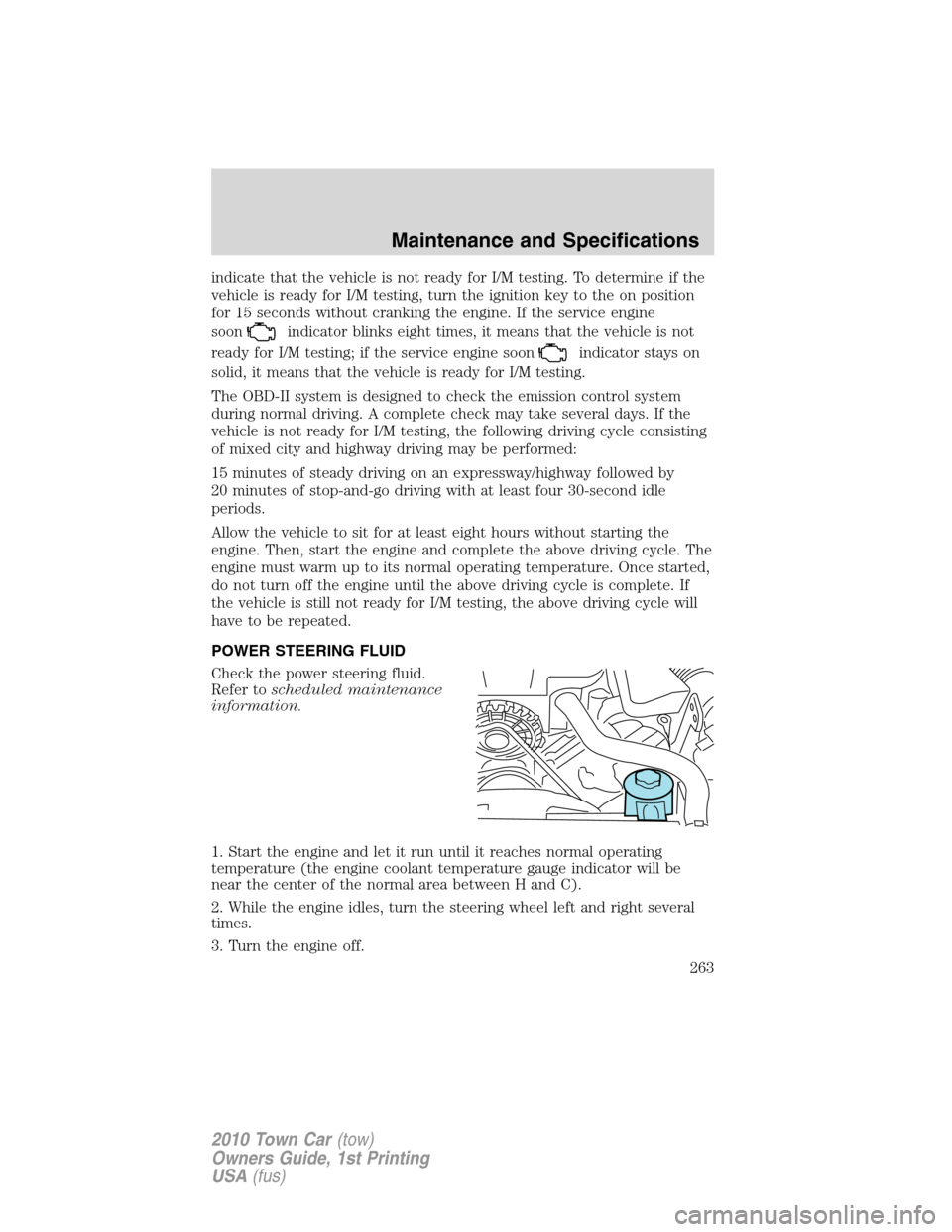
POWER STEERING FLUID
Check the power steering fluid.
Refer toscheduled maintenance
information.
1. Start the engine and let it run until it reaches normal operating
temperature (the engine coolant temperature gauge indicator will be
near the center of the normal area between H and C).
2. While the engine idles, turn the steering wheel left and right several
times.
3. Turn the engine off.
Maintenance and Specifications
263
2010 Town Car(tow)
Owners Guide, 1st Printing
USA(fus)