warning lights LINCOLN TOWN CAR 2010 User Guide
[x] Cancel search | Manufacturer: LINCOLN, Model Year: 2010, Model line: TOWN CAR, Model: LINCOLN TOWN CAR 2010Pages: 285, PDF Size: 1.94 MB
Page 176 of 285
Safety chains
Always connect the trailer’s safety chains to the frame or hook retainers
of the vehicle hitch. To connect the trailer’s safety chains, cross the
chains under the trailer tongue and allow slack for turning corners.
If you use a rental trailer, follow the instructions that the rental agency
gives to you.
Do not attach safety chains to the bumper.
Trailer brakes
Electric brakes and manual, automatic or surge-type trailer brakes are
safe if installed properly and adjusted to the manufacturer’s
specifications. The trailer brakes must meet local and Federal
regulations.
WARNING:Do not connect a trailer’s hydraulic brake system
directly to your vehicle’s brake system. Your vehicle may not
have enough braking power and your chances of having a collision
greatly increase.
The braking system of the tow vehicle is rated for operation at the
GVWR not GCWR.
Trailer lamps
Trailer lamps are required on most towed vehicles. Make sure all running
lights, brake lights, turn signals and hazard lights are working. Contact
your authorized dealer or trailer rental agency for proper instructions
and equipment for hooking up trailer lamps.
Driving while you tow
When towing a trailer:
•To ensure proper “break-in” of powertrain components, do not trailer
tow during the first 1,000 miles (1,600 km) of a new vehicle.
•To ensure proper “break-in” of powertrain components during the first
500 miles (800 km) of trailer towing, drive no faster than 70 mph
(113 km/h) with no full throttle starts.
•Turn off the speed control. The speed control may shut off
automatically when you are towing on long, steep grades.
•Consult your local motor vehicle speed regulations for towing a trailer.
Tires, Wheels and Loading
176
2010 Town Car(tow)
Owners Guide, 1st Printing
USA(fus)
Page 179 of 285
STARTING
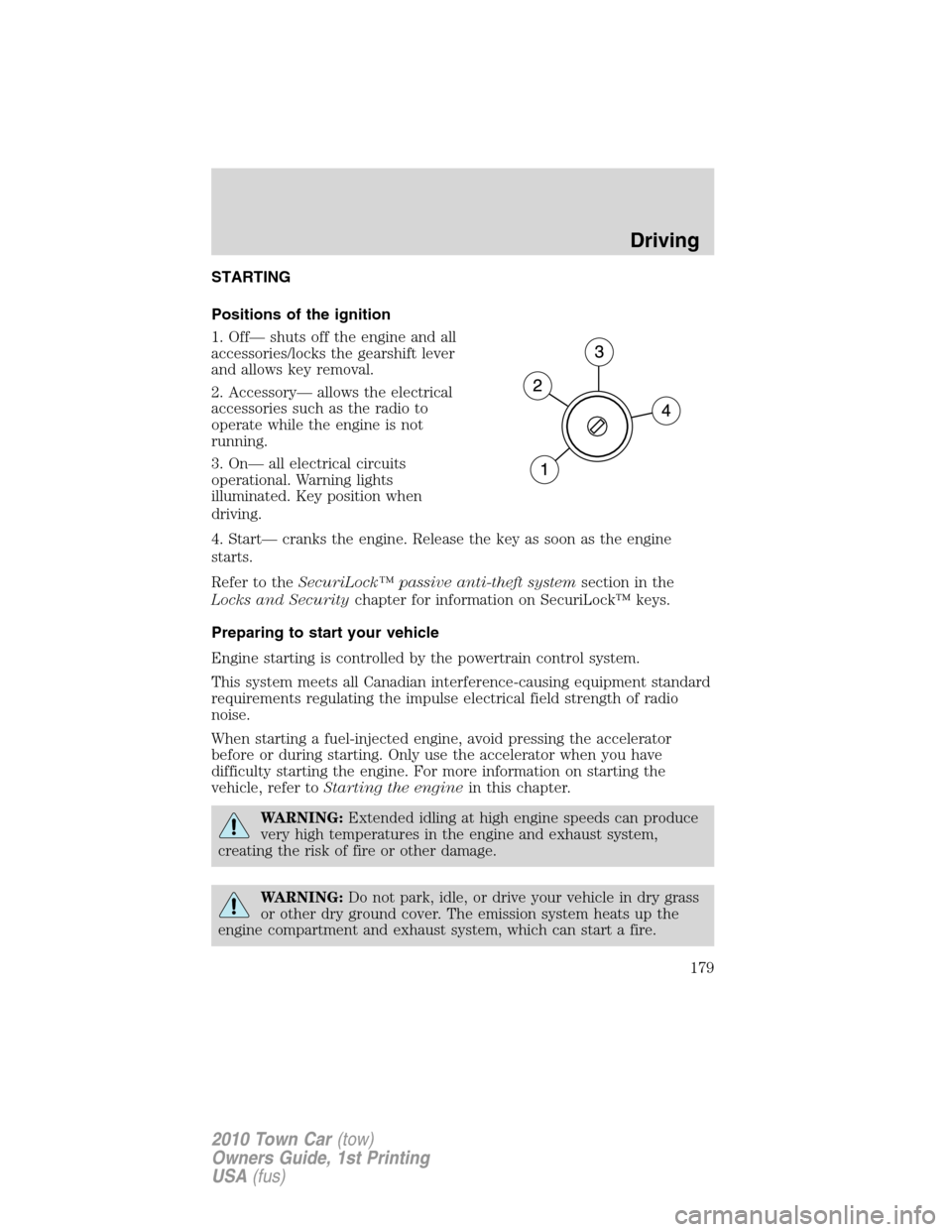
Positions of the ignition
1. Off— shuts off the engine and all
accessories/locks the gearshift lever
and allows key removal.
2. Accessory— allows the electrical
accessories such as the radio to
operate while the engine is not
running.
3. On— all electrical circuits
operational. Warning lights
illuminated. Key position when
driving.
4. Start— cranks the engine. Release the key as soon as the engine
starts.
Refer to theSecuriLock™ passive anti-theft systemsection in the
Locks and Securitychapter for information on SecuriLock™ keys.
Preparing to start your vehicle
Engine starting is controlled by the powertrain control system.
This system meets all Canadian interference-causing equipment standard
requirements regulating the impulse electrical field strength of radio
noise.
When starting a fuel-injected engine, avoid pressing the accelerator
before or during starting. Only use the accelerator when you have
difficulty starting the engine. For more information on starting the
vehicle, refer toStarting the enginein this chapter.
WARNING:Extended idling at high engine speeds can produce
very high temperatures in the engine and exhaust system,
creating the risk of fire or other damage.
WARNING:Do not park, idle, or drive your vehicle in dry grass
or other dry ground cover. The emission system heats up the
engine compartment and exhaust system, which can start a fire.
Driving
179
2010 Town Car(tow)
Owners Guide, 1st Printing
USA(fus)
Page 181 of 285
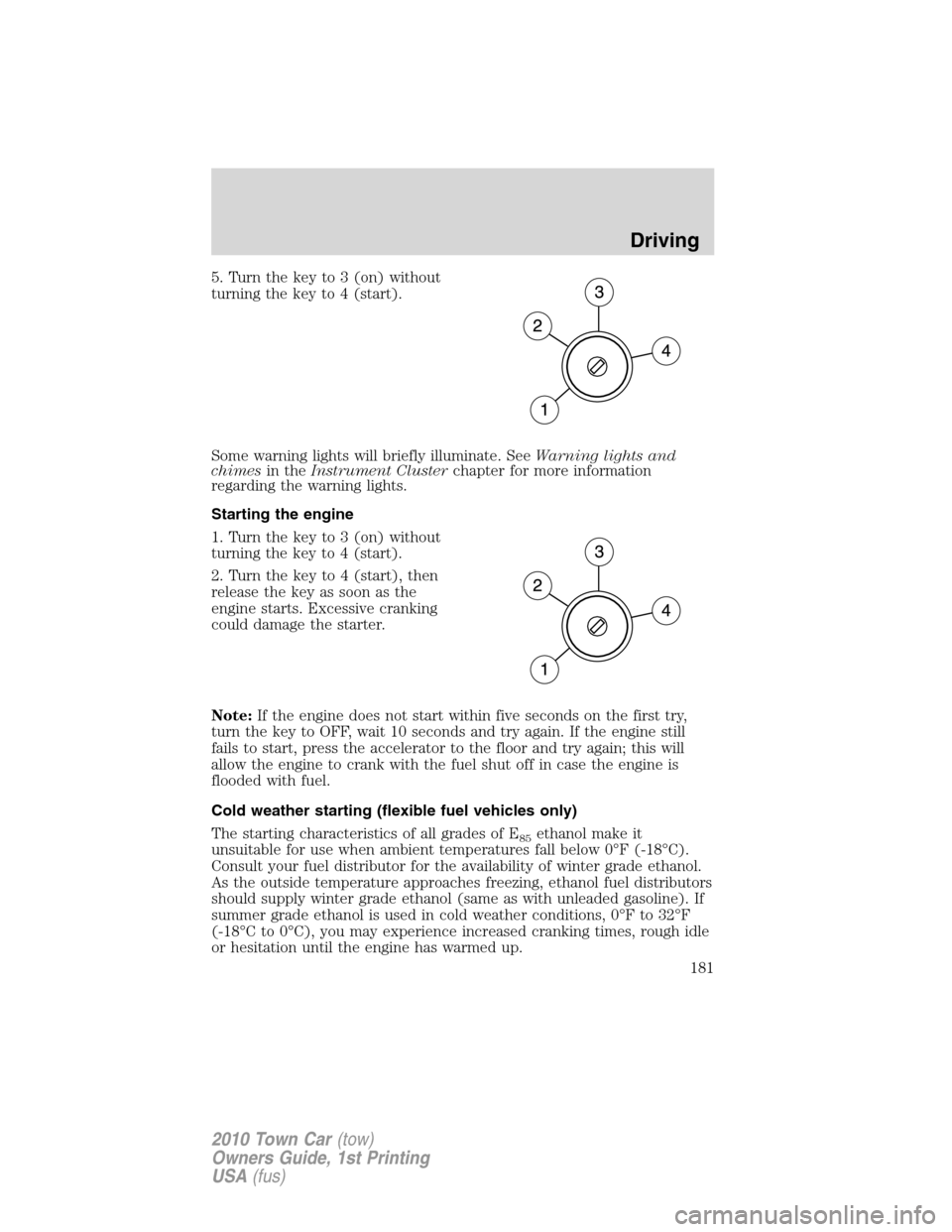
5. Turn the key to 3 (on) without
turning the key to 4 (start).
Some warning lights will briefly illuminate. SeeWarning lights and
chimesin theInstrument Clusterchapter for more information
regarding the warning lights.
Starting the engine
1. Turn the key to 3 (on) without
turning the key to 4 (start).
2. Turn the key to 4 (start), then
release the key as soon as the
engine starts. Excessive cranking
could damage the starter.
Note:If the engine does not start within five seconds on the first try,
turn the key to OFF, wait 10 seconds and try again. If the engine still
fails to start, press the accelerator to the floor and try again; this will
allow the engine to crank with the fuel shut off in case the engine is
flooded with fuel.
Cold weather starting (flexible fuel vehicles only)
The starting characteristics of all grades of E
85ethanol make it
unsuitable for use when ambient temperatures fall below 0°F (-18°C).
Consult your fuel distributor for the availability of winter grade ethanol.
As the outside temperature approaches freezing, ethanol fuel distributors
should supply winter grade ethanol (same as with unleaded gasoline). If
summer grade ethanol is used in cold weather conditions, 0°F to 32°F
(-18°C to 0°C), you may experience increased cranking times, rough idle
or hesitation until the engine has warmed up.
Driving
181
2010 Town Car(tow)
Owners Guide, 1st Printing
USA(fus)
Page 184 of 285
•Be sure that the engine block heater, heater cord and extension cord
are solidly connected. A poor connection can cause the cord to
become very hot and may result in an electrical shock or fire. Be sure
to check for heat anywhere in the electrical hookup once the system
has been operating for approximately a half hour.
•Finally, have the engine block heater system checked during your fall
tune-up to be sure it’s in good working order.
How to use the engine block heater
Ensure the receptacle terminals are clean and dry prior to use. To clean
them, use a dry cloth.
Depending on the type of factory installed equipment, your engine block
heater will use .4 to 1.0 kilowatt-hours of energy per hour of use. Your
factory installed block heater system does not have a thermostat;
however, maximum temperature is attained after approximately three
hours of operation. Block heater operation longer than three hours will
not improve system performance and will unnecessarily use additional
electricity.
Make sure system is unplugged and properly stowed before driving the
vehicle. While not in use, make sure the protective cover seals the
prongs of the engine block heater cord plug.
BRAKES
Occasional brake noise is normal. If a metal-to-metal, continuous grinding
or continuous squeal sound is present, the brake linings may be worn-out
and should be inspected by an authorized dealer. If the vehicle has
continuous vibration or shudder in the steering wheel while braking, the
vehicle should be inspected by an authorized dealer.
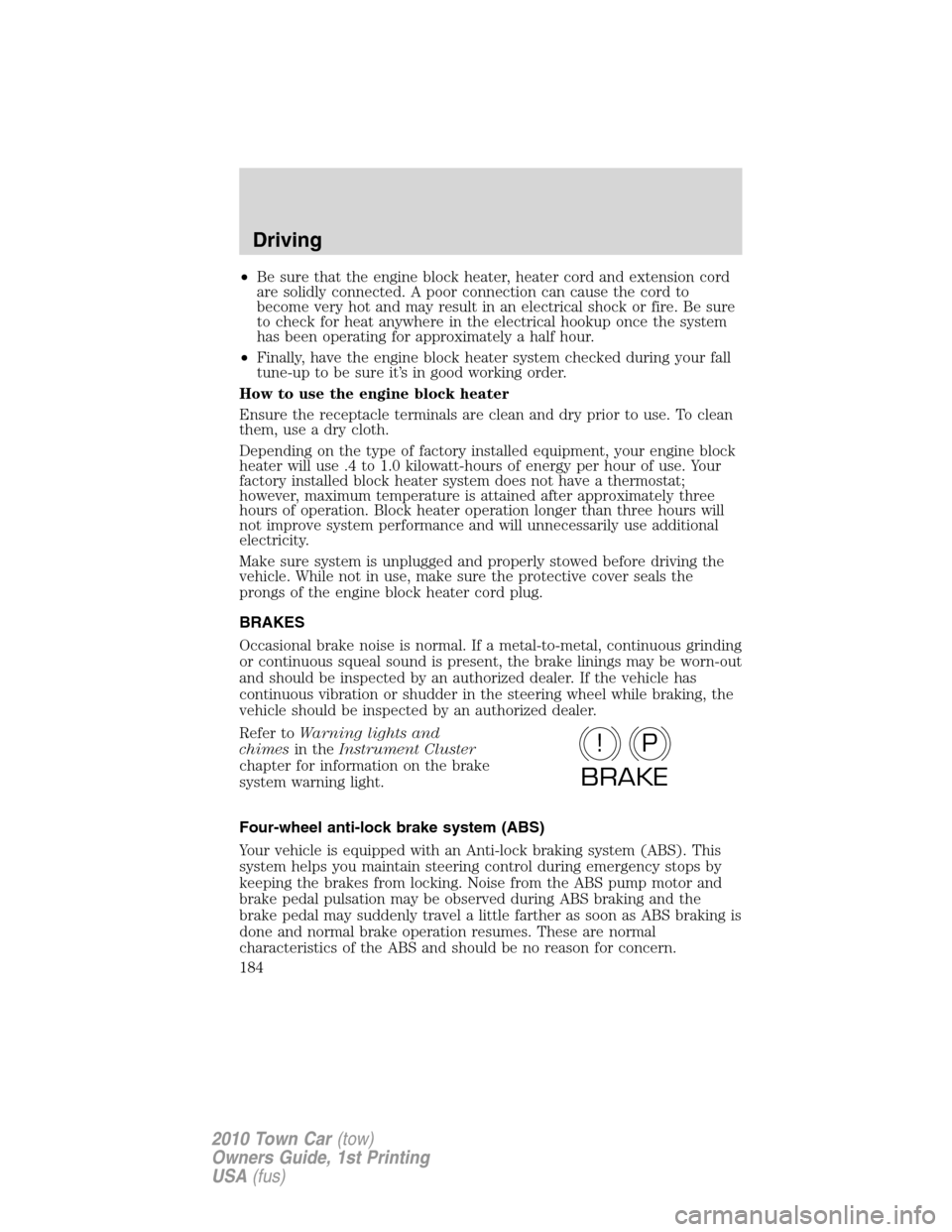
Refer toWarning lights and
chimesin theInstrument Cluster
chapter for information on the brake
system warning light.
Four-wheel anti-lock brake system (ABS)
Your vehicle is equipped with an Anti-lock braking system (ABS). This
system helps you maintain steering control during emergency stops by
keeping the brakes from locking. Noise from the ABS pump motor and
brake pedal pulsation may be observed during ABS braking and the
brake pedal may suddenly travel a little farther as soon as ABS braking is
done and normal brake operation resumes. These are normal
characteristics of the ABS and should be no reason for concern.
P!
BRAKE
Driving
184
2010 Town Car(tow)
Owners Guide, 1st Printing
USA(fus)
Page 257 of 285
rating. These products have not been approved for your engine and
could cause damage to the fuel system. Repairs to correct the effects of
using an aftermarket product in your fuel may not be covered by your
warranty.
Many of the world’s automakers approved the World-Wide Fuel Charter
that recommends gasoline specifications to provide improved
performance and emission control system protection for your vehicle.
Gasolines that meet the World-Wide Fuel Charter should be used when
available. Ask your fuel supplier about gasolines that meet the
World-Wide Fuel Charter.
Running out of fuel
Avoid running out of fuel because this situation may have an adverse
effect on powertrain components.
If you have run out of fuel:
•You may need to cycle the ignition from off to on several times after
refueling to allow the fuel system to pump the fuel from the tank to
the engine. On restarting, cranking time will take a few seconds longer
than normal.
•Normally, adding 1 gallon (3.8L) of fuel is enough to restart the
engine. If the vehicle is out of fuel and on a steep grade, more than
1 gallon (3.8L) may be required.
•The service engine soon
indicator may come on. For more
information on the service engine soon
indicator, refer to
Warning lights and chimesin theInstrument Clusterchapter.
ESSENTIALS OF GOOD FUEL ECONOMY
Measuring techniques
Your best source of information about actual fuel economy is you, the
driver. You must gather information as accurately and consistently as
possible. Fuel expense, frequency of fill-ups or fuel gauge readings are
NOT accurate as a measure of fuel economy. We do not recommend
taking fuel economy measurements during the first 1,000 miles
(1,600 km) of driving (engine break-in period). You will get a more
accurate measurement after 2,000 miles–3,000 miles
(3,000 km–5,000 km).
Filling the tank
The advertised fuel capacity of the fuel tank on your vehicle is equal to
the rated refill capacity of the fuel tank as listed in theMaintenance
product specifications and capacitiessection of this chapter.
Maintenance and Specifications
257
2010 Town Car(tow)
Owners Guide, 1st Printing
USA(fus)
Page 283 of 285
J
Jack ............................................206
positioning ...............................206
storage .....................................206
Jump-starting your vehicle ......215
K
Keyless entry system
keypad .......................................87
locking and unlocking doors ....88
programming entry code .........87
Keys .......................................77, 92
positions of the ignition .........179
L
Lamps
autolamp system .......................42
bulb replacement
specifications chart ..................47
daytime running light ...............43
headlamps .................................42
headlamps, flash to pass ..........43
instrument panel, dimming .....44
interior lamps .....................46, 48
replacing bulbs .........................49
LATCH anchors .........................138
Lights, warning and indicator ....12
anti-lock brakes (ABS) ..........185
Load limits .................................168
Locks
childproof ..................................79
doors ..........................................77
Lubricant specifications ...........269
Lug nuts ....................................214
Lumbar support, seats ...............98M
Message center .....................18–19
english/metric button .........22–23
system check button ................22
warning messages .....................23
Mirrors .........................................58
automatic dimming rearview
mirror ........................................58
fold away ...................................60
heated ........................................59
programmable memory ............84
side view mirrors (power) .......58
Motorcraft parts ........235, 251, 268
O
Octane rating ............................256
Oil (see Engine oil) ..................240
P
Parking brake ............................185
Parts (see Motorcraft parts) ....268
Passenger Occupant
Classification Sensor .................104
Pedals (see Power adjustable
foot pedals) .................................60
Power adjustable foot pedals .....60
Power distribution box
(see Fuses) ...............................203
Power door locks ........................77
Power mirrors .............................58
Power point .................................55
Power steering ..........................187
fluid, checking and adding ....263
fluid, refill capacity ................269
Index
283
2010 Town Car(tow)
Owners Guide, 1st Printing
USA(fus)
Page 285 of 285
changing ..........................206, 209
checking the pressure ............152
inflating ...................................150
label .........................................162
replacing ..................................154
rotating ....................................157
safety practices .......................156
sidewall information ...............158
snow tires and chains ............168
spare tire .........................207, 209
terminology .............................149
tire grades ...............................149
treadwear ........................148, 153
Towing .......................................175
recreational towing .................178
trailer towing ..........................175
wrecker ....................................220
Traction control ........................186
Traction-lok rear axle ...............189
Transmission .............................190
brake-shift interlock (BSI) ....189
fluid, checking and adding
(automatic) .............................264
fluid, refill capacities ..............269lubricant specifications ..........269
Trunk ...........................................80
remote release ....................75, 83
Turn signal ..................................46
U
Universal garage door opener ....64
V
Vehicle Identification Number
(VIN) ..........................................273
Vehicle loading ..........................168
Ventilating your vehicle ...........182
W
Warning lights (see Lights) .......12
Water, Driving through .............196
Windows
power .........................................57
Windshield washer fluid and
wipers ..........................................53
replacing wiper blades ...........240
Wrecker towing .........................220
Index
285
2010 Town Car(tow)
Owners Guide, 1st Printing
USA(fus)