display LINCOLN TOWN CAR 2011 Owner's Manual
[x] Cancel search | Manufacturer: LINCOLN, Model Year: 2011, Model line: TOWN CAR, Model: LINCOLN TOWN CAR 2011Pages: 306, PDF Size: 2.04 MB
Page 40 of 306
15.EXT:Displays the outside air
temperature. It will remain
displayed until the EXT control is
pressed again. The external
temperature will be most accurate when the vehicle has been moving for
a period of time.
16.Temperature conversion:
Press to switch between Fahrenheit
and Celsius temperature on the
DEATC display only. The set point
temperatures in Celsius will be displayed in half-degree increments.
Operating tips
•To reduce fog build-up on the windshield during humid weather, place
the air flow selector in the
position.
•To reduce humidity build-up inside the vehicle: do not drive with the
recirculation control on or the system turned off.
•To improve the A/C cool down, drive with the windows slightly open
for 2–3 minutes after start up or until the vehicle has been “aired out.”
•Do not put objects under the front seats that will interfere with the
airflow to the back seats.
•Remove any snow, ice or leaves from the air intake area at the base of
the windshield.
•A small amount of air may be felt from the floor vent regardless of the
air distribution setting that is selected.
During extreme high ambient temperatures when idling stationary for
extended periods of time in gear, it is recommended to run the A/C
with
selected, reduce blower fan speed from the highest setting
and put the vehicle’s transmission into the P (Park) gear position to
continue to receive cool air from your A/C system.
To aid in side window defogging/demisting in cold weather:
1. Select
.
2. Select A/C.
3. Adjust the temperature control to maintain comfort.
4. Set the fan to the highest speed.
5. Direct the outer instrument panel vents towards the side windows.
To increase airflow to the outer instrument panel vents, close the vents
located in the middle of the instrument panel.
Climate Controls
40
2011 Town Car(tow)
Owners Guide, 2nd Printing
USA(fus)
Page 56 of 306
CLOCK
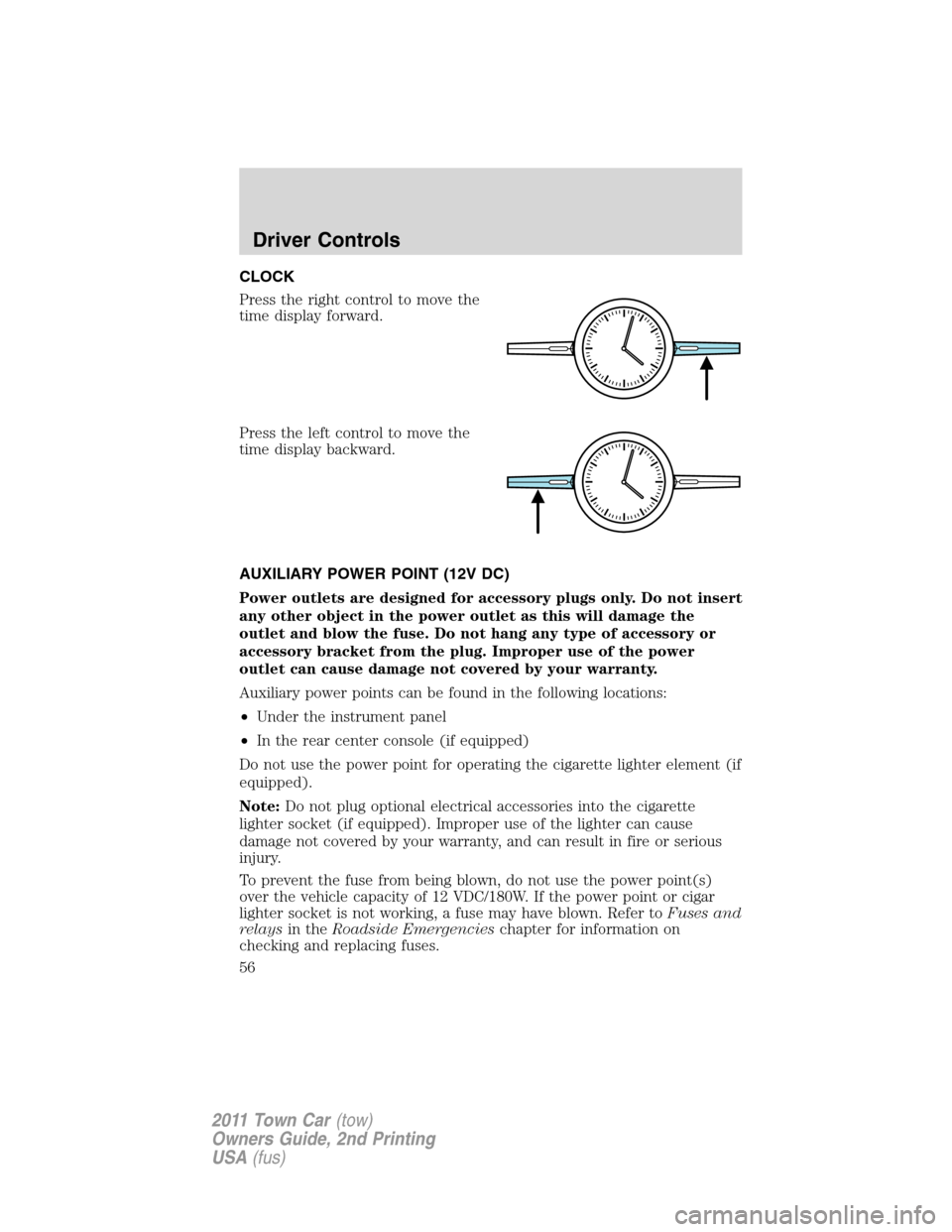
Press the right control to move the
time display forward.
Press the left control to move the
time display backward.
AUXILIARY POWER POINT (12V DC)
Power outlets are designed for accessory plugs only. Do not insert
any other object in the power outlet as this will damage the
outlet and blow the fuse. Do not hang any type of accessory or
accessory bracket from the plug. Improper use of the power
outlet can cause damage not covered by your warranty.
Auxiliary power points can be found in the following locations:
•Under the instrument panel
•In the rear center console (if equipped)
Do not use the power point for operating the cigarette lighter element (if
equipped).
Note:Do not plug optional electrical accessories into the cigarette
lighter socket (if equipped). Improper use of the lighter can cause
damage not covered by your warranty, and can result in fire or serious
injury.
To prevent the fuse from being blown, do not use the power point(s)
over the vehicle capacity of 12 VDC/180W. If the power point or cigar
lighter socket is not working, a fuse may have blown. Refer toFuses and
relaysin theRoadside Emergencieschapter for information on
checking and replacing fuses.
Driver Controls
56
2011 Town Car(tow)
Owners Guide, 2nd Printing
USA(fus)
Page 61 of 306
WARNING:Never adjust the accelerator and brake pedal with
feet on the pedals while the vehicle is moving.
SPEED CONTROL
With speed control set, you can maintain a set speed without keeping
your foot on the accelerator pedal.
WARNING:Do not use the speed control in heavy traffic or on
roads that are winding, slippery or unpaved.
Using speed control
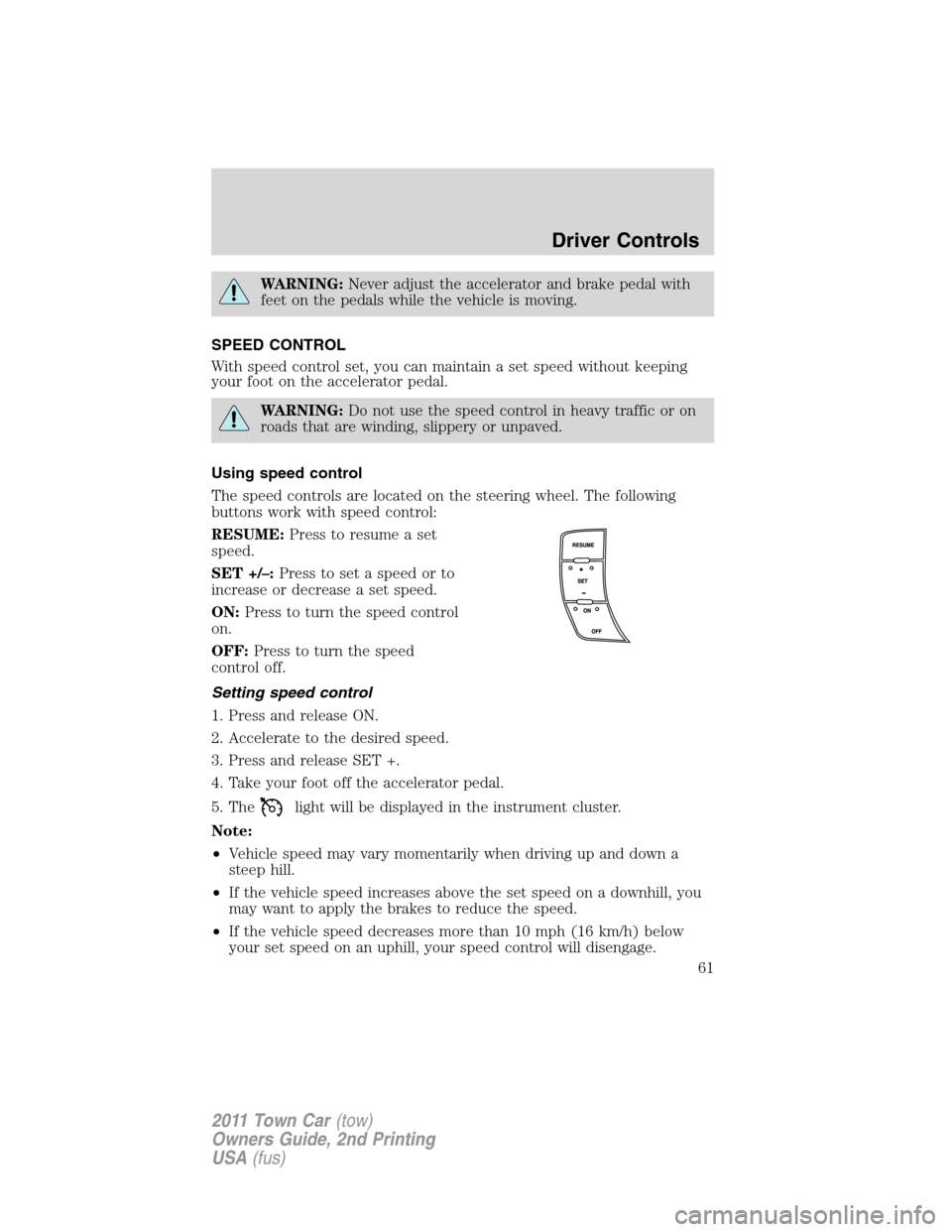
The speed controls are located on the steering wheel. The following
buttons work with speed control:
RESUME:Press to resume a set
speed.
SET +/–:Press to set a speed or to
increase or decrease a set speed.
ON:Press to turn the speed control
on.
OFF:Press to turn the speed
control off.
Setting speed control
1. Press and release ON.
2. Accelerate to the desired speed.
3. Press and release SET +.
4. Take your foot off the accelerator pedal.
5. The
light will be displayed in the instrument cluster.
Note:
•Vehicle speed may vary momentarily when driving up and down a
steep hill.
•If the vehicle speed increases above the set speed on a downhill, you
may want to apply the brakes to reduce the speed.
•If the vehicle speed decreases more than 10 mph (16 km/h) below
your set speed on an uphill, your speed control will disengage.
Driver Controls
61
2011 Town Car(tow)
Owners Guide, 2nd Printing
USA(fus)
Page 247 of 306
•Thesymbol will display in the message center.
•The message center will display COOLANT OVER TEMPERATURE.
•A chime will sound.
•Theservice engine soon
indicator light will illuminate.
If the engine reaches a preset over-temperature condition, the engine
will automatically switch to alternating cylinder operation. Each disabled
cylinder acts as an air pump and cools the engine.
When this occurs the vehicle will still operate. However:
•The engine power will be limited.
•The air conditioning system will be disabled.
Continued operation will increase the engine temperature and the engine
will completely shut down, causing steering and braking effort to
increase.
Once the engine temperature cools, the engine can be re-started. Take
your vehicle to an authorized dealer as soon as possible to minimize
engine damage.
When fail-safe mode is activated
You have limited engine power when in the fail-safe mode, so drive the
vehicle with caution. The vehicle will not be able to maintain high-speed
operation and the engine will run rough. Remember that the engine is
capable of completely shutting down automatically to prevent engine
damage, therefore:
1. Pull off the road as soon as safely possible and turn off the engine.
2. Arrange for the vehicle to be taken to an authorized dealer.
3. If this is not possible, wait a short period for the engine to cool.
4. Check the coolant level and replenish if low.
WARNING:Fail-safe mode is for use during emergencies only.
Operate the vehicle in fail-safe mode only as long as necessary to
bring the vehicle to rest in a safe location and seek immediate repairs.
When in fail-safe mode, the vehicle will have limited power, will not be
able to maintain high-speed operation, and may completely shut down
without warning, potentially losing engine power, power steering assist,
and power brake assist, which may increase the possibility of a crash
resulting in serious injury.
Maintenance and Specifications
247
2011 Town Car(tow)
Owners Guide, 2nd Printing
USA(fus)
Page 295 of 306
ENGINE IDLE HOUR METER (IF EQUIPPED):
Your vehicle may be equipped with an idle meter to indicate how much
time the vehicle is idling in P (Park) or N (Neutral). The meter is
incorporated with the vehicle odometer. Depressing the odometer-reset
button once will display the trip odometer (miles [km] followed by a “T”
for trip odometer); depressing the odometer-reset button a second time
will display the idle meter (hours followed by an “H” for hours). The idle
meter only accumulates time when the vehicle is in P (Park) or N
(Neutral). Displayed time is cumulative for the vehicle.It cannot be
reset to zero.Police/Fleet vehicles often experience long periods of
idling, during which engine oil will continue to break down but distance
is not accumulated on the odometer.
To assist fleet managers in maintaining proper oil change intervals, the
idle meter will help determine when an oil change is required. For every
hour that the vehicle idles, it has accumulated the equivalent of
approximately 33 miles (53 km) of driving. Using the combination of the
vehicle odometer and idle meter allows the fleet manager to better
determine when the oil needs to be changed
Engine idle hour meter calculation:
Idle hours x 33 = miles (km) equivalency
Miles (km) driven + miles (km) equivalency = oil change interval
Example:When the odometer has accumulated 3,000 miles (4,800 km)
and the idle meter shows 61 hours, a 5,000 mile (8,000 km) oil change
interval will have been reached: 3,000 road miles (4,800 road km) + (61
idle hours x 33 miles [53 km]/idle hour) = 5,013 miles (8,067 km).
Scheduled Maintenance Guide
295
2011 Town Car(tow)
Owners Guide, 2nd Printing
USA(fus)