battery LOTUS ELISE 2005 User Guide
[x] Cancel search | Manufacturer: LOTUS, Model Year: 2005, Model line: ELISE, Model: LOTUS ELISE 2005Pages: 205, PDF Size: 4.51 MB
Page 37 of 205
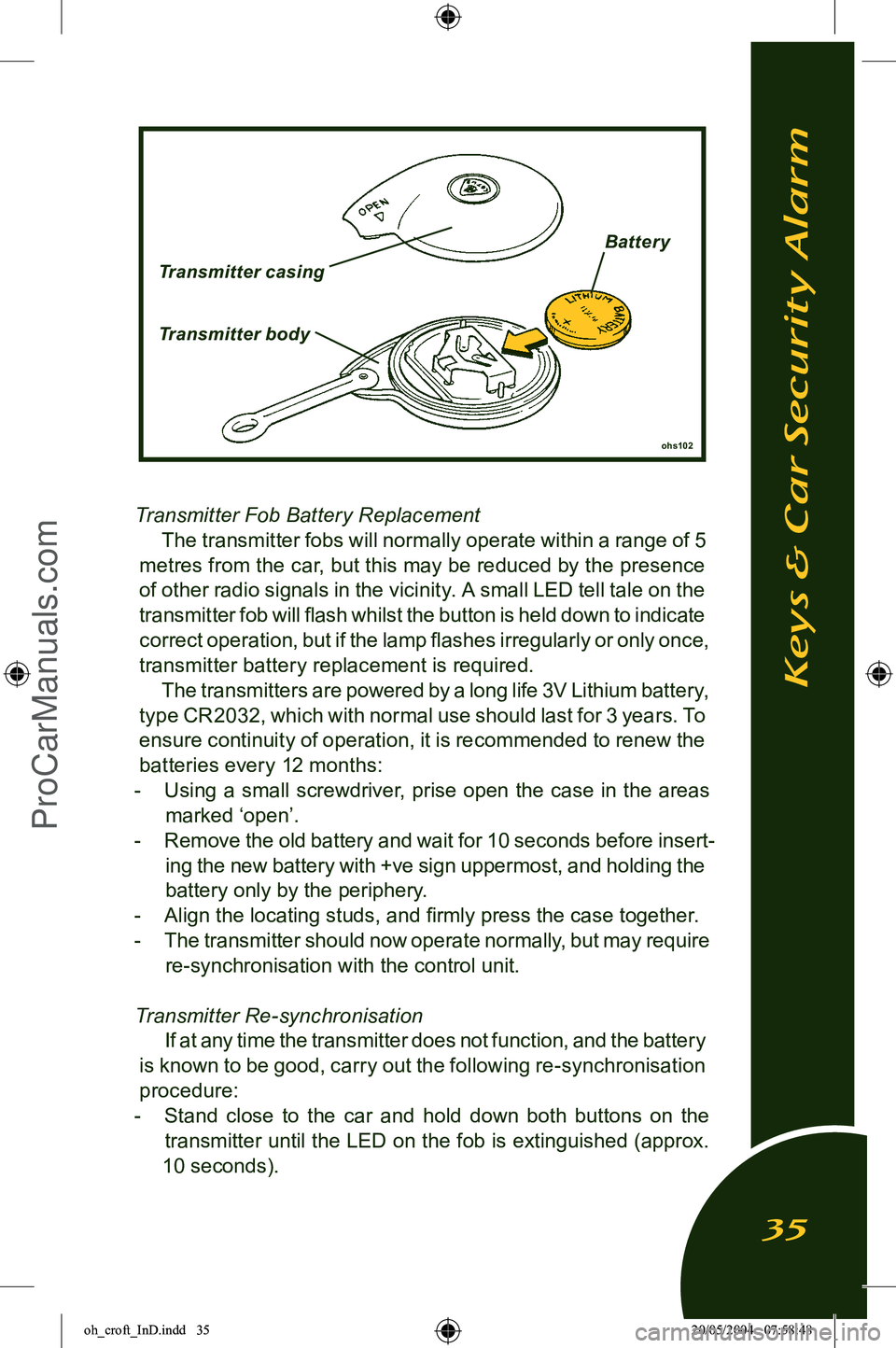
Transmitter Fob Battery ReplacementThe transmitter fobs will normally operate within a range of 5
metres from the car, but this may be reduced by the presence
of other radio signals in the vicinity. A small LED tell tale on the
transmitter fob will flash whilst the button is held down to indicate correct operation, but if the lamp flashes irregularly or only once,
transmitter battery replacement is required.
The transmitters are powered by a long life 3V Lithium battery,
type CR2032, which with normal use should last for 3 years. To ensure continuity of operation, it is recommended to renew the batteries every 12 months:
- Using a small screwdriver, prise open the case in the areas
marked ‘open’.
- Remove the old battery and wait for 10 seconds before insert
-
ing the new battery with +ve sign uppermost, and holding the battery only by the periphery.
- Align the locating studs, and firmly press the case together.
- The transmitter should now operate normally, but may require
re-synchronisation with the control unit.
Transmitter Re-synchronisation If at any time the transmitter does not function, and the battery
is known to be good, carry out the following re-synchronisation procedure:
- Stand close to the car and hold down both buttons on the
transmitter until the LED on the fob is extinguished (approx.
10 seconds).
ohs102
Keys & Car Security Alarm
35
Transmitter casing
Transmitter body
Batter y
oh_croft_InD.indd 3520/05/2004 07:58:48ProCarManuals.com
Page 38 of 205
- Release both buttons; the fob tell tale should come on con-
stantly.
- Press the larger button for one second (the fob tell tale will
flash). Synchronisation is complete.
Programming Additional Transmitter Fobs Two transmitter fobs are provided with the new car. If one
transmitter is lost or damaged, a replacement should be ob
-
tained immediately from your dealer, and programmed to the car alarm controller using a functioning transmitter fob and the
system owner’s unique Personal Identification Number (PIN).
Up to 4 transmitter fobs can be matched with the alarm system, but all fobs must collectively undergo the single programming
operation:
1. Press, simultaneously, both buttons on a transmitter fob until the fob tell tale stops flashing (approx. 10 seconds).
On release of the buttons, the fob tell tale will light.
2. Repeat operation (1) for ALL the transmitter fobs required to
operate the system.
3. Turn the ignition on and off 3 times within 7 seconds; the
security tell tale in the tachometer will light for 3 seconds.
4. Enter the PIN: Immediately the tell tale goes out, switch ON the ignition and count the number of security tell tale flashes
until equal to the first number of the PIN, then turn the ignition
OFF, then back ON again.
5. Repeat operation (4) for the remaining 3 digits of the PIN, remembering to turn the ignition OFF and back ON after each
code number.
Note: If at any time a mistake is made when entering the
PIN, turn the ignition OFF for 10 seconds and re-commence entering the PIN.
6. If the PIN is correct, the security tell tale will be lit. Test op
-
eration of each transmitter fob.
Disconnecting the Car Battery If the battery is to be disconnected, refer to the ‘Battery’
section later in this handbook which includes the following precaution:
- Before disconnecting the battery, ensure that the alarm system
is disarmed and mobilised.
Keys & Car Security Alarm
36
oh_croft_InD.indd 3620/05/2004 07:58:48ProCarManuals.com
Page 41 of 205
Notes:
• In the event of a flat car battery, the CDL will not operate. The
doors can be unlocked from outside only after opening the
engine cover and restoring power to the battery by substitution,
re-charging or ‘jumping’ to a second battery. The doors cannot
be unlocked using the mechanical key if the CDL was used
to lock the car.
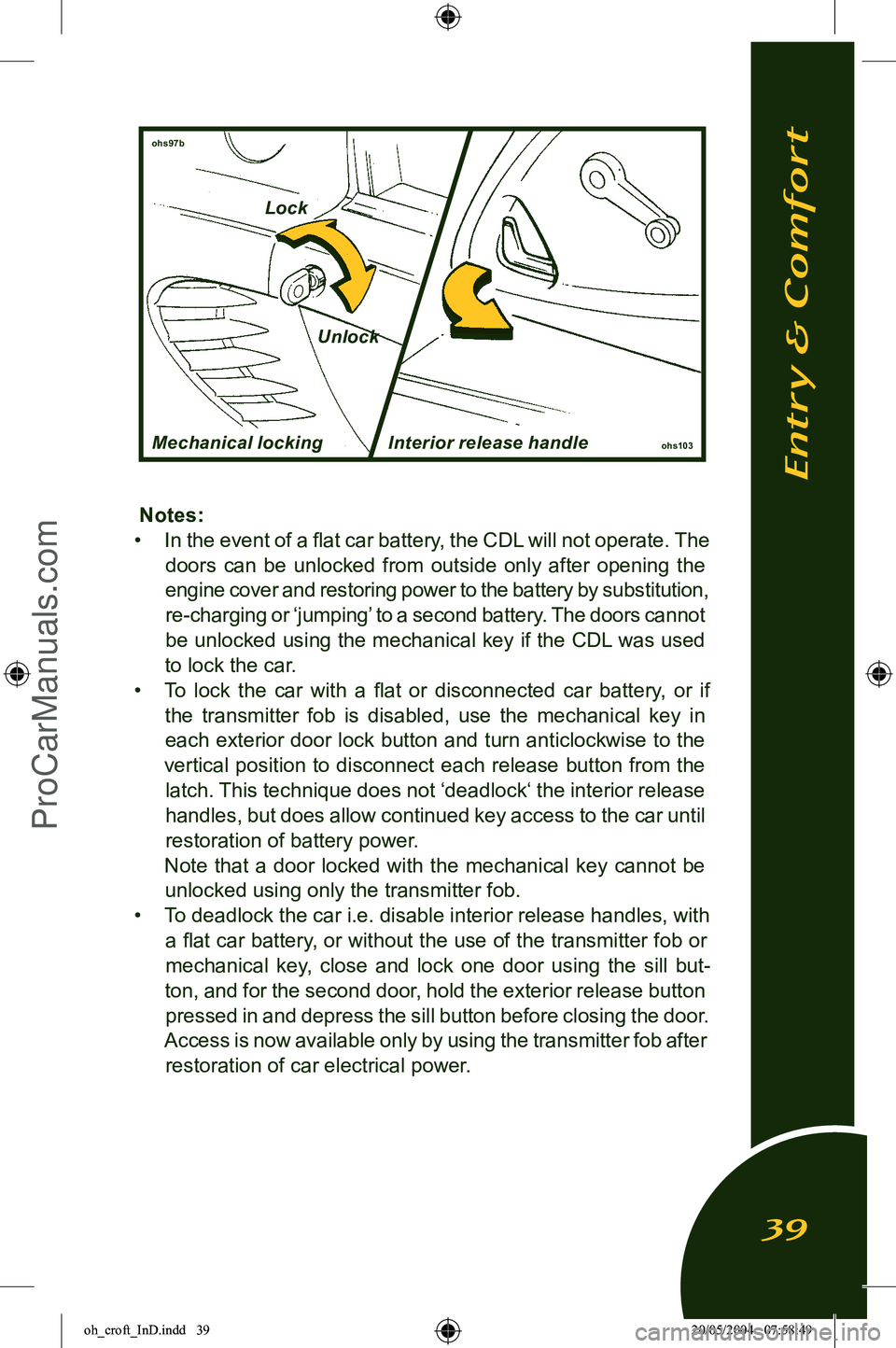
• To lock the car with a flat or disconnected car battery, or if
the transmitter fob is disabled, use the mechanical key in each exterior door lock button and turn anticlockwise to the
vertical position to disconnect each release button from the latch. This technique does not ‘deadlock‘ the interior release
handles, but does allow continued key access to the car until restoration of battery power.
Note that a door locked with the mechanical key cannot be
unlocked using only the transmitter fob.
• To deadlock the car i.e. disable interior release handles, with
a flat car battery, or without the use of the transmitter fob or mechanical key, close and lock one door using the sill but
-
ton, and for the second door, hold the exterior release button pressed in and depress the sill button before closing the door.
Access is now available only by using the transmitter fob after restoration of car electrical power.
ohs97b
ohs103
Mechanical locking Interior release handle
Entry & Comfort
39
LockUnlock
oh_croft_InD.indd 3920/05/2004 07:58:49ProCarManuals.com
Page 43 of 205
ohs99
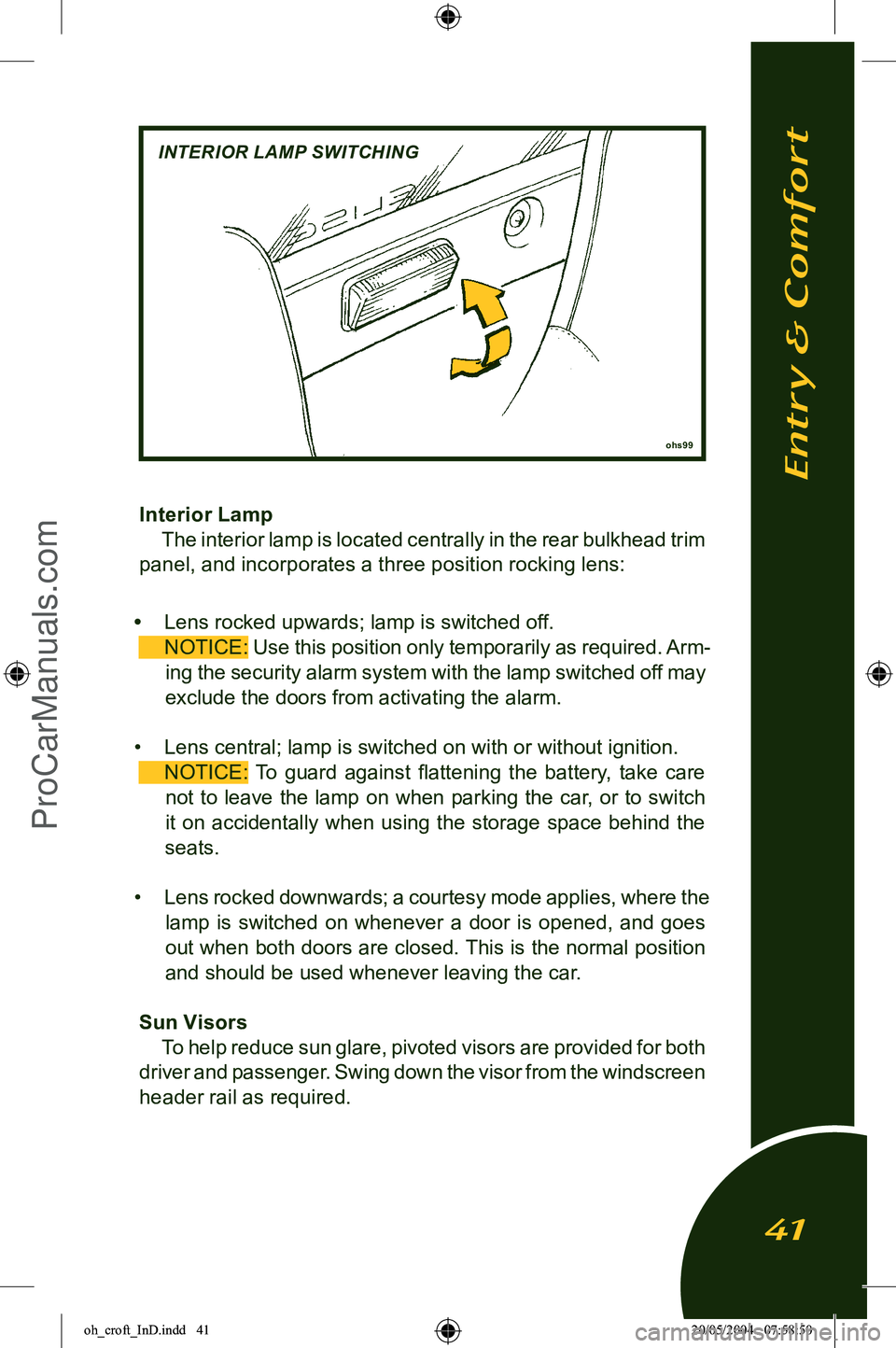
Interior LampThe interior lamp is located centrally in the rear bulkhead trim
panel, and incorporates a three position rocking lens:
• Lens rocked upwards; lamp is switched off.
NOTICE:
Use this position only temporarily as required. Arm-
ing the security alarm system with the lamp switched off may
exclude the doors from activating the alarm.
• Lens central; lamp is switched on with or without ignition.
NOTICE: To guard against flattening the battery, take care
not to leave the lamp on when parking the car, or to switch
it on accidentally when using the storage space behind the
seats.
• Lens rocked downwards; a courtesy mode applies, where the
lamp is switched on whenever a door is opened, and goes out when both doors are closed. This is the normal position
and should be used whenever leaving the car.
Sun Visors To help reduce sun glare, pivoted visors are provided for both
driver and passenger. Swing down the visor from the windscreen
header rail as required.
Entry & Comfort
41
INTERIOR LAMP SWITCHING
oh_croft_InD.indd 4120/05/2004 07:58:50ProCarManuals.com
Page 46 of 205
oh33e
Key insert /removeColumn unlocked
Ignition auxilliaries
Position not used
INSTRUMENTS & SWITCHES
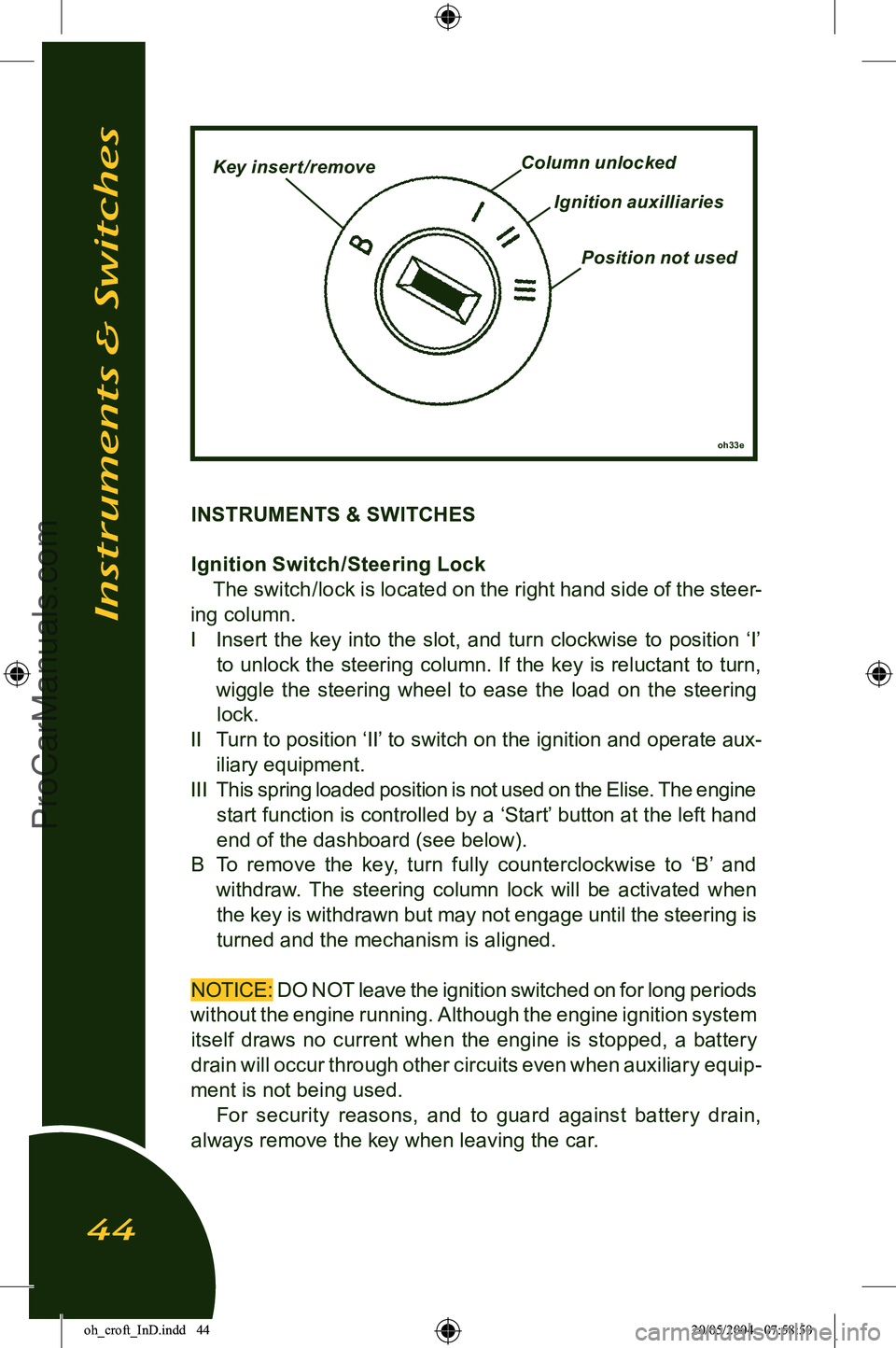
Ignition Switch /Steering LockThe switch/lock is located on the right hand side of the steer
-
ing column.
I Insert the key into the slot, and turn clockwise to position ‘I’ to unlock the steering column. If the key is reluctant to turn,
wiggle the steering wheel to ease the load on the steering
lock.
II Turn to position ‘II’ to switch on the ignition and operate aux-
iliary equipment.
III This spring loaded position is not used on the Elise. The engine
start function is controlled by a ‘Start’ button at the left hand
end of the dashboard (see below).
B To remove the key, turn fully counterclockwise to ‘B’ and withdraw. The steering column lock will be activated when the key is withdrawn but may not engage until the steering is
turned and the mechanism is aligned.
NOTICE: DO NOT leave the ignition switched on for long periods
without the engine running. Although the engine ignition system itself draws no current when the engine is stopped, a battery drain will occur through other circuits even when auxiliary equip
-
ment is not being used. For security reasons, and to guard against battery drain,
always remove the key when leaving the car.
Instruments & Switches
44
oh_croft_InD.indd 4420/05/2004 07:58:50ProCarManuals.com
Page 50 of 205
WARNING:Continuing to run the engine with the oil tell tale lit could
cause major engine damage or seizure, resulting in loss
of car control and a crash. You or others could be killed
or seriously injured.
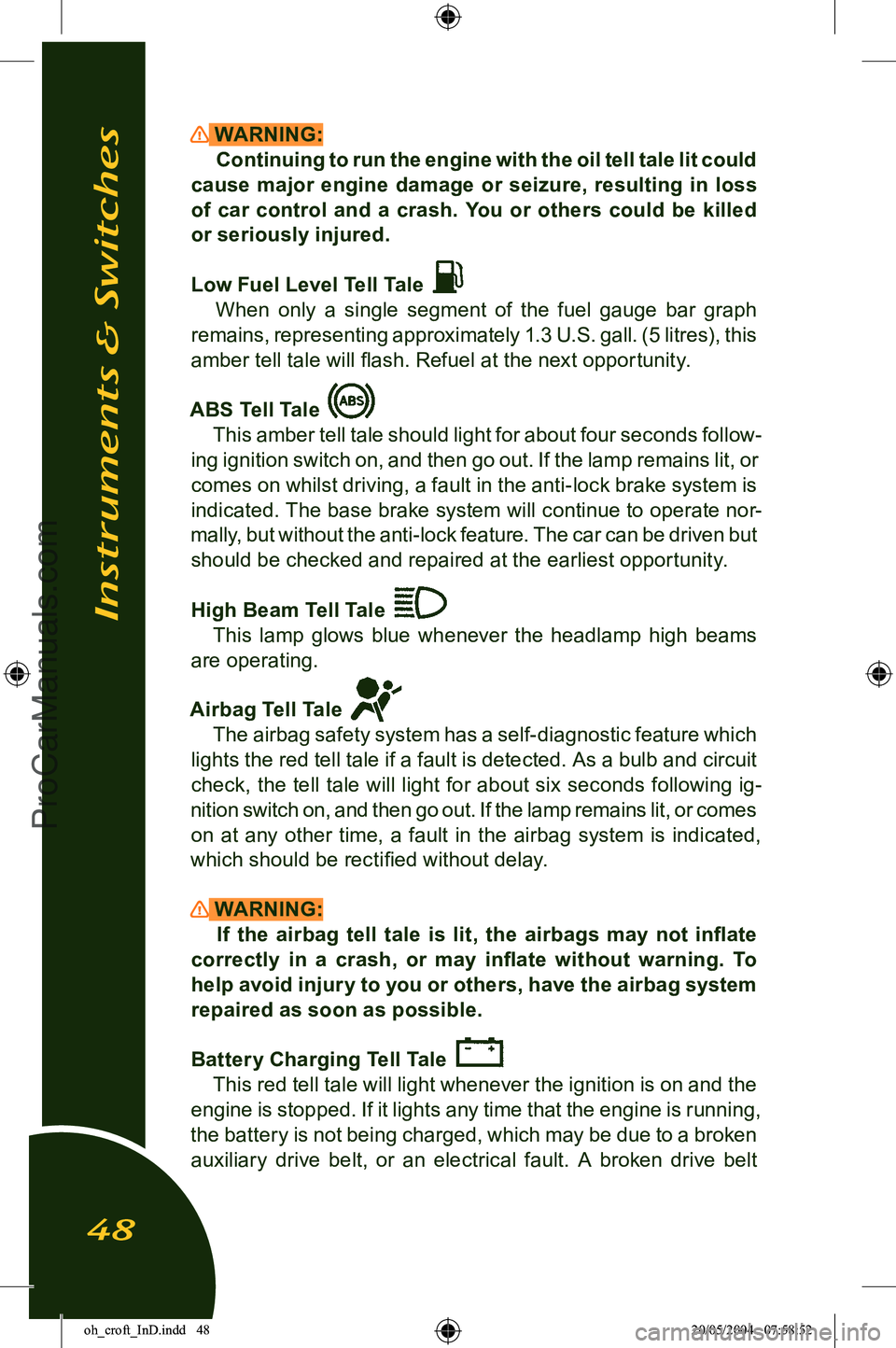
Low Fuel Level Tell Tale
When only a single segment of the fuel gauge bar graph
remains, representing approximately 1.3 U.S. gall. (5 litres), this
amber tell tale will flash. Refuel at the next opportunity.
ABS Tell Tale
This amber tell tale should light for about four seconds follow-
ing ignition switch on, and then go out. If the lamp remains lit, or
comes on whilst driving, a fault in the anti-lock brake system is
indicated. The base brake system will continue to operate nor
-
mally, but without the anti-lock feature. The car can be driven but should be checked and repaired at the earliest opportunity.
High Beam Tell Tale
This lamp glows blue whenever the headlamp high beams
are operating.
Airbag Tell Tale
The airbag safety system has a self-diagnostic feature which
lights the red tell tale if a fault is detected. As a bulb and circuit
check, the tell tale will light for about six seconds following ig
-
nition switch on, and then go out. If the lamp remains lit, or comes on at any other time, a fault in the airbag system is indicated,
which should be rectified without delay.
WARNING: If the airbag tell tale is lit, the airbags may not inflate
correctly in a crash, or may inflate without warning. To
help avoid injury to you or others, have the airbag system repaired as soon as possible.
Battery Charging Tell Tale
This red tell tale will light whenever the ignition is on and the
engine is stopped. If it lights any time that the engine is running,
the battery is not being charged, which may be due to a broken
auxiliary drive belt, or an electrical fault. A broken drive belt
Instruments & Switches
48
oh_croft_InD.indd 4820/05/2004 07:58:52ProCarManuals.com
Page 51 of 205
will also disable the engine coolant pump and result in rapid overheating; stop the engine as soon as it is safe to do so, and
summon assistance. If the drive belt is intact and the cooling
system unaffected, it may be possible in favourable daylight conditions, to drive a short distance to a repair facility, but do not, under any circumstances, allow the battery to become
completely discharged by continuing to drive.
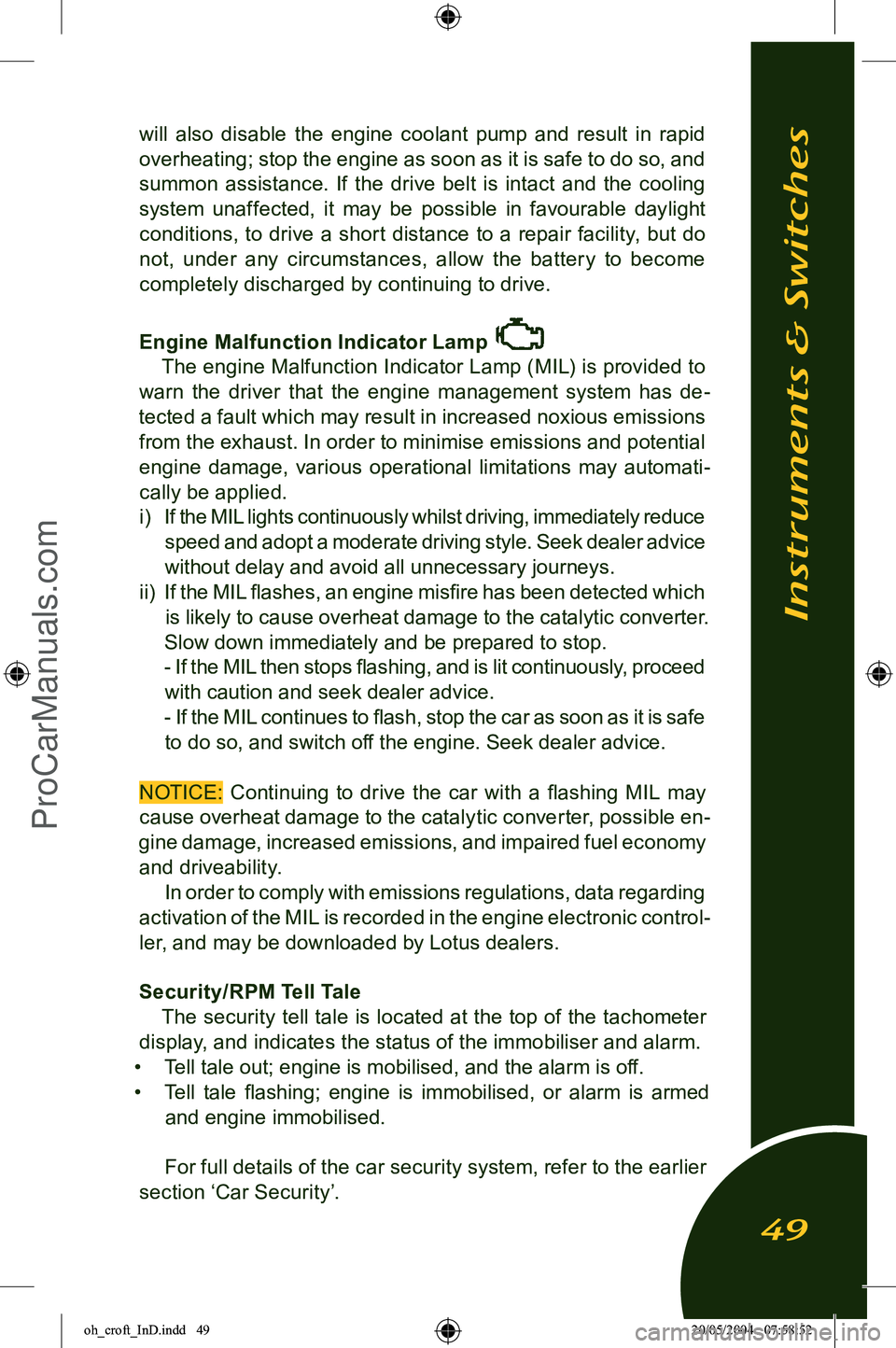
Engine Malfunction Indicator Lamp
The engine Malfunction Indicator Lamp (MIL) is provided to
warn the driver that the engine management system has de
-
tected a fault which may result in increased noxious emissions from the exhaust. In order to minimise emissions and potential
engine damage, various operational limitations may automati
-
cally be applied. i) If the MIL lights continuously whilst driving, immediately reduce
speed and adopt a moderate driving style. Seek dealer advice
without delay and avoid all unnecessary journeys.
ii) If the MIL flashes, an engine misfire has been detected which is likely to cause overheat damage to the catalytic converter.
Slow down immediately and be prepared to stop.
- If the MIL then stops flashing, and is lit continuously, proceed with caution and seek dealer advice.
- If the MIL continues to flash, stop the car as soon as it is safe to do so, and switch off the engine. Seek dealer advice.
NOTICE:
Continuing to drive the car with a flashing MIL may
cause overheat damage to the catalytic converter, possible en
-
gine damage, increased emissions, and impaired fuel economy and driveability.
In order to comply with emissions regulations, data regarding
activation of the MIL is recorded in the engine electronic control
-
ler, and may be downloaded by Lotus dealers.
Security/RPM Tell Tale The security tell tale is located at the top of the tachometer
display, and indicates the status of the immobiliser and alarm.
• Tell tale out; engine is mobilised, and the alarm is off.
• Tell tale flashing; engine is immobilised, or alarm is armed
and engine immobilised.
For full details of the car security system, refer to the earlier
section ‘Car Security’.
Instruments & Switches
49
oh_croft_InD.indd 4920/05/2004 07:58:52ProCarManuals.com
Page 62 of 205
Windscreen Washer: Two windscreen washer jets are provided,
one each side of the wiper spindle. Pulling the control lever to
-
wards the steering wheel will operate both the washer pump and the wiper. When the switch is released, the wiper will continue
for a further four sweeps.
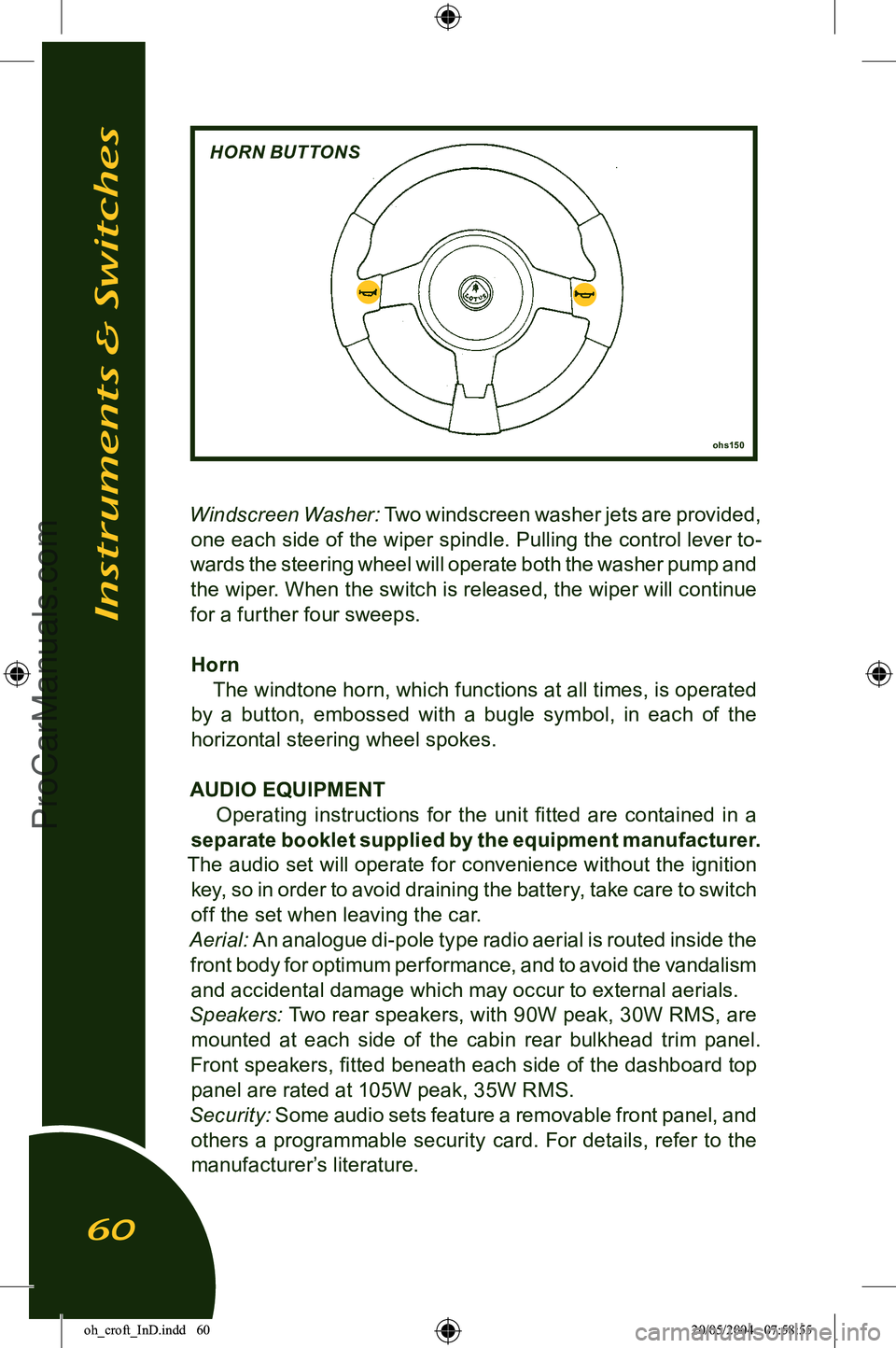
Horn The windtone horn, which functions at all times, is operated
by a button, embossed with a bugle symbol, in each of the
horizontal steering wheel spokes.
AUDIO EQUIPMENT Operating instructions for the unit fitted are contained in a
separate booklet supplied by the equipment manufacturer.
The audio set will operate for convenience without the ignition key, so in order to avoid draining the battery, take care to switch
off the set when leaving the car.
Aerial:
An analogue di-pole type radio aerial is routed inside the
front body for optimum performance, and to avoid the vandalism and accidental damage which may occur to external aerials.
Speakers:
Two rear speakers, with 90W peak, 30W RMS, are
mounted at each side of the cabin rear bulkhead trim panel.
Front speakers, fitted beneath each side of the dashboard top
panel are rated at 105W peak, 35W RMS.
Security:
Some audio sets feature a removable front panel, and
others a programmable security card. For details, refer to the
manufacturer’s literature.
Instruments & Switches
60
ohs150
HORN BUTTONS
oh_croft_InD.indd 6020/05/2004 07:58:55ProCarManuals.com
Page 80 of 205
ohs93
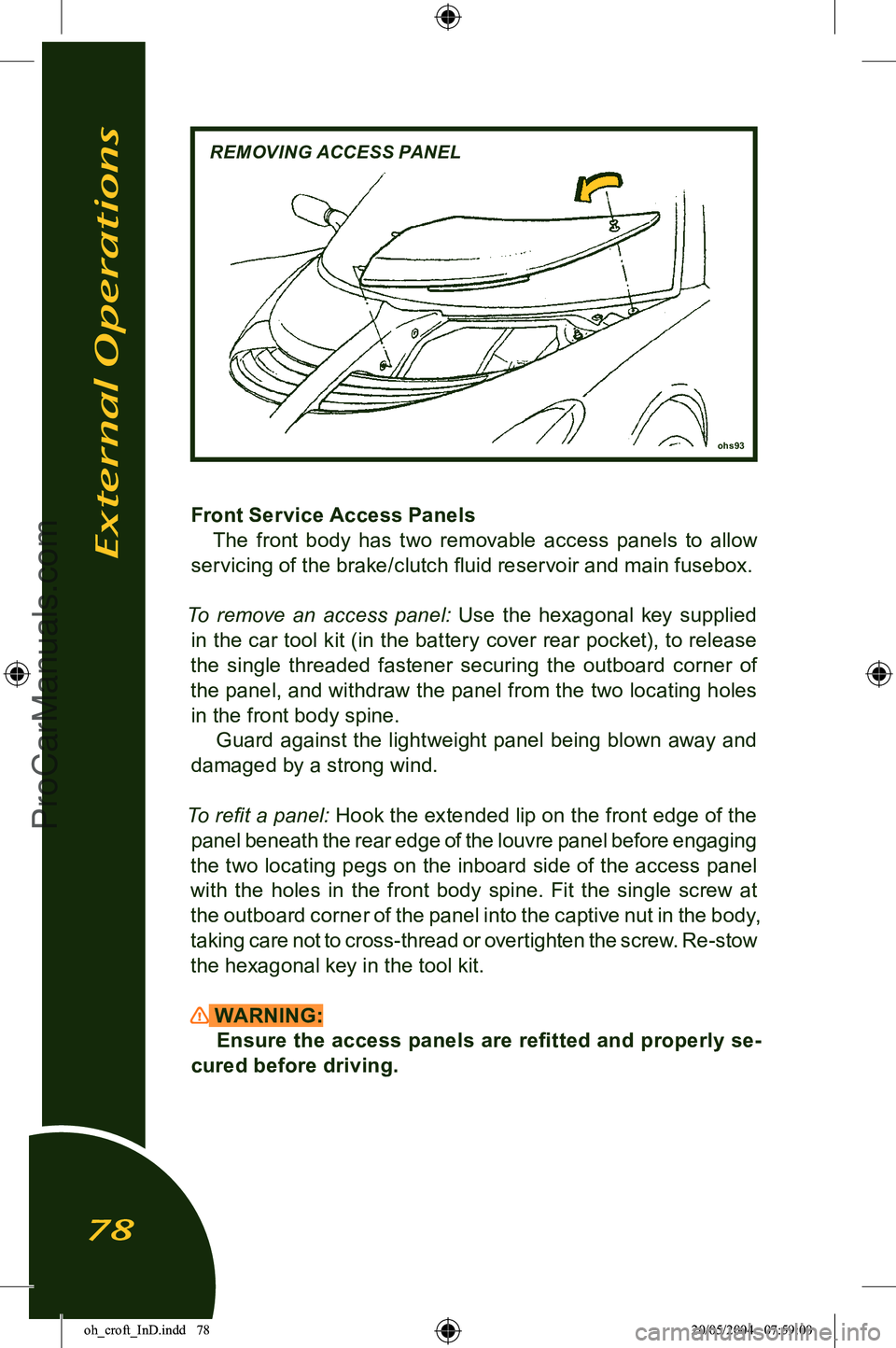
REMOVING ACCESS PANEL
Front Service Access PanelsThe front body has two removable access panels to allow
servicing of the brake/clutch fluid reservoir and main fusebox.
To remove an access panel:
Use the hexagonal key supplied
in the car tool kit (in the battery cover rear pocket), to release
the single threaded fastener securing the outboard corner of
the panel, and withdraw the panel from the two locating holes in the front body spine. Guard against the lightweight panel being blown away and
damaged by a strong wind.
To refit a panel: Hook the extended lip on the front edge of the panel beneath the rear edge of the louvre panel before engaging
the two locating pegs on the inboard side of the access panel
with the holes in the front body spine. Fit the single screw at
the outboard corner of the panel into the captive nut in the body,
taking care not to cross-thread or overtighten the screw. Re-stow
the hexagonal key in the tool kit.
WARNING: Ensure the access panels are refitted and properly se
-
cured before driving.
External Operations
78
oh_croft_InD.indd 7820/05/2004 07:59:00ProCarManuals.com
Page 87 of 205
5. Unhook the two roof stays and pack in the roof bag. Stow the
bag in the rear luggage compartment.
NOTICE: If the roof is not fully dry, it should be stowed for no longer than 1 or 2 days before unrolling or refitting and allowing
to air dry completely. Prolonged stowage of a wet or damp roof
will promote rotting of the fabric.
HARD TOP ROOF
NOTICE:
• The hard top roof has been designed to provide a seasonal,
rather than single trip option. Some owners may prefer to
entrust the fitting and removal of the hard top roof to their
dealer.
• When stowing the roof off the car, care should be taken to
avoid damage to the roof corners; e.g. use a suitable soft
floor covering on which to stand the roof. Note that there is
no provision for on-board hard top roof stowage.
• Fitment or removal of the hardtop is made considerably easier
with the assistance of a second person.
• Use only the ‘Torx’ tool supplied in the car tool kit (in the
battery cover rear pocket), to tighten or release the roof
fixing screws.
• The hardtop roof fixings are tethered to the roof panel to guard
against their loss.
WARNING:
Take care to avoid trapping hands or fingers when fitting
or removing the hard top.
External Operations
85
oh_croft_InD.indd 8520/05/2004 07:59:01ProCarManuals.com