engine oil LOTUS ELISE 2005 User Guide
[x] Cancel search | Manufacturer: LOTUS, Model Year: 2005, Model line: ELISE, Model: LOTUS ELISE 2005Pages: 205, PDF Size: 4.51 MB
Page 105 of 205
oh48e
a small amount of clean engine oil into the filter, screw onto its
spigot and tighten BY HAND sufficiently to make a secure seal,
typically 2/3 to 3/4 of a turn after the sealing faces have made
contact. Overtightening using a filter wrench may damage the
canister and/or complicate subsequent removal. Before refitting the undertray, start the engine and check for
oil leaks. Re-check the security of the filter, further tightening
by hand if necessary. Check the oil level (see above) when the
engine is fully warm.
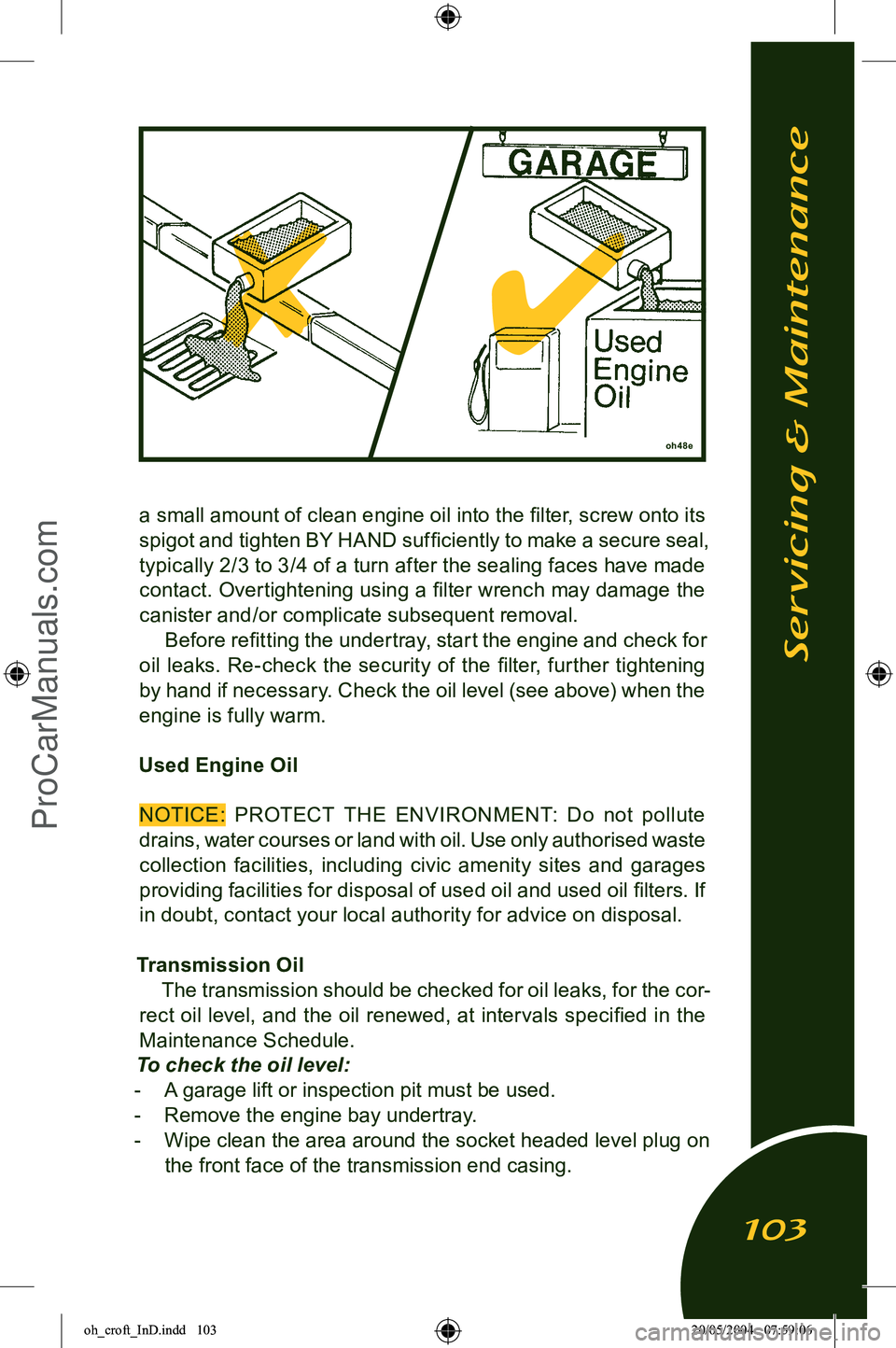
Used Engine Oil NOTICE: PROTECT THE ENVIRONMENT: Do not pollute
drains, water courses or land with oil. Use only authorised waste
collection facilities, including civic amenity sites and garages providing facilities for disposal of used oil and used oil filters. If
in doubt, contact your local authority for advice on disposal.
Transmission Oil The transmission should be checked for oil leaks, for the cor
-
rect oil level, and the oil renewed, at intervals specified in the
Maintenance Schedule.
To check the oil level:
- A garage lift or inspection pit must be used.
- Remove the engine bay undertray.
- Wipe clean the area around the socket headed level plug on
the front face of the transmission end casing.
Servicing & Maintenance
103
oh_croft_InD.indd 10320/05/2004 07:59:06ProCarManuals.com
Page 106 of 205
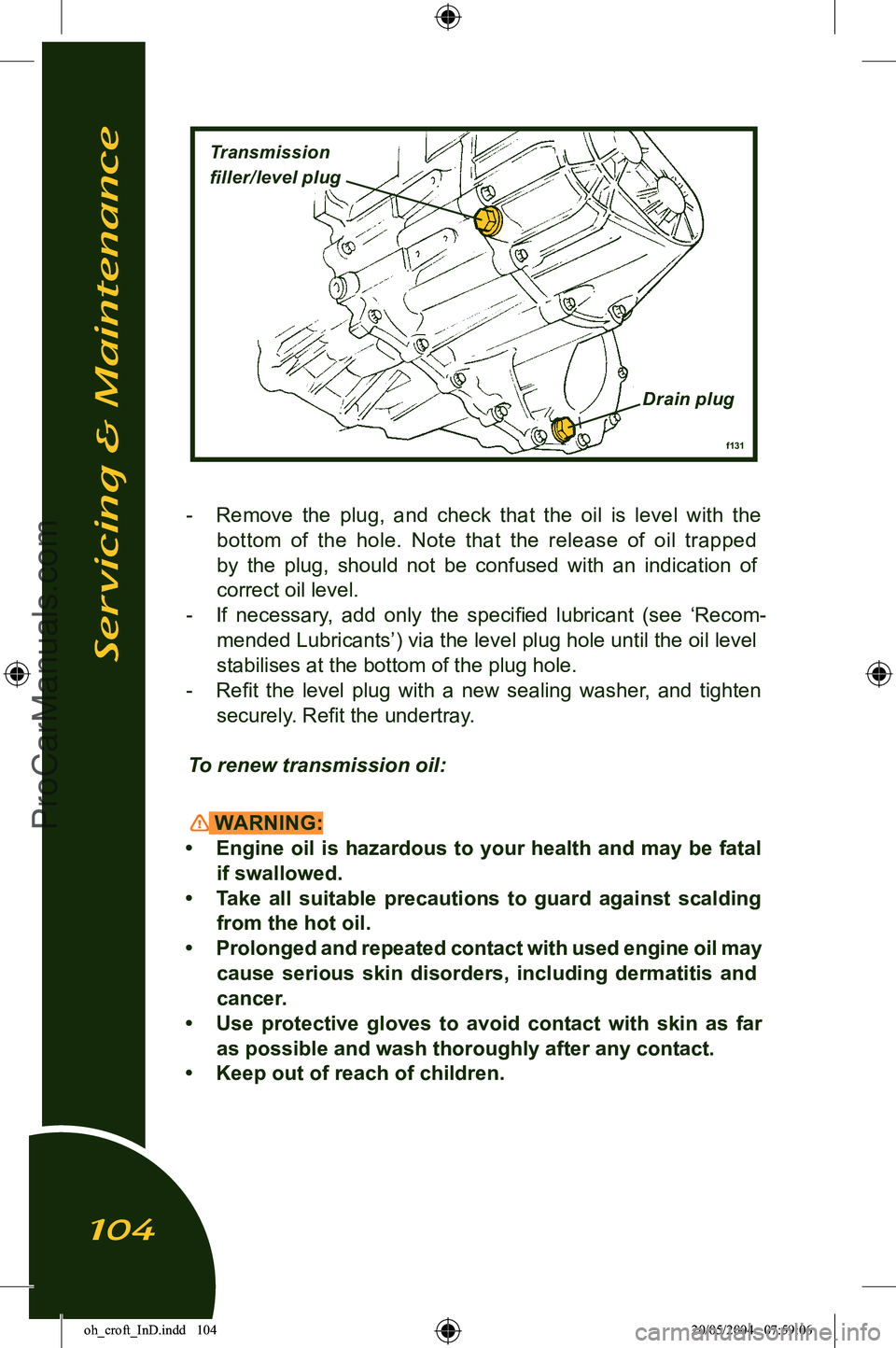
- Remove the plug, and check that the oil is level with the bottom of the hole. Note that the release of oil trapped
by the plug, should not be confused with an indication of
correct oil level.
- If necessary, add only the specified lubricant (see ‘Recom
-
mended Lubricants’) via the level plug hole until the oil level
stabilises at the bottom of the plug hole.
- Refit the level plug with a new sealing washer, and tighten securely. Refit the undertray.
To renew transmission oil:
WARNING:
• Engine oil is hazardous to your health and may be fatal
if swallowed.
• Take all suitable precautions to guard against scalding
from the hot oil.
• Prolonged and repeated contact with used engine oil may cause serious skin disorders, including dermatitis and
cancer.
• Use protective gloves to avoid contact with skin as far as possible and wash thoroughly after any contact.
• Keep out of reach of children.
Servicing & Maintenance
104
f131
Transmission
filler/level plug
Drain plug
oh_croft_InD.indd 10420/05/2004 07:59:06ProCarManuals.com
Page 108 of 205
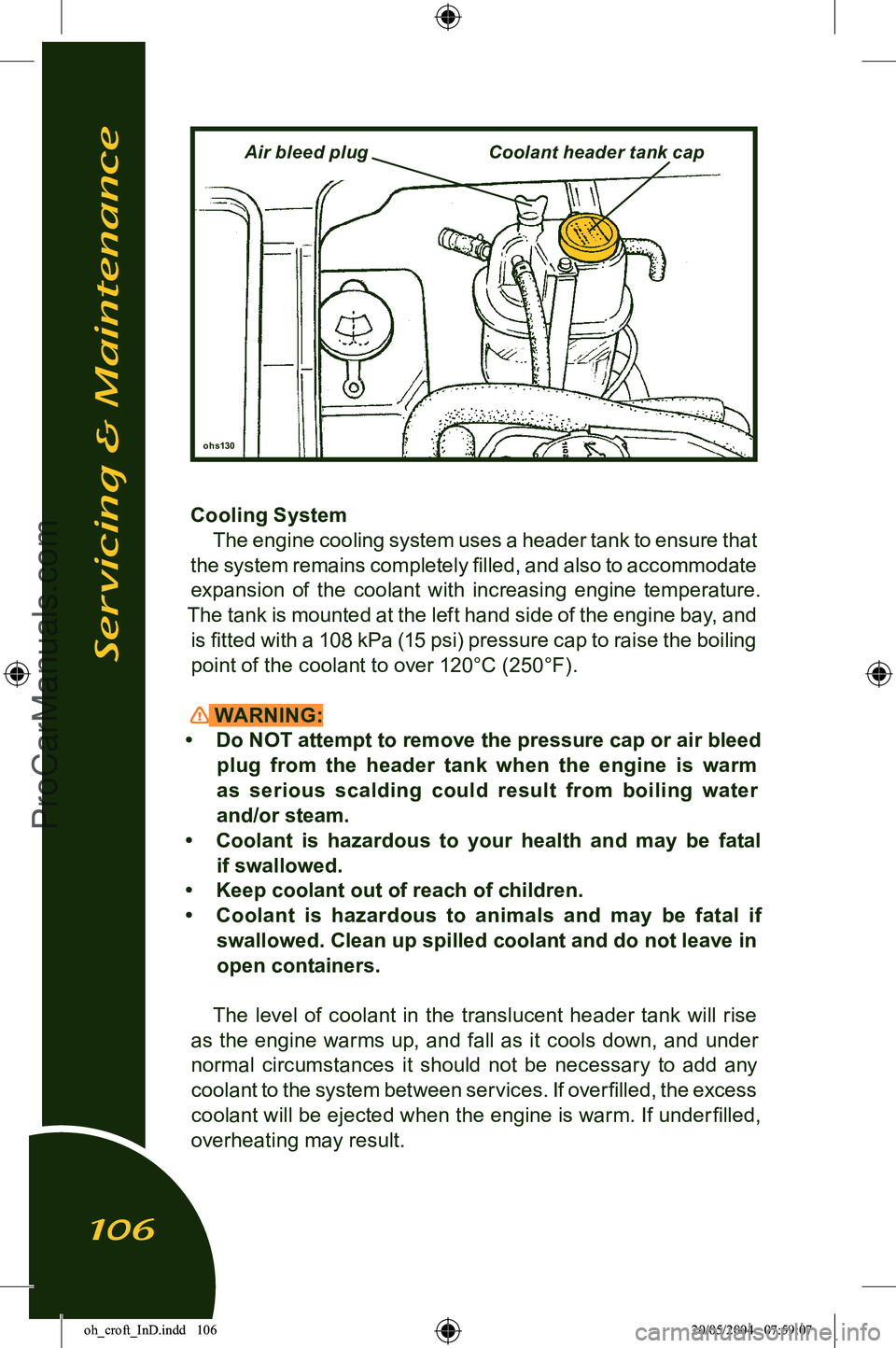
Cooling SystemThe engine cooling system uses a header tank to ensure that
the system remains completely filled, and also to accommodate
expansion of the coolant with increasing engine temperature.
The tank is mounted at the left hand side of the engine bay, and is fitted with a 108 kPa (15 psi) pressure cap to raise the boiling point of the coolant to over 120°C (250°F).
WARNING:
• Do NOT attempt to remove the pressure cap or air bleed plug from the header tank when the engine is warm
as serious scalding could result from boiling water
and/or steam.
• Coolant is hazardous to your health and may be fatal
if swallowed.
• Keep coolant out of reach of children.
• Coolant is hazardous to animals and may be fatal if
swallowed. Clean up spilled coolant and do not leave in
open containers.
The level of coolant in the translucent header tank will rise
as the engine warms up, and fall as it cools down, and under
normal circumstances it should not be necessary to add any
coolant to the system between services. If overfilled, the excess
coolant will be ejected when the engine is warm. If under filled, overheating may result.
Servicing & Maintenance
106
ohs130
Air bleed plugCoolant header tank cap
oh_croft_InD.indd 10620/05/2004 07:59:07ProCarManuals.com
Page 109 of 205
As a precaution, every week when the engine is completely
COLD, and without disturbing the filler cap, check that the level of coolant in the translucent tank is between the ‘FULL’
and ‘LOW’ marks moulded on the front of the tank. If topping
up is required, wait until the coolant has fully cooled before
turning the cap a quarter turn counterclockwise and allowing any remaining pressure to escape. Only then may the cap be
completely unscrewed. In order to maintain protection from freezing damage and
metal corrosion, use only an approved coolant mixture (see below) to top up the tank to the ‘FULL’ mark. Refit the cap, and
turn clockwise until the leg on the cap locates in the slot at the
front of the tank.
NOTICE: If the cap is removed when the engine is warm, the coolant may boil and a small coolant loss may occur. The com
-
pletely cold header tank level should be checked at the first subsequent opportunity.
Cooling Fans
: Two cooling fans are fitted below the radiator in
the air intake duct. The fans are energised at high coolant tem
-
peratures, or when the air conditioning (if fitted) is selected. The
fans will also run if certain types of engine fault are detected, and
may operate during a 20 minute period following ignition switch off to prevent ‘hot soak’ boiling. An electric coolant circulation pump may also be heard running during this period.
WARNING: Keep hands, tools and clothing away from the radiator
cooling fan area, as personal injury could result from the
fans starting up without warning.
At service intervals, the air duct and matrices of the engine
cooling radiator, a.c. condenser and oil coolers, should be
checked externally for clogging by insects, leaves or other debris,
and if necessary, a water jet used to clear the finning. Take care not to damage or distort the delicate finning of the radiator or
the cooling performance will be degraded.
Anti-Freeze/Corrosion Inhibitor It is most important that the correct coolant specification is
used in order to inhibit boiling and protect the engine and heat
Servicing & Maintenance
107
oh_croft_InD.indd 10720/05/2004 07:59:07ProCarManuals.com
Page 116 of 205
Auxiliary Drive BeltA single, multi-rib type auxiliary belt is used to transmit drive
from the crankshaft to the alternator, water pump, and (if fitted)
air conditioning compressor. The belt is automatically tensioned,
and requires no periodic maintenance other than a visual check of its condition. If the belt exhibits any evidence of physical dam
-
age, cracking, fraying, perishing, abrasion or contamination, it
should be renewed. In the case of contamination, the cause
must be identified and rectified, and each of the pulleys must be thoroughly degreased before the new belt is fitted. It is recommended that auxiliary belt replacement be en
-
trusted to your Lotus dealer.
Sparking Plugs The Elise uses a direct ignition system with an individual
high tension coil mounted atop each of the four spark plugs and protected by a plastic cover, screw fixed to the engine.
WARNING: The voltages produced with this ignition system can
cause serious and potentially fatal injur y. Never touch
any ignition components when the engine is running or being cranked.
The spark plugs should be renewed in accordance with the
Maintenance Schedule, with the gaps set to 0.043 in. (1.1 mm).
This operation should be entrusted to your Lotus dealer.
Servicing & Maintenance
114
oh_croft_InD.indd 11420/05/2004 07:59:09ProCarManuals.com
Page 139 of 205
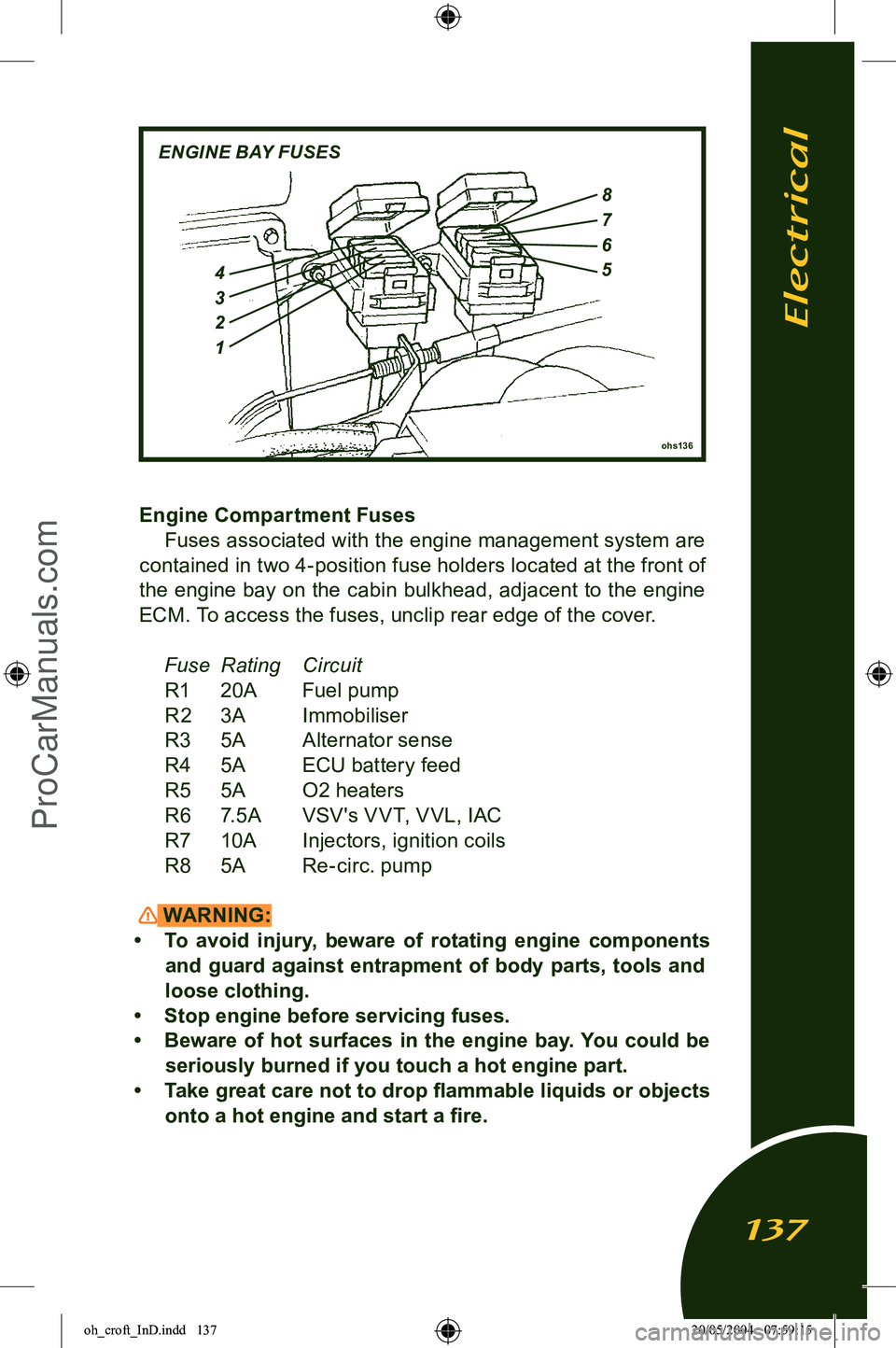
Engine Compartment FusesFuses associated with the engine management system are
contained in two 4-position fuse holders located at the front of
the engine bay on the cabin bulkhead, adjacent to the engine ECM. To access the fuses, unclip rear edge of the cover.
Fuse Rating CircuitR1 20A Fuel pump
R2 3A Immobiliser
R3 5A Alternator sense
R4 5A ECU battery feed
R5 5A O2 heaters
R6 7.5A VSV's V VT, V VL, IAC
R7 10A Injectors, ignition coils
R8 5A Re-circ. pump
WARNING:
• To avoid injury, beware of rotating engine components and guard against entrapment of body parts, tools and
loose clothing.
• Stop engine before servicing fuses.
• Beware of hot surfaces in the engine bay. You could be seriously burned if you touch a hot engine part.
• Take great care not to drop flammable liquids or objects onto a hot engine and start a fire.
ohs136
ENGINE BAY FUSES
4
3
2
1
8
7
6
5
Electrical
137
oh_croft_InD.indd 13720/05/2004 07:59:15ProCarManuals.com
Page 154 of 205
Storing Your EliseIf you intend to store your Elise for a prolonged period, con
-
sult your Lotus dealer who will be pleased to advise you. We recommend that the car is stored inside a secure garage. The
following guidelines are provided for your information:
• Ensure the engine oil and filter, coolant and brake fluid have recently been renewed. The a.c. system should be in good
working order and fully charged.
• Thoroughly clean the inside and outside of the car, including the engine compartment. If necessary, use a ‘jet’ washer to remove dirt and salt deposits from the underside, but do not
use around bearings, hydraulic components, painted surfaces or the soft top roof. Allow to dry completely.
• Chock the road wheels, leave off the parking brake, and engage reverse gear.
• Increase the tire pressures to 60 psi (4 bar). If possible, move the car slightly every month to help avoid flat spots on the
Tires.
• Either leave the battery in the car and connect a battery management (conditioner) type of charger, or remove the battery and trickle charge every two months. Note that with
the battery disconnected or removed, the alarm system is
de-activated.
• Unless the garage is equipped with a de-humidifier, the use of drying agents (Silica-Gel) is recommended in cars with
leather upholstery and in conditions of high humidity.
• The use of unapproved car covers may have a detrimental effect on the car’s paint finish and such damage will not be
covered by your car’s warranty.
In general, the Elise will be kept in best operating condition
by regular use.
Accessories
152
oh_croft_InD.indd 15220/05/2004 07:59:19ProCarManuals.com
Page 155 of 205
RECOMMENDED LUBRICANTS
EngineIn order to enhance the longevity and reliability of the car, it
is most important that only the specified lubricants are used. It
is an entirely false economy to try to save money by using lower quality oils, which may break down before the next change in
-
terval and provide inadequate protection before the end of the
term. High oil consumption may also result.
For topping up purposes during the running-in period prior to
the First After Sales Service, a top quality mineral or semi-syn
-
thetic 5W/40 oil should be used. At the First After Sales Service and completion of the running-in period, a fully synthetic 5W/40
oil such as Texaco Havoline Synthetic should be used. This oil
has been tested in all climatic conditions likely to be encountered,
and offers advantages in ease of cranking, smooth cold running
and fuel economy at low temperatures, in combination with good
wear protection at elevated temperatures and at high engine speeds. If Texaco/Havoline products are not available, an oil meeting the following specification should be used.
NOTICE: Note that Lotus does not recommend the use of any oil additives and use of such additives may invalidate the terms
of your car’s warranty.
Viscosity: 5W/40
Quality Standard: API SJEC; ILSAC; ACEA A3
Capacity - refill inc. filter 4.4 litre
(Cars fitted with front mounted oil coolers contain an additional
3.5 litres, but this oil is not drained during routine servicing) Difference between high & low dipstick marks
1.5 litre
Oil change interval Refer to Maintenance Schedule
‘Severe Service’ Conditions Certain operating conditions can cause rapid degradation of
the oil quality, either by the accumulation of dirt particles, or by
the absorption of water from condensation. If any of the ‘severe
service’ conditions described below apply, it is recommended
that the oil and filter be changed twice as frequently as is listed in the Maintenance Schedule.
Recommended Lubricants
153
oh_croft_InD.indd 15320/05/2004 07:59:19ProCarManuals.com
Page 156 of 205
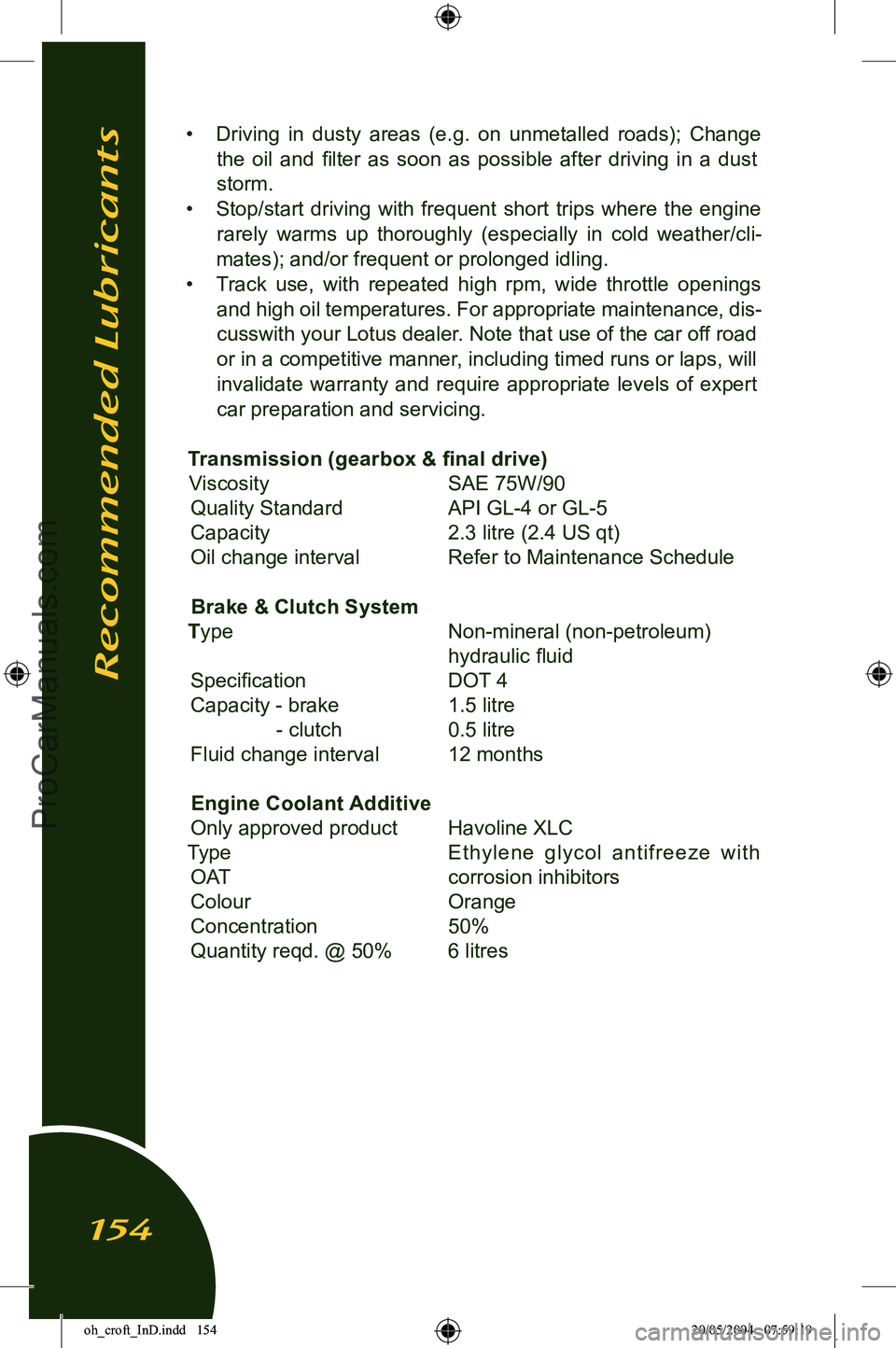
• Driving in dusty areas (e.g. on unmetalled roads); Change
the oil and filter as soon as possible after driving in a dust
storm.
• Stop/start driving with frequent short trips where the engine
rarely warms up thoroughly (especially in cold weather/cli
-
mates); and/or frequent or prolonged idling.
• Track use, with repeated high rpm, wide throttle openings
and high oil temperatures. For appropriate maintenance, dis
-
cusswith your Lotus dealer. Note that use of the car off road or in a competitive manner, including timed runs or laps, will
invalidate warranty and require appropriate levels of expert
car preparation and servicing.
Transmission (gearbox & final drive) Viscosity SAE 75W/90
Quality Standard API GL-4 or GL-5
Capacity 2.3 litre (2.4 US qt)
Oil change interval Refer to Maintenance Schedule
Brake & Clutch System
Type Non-mineral (non-petroleum)
hydraulic fluid
Specification DOT 4
Capacity - brake 1.5 litre
- clutch 0.5 litre
Fluid change interval 12 months
Engine Coolant Additive
Only approved product Havoline XLC
Type Ethylene glycol antifreeze with
OAT corrosion inhibitors
Colour Orange
Concentration 50%
Quantity reqd. @ 50% 6 litres
Recommended Lubricants
154
oh_croft_InD.indd 15420/05/2004 07:59:19ProCarManuals.com
Page 158 of 205
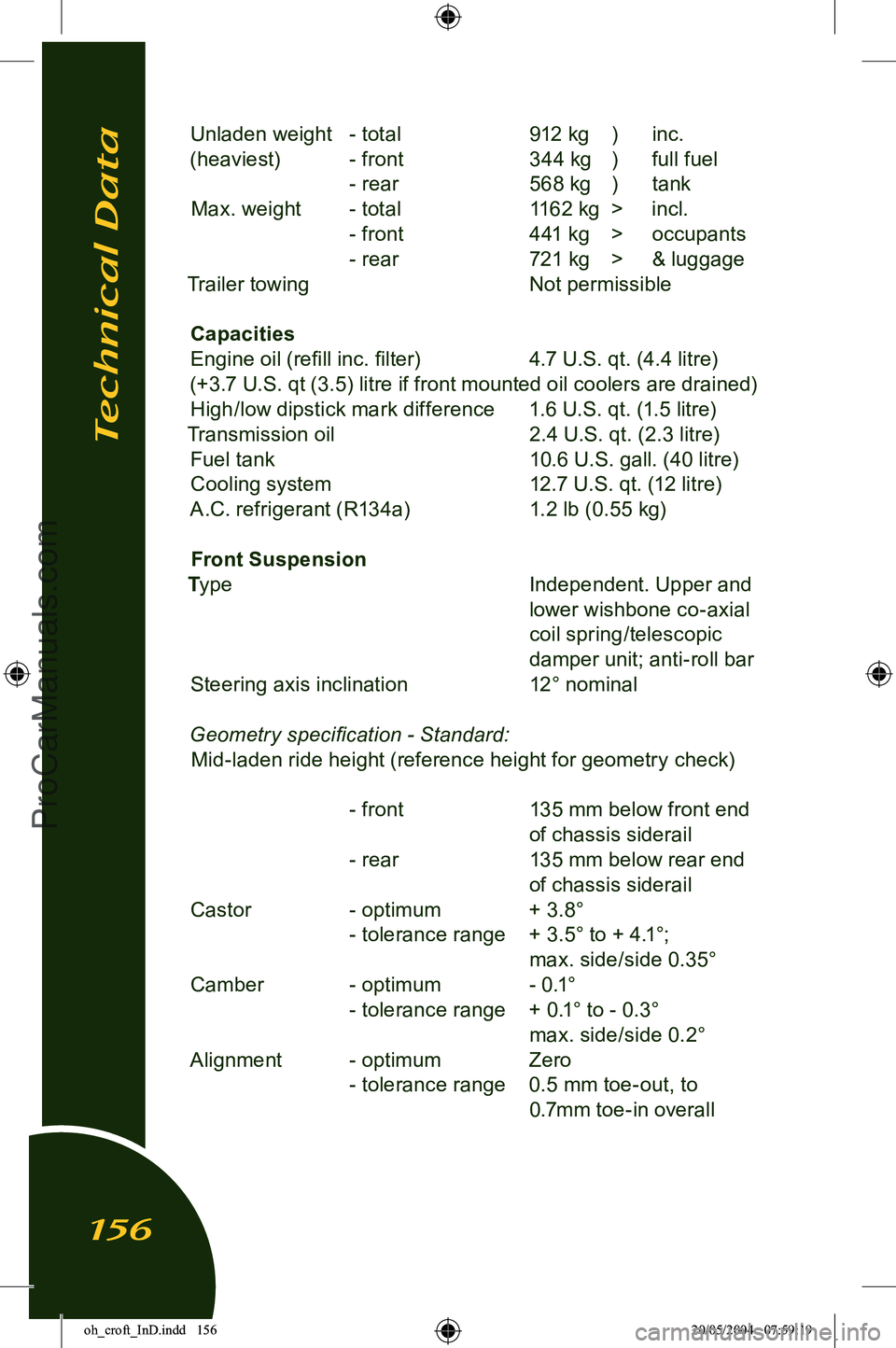
Unladen weight - total 912 kg ) inc.
(heaviest) - front 344 kg ) full fuel
- rear 568 kg ) tank
Max. weight - total 1162 kg > incl.
- front 441 kg > occupants
- rear 721 kg > & luggage
Trailer towing Not permissible
Capacities Engine oil (refill inc. filter) 4.7 U.S. qt. (4.4 litre)
(+3.7 U.S. qt (3.5) litre if front mounted oil coolers are drained) High/low dipstick mark difference 1.6 U.S. qt. (1.5 litre)
Transmission oil 2.4 U.S. qt. (2.3 litre)
Fuel tank 10.6 U.S. gall. (40 litre)
Cooling system 12.7 U.S. qt. (12 litre)
A.C. refrigerant (R134a) 1.2 lb (0.55 kg)
Front Suspension
T ype Independent. Upper and
lower wishbone co-axial
coil spring/telescopic
damper unit; anti-roll bar
Steering axis inclination 12° nominal
Geometry specification - Standard: Mid-laden ride height (reference height for geometry check)
- front 135 mm below front end
of chassis siderail
- rear 135 mm below rear end
of chassis siderail
Castor - optimum + 3.8°
- tolerance range + 3.5° to + 4.1°;
max. side/side 0.35°
Camber - optimum - 0.1°
- tolerance range + 0.1° to - 0.3°
max. side/side 0.2°
Alignment - optimum Zero - tolerance range 0.5 mm toe-out, to
0.7mm toe-in overall
Technical Data
156
oh_croft_InD.indd 15620/05/2004 07:59:19ProCarManuals.com