service LOTUS ELISE 2005 User Guide
[x] Cancel search | Manufacturer: LOTUS, Model Year: 2005, Model line: ELISE, Model: LOTUS ELISE 2005Pages: 205, PDF Size: 4.51 MB
Page 112 of 205
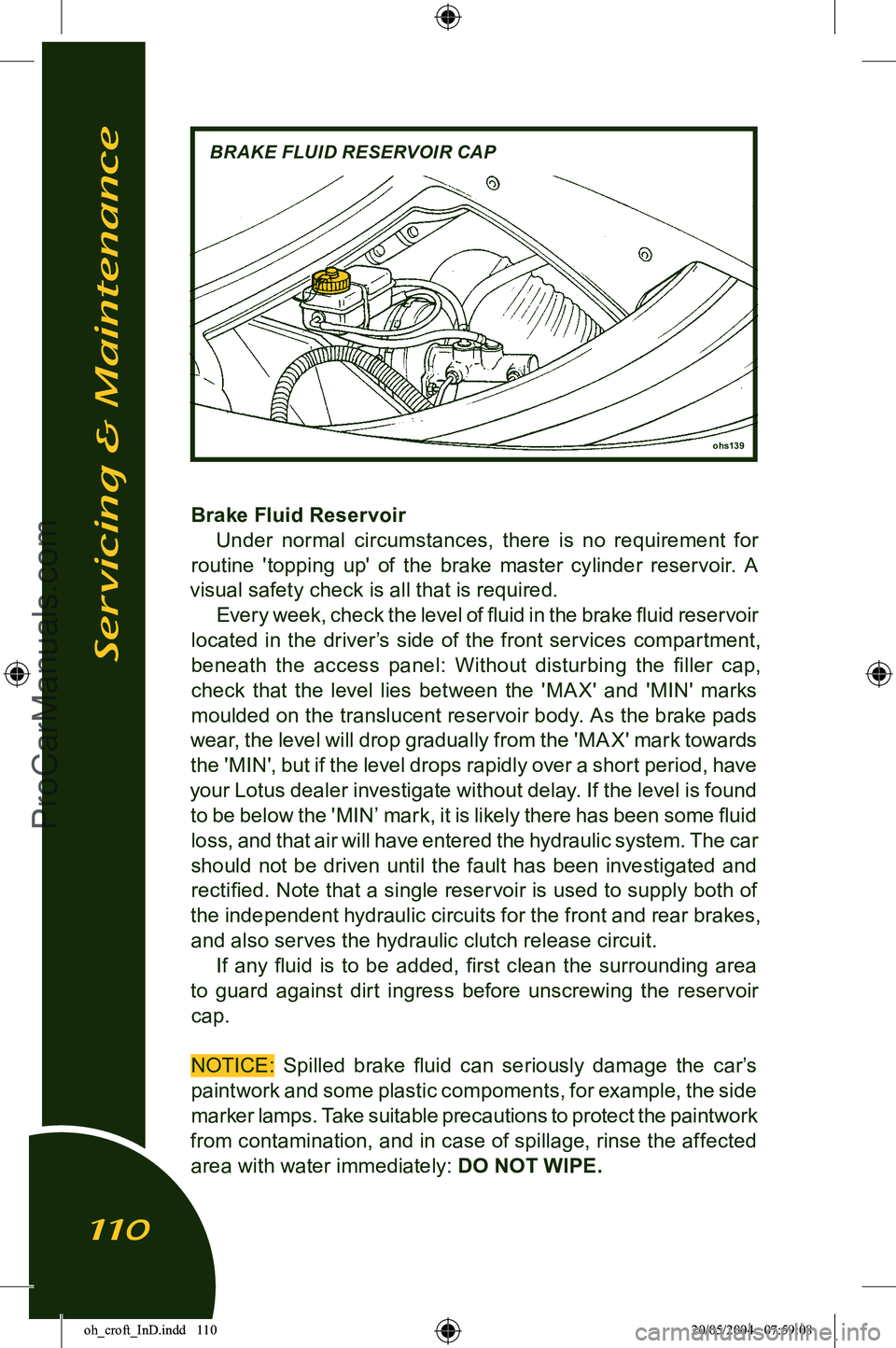
Brake Fluid ReservoirUnder normal circumstances, there is no requirement for
routine 'topping up' of the brake master cylinder reservoir. A
visual safety check is all that is required. Every week, check the level of fluid in the brake fluid reservoir
located in the driver’s side of the front services compartment, beneath the access panel: Without disturbing the filler cap,
check that the level lies between the 'MA X' and 'MIN' marks moulded on the translucent reservoir body. As the brake pads
wear, the level will drop gradually from the 'MA X' mark towards the 'MIN', but if the level drops rapidly over a short period, have
your Lotus dealer investigate without delay. If the level is found
to be below the 'MIN’ mark, it is likely there has been some fluid loss, and that air will have entered the hydraulic system. The car
should not be driven until the fault has been investigated and rectified. Note that a single reservoir is used to supply both of
the independent hydraulic circuits for the front and rear brakes, and also serves the hydraulic clutch release circuit. If any fluid is to be added, first clean the surrounding area
to guard against dirt ingress before unscrewing the reservoir cap.
NOTICE: Spilled brake fluid can seriously damage the car’s paintwork and some plastic compoments, for example, the side
marker lamps. Take suitable precautions to protect the paintwork
from contamination, and in case of spillage, rinse the affected area with water immediately: DO NOT WIPE.
ohs139
BRAKE FLUID RESERVOIR CAP
Servicing & Maintenance
110
oh_croft_InD.indd 11020/05/2004 07:59:08ProCarManuals.com
Page 113 of 205
Use only a non-mineral type DOT 4 brake fluid from a sealed
container marked with a yellow and black (non-mineral) symbol.
Do not use DOT 5 silicone fluid, or any fluid which has been
exposed to the atmosphere for more than a brief period, or
any fluid suspected of being wet, dirty or contaminated. Do not over fill, and replace the cap securely. Brake fluid, being hygroscopic, absorbs water from the atmos
-
phere over a period of time, resulting in a lowering of the boiling
point of the fluid, and corrosion of the hydraulic system. For
optimum safety and brake performance, the brake fluid should be renewed every twelve months by your Lotus Dealer.
WARNING:
• Brake fluid is hazardous to health and may be fatal if swallowed. Keep out of children’s reach.
• Using the wrong type of brake fluid can damage brake system components and result in brake failure causing a
crash in which you and others could be killed or seriously
injured. See ‘Recommended Lubricants’.
Brake Pads The thickness of the brake pad lining material should be
checked at every service, and under no circumstances be al
-
lowed to fall below 0.1 inch (2.5 mm). If the brakes are in very frequent or arduous use, as when driving in mountainous terrain,
or on race circuits, it is recommended that they be examined
more frequently. The pads should be renewed if of insufficient
thickness to ensure safe braking until the next scheduled service.
Note that in order to ensure that brake pads with the correct
material specification are used, only genuine Lotus replacement parts should be fitted, and in the interests of safety, pad renewal
should be entrusted to your Lotus dealer.
WARNING: Using incorrect brake pads, or pads below 0.1 inch
(2.5mm) thickness, may cause a crash in which you or
others could be killed or seriously injured. With a new car, or new brake system components, maxi
-
mum braking efficiency will be achieved if, for the first few
hundred miles, needless heavy braking is avoided, and the
brake pads and discs are allowed to ‘bed in’ fully before
being used to their full potential (see also ‘Footbrake’).
Servicing & Maintenance
111
oh_croft_InD.indd 11120/05/2004 07:59:08ProCarManuals.com
Page 114 of 205

Brake Pipes & HosesAt the recommended service intervals, the brake pipes and
flexible hoses should be carefully examined for signs of dam
-
age, corrosion or perishing, especially in territories where salt is used on the road surface in the winter months.
Servicing & Maintenance
112
oh_croft_InD.indd 11220/05/2004 07:59:08ProCarManuals.com
Page 118 of 205
NOTICE:
• On cars used on a race track or in a competitive manner,
special vigilance is required due to the severity of tire operating conditions, with careful inspections carried
out between sessions.
• Take care when parking to avoid tire contact with high
or sharp edged kerbs. Such mistreatment can cause
internal damage to the tire structure and this may not be readily apparent. The wheel rims may also be distorted or damaged by careless parking, and result in wheel
imbalance or loss of tire pressure. Similar damage may also be caused by potholes, rocks or other highway
debris.
WARNING:
• Damage to wheels and tires may cause an accident in which you or others may be killed or seriously
injured. If the wheels or tires have been damaged,
have them replaced.
• Safety considerations should always be paramount when assessing tire condition and serviceability, and the tires replaced if any doubt exists, or if the
legal tread depth limits are approached.
• Poorly maintained and improperly used tires are dangerous.
• Overloading your tires can cause overheating as a result of too much friction. You could have a blow
out and a serious accident in which you could be killed or seriously injured. See ‘Tire Placard La
-
bel’.
• Underinflated tires pose the same danger as over loaded tires. The resulting accident could cause serious injury, or death. Check all tires frequently
and maintain at the recommended pressure. Tire
pressures should be checked only when the tires
are cold.
• Overinflated tires are more likely to be cut, punc- tured or broken by a sudden impact - such as hitting a pothole. Keep tires at the recommended pressure.
• Installing improper tires on your car can affect handling and stability. This can cause a crash
in which you can be killed or seriously injured.
Tires & Wheels
116
oh_croft_InD.indd 11620/05/2004 07:59:09ProCarManuals.com
Page 122 of 205
ding.
Tire Chains In extreme weather conditions, Lotus approves the fit
-
ment of Pewag Neon X3 - NX373 snow chains, used only in conjunction with winter Tires (see above) and fitted only on the rear wheels. Close attention should be paid
to the fitting and tensioning instructions supplied with the chains, and the chains should be removed as soon as
road conditions allow.
Uniform Tire Quality Grading Quality grades can be found where applicable on the
tire sidewall between tread shoulder and maximum section
width. For example:
Treadwear 200 Traction AA Temperature A
The following information relates to the system de
-
veloped by the United States National Highway Traffic
Safety Administration, which grades Tires by treadwear, traction and temperature performance (This applies only
to cars sold in the United States). The grades are moulded on the sidewalls of most
passenger car Tires. The Uniform Tire Quality Grading system does not apply to deep tread, winter-type snow
Tires, space-saver or temporary use spare Tires, Tires with nominal rim diameters of 10 to 12 inches (25 to 30 cm), or to some limited-production Tires. While the Tires available on Lotus cars may vary with
respect to these grades, they must also conform to federal safety requirements.
Treadwear The treadwear grade is a comparative rating based
on the wear rate of the tire when tested under controlled
conditions on a specified government test course. For example, a tire graded 150 would wear one and a half
(1.5) times as well on the government course as a tire graded 100. The relative performance of Tires depends
upon the actual conditions of their use, however, and may depart significantly from the norm due to variations in
driving habits, service practices, and differences in road
Tires & Wheels
120
oh_croft_InD.indd 12020/05/2004 07:59:10ProCarManuals.com
Page 134 of 205
charged. If, in an emergency, the car has to be ‘jump’ started,
the subsequent conditions of car use may not allow for sufficient alternator charging of the battery to achieve a fully charged
state. The battery should be trickle charged until 12.8 volts is recorded, which process may take 24 hours or longer. Putting
the battery into service at a lower state of charge will reduce
the time period for which the car can be parked. A battery left
in a fully discharged state for a prolonged period, may not be recoverable to its original condition.
WARNING:
• Hydrogen gas generated by the battery could cause an explosion, resulting in severe personal injuries.
• Charge battery in a well ventilated area.
• Never charge a frozen battery. It may explode because of gas trapped in the ice. Allow a frozen battery to thaw
out first.
• If you get electrolyte, which is an acid, in your eyes or on your skin, immediately rinse with cold water for several minutes and call a doctor.
Unless you are using an automatic batter y management
conditioner, the battery should be removed from the car for
recharging, to a well ventilated area to avoid a build up of fumes
in the luggage compartment and to prevent damage to the car's
electrical system. Observe the safety precautions listed above
when removing the battery and take care to avoid sharp knocks
or shocks, keeping the battery as upright as possible. Beware
of the considerable weight of a battery, and take necessary precautions against personal injury. Check that the electrolyte level is between the upper and
lower markers on the battery case, and if necessary add dis
-
tilled water. The recommended bench charge rate is 4 amps.
When the battery is fully charged (12.8 volts), allow the battery
to stand for an hour before refitting to the car and reconnecting
the leads - see above.
Electrical
132
oh_croft_InD.indd 13220/05/2004 07:59:13ProCarManuals.com
Page 137 of 205
WARNING:Inexper t modifications or additions to the electrical
system could jeopardise safety.
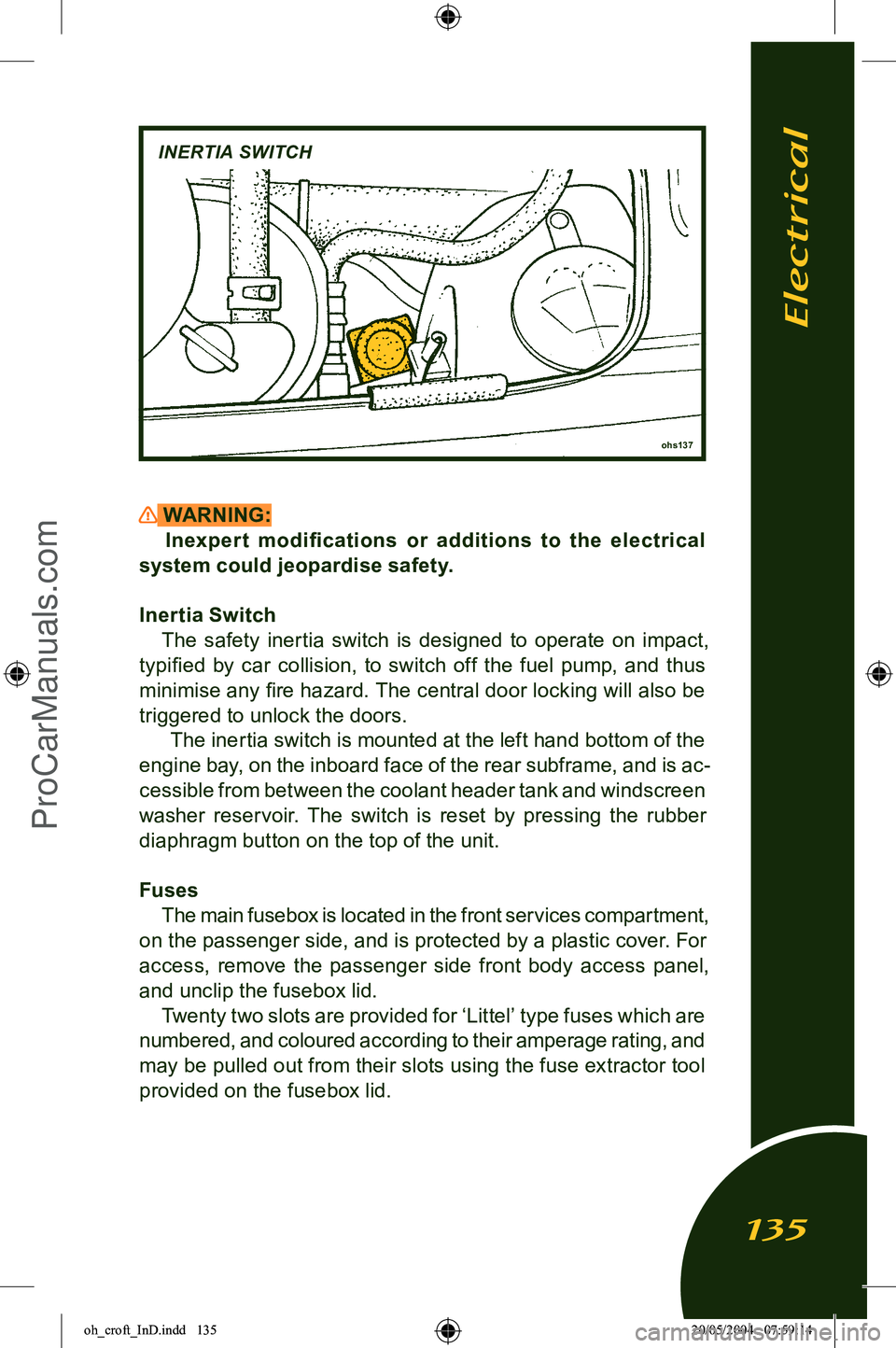
Inertia Switch The safety inertia switch is designed to operate on impact,
typified by car collision, to switch off the fuel pump, and thus
minimise any fire hazard. The central door locking will also be
triggered to unlock the doors. The inertia switch is mounted at the left hand bottom of the
engine bay, on the inboard face of the rear subframe, and is ac
-
cessible from between the coolant header tank and windscreen
washer reservoir. The switch is reset by pressing the rubber
diaphragm button on the top of the unit.
Fuses The main fusebox is located in the front services compartment,
on the passenger side, and is protected by a plastic cover. For
access, remove the passenger side front body access panel,
and unclip the fusebox lid. Twenty two slots are provided for ‘Littel’ type fuses which are
numbered, and coloured according to their amperage rating, and
may be pulled out from their slots using the fuse extractor tool provided on the fusebox lid.
ohs137
INERTIA SWITCH
Electrical
135
oh_croft_InD.indd 13520/05/2004 07:59:14ProCarManuals.com
Page 138 of 205
WARNING:Replacing a fuse with one which has a higher rating may
cause extensive damage to the electrical system and pos
-
sibly cause a fire. If a fuse of the correct rating is not avail
-
able, use one of a lower rating as a temporary measure.
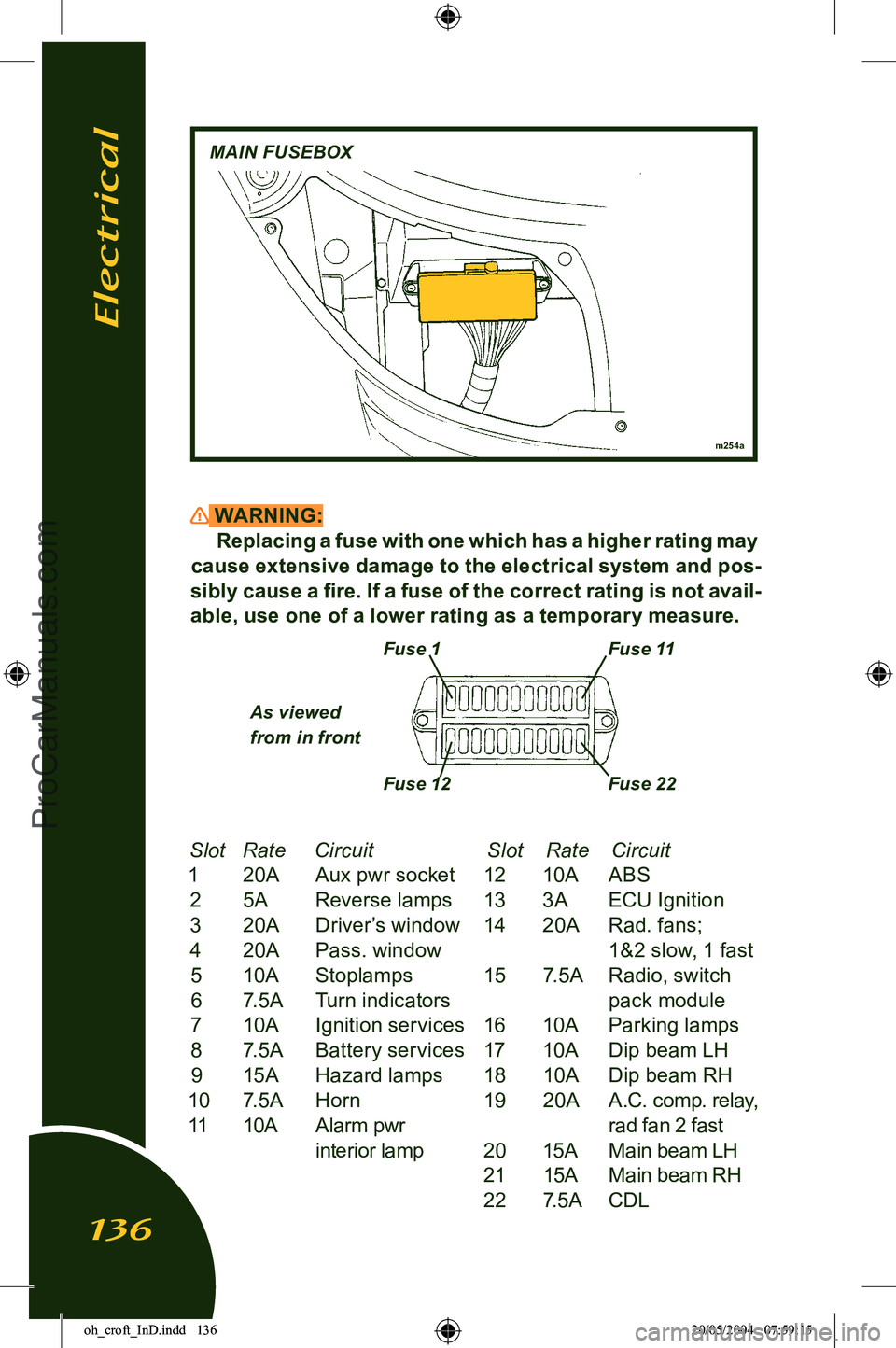
Slot
Rate Circuit Slot Rate Circuit
1 20A Aux pwr socket 12 10A ABS 2 5A Reverse lamps 13 3A ECU Ignition
3 20A Driver’s window 14 20A Rad. fans;
4 20A Pass. window 1&2 slow, 1 fast 5 10A Stoplamps 15 7.5A Radio, switch6 7.5A Turn indicators pack module
7 10A Ignition services 16 10A Parking lamps
8 7.5A Battery services 17 10A Dip beam LH9 15A Hazard lamps 18 10A Dip beam RH
10 7.5A Horn 19 20A A.C. comp. relay,
11 10A Alarm pwr rad fan 2 fast interior lamp 20 15A Main beam LH
21 15A Main beam RH
22 7.5A CDL
m254a
MAIN FUSEBOX
Fuse 1Fuse 11
Fuse 12 Fuse 22
As viewed
from in front
Electrical
136
oh_croft_InD.indd 13620/05/2004 07:59:15ProCarManuals.com
Page 155 of 205
RECOMMENDED LUBRICANTS
EngineIn order to enhance the longevity and reliability of the car, it
is most important that only the specified lubricants are used. It
is an entirely false economy to try to save money by using lower quality oils, which may break down before the next change in
-
terval and provide inadequate protection before the end of the
term. High oil consumption may also result.
For topping up purposes during the running-in period prior to
the First After Sales Service, a top quality mineral or semi-syn
-
thetic 5W/40 oil should be used. At the First After Sales Service and completion of the running-in period, a fully synthetic 5W/40
oil such as Texaco Havoline Synthetic should be used. This oil
has been tested in all climatic conditions likely to be encountered,
and offers advantages in ease of cranking, smooth cold running
and fuel economy at low temperatures, in combination with good
wear protection at elevated temperatures and at high engine speeds. If Texaco/Havoline products are not available, an oil meeting the following specification should be used.
NOTICE: Note that Lotus does not recommend the use of any oil additives and use of such additives may invalidate the terms
of your car’s warranty.
Viscosity: 5W/40
Quality Standard: API SJEC; ILSAC; ACEA A3
Capacity - refill inc. filter 4.4 litre
(Cars fitted with front mounted oil coolers contain an additional
3.5 litres, but this oil is not drained during routine servicing) Difference between high & low dipstick marks
1.5 litre
Oil change interval Refer to Maintenance Schedule
‘Severe Service’ Conditions Certain operating conditions can cause rapid degradation of
the oil quality, either by the accumulation of dirt particles, or by
the absorption of water from condensation. If any of the ‘severe
service’ conditions described below apply, it is recommended
that the oil and filter be changed twice as frequently as is listed in the Maintenance Schedule.
Recommended Lubricants
153
oh_croft_InD.indd 15320/05/2004 07:59:19ProCarManuals.com
Page 160 of 205
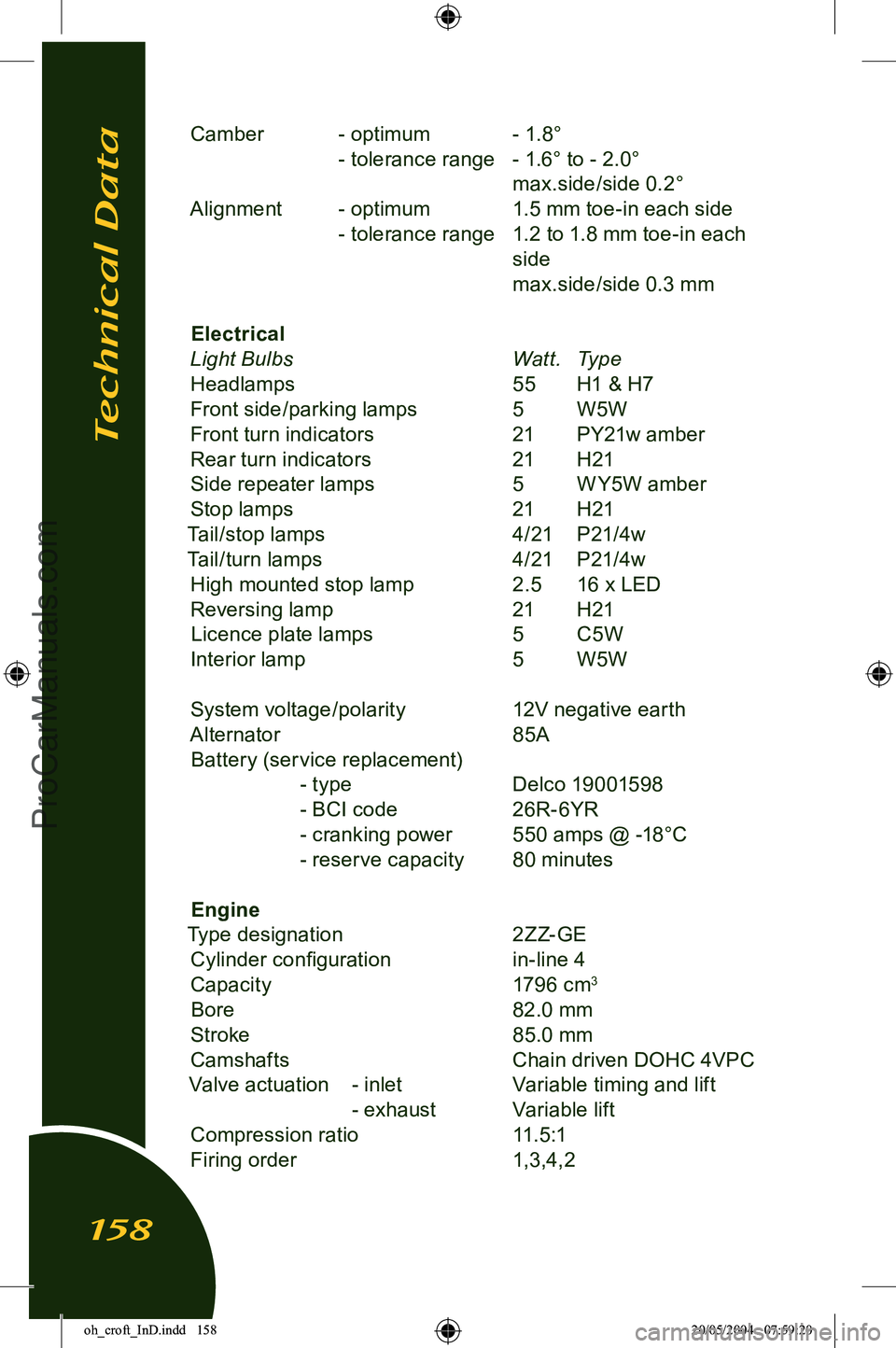
Camber - optimum - 1.8°
- tolerance range - 1.6° to - 2.0°
max.side/side 0.2°
Alignment - optimum 1.5 mm toe-in each side - tolerance range 1.2 to 1.8 mm toe-in each
side
max.side/side 0.3 mm
Electrical
Light Bulbs Watt. Type
Headlamps 55 H1 & H7
Front side/parking lamps 5 W5W
Front turn indicators 21 PY21w amber
Rear turn indicators 21 H21
Side repeater lamps 5 W Y5W amber
Stop lamps 21 H21
Tail/stop lamps 4/21 P21/4w
Tail/turn lamps 4/21 P21/4w
High mounted stop lamp 2.5 16 x LED
Reversing lamp 21 H21
Licence plate lamps 5 C5W
Interior lamp 5 W5W
System voltage/polarity 12V negative earth
Alternator 85A
Battery (service replacement)
- type Delco 19001598
- BCI code 26R- 6YR
- cranking power 550 amps @ -18°C
- reserve capacity 80 minutes
Engine
Type designation 2ZZ-GE
Cylinder configuration in-line 4
Capacity 1796 cm
3
Bore 82.0 mm
Stroke 85.0 mm
Camshafts Chain driven DOHC 4VPC
Valve actuation - inlet Variable timing and lift
- exhaust Variable lift
Compression ratio 11.5:1
Firing order 1,3,4,2
Technical Data
158
oh_croft_InD.indd 15820/05/2004 07:59:20ProCarManuals.com