weight LOTUS ELISE 2005 User Guide
[x] Cancel search | Manufacturer: LOTUS, Model Year: 2005, Model line: ELISE, Model: LOTUS ELISE 2005Pages: 205, PDF Size: 4.51 MB
Page 134 of 205
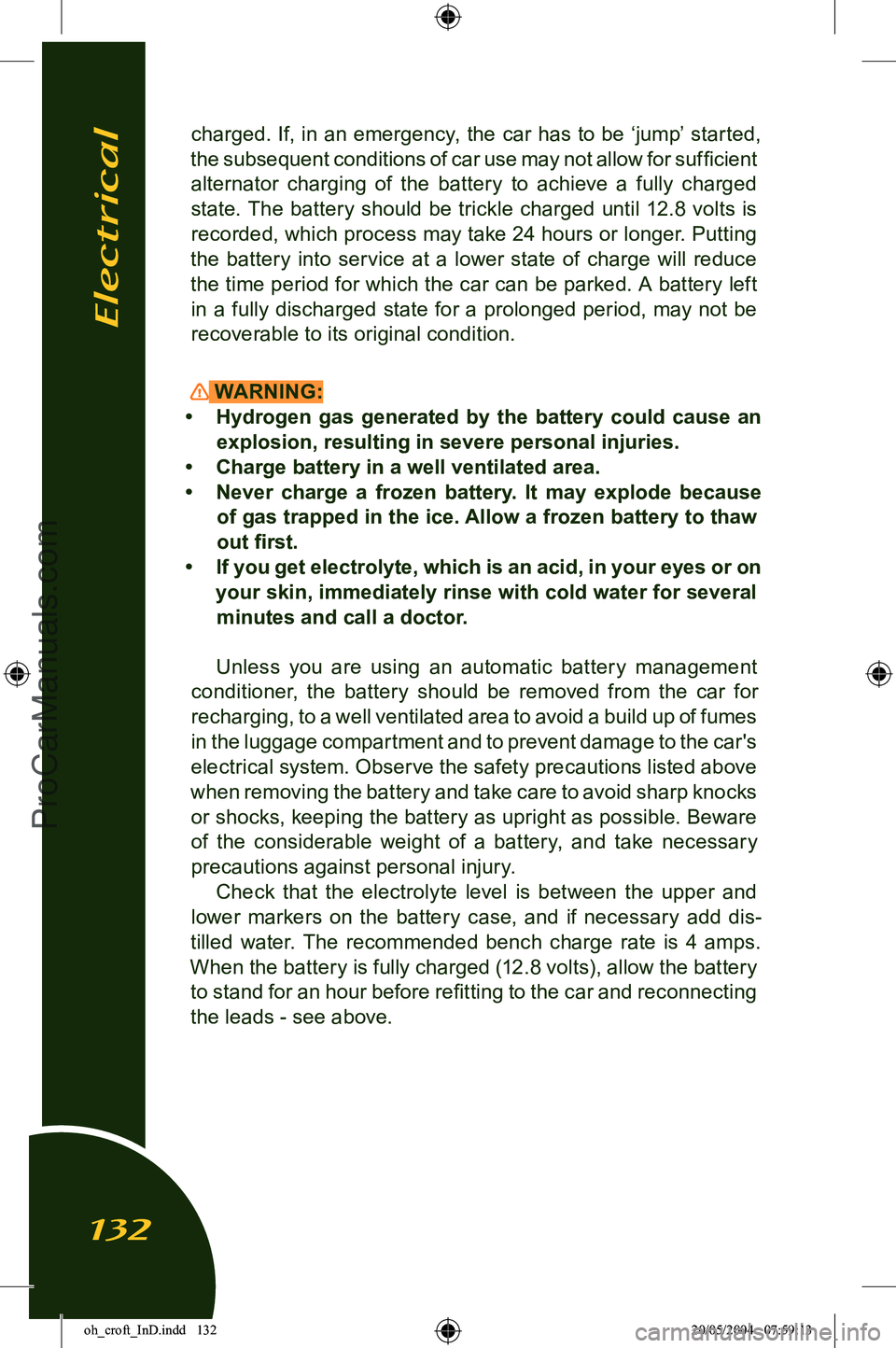
charged. If, in an emergency, the car has to be ‘jump’ started,
the subsequent conditions of car use may not allow for sufficient alternator charging of the battery to achieve a fully charged
state. The battery should be trickle charged until 12.8 volts is recorded, which process may take 24 hours or longer. Putting
the battery into service at a lower state of charge will reduce
the time period for which the car can be parked. A battery left
in a fully discharged state for a prolonged period, may not be recoverable to its original condition.
WARNING:
• Hydrogen gas generated by the battery could cause an explosion, resulting in severe personal injuries.
• Charge battery in a well ventilated area.
• Never charge a frozen battery. It may explode because of gas trapped in the ice. Allow a frozen battery to thaw
out first.
• If you get electrolyte, which is an acid, in your eyes or on your skin, immediately rinse with cold water for several minutes and call a doctor.
Unless you are using an automatic batter y management
conditioner, the battery should be removed from the car for
recharging, to a well ventilated area to avoid a build up of fumes
in the luggage compartment and to prevent damage to the car's
electrical system. Observe the safety precautions listed above
when removing the battery and take care to avoid sharp knocks
or shocks, keeping the battery as upright as possible. Beware
of the considerable weight of a battery, and take necessary precautions against personal injury. Check that the electrolyte level is between the upper and
lower markers on the battery case, and if necessary add dis
-
tilled water. The recommended bench charge rate is 4 amps.
When the battery is fully charged (12.8 volts), allow the battery
to stand for an hour before refitting to the car and reconnecting
the leads - see above.
Electrical
132
oh_croft_InD.indd 13220/05/2004 07:59:13ProCarManuals.com
Page 151 of 205
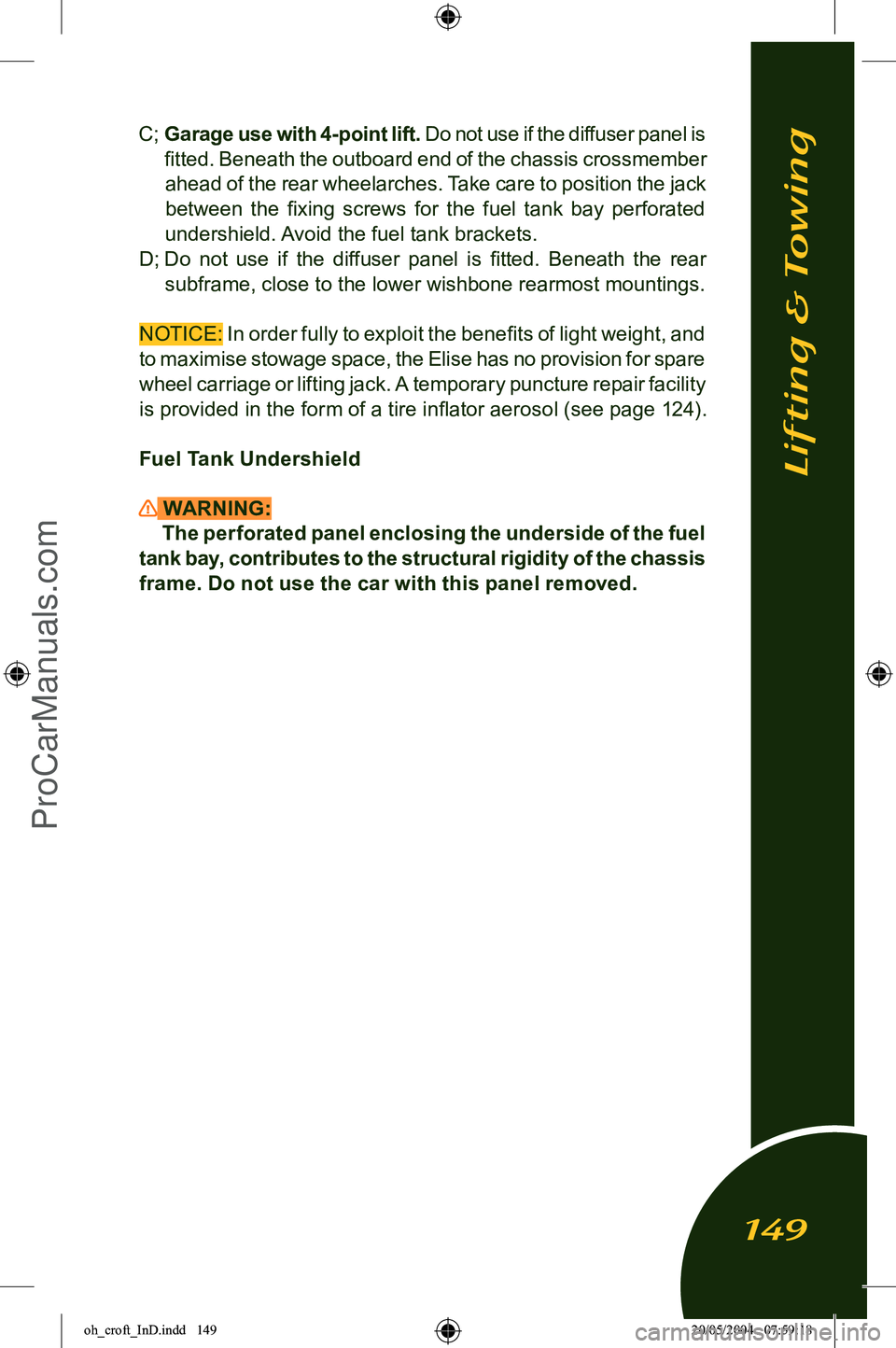
C; Garage use with 4-point lift. Do not use if the diffuser panel is
fitted. Beneath the outboard end of the chassis crossmember ahead of the rear wheelarches. Take care to position the jack
between the fixing screws for the fuel tank bay perforated
undershield. Avoid the fuel tank brackets.
D; Do not use if the diffuser panel is fitted. Beneath the rear
subframe, close to the lower wishbone rearmost mountings.
NOTICE: In order fully to exploit the benefits of light weight, and
to maximise stowage space, the Elise has no provision for spare
wheel carriage or lifting jack. A temporary puncture repair facility is provided in the form of a tire inflator aerosol (see page 124).
Fuel Tank Undershield
WARNING: The perforated panel enclosing the underside of the fuel
tank bay, contributes to the structural rigidity of the chassis
frame. Do not use the car with this panel removed.
Lifting & Towing
149
oh_croft_InD.indd 14920/05/2004 07:59:18ProCarManuals.com
Page 157 of 205
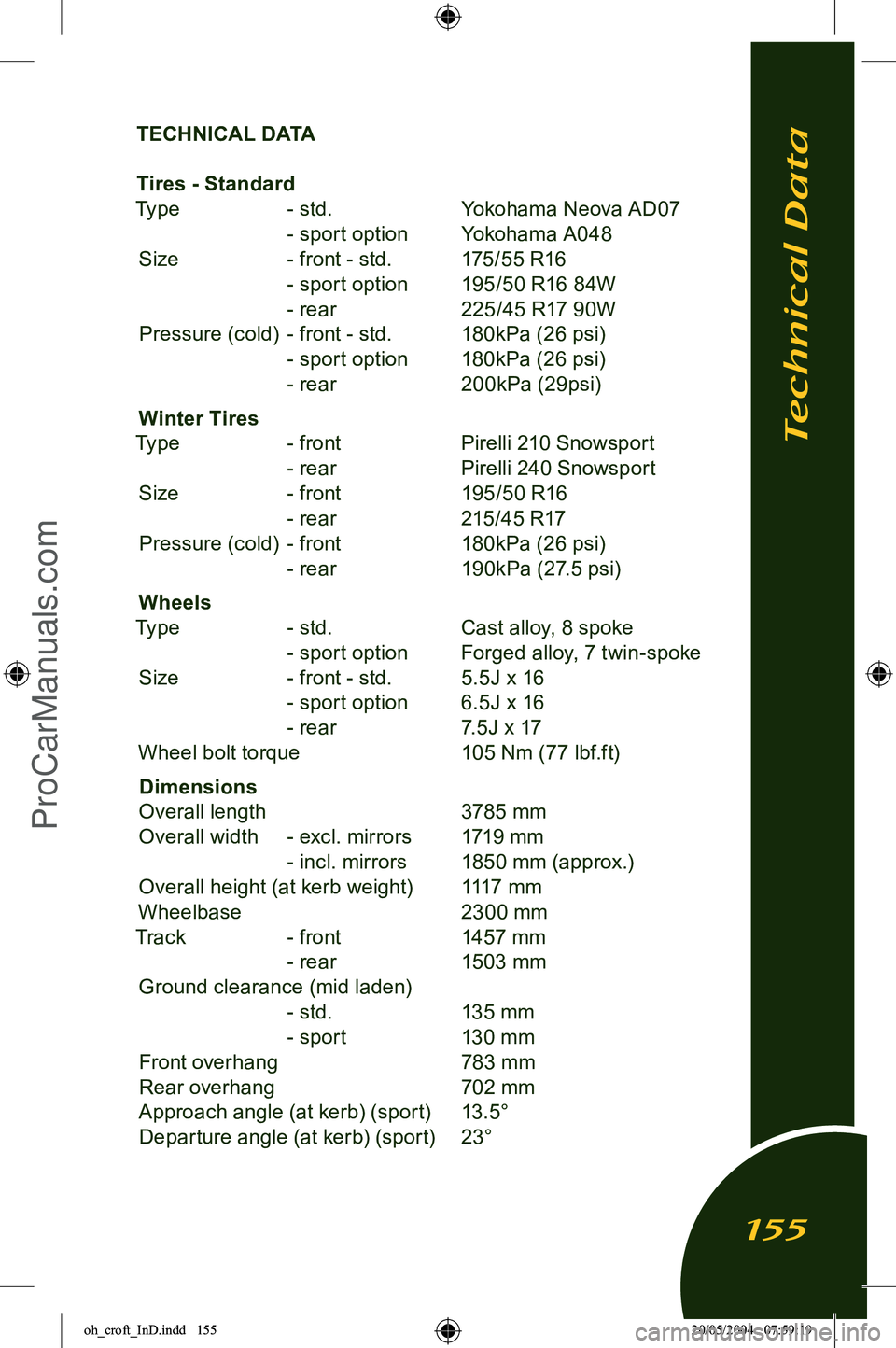
TECHNICAL DATA
Tires - Standard
Type - std. Yokohama Neova AD07
- sport option Yokohama A048
Size - front - std. 175/55 R16
- sport option 195/50 R16 84W
- rear 225/45 R17 90W
Pressure (cold) - front - std. 180kPa (26 psi)
- sport option 180kPa (26 psi)
- rear 200kPa (29psi)
Winter Tires
Type - front Pirelli 210 Snowsport
- rear Pirelli 240 Snowsport
Size - front 195/50 R16
- rear 215/45 R17
Pressure (cold) - front 180kPa (26 psi)
- rear 190kPa (27.5 psi)
Wheels
Type - std. Cast alloy, 8 spoke
- sport option Forged alloy, 7 twin-spoke
Size - front - std. 5.5J x 16
- sport option 6.5J x 16
- rear 7.5J x 17
Wheel bolt torque 105 Nm (77 lbf.ft)
Dimensions
Overall length 3785 mm
Overall width - excl. mirrors 1719 mm
- incl. mirrors 1850 mm (approx.)
Overall height (at kerb weight) 1117 mm
Wheelbase 2300 mm
Track - front 1457 mm
- rear 1503 mm
Ground clearance (mid laden)
- std. 135 mm
- sport 130 mm
Front overhang 783 mm
Rear overhang 702 mm
Approach angle (at kerb) (sport) 13.5° Departure angle (at kerb) (sport) 23°
Technical Data
155
oh_croft_InD.indd 15520/05/2004 07:59:19ProCarManuals.com
Page 158 of 205
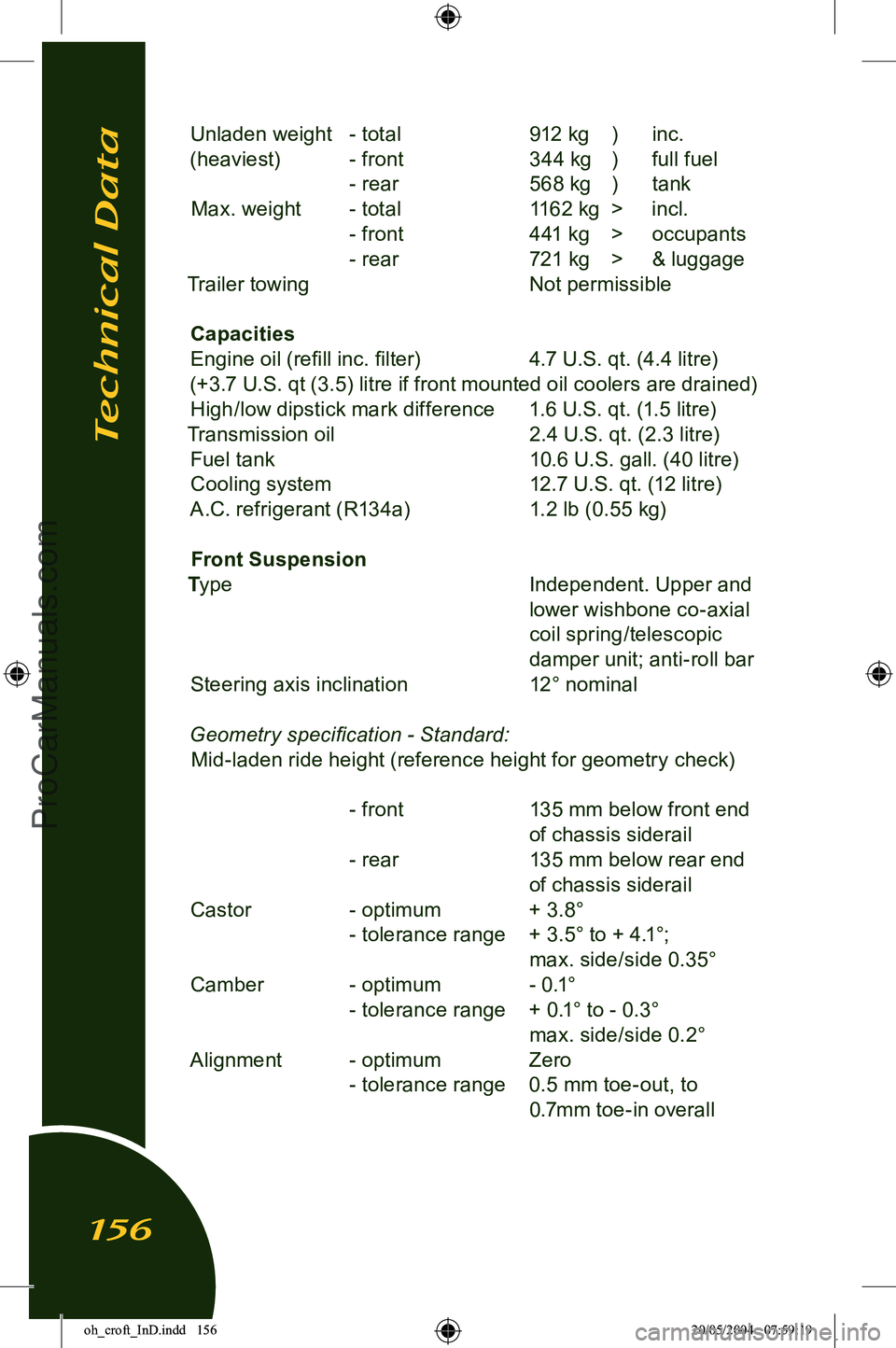
Unladen weight - total 912 kg ) inc.
(heaviest) - front 344 kg ) full fuel
- rear 568 kg ) tank
Max. weight - total 1162 kg > incl.
- front 441 kg > occupants
- rear 721 kg > & luggage
Trailer towing Not permissible
Capacities Engine oil (refill inc. filter) 4.7 U.S. qt. (4.4 litre)
(+3.7 U.S. qt (3.5) litre if front mounted oil coolers are drained) High/low dipstick mark difference 1.6 U.S. qt. (1.5 litre)
Transmission oil 2.4 U.S. qt. (2.3 litre)
Fuel tank 10.6 U.S. gall. (40 litre)
Cooling system 12.7 U.S. qt. (12 litre)
A.C. refrigerant (R134a) 1.2 lb (0.55 kg)
Front Suspension
T ype Independent. Upper and
lower wishbone co-axial
coil spring/telescopic
damper unit; anti-roll bar
Steering axis inclination 12° nominal
Geometry specification - Standard: Mid-laden ride height (reference height for geometry check)
- front 135 mm below front end
of chassis siderail
- rear 135 mm below rear end
of chassis siderail
Castor - optimum + 3.8°
- tolerance range + 3.5° to + 4.1°;
max. side/side 0.35°
Camber - optimum - 0.1°
- tolerance range + 0.1° to - 0.3°
max. side/side 0.2°
Alignment - optimum Zero - tolerance range 0.5 mm toe-out, to
0.7mm toe-in overall
Technical Data
156
oh_croft_InD.indd 15620/05/2004 07:59:19ProCarManuals.com