light LOTUS ELISE 2005 Owner's Manual
[x] Cancel search | Manufacturer: LOTUS, Model Year: 2005, Model line: ELISE, Model: LOTUS ELISE 2005Pages: 205, PDF Size: 4.51 MB
Page 61 of 205
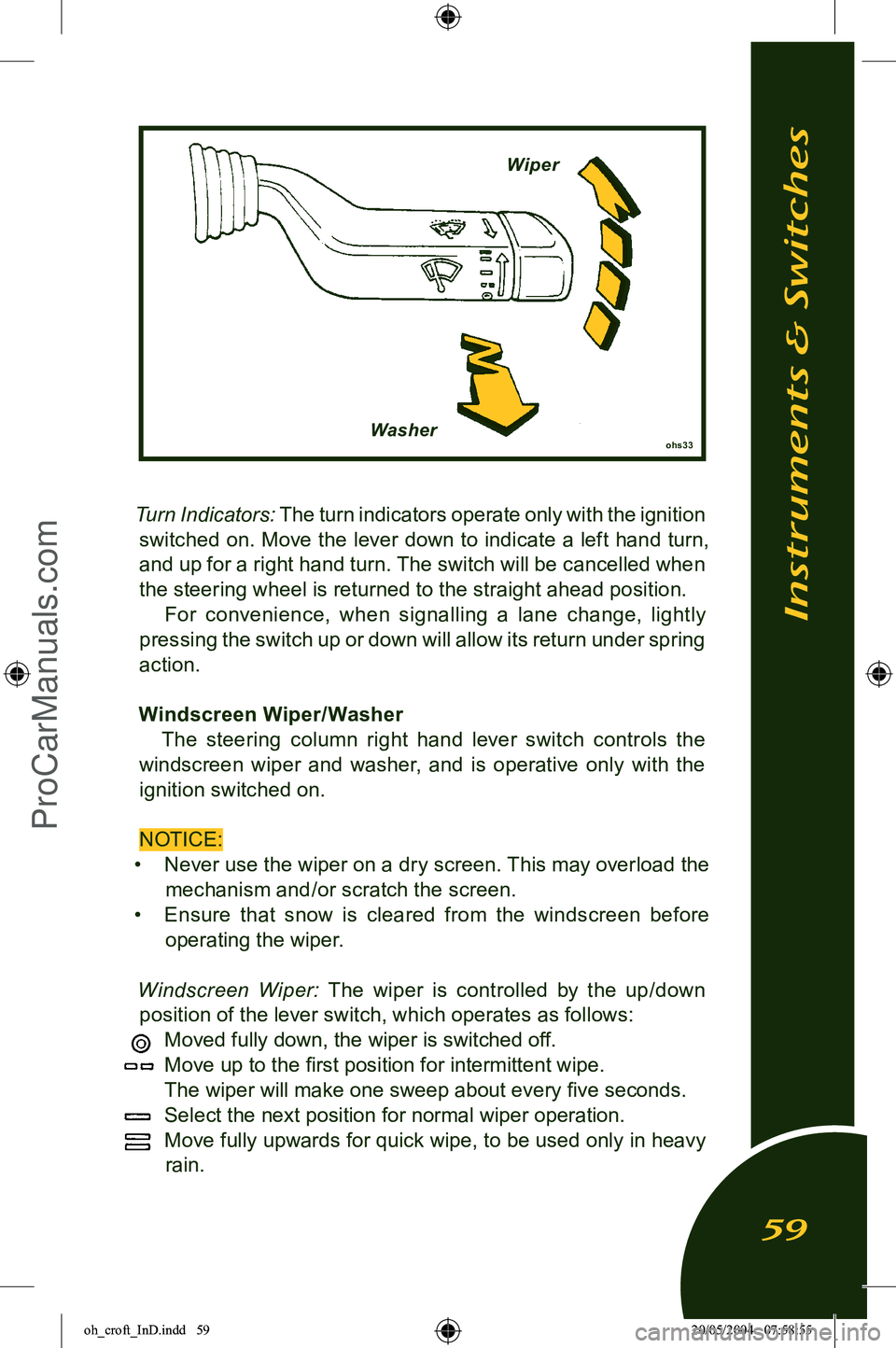
Turn Indicators: The turn indicators operate only with the ignition
switched on. Move the lever down to indicate a left hand turn, and up for a right hand turn. The switch will be cancelled when
the steering wheel is returned to the straight ahead position. For convenience, when signalling a lane change, lightly
pressing the switch up or down will allow its return under spring
action.
Windscreen Wiper/ Washer The steering column right hand lever switch controls the
windscreen wiper and washer, and is operative only with the ignition switched on.
NOTICE:
• Never use the wiper on a dry screen. This may overload the
mechanism and/or scratch the screen.
• Ensure th at snow is cleared from the windscreen before
operating the wiper.
Windscreen Wiper:
The wiper is controlled by the up/down
position of the lever switch, which operates as follows:
Moved fully down, the wiper is switched off.
Move up to the first position for intermittent wipe.
The wiper will make one sweep about every five seconds.
Select the next position for normal wiper operation.
Move fully upwards for quick wipe, to be used only in heavy
rain.
Instruments & Switches
59
ohs33Washer Wiper
oh_croft_InD.indd 5920/05/2004 07:58:55ProCarManuals.com
Page 63 of 205
HEATING, VENTILATION & AIR CONDITIONINGThe small size of the Elise together with the method of
construction and emphasis on lightweight, have resulted in heating and a.c. sytems which perform well under non-extreme
climatic conditions. In extreme temperatures and humidity the operational limits of the systems may be reached before the
desired temperature, or rate of temperature change inside the
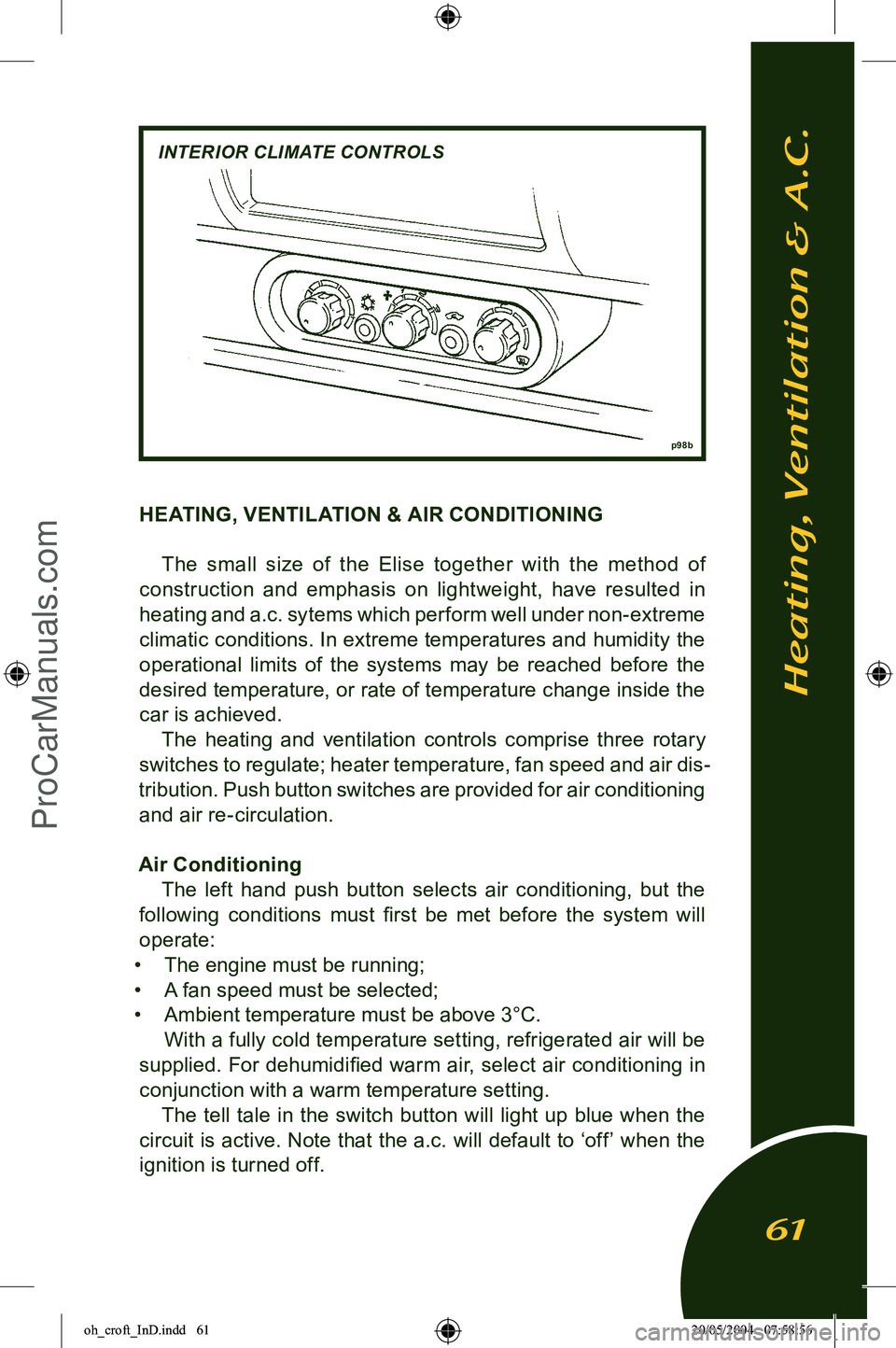
car is achieved. The heating and ventilation controls comprise three rotary
switches to regulate; heater temperature, fan speed and air dis
-
tribution. Push button switches are provided for air conditioning and air re-circulation.
Air Conditioning The left hand push button selects air conditioning, but the
following conditions must first be met before the system will
operate:
• The engine must be running;
• A fan speed must be selected;
• Ambient temperature must be above 3°C.
With a fully cold temperature setting, refrigerated air will be
supplied. For dehumidified warm air, select air conditioning in
conjunction with a warm temperature setting. The tell tale in the switch button will light up blue when the
circuit is active. Note that the a.c. will default to ‘off’ when the ignition is turned off.
Heating, Ventilation & A.C.
61
p 98b
INTERIOR CLIMATE CONTROLS
oh_croft_InD.indd 6120/05/2004 07:58:56ProCarManuals.com
Page 64 of 205
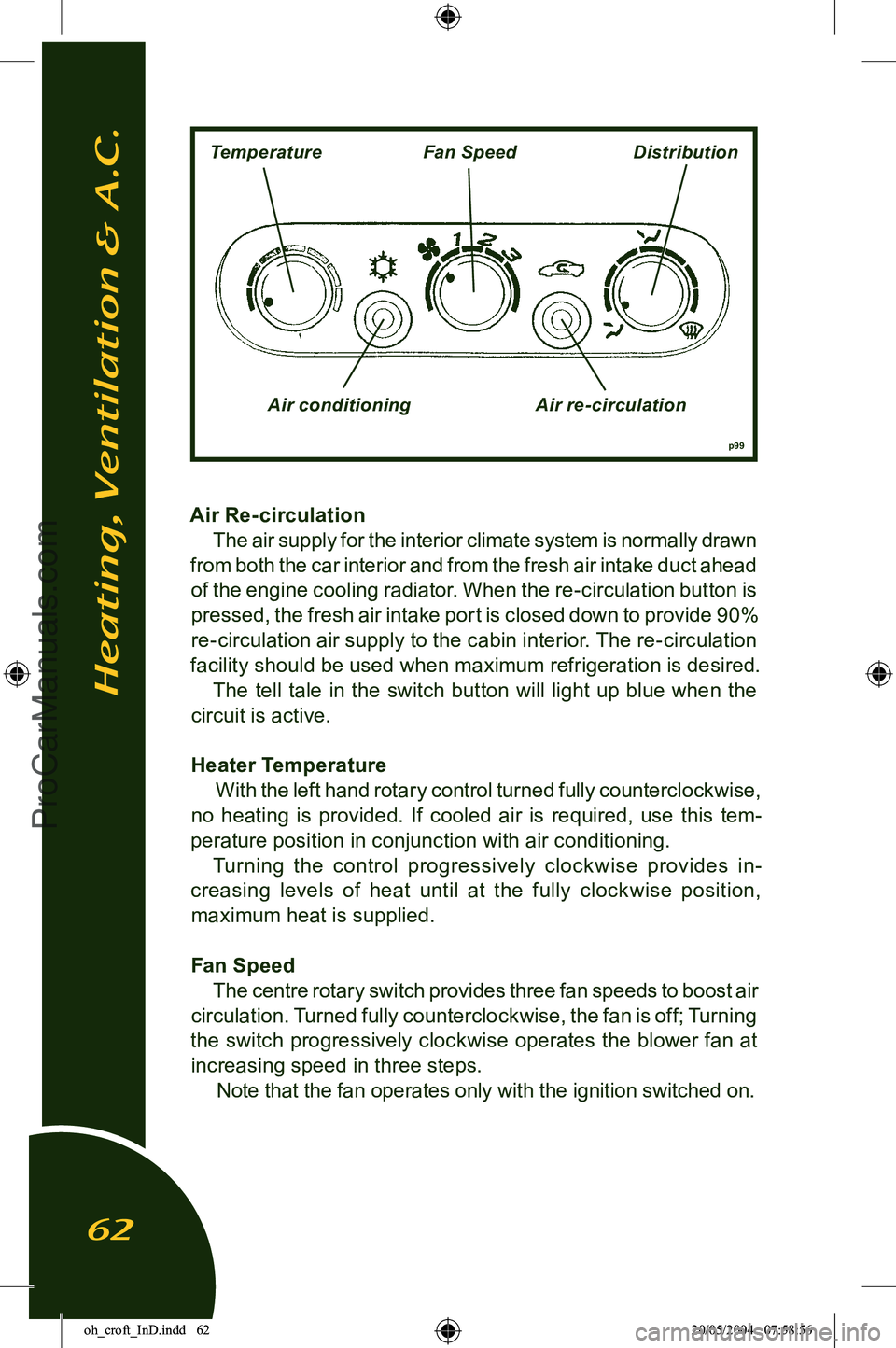
Air Re- circulation The air supply for the interior climate system is normally drawn
from both the car interior and from the fresh air intake duct ahead
of the engine cooling radiator. When the re-circulation button is pressed, the fresh air intake port is closed down to provide 90%
re-circulation air supply to the cabin interior. The re-circulation
facility should be used when maximum refrigeration is desired.
The tell tale in the switch button will light up blue when the
circuit is active.
Heater Temperature With the left hand rotary control turned fully counterclockwise,
no heating is provided. If cooled air is required, use this tem
-
perature position in conjunction with air conditioning. Turning the control progressively clock wise provides in
-
creasing levels of heat until at the fully clockwise position, maximum heat is supplied.
Fan Speed The centre rotary switch provides three fan speeds to boost air
circulation. Turned fully counterclockwise, the fan is off; Turning
the switch progressively clockwise operates the blower fan at increasing speed in three steps. Note that the fan operates only with the ignition switched on.
Heating, Ventilation & A.C.
62
p99
TemperatureFan SpeedDistribution
Air conditioning Air re-circulation
oh_croft_InD.indd 6220/05/2004 07:58:56ProCarManuals.com
Page 71 of 205
integral self diagnostics have switched out the anti-lock function.
See ‘ABS tell tale lamp’.
WARNING:
• The increased control that ABS provides should not induce you to take more risks with your safety. ABS will
not prevent a skid caused by abrupt steering movements,
or attempting to corner too quickly.
• Always maintain a safe following distance from other cars relative to the road surface and weather conditions.
Obey all traffic laws.
• Risk of accidents due to inappropriate speed cannot be reduced even by ABS. The driver is responsible for the
judgement of safe speed.
• The control unit of the ABS is set for standard tire size. If non-standard Tires are fitted, the control unit may mis-
interpret the speed of the car, because of the variant data
it receives from the wheel speed sensors. Fitting non standard tires would seriously affect the performance of
your ABS.
• The amber ABS tell tale in the instrument panel should light for about 4 seconds following ignition switch on, and
then go out. If the lamp remains lit, or comes on whilst driving, a fault in the anti-lock brake system is indicated.
The base brake system will continue to operate normally,
but without ABS. The car can be driven but should be
checked and repaired at the earliest opportunity.
• Activation of the ABS will vary according to the level of grip available at the Tires. On dry surfaces, activation
will occur only with a high pedal pressure. On slippery
surfaces, only a low pressure will be needed.
• On loose or uneven surfaces, such as gravel or snow, a car with ABS may need a longer stopping distance. Allow
a greater distance between cars in these conditions.
Driving Controls
69
oh_croft_InD.indd 6920/05/2004 07:58:57ProCarManuals.com
Page 73 of 205
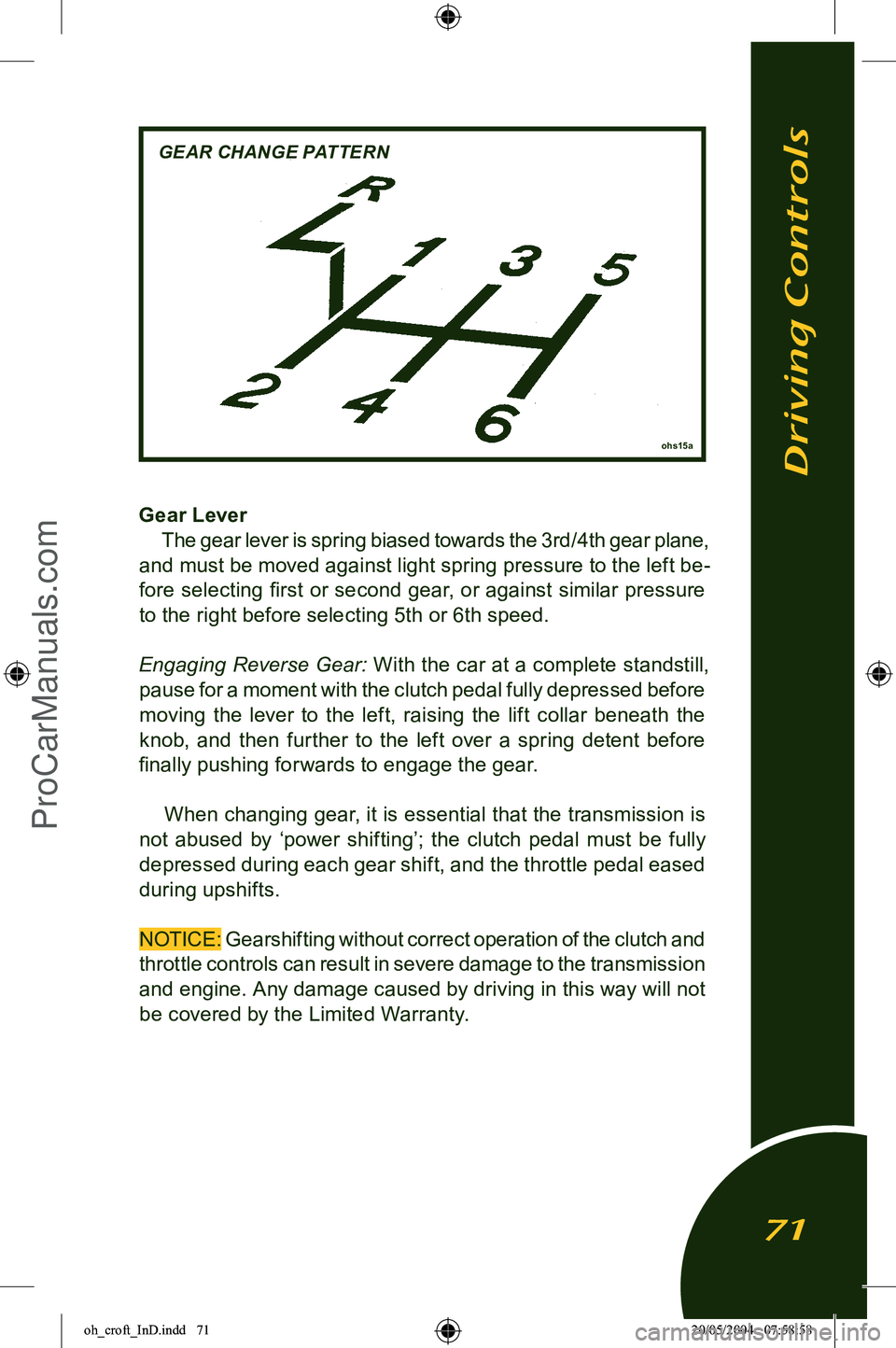
Gear LeverThe gear lever is spring biased towards the 3rd/4th gear plane,
and must be moved against light spring pressure to the left be
-
fore selecting first or second gear, or against similar pressure to the right before selecting 5th or 6th speed.
Engaging Reverse Gear: With the car at a complete standstill
,
pause for a moment with the clutch pedal fully depressed before
moving the lever to the left, raising the lift collar beneath the
knob, and then further to the left over a spring detent before
finally pushing forwards to engage the gear.
When changing gear, it is essential that the transmission is
not abused by ‘power shifting’; the clutch pedal must be fully
depressed during each gear shift, and the throttle pedal eased
during upshifts.
NOTICE: Gearshifting without correct operation of the clutch and
throttle controls can result in severe damage to the transmission
and engine. Any damage caused by driving in this way will not be covered by the Limited Warranty.
Driving Controls
71
ohs15a
GEAR CHANGE PATTERN
oh_croft_InD.indd 7120/05/2004 07:58:58ProCarManuals.com
Page 75 of 205
NOTICE: The use of wide throttle openings and/or high rpm before the engine has reached normal running temperature will
result in premature wear, and should be avoided.
Idle Speed Engine idle speed is controlled electronically by the engine
management computer, and is normally about 850 rpm. A
raised idle speed is required under certain operating conditions
including the engine warm up phase, when the increased speed helps the catalytic converter to reach operating temperature, as
well as inhibiting engine stall. Idle speed will return to normal automatically when the engine has warmed sufficiently.
Engine Break-In Although the Elise powertrain is built to close tolerances
using modern technology, the progressive and sympathetic
breaking-in (or bedding-in) of a new engine and transmission
remains a major factor in attaining ef ficient operation with
smooth, durable and economic performance to last throughout
the life of the car.
NOTICE: Failure to comply with the following break-in provi
-
sions could invalidate the terms of the car warranty:
It is important during the car’s early life to limit the workload on
the engine and thus control the heat generated within it, which is primarily a function of throttle opening and rpm. However, being
too sympathetic on the car will not allow the piston rings to bed in
satisfactorily, so a balance of spirited and gentle use is required.
For the first 600 miles (1,000 km), use no more than moderate
throttle openings (about half of the available accelerator pedal
travel) and do not run the engine continuously at engine speeds over 4,500 rpm. Occasional short bursts at wider throttle and
higher rpm will be beneficial, as will a constantly changing cruis
-
ing speed and making full use of the gearbox. Do not allow the
engine to labour in too high a gear ratio, but change down and
let the engine operate in its natural power band. When changing gear, use only a light touch on the gear lever.
Forcing the change will cause unnecessary wear on the system components and result in higher shift efforts being required. Al
-
low the brakes to bed-in by avoiding needless heavy braking for
the first 100 miles (160 km). Both gearchange and brake pedal
Starting & Engine Break-In
73
oh_croft_InD.indd 7320/05/2004 07:58:59ProCarManuals.com
Page 77 of 205
EXTERNAL OPERATIONS
Fuel Requirement USE UNLEADED PREMIUM GR ADE GASOLINE.
Use only unleaded gasoline meeting ASTM specifications.
Use of fuels not meeting ASTM specifications could cause poor performance and increase emissions.
For optimum car performance and fuel economy, the use
of super or premium unleaded gasoline, with a minimum
octane rating of 91 (RON+MON)/2 is recommended. Where
super or premium fuel is not available, the Elise will operate
satisfactorily on unleaded gasoline having a minimum rating
of 87 (RON+MON)/2, but car performance and economy will be reduced. Using fuel with a lower octane rating may cause knocking
(pinking) which, if severe, can cause serious engine damage.
Light knocking may occasionally be heard for short periods when accelerating or driving up hills, and this should cause no concern,
although using a lower gear would be advised. If, however, you hear persistent heavy knocking when using the specified fuel,
consult your dealer without delay.
The use of good quality fuels containing proper detergent ad
-
ditives is advised for good performance and emission control.
NOTICE: Do NOT use leaded fuel: damage caused by the use of leaded or other improper fuel is not covered by the New Car
or Emission Control System Warranty. The effectiveness of
the catalytic converter decreases after as little as one tankful
of leaded fuel. Also, the car is fitted with a fuel injection system
which includes an oxygen sensor. Leaded fuel will damage the sensor, and cause emission control to deteriorate.
Gasolines Containing Alcohol - Some gasolines sold at service stations contain alcohol although they may not be so identified.
Use of fuels containing alcohol is not recommended, unless the nature of the blend can be determined as being satisfactory.
Gasohol - A mixture of 10% ethanol (grain alcohol) and 90% unleaded gasoline may be used in the Lotus Elise. If driveabil
-
ity problems are experienced as a result of using gasohol, it is recommended that the car is operated on gasoline.
External Operations
75
oh_croft_InD.indd 7520/05/2004 07:58:59ProCarManuals.com
Page 79 of 205
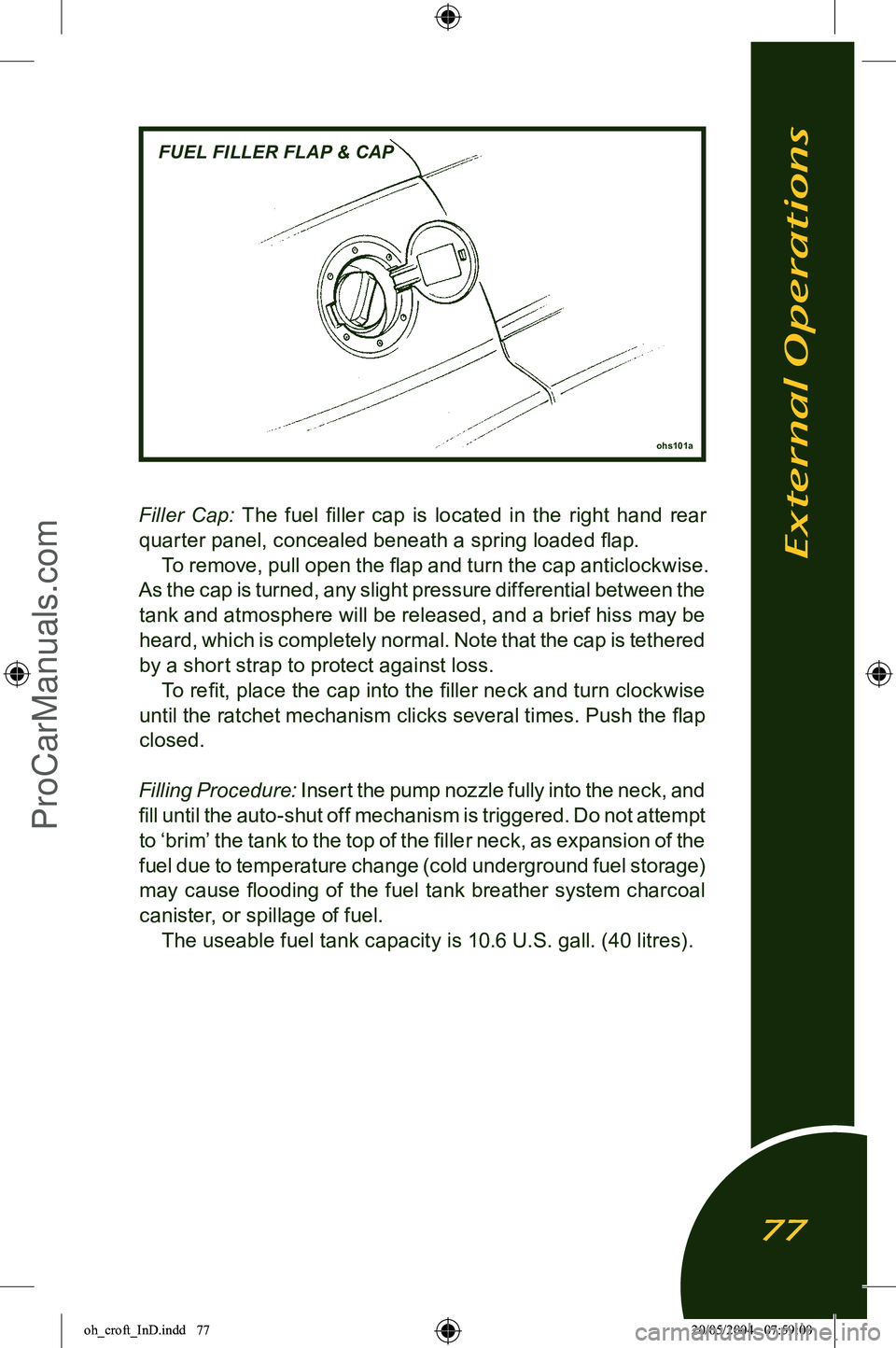
Filler Cap: The fuel filler cap is located in the right hand rear
quarter panel, concealed beneath a spring loaded flap. To remove, pull open the flap and turn the cap anticlockwise.
As the cap is turned, any slight pressure differential between the tank and atmosphere will be released, and a brief hiss may be heard, which is completely normal. Note that the cap is tethered by a short strap to protect against loss.
To refit, place the cap into the filler neck and turn clockwise
until the ratchet mechanism clicks several times. Push the flap closed.
Filling Procedure:
Insert the pump nozzle fully into the neck, and
fill until the auto-shut off mechanism is triggered. Do not attempt to ‘brim’ the tank to the top of the filler neck, as expansion of the
fuel due to temperature change (cold underground fuel storage) may cause flooding of the fuel tank breather system charcoal
canister, or spillage of fuel. The useable fuel tank capacity is 10.6 U.S. gall. (40 litres).
ohs101a
FUEL FILLER FLAP & CAP
External Operations
77
oh_croft_InD.indd 7720/05/2004 07:59:00ProCarManuals.com
Page 80 of 205
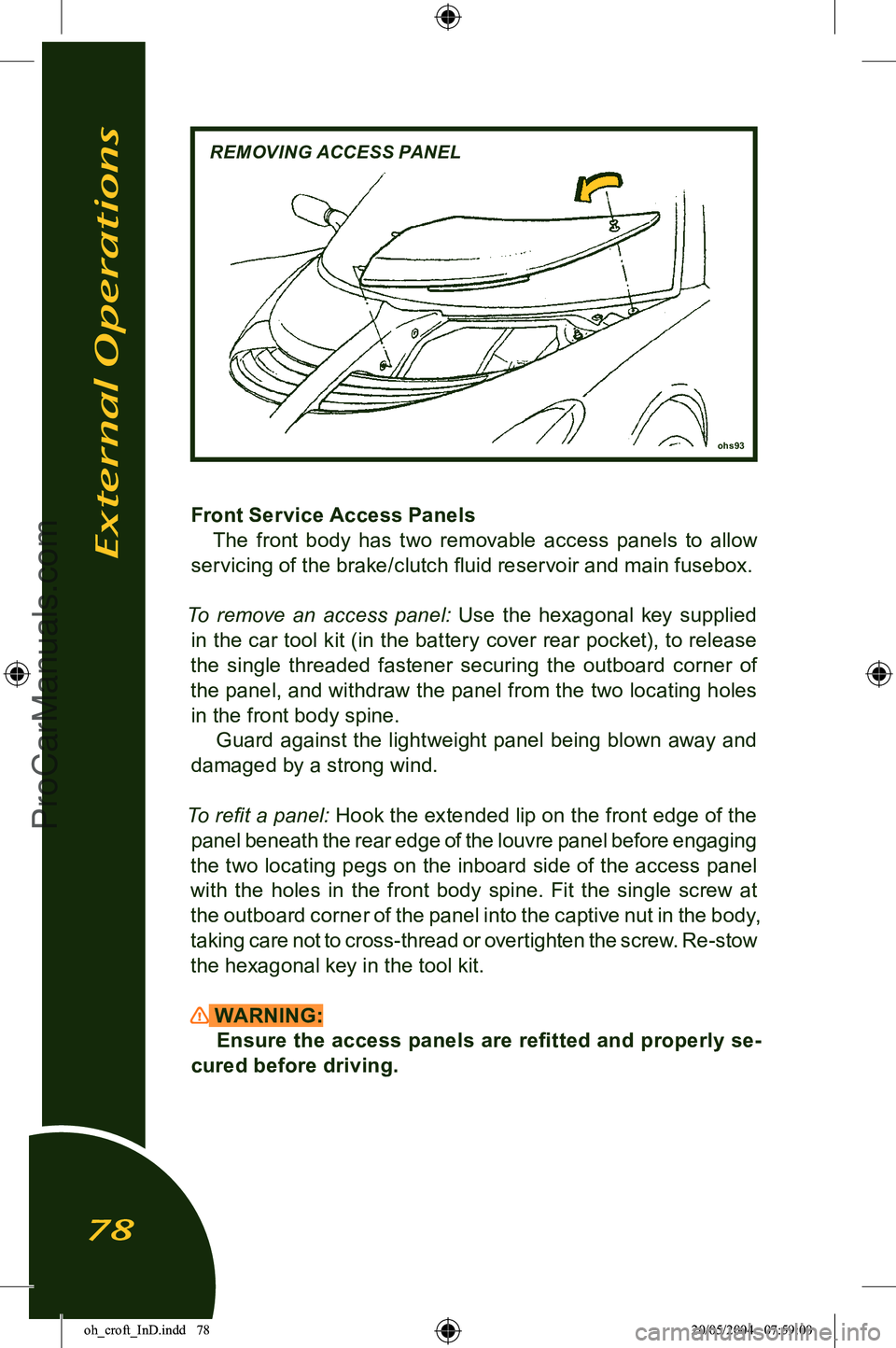
ohs93
REMOVING ACCESS PANEL
Front Service Access PanelsThe front body has two removable access panels to allow
servicing of the brake/clutch fluid reservoir and main fusebox.
To remove an access panel:
Use the hexagonal key supplied
in the car tool kit (in the battery cover rear pocket), to release
the single threaded fastener securing the outboard corner of
the panel, and withdraw the panel from the two locating holes in the front body spine. Guard against the lightweight panel being blown away and
damaged by a strong wind.
To refit a panel: Hook the extended lip on the front edge of the panel beneath the rear edge of the louvre panel before engaging
the two locating pegs on the inboard side of the access panel
with the holes in the front body spine. Fit the single screw at
the outboard corner of the panel into the captive nut in the body,
taking care not to cross-thread or overtighten the screw. Re-stow
the hexagonal key in the tool kit.
WARNING: Ensure the access panels are refitted and properly se
-
cured before driving.
External Operations
78
oh_croft_InD.indd 7820/05/2004 07:59:00ProCarManuals.com
Page 88 of 205

b330
FRONT SPIGOT BRACKET
Hard Top - Fitting
1. Open both doors, and preferably with the aid of an assistant, lower the roof onto the car holding aside the loose tethered
fixings to avoid their entrapment or their causing paint damage. Position the rear edge of the roof first before locating the front
edge against the windscreen header rail.
2. Locate a front spigot bracket into its latch plate lower slot (lifting the roof slightly to allow this) and retain to the roof with the Torx bolt. Use only the special Torx tool supplied in the car tool kit (stowed in the battery cover pocket), and do not
fully tighten at this stage.
3. Repeat step (2) for the opposite front spigot bracket.
External Operations
86
oh_croft_InD.indd 8620/05/2004 07:59:02ProCarManuals.com