park LOTUS ELISE 2005 Owner's Manual
[x] Cancel search | Manufacturer: LOTUS, Model Year: 2005, Model line: ELISE, Model: LOTUS ELISE 2005Pages: 205, PDF Size: 4.51 MB
Page 102 of 205
pressing firmly to ensure that the handle is fully seated. With-
draw the dipstick again to inspect the oil level, which should lie between the two dimples on the end of the stick. The oil level
should be maintained at the upper of these two marks in order
to provide optimum engine protection.
Topping Up
: If topping up is necessary, unscrew the oil filler cap
from the left hand end of the cam cover. Add a suitable quantity of the recommended engine oil (see ‘Recommended Lubricants’)
taking care not to spill any oil onto engine or electrical compo
-
nents; use a funnel if necessary. The difference between high and low dipstick marks is equiv
-
alent to 1.6 U.S. quarts (1.5 litre). Allow several minutes for the oil to drain through to the sump before re-checking the oil level.
Do NOT over fill, or lubrication will be degraded and consump
-
tion increased as the oil becomes aerated. Refit the filler cap,
turning clockwise until secure.
Engine Oil Change The use of high quality oil, renewed at the specified intervals,
is the key to engine longevity and sustained performance. Ad
-
here strictly to the engine oil and filter change intervals specified
in the Maintenance Schedule.
For access to the engine sump and filter, the engine bay
undertray must first be removed. This is most easily achieved
with the car raised on a garage hydraulic lift, or alternatively, parked over an inspection pit.
The drain plug is located at the rear of the sump, and should
be removed to drain the sump immediately after a run when
the oil is warm and the impurities are still held in suspension.
On cars fitted with front mounted oil coolers, it is not necessary routinely to attempt to drain the cooler circuit. Servicing & Maintenance
100
oh_croft_InD.indd 10020/05/2004 07:59:05ProCarManuals.com
Page 116 of 205
Auxiliary Drive BeltA single, multi-rib type auxiliary belt is used to transmit drive
from the crankshaft to the alternator, water pump, and (if fitted)
air conditioning compressor. The belt is automatically tensioned,
and requires no periodic maintenance other than a visual check of its condition. If the belt exhibits any evidence of physical dam
-
age, cracking, fraying, perishing, abrasion or contamination, it
should be renewed. In the case of contamination, the cause
must be identified and rectified, and each of the pulleys must be thoroughly degreased before the new belt is fitted. It is recommended that auxiliary belt replacement be en
-
trusted to your Lotus dealer.
Sparking Plugs The Elise uses a direct ignition system with an individual
high tension coil mounted atop each of the four spark plugs and protected by a plastic cover, screw fixed to the engine.
WARNING: The voltages produced with this ignition system can
cause serious and potentially fatal injur y. Never touch
any ignition components when the engine is running or being cranked.
The spark plugs should be renewed in accordance with the
Maintenance Schedule, with the gaps set to 0.043 in. (1.1 mm).
This operation should be entrusted to your Lotus dealer.
Servicing & Maintenance
114
oh_croft_InD.indd 11420/05/2004 07:59:09ProCarManuals.com
Page 118 of 205
NOTICE:
• On cars used on a race track or in a competitive manner,
special vigilance is required due to the severity of tire operating conditions, with careful inspections carried
out between sessions.
• Take care when parking to avoid tire contact with high
or sharp edged kerbs. Such mistreatment can cause
internal damage to the tire structure and this may not be readily apparent. The wheel rims may also be distorted or damaged by careless parking, and result in wheel
imbalance or loss of tire pressure. Similar damage may also be caused by potholes, rocks or other highway
debris.
WARNING:
• Damage to wheels and tires may cause an accident in which you or others may be killed or seriously
injured. If the wheels or tires have been damaged,
have them replaced.
• Safety considerations should always be paramount when assessing tire condition and serviceability, and the tires replaced if any doubt exists, or if the
legal tread depth limits are approached.
• Poorly maintained and improperly used tires are dangerous.
• Overloading your tires can cause overheating as a result of too much friction. You could have a blow
out and a serious accident in which you could be killed or seriously injured. See ‘Tire Placard La
-
bel’.
• Underinflated tires pose the same danger as over loaded tires. The resulting accident could cause serious injury, or death. Check all tires frequently
and maintain at the recommended pressure. Tire
pressures should be checked only when the tires
are cold.
• Overinflated tires are more likely to be cut, punc- tured or broken by a sudden impact - such as hitting a pothole. Keep tires at the recommended pressure.
• Installing improper tires on your car can affect handling and stability. This can cause a crash
in which you can be killed or seriously injured.
Tires & Wheels
116
oh_croft_InD.indd 11620/05/2004 07:59:09ProCarManuals.com
Page 131 of 205
ELECTRICAL
BATTERY
WARNING:
POISON/DANGER - CAUSES SEVERE BURNS KEEP OUT
OF REACH OF CHILDREN.
• Contains sulphuric acid - avoid contact with skin, eyes or clothing. If in contact with skin or eyes; flush with copious amounts of water. Remove contaminated clothing. Seek
immediate medical attention. If ingested; seek immediate
medical attention. Do not induce vomiting or give fluids
to drink.
• Batteries produce explosive gases. Keep sparks, flames and cigarettes away. Ventilate when charging or using in
enclosed space. Always shield eyes when working near
batteries.
RISK OF SHORT CIRCUIT AND FIRE
• Observe all warning notes on the battery.
• Disconnect the battery during all work on the electrical system.
• Do not lay tools or other metal objects on the battery as they could cause a short circuit across the battery
terminals.
Battery Access The ‘maintenance free’ battery is located at the left hand
front of the rear luggage compartment. No routine inspection or topping up of the electrolyte is required, but at inter vals
specified in the Maintenance Schedule, the battery terminals
should be checked for security and condition, and protected
with petroleum jelly. For access to the terminals, first unclip the battery cover
from the floor and ease the cover from around the left hand rear corner of the battery.
Disconnecting the Battery
WARNING: Failure to follow the correct battery disconnection pro
-
cedure detailed below could result in serious burns.
Electrical
129
oh_croft_InD.indd 12920/05/2004 07:59:13ProCarManuals.com
Page 132 of 205
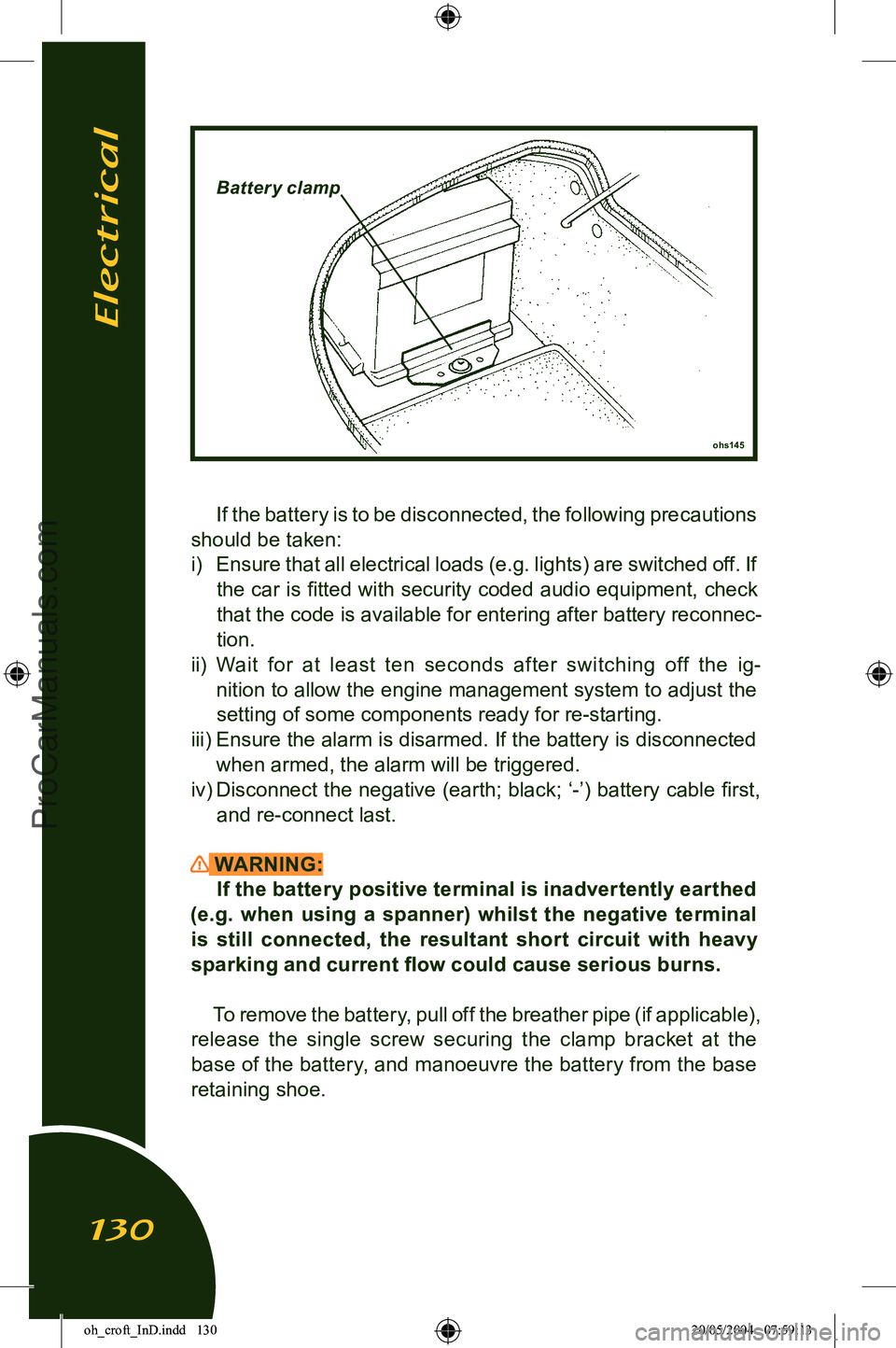
If the battery is to be disconnected, the following precautions
should be taken: i) Ensure that all electrical loads (e.g. lights) are switched off. If
the car is fitted with security coded audio equipment, check
that the code is available for entering after battery reconnec
-
tion.
ii) Wait for at least ten seconds after switching off the ig-
nition to allow the engine management system to adjust the
setting of some components ready for re-starting.
iii) Ensure the alarm is disarmed. If the battery is disconnected
when armed, the alarm will be triggered.
iv) Disconnect the
negative (earth; black; ‘-’) battery cable first,
and re-connect last.
WARNING:
If the battery positive terminal is inadvertently earthed
(e.g. when using a spanner) whilst the negative terminal
is still connected, the resultant short circuit with heavy sparking and current flow could cause serious burns.
To remove the battery, pull off the breather pipe (if applicable),
release the single screw securing the clamp bracket at the
base of the battery, and manoeuvre the battery from the base
retaining shoe.
ohs145
Batter y clamp
Electrical
130
oh_croft_InD.indd 13020/05/2004 07:59:13ProCarManuals.com
Page 134 of 205
charged. If, in an emergency, the car has to be ‘jump’ started,
the subsequent conditions of car use may not allow for sufficient alternator charging of the battery to achieve a fully charged
state. The battery should be trickle charged until 12.8 volts is recorded, which process may take 24 hours or longer. Putting
the battery into service at a lower state of charge will reduce
the time period for which the car can be parked. A battery left
in a fully discharged state for a prolonged period, may not be recoverable to its original condition.
WARNING:
• Hydrogen gas generated by the battery could cause an explosion, resulting in severe personal injuries.
• Charge battery in a well ventilated area.
• Never charge a frozen battery. It may explode because of gas trapped in the ice. Allow a frozen battery to thaw
out first.
• If you get electrolyte, which is an acid, in your eyes or on your skin, immediately rinse with cold water for several minutes and call a doctor.
Unless you are using an automatic batter y management
conditioner, the battery should be removed from the car for
recharging, to a well ventilated area to avoid a build up of fumes
in the luggage compartment and to prevent damage to the car's
electrical system. Observe the safety precautions listed above
when removing the battery and take care to avoid sharp knocks
or shocks, keeping the battery as upright as possible. Beware
of the considerable weight of a battery, and take necessary precautions against personal injury. Check that the electrolyte level is between the upper and
lower markers on the battery case, and if necessary add dis
-
tilled water. The recommended bench charge rate is 4 amps.
When the battery is fully charged (12.8 volts), allow the battery
to stand for an hour before refitting to the car and reconnecting
the leads - see above.
Electrical
132
oh_croft_InD.indd 13220/05/2004 07:59:13ProCarManuals.com
Page 135 of 205

‘Jump’ StartingIf the battery becomes discharged to the extent that the en
-
gine cannot be started, proprietary good quality ‘jumper cables’ may be used to connect with the battery of a second car in order
to provide the energy necessary for starting.
WARNING: It is most important that the correct procedure is fol
-
lowed in order to avoid damage to either car’s electrical system, and most importantly, to minimise the danger of a
spark induced battery explosion. Check that the slave car
also has a NEGATIVE EARTH electrical system.
i) With the engine of the slave car running at a fast idle, use one jumper cable (red) to connect the positive (+) terminal of
one battery to the positive terminal of the other battery. Take
care during this process to avoid inadvertently earthing a free end of this cable to the metal body or chassis of either car.
ii) Connect one end of the other jumper cable (black) to the negative (-) terminal of the discharged battery.
iii) A spark will occur when the other end of this cable (the final connection) is connected to an earth on the slave car. This
connection should therefore be made to a point away from
the battery, and away from any fuel vapour area or moving
parts. An engine hanger bracket is often ideal.
iv) Start the car in the usual way, and run at a fast idle.
ohs14c
JUMP STARTING
Electrical
133
oh_croft_InD.indd 13320/05/2004 07:59:14ProCarManuals.com
Page 136 of 205
v) A spark will occur at the first disconnection of a jumper cable, so it is essential that the first disconnection is made from the
slave car earth. Both batteries (especially the
discharged one) will be ‘gassing’ heavily at this time, and if the first disconnection is made at a battery terminal, there is
a danger that the hydrogen gas may be ignited by the spark
with a resultant explosion.
vi) Have the cause of the flat battery investigated and rectified,
and trickle charge the battery as detailed above.
WARNING:
• Risk of damage and serious personal injury due to
shortcircuit.
• Use only jumper cables of adequate cross-section, fitted
with completely insulated alligator clamps. The cables must be long enough to allow that neither cars nor cables
touch each other.
• Follow all warnings and instructions of the jumper cable
manufacturer.
• When connnecting the jumper cables, keep them away
from engine moving parts.
• The two cars must not contact each other, or current could flow as soon as the positive terminals are connected.
• When the first clamp on each cable is connected, the other clamp on that cable must be held carefully to make sure it does not come into contact with either another cable
clamp or either car.
• Ensure that tools or metal watches or jewellery do not contact the battery terminals or live car parts.
NOTICE:
• Improper jumper cable connection can damage the alternator
and other electrical components.
• Do not attempt to push or tow start the car, as damage to the
catalytic converter or other parts could be caused.
Electrical Accessories Owners should note that the only approved extras and modi
-
fications are those which are specified by Lotus and carried out by Lotus or by an authorised dealer. Neither Lotus Cars Ltd. or
Lotus Cars Inc. accept any liability whatsoever for defects which arise from extras or modifications which are not approved by
Lotus Cars Ltd.
Electrical
134
oh_croft_InD.indd 13420/05/2004 07:59:14ProCarManuals.com
Page 138 of 205
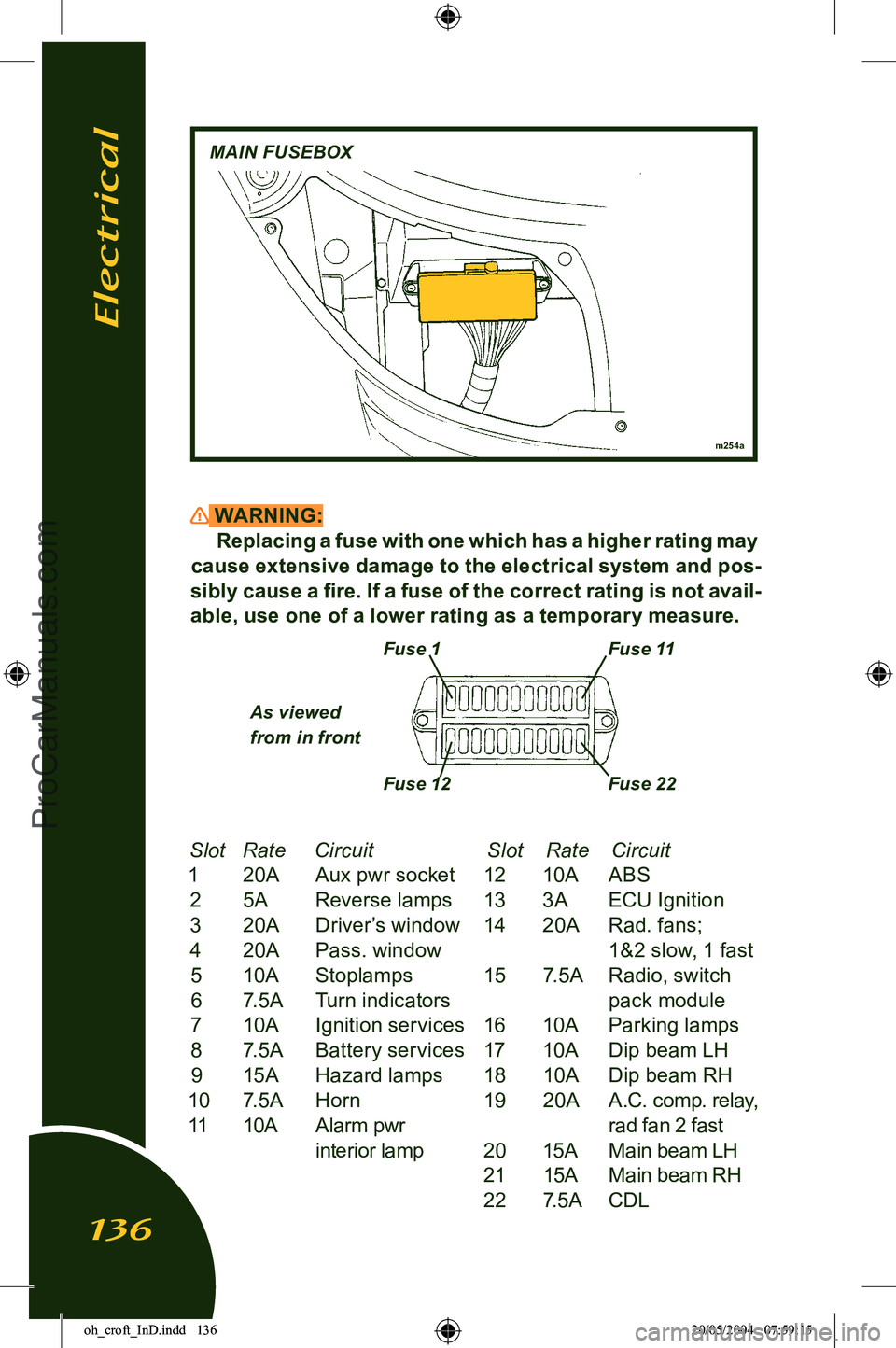
WARNING:Replacing a fuse with one which has a higher rating may
cause extensive damage to the electrical system and pos
-
sibly cause a fire. If a fuse of the correct rating is not avail
-
able, use one of a lower rating as a temporary measure.
Slot
Rate Circuit Slot Rate Circuit
1 20A Aux pwr socket 12 10A ABS 2 5A Reverse lamps 13 3A ECU Ignition
3 20A Driver’s window 14 20A Rad. fans;
4 20A Pass. window 1&2 slow, 1 fast 5 10A Stoplamps 15 7.5A Radio, switch6 7.5A Turn indicators pack module
7 10A Ignition services 16 10A Parking lamps
8 7.5A Battery services 17 10A Dip beam LH9 15A Hazard lamps 18 10A Dip beam RH
10 7.5A Horn 19 20A A.C. comp. relay,
11 10A Alarm pwr rad fan 2 fast interior lamp 20 15A Main beam LH
21 15A Main beam RH
22 7.5A CDL
m254a
MAIN FUSEBOX
Fuse 1Fuse 11
Fuse 12 Fuse 22
As viewed
from in front
Electrical
136
oh_croft_InD.indd 13620/05/2004 07:59:15ProCarManuals.com
Page 144 of 205
BULB REPLACEMENT
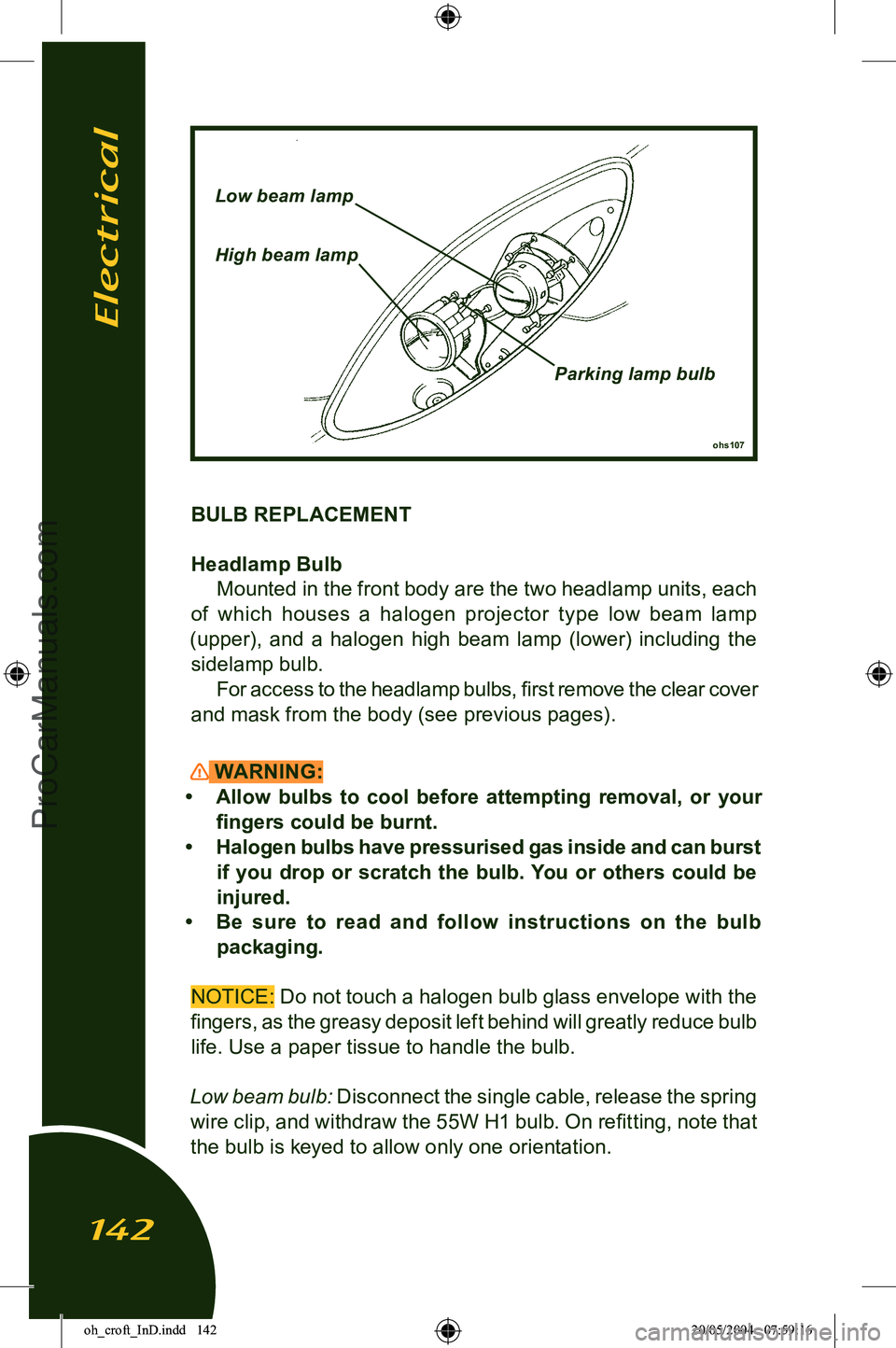
Headlamp BulbMounted in the front body are the two headlamp units, each
of which houses a halogen projector type low beam lamp
(upper), and a halogen high beam lamp (lower) including the sidelamp bulb. For access to the headlamp bulbs, first remove the clear cover
and mask from the body (see previous pages).
WARNING:
• Allow bulbs to cool before attempting removal, or your fingers could be burnt.
• Halogen bulbs have pressurised gas inside and can burst if you drop or scratch the bulb. You or others could be
injured.
• Be sure to read and follow instructions on the bulb
packaging.
NOTICE: Do not touch a halogen bulb glass envelope with the
fingers, as the greasy deposit left behind will greatly reduce bulb life. Use a paper tissue to handle the bulb.
Low beam bulb: Disconnect the single cable, release the spring wire clip, and withdraw the 55W H1 bulb. On refitting, note that the bulb is keyed to allow only one orientation.
ohs107
Low beam lamp
High beam lamp
Parking lamp bulb
Electrical
142
oh_croft_InD.indd 14220/05/2004 07:59:16ProCarManuals.com