air condition LUCID AIR 2022 User Guide
[x] Cancel search | Manufacturer: LUCID, Model Year: 2022, Model line: AIR, Model: LUCID AIR 2022Pages: 241, PDF Size: 5.15 MB
Page 169 of 241

Multi-Point Inspection
Your vehicle should be given a full multi-point
inspection service every 12 months or 12,000
miles (19300 km), whichever comes first.
Note: A message displays on the Cockpit
Panel to remind you to service your vehicle.
This service includes inspections and checks
for the following systems:
-Steering alignment
- Battery (12V) condition
- Battery pack (HV) condition
- Coolant condition
- Brake
fluid condition
- Brake rotors and pads wear
- Chassis bolts torque
- Closures (doors, hood, and trunk)
operation
- Condenser (check for debris)
- Electronic parking brake operation
- Heating, ventilation, and air conditioning
operation
- Horn
- Interior and exterior lights
- Key fob operation
- Seat belts operation
- Tire pressure and tire wear
- Visual signs of fluid leaks
- Wipers and washers
- Charging system and charging cable
- Firmware
Your vehicle will also be given a road test to inspect its current driving condition (such
as pedal operation, vehicle handling, and
steering alignment) and to check for any abnormal operational noises.WARNING: Your vehicle is equipped
with two 12V batteries. It
Page 178 of 241

CAUTION: Do not use statically-
charged materials (such as a cloth
that was recently machine-washed
and dried) on the displays.CAUTION: Do not use cleansers (such
as glass cleaner) to clean displays.
Display screens should only be cleaned using
a soft, lint-free cloth designed for cleaning
screens and monitors.
Before cleaning the display screens, use the
Pilot Panel to enable screen cleaning mode
to prevent accidental operation of vehicle
controls. Select
> Displays > Displays
& Accessibility > SCREEN CLEANING MODE.
Airbags
WARNING: Airbag covers should only
be cleaned using a slightly dampened
cloth or cleaning wipe. Water or any
other liquid entering into an airbag
or its associated electrical wiring may
cause the airbags to deploy or not
function properly in an accident.WARNING: Any damage or cracks on
an airbag cover should be referred to a
Lucid Service Center for inspection.
Seats
WARNING: Never use steam or
upholstery cleaners on the seats,
or any cleaning method that would
saturate the seat with liquid. This can
damage the occupancy weight sensor
in the seat, which in turn can affect
the operation of the airbag system and
result in serious injury or death.
For cloth seats:
-If necessary, gently vacuum the seats
first to remove any loose dust, dirt, or
debris.
- Use a soft, colorless cloth moistened
with warm water and (if necessary) non- detergent soap. Wipe gently in a circular
motion. Allow the seats to air dry after
cleaning.
For leather and artificial leather seats:
-To clean, use a soft, colorless cloth
moistened only with warm water. Do
not use polishes, oils, cleaning fluids,
solvents, or detergents.
- Avoid vacuuming. Instead, use your
moistened cleaning cloth to gently
remove any loose particles.
- Application of a leather conditioner is
not necessary to maintain the original
condition of the seats.
Seat beltsWARNING: Never allow any substance
to enter a seat belt mechanism,
as this can negatively affect its
performance in an impact.
Extend the seat belt and clean using a cloth
moistened only with water. Do not use any
type of detergent or chemical cleaning agent.
Allow the belts to air dry while extended, away
from direct sunlight if possible.
Chrome and metal surfaces
Do not use abrasive cleansers, rough cloths,
or polish, as these materials can damage the
finish of these surfaces.
Plastic materials
WARNING: Do not use polish or wax
cleaner on the upper surfaces of the dashboard. Polished surfaces are
reflective and may interfere with the
driver
Page 190 of 241

Lucid does not recommend moving the
wheels between the front and rear axles, or
from side to side on the same axle pair.
Punctured tiresWARNING: Do not drive the vehicle
with a punctured tire. Even if the
punctured tire has not deflated, it is
unsafe to use as the tire may deflate
suddenly at any time.
Your vehicle is fitted with tubeless tires, which
may not leak when penetrated, provided the
object remains in the tire.
If, however, you feel a sudden vibration or ride
disturbance while driving, or you suspect your
tire or vehicle has been damaged, immediately
reduce your speed. Drive slowly while avoiding
heavy braking or sharp steering, and when
safe to do so, stop the vehicle.
Inspect the tires for damage. If a tire is under-
inflated and does not appear to have any
damage to the sidewall, try to repair using a
tire repair kit. If you cannot detect the cause
or the tire is too heavily damaged, have the
vehicle recovered to a tire repair center, or a Lucid Service Center to have the vehicle
inspected.
A puncture will eventually cause the tire to
lose pressure, which is why frequent checking
of tire pressures is important. Punctured or
damaged tires must be permanently repaired or replaced as soon as possible.
Age degradation
Tires degrade over time due to the effects of
ultraviolet light, extreme temperatures, high
loads, and environmental conditions. It is recommended that tires are replaced every
six years, but may require replacement more
frequently.
Maintaining Tire Pressures
WARNING: Use a gauge to check tire
pressures when COLD. Under-inflation
is the most common cause of tire
failures and may result in severe
tire cracking, tread separation, or
“blowout,” with an unexpected loss of
vehicle control and increased risk of
injury.Each tire should be checked monthly and
inflated to the pressure recommended on the
vehicle placard or tire inflation pressure label.
(If your vehicle has tires of a different size than the size indicated on the vehicle placard
or tire inflation pressure label, you should
determine the proper tire inflation pressure for
those tires).
Driving on a significantly under-inflated tire
causes the tire to overheat and can lead
to tire failure. Under-inflation also reduces
battery range and tire tread life, and may
affect the vehicle
Page 191 of 241

To view current tire pressures on the Pilot
Panel. Select
> Vehicle > Tire
Pressure.
Note: Tire pressure is shown once the vehicle
is driven over 13 mph (21 km/h).
If it is necessary to check the tires when they
are warm, you should expect the pressures to
have increased. Do not reduce the pressure of warm tires in an attempt to match the
recommended cold tire pressures.
To view the recommended COLD tire
pressures for your vehicle, select the
RECOMMENDED tab. Always inflate your tires
to the pressures recommended by Lucid, even
if it is different from the maximum inflation
pressure information found on the tire itself.
Adjusting tire pressure
To check and adjust tire pressure: 1. Remove the cap from the valve, then firmly press the tire gauge onto the valve
and measure the pressure.
2. If required, add air to reach the required pressure.
3. Check the pressure by removing the tire gauge and then re-attaching it. Failure
to remove and re-attach the gauge to
the valve could cause the gauge to show
an incorrect reading.
4. If the tire pressure is too high, remove the gauge and release air from the tireby pressing on the metal stem in the
center of the valve. Refit the gauge to
the valve and check the pressure.
5. Repeat the process of adding or removing air as required until the correct
tire pressure is reached.
6. Refit the valve cap.
Tire valves
Keep the valve caps screwed down firmly to
prevent water or dirt from entering the valve.
Check the valves for leaks when checking the tire pressures.
Flat spots
If the vehicle is stationary for a long period when the ambient temperature is high, the
tires may form flat spots. When the vehicle is
driven, these flat spots will cause a vibration
that will steadily disappear as the tires warm
up and regain their original shape.
Tire pressures during long-term storage
Inflate tires to the maximum pressure as
indicated on the tire wall to minimize flat
spots during storage.WARNING: The tire pressures must be
reduced to the correct pressure before
the vehicle is driven.
Tire pressures at high speeds
CAUTION: Vehicle speed is capped
depending on the trim level. Operating
your vehicle at speeds over the speed
limit is not recommended. Customer is
responsible for obeying all traffic laws.
If operating the vehicle above 155mph (250
km/h) , temporarily inflate the tire to a cold
inflation pressure according to the table
below. If the conditions in the table below are
met, then all axle loads up to Front Gross Axle
Weight Rating and Rear Gross Axle Weight
Rating are acceptable.
Tire SizeSpeeds below
155mph (250
km/h)Speeds above
155mph (250
km/h)245/45R1949 psi (340
kPa)49 psi (340
kPa)245/40R2042 psi (290
kPa)45 psi (310
kPa)265/40R2042 psi (290
kPa)45 psi (310
kPa)245/35R2142 psi (290
kPa)45 psi (310
kPa)265/35R2142 psi (290
kPa)45 psi (310
kPa)
Note: Track or competition use of the vehicle
is not covered under the Lucid New Vehicle
Limited Warranty, and is not recommended.
Tire & Wheels178
Page 192 of 241
Replacing Tires and WheelsWARNING: For your safety, it is
recommended that only wheels
and tires that match the original
specification are used on the vehicle.
Specifications for approved winter
tires are available by contacting your
Lucid Service Center.WARNING: Operation of the Tire
Pressure Monitoring System (TPMS)
may be affected if the tires are
replaced with a different specification
from the originals.
Wheel rims and tires are matched to suit
the handling characteristics of the vehicle.
Always check that replacement tires comply
with the original specification. If tires other
than those specified are used, ensure that
the load and speed ratings (shown on the tire
side wall) equal or exceed those of the original
specification.
Ideally, tires should be replaced as sets of
four. If this is not possible, replace the tires
in pairs (front and rear). When replacng tires,
the wheels should be balanced and alignment
checked.
Asymmetric tires
WARNING: Vehicle traction and
handling will be seriously impaired if
the tires are incorrectly installed on
the wheels.
Your vehicle is equipped with Asymmetric
tires that have different tread patterns on
the outer and inner edge of the tire. On the
outside edge, the tread pattern exhibits large
tread blocks that are designed to provide
dry traction and handling thanks to a larger
contact area with the road.
On the inside edge, the tread block is smaller
to provide better wet grip. An increased
number of grooves helps disperse water on wet roads and reduce the risk of aquaplaning.
This means the tire is built to provide great
performance in both wet and dry conditions.
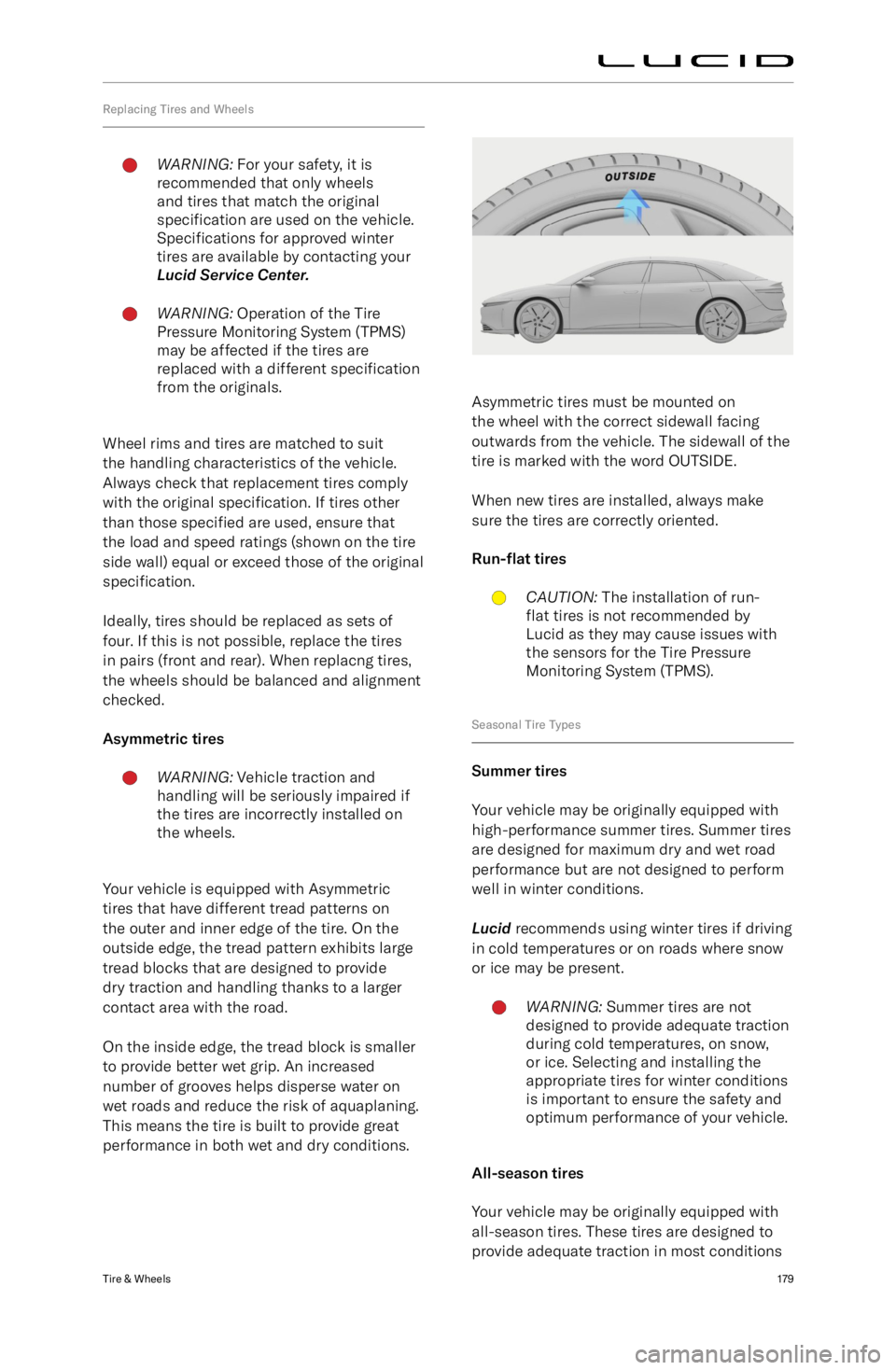
Asymmetric tires must be mounted on
the wheel with the correct sidewall facing
outwards from the vehicle. The sidewall of the
tire is marked with the word OUTSIDE.
When new tires are installed, always make
sure the tires are correctly oriented.
Run-
Page 194 of 241
Tire Pressure Monitoring System
Tire Pressure Monitoring System (TPMS)WARNING: The TPMS is not a
substitute for manually checking tire
pressures. The TPMS only provides a
tire pressure warning and does not re-
inflate the tires.WARNING: The TPMS cannot register
damage to a tire. Regularly check the
condition of your tires.WARNING: Using liquid or aerosol tire
sealants may cause a malfunction of
tire pressure sensors.
The TPMS monitors the pressure of the
tires using sensors located in each wheel.
In-vehicle sensors receive TMPS data using
Radio Frequency (RF) signals.
Note: Installing accessories that are not
approved by Lucid may interfere with the
TPMS system.
Tire pressure warnings are displayed
on the Cockpit Panel using an
amber warning indicator. A warning
chime will sound, and a warning
message will display to alert you to a problem.
The tire pressure warning indicator will
illuminate if a tire is under-inflated.
If the tire pressure warning indicator
illuminates, stop and check your tires as soon as possible and inflate them to the correct
pressure. If the tire pressure warning occurs
frequently, the cause must be determined and rectified.
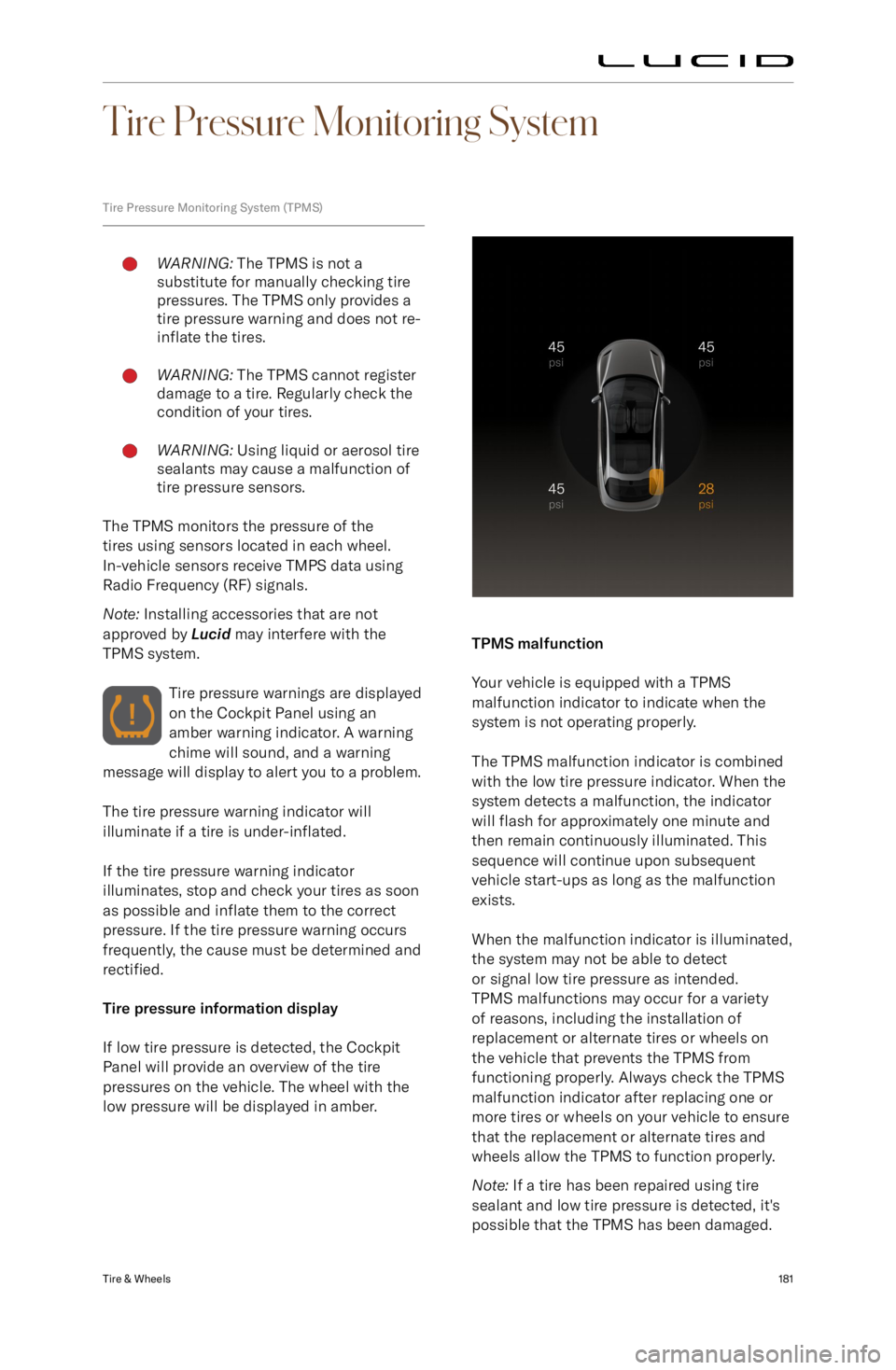
Tire pressure information display
If low tire pressure is detected, the Cockpit
Panel will provide an overview of the tire
pressures on the vehicle. The wheel with the low pressure will be displayed in amber.
TPMS malfunction
Your vehicle is equipped with a TPMS
malfunction indicator to indicate when the system is not operating properly.
The TPMS malfunction indicator is combined
with the low tire pressure indicator. When the system detects a malfunction, the indicatorwill flash for approximately one minute and
then remain continuously illuminated. This
sequence will continue upon subsequent
vehicle start-ups as long as the malfunction
exists.
When the malfunction indicator is illuminated,
the system may not be able to detect
or signal low tire pressure as intended.
TPMS malfunctions may occur for a variety
of reasons, including the installation of
replacement or alternate tires or wheels on
the vehicle that prevents the TPMS from
functioning properly. Always check the TPMS
malfunction indicator after replacing one or
more tires or wheels on your vehicle to ensure that the replacement or alternate tires and
wheels allow the TPMS to function properly.
Note: If a tire has been repaired using tire
sealant and low tire pressure is detected, it
Page 216 of 241
New Vehicle Limited Warranty
Message to Customers
Welcome to the Lucid New Vehicle LimitedWarranty, and welcome to luxury electric. This
guide provides a detailed explanation of the
warranty terms for the Lucid Air, including
coverage types, durations, limitations, regions,
and more. Our goal is to provide peace of
mind and exceptional service at every step of
the Lucid Air ownership experience.
Who is the Warrantor?
Lucid USA, Inc. is the warrantor in the
United States and Lucid Motors Canada
ULC is the warrantor in Canada (collectively
"Lucid”). Lucid will provide repairs to Lucid
Airs sold by and delivered directly from Lucid
or its affiliates during the applicable warranty
periods in the specified Warranty Regions
listed below in accordance with the terms, conditions and limitations in this Lucid New
Vehicle Limited Warranty.
Warranty RegionWarrantor and Contact InformationUSALucid USA, Inc.
7373 Gateway Blvd
Newark, CA 94560
Phone: 1-888-99 LUCID
(1-888-995-8243)CanadaLucid Motors Canada ULC
Suite 2300, Bentall 5, 550
Burrard Street Vancouver BC,
V6C 2B5
Phone: 1-888-99 LUCID
(1-888-995-8243)
The Lucid New Vehicle Limited Warranty is valid only within the region for which theLucid Air was originally manufactured and
sold. Any service required under the terms of
this Lucid New Vehicle Limited Warranty will
be provided by a Lucid Service Center.
You may take your Lucid Air temporarily to any
region where there is a Lucid Service Center,
and the Lucid Warranty will be honored in that
region. Temporary is defined as a period less
than six months. Proof of compliance with
any temporary import laws or regulations is
required. If you are permanently moving to
a new region supported by a Lucid Service
Center, you may apply to Lucid to transfer the
Lucid Warranty to the region for the duration of your ownership. Requests to transfer a
vehicle
Page 221 of 241

demonstrator vehicle), whichever occurs first
and lasts until the time period as stated in
the New Vehicle Warranty Coverage section of
this guide.
What Are Your Remedies?
The Lucid New Vehicle Limited Warranty
covers the rectification of reported defects
covered by this warranty via repair,
replacement, or adjustment of faulty parts
or components, as determined by Lucid in
its discretion. If a defect can be properly
eliminated by repair, and this is the most
economical course of action, then the Lucid
Service Representative will complete the
repair. Lucid may determine at its sole
discretion that certain parts or components
should be replaced rather than repaired.
For Lucid Genuine Spare Parts installed
during a warranty repair, the warranty
coverage ends at the expiration of the
warranty period for that covered system.
For reported defects in the materials or
workmanship of any parts manufactured or
supplied by Lucid but not remedied within the
warranty period, the Lucid Warranty coverage for that reported defect will continue until the
reported defect is resolved. Such coverage will
end:
-When the Lucid Service Representative
confirms that the defect has been
eliminated;
- When the Lucid Service Representative
confirms that no fault exists; or
- Thirty days after you have been notified
in writing that the Lucid Genuine Spare
Parts required to carry out the repair
are in stock at the Lucid Service
Representative.
Limitations on Liability
To the fullest extent allowed by applicable law,
all of the warranties in this Lucid New Vehicle
Limited Warranty are subject to the following
limitations and disclaimers:
THE WARRANTIES IN THIS LUCID NEW
VEHICLE LIMITED WARRANTY ARE THE
ONLY EXPRESS WARRANTIES APPLICABLE
TO YOUR VEHICLE. LUCID DOES NOT
ASSUME OR AUTHORIZE ANYONE TO
ASSUME FOR IT ANY OTHER OBLIGATION OR LIABILITY IN CONNECTION WITH YOUR
VEHICLE OR THESE WARRANTIES. NO
PERSON MAY MODIFY OR WAIVE ANY PART OF THESE WARRANTIES.
As a condition of these warranties, you are
responsible for properly using, maintaining, and caring for your vehicle as outlined in yourOwner
Page 226 of 241
Disclaimers
California Proposition 65
WARNING: Operating, servicing, andmaintaining a passenger vehicle can
expose you to chemicals, including
phthalates, which are known to
the State of California to cause cancer
and birth defects, or other reproductive
harm. To minimize exposure, wear gloves or
wash your hands frequently when servicing
your vehicle. For more information, go to
www.P65Warnings.ca.gov/passenger-vehicle .
California Perchlorate Advisory
WARNING: Certain components of
this vehicle, such as lithium batteries,
may contain perchlorate material.
Special handling may apply for
service or end-of-life disposal. See
www.dtsc.ca.gov .
Vehicle Telematics
Lucid Air is an advanced connected vehicle
equipped with a host of advanced electronic
control units (ECUs), each responsible for
a specific set of features. The features
span domains including controls, safety,
infotainment, chassis, AD/ADAS, telematics, to name a few that contribute to functionality,
performance, safety, and security of the
vehicle.
In the process of its operation, each ECU
monitors a set of sensors and controls a
set of actuators depending on the role of
the ECU. As a result, each ECU generates
and collects data about the operational
state, performance, anomalies, environment
conditions, battery and charging related information, speed, direction, location, etc.
The collected data are transmitted to the
Lucid cloud services infrastructure on an
ongoing basis over cellular wireless and
wireless LAN networks. In addition, a portion of the data may be accessed by the
technicians at the service center and stored
in the Lucid information databases.
Lucid may use the vehicle data stored
in the vehicle, databases in the service
centers, and cloud-based infrastructure to enhance its products and services,
including but not limited to vehicle
maintenance, troubleshooting, timely service
recommendations & reminders, additional
feature recommendations, research and
development, and marketing & business
analysis purposes. Lucid Air has the over-the-
air (OTA) software update capability to keep the vehicle software current and improved.Lucid may use the vehicle data to update
vehicle software improvements OTA to avoid
issues proactively before they occur on the
vehicle.
Please see Lucid