tire LUCID AIR 2022 Owner's Manual
[x] Cancel search | Manufacturer: LUCID, Model Year: 2022, Model line: AIR, Model: LUCID AIR 2022Pages: 241, PDF Size: 5.15 MB
Page 194 of 241
Tire Pressure Monitoring System
Tire Pressure Monitoring System (TPMS)WARNING: The TPMS is not a
substitute for manually checking tire
pressures. The TPMS only provides a
tire pressure warning and does not re-
inflate the tires.WARNING: The TPMS cannot register
damage to a tire. Regularly check the
condition of your tires.WARNING: Using liquid or aerosol tire
sealants may cause a malfunction of
tire pressure sensors.
The TPMS monitors the pressure of the
tires using sensors located in each wheel.
In-vehicle sensors receive TMPS data using
Radio Frequency (RF) signals.
Note: Installing accessories that are not
approved by Lucid may interfere with the
TPMS system.
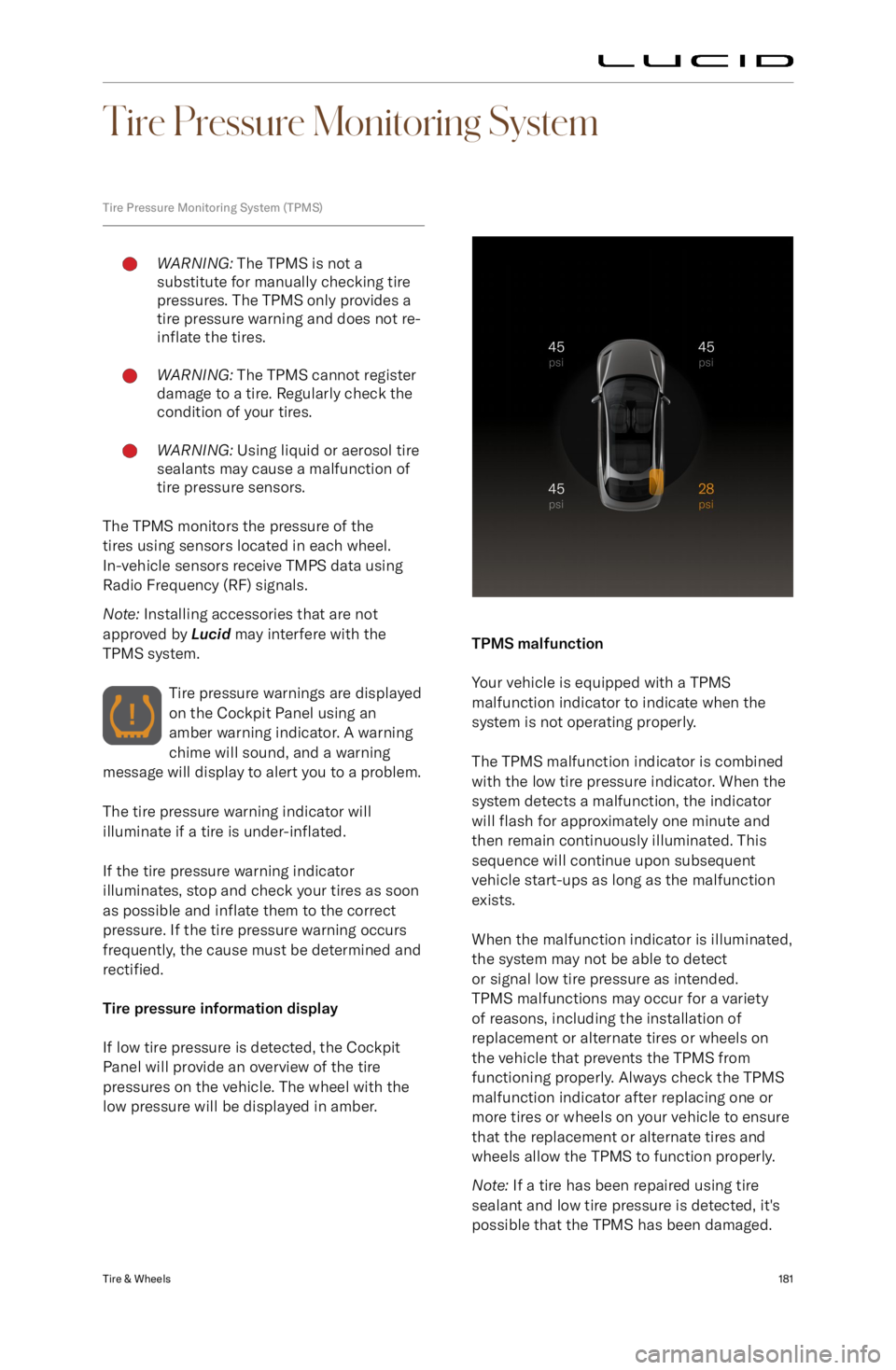
Tire pressure warnings are displayed
on the Cockpit Panel using an
amber warning indicator. A warning
chime will sound, and a warning
message will display to alert you to a problem.
The tire pressure warning indicator will
illuminate if a tire is under-inflated.
If the tire pressure warning indicator
illuminates, stop and check your tires as soon as possible and inflate them to the correct
pressure. If the tire pressure warning occurs
frequently, the cause must be determined and rectified.
Tire pressure information display
If low tire pressure is detected, the Cockpit
Panel will provide an overview of the tire
pressures on the vehicle. The wheel with the low pressure will be displayed in amber.
TPMS malfunction
Your vehicle is equipped with a TPMS
malfunction indicator to indicate when the system is not operating properly.
The TPMS malfunction indicator is combined
with the low tire pressure indicator. When the system detects a malfunction, the indicatorwill flash for approximately one minute and
then remain continuously illuminated. This
sequence will continue upon subsequent
vehicle start-ups as long as the malfunction
exists.
When the malfunction indicator is illuminated,
the system may not be able to detect
or signal low tire pressure as intended.
TPMS malfunctions may occur for a variety
of reasons, including the installation of
replacement or alternate tires or wheels on
the vehicle that prevents the TPMS from
functioning properly. Always check the TPMS
malfunction indicator after replacing one or
more tires or wheels on your vehicle to ensure that the replacement or alternate tires and
wheels allow the TPMS to function properly.
Note: If a tire has been repaired using tire
sealant and low tire pressure is detected, it
Page 195 of 241
Contact a Lucid Service Center to have the
issue rectified as soon as possible.
Tire pressure correction
The tire pressure indicator light does not
automatically turn off when the tire pressure
is adjusted for all four tires.
After the tires are inflated to the correct
pressures, drive your vehicle over 18 mph
(30 km/h) to activate the Tire Pressure
Monitoring System (TPMS) and turn off the
low tire pressure indicator light.
Tire changing
Always have your tires serviced or changed by
a qualified technician.
Care must be taken to avoid contact between
the bead of the tire and the sensor during removal and refitting of the tire, otherwise
the sensor may become damaged and/or inoperable.
Replacing a tire pressure sensor
If you experience frequent low tire pressure warnings and the tire pressures are correct,
contact Lucid Service Center to determine if
a tire pressure sensor requires replacement.
Note: If a non-Lucid Service Center has
replaced a tire pressure sensor, it may not
work until it has been programmed to the
vehicle by Lucid.Tire & Wheels182
Page 197 of 241

Example load limit calculations
The number and weight of passengers will
affect the weight of available cargo and
luggage load capacity.
The following are typical examples of
calculated load limits.DescriptionTotalVehicle Capacity Weight =950 lb (431 kg)Subtract Occupant Weight (2 x
150 lb) =300 lb (136 kg)Available Cargo or Luggage
Weight =650 lb (295 kg)DescriptionTotalVehicle Capacity Weight =950 lb (431 kg)Subtract Occupant Weight (4 x
150 lb) =600 lb (272 kg)Available Cargo or Luggage
Weight =350 lb (159 kg)
Note: Calculations for the available cargo and
luggage capacity assume that the passengers
weigh 150 lb (68 kg). If the passengers
weigh more than this, the available cargo and
luggage load capacity will decrease.
Tire & Wheels184
Page 201 of 241

Wheels and Tires
Wheel and Tire SpecificationsWheel TypePositionSizeStandard production wheels19
Page 202 of 241

Tire PressuresRecommended COLD inflation pressuresTire pressures may vary depending on the type
of tires
Page 209 of 241
Roadside Assistance
Contacting Roadside Assistance
Lucid is committed to providing excellent
service. Our Roadside Assistance Program is
available 24 hours a day, 365 days a year. For
assistance call::
+1 888-995-8243 (888-99-LUCID)
Advise the representative of: -Vehicle identification number (VIN)
- Vehicle description
- License plate number
- Problem with the vehicle
- Your location
Lucid ensures appropriate transportation of its vehicles under the Lucid Roadside
Assistance Program. However, it is your
responsibility to provide the vehicle
transporter with instructions on how to
transport the vehicle. See Transporting the
Vehicle .
Services Covered
The following are covered at no charge for four
years or 50,000 miles, whichever comes first:
- Emergency Towing/Transport Service
for warranty repairs to the nearest
authorized Lucid Service Center
- Roadside service
- Flat Tire
- 12v Battery
Within the first year of ownership, Lucid
will also provide towing and transport to an
authorized Collison Repair facility in the event
of an accident.
Roadside Assistance & Emergency Information196
Page 214 of 241
Vehicle Fire
FirefightingWARNING: When a fire is involved,
consider the entire vehicle to be
energized. Always wear full personal
protective equipment (PPE), including
a self-contained breathing apparatus
(SCBA).WARNING: Extinguishing any vehicle
fire is best accomplished by
firefighting professionals. Contact
your local authorities or fire
department for help.
A vehicle battery fire presents a risk of
exposure to high heat or toxic gases. It
can take copious amounts of water applied
directly to the battery to extinguish and cool a
battery fire. Establish or request an additional
water supply from nearby sources.
In the absence of a water supply, use dry
chemicals, such as Carbon dioxide (CO2), foam, or any other typical fire-extinguishing
agent, to fight the fire until a water supply is
available.
Extinguishing smaller fires that do not involve
a high-voltage battery follows the standard
firefighting procedures.
A burning or a heated battery releases toxic
vapors. Responders should always protect
themselves with full PPE (including a SCBA)
and take appropriate measures to protect
civilians from the incident. Use fog streams
or positive-pressure ventilation fans (PPV) to
direct smoke and vapors away from other
responders and civilians.
After knock down
Make sure any fires are knocked down before
entering a hot zone. Heat combined with
flames can compromise the airbag inflators,
stored gas inflation cylinders, gas struts, and
other components, resulting in an unexpected
explosion.
During vehicle inspections, always use
insulated tools and do not make contact with
any high-voltage components.
Use a thermal imaging camera to measure the temperature of the high-voltage battery
and monitor heating or cooling trends.
Before releasing the vehicle to second
responders (such as law enforcement or vehicle transporters) or otherwise leaving the
incident, completely cool the battery with no
fire, smoke, or heating present for at least one
hour. Always notify second responders of the
risk of battery re-ignition.Roadside Assistance & Emergency Information201
Page 219 of 241

-Upholstery and trim
- Steering Wheel
- Floor coverings
Service parts include, but are not limited to: -Filters
- Lubricants
- Items replaced during routine
maintenance
Service adjustments required after the first
service, including but not limited to:
-Adjustment to doors and hoods
- Head lamp adjustment
- Wheel alignment
- Wheel balancing
Tires
The original factory fitted tires are covered
against manufacturing defects by the tire
manufacturer, who provides a separate
warranty to you with its own terms and
conditions. Warranty claims must be made
directly with the tire manufacturer. The Lucid
New Vehicle Limited Warranty does not cover
tires.
Performance Modi
Page 230 of 241

ComponentManufacturerModelOperating Frequency (MHz)FCC ID / ISED IDTelematics
Control UnitLucid USA, Inc.P11-K290G02412.0-2462.0 MHz,
2502.5-2567.5 MHz,
5180.0-5240.0 MHz,
5745.0-5825.0 MHz,
699.7-715.3 MHz,
779.5-784.5 MHz,
824.2-848.8 MHz,
1710.7-1754.3 MHz,
1850.2-1909.8 MHz2AXZJ-CTX0710
IC: 27970-CTX0710Tire Pressure
Monitoring
SystemContinental
Automotive
GmbHTIS-01433.92 MHzKR5TIS-01
IC: 7812D-TIS01
Note: ISED compliance: CAN ICES-002/NMB-002
FCC and ISED Notes: Wireless Charger-JVIS USA FCC ID: 2AZX6-1LCID350001
IC: 27404-1LCID350001
This device complies with part 15 of the FCC Rules. Operation is subject to the following two conditions:
1. This device may not cause harmful interference.
2. This device must accept any interference received, including interference that may cause undesired operation.
Changes or modifications not expressly approved by the party responsible for compliance could
void the user
Page 240 of 241
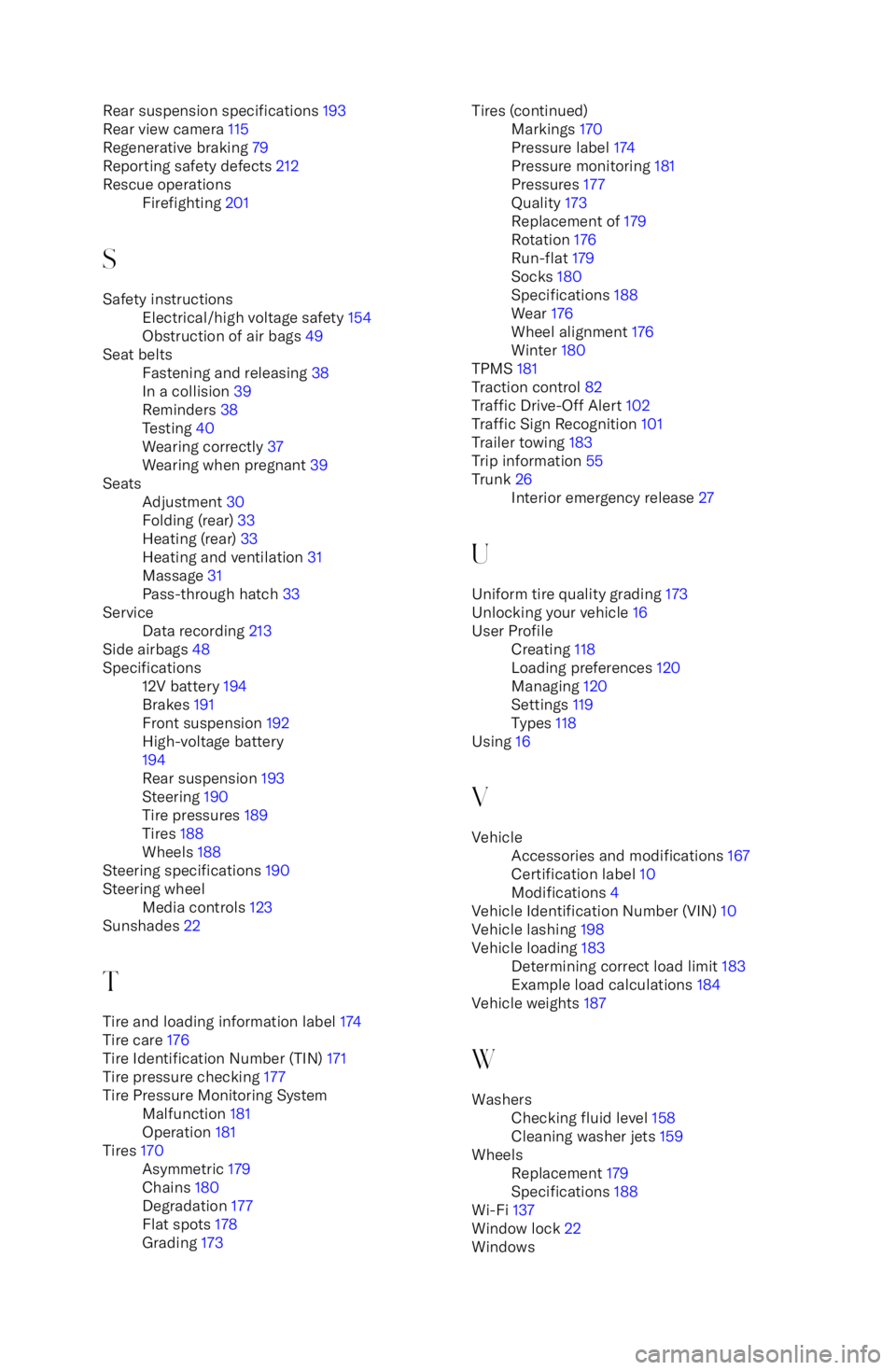
Rear suspension specifications 193
Rear view camera 115
Regenerative braking 79
Reporting safety defects 212Rescue operationsFirefighting 201
S
Safety instructionsElectrical/high voltage safety 154
Obstruction of air bags 49Seat beltsFastening and releasing 38
In a collision 39
Reminders 38
Testing 40
Wearing correctly 37
Wearing when pregnant 39SeatsAdjustment 30
Folding (rear) 33
Heating (rear) 33
Heating and ventilation 31
Massage 31
Pass-through hatch 33ServiceData recording 213
Side airbags 48
Specifications12V battery 194
Brakes 191
Front suspension 192
High-voltage battery
194
Rear suspension 193
Steering 190
Tire pressures 189
Tires 188
Wheels 188
Steering specifications 190
Steering wheelMedia controls 123
Sunshades 22
T
Tire and loading information label 174
Tire care 176
Tire Identification Number (TIN) 171
Tire pressure checking 177
Tire Pressure Monitoring SystemMalfunction 181
Operation 181Tires 170Asymmetric 179
Chains 180
Degradation 177
Flat spots 178
Grading 173Tires (continued)Markings 170
Pressure label 174
Pressure monitoring 181
Pressures 177
Quality 173
Replacement of 179
Rotation 176
Run-flat 179
Socks 180
Specifications 188
Wear 176
Wheel alignment 176
Winter 180
TPMS 181
Traction control 82
Traffic Drive-Off Alert 102
Traffic Sign Recognition 101
Trailer towing 183
Trip information 55
Trunk 26Interior emergency release 27
U
Uniform tire quality grading 173
Unlocking your vehicle 16
User ProfileCreating 118
Loading preferences 120
Managing 120
Settings 119
Types 118
Using 16
V
VehicleAccessories and modifications 167
Certification label 10
Modifications 4
Vehicle Identification Number (VIN) 10
Vehicle lashing 198
Vehicle loading 183Determining correct load limit 183
Example load calculations 184
Vehicle weights 187
W
WashersChecking fluid level 158
Cleaning washer jets 159WheelsReplacement 179
Specifications 188
Wi-Fi 137
Window lock 22
Windows