wheel LUCID AIR 2023 Service Manual
[x] Cancel search | Manufacturer: LUCID, Model Year: 2023, Model line: AIR, Model: LUCID AIR 2023Pages: 241, PDF Size: 5.15 MB
Page 195 of 241

Contact a Lucid Service Center to have the
issue rectified as soon as possible.
Tire pressure correction
The tire pressure indicator light does not
automatically turn off when the tire pressure
is adjusted for all four tires.
After the tires are inflated to the correct
pressures, drive your vehicle over 18 mph
(30 km/h) to activate the Tire Pressure
Monitoring System (TPMS) and turn off the
low tire pressure indicator light.
Tire changing
Always have your tires serviced or changed by
a qualified technician.
Care must be taken to avoid contact between
the bead of the tire and the sensor during removal and refitting of the tire, otherwise
the sensor may become damaged and/or inoperable.
Replacing a tire pressure sensor
If you experience frequent low tire pressure warnings and the tire pressures are correct,
contact Lucid Service Center to determine if
a tire pressure sensor requires replacement.
Note: If a non-Lucid Service Center has
replaced a tire pressure sensor, it may not
work until it has been programmed to the
vehicle by Lucid.Tire & Wheels182
Page 196 of 241

Vehicle Loading
Loading the VehicleWARNING: Overloading the vehicle
has an adverse effect on braking and
handling characteristics, which can compromise your safety or damage
the vehicle.
It is important to understand the maximum
weight rating for your vehicle and how much
weight your vehicle can safely carry.
See the vehicle certification label located on
the driver side front door jamb, by the front
wheel, for the maximum load for your vehicle
Page 197 of 241

Example load limit calculations
The number and weight of passengers will
affect the weight of available cargo and
luggage load capacity.
The following are typical examples of
calculated load limits.DescriptionTotalVehicle Capacity Weight =950 lb (431 kg)Subtract Occupant Weight (2 x
150 lb) =300 lb (136 kg)Available Cargo or Luggage
Weight =650 lb (295 kg)DescriptionTotalVehicle Capacity Weight =950 lb (431 kg)Subtract Occupant Weight (4 x
150 lb) =600 lb (272 kg)Available Cargo or Luggage
Weight =350 lb (159 kg)
Note: Calculations for the available cargo and
luggage capacity assume that the passengers
weigh 150 lb (68 kg). If the passengers
weigh more than this, the available cargo and
luggage load capacity will decrease.
Tire & Wheels184
Page 199 of 241
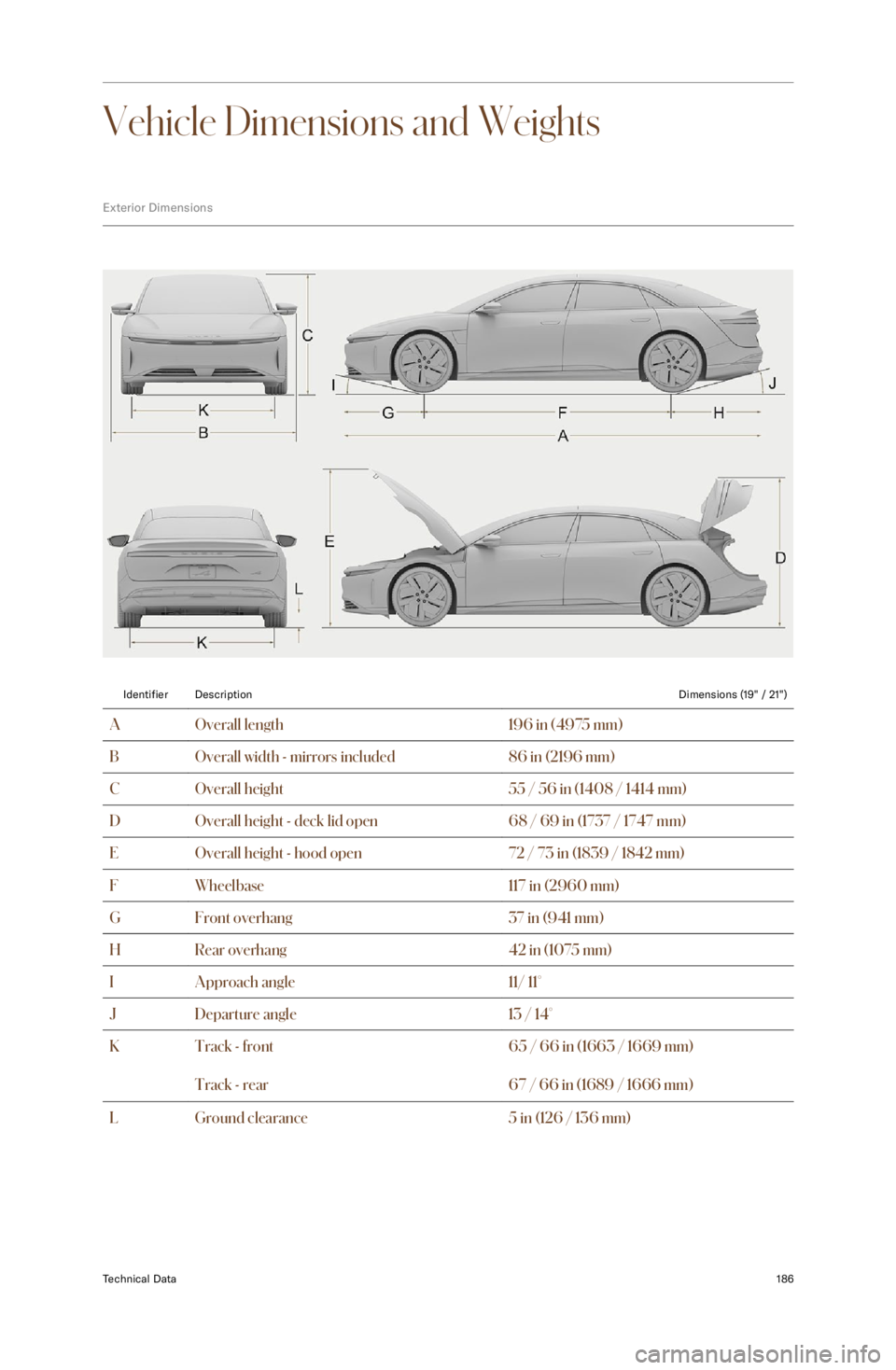
Vehicle Dimensions and Weights
Exterior DimensionsIdentifierDescriptionDimensions (19" / 21")AOverall length196 in (4975 mm)BOverall width - mirrors included86 in (2196 mm)COverall height55 / 56 in (1408 / 1414 mm)DOverall height - deck lid open68 / 69 in (1737 / 1747 mm)EOverall height - hood open72 / 73 in (1839 / 1842 mm)FWheelbase117 in (2960 mm)GFront overhang37 in (941 mm)HRear overhang42 in (1075 mm)IApproach angle11/ 11
Page 201 of 241
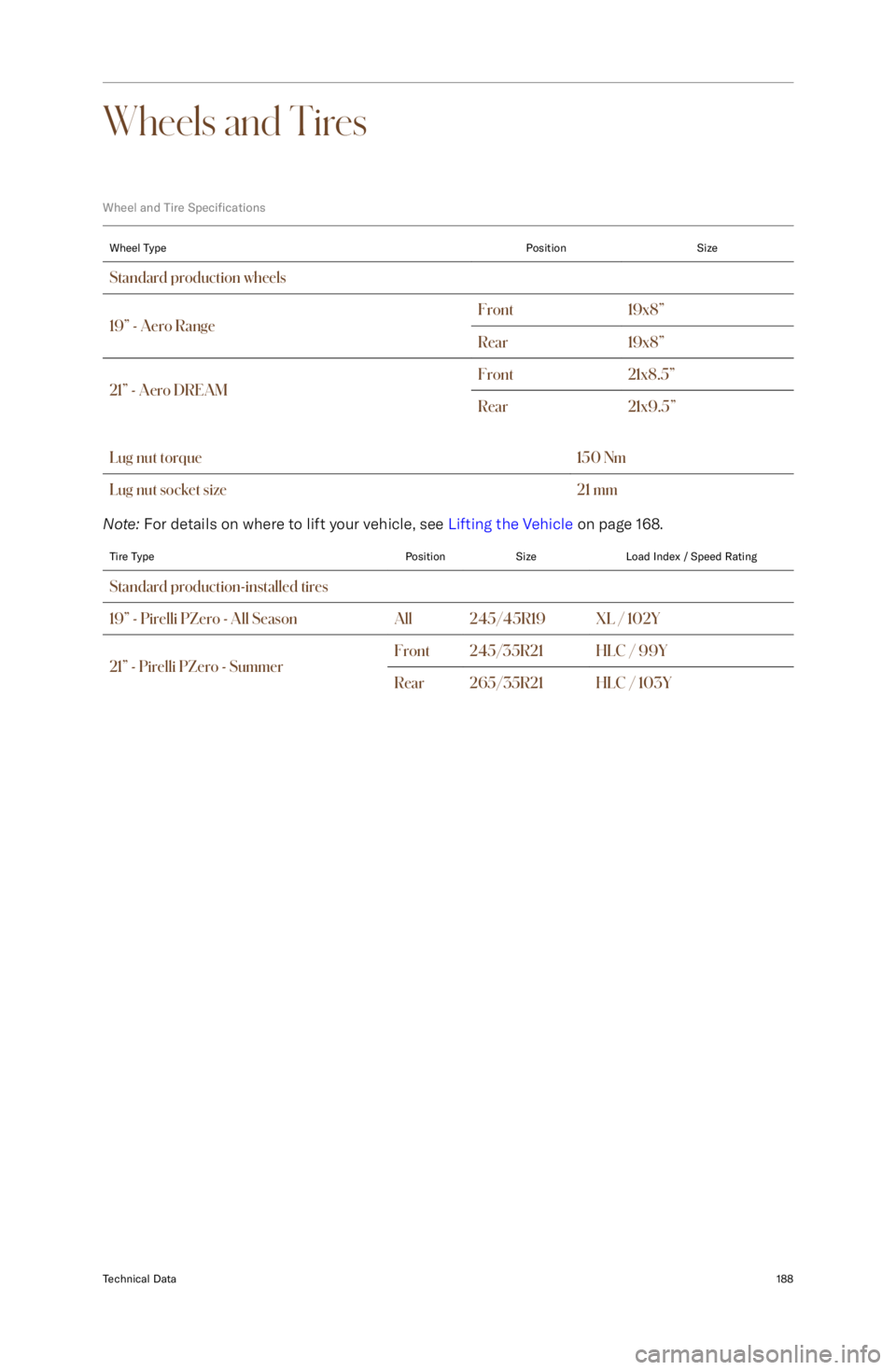
Wheels and Tires
Wheel and Tire SpecificationsWheel TypePositionSizeStandard production wheels19
Page 204 of 241

BrakesType4-wheel anti-lock braking system (ABS) with Electronic Brake Force Distribution,
Integrated Electronic Stability Control and electronic accelerator pedal-actuated regenerative braking system.CalipersFront: six-piston
Page 210 of 241

Instructions for Transporters
Transporting the VehicleCAUTION: Towing the vehicle with
the wheels on the ground or on a
suspended lift may cause serious
damage to the vehicle as well as
generate high voltages in the vehicle
Page 211 of 241
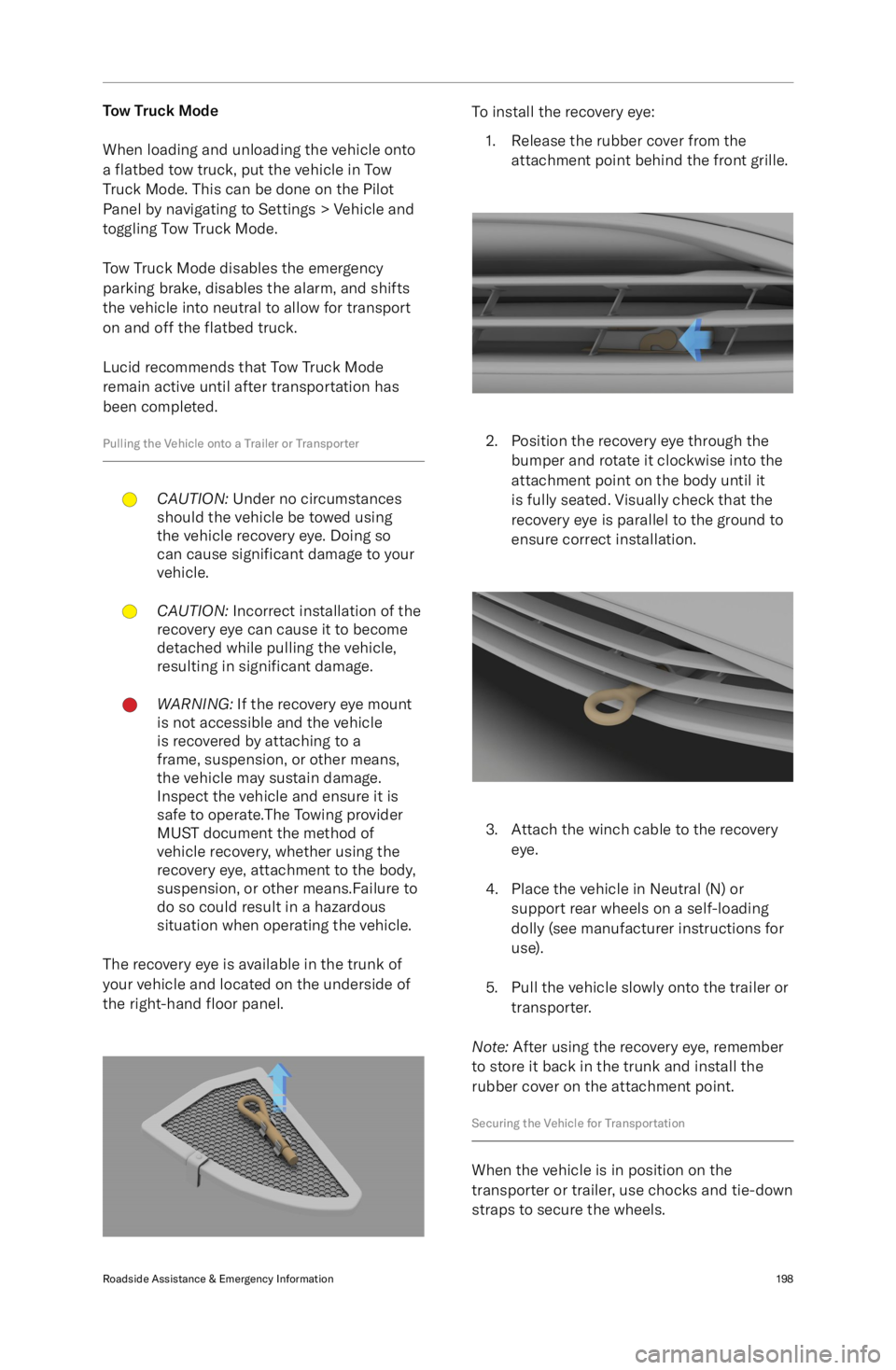
Tow Truck Mode
When loading and unloading the vehicle onto
a flatbed tow truck, put the vehicle in Tow
Truck Mode. This can be done on the Pilot
Panel by navigating to Settings > Vehicle and
toggling Tow Truck Mode.
Tow Truck Mode disables the emergency
parking brake, disables the alarm, and shifts
the vehicle into neutral to allow for transport
on and off the flatbed truck.
Lucid recommends that Tow Truck Mode
remain active until after transportation has been completed.
Pulling the Vehicle onto a Trailer or TransporterCAUTION: Under no circumstances
should the vehicle be towed using
the vehicle recovery eye. Doing so
can cause significant damage to your
vehicle.CAUTION: Incorrect installation of the
recovery eye can cause it to become
detached while pulling the vehicle,
resulting in significant damage.WARNING: If the recovery eye mount
is not accessible and the vehicle
is recovered by attaching to a
frame, suspension, or other means,
the vehicle may sustain damage.
Inspect the vehicle and ensure it is
safe to operate.The Towing provider
MUST document the method of
vehicle recovery, whether using the
recovery eye, attachment to the body,
suspension, or other means.Failure to
do so could result in a hazardous
situation when operating the vehicle.
The recovery eye is available in the trunk of
your vehicle and located on the underside of
the right-hand floor panel.
To install the recovery eye:
1. Release the rubber cover from the attachment point behind the front grille.
2. Position the recovery eye through thebumper and rotate it clockwise into the
attachment point on the body until it
is fully seated. Visually check that the
recovery eye is parallel to the ground to
ensure correct installation.
3. Attach the winch cable to the recovery eye.
4. Place the vehicle in Neutral (N) or support rear wheels on a self-loading
dolly (see manufacturer instructions for use).
5. Pull the vehicle slowly onto the trailer or transporter.
Note: After using the recovery eye, remember
to store it back in the trunk and install the
rubber cover on the attachment point.
Securing the Vehicle for Transportation
When the vehicle is in position on the
transporter or trailer, use chocks and tie-down
straps to secure the wheels.
Roadside Assistance & Emergency Information198
Page 219 of 241

-Upholstery and trim
- Steering Wheel
- Floor coverings
Service parts include, but are not limited to: -Filters
- Lubricants
- Items replaced during routine
maintenance
Service adjustments required after the first
service, including but not limited to:
-Adjustment to doors and hoods
- Head lamp adjustment
- Wheel alignment
- Wheel balancing
Tires
The original factory fitted tires are covered
against manufacturing defects by the tire
manufacturer, who provides a separate
warranty to you with its own terms and
conditions. Warranty claims must be made
directly with the tire manufacturer. The Lucid
New Vehicle Limited Warranty does not cover
tires.
Performance Modi
Page 240 of 241

Rear suspension specifications 193
Rear view camera 115
Regenerative braking 79
Reporting safety defects 212Rescue operationsFirefighting 201
S
Safety instructionsElectrical/high voltage safety 154
Obstruction of air bags 49Seat beltsFastening and releasing 38
In a collision 39
Reminders 38
Testing 40
Wearing correctly 37
Wearing when pregnant 39SeatsAdjustment 30
Folding (rear) 33
Heating (rear) 33
Heating and ventilation 31
Massage 31
Pass-through hatch 33ServiceData recording 213
Side airbags 48
Specifications12V battery 194
Brakes 191
Front suspension 192
High-voltage battery
194
Rear suspension 193
Steering 190
Tire pressures 189
Tires 188
Wheels 188
Steering specifications 190
Steering wheelMedia controls 123
Sunshades 22
T
Tire and loading information label 174
Tire care 176
Tire Identification Number (TIN) 171
Tire pressure checking 177
Tire Pressure Monitoring SystemMalfunction 181
Operation 181Tires 170Asymmetric 179
Chains 180
Degradation 177
Flat spots 178
Grading 173Tires (continued)Markings 170
Pressure label 174
Pressure monitoring 181
Pressures 177
Quality 173
Replacement of 179
Rotation 176
Run-flat 179
Socks 180
Specifications 188
Wear 176
Wheel alignment 176
Winter 180
TPMS 181
Traction control 82
Traffic Drive-Off Alert 102
Traffic Sign Recognition 101
Trailer towing 183
Trip information 55
Trunk 26Interior emergency release 27
U
Uniform tire quality grading 173
Unlocking your vehicle 16
User ProfileCreating 118
Loading preferences 120
Managing 120
Settings 119
Types 118
Using 16
V
VehicleAccessories and modifications 167
Certification label 10
Modifications 4
Vehicle Identification Number (VIN) 10
Vehicle lashing 198
Vehicle loading 183Determining correct load limit 183
Example load calculations 184
Vehicle weights 187
W
WashersChecking fluid level 158
Cleaning washer jets 159WheelsReplacement 179
Specifications 188
Wi-Fi 137
Window lock 22
Windows