ESP MASERATI GHIBLI 2019 Owners Manual
[x] Cancel search | Manufacturer: MASERATI, Model Year: 2019, Model line: GHIBLI, Model: MASERATI GHIBLI 2019Pages: 384, PDF Size: 13.33 MB
Page 353 of 384
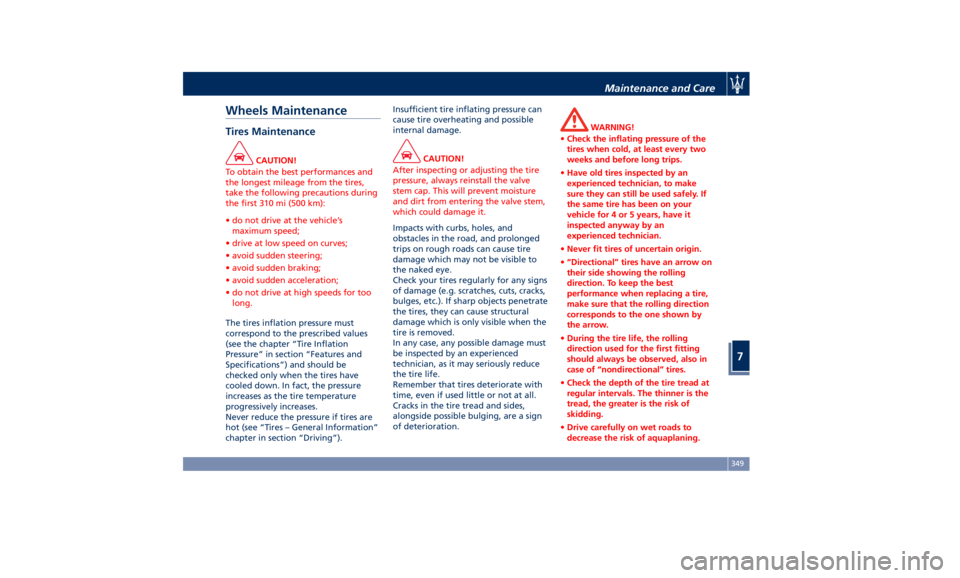
Wheels Maintenance Tires Maintenance CAUTION!
To obtain the best performances and
the longest mileage from the tires,
take the following precautions during
the first 310 mi (500 km):
• do not drive at the vehicle’s
maximum speed;
• drive at low speed on curves;
• avoid sudden steering;
• avoid sudden braking;
• avoid sudden acceleration;
• do not drive at high speeds for too
long.
The tires inflation pressure must
correspond
to the prescribed values
(see the chapter “Tire Inflation
Pressure” in section “Features and
Specifications”) and should be
checked only when the tires have
cooled down. In fact, the pressure
increases as the tire temperature
progressively increases.
Never reduce the pressure if tires are
hot (see “Tires – General Information”
chapter in section “Driving”). Insufficient tire inflating pressure can
cause tire overheating and possible
internal damage.
CAUTION!
After inspecting or adjusting the tire
pressure, always reinstall the valve
stem cap. This will prevent moisture
and dirt from entering the valve stem,
which could damage it.
Impacts with curbs, holes, and
obstacles
in the road, and prolonged
trips on rough roads can cause tire
damage which may not be visible to
the naked eye.
Check your tires regularly for any signs
of damage (e.g. scratches, cuts, cracks,
bulges, etc.). If sharp objects penetrate
the tires, they can cause structural
damage which is only visible when the
tire is removed.
In any case, any possible damage must
be inspected by an experienced
technician, as it may seriously reduce
the tire life.
Remember that tires deteriorate with
time, even if used little or not at all.
Cracks in the tire tread and sides,
alongside possible bulging, are a sign
of deterioration. WARNING!
• Check the inflating pressure of the
tires when cold, at least every two
weeks and before long trips.
• Have old tires inspected by an
experienced technician, to make
sure they can still be used safely. If
the same tire has been on your
vehicle for 4 or 5 years, have it
inspected anyway by an
experienced technician.
• Never fit tires of uncertain origin.
• “Directional” tires have an arrow on
their side showing the rolling
direction. To keep the best
performance when replacing a tire,
make sure that the rolling direction
corresponds to the one shown by
the arrow.
• During the tire life, the rolling
direction used for the first fitting
should always be observed, also in
case of “nondirectional” tires.
• Check the depth of the tire tread at
regular intervals. The thinner is the
tread, the greater is the risk of
skidding.
• Drive carefully on wet roads to
decrease the risk of aquaplaning.Maintenance and Care
7
349
Page 360 of 384
• With the transmission in N (Neutral),
let the engine idle for several
minutes.
WARNING!
The engine idle must be performed
outdoors. Exhaust gases contain
carbon monoxide which is strongly
toxic and potentially lethal.
WARNING!
California Proposition 65
Operating, servicing and maintaining
a passenger vehicle or off-road vehicle
can expose you to chemicals including
such as, engine exhaust, carbon
monoxide, phthalates and lead, that
which are known to the State of
California to cause cancer and birth
defects or other reproductive harm. To
minimize exposure, avoid breathing
exhaust, do not idle the engine except
as necessary, service your vehicle in a
well-ventilated area and wear gloves
or wash your hands frequently when
servicing your vehicle. For more
information go to:
www.P65Warnings.ca.gov/passenger-
vehicle Battery Statement Battery Statement Status of
Charge To avoid problems with ignition and/or
the electrical system in general when
you are driving, the battery charge
status is constantly maintained and
guaranteed by the vehicle's recharge
circuit; the main component of which
is the alternator. This circuit is only
able to supply voltage to the battery
when the vehicle is traveling.
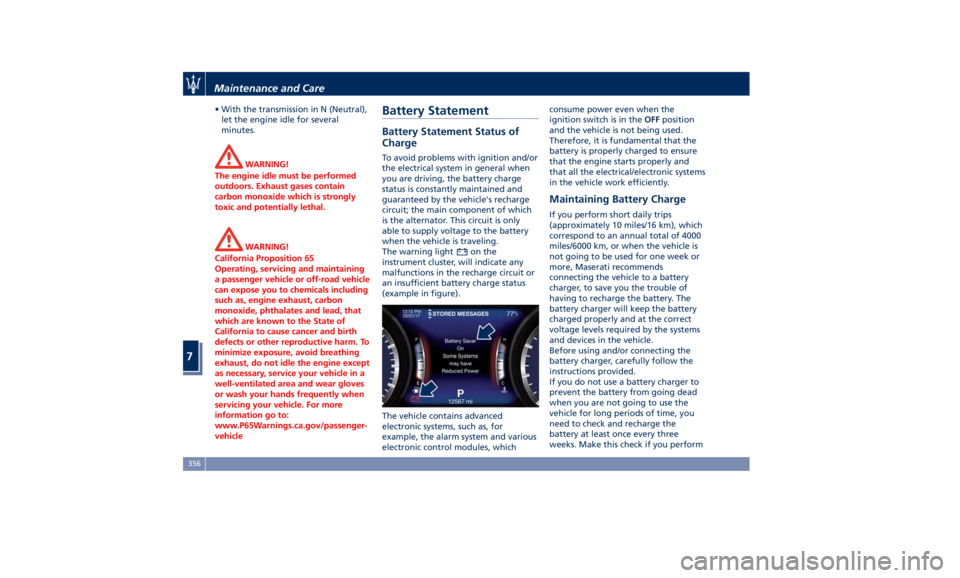
The warning light
on the
instrument cluster, will indicate any
malfunctions in the recharge circuit or
an insufficient battery charge status
(example in figure).
The vehicle contains advanced
electronic systems, such as, for
example, the alarm system and various
electronic control modules, which consume power even when the
ignition switch is in the OFF position
and the vehicle is not being used.
Therefore, it is fundamental that the
battery is properly charged to ensure
that the engine starts properly and
that all the electrical/electronic systems
in the vehicle work efficiently.
Maintaining Battery Charge If you perform short daily trips
(approximately 10 miles/16 km), which
correspond to an annual total of 4000
miles/6000 km, or when the vehicle is
not going to be used for one week or
more, Maserati recommends
connecting the vehicle to a battery
charger, to save you the trouble of
having to recharge the battery. The
battery charger will keep the battery
charged properly and at the correct
voltage levels required by the systems
and devices in the vehicle.
Before using and/or connecting the
battery charger, carefully follow the
instructions provided.
If you do not use a battery charger to
prevent the battery from going dead
when you are not going to use the
vehicle for long periods of time, you
need to check and recharge the
battery at least once every three
weeks. Make this check if you performMaintenance and Care
7
356
Page 361 of 384
short daily trips (approximately 10
miles/16 km) which correspond to an
annual total of 4000 miles/6000 km.
Please note that allowing the battery
to go dead repeatedly can cause
premature wear on the internal cells
and greatly reduce their life, leading
to problems with the ignition system
and other electrical/electronic systems.
The Authorized Maserati Dealer is
available to advise you on how to
recharge your battery correctly and
give you useful information on battery
care and maintenance.
NOTE:
The Authorized Maserati Dealer can
provide you with any information
about the Maserati approved “Battery
Charger and Conditioner”, available in
the “Genuine Accessories” range.
WARNING!
The process of charging or recharging
the battery produces hydrogen, a
dangerous gas that can explode and
cause serious injuries. When charging
or recharging the battery, follow the
recommended precautions at all
times:
• always charge or recharge the battery in a well-ventilated
environment;
• never charge or recharge a battery
that has frozen;
• ensure that any sparks or open
flames are nowhere near the battery
while it is charging;
• before using a charger to charge or
maintain the battery charge status,
carefully follow the instructions
provided to ensure the charger is
connected to the battery safely and
correctly. Maintenance and Care
7
357
Page 368 of 384

Technical Data NOTE:
The technical data, values and specifications in this Owner’s Manual are provided as guidance only. The vehicle specific
data can vary from the information provided, for example, as a result of optional or special equipment ordered with the
vehicle, vehicle loads, and country specific measurement methods.
Engine Data Data Ghibli S Q4 (AWD version)
Ghibli S Ghibli
Cylinder number and position 6 - 60° V 6 - 60° V
Number of valves per cylinder 4 4
Bore x stroke 86.5 x 84.5 mm 86.5 x 84.5 mm
Total displacement 2,979 cm 3
2,979 cm 3
Compression ratio 9.7 : 1 9.7 : 1
Maximum power output (EC) 316 kW – 424 HP 257 kW – 345 HP
- corresponding RPM 5,750 RPM 5,500 RPM
Peak and overboost torque (EC) 428 ft-lb (580 N-m) 369 ft-lb (500 N-m)
- corresponding RPM 1,750 – 4,500 RPM 1,600 – 4,500 RPM
Properties
Timing The timing system uses two overhead camshafts with timing variator.
Timing system control Timing chain.
Supply Over-supplied with turbocompressor and related intercooler for each bank.
Injection – Ignition High pressure 2900 PSI (200 bar) direct fuel injection system. Static ignition with digital
electronic control system included and controlled by a single microprocessor ECU.Features and Specifications
8
364
Page 370 of 384
Wheels NOTE:
• Maserati recommends Maserati Genuine Tires marked with “MGT” logo specifically designed for its models.
• In order to maintain high performance and safety level, Maserati recommends to use tires equivalent to the original
size.
WARNING!
• The maximum speed reachable with the tires is indicated by the tire manufacturer. Always comply with the regulations
in force in the Country you are driving in.
• Never exceed the maximum speed indicated for the tires: failure to respect the max. speed may damage these tires.
Danger: risk of accident!
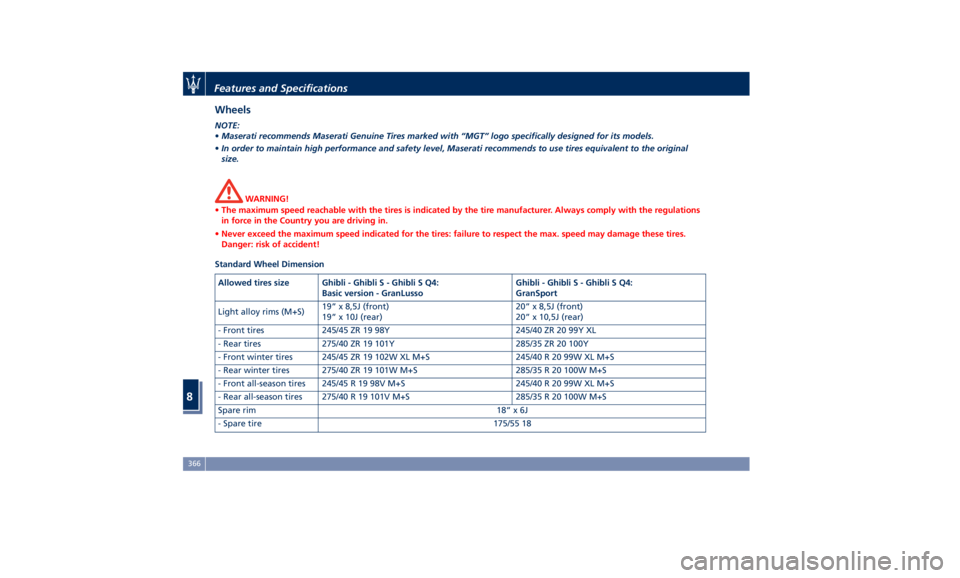
Standard Wheel Dimension
Allowed tires size Ghibli - Ghibli S - Ghibli S Q4:
Basic version - GranLusso Ghibli - Ghibli S - Ghibli S Q4:
GranSport
Light alloy rims (M+S) 19” x 8,5J (front)
19” x 10J (rear) 20” x 8,5J (front)
20” x 10,5J (rear)
- Front tires 245/45 ZR 19 98Y 245/40 ZR 20 99Y XL
- Rear tires 275/40 ZR 19 101Y 285/35 ZR 20 100Y
- Front winter tires 245/45 ZR 19 102W XL M+S 245/40 R 20 99W XL M+S
- Rear winter tires 275/40 ZR 19 101W M+S 285/35 R 20 100W M+S
- Front all-season tires 245/45 R 19 98V M+S 245/40 R 20 99W XL M+S
- Rear all-season tires 275/40 R 19 101V M+S 285/35 R 20 100W M+S
Spare rim 18” x 6J
- Spare tire 175/55 18Features and Specifications
8
366