dashboard MASERATI GRANTURISMO 2019 Manual PDF
[x] Cancel search | Manufacturer: MASERATI, Model Year: 2019, Model line: GRANTURISMO, Model: MASERATI GRANTURISMO 2019Pages: 286, PDF Size: 8.08 MB
Page 232 of 286
recommended on the “Scheduled
Service Plan”:
• check front disc brake pad conditions
and wear;
• check cleanliness of hood and trunk
locks, cleanliness and lubrication of
linkage;
• visually inspect conditions of: engine,
transmission, pipes and hoses
(exhaust - fuel system - brakes) and
rubber elements (trunks - sleeves -
bushes - etc.);
• check battery charge;
• visually inspect condition of the
accessory drive belts;
• check and, if necessary, change
engine oil and replace oil filter;
• check and, if necessary, replace
pollen filter of the A/C system;
• check and, if necessary, replace air
cleaner filter.
CAUTION!
All maintenance operations for the
vehicle must be carried out by the
Authorized Maserati Dealer . For
routine and minor maintenance
operations which you can carry out
yourself, make sure that you have the
necessary experience and always use suitable equipment, original Maserati
spare parts (or equivalent) and the
prescribed fluids. Shall this not be the
case, do not carry any operation on
your own and contact an Authorized
Maserati Dealer .
Onboard Diagnostic System Your vehicle is equipped with a
sophisticated onboard diagnostic
system. This system monitors the
performance of the emissions, engine,
and automatic transmission control
systems. When these systems are
operating properly, your vehicle will
provide excellent performance and
fuel economy, as well as engine
emissions suited to current
government regulations.
If any of these systems require service,
the system will turn on the
Malfunction Indicator Light on the
instrument cluster display (refer to
“Instrument Cluster” in section
“Dashboard Instruments and
Controls”). The system stores as well
diagnostic codes and other
information to assist your service
technician by performing repairs.
Although the vehicle will be driveable
and will not need towing, contact an Authorized Maserati Dealer for service
as soon as possible.
CAUTION!
• Prolonged driving with the MIL
on could cause further damage to
the emissions control system. It could
also affect fuel economy and
drivability. The vehicle must be
serviced before any emissions tests
can be performed.
•Ifthe
MIL is flashing while the
engine is running, severe catalytic
converter damage and power loss
will soon occur. Immediate service at
the Authorized Maserati Dealer is
required.
Spare Parts Use of genuine parts for normal or
scheduled maintenance and repairs is
highly recommended to ensure
excellent performance.
Damage or failures caused by
non-genuine spare parts used for
maintenance and repairs will not be
covered by the manufacturer's
warranty.Maintenance and Care
7
228
Page 242 of 286
(Continued)
quick coupling from the negative
pole (–) of the battery.
If the battery needs to be removed
from
its compartment, you must first
detach the terminal clamp from
negative pole (–) and then the other
terminal clamp from positive pole (+),
after removing the protective cover.
Battery poles are marked positive (+)
and negative (–) and are identified on
the battery case.
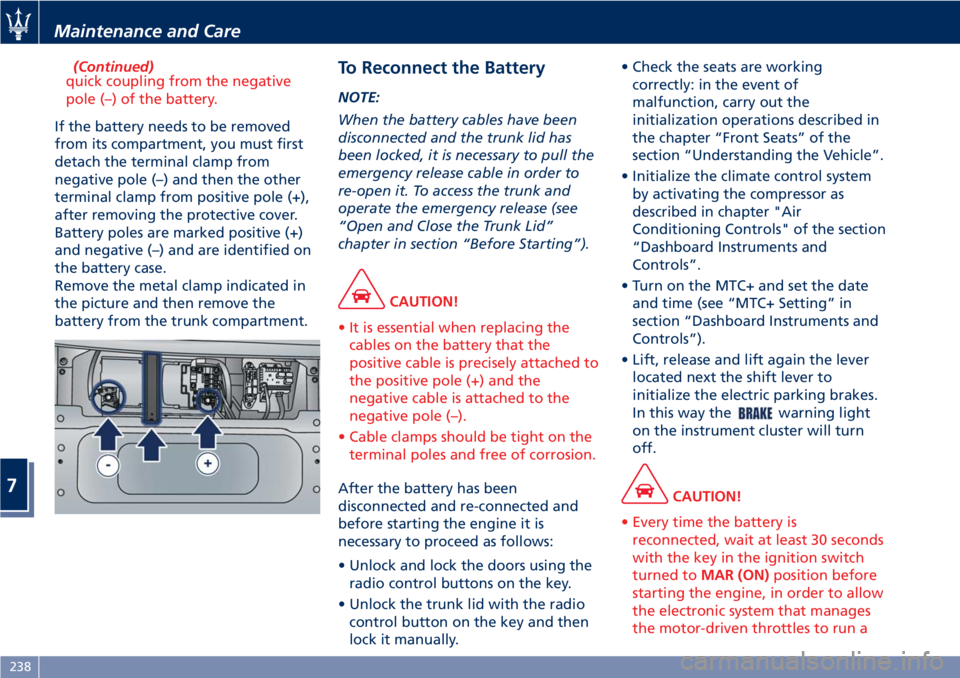
Remove the metal clamp indicated in
the picture and then remove the
battery from the trunk compartment. To Reconnect the Battery NOTE:
When the battery cables have been
disconnected and the trunk lid has
been locked, it is necessary to pull the
emergency release cable in order to
re-open it. To access the trunk and
operate the emergency release (see
“Open and Close the Trunk Lid”
chapter in section “Before Starting”).
CAUTION!
• It is essential when replacing the
cables on the battery that the
positive cable is precisely attached to
the positive pole (+) and the
negative cable is attached to the
negative pole (–).
• Cable clamps should be tight on the
terminal poles and free of corrosion.
After the battery has been
disconnected
and re-connected and
before starting the engine it is
necessary to proceed as follows:
• Unlock and lock the doors using the
radio control buttons on the key.
• Unlock the trunk lid with the radio
control button on the key and then
lock it manually. • Check the seats are working
correctly: in the event of
malfunction, carry out the
initialization operations described in
the chapter “Front Seats” of the
section “Understanding the Vehicle”.
• Initialize the climate control system
by activating the compressor as
described in chapter "Air
Conditioning Controls" of the section
“Dashboard Instruments and
Controls”.
• Turn on the MTC+ and set the date
and time (see “MTC+ Setting” in
section “Dashboard Instruments and
Controls”).
• Lift, release and lift again the lever
located next the shift lever to
initialize the electric parking brakes.
In this way the
warning light
on the instrument cluster will turn
off.
CAUTION!
• Every time the battery is
reconnected, wait at least 30 seconds
with the key in the ignition switch
turned to MAR (ON) position before
starting the engine, in order to allow
the electronic system that manages
the motor-driven throttles to run aMaintenance and Care
7
238
Page 264 of 286
Restarting the Vehicle Before restarting the vehicle after a
long period of inactivity, we
recommend that you carry out the
following operations.
• Check the tires for pressure and for
any damages, cuts or cracks. If this is
the case, have them replaced.
• Do not dry-rub the external surface
of the vehicle.
• Visually inspect if there are any fluid
leaks (oil, brake and clutch fluid,
engine coolant etc.).
• Have the engine oil and filter
replaced.
• Check the fluid levels in the brake
system, as well as the engine coolant
level.
• Check the air filter and have them
replaced if necessary.
• Reconnect the battery after checking
the charge status (refer to
“Maintenance-Free Battery” in this
section) and perform the initializing
procedure if applicable.
• With the transmission in N (Neutral),
let the engine idle for several
minutes. WARNING!
The engine idle must be performed
outdoors. Exhaust gases contain
carbon monoxide which is strongly
toxic and potentially lethal.
WARNING!
California Proposition 65
Operating, servicing and maintaining
a passenger vehicle or off-road vehicle
can expose you to chemicals including
such as, engine exhaust, carbon
monoxide, phthalates and lead, that
which are know to the State of
California to cause cancer and birth
defects or other reproductive harm. To
minimize exposure, avoid breathing
exhaust, do not idle the engine except
as necessary, service your vehicle in a
well-ventilated area and wear gloves
or wash your hands frequently when
servicing your vehicle. For more
information go to:
www.P65Warnings.ca.gov/passenger-
vehicle Battery Statement Battery Statement Status of
Charge To avoid problems with ignition and/or
the electrical system in general when
you are driving, the battery charge
status is constantly maintained and
guaranteed by the vehicle's recharge
circuit; the main component of which
is the alternator. This circuit is only
able to supply voltage to the battery
when the vehicle is traveling.
The
warning light on the
instrument cluster (see “Instrument
Cluster” in section “Dashboard
Instruments and Controls”), will
indicate any malfunctions in the
recharge circuit or an insufficient
battery charge status (flashing).
The vehicle is fitted with advanced
electronic systems, such as, for
example, the alarm system and various
electronic control modules, which
consume power even when the key in
the ignition switch is in the STOP (OFF)
position and the vehicle is not being
used.
Therefore, it is fundamental that the
battery is properly charged to ensure
that the engine starts properly andMaintenance and Care
7
260
Page 280 of 286
Abbreviations .................7
ABS (Anti-lock Braking System) . . .169
A/C Air Filter Replacement ...... .253
Accessories
Aftermarket Parts and Accessories
Statement .................11
Accident, in the event of ....... .203
A/C System Maintenance ....... .252
Airbag.....................47
Air bag System Components .....47
Air bag Warning Light .........66
Passenger Air bag Labels .......18
Supplemental Restraint System
(SRS) .....................47
Air Conditioning Controls ...... .140
Air Conditioning Distribution .... .101
Alarm, Vehicle Security ..........26
ALR (Automatic Locking Retractor) . .44
Assistance ....................9
Assistance, if you need .........9
Audio Controls .............. .128
Steering Wheel Audio Controls . .128
Audio, Customer Setting ....... .136
Audio System ............... .130
Automatic Transmission ....... .150
Automatic Transmission Range . .152
AUX, USB and SD Memory Card
Ports .................... .122
Battery ................... .237
Access the Battery .......... .215
Jump Start Procedure ....... .215
Maintenance - Free Battery . . . .237 To Disconnect the Battery .... .237
To Reconnect the Battery ..... .238
Bluetooth, Customer settings .... .137
Bodywork Maintenance and Care . .255
Protection from Atmospheric
Agents ................. .255
Useful Advice to Keep the
Bodywork in Good Condition . . .256
Brakes
Brake and Stability Control
System .................. .167
Brake Fluid Level Check ...... .232
Brake Overheating ......... .172
Parking Brake ............. .164
Parking Brake - Manual
Release ................. .209
Using the Brakes ........... .171
Bulb Replacement ........... .247
Cargo Area
..................97
Child
Restraint Systems
Children too large for Booster
Seats .....................55
Infants and Child Restraints .....54
Lower Anchors and Tether for
Children (LATCH) ............57
Older Children and Child
Restraints .................55
Tips on getting the most out of
your child restraint ...........56
Clock, analog ............... .134
Comfort Pack Front Seats ........76
Driver Memory Seat ..........77 Front Heated Seats ...........76
Console
Central Console Components ....73
Front Dome Console
Components ...............71
Cruise Control .............. .175
Cupholders
Front Seats Cupholders ........94
Rear Seats Cupholders .........94
Dashboard Components .........70
Data, Technical ............. .269
Defroster ...................66
Doors Components .............72
Drive Mode, Controls ......... .159
Driving Conditions
Before the Trip ............ .194
Driving at Night ........... .194
Driving in Fog ............. .195
Driving in the Mountains ..... .195
Driving in the Rain ......... .194
Driving on Snow or Ice ....... .196
Driving through Flooded
Sections ................. .196
Safe Driving .............. .194
DRL (Daytime Running Light) ......84
Easy Entry/Exit function .........80
EDR (Event Data Recorder) .......53
Emergency
Emergency Fuel Filler Door
Release ................. .193
Hazard Warning Flasher .......89Index
9
276