ABS MASERATI GRANTURISMO 2020 Owner's Manual
[x] Cancel search | Manufacturer: MASERATI, Model Year: 2020, Model line: GRANTURISMO, Model: MASERATI GRANTURISMO 2020Pages: 286, PDF Size: 6.7 MB
Page 230 of 286
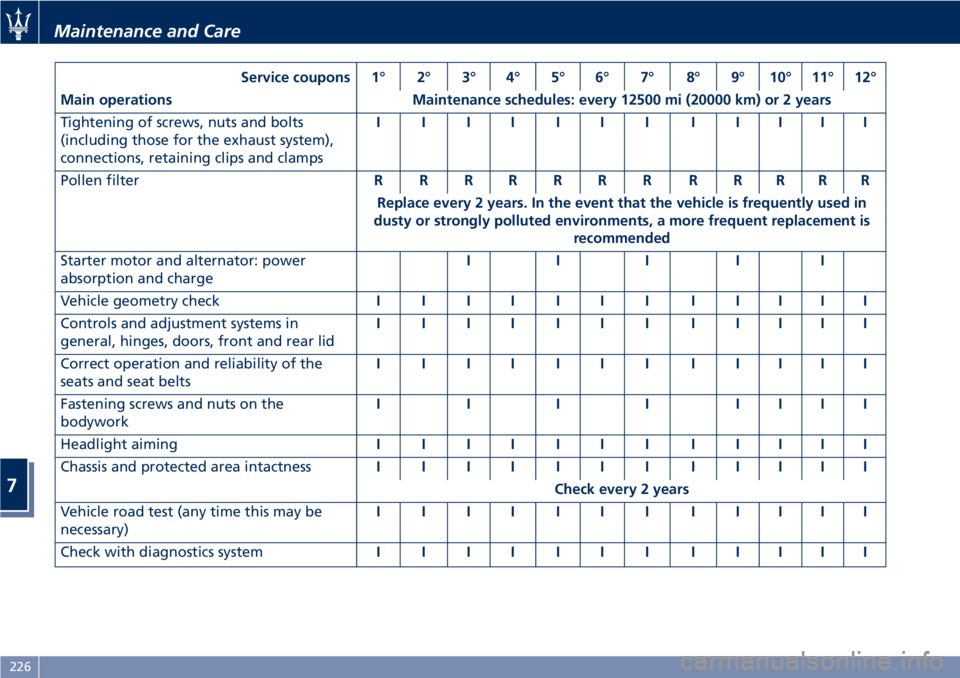
Service coupons 1° 2° 3° 4° 5° 6° 7° 8° 9° 10° 11° 12°
Main operations Maintenance schedules: every 12500 mi (20000 km) or 2 years
Tightening of screws, nuts and bolts
(including those for the exhaust system),
connections, retaining clips and clampsIIIIIIIIIIII
Pollen filterRRRRRRRRRRRR
Replace every 2 years. In the event that the vehicle is frequently used in
dusty or strongly polluted environments, a more frequent replacement is
recommended
Starter motor and alternator: power
absorption and chargeIII II
Vehicle geometry checkIIIIIIIIIIII
Controls and adjustment systems in
general, hinges, doors, front and rear lidIIIIIIIIIIII
Correct operation and reliability of the
seats and seat beltsIIIIIIIIIIII
Fastening screws and nuts on the
bodyworkIIIIIIII
Headlight aimingIIIIIIIIIIII
Chassis and protected area intactnessIIIIIIIIIIII
Check every 2 years
Vehicle road test (any time this may be
necessary)IIIIIIIIIIII
Check with diagnostics systemIIIIIIIIIIII
Maintenance and Care
7
226
Page 236 of 286
(Continued)
www.P65Warnings.ca.gov/passenger-
vehicle
Brake Fluid Level Check
Check the fluid level immediately if
the brake system
red warning
light and the related message turn on
indicating a low level of brake fluid.
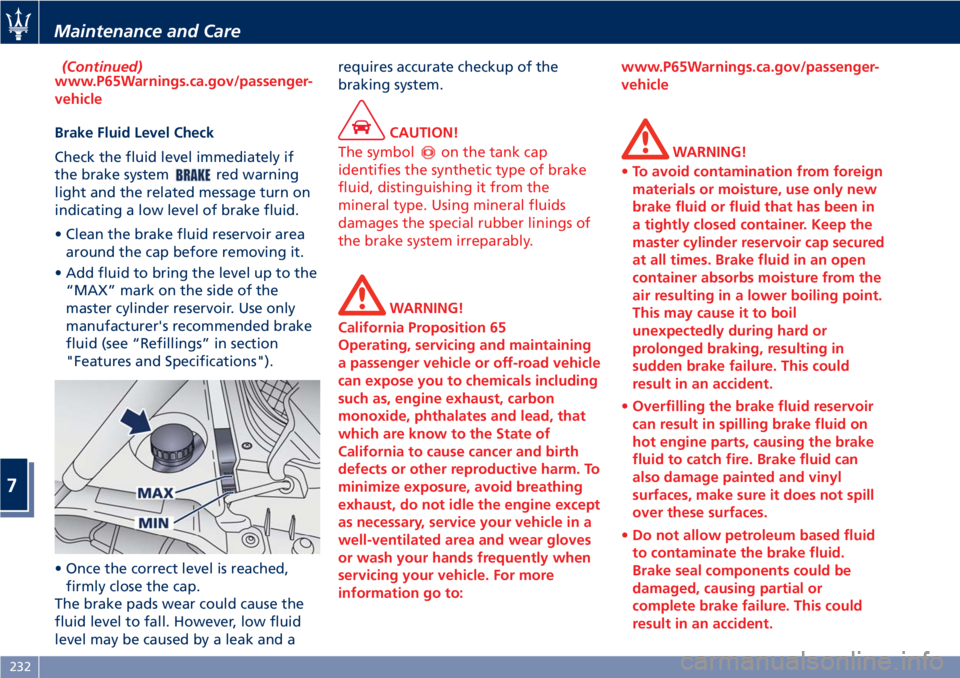
• Clean the brake fluid reservoir area
around the cap before removing it.
• Add fluid to bring the level up to the
“MAX” mark on the side of the
master cylinder reservoir. Use only
manufacturer's recommended brake
fluid (see “Refillings” in section
"Features and Specifications").
• Once the correct level is reached,
firmly close the cap.
The brake pads wear could cause the
fluid level to fall. However, low fluid
level may be caused by a leak and arequires accurate checkup of the
braking system.
CAUTION!
The symbol
on the tank cap
identifies the synthetic type of brake
fluid, distinguishing it from the
mineral type. Using mineral fluids
damages the special rubber linings of
the brake system irreparably.
WARNING!
California Proposition 65
Operating, servicing and maintaining
a passenger vehicle or off-road vehicle
can expose you to chemicals including
such as, engine exhaust, carbon
monoxide, phthalates and lead, that
which are know to the State of
California to cause cancer and birth
defects or other reproductive harm. To
minimize exposure, avoid breathing
exhaust, do not idle the engine except
as necessary, service your vehicle in a
well-ventilated area and wear gloves
or wash your hands frequently when
servicing your vehicle. For more
information go to:www.P65Warnings.ca.gov/passenger-
vehicle
WARNING!
•To avoid contamination from foreign
materials or moisture, use only new
brake fluid or fluid that has been in
a tightly closed container. Keep the
master cylinder reservoir cap secured
at all times. Brake fluid in an open
container absorbs moisture from the
air resulting in a lower boiling point.
This may cause it to boil
unexpectedly during hard or
prolonged braking, resulting in
sudden brake failure. This could
result in an accident.
•Overfilling the brake fluid reservoir
can result in spilling brake fluid on
hot engine parts, causing the brake
fluid to catch fire. Brake fluid can
also damage painted and vinyl
surfaces, make sure it does not spill
over these surfaces.
•Do not allow petroleum based fluid
to contaminate the brake fluid.
Brake seal components could be
damaged, causing partial or
complete brake failure. This could
result in an accident.
Maintenance and Care
7
232
Page 243 of 286
self-learning cycle. At the same time,
you can run the date and time set up
procedure for the MTC.
• Every time the battery is
reconnected the
and
warning lights will flash for
about 10 seconds and then go off.
WARNING!
California Proposition 65
Operating, servicing and maintaining
a passenger vehicle or off-road vehicle
can expose you to chemicals including
such as, engine exhaust, carbon
monoxide, phthalates and lead, that
which are know to the State of
California to cause cancer and birth
defects or other reproductive harm. To
minimize exposure, avoid breathing
exhaust, do not idle the engine except
as necessary, service your vehicle in a
well-ventilated area and wear gloves
or wash your hands frequently when
servicing your vehicle. For more
information go to:
www.P65Warnings.ca.gov/passenger-
vehicle
Useful Advice to Extend
Battery Life
When parking the vehicle, make sure
that the doors, front, rear lids and
flaps are properly closed. All interior
lights should be off.
When the engine is turned off, do not
keep the connected devices switched
on for a long time (such as radio,
hazard warning flashers, fan, etc.).
CAUTION!
If the battery charge remains below
50% for a long period of time, it will
be damaged due to sulfation; its
performance and starting power will
be reduced and it will be more subject
to freezing (this can happen even at
14°F/-10°C).
We recommend you to have the
battery charge condition checked,
preferably at the beginning of the
cold season, to prevent the electrolyte
from freezing.
This check should be carried out more
frequently if the vehicle is used mainly
for short trips or if it is equipped with
power absorbing devices that remain
permanently on even when the
ignition switch is off. This appliesabove all if these devices have been
retrofitted ("Aftermarket" services).
If the vehicle is not used for long
periods of time, please see “Vehicle
Stored for Long Periods” in this
section.
Battery Recharge
WARNING!
The process of charging or recharging
the battery produces hydrogen, a
flammable gas that can explode and
cause serious injuries. When charging
or recharging the battery, follow the
recommended precautions at all
times.
•Before using a charger device
always check that this tool is
suitable for the installed battery,
with constant voltage (lower than
14.8 V) and low amperage
(maximum limit 15 A).
•Recharge the battery in a
well-ventilated environment.
•Never charge or recharge a frozen
battery: it can explode due to
hydrogen trapped inside the ice
crystals.
•Ensure that any sparks or open
(Continued)
Maintenance and Care
7
239
Page 246 of 286
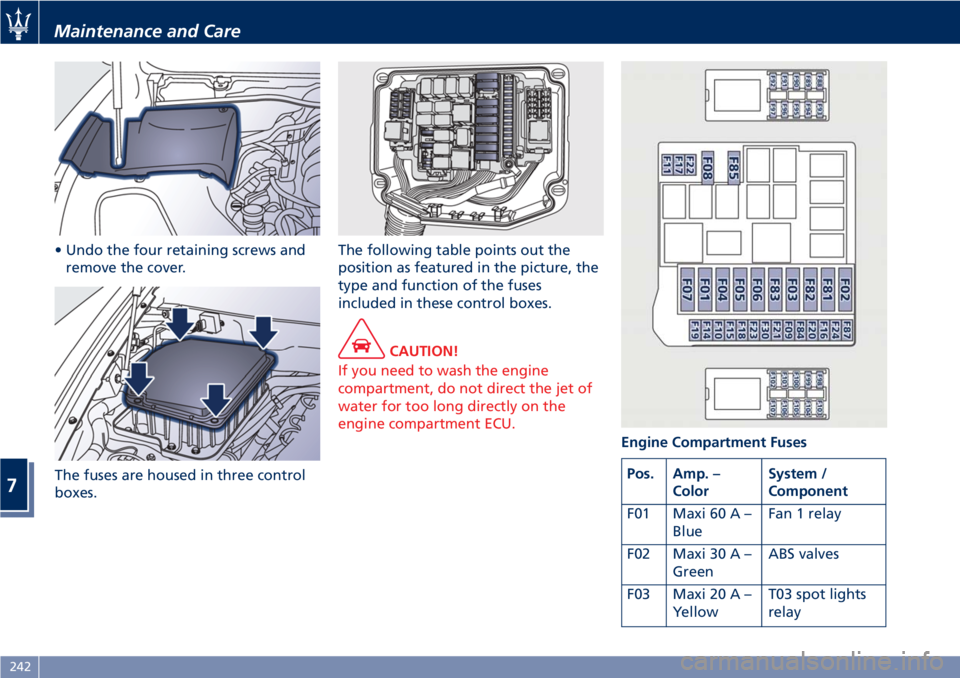
• Undo the four retaining screws and
remove the cover.
The fuses are housed in three control
boxes.The following table points out the
position as featured in the picture, the
type and function of the fuses
included in these control boxes.
CAUTION!
If you need to wash the engine
compartment, do not direct the jet of
water for too long directly on the
engine compartment ECU.
Engine Compartment Fuses
Pos. Amp. –
ColorSystem /
Component
F01 Maxi 60 A –
BlueFan 1 relay
F02 Maxi 30 A –
GreenABS valves
F03 Maxi 20 A –
YellowT03 spot lights
relay
Maintenance and Care
7
242
Page 247 of 286
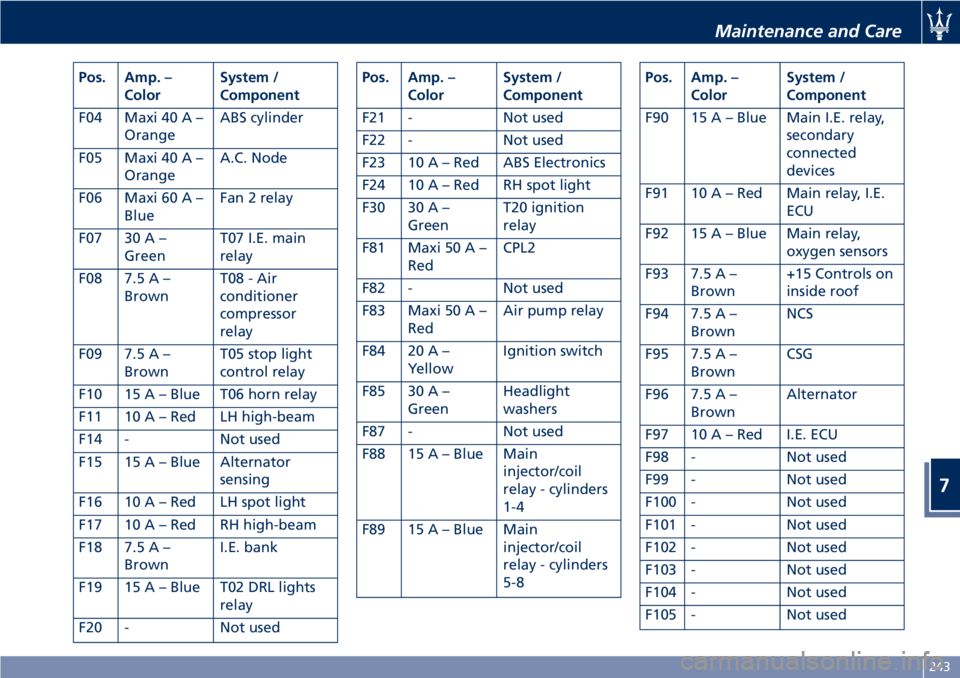
Pos. Amp. –
ColorSystem /
Component
F04 Maxi 40 A –
OrangeABS cylinder
F05 Maxi 40 A –
OrangeA.C. Node
F06 Maxi 60 A –
BlueFan 2 relay
F07 30 A –
GreenT07 I.E. main
relay
F08 7.5 A –
BrownT08 - Air
conditioner
compressor
relay
F09 7.5 A –
BrownT05 stop light
control relay
F10 15 A – Blue T06 horn relay
F11 10 A – Red LH high-beam
F14 - Not used
F15 15 A – Blue Alternator
sensing
F16 10 A – Red LH spot light
F17 10 A – Red RH high-beam
F18 7.5 A –
BrownI.E. bank
F19 15 A – Blue T02 DRL lights
relay
F20 - Not usedPos. Amp. –
ColorSystem /
Component
F21 - Not used
F22 - Not used
F23 10 A – Red ABS Electronics
F24 10 A – Red RH spot light
F30 30 A –
GreenT20 ignition
relay
F81 Maxi 50 A –
RedCPL2
F82 - Not used
F83 Maxi 50 A –
RedAir pump relay
F84 20 A –
YellowIgnition switch
F85 30 A –
GreenHeadlight
washers
F87 - Not used
F88 15 A – Blue Main
injector/coil
relay - cylinders
1-4
F89 15 A – Blue Main
injector/coil
relay - cylinders
5-8Pos. Amp. –
ColorSystem /
Component
F90 15 A – Blue Main I.E. relay,
secondary
connected
devices
F91 10 A – Red Main relay, I.E.
ECU
F92 15 A – Blue Main relay,
oxygen sensors
F93 7.5 A –
Brown+15 Controls on
inside roof
F94 7.5 A –
BrownNCS
F95 7.5 A –
BrownCSG
F96 7.5 A –
BrownAlternator
F97 10 A – Red I.E. ECU
F98 - Not used
F99 - Not used
F100 - Not used
F101 - Not used
F102 - Not used
F103 - Not used
F104 - Not used
F105 - Not used
Maintenance and Care
7
243
Page 250 of 286
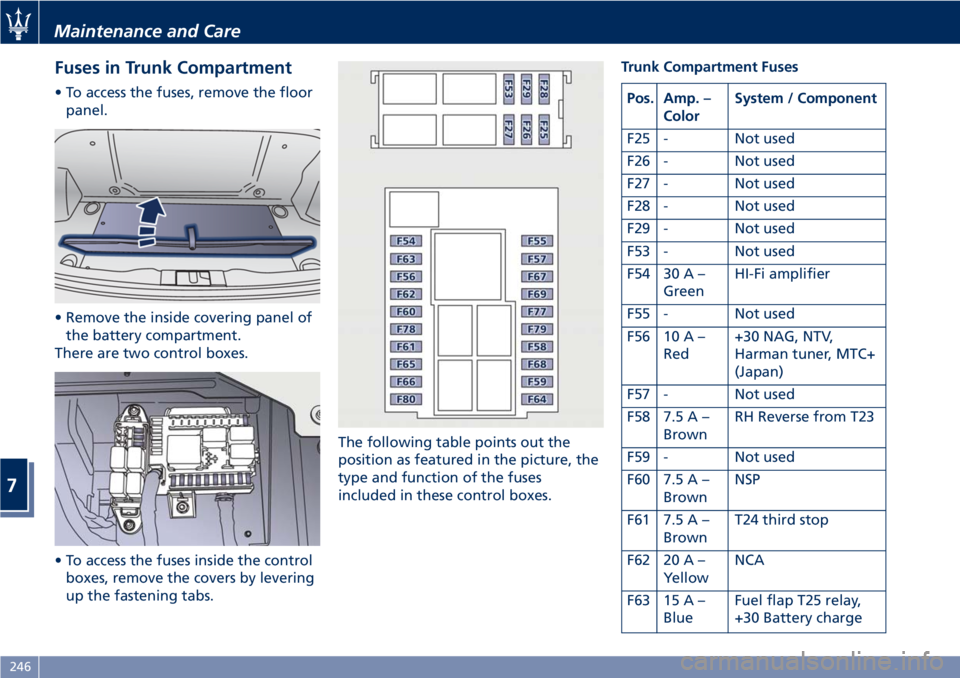
Fuses in Trunk Compartment
• To access the fuses, remove the floor
panel.
• Remove the inside covering panel of
the battery compartment.
There are two control boxes.
• To access the fuses inside the control
boxes, remove the covers by levering
up the fastening tabs.The following table points out the
position as featured in the picture, the
type and function of the fuses
included in these control boxes.Trunk Compartment FusesPos. Amp. –
ColorSystem / Component
F25 - Not used
F26 - Not used
F27 - Not used
F28 - Not used
F29 - Not used
F53 - Not used
F54 30 A –
GreenHI-Fi amplifier
F55 - Not used
F56 10 A –
Red+30 NAG, NTV,
Harman tuner, MTC+
(Japan)
F57 - Not used
F58 7.5 A –
BrownRH Reverse from T23
F59 - Not used
F60 7.5 A –
BrownNSP
F61 7.5 A –
BrownT24 third stop
F62 20 A –
YellowNCA
F63 15 A –
BlueFuel flap T25 relay,
+30 Battery charge
Maintenance and Care
7
246
Page 255 of 286
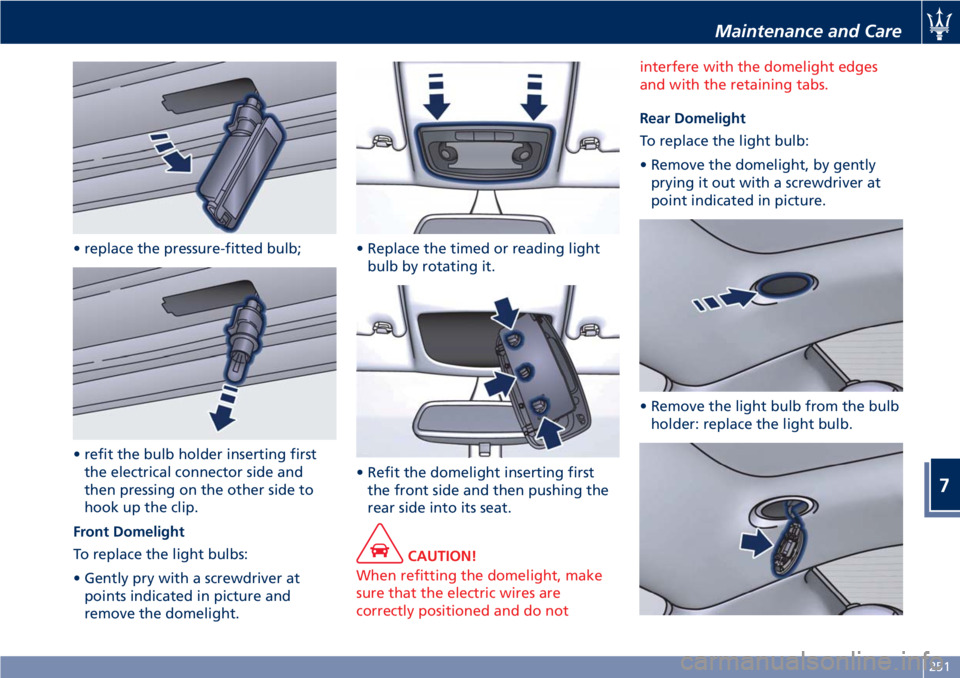
• replace the pressure-fitted bulb;
• refit the bulb holder inserting first
the electrical connector side and
then pressing on the other side to
hook up the clip.
Front Domelight
To replace the light bulbs:
• Gently pry with a screwdriver at
points indicated in picture and
remove the domelight.• Replace the timed or reading light
bulb by rotating it.
• Refit the domelight inserting first
the front side and then pushing the
rear side into its seat.
CAUTION!
When refitting the domelight, make
sure that the electric wires are
correctly positioned and do notinterfere with the domelight edges
and with the retaining tabs.
Rear Domelight
To replace the light bulb:
• Remove the domelight, by gently
prying it out with a screwdriver at
point indicated in picture.
• Remove the light bulb from the bulb
holder: replace the light bulb.
Maintenance and Care
7
251
Page 275 of 286
Brakes
Self-ventilating disc brakes on the four
wheels.
• Front disc diameter: 14.1 in (360
mm).
• Rear disc diameter: 13 in (330 mm).
• 6-piston front brake caliper
(Dual-cast technology).
• 4-piston rear brake caliper.
The Electric Parking Brake (EPB) acts
on the rear wheels.
Transmission
Electro-hydraulically controlled
automatic transmission with 6 gears
(plus reverse), torque converter,
lock-up clutch and anti-slip function.
TRANSAXLE-type transmission.
Traction system equipped with rear
self-locking differential.
Suspension
Front and rear articulated
quadrilateral suspensions.
Skyhook adjustable damping
suspension (optional on MC version)
that allows the driver to choose two
settings for the shock absorbers,
depending on the road surface
conditions, speed and comfort.
Steering
Hydraulic speed-sensitive steering with
cooling exchanger system.
Steering diameter = 11.7 yd (10,7 m).
No. of steering wheel turns = 1.5 (to
the left and right).
Wheels
NOTE:
In order to maintain high performance
and safety level, Maserati
recommends to use tires equivalent to
the original size.
WARNING!
•The maximum speed reachable with
the tires (including winter tires) is
indicated by the tire manufacturer.
Always comply with the regulations
in force in the Country you are
driving in.
•Never exceed the maximum speed
indicated for the tires (including
winter tires): failure to respect the
max. speed may damage these tires.
Danger: risk of accident!
CAUTION!
• While respecting the specified sizes,
for the safe operation of the vehicle
it is also essential that it is equipped
with the same brand and type of
tires on all wheels.
• Do not use an inner tube with
Tubeless tires.
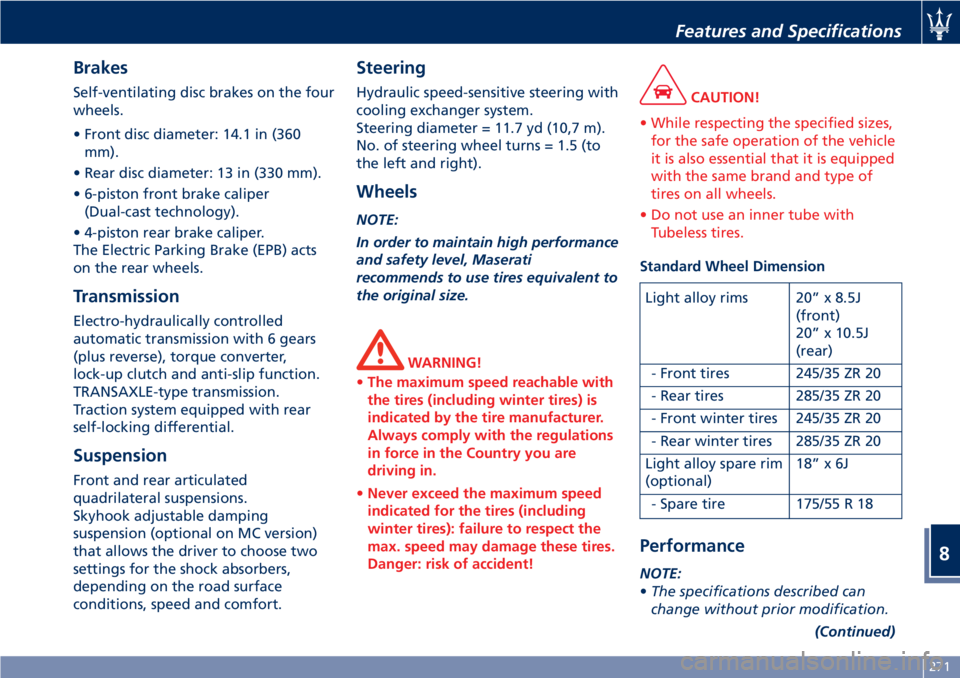
Standard Wheel Dimension
Light alloy rims 20” x 8.5J
(front)
20” x 10.5J
(rear)
- Front tires 245/35 ZR 20
- Rear tires 285/35 ZR 20
- Front winter tires 245/35 ZR 20
- Rear winter tires 285/35 ZR 20
Light alloy spare rim
(optional)18”x6J
- Spare tire 175/55 R 18
Performance
NOTE:
•The specifications described can
change without prior modification.
(Continued)
Features and Specifications
8
271
Page 280 of 286
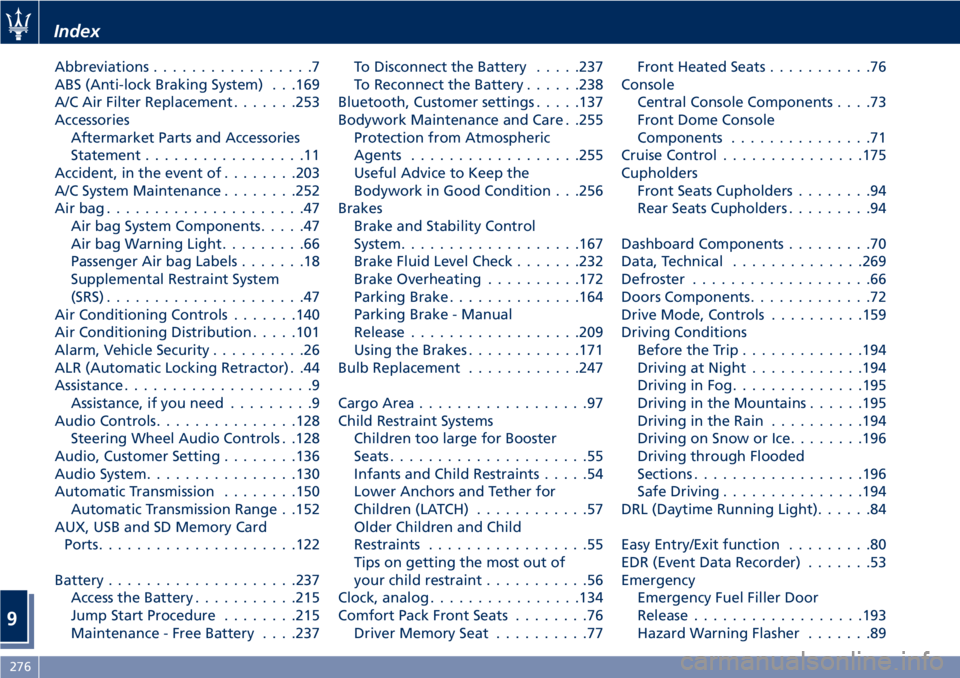
Abbreviations.................7
ABS (Anti-lock Braking System) . . .169
A/C Air Filter Replacement.......253
Accessories
Aftermarket Parts and Accessories
Statement.................11
Accident, in the event of........203
A/C System Maintenance........252
Airbag.....................47
Air bag System Components.....47
Air bag Warning Light.........66
Passenger Air bag Labels.......18
Supplemental Restraint System
(SRS).....................47
Air Conditioning Controls.......140
Air Conditioning Distribution.....101
Alarm, Vehicle Security..........26
ALR (Automatic Locking Retractor) . .44
Assistance....................9
Assistance, if you need.........9
Audio Controls...............128
Steering Wheel Audio Controls . .128
Audio, Customer Setting........136
Audio System................130
Automatic Transmission........150
Automatic Transmission Range . .152
AUX, USB and SD Memory Card
Ports.....................122
Battery....................237
Access the Battery...........215
Jump Start Procedure........215
Maintenance - Free Battery. . . .237To Disconnect the Battery.....237
To Reconnect the Battery......238
Bluetooth, Customer settings.....137
Bodywork Maintenance and Care . .255
Protection from Atmospheric
Agents..................255
Useful Advice to Keep the
Bodywork in Good Condition . . .256
Brakes
Brake and Stability Control
System...................167
Brake Fluid Level Check.......232
Brake Overheating..........172
Parking Brake..............164
Parking Brake - Manual
Release..................209
Using the Brakes............171
Bulb Replacement............247
Cargo Area
..................97
Child Restraint Systems
Children too large for Booster
Seats.....................55
Infants and Child Restraints.....54
Lower Anchors and Tether for
Children (LATCH)............57
Older Children and Child
Restraints.................55
Tips on getting the most out of
your child restraint...........56
Clock, analog................134
Comfort Pack Front Seats........76
Driver Memory Seat..........77Front Heated Seats...........76
Console
Central Console Components....73
Front Dome Console
Components...............71
Cruise Control...............175
Cupholders
Front Seats Cupholders........94
Rear Seats Cupholders.........94
Dashboard Components.........70
Data, Technical..............269
Defroster...................66
Doors Components.............72
Drive Mode, Controls..........159
Driving Conditions
Before the Trip.............194
Driving at Night............194
Driving in Fog..............195
Driving in the Mountains......195
Driving in the Rain..........194
Driving on Snow or Ice........196
Driving through Flooded
Sections..................196
Safe Driving...............194
DRL (Daytime Running Light)......84
Easy Entry/Exit function.........80
EDR (Event Data Recorder).......53
Emergency
Emergency Fuel Filler Door
Release..................193
Hazard Warning Flasher.......89
Index
9
276