dead battery MASERATI LEVANTE 2019 Owners Manual
[x] Cancel search | Manufacturer: MASERATI, Model Year: 2019, Model line: LEVANTE, Model: MASERATI LEVANTE 2019Pages: 436, PDF Size: 15.24 MB
Page 29 of 436
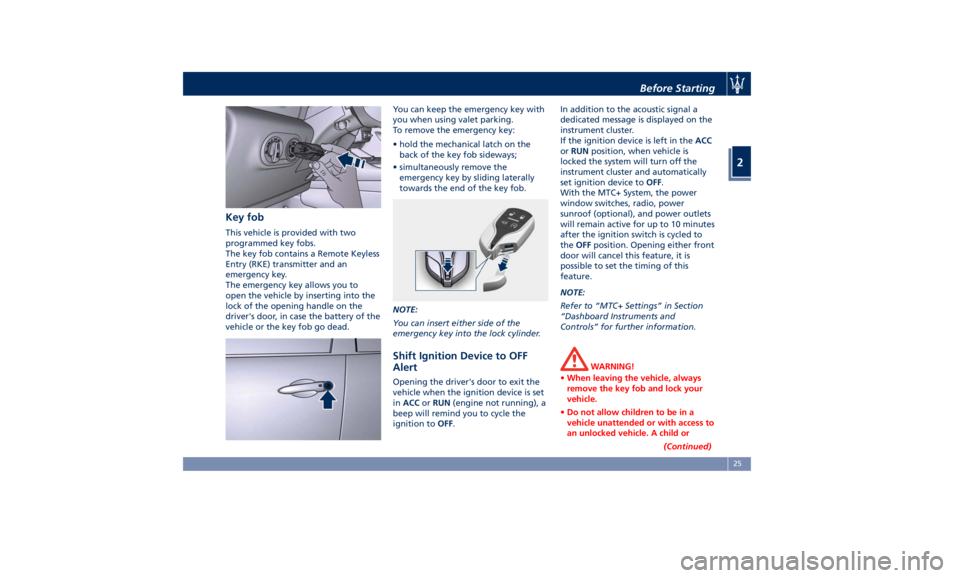
Key fob This vehicle is provided with two
programmed key fobs.
The key fob contains a Remote Keyless
Entry (RKE) transmitter and an
emergency key.
The emergency key allows you to
open the vehicle by inserting into the
lock of the opening handle on the
driver's door, in case the battery of the
vehicle or the key fob go dead. You can keep the emergency key with
you when using valet parking.
To remove the emergency key:
• hold the mechanical latch on the
back of the key fob sideways;
• simultaneously remove the
emergency key by sliding laterally
towards the end of the key fob.
NOTE:
You can insert either side of the
emergency key into the lock cylinder.
Shift Ignition Device to OFF
Alert Opening the driver's door to exit the
vehicle when the ignition device is set
in ACC or RUN (engine not running), a
beep will remind you to cycle the
ignition to OFF . In addition to the acoustic signal a
dedicated message is displayed on the
instrument cluster.
If the ignition device is left in the ACC
or RUN position, when vehicle is
locked the system will turn off the
instrument cluster and automatically
set ignition device to OFF .
With the MTC+ System, the power
window switches, radio, power
sunroof (optional), and power outlets
will remain active for up to 10 minutes
after the ignition switch is cycled to
the OFF position. Opening either front
door will cancel this feature, it is
possible to set the timing of this
feature.
NOTE:
Refer to “MTC+ Settings” in Section
“Dashboard Instruments and
Controls” for further information.
WARNING!
• When leaving the vehicle, always
remove the key fob and lock your
vehicle.
• Do not allow children to be in a
vehicle unattended or with access to
an unlocked vehicle. A child or
(Continued)Before Starting
2
25
Page 48 of 436
(Continued)
• there is a valid key fob RKE
transmitter outside the vehicle and
within 3.3 ft (1 m) of either “Passive
Entry” door handle;
• fifteen attempts are made to lock
the doors using the door panel
switch and/or the lower
button
(on the outer edge of the left trunk
compartment) and then close the
doors. If the key fob RKE transmitter is inside
the passenger compartment and one
of the doors locked only to the first
detent of lock pawl (hence it is not
fully closed), when the vehicle lock
function with alarm system for trunk
lid and doors is being activated by
means of RH button
at the bottom
of the trunk lid, said function will be
activated all the same.
In this condition, any attempt to duly
close the door that is partially open
will cancel vehicle lock and alarm
system arming thus leaving vehicle
unlocked.
Release the Liftgate and Enter
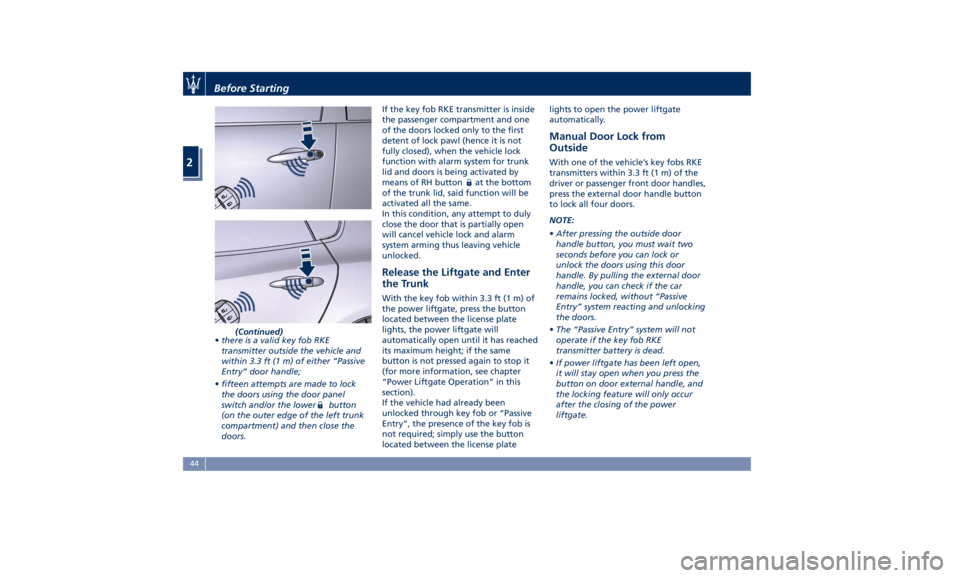
the Trunk With the key fob within 3.3 ft (1 m) of
the power liftgate, press the button
located between the license plate
lights, the power liftgate will
automatically open until it has reached
its maximum height; if the same
button is not pressed again to stop it
(for more information, see chapter
“Power Liftgate Operation” in this
section).
If the vehicle had already been
unlocked through key fob or “Passive
Entry”, the presence of the key fob is
not required; simply use the button
located between the license plate lights to open the power liftgate
automatically.
Manual Door Lock from
Outside With one of the vehicle’s key fobs RKE
transmitters within 3.3 ft (1 m) of the
driver or passenger front door handles,
press the external door handle button
to lock all four doors.
NOTE:
• After pressing the outside door
handle button, you must wait two
seconds before you can lock or
unlock the doors using this door
handle. By pulling the external door
handle, you can check if the car
remains locked, without “Passive
Entry” system reacting and unlocking
the doors.
• The “Passive Entry” system will not
operate if the key fob RKE
transmitter battery is dead.
• If power liftgate has been left open,
it will stay open when you press the
button on door external handle, and
the locking feature will only occur
after the closing of the power
liftgate.Before Starting
2
44
Page 216 of 436
NOTE:
• If you do not enter all PIN digits, a
prompt will indicate that you should
do so.
• In case of an incoming call while
entering the PIN, the MTC+ system
will temporarily stop the release
function. As soon as the call is over,
the keypad screen will be displayed
again so that you can enter the PIN.
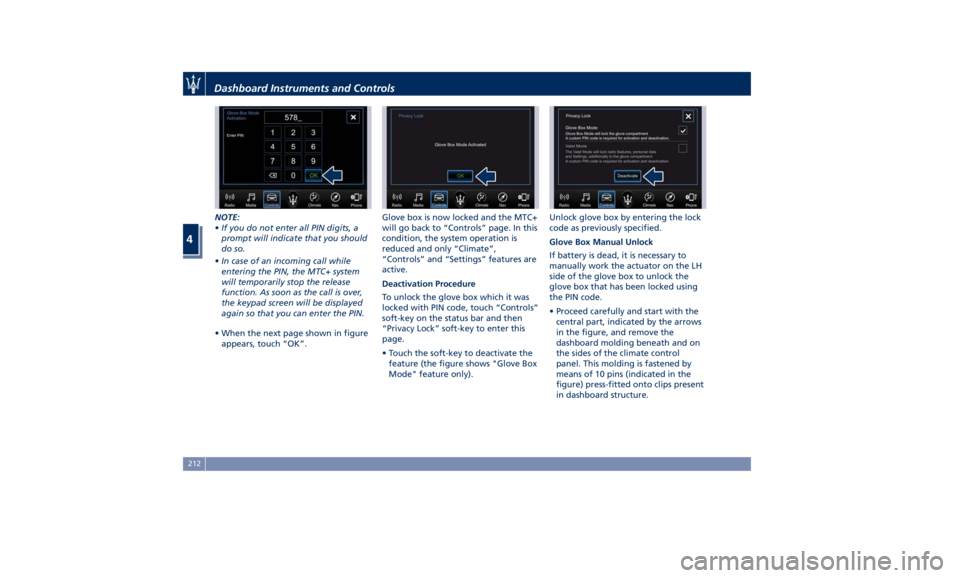
• When the next page shown in figure
appears, touch “OK”. Glove box is now locked and the MTC+
will go back to “Controls” page. In this
condition, the system operation is
reduced and only “Climate”,
“Controls” and “Settings” features are
active.
Deactivation Procedure
To unlock the glove box which it was
locked with PIN code, touch “Controls”
soft-key on the status bar and then
“Privacy Lock” soft-key to enter this
page.
• Touch the soft-key to deactivate the
feature (the figure shows "Glove Box
Mode" feature only). Unlock glove box by entering the lock
code as previously specified.
Glove Box Manual Unlock
If battery is dead, it is necessary to
manually work the actuator on the LH
side of the glove box to unlock the
glove box that has been locked using
the PIN code.
• Proceed carefully and start with the
central part, indicated by the arrows
in the figure, and remove the
dashboard molding beneath and on
the sides of the climate control
panel. This molding is fastened by
means of 10 pins (indicated in the
figure) press-fitted onto clips present
in dashboard structure.Dashboard Instruments and Controls
4
212
Page 233 of 436
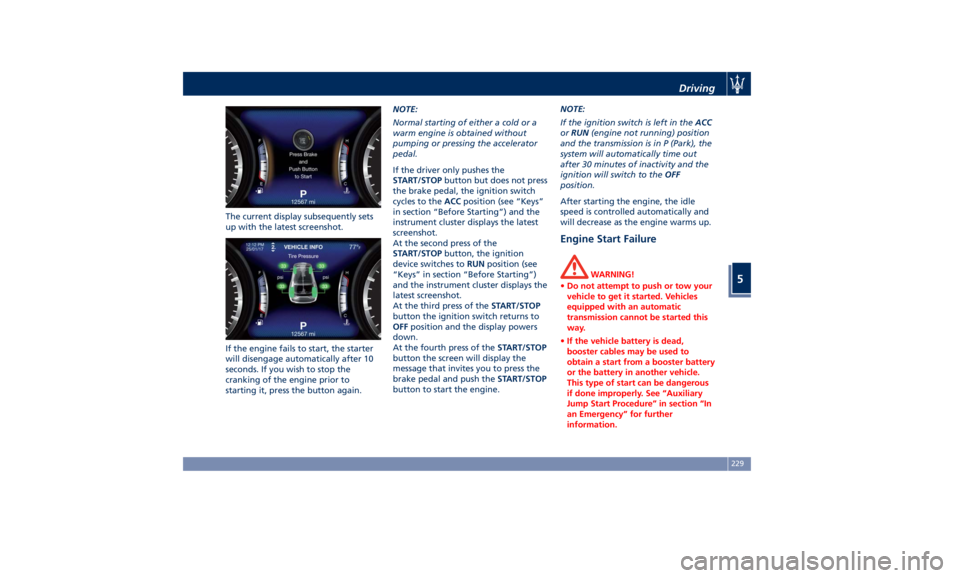
The current display subsequently sets
up with the latest screenshot.
If the engine fails to start, the starter
will disengage automatically after 10
seconds. If you wish to stop the
cranking of the engine prior to
starting it, press the button again. NOTE:
Normal starting of either a cold or a
warm engine is obtained without
pumping or pressing the accelerator
pedal.
If the driver only pushes the
START/STOP button but does not press
the brake pedal, the ignition switch
cycles to the ACC position (see “Keys”
in section “Before Starting”) and the
instrument cluster displays the latest
screenshot.
At the second press of the
START/STOP button, the ignition
device switches to RUN position (see
“Keys” in section “Before Starting”)
and the instrument cluster displays the
latest screenshot.
At the third press of the START/STOP
button the ignition switch returns to
OFF position and the display powers
down.
At the fourth press of the START/STOP
button the screen will display the
message that invites you to press the
brake pedal and push the START/STOP
button to start the engine. NOTE:
If the ignition switch is left in the ACC
or RUN (engine not running) position
and the transmission is in P (Park), the
system will automatically time out
after 30 minutes of inactivity and the
ignition will switch to the OFF
position.
After starting the engine, the idle
speed is controlled automatically and
will decrease as the engine warms up.
Engine Start Failure WARNING!
• Do not attempt to push or tow your
vehicle to get it started. Vehicles
equipped with an automatic
transmission cannot be started this
way.
• If the vehicle battery is dead,
booster cables may be used to
obtain a start from a booster battery
or the battery in another vehicle.
This type of start can be dangerous
if done improperly. See “Auxiliary
Jump Start Procedure” in section “In
an Emergency” for further
information.Driving
5
229
Page 373 of 436
CAUTION!
• Prolonged driving with the MIL
on could cause further damage to
the emissions control system. It could
also affect fuel economy and
driveability. The vehicle must be
serviced before any emissions tests
can be performed.
• If the MIL
is flashing while the
engine is running, severe catalytic
converter damage and power loss
will soon occur. Immediate service at
an Authorized Maserati Dealer is
required. Emissions Inspection and
Maintenance Programs In some localities, it may be a legal
requirement to pass an inspection of
your vehicle's emissions control
system. Failure to pass could prevent
vehicle registration. For states that
require an Inspection and
Maintenance (I/M), this check verifies
the “Malfunction Indicator Light
”
is functioning and is not on when the
engine is running, and that the OBD II
system is ready for testing.
Normally, the OBD II system will be
ready. The OBD II system may not be
ready if your vehicle was recently
serviced, recently had a dead battery
or a battery replacement. If the OBD II
system should be determined not
ready for the I/M test, your vehicle
may fail the test.
To check if your vehicle's OBD II system
is ready, you must do the following: 1. Press the ignition device to the
RUN position, but do not crank or
start the engine.
2. As soon as you press the ignition
device to turn the engine On, you
will see the MIL remain
illuminated for 15 seconds, this is a
normal bulb check.
3. Approximately 15 seconds later,
one of two things will happen:
•
The MIL
will remain
illuminated and a message error
will appear on your instrument
cluster. This means that your
vehicle's OBD II system is not
ready and you should not
proceed to the I/M station.
•
The MIL
will turn Off. This
means that your vehicle's OBD II
system is ready and you can
proceed to the I/M station.
If your OBD II system is not ready, you
should see an Authorized Maserati
Dealer or repair facility. If your vehicle
was recently serviced or had a battery
failure or replacement, you may need
to do nothing more than drive your
vehicle as you normally would in order
for your OBD II system to update. A
recheck with the above test routineMaintenance and Care
7
369
Page 407 of 436
operating pressure and lift the car to
the Entry/Exit height (for further
details, see “Drive Modes” in section
“Driving”).
WARNING!
The engine idle must be performed
outdoors. Exhaust gases contain
carbon monoxide which is strongly
toxic and potentially lethal.
WARNING!
California Proposition 65
Operating, servicing and maintaining
a passenger vehicle or off-road vehicle
can expose you to chemicals including
such as, engine exhaust, carbon
monoxide, phthalates and lead, that
which are known to the State of
California to cause cancer and birth
defects or other reproductive harm. To
minimize exposure, avoid breathing
exhaust, do not idle the engine except
as necessary, service your vehicle in a
well-ventilated area and wear gloves
or wash your hands frequently when
servicing your vehicle. For more
information go to:
www.P65Warnings.ca.gov/passenger-
vehicle Battery Statement Battery Statement Status of
Charge To avoid problems with ignition
and/or the electrical system in general
when you are driving, the battery
charge status is constantly maintained
and guaranteed by the vehicle's
recharge circuit; the main component
of which is the alternator. This circuit
is only able to supply voltage to the
battery when the vehicle is traveling.
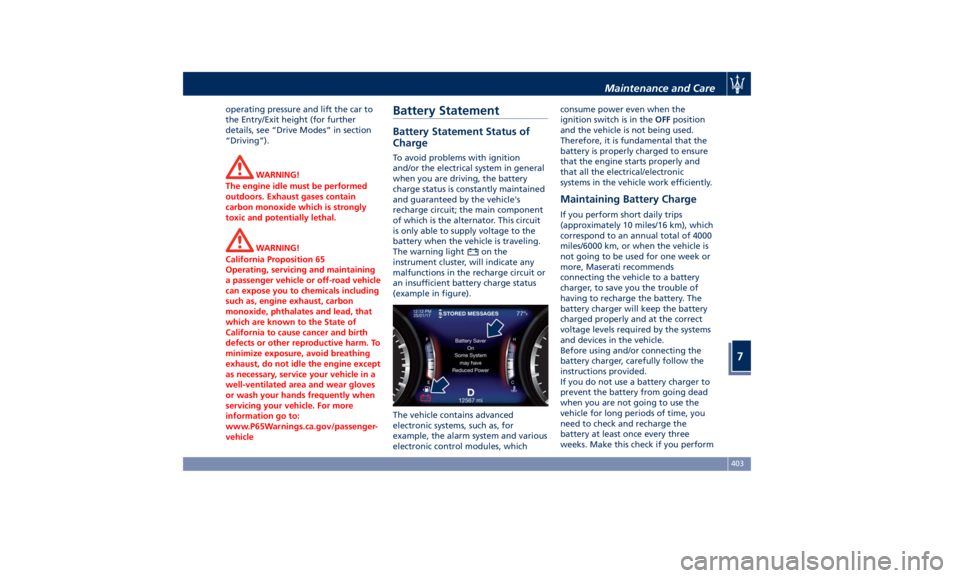
The warning light
on the
instrument cluster, will indicate any
malfunctions in the recharge circuit or
an insufficient battery charge status
(example in figure).
The vehicle contains advanced
electronic systems, such as, for
example, the alarm system and various
electronic control modules, which consume power even when the
ignition switch is in the OFF position
and the vehicle is not being used.
Therefore, it is fundamental that the
battery is properly charged to ensure
that the engine starts properly and
that all the electrical/electronic
systems in the vehicle work efficiently.
Maintaining Battery Charge If you perform short daily trips
(approximately 10 miles/16 km), which
correspond to an annual total of 4000
miles/6000 km, or when the vehicle is
not going to be used for one week or
more, Maserati recommends
connecting the vehicle to a battery
charger, to save you the trouble of
having to recharge the battery. The
battery charger will keep the battery
charged properly and at the correct
voltage levels required by the systems
and devices in the vehicle.
Before using and/or connecting the
battery charger, carefully follow the
instructions provided.
If you do not use a battery charger to
prevent the battery from going dead
when you are not going to use the
vehicle for long periods of time, you
need to check and recharge the
battery at least once every three
weeks. Make this check if you performMaintenance and Care
7
403
Page 408 of 436
short daily trips (approximately 10
miles/16 km) which correspond to an
annual total of 4000 miles/6000 km.
Please note that allowing the battery
to go dead repeatedly can cause
premature wear on the internal cells
and greatly reduce their life, leading
to problems with the ignition system
and other electrical/electronic systems.
The Authorized Maserati Dealer is
available to advise you on how to
recharge your battery correctly and
give you useful information on battery
care and maintenance.
NOTE:
The Authorized Maserati Dealer can
provide you with any information
about the Maserati approved “Battery
Charger and Conditioner”, available in
the “Genuine Accessories” range.
WARNING!
The process of charging or recharging
the battery produces hydrogen, a
dangerous gas that can explode and
cause serious injuries. When charging
or recharging the battery, follow the
recommended precautions at all times:
• always charge or recharge the
battery in a well-ventilated environment;
• never charge or recharge a battery
that has frozen;
• ensure that any sparks or open
flames are nowhere near the battery
while it is charging;
• before using a charger to charge or
maintain the battery charge status,
carefully follow the instructions
provided to ensure the charger is
connected to the battery safely and
correctly.Maintenance and Care
7
404