high MASERATI QUATTROPORTE 2019 Owners Manual
[x] Cancel search | Manufacturer: MASERATI, Model Year: 2019, Model line: QUATTROPORTE, Model: MASERATI QUATTROPORTE 2019Pages: 396, PDF Size: 13.9 MB
Page 356 of 396
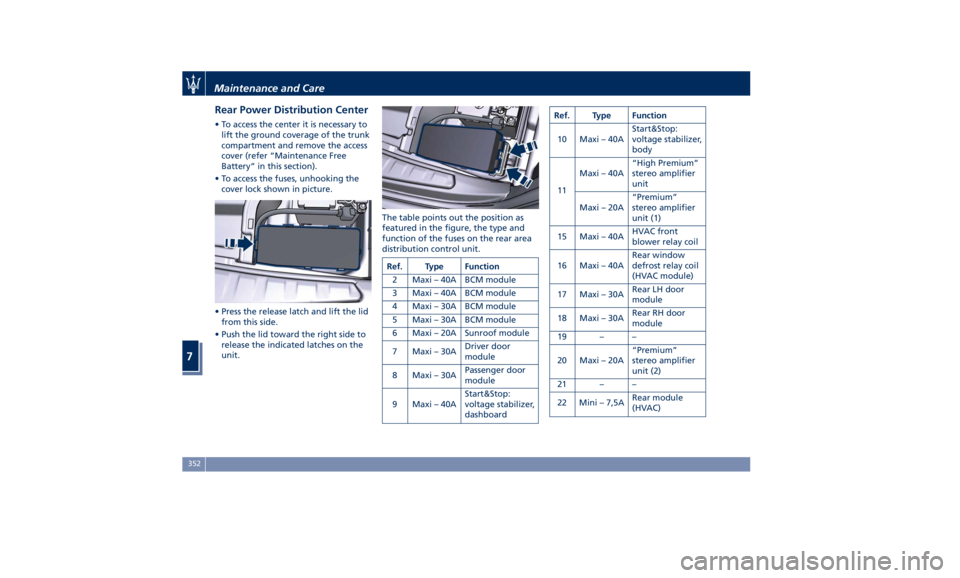
Rear Power Distribution Center • To access the center it is necessary to
lift the ground coverage of the trunk
compartment and remove the access
cover (refer “Maintenance Free
Battery” in this section).
• To access the fuses, unhooking the
cover lock shown in picture.
• Press the release latch and lift the lid
from this side.
• Push the lid toward the right side to
release the indicated latches on the
unit. The table points out the position as
featured in the figure, the type and
function of the fuses on the rear area
distribution control unit.
Ref. Type Function
2 Maxi – 40A BCM module
3 Maxi – 40A BCM module
4 Maxi – 30A BCM module
5 Maxi – 30A BCM module
6 Maxi – 20A Sunroof module
7 Maxi – 30A Driver door
module
8 Maxi – 30A Passenger door
module
9 Maxi – 40A Start&Stop:
voltage stabilizer,
dashboard Ref. Type Function
10 Maxi – 40A Start&Stop:
voltage stabilizer,
body
11 Maxi – 40A “High Premium”
stereo amplifier
unit
Maxi – 20A “Premium”
stereo amplifier
unit (1)
15 Maxi – 40A HVAC front
blower relay coil
16 Maxi – 40A Rear window
defrost relay coil
(HVAC module)
17 Maxi – 30A Rear LH door
module
18 Maxi – 30A Rear RH door
module
19 – –
20 Maxi – 20A “Premium”
stereo amplifier
unit (2)
21 – –
22 Mini – 7,5A Rear module
(HVAC)Maintenance and Care
7
352
Page 359 of 396
Ref. Type Function
8 Mini – 10A Start & Stop
switch,
diagnostic outlet
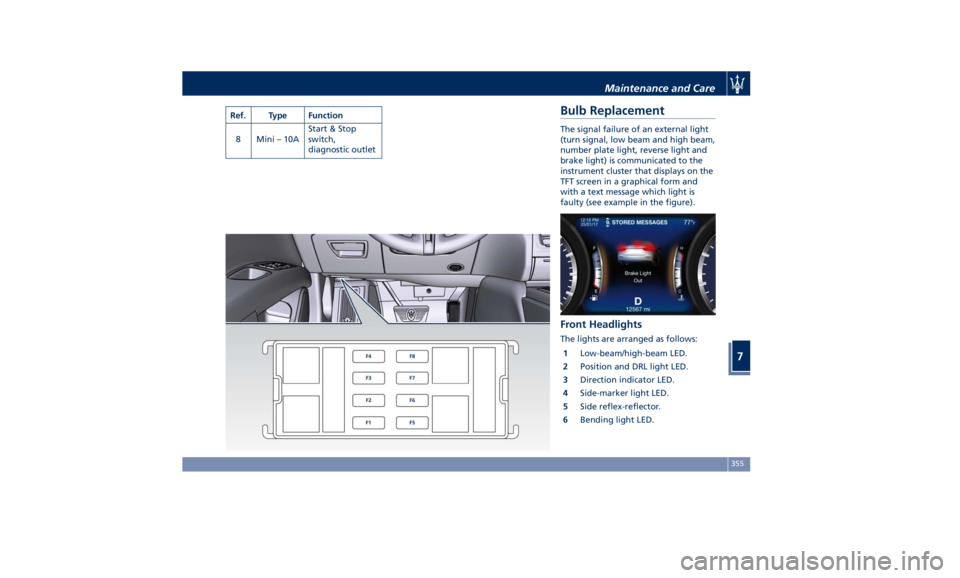
Bulb Replacement The signal failure of an external light
(turn signal, low beam and high beam,
number plate light, reverse light and
brake light) is communicated to the
instrument cluster that displays on the
TFT screen in a graphical form and
with a text message which light is
faulty (see example in the figure).
Front Headlights The lights are arranged as follows:
1 Low-beam/high-beam LED.
2 Position and DRL light LED.
3 Direction indicator LED.
4 Side-marker light LED.
5 Side reflex-reflector.
6 Bending light LED.Maintenance and Care
7
355
Page 362 of 396
(Continued)
which are known to the State of
California to cause cancer and birth
defects or other reproductive harm. To
minimize exposure, avoid breathing
exhaust, do not idle the engine except
as necessary, service your vehicle in a
well-ventilated area and wear gloves
or wash your hands frequently when
servicing your vehicle. For more
information go to:
www.P65Warnings.ca.gov/passenger-
vehicle
WARNING!
• Use only refrigerants and
compressor lubricants approved by
the manufacturer for your air
conditioning system. Some
unapproved refrigerants are
flammable and can explode, causing
injuries. Other unapproved
refrigerants or lubricants can cause
the system to fail, requiring costly
repairs.
• The air conditioning system contains
refrigerant under high pressure. To
avoid risk of personal injury or
damage to the system, adding
refrigerant or any repair requiring
lines to be disconnected should be done by an Authorized Maserati
Dealer.
Periodically remove any leaves and
insects
that may build up and obstruct
the inlet of external air in the air
conditioning system through the grille
present underneath the rear part of
the hood.
To access the grille, lift the hood as
described in “Hood Operation” in
section “Before Starting”.
Wheels Maintenance Tires Maintenance CAUTION!
To obtain the best performances and
the longest mileage from the tires,
take the following precautions during
the first 310 mi (500 km):
• do not drive at the vehicle’s
maximum speed;
• drive at low speed on curves;
• avoid sudden steering;
• avoid sudden braking;
• avoid sudden acceleration;
• do not drive at high speeds for too
long.
The tires inflation pressure must
correspond
to the prescribed values
(see the chapter “Tire Inflation
Pressure” in section “Features and
Specifications”) and should be checked
only when the tires have cooled down.
In fact, the pressure increases as the
tire temperature progressively
increases.
Never reduce the pressure if tires are
hot (see “Tires – General Information”
chapter in section “Driving”).Maintenance and Care
7
358
Page 363 of 396
Insufficient tire inflating pressure can
cause tire overheating and possible
internal damage.
CAUTION!
After inspecting or adjusting the tire
pressure, always reinstall the valve
stem cap. This will prevent moisture
and dirt from entering the valve stem,
which could damage it.
Impacts with curbs, holes, and
obstacles
in the road, and prolonged
trips on rough roads can cause tire
damage which may not be visible to
the naked eye.
Check your tires regularly for any signs
of damage (e.g. scratches, cuts, cracks,
bulges, etc.). If sharp objects penetrate
the tires, they can cause structural
damage which is only visible when the
tire is removed.
In any case, any possible damage must
be inspected by an experienced
technician, as it may seriously reduce
the tire life.
Remember that tires deteriorate with
time, even if used little or not at all.
Cracks in the tire tread and sides,
alongside possible bulging, are a sign
of deterioration. WARNING!
• Check the inflating pressure of the
tires when cold, at least every two
weeks and before long trips.
• Have old tires inspected by an
experienced technician, to make
sure they can still be used safely. If
the same tire has been on your
vehicle for 4 or 5 years, have it
inspected anyway by an
experienced technician.
• Never fit tires of uncertain origin.
• “Directional” tires have an arrow on
their side showing the rolling
direction. To keep the best
performance when replacing a tire,
make sure that the rolling direction
corresponds to the one shown by
the arrow.
• During the tire life, the rolling
direction used for the first fitting
should always be observed, also in
case of “nondirectional” tires.
• Check the depth of the tire tread at
regular intervals. The thinner is the
tread, the greater is the risk of
skidding.
• Drive carefully on wet roads to
decrease the risk of aquaplaning. Winter Tires
These
tires are specially designed for
driving on snow and ice and are fitted
to replace the ones supplied with the
vehicle.
The specific features of the winter
tires lead to lower performance under
normal environmental conditions or
on long highway trips, compared to
the standard tires.
Therefore, their use should be limited
to the situations and performance for
which they have been type-approved.
The Authorized Maserati Dealer can
provide all necessary information
about fitting winter tires on the
vehicle.
NOTE:
• We recommend fitting winter tires
on the vehicle at temperatures
below 45 °F (7°C) since the driving
performance of summer tires is
reduced at low temperatures.
Summer tires may be permanently
damaged at extremely low
temperatures.
• Comply with all state and local laws
governing snow tire and tread depth
requirements.Maintenance and Care
7
359
Page 364 of 396

Wheel Rims Maintenance All wheel trims should be cleaned
regularly with a mild soap and water.
To remove heavy soil and/or excessive
brake dust, use a nonabrasive,
non-acidic cleaner.
Do not use scouring pads, steel wool, a
bristle brush, or metal polishes.
Do not use oven cleaner that may
affect and damage the brake calipers.
Avoid automatic car washes that use
acidic solutions or harsh brushes that
may damage the wheel rim protective
finish.
Bodywork Maintenance
and Care Protection from Atmospheric
Agents The main causes of corrosion are:
• atmospheric pollution;
• salinity and humidity in the
atmosphere (marine areas or a damp
climate);
• seasonal environmental conditions;
• salt scattered on the roadbed to melt
ice and snow.
The abrasive action of wind-carried
atmospheric dust and sand, mud and
stones should not be underestimated.
On this vehicle, Maserati has adopted
the best technological solutions to
protect the bodywork from corrosion.
The main measures are:
• paint products and systems that give
the vehicle particular resistance to
corrosion and abrasion;
• use of galvanized (or pre-treated)
metal sheets which are highly
resistant to corrosion in the most
exposed parts;
• spraying of the underbody, engine
compartment, insides of wheel
housings, and other structures with wax products having high protective
power;
• spraying of plastic materials, with a
protective function, in the most
exposed points: underneath the
doors, inside part of the mud guards,
edges, etc.;
• use of ventilated box sections, coated
with protective wax products, to
avoid condensation and trapped
water which could encourage the
formation of internal rust.
Useful Advice to Keep the
Bodywork in Good Condition Paint
The paintwork does not only have an
aesthetic function but also protects the
underlying metal sheets. In the event
of abrasions or deep scratches, we
recommend to have the necessary
touch-ups made immediately, to avoid
any rust formation. Touch-ups do not
feature particular difficulties, even on
metallic finishes.
For all paint touch-ups, use only
original products indicated on the
plate applied on the lower left side of
the hood.Maintenance and Care
7
360
Page 365 of 396

Normal paint maintenance consists in
washing, the frequency of which
depends on the conditions of use and
of the environment. For example, if
driving the vehicle in areas where
there is high atmospheric pollution or
the roads are spread with anti-freeze
salt, it is advisable to wash the vehicle
more frequently.
ENVIRONMENTAL!
Detergents pollute water. Therefore
the vehicle should be washed in areas
equipped for the collection and
purification of the fluids used for
washing. NOTE:
The use of alcohol-based products for
cleaning the metal surfaces in the
engine compartment and/or the trunk
may deteriorate the protective paint.
It is recommended to use water-based
products.
Car Wash
For correct washing:
• wet the bodywork with a low
pressure water jet;
• pass a sponge with a light detergent
solution over the bodywork,
frequently rinsing the sponge;
• rinse well with water and dry with
an air jet or chamois leather.
When drying, take particular care with
the parts that are less visible, such as
the door and lids bays, headlight
edges, in which water can be trapped
more easily.
You are recommended not to take the
vehicle immediately into an enclosed
environment, but leave it in the open
air so as to allow the water to
evaporate.
Do not wash the vehicle after it has
been left in the sun or when the hood
is hot: the paint gloss could be
affected. External plastic parts must be cleaned
with the same procedure followed for
the normal washing of the bodywork.
Avoid, as far as possible, parking the
vehicle under trees; the resinous
substances that very often drop from
the trees give the paint a dull
appearance and increase the
possibility of originating corrosive
processes.
It is important that the drain holes in
the lower sides of the doors, rocker
panels, and trunk bottom be kept
clear and open.
CAUTION!
• Bird droppings must be washed off
immediately and thoroughly, since
their acidity is particularly corrosive.
• To provide better protection for the
paint, polish the vehicle at intervals
with a suitable product leaving a
protective film on the paint.
• If the vehicle is washed using
high-pressure water jets or cleaners,
it is important that the nozzle of the
jet be kept at a distance of at least
16 in (40 cm) from the bodywork to
avoid damaging it.Maintenance and Care
7
361
Page 369 of 396

• Clean and protect polished metal
parts with special products available
on the market.
• Cover the vehicle with a long cloth
in breathable fabric (available from
an Authorized Maserati Dealer ). Do
not use thick plastic sheets, which do
not allow the humidity on the
vehicle surface to evaporate.
• Inflate the tires up to a pressure
which must be 14.5 psi (1 bar) higher
than the normally prescribed one,
and check it at regular intervals.
NOTE:
The Authorized Maserati Dealer can
provide you with any information
about the available “Indoor and
Outdoor Car Covers”, available in the
“Genuine Accessories” range.
WARNING!
The tire pressure must be brought
back to the prescribed value before
reusing the vehicle (see “Tire Inflation
Pressure” in section “Features and
Specifications”). Restarting the Vehicle Before restarting the vehicle after a
long period of inactivity, we
recommend that you carry out the
following operations.
• Check the tires for pressure and for
any damages, cuts or cracks. If this is
the case, have them replaced.
• Do not dry-rub the external surface
of the vehicle: use a damp cloth.
• Visually inspect if there are any fluid
leaks (oil, brake and clutch fluid,
engine coolant etc.).
• Have the engine oil and filter
replaced.
• Check the fluid levels in the brake
system, as well as the engine coolant
level.
• Check the air filters and have them
replaced if necessary.
• Reconnect the battery after checking
the charge status (refer to
“Maintenance-Free Battery” in this
section) and perform the initializing
procedure if applicable. You can
consult the paragraph “Battery
Reconnection” in this chapter for
further information on this subject. • With the transmission in N (Neutral),
let the engine idle for several
minutes.
WARNING!
The engine idle must be performed
outdoors. Exhaust gases contain
carbon monoxide which is strongly
toxic and potentially lethal.
WARNING!
California Proposition 65
Operating, servicing and maintaining
a passenger vehicle or off-road vehicle
can expose you to chemicals including
such as, engine exhaust, carbon
monoxide, phthalates and lead, that
which are known to the State of
California to cause cancer and birth
defects or other reproductive harm. To
minimize exposure, avoid breathing
exhaust, do not idle the engine except
as necessary, service your vehicle in a
well-ventilated area and wear gloves
or wash your hands frequently when
servicing your vehicle. For more
information go to:
www.P65Warnings.ca.gov/passenger-
vehicleMaintenance and Care
7
365
Page 378 of 396

Fuel Consumption NOTE:
• The technical data, values and specifications in this Owner’s Manual are provided as guidance only. The vehicle specific
data can deviate from the information provided, for example, as a result of optional or special equipment ordered with
the vehicle, vehicle loads, and country specific measurement methods.
• The specifications described below can change without prior notification.
The fuel consumption values shown (Miles Per Gallon - MPG) are established using EPA test guidelines.
Quattroporte GTS (V8 Engine) Quattroporte S (V6 Engine) Quattroporte SQ4 (V6 Engine -
AWD version)
City 18 MPG 19.3 MPG 19.4 MPG
Highway 30.3 MPG 32 MPG 32 MPG
Combined 22 MPG 23.4 MPG 23.6 MPG
CAUTION!
• Actual fuel economy results will vary for many reasons, including driving conditions and how you drive and maintain
your vehicle.
• The type of route, traffic and weather conditions, driving style, general condition of the vehicle, equipment/accessories in
the vehicle, use of the air conditioning system, vehicle load and other items or situations which may negatively affect the
vehicle aerodynamics or wind resistance lead to consumption ratios differing from the indicated ones.Features and Specifications
8
374
Page 380 of 396
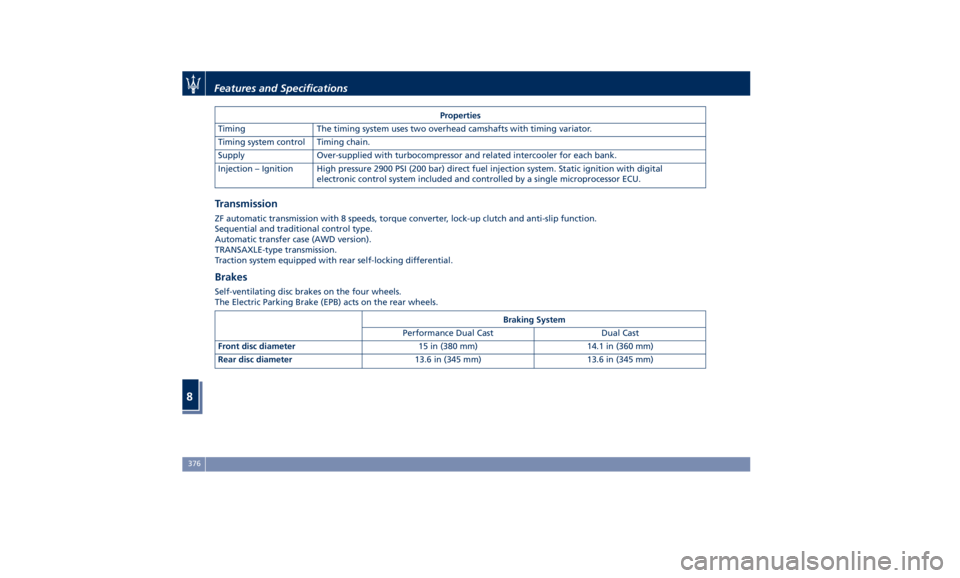
Properties
Timing The timing system uses two overhead camshafts with timing variator.
Timing system control Timing chain.
Supply Over-supplied with turbocompressor and related intercooler for each bank.
Injection – Ignition High pressure 2900 PSI (200 bar) direct fuel injection system. Static ignition with digital
electronic control system included and controlled by a single microprocessor ECU.
Transmission ZF automatic transmission with 8 speeds, torque converter, lock-up clutch and anti-slip function.
Sequential and traditional control type.
Automatic transfer case (AWD version).
TRANSAXLE-type transmission.
Traction system equipped with rear self-locking differential.
Brakes Self-ventilating disc brakes on the four wheels.
The Electric Parking Brake (EPB) acts on the rear wheels.
Braking System
Performance Dual Cast Dual Cast
Front disc diameter 15 in (380 mm) 14.1 in (360 mm)
Rear disc diameter 13.6 in (345 mm) 13.6 in (345 mm)Features and Specifications
8
376
Page 381 of 396

Suspension Double-wishbone independent front suspension.
Multilink independent rear suspension.
Skyhook active suspensions with electronic controlled dampening.
Steering Electric Power Steering (EPS) system, axis parallel type.
Turning Circle = 13.5 yd (12.4 m)
No. of steering wheel turns = 1.37 (to the left and right).
Wheels NOTE:
• Maserati recommends Maserati Genuine Tires marked with “MGT” logo specifically designed for its models.
• In order to maintain high performance and safety level, Maserati recommends to use tires equivalent to the original
size.
WARNING!
• The maximum speed reachable with the tires is indicated by the tire manufacturer. Always comply with the regulations
in force in the Country you are driving in.
• Never exceed the maximum speed indicated for the tires: failure to respect the max. speed may damage these tires.
Danger: risk of accident!
Allowed tires size with
standard wheel rims Quattroporte GTS:
All versions Quattroporte S - Quattroporte
SQ4:
Basic version Quattroporte S -
Quattroporte SQ4:
GranLusso - GranSport
Light alloy rims 20” x 8,5J (front)
20” x 10,5J (rear) 19” x 8,5J (front)
19” x 10J (rear) 20” x 8,5J (front)
20” x 10,5J (rear)
- Front tires 245/40 ZR 20 99Y XL 245/45 ZR 19 98Y 245/40 ZR 20 99Y XL
- Rear tires 285/35 ZR 20 100Y 275/40 ZR 19 101Y 285/35 ZR 20 100Y Features and Specifications
8
377