air condition MASERATI QUATTROPORTE 2019 Service Manual
[x] Cancel search | Manufacturer: MASERATI, Model Year: 2019, Model line: QUATTROPORTE, Model: MASERATI QUATTROPORTE 2019Pages: 396, PDF Size: 13.9 MB
Page 302 of 396
When the tread is worn to one of the
tread wear indicators, the tire should
be replaced.
WARNING!
The wet performance (aquaplaning
resistance) will decrease
proportionally to the thickness of the
tread.
Tires Durability The service life of a tire depends on
various factors including, but not
limited to:
• driving style;
• tire pressure;
• distance driven.
WARNING!
Tires and the spare tire (if equipped)
should be replaced after six years,
regardless of the remaining tread.
Failure to follow this warning could
result in tire failure. Replacement Tires NOTE:
In order to maintain high performance
and safety level under all driving
conditions, Maserati strongly
recommends to use tires equivalent to
the originals in size, quality and
performance when replacement is
needed.
For the size designation of your tire
see the label on the driver's side rear
door pillar or see table “Wheels” in
section “Features and Specifications”.
The “Load Index” and “Speed Symbol”
for your tire will be found on the
original equipment tire sidewall.
NOTE:
Maserati recommends Maserati
Genuine Tires marked with “MGT”
logo specifically designed for its
models.
It is recommended to replace the two
front tires or two rear tires as a pair.
Replacing just one tire can seriously
affect your vehicle’s handling.
If you ever replace a wheel assembly,
make sure that the wheel’s
specifications (valve, TPMS sensor and
tire) match those of the original
wheels. Failure to use equivalent replacement tires may adversely affect
the safety, handling, and ride of your
vehicle.
Your Authorized Maserati Dealer is
available to provide suggestions as to
the types of tires most suited to the
use foreseen by the Customer.
WARNING!
• Do not use a tire, wheel size or
rating other than that specified for
your vehicle. Some combinations of
unapproved tires and wheels may
change suspension dimensions and
performance characteristics,
resulting in altered steering,
handling, and braking operations of
the vehicle. This can cause
unpredictable handling and stress to
steering and suspension
components. Use only the tire and
wheel sizes with load ratings
appointed for your vehicle.
• Never use a tire with a smaller load
index or capacity, other than what
was originally equipped on your
vehicle. Using a tire with a smaller
load index could result in tire
overloading and failure.
• Always check the maximum speed
rating on the tire sidewall on anyDriving
5
298
Page 304 of 396
NOTE:
The Authorized Maserati Dealer can
provide you with all information about
the Maserati Snow Chains, available in
the "Genuine Accessories" range.
Compact Spare Tire The limited-use spare tire, or compact
spare tire, is for temporary emergency
use only.
This tire is identified by a label
indicating the driving speed limitations
to comply with when using the spare
tire.
Inflate the spare tire to the cold
inflation pressure listed on the table
“Tire Inflation Pressure” in section
“Features and Specifications”.
Mounting the spare tire affects vehicle
handling. Replace (or repair) as soon as
possible the original equipment tire
and reinstall it on the vehicle. Do not
install more than one compact spare
tire and wheel on the vehicle at a
time.
WARNING!
With these compact spare tires, do not
drive more than 50 mph (80 km/h).
Temporary use spares have limited
tread life. Tire Pressure Monitoring
System (TPMS) The Tire Pressure Monitoring System
(TPMS) will warn the driver of a low
tire pressure according to the vehicle
recommended cold pressure indicated
on the table “Tire Inflation Pressure”
in section “Features and
Specifications” and on the label
applied on the driver's side rear door
pillar.
Tire pressure should always be set
based on cold inflation tire pressure.
The cold tire inflation pressure must
not exceed the maximum inflation
pressure molded into the tire sidewall.
Check “Tires – General Information” in
section “Driving” for information on
how to properly inflate the tires.
The tire pressure will also increase as
the vehicle is driven - this is normal
and there is no adjustment required
when this occurs.
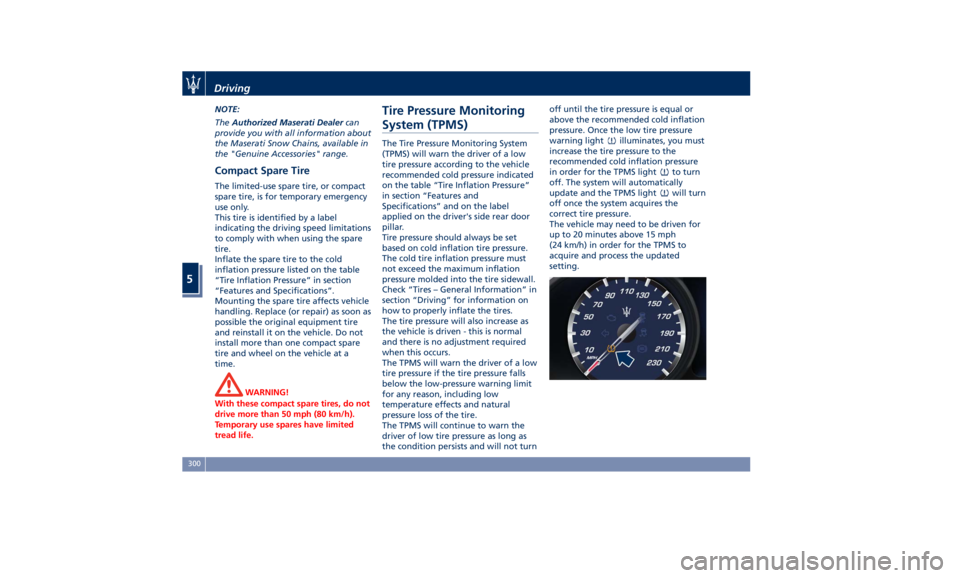
The TPMS will warn the driver of a low
tire pressure if the tire pressure falls
below the low-pressure warning limit
for any reason, including low
temperature effects and natural
pressure loss of the tire.
The TPMS will continue to warn the
driver of low tire pressure as long as
the condition persists and will not turn off until the tire pressure is equal or
above the recommended cold inflation
pressure. Once the low tire pressure
warning light
illuminates, you must
increase the tire pressure to the
recommended cold inflation pressure
in order for the TPMS light
to turn
off. The system will automatically
update and the TPMS light
will turn
off once the system acquires the
correct tire pressure.
The vehicle may need to be driven for
up to 20 minutes above 15 mph
(24 km/h) in order for the TPMS to
acquire and process the updated
setting.Driving
5
300
Page 310 of 396
Materials Added to Fuel All gasoline sold in the United States is
required to contain effective
detergent additives. Use of additional
detergents or other additives is not
needed under normal conditions and
they would result in additional cost.
Therefore, you should not have to add
anything to the fuel.
Fuel System Warnings WARNING!
Follow these guidelines to maintain
your vehicle's performance:
• The use of leaded gasoline is
prohibited by Federal and Provincial
law. Using leaded gasoline can
impair engine performance and
damage the emissions control
system.
• The use of fuel additives, which are
now being sold as octane enhancers,
is not recommended. Most of these
products contain high concentrations
of methanol. Fuel system damage or
vehicle performance problems
resulting from the use of such fuels
or additives is not the responsibility
of Maserati. NOTE:
Intentional
tampering with the
emissions control system can result in
civil penalties civil penalties and could
void the vehicle warranty.
Carbon Monoxide Warnings WARNING!
Carbon monoxide (CO) in exhaust
gases is deadly. Follow the precautions
below to prevent carbon monoxide
poisoning:
• Do not inhale exhaust gases. They
contain carbon monoxide, a colorless
and odorless gas, which can kill.
Never run the engine in a closed
area, such as a garage, and never sit
in a parked vehicle with the engine
running for an extended period. If
the vehicle is stopped in an open
area with the engine running for
more than a short period, adjust the
ventilation system to force fresh,
outside air into the vehicle.
• Guard against carbon monoxide
with proper maintenance. Have the
exhaust system inspected every time
the vehicle is raised. Have any
abnormal conditions repaired promptly. Until repaired, drive with
all side windows fully open.
WARNING!
California Proposition 65
Operating, servicing and maintaining
a passenger vehicle or off-road vehicle
can expose you to chemicals including
such as, engine exhaust, carbon
monoxide, phthalates and lead, that
which are known to the State of
California to cause cancer and birth
defects or other reproductive harm. To
minimize exposure, avoid breathing
exhaust, do not idle the engine except
as necessary, service your vehicle in a
well-ventilated area and wear gloves
or wash your hands frequently when
servicing your vehicle. For more
information go to:
www.P65Warnings.ca.gov/passenger-
vehicleDriving
5
306
Page 314 of 396
Some advices for driving in the rain are
listed below.
• Reduce your speed and keep a
greater safety distance from the
vehicles in front of you. High speed
may result in a loss of vehicle control.
• When driving on wet or slushy roads,
it is possible for a wedge of water to
build up between the tire and road
surface. This is known as
aquaplaning and may cause partial
or complete loss of vehicle control
and stopping ability. To reduce this
possibility: slow down if the road has
standing water or puddles.
• Heavy rain substantially reduces
visibility. In these circumstances, even
during the day, turn on the low
beams, to be more visible to other
drivers.
• Set the air conditioning and heating
system controls on the defogging
function, in order to avoid any
visibility problem.
• Periodically check the conditions of
the windshield wiper blades.
• In low grip conditions use “I.C.E.”
driving mode (see chapters “Drive
Mode” in this section). • Avoid driving with ESC OFF as this
will likely cause a loss of control of
the vehicle.
Driving in Fog
If the fog is dense, avoid traveling if
possible.
When driving in mist, blanket fog or
when there is the possibility of banks
of fog, please consider some advices
listed below.
• Keep a moderate speed.
• Even in daytime, turn on the low
beams and rear fog lights. Do not
use the high beams.
• Remember that fog creates
dampness on the asphalt and thus
any type of maneuver is more
difficult and braking distances are
extended.
• Keep a safe distance from the vehicle
in front of you.
• Avoid sudden changes in speed as
much as possible.
• Whenever possible, avoid overtaking.
• If you are forced to stop the vehicle
(breakdowns, impossibility of
proceeding due to poor visibility,
etc.), first of all, try to stop off of the
travel lane. Then turn on the hazard
warning flashers and, if possible, the
low beams. CAUTION!
Be aware that rear fog lights can
bother the drivers following your
vehicle: when visibility is back to
normal, turn off these lights.
Driving in the Mountains
Mountain
roads usually
have many
narrow turns and curves, tunnels and
steep uphill or downhill slopes: please
consider some advices listed below.
• Drive at a moderate speed, avoid
“cutting” corners.
• When driving inside a tunnel in
daylight turn on the low beams in
advance; avoid high beams and be
aware of the rapid brightness
change. Avoid abrupt maneuvers
that could be dangerous for the
following vehicle.
• Never coast downhill with the engine
off or in neutral.
• Remember that passing other
vehicles when driving uphill is slower
and thus requires more free distance
on the road. If you are being
overtaken on a hill, slow down and
allow the other vehicle to pass.Driving
5
310
Page 333 of 396
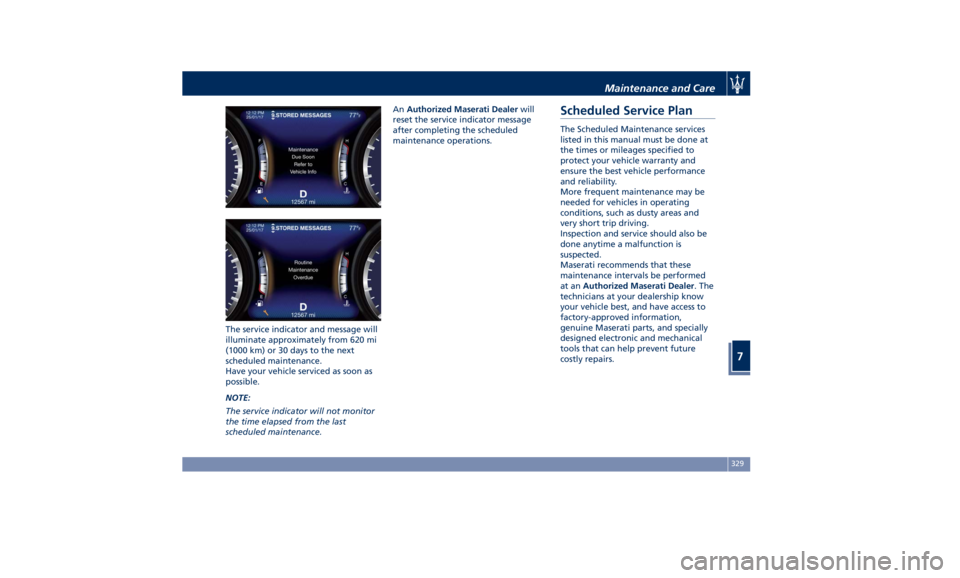
The service indicator and message will
illuminate approximately from 620 mi
(1000 km) or 30 days to the next
scheduled maintenance.
Have your vehicle serviced as soon as
possible.
NOTE:
The service indicator will not monitor
the time elapsed from the last
scheduled maintenance. An Authorized Maserati Dealer will
reset the service indicator message
after completing the scheduled
maintenance operations.
Scheduled Service Plan The Scheduled Maintenance services
listed in this manual must be done at
the times or mileages specified to
protect your vehicle warranty and
ensure the best vehicle performance
and reliability.
More frequent maintenance may be
needed for vehicles in operating
conditions, such as dusty areas and
very short trip driving.
Inspection and service should also be
done anytime a malfunction is
suspected.
Maserati recommends that these
maintenance intervals be performed
at an Authorized Maserati Dealer . The
technicians at your dealership know
your vehicle best, and have access to
factory-approved information,
genuine Maserati parts, and specially
designed electronic and mechanical
tools that can help prevent future
costly repairs.Maintenance and Care
7
329
Page 334 of 396
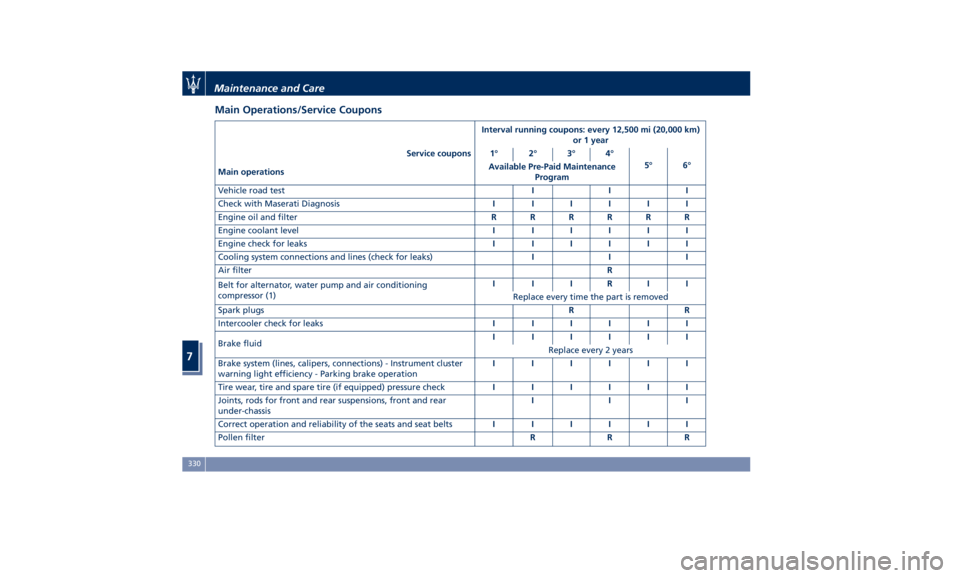
Main Operations/Service Coupons Interval running coupons: every 12,500 mi (20,000 km)
or 1 year
Service coupons 1° 2° 3° 4°
5° 6°
Main operations Available Pre-Paid Maintenance
Program
Vehicle road test III
Check with Maserati Diagnosis IIIIII
Engine oil and filter RRRRRR
Engine coolant level IIIIII
Engine check for leaks IIIIII
Cooling system connections and lines (check for leaks) III
Air filter R
Belt for alternator, water pump and air conditioning
compressor (1) IIIRII
Replace every time the part is removed
Spark plugs RR
Intercooler check for leaks IIIIII
Brake fluid IIIIII
Replace every 2 years
Brake system (lines, calipers, connections) - Instrument cluster
warning light efficiency - Parking brake operation IIIIII
Tire wear, tire and spare tire (if equipped) pressure check IIIIII
Joints, rods for front and rear suspensions, front and rear
under-chassis III
Correct operation and reliability of the seats and seat belts IIIIII
Pollen filter RRRMaintenance and Care
7
330
Page 335 of 396
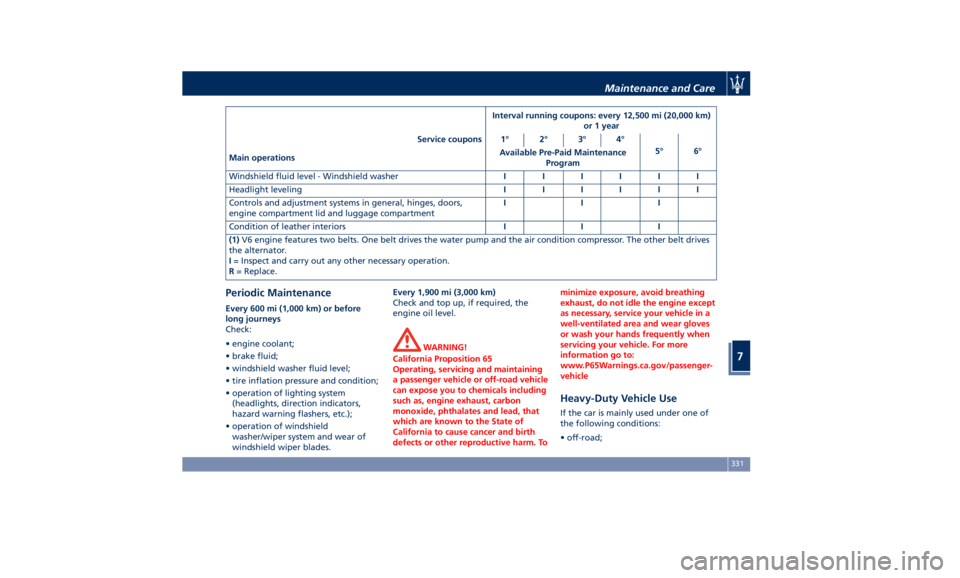
Interval running coupons: every 12,500 mi (20,000 km)
or 1 year
Service coupons 1° 2° 3° 4°
5° 6°
Main operations Available Pre-Paid Maintenance
Program
Windshield fluid level - Windshield washer IIIIII
Headlight leveling IIIIII
Controls and adjustment systems in general, hinges, doors,
engine compartment lid and luggage compartment III
Condition of leather interiors III
(1) V6 engine features two belts. One belt drives the water pump and the air condition compressor. The other belt drives
the alternator.
I = Inspect and carry out any other necessary operation.
R = Replace.
Periodic Maintenance Every 600 mi (1,000 km) or before
long journeys
Check:
• engine coolant;
• brake fluid;
• windshield washer fluid level;
• tire inflation pressure and condition;
• operation of lighting system
(headlights, direction indicators,
hazard warning flashers, etc.);
• operation of windshield
washer/wiper system and wear of
windshield wiper blades. Every 1,900 mi (3,000 km)
Check and top up, if required, the
engine oil level.
WARNING!
California Proposition 65
Operating, servicing and maintaining
a passenger vehicle or off-road vehicle
can expose you to chemicals including
such as, engine exhaust, carbon
monoxide, phthalates and lead, that
which are known to the State of
California to cause cancer and birth
defects or other reproductive harm. To minimize exposure, avoid breathing
exhaust, do not idle the engine except
as necessary, service your vehicle in a
well-ventilated area and wear gloves
or wash your hands frequently when
servicing your vehicle. For more
information go to:
www.P65Warnings.ca.gov/passenger-
vehicle
Heavy-Duty Vehicle Use If the car is mainly used under one of
the following conditions:
• off-road;Maintenance and Care
7
331
Page 336 of 396
• short, repeated journeys (less than
4–5 mi/7-8 km) at sub-zero outside
temperatures;
• engine often idling or driving long
distances at low speeds or long
periods of idleness;
you should perform the following
inspections more frequently than
recommended on the “Scheduled
Service Plan”:
• check front disc brake pad conditions
and wear;
• check cleanliness of hood and trunk
locks, cleanliness and lubrication of
linkage;
• visually inspect conditions of: engine,
transmission, pipes and hoses
(exhaust - fuel system - brakes) and
rubber elements (boots - sleeves -
bushes - etc.);
• check battery charge;
• visually inspect condition of the
accessory drive belts;
• check and, if necessary, change
engine oil and replace oil filter;
• check and, if necessary, replace
pollen filter of the A/C system;
• check and, if necessary, replace air
cleaner filter. CAUTION!
All maintenance operations for the
vehicle must be carried out by an
Authorized Maserati Dealer . For
routine and minor maintenance
operations which you can carry out
yourself, make sure that you have the
necessary experience and always use
suitable equipment, original Maserati
spare parts and the prescribed fluids.
Shall this not be the case, do not carry
any operation on your own and
contact an Authorized Maserati
Dealer .
On Board Diagnostic System Your vehicle is equipped with a
sophisticated on board diagnostic
system called OBD II. This system
monitors the performance of the
emissions, engine, and automatic
transmission control systems. When
these systems are operating properly,
your vehicle will provide excellent
performance and fuel economy, as
well as engine emissions suited to
current government regulations.
If any of these systems require service,
the OBD II system will turn on the
Malfunction Indicator Light
on the
instrument cluster display (refer to “Instrument Cluster” in section
“Dashboard Instruments and
Controls”). The system stores as well
diagnostic codes and other
information to assist your service
technician by performing repairs.
Although the vehicle will be driveable
and will not need towing, contact an
Authorized Maserati Dealer for service
as soon as possible.
CAUTION!
• Prolonged driving with the MIL
on could cause further damage to
the emissions control system. It could
also affect fuel economy and
driveability. The vehicle must be
serviced before any emissions tests
can be performed.
• If the MIL
is flashing while the
engine is running, severe catalytic
converter damage and power loss
will soon occur. Immediate service at
an Authorized Maserati Dealer is
required.
Emissions Inspection and
Maintenance Programs In some localities, it may be a legal
requirement to pass an inspection of
your vehicle's emissions control system.Maintenance and Care
7
332
Page 338 of 396

Intentional tampering with emissions
control systems may void your
warranty and could result in civil
penalties.
WARNING!
You can be badly injured working on
or around a motor vehicle. Take your
vehicle to an Authorized Maserati
Dealer.
WARNING!
California Proposition 65
Operating, servicing and maintaining
a passenger vehicle or off-road vehicle
can expose you to chemicals including
such as, engine exhaust, carbon
monoxide, phthalates and lead, that
which are known to the State of
California to cause cancer and birth
defects or other reproductive harm. To
minimize exposure, avoid breathing
exhaust, do not idle the engine except
as necessary, service your vehicle in a
well-ventilated area and wear gloves
or wash your hands frequently when
servicing your vehicle. For more
information go to:
www.P65Warnings.ca.gov/passenger-
vehicle Maintenance Procedures The following pages contain the
“required” maintenance standards
determined by Maserati engineers.
Besides those maintenance items
specified in the “Scheduled Service
Plan”, there are other components
which may require service or
replacement in the future.
To perform most of the services, it is
necessary to open the hood (see
“Hood Operation” in section “Before
Starting”).
The following images show the
position of the components involved in
the maintenance service.
CAUTION!
• Failure to properly maintain your
vehicle or perform repairs and service
when necessary could result in more
costly repairs, damage to other
components or negatively impact
vehicle performance. Immediately
have potential malfunctions
examined by an Authorized Maserati
Dealer or a qualified repair center.
• Your vehicle has been equipped with
improved fluids that protect the
performance and durability of your
vehicle and also allow extended maintenance intervals. Do not use
chemical flushes for washing as the
chemicals can damage your engine,
transmission, power steering or air
conditioning. Such damages are not
covered by the New Vehicle Limited
Warranty. If a flush is needed
because of component malfunction,
use only the specified fluid for the
flushing procedure.Maintenance and Care
7
334
Page 346 of 396
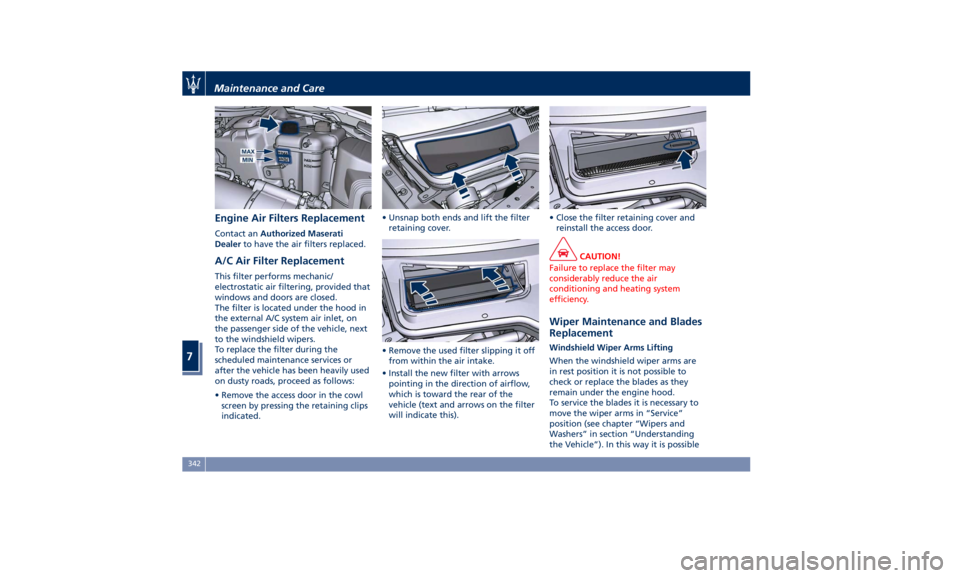
Engine Air Filters Replacement Contact an Authorized Maserati
Dealer to have the air filters replaced.
A/C Air Filter Replacement This filter performs mechanic/
electrostatic air filtering, provided that
windows and doors are closed.
The filter is located under the hood in
the external A/C system air inlet, on
the passenger side of the vehicle, next
to the windshield wipers.
To replace the filter during the
scheduled maintenance services or
after the vehicle has been heavily used
on dusty roads, proceed as follows:
• Remove the access door in the cowl
screen by pressing the retaining clips
indicated. • Unsnap both ends and lift the filter
retaining cover.
• Remove the used filter slipping it off
from within the air intake.
• Install the new filter with arrows
pointing in the direction of airflow,
which is toward the rear of the
vehicle (text and arrows on the filter
will indicate this). • Close the filter retaining cover and
reinstall the access door.
CAUTION!
Failure to replace the filter may
considerably reduce the air
conditioning and heating system
efficiency.
Wiper Maintenance and Blades
Replacement Windshield Wiper Arms Lifting
When the windshield wiper arms are
in rest position it is not possible to
check or replace the blades as they
remain under the engine hood.
To service the blades it is necessary to
move the wiper arms in “Service”
position (see chapter “Wipers and
Washers” in section “Understanding
the Vehicle”). In this way it is possibleMaintenance and Care
7
342