ignition MASERATI QUATTROPORTE 2019 Manual Online
[x] Cancel search | Manufacturer: MASERATI, Model Year: 2019, Model line: QUATTROPORTE, Model: MASERATI QUATTROPORTE 2019Pages: 396, PDF Size: 13.9 MB
Page 327 of 396
CAUTION!
• To jump start a vehicle do not use a
portable battery, a booster pack or
any other booster source with a
system voltage greater than 14 Volts
or damage to the battery, starter
motor, alternator or electrical system
of the vehicle with the discharged
battery may occur.
• Do not use a battery charger for
emergency starting under any
circumstances. You could damage
the electronic systems, particularly
the control units managing the
ignition and fuel supply functions.
• If the battery is completely
discharged when the windows are
fully raised, open the door with the
utmost care; do not close the door
again until it is possible to lower the
window.
WARNING!
Always secure your vehicle by fully
applying the parking brake, before
activating the manual park release.
Activating the manual park release
could allow your vehicle to roll away if it is not secured by the parking
brake. Activating the manual park
release on an unsecured vehicle could
lead to serious injury or death for
those in or around the vehicle.
NOTE:
If
you need
to disconnect the battery
from the vehicle electrical system, see
“Maintenance — Free Battery” in
section “Maintenance and Care”).
WARNING!
California Proposition 65
Operating, servicing and maintaining
a passenger vehicle or off-road vehicle
can expose you to chemicals including
such as, engine exhaust, carbon
monoxide, phthalates and lead, that
which are known to the State of
California to cause cancer and birth
defects or other reproductive harm. To
minimize exposure, avoid breathing
exhaust, do not idle the engine except
as necessary, service your vehicle in a
well-ventilated area and wear gloves
or wash your hands frequently when
servicing your vehicle. For more
information go to: www.P65Warnings.ca.gov/passenger-
vehicle
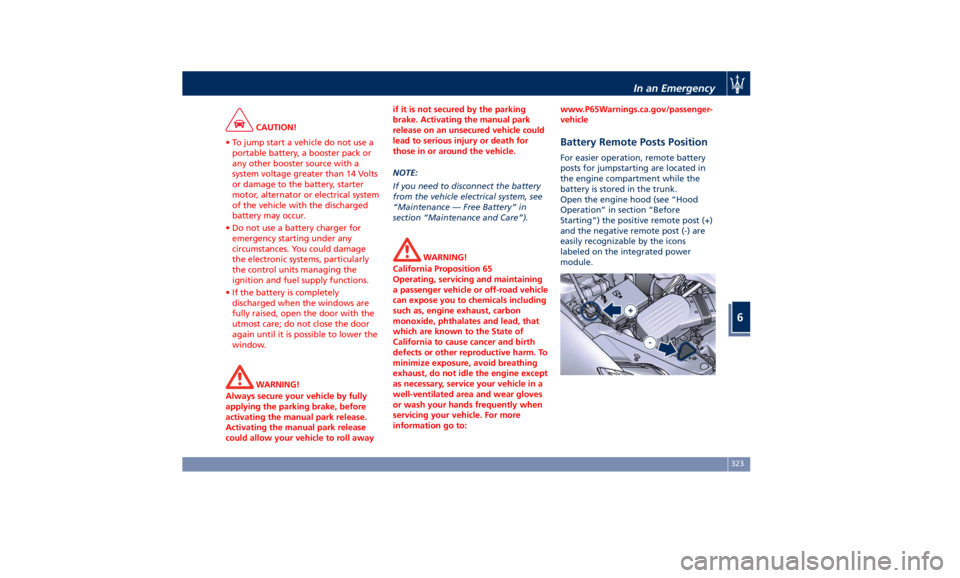
Battery Remote Posts Position For easier operation, remote battery
posts for jumpstarting are located in
the engine compartment while the
battery is stored in the trunk.
Open the engine hood (see “Hood
Operation” in section “Before
Starting”) the positive remote post (+)
and the negative remote post (-) are
easily recognizable by the icons
labeled on the integrated power
module.In an Emergency
6
323
Page 328 of 396
Jump-Start Procedure WARNING!
• Stay clear of the radiator cooling fan
whenever the engine hood is raised.
It can start anytime the ignition
switch is on. You could be injured by
the moving fan blades.
• Remove any metal jewelry such as
watch bands or bracelets that might
make an inadvertent electrical
contact. You could be seriously
injured.
• Do not allow the vehicles involved in
the jumpstarting operation to touch
each other as this could establish a
ground connection and cause
personal injury.
• Turn off the heater, radio, and all
unnecessary
electrical accessories.
•
Set the parking brake, shift the
automatic transmission into P (Park)
and turn the ignition to OFF .
• If using another vehicle to jumpstart
the battery, park the vehicle within
the jumper cables reach and set the
parking brake and make sure the
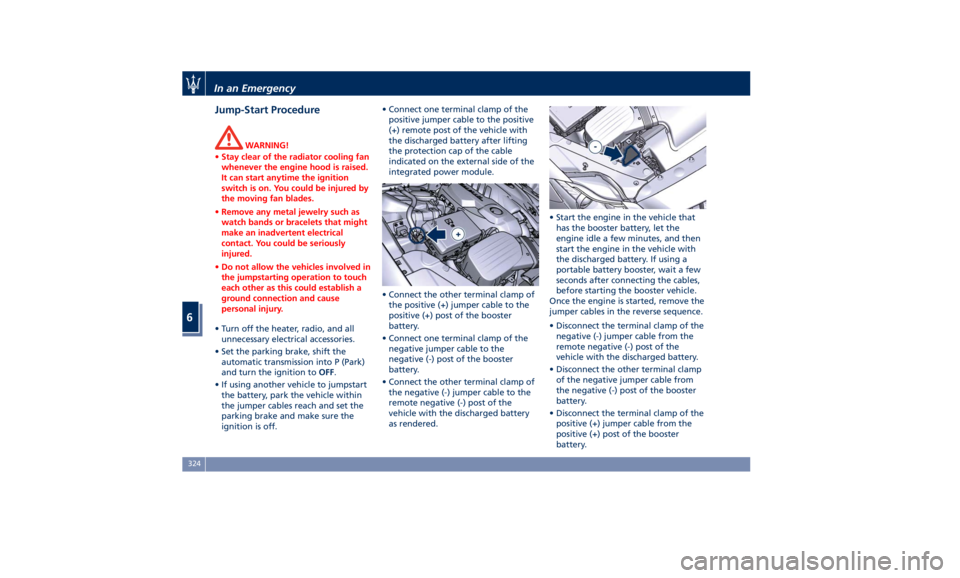
ignition is off. • Connect one terminal clamp of the
positive jumper cable to the positive
(+) remote post of the vehicle with
the discharged battery after lifting
the protection cap of the cable
indicated on the external side of the
integrated power module.
• Connect the other terminal clamp of
the positive (+) jumper cable to the
positive (+) post of the booster
battery.
• Connect one terminal clamp of the
negative jumper cable to the
negative (-) post of the booster
battery.
• Connect the other terminal clamp of
the negative (-) jumper cable to the
remote negative (-) post of the
vehicle with the discharged battery
as rendered. • Start the engine in the vehicle that
has the booster battery, let the
engine idle a few minutes, and then
start the engine in the vehicle with
the discharged battery. If using a
portable battery booster, wait a few
seconds after connecting the cables,
before starting the booster vehicle.
Once the engine is started, remove the
jumper cables in the reverse sequence.
• Disconnect the terminal clamp of the
negative (-) jumper cable from the
remote negative (-) post of the
vehicle with the discharged battery.
• Disconnect the other terminal clamp
of the negative jumper cable from
the negative (-) post of the booster
battery.
• Disconnect the terminal clamp of the
positive (+) jumper cable from the
positive (+) post of the booster
battery.In an Emergency
6
324
Page 330 of 396
(Continued)
ignition switch is in the OFF position. If
this is not observed, when the ESC is
active, the ECU will store a
malfunction and the relative warning
light
will illuminate on the
instrument cluster display. This
requires the intervention of an
Authorized Maserati Dealer to reset
the system.
Towing an AWD Vehicle
WARNING!
Single axle towing or use of a tow
dolly is not allowed since it will
severely damage components of an
AWD vehicle.
WARNING!
Use of a tow dolly on front wheels is
strictly forbidden since front wheels
may still receive a residual amount of
torque and disengage the vehicle from
the tow dolly and affect safety of
both rescuers and other road users. Use the Tow Hook of the Tool
Kit CAUTION!
The tow hook should only be used for
towing the car on flat roads. Do not
use the tow hook to remove the car
that is stuck on off road stretches.
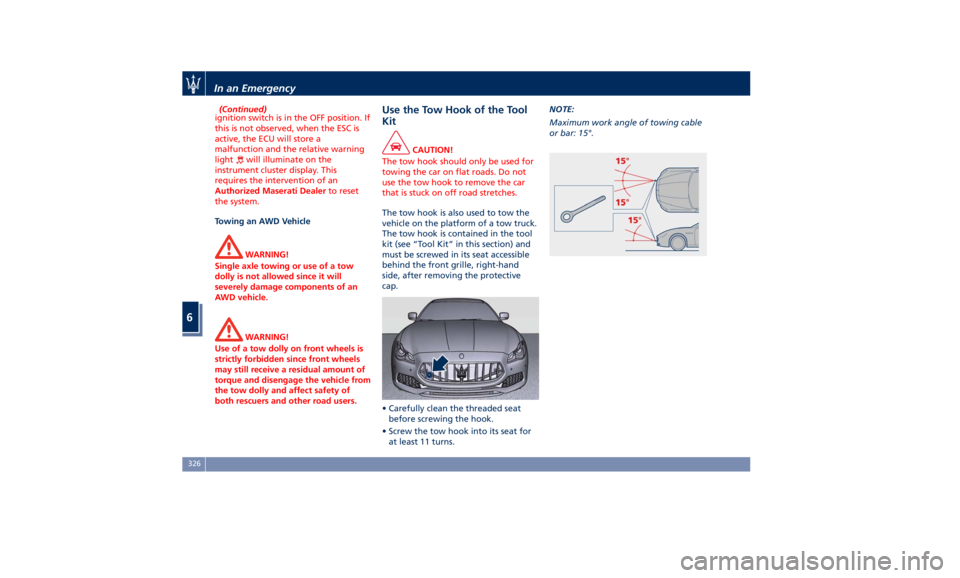
The tow hook is also used to tow the
vehicle
on the
platform of a tow truck.
The tow hook is contained in the tool
kit (see “Tool Kit” in this section) and
must be screwed in its seat accessible
behind the front grille, right-hand
side, after removing the protective
cap.
• Carefully clean the threaded seat
before screwing the hook.
• Screw the tow hook into its seat for
at least 11 turns. NOTE:
Maximum work angle of towing cable
or bar: 15°.
In an Emergency
6
326
Page 337 of 396
Failure to pass could prevent vehicle
registration. For states that require an
Inspection and Maintenance (I/M), this
check verifies the “Malfunction
Indicator Light
” is functioning
and is not on when the engine is
running, and that the OBD II system is
ready for testing.
Normally, the OBD II system will be
ready. The OBD II system may not be
ready if your vehicle was recently
serviced, recently had a dead battery
or a battery replacement. If the OBD II
system should be determined not
ready for the I/M test, your vehicle
may fail the test.
To check if your vehicle's OBD II system
is ready, you must do the following: 1. Press the ignition device to the
RUN position, but do not crank or
start the engine.
2. As soon as you press the ignition
device to turn the engine On, you
will see the MIL remain
illuminated for 15 seconds, this is a
normal bulb check.
3. Approximately 15 seconds later,
one of two things will happen:
•
The MIL
will remain
illuminated and a message error
will appear on your instrument
cluster. This means that your
vehicle's OBD II system is not
ready and you should not
proceed to the I/M station.
•
The MIL
will turn Off. This
means that your vehicle's OBD II
system is ready and you can
proceed to the I/M station.
If your OBD II system is not ready, you
should see an Authorized Maserati
Dealer or repair facility. If your vehicle
was recently serviced or had a battery
failure or replacement, you may need
to do nothing more than drive your
vehicle as you normally would in order
for your OBD II system to update. A
recheck with the above test routine may then indicate that the system is
now ready.
Regardless of whether your vehicle's
OBD II system is ready or not, if the
MIL
is illuminated during normal
vehicle operation you should have
your vehicle serviced before going to
the I/M station. The I/M station can fail
your vehicle because the MIL
is on
with the engine running.
Spare Parts Use of genuine Maserati parts for
normal or scheduled maintenance and
repairs is highly recommended to
ensure excellent performance.
Damage or failures caused by
non-genuine spare parts used for
maintenance and repairs will not be
covered by the manufacturer's
warranty.
Dealer Service An Authorized Maserati Dealer has
the qualified service personnel, special
tools, and equipment to perform all
service operations in an expert
manner. Service Manuals are available
which include detailed service
information for your vehicle. Refer to
these Service Manuals before
attempting any procedure yourself.Maintenance and Care
7
333
Page 347 of 396
to lift the arms for cleaning or
replacing the wiper blades.
WARNING!
It is dangerous to operate or service
the wiper blades with the windshield
wipers in an active position (any
position different from “OFF”) and
with the ignition switch in the RUN
position. The rain sensors may
suddenly activate the wipers. Always
use the “Service” position for any
intervention on the windshield wiper
blades.
Windshield Wiper Maintenance
Life
expectancy of wiper blades varies
depending on the geographical area’s
weather conditions where the car is
used and frequency of use. Poor
performance of blades may be present
with chattering, marks on the glass,
water lines or wet spots. If any of
these conditions are present, clean the
wiper blades or replace if necessary.
Clean the rubber edges of the wiper
blades and the windshield/rear
window glasses periodically with a
sponge or soft cloth and a mild
nonabrasive cleaner. This will remove
accumulations of salt or road film. Operation of the wipers on dry glass
for long periods may cause
deterioration of the wiper blades.
Always use washer fluid when using
the wipers to remove salt or dirt from
a dry windshield.
Avoid using the wiper blades to
remove frost or ice from the
windshield. Keep the blade rubber out
of contact with petroleum products
such as engine oil, gasoline, etc.
Spray nozzles
If the jet does not work, first check
that there is fluid in the tank (see
paragraph “Level checks” in this
section) then check that the nozzles
are not clogged.
Windshield Wiper Blades Replacement
• Move the wiper arms into “Service”
position, (see chapter “Windshield
Wipers and Washers” in section
“Understanding the Vehicle”) and
lift them.
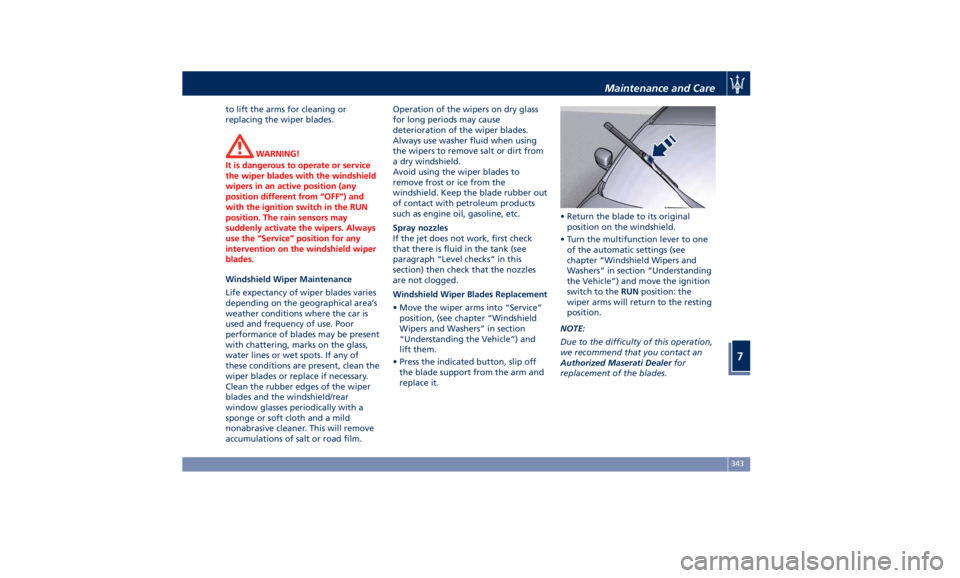
• Press the indicated button, slip off
the blade support from the arm and
replace it. • Return the blade to its original
position on the windshield.
• Turn the multifunction lever to one
of the automatic settings (see
chapter “Windshield Wipers and
Washers” in section “Understanding
the Vehicle”) and move the ignition
switch to the RUN position: the
wiper arms will return to the resting
position.
NOTE:
Due to the difficulty of this operation,
we recommend that you contact an
Authorized Maserati Dealer for
replacement of the blades.Maintenance and Care
7
343
Page 350 of 396
time. Then move the lid
automatically, using the buttons on
the lid itself, performing a complete
cycle of opening and closing.
• Initialize the climate control system
by activating the system and pressing
the “AUTO” control as described in
chapter “Air Conditioning Controls”
in section “Dashboard Instruments
and Controls”.
• Turn on the MTC+ and set the date
and time (see “MTC+ Settings” in
section “Dashboard Instruments and
Controls”).
• Lift, release and lift again the lever
on the central console to initialize
the electric parking brake. Following
this operation the
warning light
on the instrument cluster will turn
off.
• For correct activation of the
approach lights on the external
mirrors, press at least once the tilt
button on the driver's door panel so
that the door mode recognizes the
mirrors position.
• If the car is equipped with power
sunshades on rear door windows,
carry out the self learning cycle
described on chapter “Power
Sunshades on Rear Door Windows”
in section “Before Starting”. CAUTION!
• Every time the battery is
reconnected, wait at least 30 seconds
with the ignition switch turned to
RUN before starting the engine, in
order to allow the electronic system
that manages the motor-driven
throttles to run a self-learning cycle.
At the same time, you can run the
date and time set up procedure for
the MTC+.
• Every time the battery is reconnected
the warning light
flash for about
10 seconds and then go off.
WARNING!
California Proposition 65
Operating, servicing and maintaining
a passenger vehicle or off-road vehicle
can expose you to chemicals including
such as, engine exhaust, carbon
monoxide, phthalates and lead, that
which are known to the State of
California to cause cancer and birth
defects or other reproductive harm. To
minimize exposure, avoid breathing
exhaust, do not idle the engine except
as necessary, service your vehicle in a
well-ventilated area and wear gloves or wash your hands frequently when
servicing your vehicle. For more
information go to:
www.P65Warnings.ca.gov/passenger-
vehicle
Useful Advice to Extend
Battery Life When parking the vehicle, make sure
that the doors, front, rear lids and
flaps are properly closed. All interior
lights should be off.
When the engine is turned off, do not
keep the connected devices switched
on for a long time (such as radio,
hazard warning flashers, fan, etc.).
CAUTION!
If the battery charge remains below
50% for a long period of time, it will
be damaged due to sulfation; its
performance and starting power will
be reduced and it will be more subject
to freezing.
We recommend you to have the
battery
charge condition
checked,
preferably at the beginning of the cold
season, to prevent the electrolyte from
freezing.
This check should be carried out more
frequently if the vehicle is used mainlyMaintenance and Care
7
346
Page 351 of 396
for short trips or if it is equipped with
power-absorbing devices that remain
permanently on even when the
ignition switch is off. This applies
above all if these devices have been
retrofitted ("Aftermarket" services).
If the vehicle is not used for long
periods of time, please see “Vehicle
Stored for Long Periods” in this
section.
Battery Recharge WARNING!
The process of charging or recharging
the battery produces hydrogen, a
flammable gas that can explode and
cause serious injuries. When charging
or recharging the battery, follow the
recommended precautions at all
times.
• Before using a charger device
always check that this tool is
suitable for the installed battery,
with constant voltage (lower than
14.0 V) and low amperage
(maximum limit 15 A).
• Recharge the battery in a
well-ventilated environment.
• Never charge or recharge a frozen
battery. • Ensure that any sparks or open
flames are kept well away from the
battery while it is charging.
• Before using a charger to charge or
maintain the battery charge status,
carefully follow the instructions
provided to ensure the charger is
connected to the battery safely and
correctly.
It is possible to recharge the battery
without
disconnecting the
cables of
the vehicle electrical system.
• To access the battery lift the ground
coverage of the trunk compartment
and remove the access cover as
previously shown (see paragraph “To
Disconnect the Battery" in this
chapter).
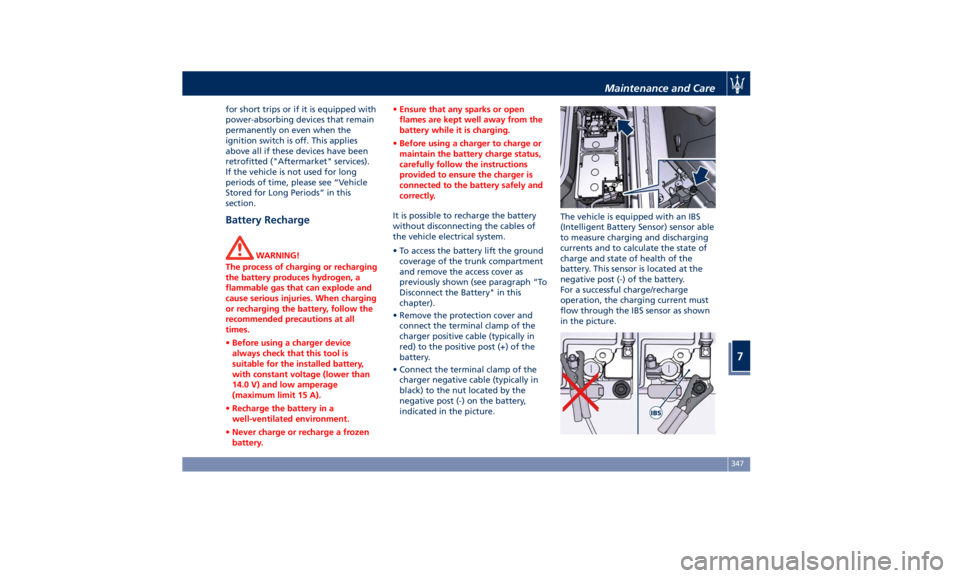
• Remove the protection cover and
connect the terminal clamp of the
charger positive cable (typically in
red) to the positive post (+) of the
battery.
• Connect the terminal clamp of the
charger negative cable (typically in
black) to the nut located by the
negative post (-) on the battery,
indicated in the picture. The vehicle is equipped with an IBS
(Intelligent Battery Sensor) sensor able
to measure charging and discharging
currents and to calculate the state of
charge and state of health of the
battery. This sensor is located at the
negative post (-) of the battery.
For a successful charge/recharge
operation, the charging current must
flow through the IBS sensor as shown
in the picture.Maintenance and Care
7
347
Page 370 of 396
Battery Statement Battery Statement Status of
Charge To avoid problems with ignition and/or
the electrical system in general when
you are driving, the battery charge
status is constantly maintained and
guaranteed by the vehicle's recharge
circuit; the main component of which
is the alternator. This circuit is only
able to supply voltage to the battery
when the vehicle is traveling.
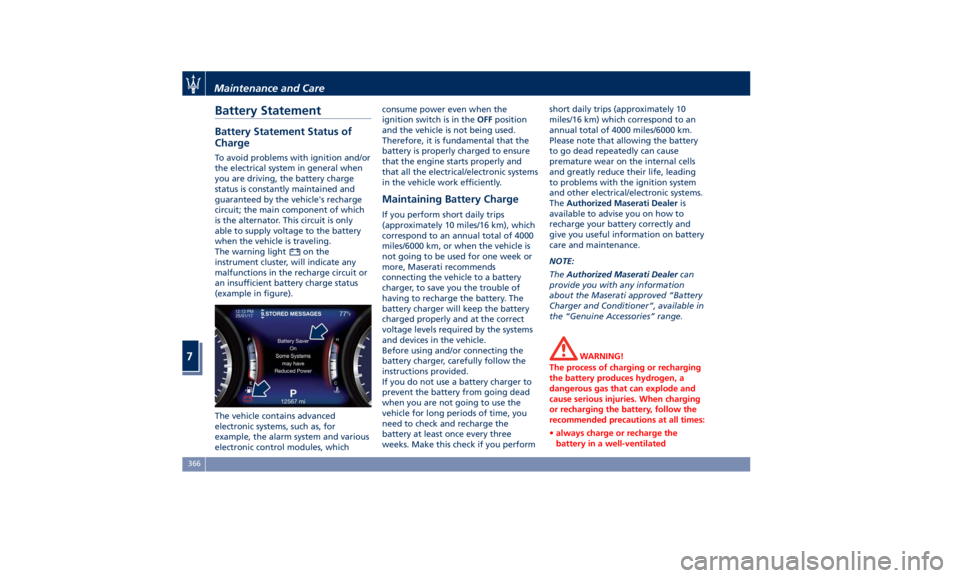
The warning light
on the
instrument cluster, will indicate any
malfunctions in the recharge circuit or
an insufficient battery charge status
(example in figure).
The vehicle contains advanced
electronic systems, such as, for
example, the alarm system and various
electronic control modules, which consume power even when the
ignition switch is in the OFF position
and the vehicle is not being used.
Therefore, it is fundamental that the
battery is properly charged to ensure
that the engine starts properly and
that all the electrical/electronic systems
in the vehicle work efficiently.
Maintaining Battery Charge If you perform short daily trips
(approximately 10 miles/16 km), which
correspond to an annual total of 4000
miles/6000 km, or when the vehicle is
not going to be used for one week or
more, Maserati recommends
connecting the vehicle to a battery
charger, to save you the trouble of
having to recharge the battery. The
battery charger will keep the battery
charged properly and at the correct
voltage levels required by the systems
and devices in the vehicle.
Before using and/or connecting the
battery charger, carefully follow the
instructions provided.
If you do not use a battery charger to
prevent the battery from going dead
when you are not going to use the
vehicle for long periods of time, you
need to check and recharge the
battery at least once every three
weeks. Make this check if you perform short daily trips (approximately 10
miles/16 km) which correspond to an
annual total of 4000 miles/6000 km.
Please note that allowing the battery
to go dead repeatedly can cause
premature wear on the internal cells
and greatly reduce their life, leading
to problems with the ignition system
and other electrical/electronic systems.
The Authorized Maserati Dealer is
available to advise you on how to
recharge your battery correctly and
give you useful information on battery
care and maintenance.
NOTE:
The Authorized Maserati Dealer can
provide you with any information
about the Maserati approved “Battery
Charger and Conditioner”, available in
the “Genuine Accessories” range.
WARNING!
The process of charging or recharging
the battery produces hydrogen, a
dangerous gas that can explode and
cause serious injuries. When charging
or recharging the battery, follow the
recommended precautions at all times:
• always charge or recharge the
battery in a well-ventilatedMaintenance and Care
7
366
Page 380 of 396
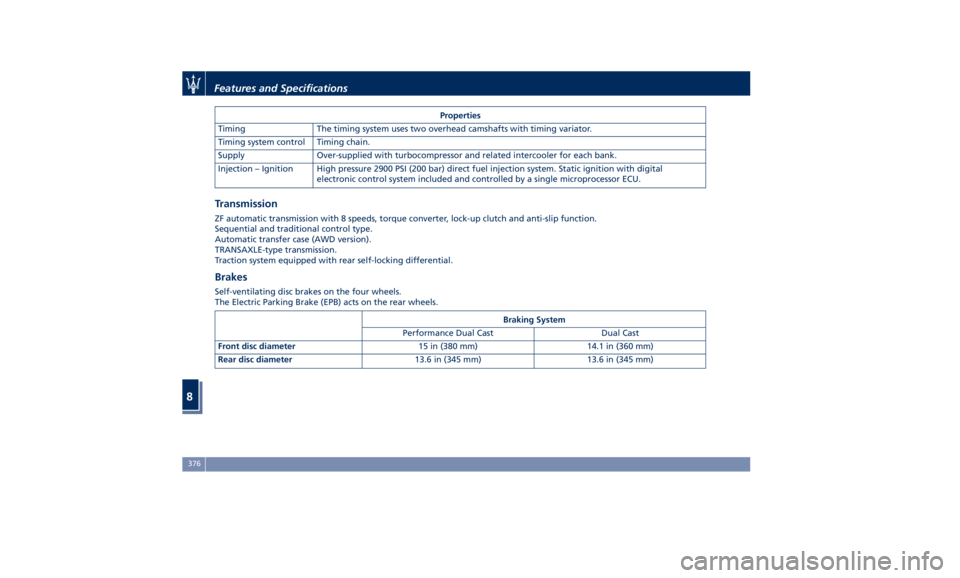
Properties
Timing The timing system uses two overhead camshafts with timing variator.
Timing system control Timing chain.
Supply Over-supplied with turbocompressor and related intercooler for each bank.
Injection – Ignition High pressure 2900 PSI (200 bar) direct fuel injection system. Static ignition with digital
electronic control system included and controlled by a single microprocessor ECU.
Transmission ZF automatic transmission with 8 speeds, torque converter, lock-up clutch and anti-slip function.
Sequential and traditional control type.
Automatic transfer case (AWD version).
TRANSAXLE-type transmission.
Traction system equipped with rear self-locking differential.
Brakes Self-ventilating disc brakes on the four wheels.
The Electric Parking Brake (EPB) acts on the rear wheels.
Braking System
Performance Dual Cast Dual Cast
Front disc diameter 15 in (380 mm) 14.1 in (360 mm)
Rear disc diameter 13.6 in (345 mm) 13.6 in (345 mm)Features and Specifications
8
376
Page 393 of 396
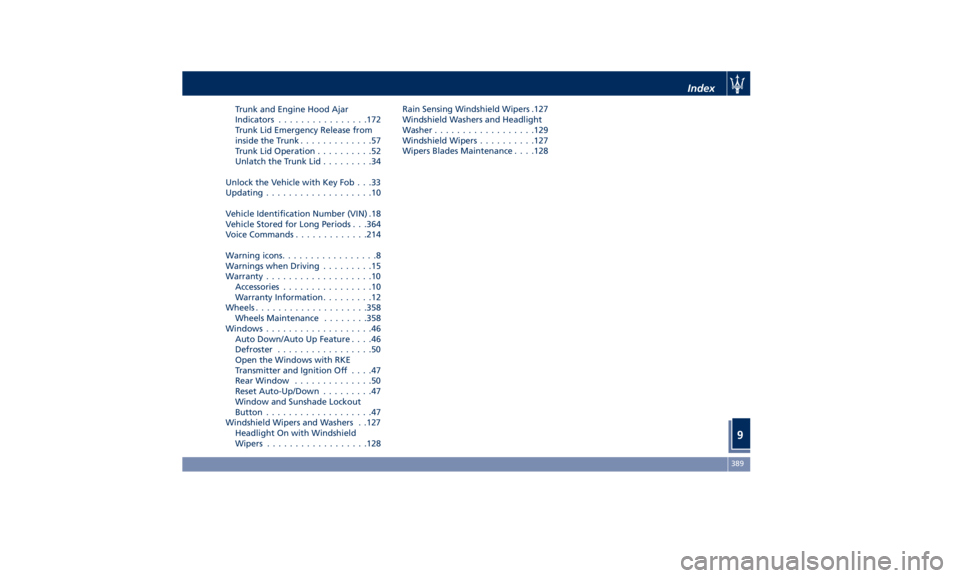
Trunk and Engine Hood Ajar
Indicators ............... .172
Trunk Lid Emergency Release from
inside the Trunk .............57
Trunk Lid Operation ..........52
Unlatch the Trunk Lid .........34
Unlock the Vehicle with Key Fob . . .33
Updating ...................10
Vehicle Identification Number (VIN) .18
Vehicle Stored for Long Periods . . .364
Voice Commands ............ .214
Warning icons .................8
Warnings when Driving .........15
Warranty ...................10
Accessories ................10
Warranty Information .........12
Wheels ................... .358
Wheels Maintenance ....... .358
Windows ...................46
Auto Down/Auto Up Feature ....46
Defroster .................50
Open the Windows with RKE
Transmitter and Ignition Off ....47
Rear Window ..............50
Reset Auto-Up/Down .........47
Window and Sunshade Lockout
Button ...................47
Windshield Wipers and Washers . .127
Headlight On with Windshield
Wipers ................. .128 Rain Sensing Windshield Wipers .127
Windshield Washers and Headlight
Washer ................. .129
Windshield Wipers ......... .127
Wipers Blades Maintenance . . . .128
Index
9 389