tire pressure MAZDA CX5 2023 Owner's Manual
[x] Cancel search | Manufacturer: MAZDA, Model Year: 2023, Model line: CX5, Model: MAZDA CX5 2023Pages: 583, PDF Size: 32.58 MB
Page 459 of 583
▼Replacing a Wheel
WARNING
Always use wheels of the correct size
on your vehicle:
Using a wrong-sized wheel is
dangerous. Braking and handling could
be affected, leading to loss of control
and an accident.
CAUTION
A wrong-sized wheel may adversely
affect:
Tire fit
Wheel and bearing life
Ground clearance
Snow-chain clearance
Speedometer calibration
Headlight aim
Bumper height
Tire Pressure Monitoring System
NOTE
When replacing a wheel, make sure
the new one is the same as the
original factory wheel in diameter,
rim width, and offset (inset/outset).
For details, contact an Authorized
Mazda Dealer.
Proper tire balancing provides the best
riding comfort and helps reduce tread
wear. Out-of-balance tires can cause
vibration and uneven wear, such as
cupping and flat spots.
Light Bulbs
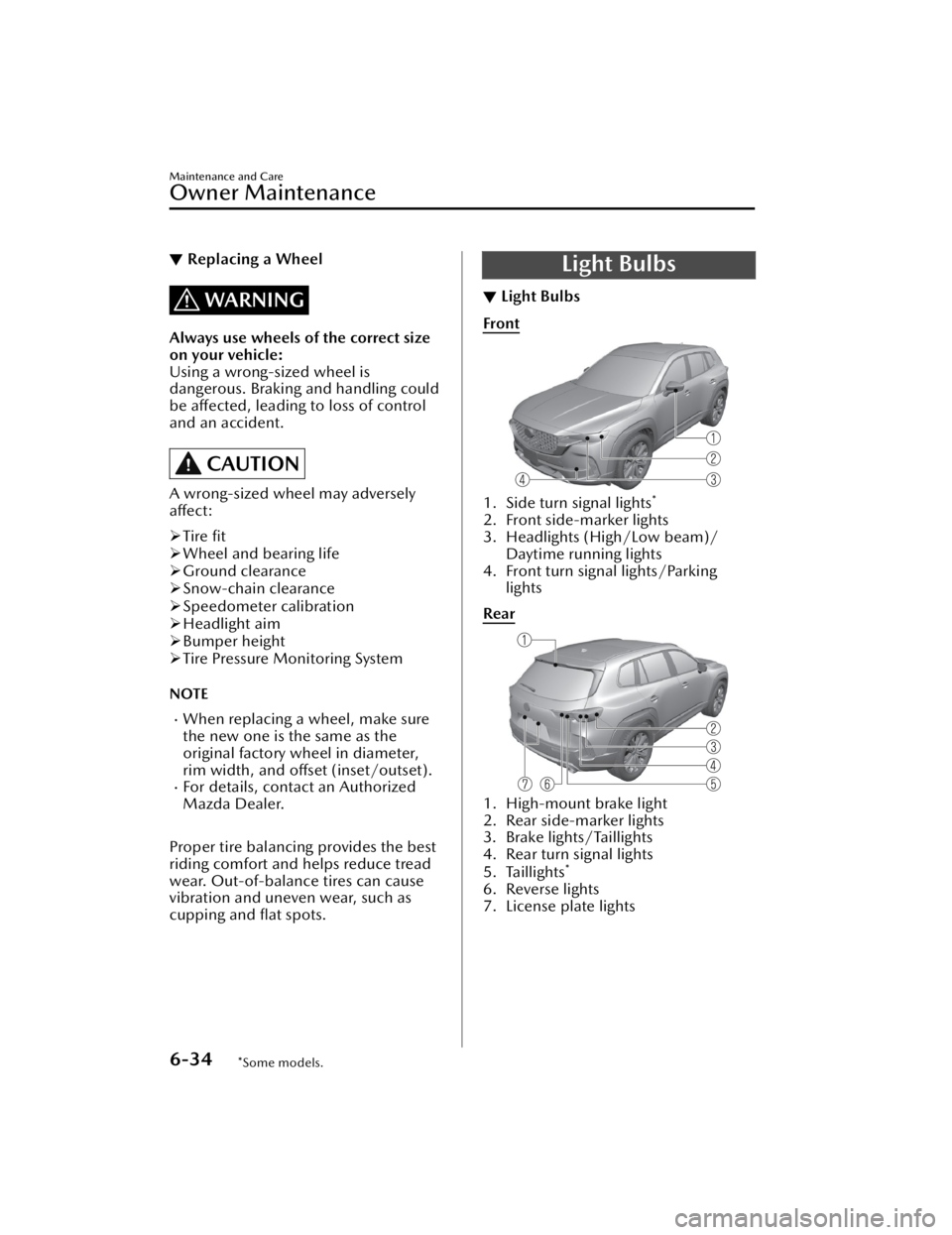
▼ Light Bulbs
Front
1. Side turn signal lights*
2. Front side-marker lights
3. Headlights (High/Low beam)/
Daytime running lights
4. Front turn signal lights/Parking lights
Rear
1. High-mount brake light
2. Rear side-marker lights
3. Brake lights/Taillights
4. Rear turn signal lights
5. Taillights
*
6. Reverse lights
7. License plate lights
Maintenance and Care
Owner Maintenance
6-34*Some models.
CX-50_8KB8-EA-22A_Edition2_new 2022-1-6 14:55:18
Page 486 of 583
To remove an antitheft lug nut
1. Obtain the special key for theantitheft lug nut.
2. Place the special key on top of the antitheft lug nut, and be sure to
hold the key square to it. If you
hold the key at an angle, you may
damage both key and nut. Do not
use a power impact wrench.
3. Place the lug wrench on top of the
key and apply pressure. Turn the
wrench counterclockwise.
To install the antitheft lug nut
1. Place the special key on top of the nut, and be sure to hold the key
square to it. If you hold the key at
an angle, you may damage both key
and nut. Do not use a power
impact wrench.
2. Place the lug wrench on top of the special key, apply pressure, and
turn it clockwise.
Nut tightening torque
N·m (kgf·m, ft·lbf) 108―
147 (12 ―14,
80― 108)
▼Mounting the Spare Tire
1. Remove dirt and grime from the
mounting surfaces of the wheel and
hub, including the hub bolts, with a
cloth.
WARNING
Make sure the mounting surfaces
of the wheel, hub and lug nuts are
clean before changing or replacing
tires:
When changing or replacing a tire,
not removing dirt and grime from
the mounting surfaces of the wheel,
hub and hub bolts is dangerous.
The lug nuts could loosen while
driving and cause the tire to come
off, resulting in an accident.
2. Mount the spare tire.
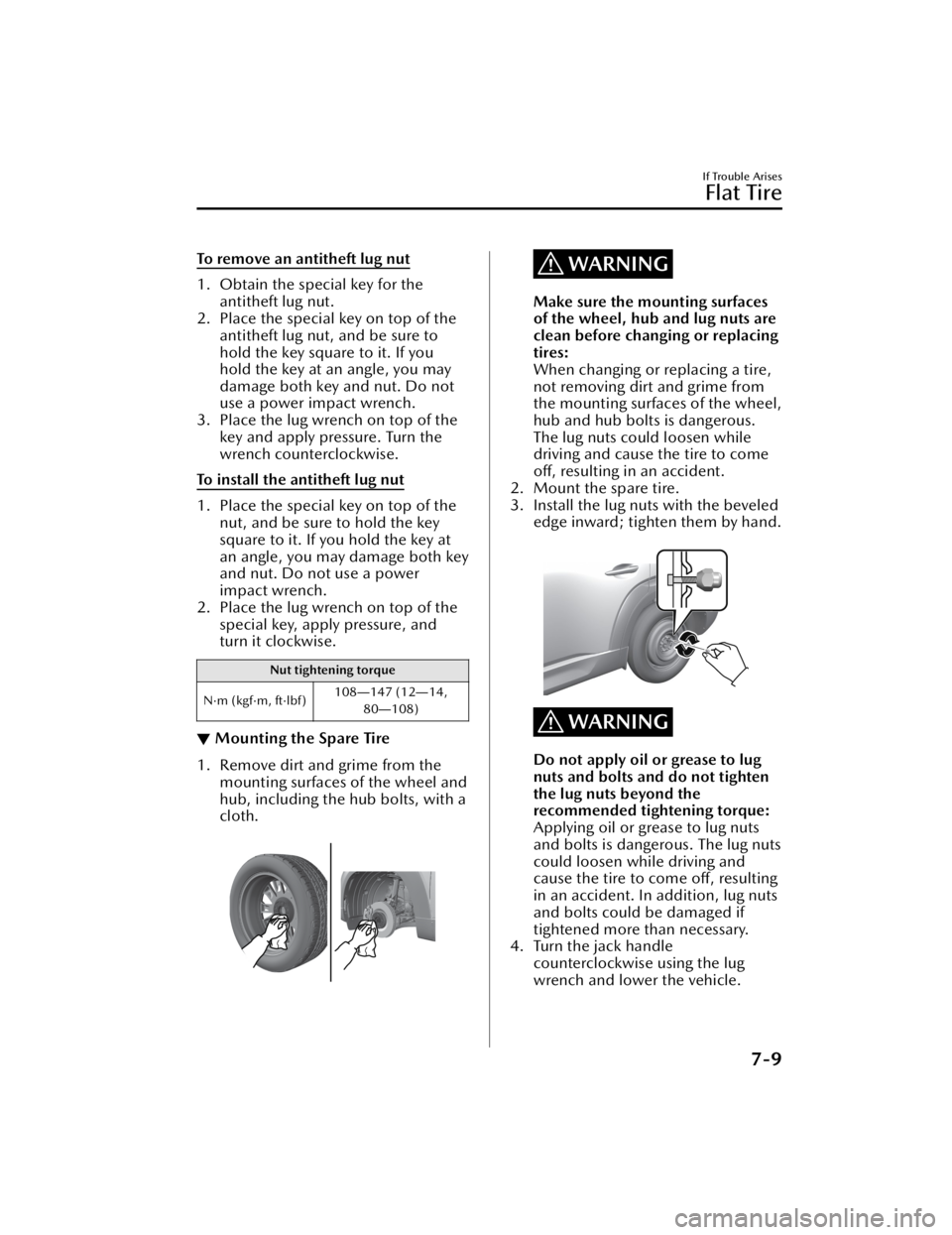
3. Install the lug nuts with the beveled edge inward; tighten them by hand.
WARNING
Do not apply oil or grease to lug
nuts and bolts and do not tighten
the lug nuts beyond the
recommended tightening torque:
Applying oil or grease to lug nuts
and bolts is dangerous. The lug nuts
could loosen while driving and
cause the tire to come off, resulting
in an accident. In addition, lug nuts
and bolts could be damaged if
tightened more than necessary.
4. Turn the jack handle counterclockwise using the lug
wrench and lower the vehicle.
If Trouble Arises
Flat Tire
7-9
CX-50_8KB8-EA-22A_Edition2_new 2022-1-6 14:55:18
Page 487 of 583
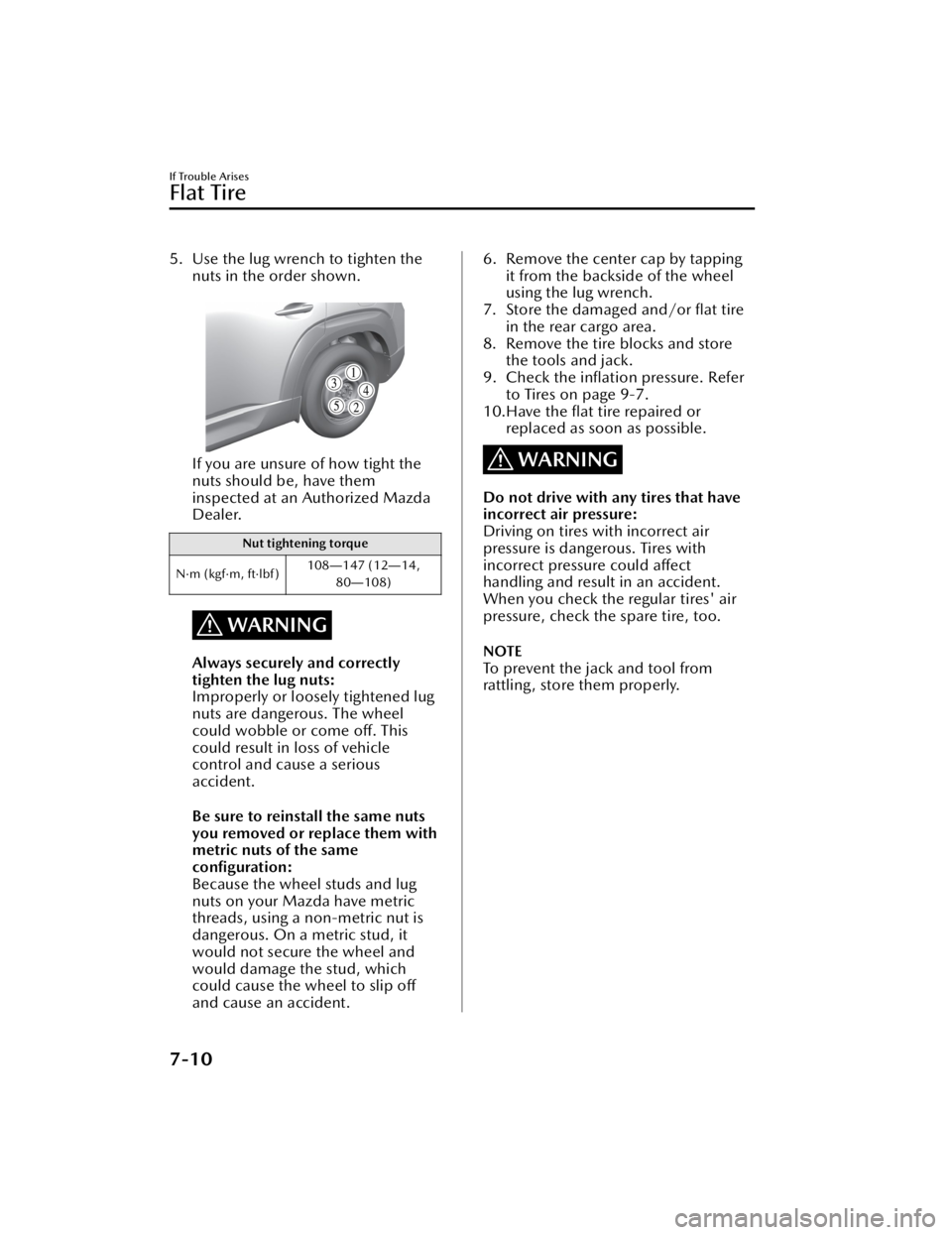
5. Use the lug wrench to tighten thenuts in the order shown.
If you are unsure of how tight the
nuts should be, have them
inspected at an Authorized Mazda
Dealer.
Nut tightening torque
N·m (kgf·m, ft·lbf) 108―
147 (12― 14,
80 ―108)
WARNING
Always securely and correctly
tighten the lug nuts:
Improperly or loosely tightened lug
nuts are dangerous. The wheel
could wobble or come
off. This
could result in loss of vehicle
control and cause a serious
accident.
Be sure to reinstall the same nuts
you removed or replace them with
metric nuts of the same
configuration:
Because the wheel studs and lug
nuts on your Mazda have metric
threads, using a non-metric nut is
dangerous. On a metric stud, it
would not secure the wheel and
would damage the stud, which
could cause the wheel to slip off
and cause an accident.
6. Remove the center cap by tapping it from the backside of the wheel
using the lug wrench.
7. Store the damaged and/or flat tire in the rear cargo area.
8. Remove the tire blocks and store the tools and jack.
9. Check the inflation pressure. Refer to Tires on page 9-7.
10.Have the flat tire repaired or replaced as soon as possible.
WARNING
Do not drive with any tires that have
incorrect air pressure:
Driving on tires with incorrect air
pressure is dangerous. Tires with
incorrect pressure could affect
handling and result in an accident.
When you check the regular tires' air
pressure, check the spare tire, too.
NOTE
To prevent the jack and tool from
rattling, store them properly.
If Trouble Arises
Flat Tire
7-10
CX-50_8KB8-EA-22A_Edition2_new 2022-1-6 14:55:18
Page 502 of 583

Inspected” is displayed/When the
light is turned on
The indication is displayed/the light
turns on under the following
conditions. The system may have a
malfunction. Have the vehicle checked
at an Authorized Mazda Dealer.
When there is a malfunction in the
AWD system.
“Excessive AWD System Load. Drive
Slowly Until Warning Light Turns Off.
Vehicle Now in Front Wheel Drive” is
displayed/When the light is flashing
The indication is displayed/the light
flashes under the following conditions.
Park the vehicle in a safe place and
check that the warning indication light
turns off/ the warning light stops
flashing, and then drive the vehicle.
Contact an Authorized Mazda Dealer
if the indication is continuously
displayed.
When the differential oil temperature
is excessively high.
When there is a large difference
between the front and rear wheel
rotation, such as when trying to
remove the vehicle from mud.
“Mismatched Tire Diameters. Vehicle
Now in Front Wheel Drive” is
displayed/When the light is turned on
The indication is displayed/the light
turns on under the following
conditions. Inspect the tire sizes or tire
pressures on all 4 wheels. Contact an
Authorized Mazda Dealer if the
indication remains on or the warning
light remains illuminated.
When any of the tire diameter is
different.
When any of the tire pressure is
incorrect.
▼ TCS/DSC Indication/Indicator
Light (Turns on)
If the light stays on, the TCS, DSC or
the brake assist system may have a
malfunction and they may not operate
correctly. Take your vehicle to an
Authorized Mazda Dealer.
▼Air Bag/Seat Belt Pretensioner
System Warning Indication/
Warning Light
A system malfunction is indicated if the
warning light constantly
flashes,
constantly illuminates or does not
illuminate at all when the ignition is
switched ON. If any of these occur,
consult an Authorized Mazda Dealer
as soon as possible. The system may
not operate in an accident.
WARNING
Never tamper with the air bag/
pretensioner systems and always have
an Authorized Mazda Dealer perform
all servicing and repairs:
Self-servicing or tampering with the
systems is dangerous. An air bag/
pretensioner could accidentally
activate or become disabled causing
serious injury or death.
If Trouble Arises
Warning/Indicator Lights and Warning Sounds
7-25
CX-50_8KB8-EA-22A_Edition2_new 2022-1-6 14:55:18
Page 503 of 583

▼Tire Pressure Monitoring System
(TPMS) Warning Indication/
Warning Light (Flashing)
If there is a problem with the TPMS or
the voltage of a tire pressure sensor
decreases, the TPMS warning light
flashes and a message is displayed on
the multi-information display. Have
your vehicle inspected by an
Authorized Mazda Dealer.
WARNING
Do not drive the vehicle at high
speeds if the TPMS warning light turns
on or flashes:
Driving the vehicle at high speeds
while the TPMS warning light is turned
on or flashing is dangerous because
the brake performance and the
steering wheel operability will be
reduced. If the vehicle is driven at high
speeds or the brakes are suddenly
applied, it could lead to an accident.
Gradually apply the brakes to lower the
vehicle's speed.
Do not ignore the TPMS warning light
when it is turned on or flashing:
Continuing to drive the vehicle while
ignoring the illumi
nation/flashing of
the TPMS warning light is dangerous
because a tire may burst which could
lead to an accident. Take appropriate
measures as soon as possible.
▼ KEY Warning Indication/Warning
Light (Red)
“Keyless Entry System Malfunction.
Have the Vehicle Inspected” is
displayed
This message is displayed if the
advanced keyless entry & push button
start system has a problem.
Contact an Authorized Mazda Dealer.
CAUTION
If the message is indicated, or the push
button start indicator light (amber)
flashes, the engine may not start. If the
engine cannot be started, try starting it
using the emergency operation for
starting the engine, and have the
vehicle inspected at an Authorized
Mazda Dealer as soon as possible.
Refer to Emergency Operation for
Starting the Engine on page 4-9.
“Key Not Detected” is displayed
If the presence of the key cannot be
detected (dead battery, battery
malfunction, no key), it is displayed
when the driver attempts to start the
engine (push button start operation,
brake pedal depression).
Displayed when it is determined that
a key that was in the vehicle has
been removed from the vehicle. (Key
taken out warning. Other than
IG-OFF).
If Trouble Arises
Warning/Indicator Lights and Warning Sounds
7-26
CX-50_8KB8-EA-22A_Edition2_new 2022-1-6 14:55:18
Page 507 of 583

▼Tire Pressure Monitoring System
(TPMS) Warning Indication/
Warning Light (Turns on)
If a tire pressure decreases below the
specified air pressure, the TPMS
warning light turns on.
At the same time, a message and the
tire pressure of each tire are displayed
on the multi-information display
alternately. In addition, the tire (s) with
low air pressure is displayed in yellow.
WARNING
Do not drive the vehicle at high
speeds if the TPMS warning light turns
on or flashes:
Driving the vehicle at high speeds
while the TPMS warning light is turned
on or
flashing is dangerous because
the brake performance and the
steering wheel operability will be
reduced. If the vehicle is driven at high
speeds or the brakes are suddenly
applied, it could lead to an accident.
Gradually apply the brakes to lower the
vehicle's speed.
Do not ignore the TPMS warning light
when it is turned on or flashing:
Continuing to driv e the vehicle while
ignoring the illumi nation/flashing of
the TPMS warning light is dangerous
because a tire may burst which could
lead to an accident. Take appropriate
measures as soon as possible.
NOTE
While the TPMS is learning the tire
positions, such as immediately after a
tire position has been changed, the tire
pressure at the tire position prior to it
being changed is displayed until the
system completes the learning. For this
reason, the tire pressures displayed for
the tire positions may be different from
the actual tire pressures at the tire
positions.
Action to be taken
Adjust the tire pressures to the
appropriate pressures.
Refer to Tire Inflation Pressure on page
6-31.
If Trouble Arises
Warning/Indicator Lights and Warning Sounds
7-30
CX-50_8KB8-EA-22A_Edition2_new 2022-1-6 14:55:18
Page 508 of 583

CAUTION
Adjust the tire pressures while the
tires are cool. Because the air
pressure in the tires fluctuates
depending on the temperature,
before adjusting the tire pressures,
let the vehicle sit for an hour or drive
it only within a 1.6 km (1 mile)
distance. If the tire pressures are
adjusted while the tires are warm,
the tire pressures may decrease
below the
specified air pressure after
cooling down which could turn on
the warning light. In addition,
because the air pressure in the tires
decreases when the ambient
temperature is low, if the ambient
temperature increases, an
illuminated TPMS warning light may
turn off. Under any circumstances,
always adjust the tire pressures while
the tires are cool.
After adjusting the tire pressures, the
TPMS warning light turns off. If the
TPMS warning light does not turn
off,
drive the vehicle at a speed of about
25 km (16 mph) or faster for 3
minutes or longer and make sure the
warning light turns off.
If the TPMS warning light remains on
even after adjusting the tire pressures,
one of the tires may have a puncture.
▼ KEY Indicator Light (Green)
(Flashing)
“Low Key Fob Battery. Replace
Battery” is displayed/When the light
is flashing
When the key battery is low, the
indication is displayed when the
ignition is switched OFF.
Action to be taken
Replace the key battery.
If Trouble Arises
Warning/Indicator Lights and Warning Sounds
7-31
CX-50_8KB8-EA-22A_Edition2_new
2022-1-6 14:55:18
Page 543 of 583
Tire Labeling
▼Tire Labeling
Federal law requires tire manufacturers
to place standardized information on
the sidewall of all tires. This
information identifies and describes
the fundamental characteristics of the
tire and also provides a tire
identification
number for safety
standard certification and in case of a
recall.
▼ Information on Passenger Vehicle
Tires
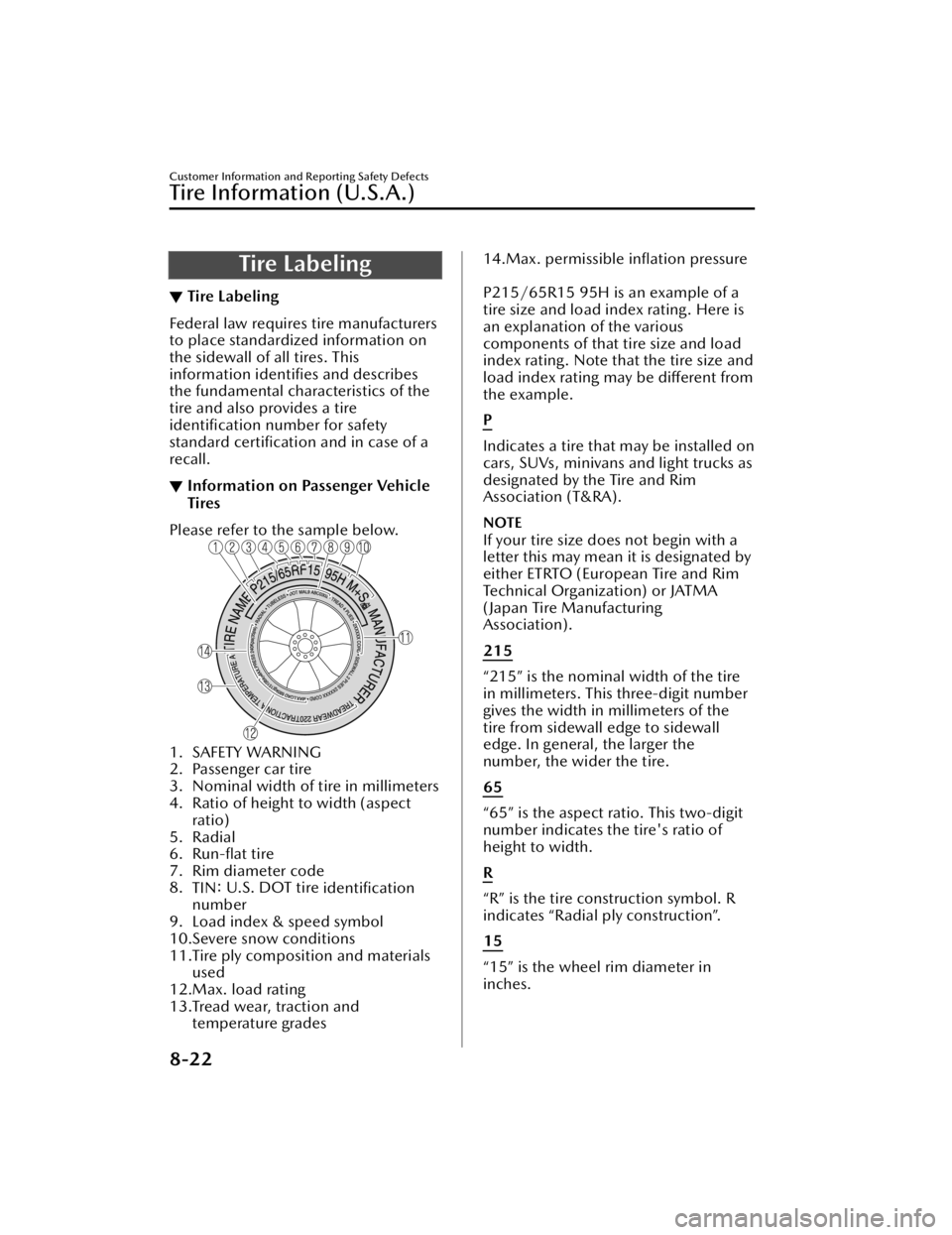
Please refer to the sample below.
1. SAFETY WARNING
2. Passenger car tire
3. Nominal width of tire in millimeters
4. Ratio of height to width (aspect
ratio)
5. Radial
6. Run-flat tire
7. Rim diameter code
8. TIN: U.S. DOT tire
identification
number
9. Load index & speed symbol
10.Severe snow conditions
11.Tire ply composition and materials used
12.Max. load rating
13.Tread wear, traction and temperature grades
14.Max. permissible inflation pressure
P215/65R15 95H is an example of a
tire size and load index rating. Here is
an explanation of the various
components of that tire size and load
index rating. Note that the tire size and
load index rating may be different from
the example.
P
Indicates a tire that may be installed on
cars, SUVs, minivans and light trucks as
designated by the Tire and Rim
Association (T&RA).
NOTE
If your tire size does not begin with a
letter this may mean it is designated by
either ETRTO (European Tire and Rim
Technical Organization) or JATMA
(Japan Tire Manufacturing
Association).
215
“215” is the nominal width of the tire
in millimeters. This three-digit number
gives the width in millimeters of the
tire from sidewall edge to sidewall
edge. In general, the larger the
number, the wider the tire.
65
“65” is the aspect ratio. This two-digit
number indicates the tire's ratio of
height to width.
R
“R” is the tire construction symbol. R
indicates “Radial ply construction”.
15
“15” is the wheel rim diameter in
inches.
Customer Information and Reporting Safety Defects
Tire Information (U.S.A.)
8-22
CX-50_8KB8-EA-22A_Edition2_new 2022-1-6 14:55:18
Page 544 of 583

95
“95” is the Load Index. This two-or
three-digit number indicates how
much weight each tire can support.
H
“H” is the speed rating. The speed
rating denotes the maximum speed for
which the use of the tire is rated.
Letter Rating Speed Rating
Q 99 mphR 106 mph
S 112 mph
T 118 mph
U 124 mph
H 130 mph
V 149 mph
W 168
* mph
Y 186
* mph
* For tires with a maximum speed capability over
149 mph, tire manufacturers sometimes use the
letters ZR. For tires with a maximum speed
capability over 186 mph, tire manufacturers
always use the letters ZR.
M+S or M/S: Mud and Snow
AT: All Terrain.
AS: All Season. The “M+S” or “M/S”
indicates that the tire has some
functional use in mud and snow.
U.S. DOT Tire Identification Number
(TIN)
This begins with the letters “DOT”
which indicates the tire meets all
federal standards. The next two
numbers or letters are the plant code
where it was manufactured, and the
last four numbers represent the week
and year the tire was manufactured.
For example, the numbers 457 means
the 45st week of 1997. After 2000 the
numbers go to four digits. For
example, the number 2102 means the
21th week of 2002. The other
numbers are marketing codes used at
the manufacturer's discretion. This
information is used to contact
consumers if a tire defect requires a
recall.
Tire Ply Composition and Materials
Used
The number of plies indicates the
number of layers of rubber-coated
fabric in the tire. In general, the greater
the number of plies, the more weight a
tire can support. Tire manufacturers
also must indicate the tire materials,
which include steel, nylon, polyester,
and other.
Maximum Load Rating
This number indicates the maximum
load in kilograms and pounds that can
be carried by the tire.
Maximum Permissible Inflation
Pressure
This number is the greatest amount of
air pressure that should ever be put in
the tire under normal driving
conditions.
Tread Wear, Traction and Temperature
Grades
Trea d wea r : The tread wear grade is a
comparative rating based on the wear
rate of the tire when tested under
controlled conditions on a specified
government test course. For example,
a tire graded 150 would wear one and
one-half (1 1/2) times as well on the
government course as a tire graded
100.
Traction: The traction grades, from
highest to lowest are AA, A, B, and C.
Customer Information and Reporting Safety Defects
Tire Information (U.S.A.)
8-23
CX-50_8KB8-EA-22A_Edition2_new 2022-1-6 14:55:18
Page 545 of 583

The grades represent the tire's ability
to stop on wet pavement as measured
under controlled conditions on
specified government test surfaces of
asphalt and concrete. A tire marked C
may have poor traction performance.
Temperature: The temperature grades
are A (the highest), B and C,
representing the tire's resistance to the
generation of heat and its ability to
dissipate heat when tested under
controlled conditions on a specified
indoor laboratory test wheel.
Snow Tires
In some heavy snow areas, local
governments may require true snow
tires, those with very deeply cut tread.
These tires should only be used in pairs
or placed on all four wheels. Make
sure you purchase snow tires that are
the same size and construction type as
the other tires on your vehicle.
SAFETY WARNING
The following safety warning appears
on the tire's sidewall.
SERIOUS INJURY MAY RESULT FROM:
EXPLOSION OF TIRE/RIM ASSEMBLY
DUE TO IMPROPER
MOUNTING-MATCH TIRE
DIAMETER TO RIM DIAMETER;
NEVER EXCEED 40 psi (275 kPa) TO
SEAT BEADS-ONLY SPECIALLY
TRAINED PERSONS SHOULD
MOUNT TIRES.
TIRE FAILURE DUE TO UNDER-INFLATION/
OVERLOADING/DAMAGE-FOLLOW
OWNER'S MANUAL AND PLACARD
IN VEHICLE-FREQUENTLY CHECK
INFLATION PRESSURE AND INSPECT
FOR DAMAGE.
▼ Information on Temporary Tires
Please refer to the sample below.
1. Temporary tires
2. Nominal width of tire in millimeters
3. Ratio of height to width (aspect
ratio)
4. Diagonal
5. Rim diameter code
6. Load index & speed symbol
T115/70D16 90M is an example of a
tire size and load index rating. Here is
an explanation of the various
components of that tire size and load
index rating. Note that the tire size and
load index rating may be different from
the example.
T
Indicates a tire that may be installed on
cars, SUVs, minivans and light trucks as
designated by the Tire and Rim
Association (T&RA).
115
“115” is the nominal width of the tire
in millimeters. This three-digit number
gives the width in millimeters of the
tire from sidewall edge to sidewall
edge. In general, the larger the
number, the wider the tire.
Customer Information and Reporting Safety Defects
Tire Information (U.S.A.)
8-24
CX-50_8KB8-EA-22A_Edition2_new 2022-1-6 14:55:18