light MAZDA CX9 2023 Owner's Manual
[x] Cancel search | Manufacturer: MAZDA, Model Year: 2023, Model line: CX9, Model: MAZDA CX9 2023Pages: 739, PDF Size: 11.69 MB
Page 58 of 739

WA R N I N G
Use the correct size child-restraint system:
For effective protection in vehicle accidents and sudden stop s, a child must be properly
restrained using a seat belt or child-restraint system depending on age and size. If not, the
child could be seriously injured or even killed in an accident.
Follow the manufacturer's instructions and always keep the child-restraint system buckled
down:
An unsecured child-restraint system is dangerous . In a sudden stop or a collision it could move
causing serious injury or death to the child or other occupants. Make sure any child-restraint
system is properly secured in place accordin g to the child-restraint system manufacturer's
instructions. When not in use, remove it from the vehicle or fasten it with a seat belt, or attach
it to BOTH ISOFIX/LATCH
*1 lower anchors for ISOFIX/LATCH*1 child-restraint systems and the
corresponding tether anchor.
*1 ISOFIX (Mexico)/LATCH (Except Mexico)
Always secure a child in a proper child-restraint system:
Holding a child in your arms while the vehicl e is moving is extremely dangerous. No matter
how strong the person may be, he or she cannot hold onto a child in a sudden stop or collision
and it could result in serious injury or death to the child or other occupants. Even in a
moderate accident, the child may be exposed to air bag forces that could result in serious
injury or death to the child, or the child may be slammed into an adult, causing injury to both
child and adult.
Never use a rear-facing child-restraint system in the front seat with an air bag that could
deploy:
Rear-facing child-restraint systems on the front seat are particularly dangerous even though
you may feel assured that a front passenger air bag will not deploy based on the fact that the
front passenger air bag deactivation indicato r light illuminates. The child-restraint system
can be hit by a deploying air bag and moved viol ently backward resulting in serious injury or
death to the child.
Essential Safety Equipment
Child Restraint
2-45
CX-9_8LJ2-EA-22H_Edition1_old 2022-6-9 13:33:08
Page 60 of 739

Seating a child in a child-restraint system on the front passenger seat is dangerous under
certain conditions (With Front Passenger Occupant Classification System):
Your vehicle is equipped with front passenger occupant classification sensor. Even with the
front passenger occupant classification sensor, if you must use the front passenger seat to
seat a child, using a child-restraint system on the front passenger seat under the following
conditions increases the danger of the front passenger air bag deploying and could result in
serious injury or death to the child.
The front passenger air bag deactivation indicator light does not illuminate when seating a
child in the child-restraint system.
Luggage or other items are placed on the seat with the child in the child-restraint system.
A rear passenger or luggage pushing or pulling down on the front passenger seatback.
Luggage or other items are placed on the seatback or hung on the head restraint.
The seat is washed.
Liquids are spilled on the seat.
The front passenger seat is moved backward, pushing into luggage or other items placed
behind it.
The front passenger seatback contacts the rear seat.
Luggage or other items are placed between the front passenger seat and driver seat.
An electric device is put on the front passenger's seat.
An additional electrical device, such as a seat warmer is installed to the surface of the front
passenger seat.
The designated positions with seat belts on the rear seats are the safest places for children.
Always use seat belts and child restraints.
Do not allow a child or anyone to lean over to or against the side window of a vehicle with
side and curtain air bags:
It is dangerous to allow anyone to lean over to or against the side window, the area of the
front passenger seat, the front and rear window pillars and the roof edge along both sides
from which the side and curtain air bags deploy, even if a child-restraint system is used. The
impact of inflation from a side or curtain air bag could ca
use serious injury or death to an out
of position child. Furthermore, leaning over to or against the door could block the side and
curtain air bags and eliminate the advantages of supplemental protection. Because the front
seats are equipped with front air bags, the rear seat is always a better location for children.
Take special care not to allow a child to lean over to or against the side window, even if the
child is seated in a child-restraint system.
Essential Safety Equipment
Child Restraint
2-47
CX-9_8LJ2-EA-22H_Edition1_old 2022-6-9 13:33:08
Page 64 of 739

Child-Restraint System Suitability for Various Seat
Positions Table
(Mexico)
Provided information in the tabl e shows your child-restraint system suitability for various
seating position. For installation suitability of other manufac turer child-restraint system,
carefully consult the manufacture r's instructions which accompany the child-restraint
system.
When installing a child-restraint system, the following points must be observed:
(Front passenger seat/Second-row seat)
Always remove the head restraint before installing a child-restraint system. However,
when installing a backless booster seat, always install the veh icle head restraint to the seat
where the backless booster seat is installed. In addition, alwa ys use a tether strap and
attach it securely. Refer to H ead Restraints on page 2-28.
When installing a child-restrain t system to the front passenger seat, adjust the seat slide
position as far back as possible. Adjust the seat bottom (heigh t adjustable seat bottom) to
the highest position so that the seat belt can securely fasten the child-restraint system.
Refer to Adjusting the Front Passenger's Seat on page 2-13.
When it is difficult to install a child-restraint system to the front passenger seat/
second-row seat, or the seat belt cannot be secured to the chil d-restraint system, perform
the following operations to adju st the seat holding the child-restraint system so that the
seat belt can be secured completely to it.
Move the seat forward or back.
Move the seatback forward or back.
Move the seat upward or downward. (Vehicles with height adjustm ent function)
(Second-row seat)
When installing a child-restraint system came equipped with a t ether, remove the head
restraint.
Refer to Head Restraints on page 2-28.
When installing a child-restraint system using the ISOFIX lower anchors, if the
connectors of the child -restraint system do not reach the lower anchorage and the
child-restraint system cannot be installed, slightly tilt the s eatback of the seat holding the
child-restraint system rearward. If the seatback of a second-row seat cannot be reclined
due to interference with luggage on the rear seat or passengers , slide the seat forward once
and then recline the seatback.
Essential Safety Equipment
Child Restraint
2-51
CX-9_8LJ2-EA-22H_Edition1_old 2022-6-9 13:33:08
Page 74 of 739

Mazda vehicles equipped with curtain
air bag will have an "SRS AIRBAG"
marking on the window pillars along the
roof edge.
WA R N I N G
Always move the front passenger seat as
far back as possible if installing a
front-facing child-restraint system on it is
unavoidable:
As your vehicle has front air bags and
doubly so because your vehicle has side air
bags, a front-facing child-restraint system
should be put on the front passenger seat
only when it is unavoidable.
Even if the front passenger air bag
deactivation indicator light illuminates,
always move the seat as far back as
possible, because the force of a deploying
air bag could cause serious injury or death
to the child.
Never use a rear-facing child-restraint
system in the front seat with an air bag
that could deploy:
Rear-facing child-restraint systems on the
front seat are particularly dangerous.
Even in a moderate collision, the
child-restraint system can be hit by a
deploying air bag and moved violently
backward resulting in serious injury or
death to the child. Even though you may
feel assured that the front passenger air
bag will not deploy based on the fact that
the front passenger air bag deactivation
indicator light illuminates, you should not
use a rear-facing child-restraint system in
the front seat.
Do not allow a child or anyone to lean over
to or against the side window of a vehicle
with side and curtain air bags:
It is dangerous to allow anyone to lean
over to or against the side window, the
area of the front passenger seat, the front
and rear window pillars and the roof edge
along both sides from which the side and
curtain air bags deploy, even if a
child-restraint system is used. The impact
of inflation from a side or curtain air bag
could cause serious injury or death to an
out of position child. Furthermore, leaning
over to or against the door could block the
side and curtain air bags and eliminate the
advantages of supplemental protection.
Because the front seats are equipped with
front air bags, the rear seat is always a
better location for children. Take special
care not to allow a child to lean over to or
against the side window, even if the child is
seated in a child-restraint system.
Always remove the head restraint and
install child-restraint system (except when
installing a backless booster seat):
Installing a child-restraint system without
removing the head restraint is dangerous.
The child-restraint system cannot be
installed correctly which may result in
death or injury to the child in a collision.
Always install the head restraint and adjust
it to the appropriate position after
removing the child-restraint system:
Driving with the head restraint removed is
dangerous as impact to the occupant's
head cannot be prevented during
emergency braking or in a collision, which
could result in a serious accident, injury or
death.
Refer to Head Restraints on page 2-28.
Essential Safety Equipment
Child Restraint
2-61
CX-9_8LJ2-EA-22H_Edition1_old2022-6-9 13:33:08
Page 76 of 739
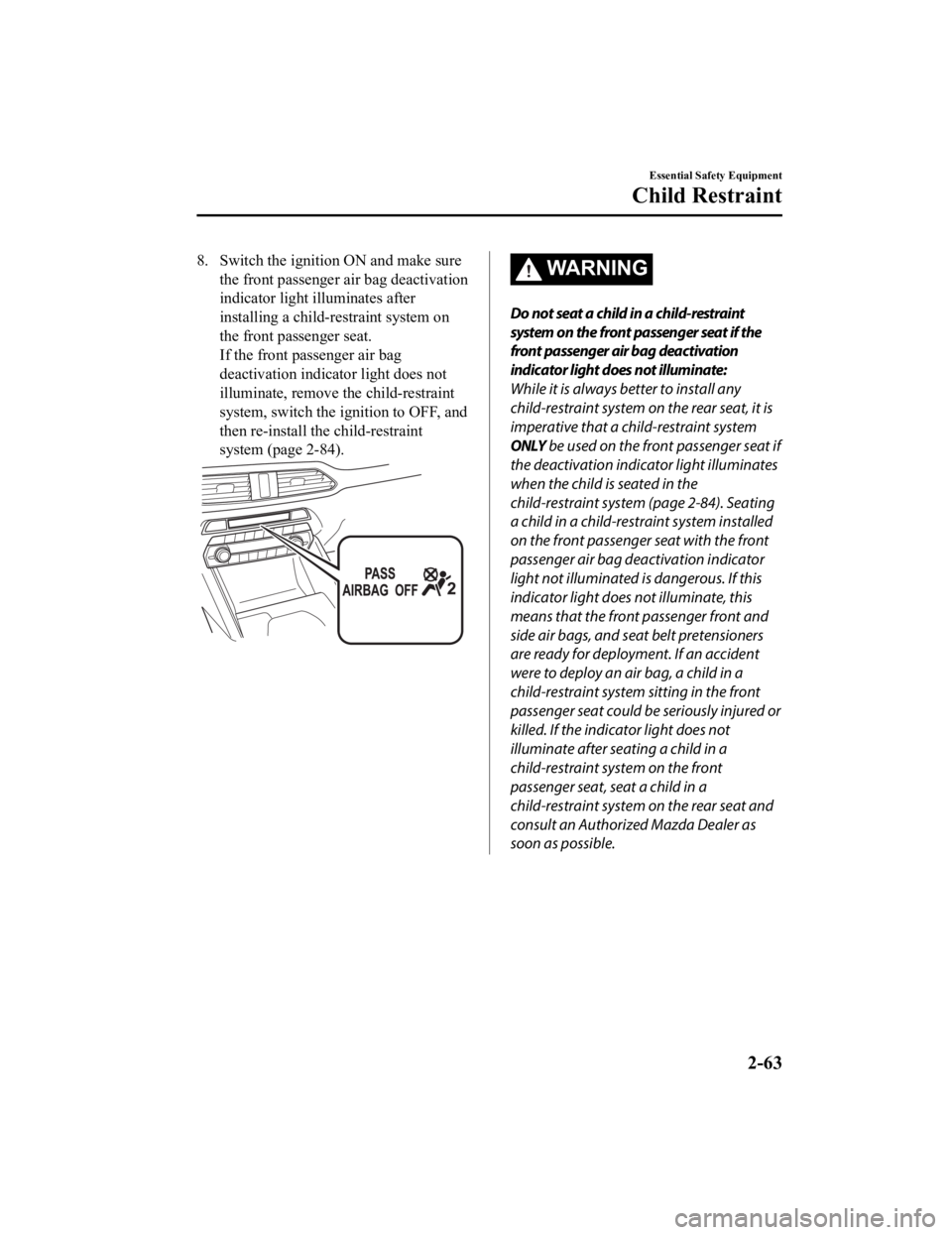
8. Switch the ignition ON and make surethe front passenger air bag deactivation
indicator light illuminates after
installing a child-restraint system on
the front passenger seat.
If the front passenger air bag
deactivation indicator light does not
illuminate, remove the child-restraint
system, switch the ignition to OFF, and
then re-install the child-restraint
system (page 2-84).WA R N I N G
Do not seat a child in a child-restraint
system on the front passenger seat if the
front passenger air bag deactivation
indicator light does not illuminate:
While it is always better to install any
child-restraint system on the rear seat, it is
imperative that a child-restraint system
ONLY be used on the front passenger seat if
the deactivation indica tor light illuminates
when the child is seated in the
child-restraint system (page 2-84). Seating
a child in a child-restraint system installed
on the front passenger seat with the front
passenger air bag deactivation indicator
light not illuminated is dangerous. If this
indicator light does not illuminate, this
means that the front passenger front and
side air bags, and seat belt pretensioners
are ready for deployment. If an accident
were to deploy an air bag, a child in a
child-restraint system sitting in the front
passenger seat could be seriously injured or
killed. If the indicator light does not
illuminate after seating a child in a
child-restraint system on the front
passenger seat, se at a child in a
child-restraint system on the rear seat and
consult an Authorized Mazda Dealer as
soon as possible.
Essential Safety Equipment
Child Restraint
2-63
CX-9_8LJ2-EA-22H_Edition1_old 2022-6-9 13:33:08
Page 83 of 739

If your vehicle is also equipped with a front passenger occupant classification system,
refer to the Front Passenger O ccupant Classification System (pa ge 2-84) for details.
If your vehicle is equipped with a front passenger occupant cla ssification system, the front
passenger air bag deactivation indicator light illuminates for a specified time after the
ignition is switched ON.
Small children must be protected by a child-restraint system as stipulated by law in every
state and province. In certain states and provinces, larger chi ldren must use a child-restraint
system (page 2-44).
Carefully consider whic h child-restraint system is necessary fo r your child and follow the
installation directions in this Owner's Manual as well as the c hild-restraint system
manufacturer's instructions.
WA R N I N G
Seat belts must be worn in air bag equipped vehicles:
Depending only on the air bags for protection during an accident is dangerous. Alone, air
bags may not prevent serious injuries. The appropriate air bags can be expected to
inflate
only in the first accident, such as frontal, near frontal or side collisions or roll-over accidents
that are at least moderate. Vehicle occu pants should always wear seat belts.
Children should not ride in the front passenger seat:
Placing a child, 12 years or under, in the front seat is dangerous. The child could be hit by a
deploying air bag and be seriously injured or even killed. A sleeping child is more likely to lean
against the door and be hit by the side air ba g in moderate collision to the front-passenger
side of the vehicle. Whenever possible, always secure a child 12 years and under on the rear
seats with an appropriate child-restrain t system for the child's age and size.
Essential Safety Equipment
SRS Air Bags
2-70
CX-9_8LJ2-EA-22H_Edition1_old 2022-6-9 13:33:08
Page 84 of 739

Never use a rear-facing child-restraint system in the front seat with an air bag that could
deploy:
Rear-facing child-restraint systems on the front seat are particularly dangerous even though
you may feel assured that a front passenger air bag will not deploy based on the fact that the
front passenger air bag deactivation indicator light illuminates. The child-restraint system
can be hit by a deploying air bag and moved viol ently backward resulting in serious injury or
death to the child.
Do not sit too close to the driver and front passenger air bags:
Sitting too close to the driver and front passenger air bag modules or placing hands or feet on
them is extremely dangerous. The driver and front passenger air bags inflate with great force
and speed. Serious injuries could occur if someon e is too close. The driver should always hold
onto only the rim of the steering wheel. The front seat passenger should keep both feet on the
floor. Front seat occupants should adjust their seats as far back as possible and always sit
upright against the seatbacks with seat belts worn properly.
Sit in the center of the seat and wear seat belts properly:
Sitting too close to the side air bag modules or placing hands on them, or sleeping up against
the door or hanging out the windows is extrem ely dangerous. The side and curtain air bags
inflate with great force and speed directly expanding
along the door on the side the car is hit.
Serious injury could occur if someone is sitting too close to the door or leaning against a
window, or if rear seat occupants grab the side s of the front seatbacks. Give the side and
curtain air bags room to work by sitting in th e center of the seat while the vehicle is moving
with seat belts worn properly.
Do not attach objects on or around the area where air bags deploy:
Attaching objects to the air bags or placing so mething in the area where the air bags deploy
is dangerous. In an accident, an object could interfere with air bag inflation and injure the
occupants. Furthermore, the bag could be damaged causing gases to release. Always keep
the deployment area of the air bag modules free of any obstructions.
For example, you should not do any of the following as it may interfere with air bag
deployment.
Do not put a covering on or lean anything against areas such as the dashboard and lower
portion of the instrument panel that blocks the passenger front air bag and knee air bags.
Do not use seat covers on the front seats and re ar seats equipped with in-seat side air bags.
Essential Safety Equipment
SRS Air Bags
2-71
CX-9_8LJ2-EA-22H_Edition1_old 2022-6-9 13:33:08
Page 87 of 739

Properly dispose of the air bag system:
Improper disposal of an air bag or a vehicle with live air bags in it can be extremely
dangerous. Unless all safety procedures are foll owed, injury could result. Have an Authorized
Mazda Dealer safely dispose of the air bag sy stem or scrap an air bag equipped vehicle.
NOTE
If it becomes necessary to have the components or wiring system for the supplementary
restraint system modified to accommodate a person with certain medical conditions in
accordance with a certified physician, contact an Authorized Mazda Dealer, refer to
“Customer Assistance (U.S.A.)” (page 8-2).
When an air bag deploys, a loud inflation noise can be heard and some smoke will be
released. Neither is likely to cause injury, however, the text ure of the air bags may cause
light skin injuries on body parts not covered with clothing through friction.
Should you sell your Mazda, we urge you to tell the new owner of its air bag systems and
that familiarization with all instructions about them, from the Owner's Manual, is
important.
This highly-visible label is displayed wh ich warns against the use of a rear-facing
child-restraint system on the front passenger seat.
(Except Mexico) (Mexico)
Essential Safety Equipment
SRS Air Bags
2-74
CX-9_8LJ2-EA-22H_Edition1_old 2022-6-9 13:33:08
Page 89 of 739

(Without Front Passenger Occupant Classification System)
Driver/Front passenger inflators and air bags
Roll-over sensor*, crash sensors, and diagnostic module (SAS unit)
Front seat belt pretensioners (page 2-40)
Front air bag sensors
Side crash sensors
Air bag/front seat belt pretensi oner system warning light (page 7-31)
Side and curtain inflators and air bags
Front passenger air bag deactivation indicator light* (page 2-84)
Front passenger occupant classification sensor* (page 2-84)
Front passenger occupant classification module*
Essential Safety Equipment
SRS Air Bags
2-76*Some models.
CX-9_8LJ2-EA-22H_Edition1_old 2022-6-9 13:33:08
Page 93 of 739

(With Front Passenger Occupant Classification System)
In a roll-over:
In response to a vehicle roll-ov er, both curtain air bags inflate.
Both curtain air bags will deploy after
the roll-over accident is detected.
▼ Warning Light/Beep
A system malfunction or operation conditions are indicated by a
warning.
Refer to Contact an Authorized Mazda Dealer and Have Vehicle In spected on page 7-31.
Refer to Warning Sound is Activated on page 7-47.
Essential Safety Equipment
SRS Air Bags
2-80
CX-9_8LJ2-EA-22H_Edition1_old 2022-6-9 13:33:08