spare wheel MAZDA CX90 2024 User Guide
[x] Cancel search | Manufacturer: MAZDA, Model Year: 2024, Model line: CX90, Model: MAZDA CX90 2024Pages: 687, PDF Size: 15.46 MB
Page 504 of 687

Spare Tire
The temporary spare tire is lighter and
smaller than a conventional tire, and is
designed only for emergency use and
should be used only for VERY short
periods. Temporary spare tires should
NEVER be used for long drives or
extended periods.
WARNING
Do not install the temporary spare tire
on the rear wheels (driving wheels).
Driving with the temporary spare tire
on one of the rear driving wheels is
dangerous. Handling will be affected.
You could lose control of the vehicle,
especially on ice or snow bound roads,
and have an accident. Move a regular
tire to the rear wheel and install the
temporary spare tire to the front.
CAUTION
When using the temporary spare tire,
driving stability may decrease
compared to when using only the
conventional tire. Drive carefully.
To avoid damage to the temporary
spare tire or to the vehicle, observe
the following precautions:
Do not exceed 80 km/h (50 mph).
Avoid driving over obstacles. Also,
do not drive through an automatic
car wash. This tire's diameter is
smaller than a conventional tire, so
the ground clearance is reduced.
Do not use a tire chain on this tire
because it will not fit properly.
Do not use your temporary spare
tire on any other vehicle, it has
been designed only for your
Mazda.
Use only one temporary spare tire
on your vehicle at the same time.
To remove the spare tire
1. Remove the luggage board.
2. Remove the cargo sub compartment.
3. (Vehicles with sub-woofer)
Uncouple the sub-woofer
connector.
Other Equipment
Spare Tire and Tool Storage
7-77
CX-90_8KG7-EA-22L_Edition1_new 2022-11-17 16:05:04
Page 527 of 687

Changing a Flat Tire (WithSpare Tire)
NOTE
If the following occurs while driving , it
could indicate a flat tire.
Steering becomes difficult.The vehicle begins to vibrate
excessively.
The vehicle pulls in one direction.
If you have a flat tire, drive slowly to a
level spot that is well off the road and
out of the way of traffic to change the
tire.
Stopping in traffic or on the shoulder
of a busy road is dangerous.
WARNING
Do not install the temporary spare tire
on the rear wheels (driving wheels).
Driving with the temporary spare tire
on one of the rear driving wheels is
dangerous. Handling will be affected.
You could lose control of the vehicle,
especially on ice or snow bound roads,
and have an accident. Move a regular
tire to the rear wheel and install the
temporary spare tire to the front.
Be sure to follow the directions for
changing a tire.
Changing a tire is dangerous if not
done properly. The vehicle can slip off
the jack and seriou sly injure someone.
No person should place any portion of
their body under a vehicle that is
supported by a jack.
Never allow anyone inside a vehicle
supported by a jack.
Allowing someone to remain in a
vehicle supported by a jack is
dangerous. The occupant could cause
the vehicle to fall resulting in serious
injury.
NOTE
Make sure the jack is well lubricated
before using it.
1. Park on a hard, level surface off the
right-of-way and firmly set the
parking brake.
2. Shift into Park (P) and turn off the
engine.
3. Turn on the hazard warning flasher.
4. Have passengers get out of the
vehicle and away from the vehicle
and traffic.
5. Remove any luggage, the jack (page
7-76), spare tire (page 7-77), and
tools.
1. Lug wrench
2. Jack lever
6. Block the wheel diagonally opposite the flat tire. When
blocking a wheel, place a tire block
both in front and behind the tire.
What to Do in Case of Emergency
Tire is Punctured or Bursts
8-22
CX-90_8KG7-EA-22L_Edition1_new 2022-11-17 16:05:04
Page 530 of 687
Do not start the engine or shake
the vehicle while it is jacked up.
Starting the engine or shaking the
vehicle while it is jacked up is
dangerous as it could cause the
vehicle to fall off the jack resulting
in an accident.
Never go under the vehicle while it
is jacked up.
Going under the vehicle while it is
jacked up is dangerous as it could
result in death or serious injury if
the vehicle were to fall off the jack.
8. Remove the lug nuts by turning them counterclockwise; then
remove the wheel and center cap.
Locking Lug Nuts
If your Mazda is equipped with the
optional antitheft wheel lug nuts, a
special key must be used to unlock the
locking lug nut for each wheel. The key
is stored in the glove compartment,
center console storage, storage box, or
trunk. Register the key and lug nuts
with the lock manufacturer by filling
out the registration card and mailing it
in using the accompanying envelope. If
the key is lost, consult an Authorized
Mazda Dealer or use the lock
manufacturer’s order form to order a
new key.
Antitheft wheel lug nuts cannot be
installed on a steel wheel spare tire.
When installing a temporary spare tire,
use one of the original lug nuts in place
of the locking lug nut. The original lug
nuts are stored inside your Mazda.
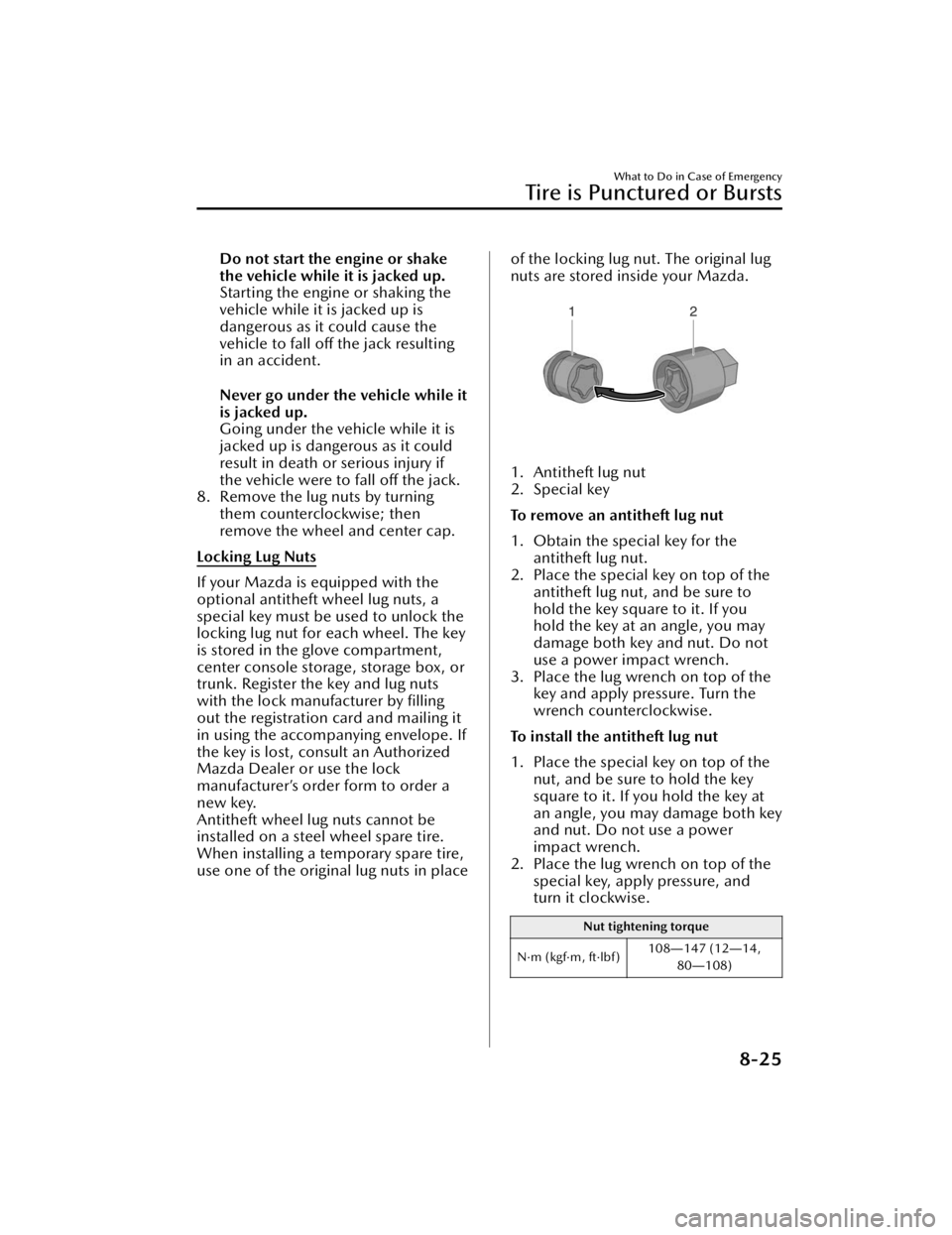
1. Antitheft lug nut
2. Special key
To remove an antitheft lug nut
1. Obtain the special key for the antitheft lug nut.
2. Place the special key on top of the antitheft lug nut, and be sure to
hold the key square to it. If you
hold the key at an angle, you may
damage both key and nut. Do not
use a power impact wrench.
3. Place the lug wrench on top of the key and apply pressure. Turn the
wrench counterclockwise.
To install the antitheft lug nut
1. Place the special key on top of the nut, and be sure to hold the key
square to it. If you hold the key at
an angle, you may damage both key
and nut. Do not use a power
impact wrench.
2. Place the lug wrench on top of the special key, apply pressure, and
turn it clockwise.
Nut tightening torque
N·m (kgf·m, ft·lbf) 108―
147 (12 ―14,
80― 108)
What to Do in Case of Emergency
Tire is Punctured or Bursts
8-25
CX-90_8KG7-EA-22L_Edition1_new 2022-11-17 16:05:04
Page 531 of 687

Mounting the Spare Tire
1. Remove dirt and grime from themounting surfaces of the wheel and
hub, including the hub bolts, with a
cloth.
WARNING
Make sure the mounting surfaces
of the wheel, hub and lug nuts are
clean before changing or replacing
tires.
When changing or replacing a tire,
not removing dirt and grime from
the mounting surfaces of the wheel,
hub and hub bolts is dangerous.
The lug nuts could loosen while
driving and cause the tire to come
off, resulting in an accident.
2. Mount the spare tire.
3. Install the lug nuts with the beveled edge inward; tighten them by hand.
WARNING
Do not apply oil or grease to lug
nuts and bolts and do not tighten
the lug nuts beyond the
recommended tightening torque.
Applying oil or grease to lug nuts
and bolts is dangerous. The lug nuts
could loosen while driving and
cause the tire to come off, resulting
in an accident. In addition, lug nuts
and bolts could be damaged if
tightened more than necessary.
4. Turn the lug wrench
counterclockwise and lower the
vehicle.
5. Use the lug wrench to tighten the nuts in the order shown.
If you are unsure of how tight the
nuts should be, have them
inspected at an Authorized Mazda
Dealer.
Nut tightening torque
N·m (kgf·m, ft·lbf) 108
―147 (12 ―14,
80 ―108)
What to Do in Case of Emergency
Tire is Punctured or Bursts
8-26
CX-90_8KG7-EA-22L_Edition1_new 2022-11-17 16:05:04
Page 534 of 687

5. Pass the flat tire beltsthrough the buckle.
6. While pressing the flat tireagainst the third-row seat,
pull the ends of the flat tire
belts and secure the flat tire.
CAUTION
When pulling the flat tire
belts, wrap the buckle with a
cloth. If the buckle directly
contacts the aluminum
wheel, the wheel may be
damaged.
7. Slowly close the liftgate while making sure that the liftgate trim
does not contact the flat tire.
NOTE
If the liftgate trim contacts the flat
tire, adjust the position of the flat
tire.
8. Make sure that the liftgate closes securely.
9. Check the tire inflation pressure.
Refer to the specification charts on
page 10-37.
10.Have the flat tire repaired or replaced as soon as possible.
WARNING
Do not drive with any tires that have
incorrect air pressure.
Driving on tires with incorrect air
pressure is dangerous. Tires with
incorrect pressure could affect
handling and result in an accident.
When you check the regular tires' air
pressure, check the spare tire, too.
NOTE
To prevent the jack and tool from
rattling , store them properly.
What to Do in Case of Emergency
Tire is Punctured or Bursts
8-29
CX-90_8KG7-EA-22L_Edition1_new 2022-11-17 16:05:04
Page 574 of 687
Maintenance ItemNumber of times, maintenance was performed.
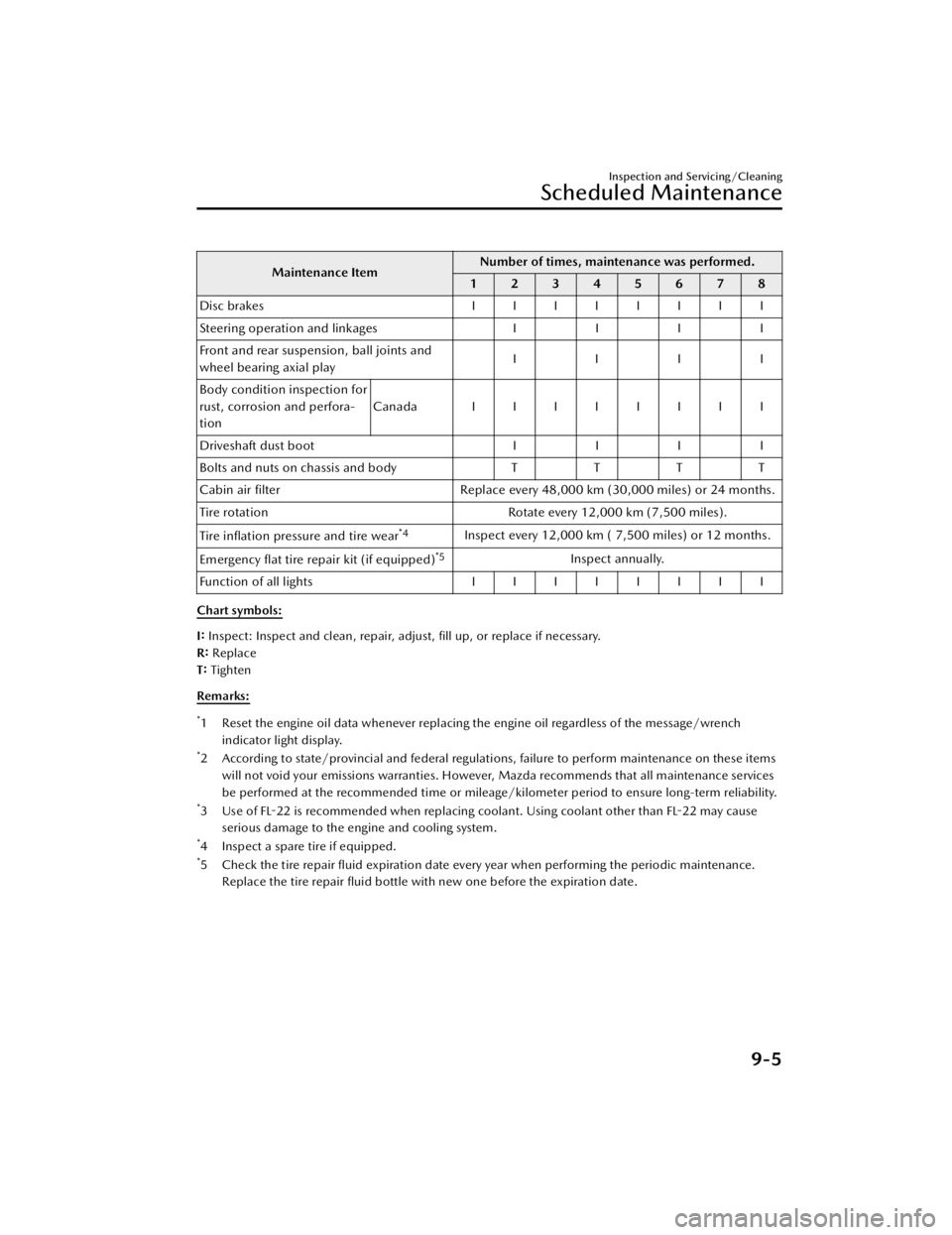
12345678
Disc brakes IIIIIIII
Steering operation and linkages II II
Front and rear suspension, ball joints and
wheel bearing axial play IIII
Body condition inspection for
rust, corrosion and perfora-
tion Canada IIIIIIII
Driveshaft dust boot II II
Bolts and nuts on chassis and body TTT T
Cabin air filter Replace every 48,000 km (30,000 miles) or 24 months.
Tire rotation Rotate every 12,000 km (7,500 miles).
Tire inflation pressure and tire wear
*4Inspect every 12,000 km ( 7,500 miles) or 12 months.
Emergency flat tire repair kit (if equipped)
*5Inspect annually.
Function of all lights IIIIIIII
Chart symbols:
I: Inspect: Inspect and clean, repair, adjust, fill up, or replace if necessary.
R: Replace
T: Tighten
Remarks:
*1 Reset the engine oil data whenever replacing the engine oil regardless of the message/wrench indicator light display.
*2 According to state/provincial and federal regulations, failure to perform maintenance on these itemswill not void your emissions warranties. However, Mazda recommends that all maintenance services
be performed at the recommended time or mileage/kilometer period to ensure long-term reliability.
*3 Use of FL-22 is recommended when replacing coolant. Using coolant other than FL-22 may causeserious damage to the engine and cooling system.
*4 Inspect a spare tire if equipped.*5 Check the tire repair fluid expiration date every year when performing the periodic maintenance.Replace the tire repair fluid bottle with new one before the expiration date.
Inspection and Servicing/Cleaning
Scheduled Maintenance
9-5
CX-90_8KG7-EA-22L_Edition1_new
2022-11-17 16:05:04
Page 596 of 687

Inspecting the Tires
About Tires
For reasons of proper performance,
safety, and better energy efficiency,
always maintain recommended tire
inflation pressures and stay within the
recommended load limits and weight
distribution.
WARNING
Using Different Tire Types.
Driving your vehicle with different
types of tires is dangerous. It could
cause poor handling and poor braking;
leading to loss of control.
Except for the limited use of the
temporary spare tire, use only the
same type tires (radial, bias-belted,
bias-type) on all four wheels.
Using Wrong-Sized Tires.
Using any other tire size than what is
specified for the vehicle (page
10-71)is dangerous. It could seriously
affect ride, handling, ground
clearance, tire clearance, and
speedometer calibration. This could
cause you to have an accident. Use
only tires that are the correct size
specified for the vehicle.
Inspecting tire inflation pressure
WARNING
Always inflate the tires to the correct
pressure.
Overinflation or underinflation of tires
is dangerous. Adverse handling or
unexpected tire failure could result in a
serious accident.
Refer to Tires on page 10-71.
Use only a Mazda-genuine tire valve
cap.
Use of a non-genuine part is
dangerous as the correct tire air
pressure cannot be maintained if the
tire valve becomes damaged. If the
vehicle is driven under this condition,
the tire air pressure will decrease
which could result in a serious
accident. Do not use any part for the
tire valve cap that is not a
Mazda-genuine part.
Inspect all tire pressures monthly
(including the spare) when the tires are
cold. Maintain recommended
pressures for the best ride, handling ,
and minimum tire wear.
Refer to the specification charts (page
10-71).
NOTE
Cold inflation pressure
The cold inflation pressure is the
pressure measured under ambient
temperatures before the vehicle is
driven.
Maximum inflation pressure
The maximum inflation pressure is
the upper limit of the cold inflation
pressure designated by the tire
manufacturer.
Recommended inflation pressure
The recommended inflation pressure
is the cold inflation pressure
necessary for maintaining the
performance of your Mazda.
Underinflation or overinflation can
cause a harsh ride, reduced fuel
economy, a greater possibility of
damage from road hazards, uneven
and accelerated tire wear, and poor
sealing of the tire bead, which will
deform the wheel and cause
separation of tire from rim.
Inspection and Servicing/Cleaning
Vehicle Exterior Inspection
9-27
CX-90_8KG7-EA-22L_Edition1_new 2022-11-17 16:05:04
Page 597 of 687

Keep your tire pressure at the correct
levels. If one frequently needsinflating, have it inspected.Rotating the Tires
WARNING
Rotate tires periodically.
Irregular tire wear is dangerous. To
equalize tread wear for maintaining
good performance in handling and
braking , rotate the tires periodically or
sooner if irregular wear develops.
Please refer to Scheduled maintenance
for your tire rotation interval.
During rotation, inspect them for
correct balance.
Do not include (TEMPORARY USE
ONLY) spare tire in rotation.
Also, inspect them for uneven wear
and damage. Abnormal wear is usually
caused by one or a combination of the
following:
Incorrect tire pressureImproper wheel alignmentOut-of-balance wheelSevere braking
After rotation, inflate all tire pressures
to specification (page 10-71) and
inspect the lug nuts for tightness.
Inspection and Servicing/Cleaning
Vehicle Exterior Inspection
9-28
CX-90_8KG7-EA-22L_Edition1_new 2022-11-17 16:05:04
Page 647 of 687

Tire Rotation
To equalize tread wear, rotate the tires
every 16,000 km (10,000 miles) at the
latest or sooner if irregular wear
develops. Mazda recommends to
rotate every 8,000 km (5,000 miles) to
help increase tire life and distribute
wear more evenly.
Do not include (TEMPORARY USE
ONLY) spare tire in rotation.
Inspect the tires for uneven wear and
damage. Abnormal wear is usually
caused by one or a combination of the
following:
Incorrect tire pressureImproper wheel alignmentOut-of-balance wheelSevere braking
After rotation, inflate all tire pressures
to specification on page 10-71 and
inspect the lug nuts for tightness.
CAUTION
Rotate unidirectional tires and radial
tires that have an asymmetrical tread
pattern or studs only from front to rear,
not from side to side. Tire performance
will be weakened if rotated from side
to side.
Replacing a Tire
WARNING
Always use tires that are in good
condition.
Driving with worn tires is dangerous.
Reduced braking , steering , and
traction could result in an accident.
If a tire wears evenly, a wear indicator
will appear as a solid band across the
tread.
Replace the tire when this happens.
1. New tread
2. Worn tread
3. Tread wear indicator
You should replace the tire before the
band crosses the entire tread.
NOTE
Tires degrade over time, even when
they are not being used on the road. It
is recommended that tires generally be
replaced when they are 6 years or
older. Heat caused by hot climates or
frequent high load ing conditions can
accelerate the aging process. You
should replace the spare tire when you
replace the other road tires due to the
aging of the spare tire. The period in
which the tire was manufactured (both
week and year) is indicated by a 4-digit
number.
Refer to Tire Labeling on page 10-30.
Specifications/Customer Information and Reporting Safety Defects
Tire Information (U.S.A.)
10-38
CX-90_8KG7-EA-22L_Edition1_new 2022-11-17 16:05:04