wheel size MAZDA CX90 2024 User Guide
[x] Cancel search | Manufacturer: MAZDA, Model Year: 2024, Model line: CX90, Model: MAZDA CX90 2024Pages: 687, PDF Size: 15.46 MB
Page 327 of 687

The vehicle is driven on slippery
roads such as icy roads,
snow-covered roads, and unpaved
roads.
The vehicle is driven on a long
downslope.
The vehicle is driven on a steep
slope.
A two-wheeled vehicle such as a
motorcycle or bicycle is traveling
ahead.
The vehicle is being towed or towing
another vehicle.
Proximity warnings activate
frequently.
Under bad weather conditions (rain,
fog , and snow).
Tires other than the
specified size are
used, such as when tire chains or
temporary spare tires are used.
The tire pressures are not adjusted to
the appropriate pressure.
Tires with insufficient tread are used.
Switch the CTS off when it is not
being used.
Leaving the CTS on when it is not in
use is dangerous as it could operate
unexpectedly, resulting in an accident.
Do not leave the vehicle while the
vehicle is stopped by the CTS control.
Getting out of the vehicle while the
stop hold control is operating is
dangerous as the vehicle may move
unexpectedly and result in an accident.
Before leaving the vehicle, switch the
CTS off, shift the selector lever to the P
position, and apply the parking brake.CAUTION
Heed the following cautions so that
the CTS can operate normally.
Do not modify the suspensions.
Always use wheels of the
specified
size for the front and rear wheels.
Consult an Authorized Mazda
Dealer for tire replacement.
Turn off the CTS when the vehicle is
running on a chassis roller.
Driving
Cruising &
Tra ffi c Support (CTS)
5-176
CX-90_8KG7-EA-22L_Edition1_new
2022-11-17 16:05:04
Page 339 of 687

Lane-keep Assist System(LAS)
*
The LAS is a system to help the driver
stay within the vehicle lane if the
vehicle might be deviating.
If your vehicle may be deviating from
the vehicle lane, the LAS provides
steering assistance to avoid departure
from the lane.
Warnings and Cautions
for Using the Lane-keep Assist System (LAS)
WARNING
Do not rely completely on the LAS.
The LAS is not an automated driving
system. Over reliance on the system
could lead to an accident.
The functions of the LAS have
limitations. Do not rely completely
on the system and always stay on
course using the steering wheel.
Do not use the LAS under the
following conditions. Otherwise, it
may result in an accident.
The vehicle is driven on slippery
roads such as icy roads,
snow-covered roads, and unpaved
roads.
Tires other than the specified size are
used, such as when tire chains or
temporary spare tires are used.
Tires with insufficient tread are used.
The tire pressures are not adjusted to
the specified pressure.
The vehicle is towing a camping
trailer or boat trailer.
The vehicle is driven on roads other
than expressways or highways with
white (yellow) lines.
CAUTION
Heed the following cautions so that
the LAS can operate normally.
Do not modify the vehicle's
suspensions.
Driving
Lane-keep Assist System (LAS)
5-188*Some models.
CX-90_8KG7-EA-22L_Edition1_new 2022-11-17 16:05:04
Page 340 of 687

Always use wheels of the specified
size for the front and rear wheels.
Consult an Authorized Mazda
Dealer for tire replacement.How to Use the
Lane-keep Assist System (LAS)
When the LAS operates
When all the following conditions are
met, the LAS operates to assist the
steering wheel operation.
The vehicle speed is about 64 km/h
(40 mph) or faster.
The system detects white (yellow)
lane lines.
The CTS steering assist function is
not operating.
The system determines that the
vehicle may depart from the lane.
While the steering wheel operation
assist is operating , the screen display
notifies the driver.
Instrument cluster
Active driving display
NOTE
The LAS operates only on the side
that detects white lines (yellow
lines).
Driving
Lane-keep Assist System (LAS)
5-189
CX-90_8KG7-EA-22L_Edition1_new 2022-11-17 16:05:04
Page 343 of 687

Warnings and Cautions
for Using the Emergency Lane Keeping (ELK)
WARNING
Do not rely completely on the ELK.
The ELK has limitations. Do not rely
completely on the system and always
stay on course using the steering
wheel.
The ELK is not an automated driving
system. Over reliance on the system
could lead to an accident.
The detection range of the camera
and sensors is limited. If the steering
wheel operation assist is operated
without detecting a two-wheeled
vehicle near the detecting vehicle, it
could result in an accident.
Do not use the ELK under the
following conditions. Otherwise, it
may result in an accident.
The vehicle is driven on slippery
roads such as icy roads,
snow-covered roads, and unpaved
roads.
Tires other than the specified size are
used, such as when tire chains or
temporary spare tires are used.
(Blind Spot Assist)
The vehicle is driven on roads other
than expressways and highways.
(Blind Spot Assist and Head-on
traffic avoidance assist)
The rear bumper around a rear side
radar sensor is deformed.
Driving
Emergency Lane Keeping (ELK)
5-192
CX-90_8KG7-EA-22L_Edition1_new 2022-11-17 16:05:04
Page 351 of 687
Refer to Cameras on page 5-137.
Always check the surrounding area
visually.
The operation of the SBS has certain
limitations. Always confirm the safety
around the vehicle visually when
driving.
CAUTION
If any of the following conditions is
met, turn the SBS
off to prevent a
mis-operation.
A trailer is pulled or an accessory
such as a bicycle carrier is installed
to the rear of the vehicle.
The vehicle is driven on rough
roads such as in areas where there
is grass and foliage or off-road.
Always use tires of the specified size
and the same manufacturer, brand,
and tread pattern on all 4 wheels. In
addition, do not use tires with
significantly different wear patterns
on the same vehicle. If such
improper tires are used, the SBS may
not operate normally.
How to Use the Smart
Brake Support (SBS)
NOTE
During the SBS brake control, the
brake pedal may move rearward or
become stiff. The brakes are operating,
but continue to depress the brake
pedal.
When the forward detection function
operates*
The forward detection function
operates when all of the following
conditions are met.
(If an object is a vehicle ahead)
The vehicle speed is about 4 km/h
(3 mph) or faster.
(If an object is a bicycle/pedestrian)
The vehicle speed is about 10
km/h to 80 km/h (6.3 mph to 49
mph).
The DSC does not operate.The system determines that there is a
possibility of a collision with an
object ahead.
When the forward detection function
operates, the driver is notified of the
danger by the screen display and
warning sound. Furthermore, if the
possibility of a collision increases,
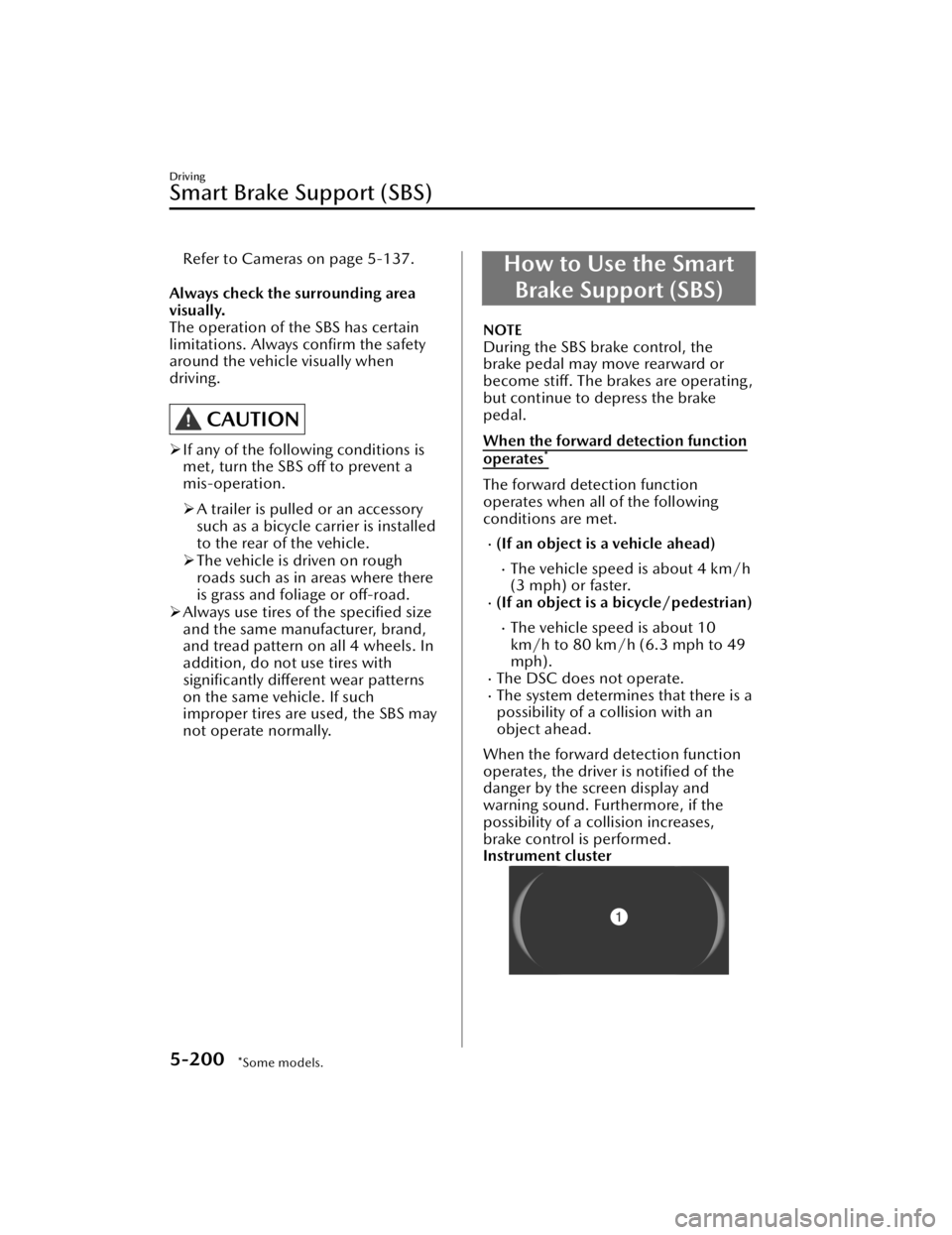
brake control is performed.
Instrument cluster
Driving
Smart Brake Support (SBS)
5-200*Some models.
CX-90_8KG7-EA-22L_Edition1_new 2022-11-17 16:05:04
Page 362 of 687

CAUTION
Handle the cameras appropriately. If the cameras are handled incorrectly, images
may not be displayed normally.
Refer to Cameras on page 5-137.
Do not use the 360° view monitor in th e following locations or conditions.
Bumpy roads
The vehicle is on a road incline.
Icy or snow-covered roads
Tire chains or a temporary spare tire is installed.
The doors are not fully closed.
The outside mirrors are retracted.
If the doors are not completely closed, images and guide lines may not be
displayed correctly.
Heed the following cautions to assure that the 360° view monitor operates
normally.
Do not modify the suspensions.
Always use wheels of the specified size for the front and rear wheels. Consult an
Authorized Mazda Dealer for tire replacement.
When the center display is cold, images may leave trails or the display might be
darker than usual, making it difficult to check the vehicle surroundings. Always
confirm the safety around the vehicle visually when driving.
Recognizing images at night may be
difficult because there are no lights in the
shooting range of the side camera. Always confirm the safety around the vehicle
visually when driving.
The method for parking/stopping the vehicle using the 360° View Monitor
differs
depending on the road conditions and ve hicle conditions. In addition, when and
how much you turn the steering wheel will differ depending on the situation,
therefore always check the vehicle surroundings directly with your eyes while using
the system.
Driving
360° View Monitor
5-211
CX-90_8KG7-EA-22L_Edition1_new 2022-11-17 16:05:04
Page 392 of 687

Snow Tires
WARNING
Use only the same size and type tires
(snow, radial, or non-radial) on all 4
wheels:
Using tires different in size or type is
dangerous. Your vehicle's handling
could be greatly affected and result in
an accident.
CAUTION
Check local regulations before using
studded tires.
Use snow tires on all 4 wheels
Do not go faster than 120 km/h (75
mph) while driving with snow tires.
When installing winter tires, use tires of
the specified size and adjust the air
pressure of all the tires to the specified
value. (page 10-71).
The vehicle is originally equipped with
all season radials designed to be used
all year around. In some extreme
climates you may find it necessary to
replace them with snow tires during
the winter months to further improve
traction on snow and ice covered
roads.
Tire Chains
Check local regulations before using
tire chains.
CAUTION
Chains may aff ect handling.
Do not go faster than 50 km/h (30
mph) or the chain manufacturer's
recommended limit, whichever is
lower.
Drive carefully and avoid bumps,
holes, and sharp turns.
Avoid locked-wheel braking.
Do not use chains on a temporary
spare tire; it may result in damage to
the vehicle and to the tire.
Do not use chains on roads that are
free of snow or ice. The tires and
chains could be damaged.
Chains may scratch or chip
aluminum wheels.
NOTE
The tire pressure monitoring system
may not function correctly when using
tire chains.
Install the chains on the rear tires only.
Do not use chains on the front tires.
Please consult an Authorized Mazda
Dealer.
Installing the chains
1. Secure the chains on the rear tires
as tightly as possible. Always follow
the chain manufacturer's
instructions.
2. Retighten the chains after driving 1/2 ―1 km (1/4 ―1/2 mile).
Driving
Winter Driving
5-241
CX-90_8KG7-EA-22L_Edition1_new 2022-11-17 16:05:04
Page 528 of 687

NOTE
When blocking a tire, use rocks or
wood blocks of sufficient size if
possible to hold the tire in place.
Removing a Flat Tire
WARNING
When jacking-up a vehicle, always
shift the selector lever to P position,
apply the parking brake, and place
wheel blocks in the position
diagonally opposed to the jack.
Changing a flat tire without using
wheel blocks is dangerous because the
vehicle may move and fall off the jack
even with the selector lever is in P
position, which could result in an
accident.
1. Loosen the lug nuts by turning them counterclockwise one turn each,
but do not remove any lug nuts
until the tire has been raised off the
ground.
NOTE
If your Mazda is equipped with the
optional antitheft wheel lug nuts, a
special key must be used to unlock
the locking lug nut for each wheel.
For details, refer to “Locking Lug
Nuts” below.
2. Place the jack on the ground.
3. Turn the jack screw in the direction shown in the figure and adjust the
jack head so that it is close to the
jack-up position.
4. Place the jack under the jack-upposition closest to the tire being
changed with the jack head
squarely under the jack-up point.
5. Continue raising the jack headgradually by rotating the screw with
your hand until the jack head is
inserted into the jack-up position.
What to Do in Case of Emergency
Tire is Punctured or Bursts
8-23
CX-90_8KG7-EA-22L_Edition1_new 2022-11-17 16:05:04
Page 551 of 687

AWD Warning Light
The light turns on if the system has a
problem or if the tire sizes do not
match.
Check the contents of the message
displayed and take the necessary
action.
Tire Pressure MonitoringSystem (TPMS) Warning Light (Flashing)
The light flashes if there is a
malfunction in the system.
Contact an Authorized Mazda Dealer.
WARNING
Do not drive the vehicle at high
speeds if the TPMS warning light turns
on or flashes:
Driving the vehicle at high speeds
while the TPMS warning light is turned
on or flashing is dangerous because
the brake performance and the
steering wheel operability will be
reduced. If the vehicle is driven at high
speeds or the brakes are suddenly
applied, it could lead to an accident.
Gradually apply the brakes to lower the
vehicle's speed.
Do not ignore the TPMS warning light
when it is turned on or flashing:
Continuing to driv e the vehicle while
ignoring the illumi nation/flashing of
the TPMS warning light is dangerous
because a tire may burst which could
lead to an accident. Take appropriate
measures as soon as possible.
What to Do in Case of Emergency
Warning/Indicator Light Turns On
8-46
CX-90_8KG7-EA-22L_Edition1_new 2022-11-17 16:05:04
Page 596 of 687

Inspecting the Tires
About Tires
For reasons of proper performance,
safety, and better energy efficiency,
always maintain recommended tire
inflation pressures and stay within the
recommended load limits and weight
distribution.
WARNING
Using Different Tire Types.
Driving your vehicle with different
types of tires is dangerous. It could
cause poor handling and poor braking;
leading to loss of control.
Except for the limited use of the
temporary spare tire, use only the
same type tires (radial, bias-belted,
bias-type) on all four wheels.
Using Wrong-Sized Tires.
Using any other tire size than what is
specified for the vehicle (page
10-71)is dangerous. It could seriously
affect ride, handling, ground
clearance, tire clearance, and
speedometer calibration. This could
cause you to have an accident. Use
only tires that are the correct size
specified for the vehicle.
Inspecting tire inflation pressure
WARNING
Always inflate the tires to the correct
pressure.
Overinflation or underinflation of tires
is dangerous. Adverse handling or
unexpected tire failure could result in a
serious accident.
Refer to Tires on page 10-71.
Use only a Mazda-genuine tire valve
cap.
Use of a non-genuine part is
dangerous as the correct tire air
pressure cannot be maintained if the
tire valve becomes damaged. If the
vehicle is driven under this condition,
the tire air pressure will decrease
which could result in a serious
accident. Do not use any part for the
tire valve cap that is not a
Mazda-genuine part.
Inspect all tire pressures monthly
(including the spare) when the tires are
cold. Maintain recommended
pressures for the best ride, handling ,
and minimum tire wear.
Refer to the specification charts (page
10-71).
NOTE
Cold inflation pressure
The cold inflation pressure is the
pressure measured under ambient
temperatures before the vehicle is
driven.
Maximum inflation pressure
The maximum inflation pressure is
the upper limit of the cold inflation
pressure designated by the tire
manufacturer.
Recommended inflation pressure
The recommended inflation pressure
is the cold inflation pressure
necessary for maintaining the
performance of your Mazda.
Underinflation or overinflation can
cause a harsh ride, reduced fuel
economy, a greater possibility of
damage from road hazards, uneven
and accelerated tire wear, and poor
sealing of the tire bead, which will
deform the wheel and cause
separation of tire from rim.
Inspection and Servicing/Cleaning
Vehicle Exterior Inspection
9-27
CX-90_8KG7-EA-22L_Edition1_new 2022-11-17 16:05:04