weight MAZDA CX90 2024 Owner's Guide
[x] Cancel search | Manufacturer: MAZDA, Model Year: 2024, Model line: CX90, Model: MAZDA CX90 2024Pages: 687, PDF Size: 15.46 MB
Page 645 of 687

Glossary of Terms
Tire Placard: A label indicating the OE
tire sizes, recommended inflation
pressure, and the maximum weight the
vehicle can carry.
Tire Identification Number (TIN):
A
number on the sidewall of each tire
providing information about the tire
brand and manufacturing plant, tire
size, and date of manufacture.
Inflation Pressure:
A measure of the
amount of air in a tire.
kPa: Kilopascal, the metric unit for air
pressure.
psi: Pounds per square inch, the
English unit for air pressure.
B-pillar: The structural member at the
side of the vehicle behind the front
door.
Original Equipment (OE): Describes
components originally equipped on
the vehicle.
Vehicle Load Limit: The maximum
value of the combination weight of
occupants and cargo.
Bead Area of the Tire: Area of the tire
next to the rim.
Sidewall Area of the Tire: Area
between the bead area and the tread.
Tread Area of the Tire: Area on the
perimeter of the tire that contacts the
road when it's mounted on the
vehicle.
Seating capacity means the total
allowable number of vehicle
occupants. Seating capacity is
described on the tire label.
Production options weight is the
combination weight of installed regular
production options weighing over 2.3
kilograms in excess of the standard
items which they replace, and not
previously considered in the curb
weight or accessory weight, including
heavy duty brakes, ride levelers, roof
rack, heavy duty battery, and special
trim.
Rim is the metal support (wheel) for a
tire or a tire and tube assembly upon
which the tire beads are seated.
Specifications/Customer Information and Reporting Safety Defects
Tire Information (U.S.A.)
10-36
CX-90_8KG7-EA-22L_Edition1_new 2022-11-17 16:05:04
Page 649 of 687

Ve h i c l e L o a d i n g
This section will guide you in the proper loading of your vehicle and/or trailer, to
keep your loaded vehicle weight within its design rating capability, with or without a
trailer. Properly loading your vehicle will provide maximum return of vehicle design
performance. Before loading your vehicle, familiarize yourself with the following
terms for determining your vehicle's weight ratings, with or without a trailer, from
the vehicle's Safety Certification Label and Tire and Load Information Label:
WARNING
Overloaded Vehicle.
Overloading a vehicle is dangerous. The results of overloading can have serious
consequences in terms of passenger sa fety. Too much weight on a vehicle's
suspension system can cause spring or shoc k absorber failure, brake failure, handling
or steering problems, irregular tire wear, tire failure or other damage.
Overloading makes a vehicle harder to drive and control. It also increases the
distance required for stopping. In cases of serious overloading , brakes can fail
completely, particularly on steep grades. The load a tire will carry safely is a
combination of the size of the tire, its load range, and corresponding inflation
pressure.
Never overload the vehicle and always observe the vehicle's weight ratings from the
vehicle's Safety Certification and Tire and Load Information labels.
Base Curb Weight is the weight of the ve hicle including a full tank of fuel and all
standard equipment. It does not include passengers, cargo, or optional
equipment.
Ve h i c l e C u r b We i g h t is the weight of your new vehicle when you picked it up from
your dealer plus any aftermarket equipment.
PAY LOA D
PAYLOAD
Specifications/Customer Information and Reporting Safety Defects
Tire Information (U.S.A.)
10-40
CX-90_8KG7-EA-22L_Edition1_new 2022-11-17 16:05:04
Page 650 of 687

Pay l o a d is the combination weight of cargo and passengers that the vehicle is
designed to carry. The maximum payload for your vehicle can be found on the Tire
and Load Information label on the driver's door frame or door pillar. Look for “THE
COMBINATION WEIGHT OF OCCUPANTS AND CARGO SHOULD NEVER EXCEED
XXX kg or XXX lbs” for your maximum payload. The payload listed on the tire label is
the maximum payload for the vehicle as built by the assembly plant. If any
aftermarket or dealer installed equipment has been installed on the vehicle, the
weight of the equipment must be subtract ed from the payload listed on the tire
label in order to be accurate.
SAMPLE
CARGO
CARGO
Specifications/Customer Information and Reporting Safety Defects
Tire Information (U.S.A.)
10-41
CX-90_8KG7-EA-22L_Edition1_new 2022-11-17 16:05:04
Page 651 of 687

Cargo Weight includes all weight added to the Base Curb Weight, including cargo
and optional equipment. When towing, trailer tongue load or king pin weight is also
part of cargo weight.
The cargo weight limit decreases depending on the number of vehicle occupants.
The cargo weight limit can be calculated by subtracting the total weight of the
vehicle occupants from the “combination weight of occupants and cargo should
never exceed” value on the tire label.
Examples: Based on a single occupant weig ht of 68 kg (150 lbs), and a value of 385
kg (849 lbs) for the “combination weight of occupants and cargo should never
exceed”:
The cargo weight limit with one occupant is 385 kg (849 lbs) - 68 kg (150 lbs) =
317 kg (699 lbs)
The cargo weight limit with two occupants is 385 kg (849 lbs) - (68 × 2) kg ( (150
× 2) lbs) = 249 kg (549 lbs)
If the weight of the occupant increases, the cargo weight limit decreases by that
much.
GAW (Gross Axle Weight) is the total weight placed on each axle (front and rear) -
including vehicle curb weight and all payload.
GAWR (Gross Axle Weight Rating) is the maximum allowable weight that can be
carried by a single axle (front or rear). These numbers are shown on the Safety
Compliance Certification Label located on the driver's door frame or door pillar.
The total load on each axle must never exceed its GAWR.
GVW
GVW
GVW (Gross Vehicle Weight) is the Vehicle Curb Weight + cargo + passengers.
Specifications/Customer Information and Reporting Safety Defects
Tire Information (U.S.A.)
10-42
CX-90_8KG7-EA-22L_Edition1_new 2022-11-17 16:05:04
Page 652 of 687
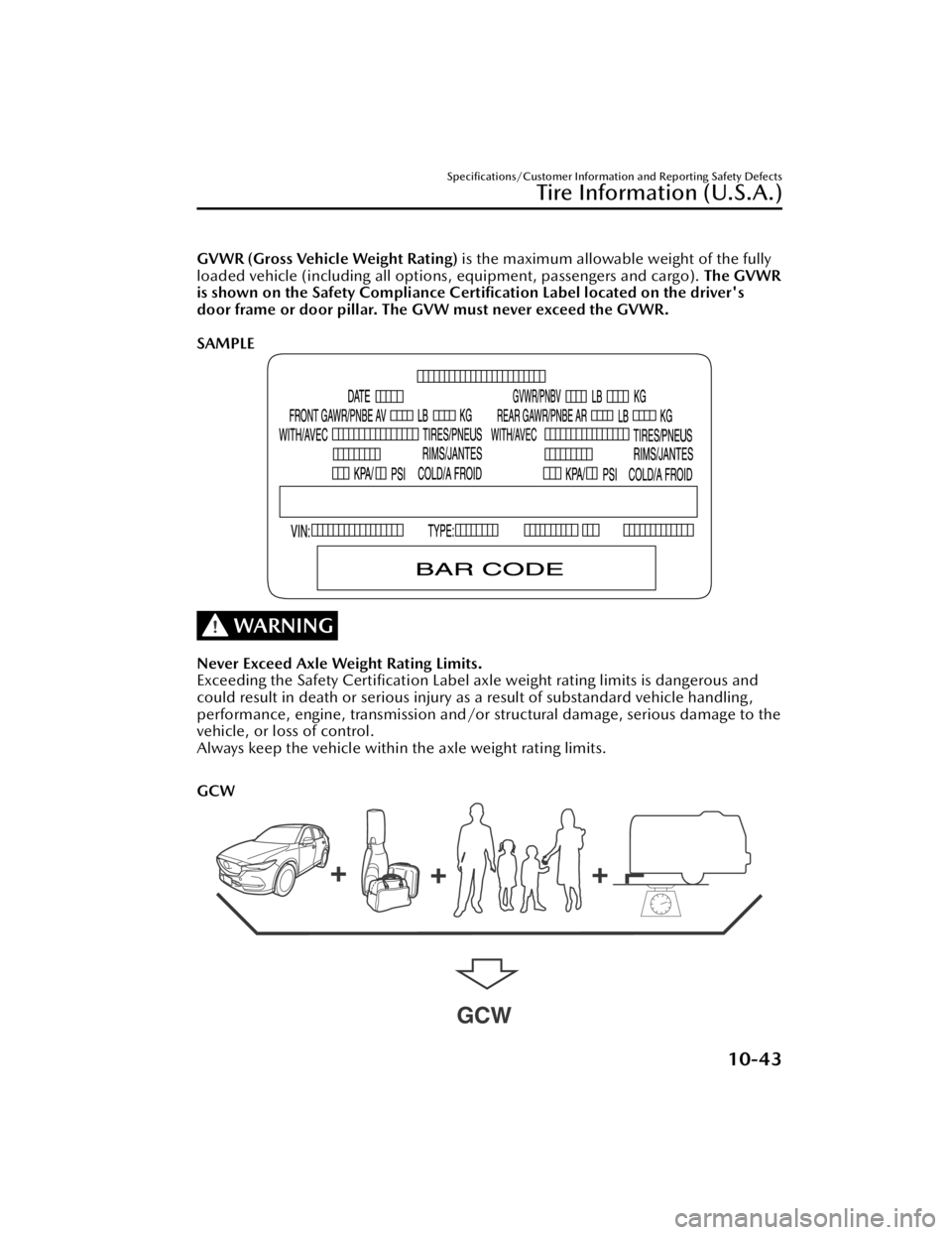
GVWR (Gross Vehicle Weight Rating) is the maximum allowable weight of the fully
loaded vehicle (including all options, equipment, passengers and cargo). The GVWR
is shown on the Safety Compliance Certification Label located on the driver's
door frame or door pillar. The GVW must never exceed the GVWR.
SAMPLE
WARNING
Never Exceed Axle Weight Rating Limits.
Exceeding the Safety Certification Label axle weight rating limits is dangerous and
could result in death or serious injury as a result of substandard vehicle handling ,
performance, engine, transmission and/or structural damage, serious damage to the
vehicle, or loss of control.
Always keep the vehicle within the axle weight rating limits.
GCW
GCW
Specifications/Customer Information and Reporting Safety Defects
Tire Information (U.S.A.)
10-43
CX-90_8KG7-EA-22L_Edition1_new 2022-11-17 16:05:04
Page 653 of 687

GCW (Gross Combination Weight) is the weight of the loaded vehicle (GVW) plus
the weight of the fully loaded trailer.
GCWR (Gross Combination Weight Rating) is the maximum allowable weight of
the vehicle and the loaded trailer - incl uding all cargo and passengers - that the
vehicle can handle without risking damage. (Important: The towing vehicle's braking
system is rated for operation at GVWR, not at GCWR. Separate functional brakes
should be used for safe control of towed vehicles and for trailers weighing more than
1,500 lbs). The GCW must never exceed the GCWR.
Maximum Loaded Trailer Weight is the highest possible weight of a fully loaded
trailer the vehicle can tow. It assumes a vehicle with only mandatory options, no
cargo (internal or external), a tongue load of 10 -15% (conventional trailer) or king
pin weight of 15 -25% (fifth-wheel trailer), and driver only (150 lbs). Consult your
dealership (or the RV and Trailer Towing Guide provided by your dealership) for
more detailed information.
Tongue Load or Fifth-Wheel King Pin Weight refers to the amount of the weight that
a trailer pushes down on a trailer hitch.
Examples: For a 5000 lb conventional trailer, multiply 5000 by 0.10 and 0.15 to
obtain a proper tongue load range of 500 to 750 lbs. For an 11,500 lb fifth-wheel
trailer, multiply by 0.15 and 0.25 to obt ain a proper king pin load range of 1,725 to
2,875 lbs.
WARNING
Never Exceed GVWR or GAWR Specifications.
Exceeding the GVWR or the GAWR specified on the certification label is dangerous.
Exceeding any vehicle rating limitation could result in a serious accident, injury, or
damage to the vehicle.
Do not use replacement tires with lower lo ad carrying capacities than the originals
because they may lower the vehicle's GVWR and GAWR limitations. Replacement
tires with a higher limit than the orig inals do not increase the GVWR and GAWR
limitations.
Never exceed the GVWR or the GAWR specified on the certification label.
Specifications/Customer Information and Reporting Safety Defects
Tire Information (U.S.A.)
10-44
CX-90_8KG7-EA-22L_Edition1_new 2022-11-17 16:05:04
Page 654 of 687

Steps for Determining the Correct Load Limit
Steps for Determining Correct Load Limit-
(1) Locate the statement “The combined weight of occupants and cargo should
never exceed XXX kg or XXX lbs.” on your vehicle's placard.
(2) Determine the combined weight of the driver and passengers that will be riding in your vehicle.
(3) Subtract the combined weight of the dr iver and passengers from XXX kg or XXX
lbs.
(4) The resulting figure equals the available amount of cargo and luggage load capacity. For example, if the “XXX” amount equals 1400 lbs. and there will be
five 150 lb passengers in your vehicle, the amount of available cargo and
luggage load capacity is 650 lbs. (1400 - 750 (5 × 150) = 650 lbs.)
(5) Determine the combined weight of luggage and cargo being loaded on the vehicle. That weight may not safely exceed the available cargo and luggage load
capacity calculated in Step 4.
(6) If your vehicle will be towing a trailer, load from your trailer will be transferred to
your vehicle. Consult this manual to determine how this reduces the available
cargo and luggage load capacity of your vehicle.
Specifications/Customer Information and Reporting Safety Defects
Tire Information (U.S.A.)
10-45
CX-90_8KG7-EA-22L_Edition1_new 2022-11-17 16:05:04
Page 678 of 687

Weights
Item19 inch wheel vehicle 21 inch wheel vehicle
GVWR (Gross Vehicle Weight Rating) 3,109 kg (6,854 lbs)
GAWR (Gross Axle
Weigh t Rat ing) Front
1,320 kg (2,910 lbs) 1,313 kg (2,895 lbs)
Rear 1,855 kg (4,090 lbs) 1,797 kg (3,962 lbs)
Specifications/Customer Information and Reporting Safety Defects
Ve h i c l e
Specification
10-69
CX-90_8KG7-EA-22L_Edition1_new 2022-11-17 16:05:04
Page 681 of 687

Standard tire
(U.S.A. and Canada)
Tire sizeInflation pressure
Front Rear
265/55R19 109V 250 kPa (2.5 bar, 36 psi)250 kPa (2.5 bar, 36 psi)
275/45R21 110W
*1250 kPa (2.5 bar, 36 psi) 270 kPa (2.7 bar, 39 psi)
Single occupant’s weight: About 75 kg*1 Before driving at high speeds, increase the pressure of the tires. For speeds above 175 km/h (109
mph), increase the pressure of the tires by 40 kPa (0.4 bar, 5.8 psi).
After high-speed driving, returning to standard tire pressure is recommended.
Temporary spare tire*
Tire size Inflation pressure
T155/90D18 113M 420 kPa (4.2 bar, 60 psi)
Lug nut tightening torque
When installing a tire, tighten the lug nut to the following torque.
108―147 N·m (12―14 kgf·m, 80―108 ft·lbf)
Specifications/Customer Information and Reporting Safety Defects
Ve h i c l e
Specification
10-72*Some models.
CX-90_8KG7-EA-22L_Edition1_new 2022-11-17 16:05:04
Page 684 of 687

Index
Starting a flooded engine...... 8-15
Taking action with depleted lead-
acid battery.......................... 8-11
H
Hood........................................4-27
Hybrid System
Charge system.................... 10-63
Charging............................ 5-113
e-SKYACTIV PHEV................ 5-16
High voltage battery............10-64
Hybrid system cannot be
stopped............................... 8-17
Power meter........................ 5-16
Power switch........................ 5-13
I
Inspection and MaintenanceAir conditioner
maintenance........................ 9-32
Capacities.......................... 10-67
Chassis Number................. 10-60
Dimensions........................ 10-68
Lubricant quality................. 10-66
Motor Vehicle Safety Standard
Label..................................10-59
Vehicle Emission Control
Information Label............... 10-60
Weights..............................10-69
Inspection and Servicing Body lubrication................... 9-22
Brake fluid............................9-16
Coolant............................... 9-14
Daily inspection..................... 9-7
Engine oil............................. 9-13
Fuses................................... 9-21
Inspecting the tires............... 9-27
Inspection and servicing..........9-2
Lead-acid battery.................. 9-18
Light bulbs........................... 9-30
Replacing a tire or a wheel.... 9-29
Rotating the tires.................. 9-28
Windshield washer fluid........ 9-17
Windshield wiper blade
rubbers................................ 9-23
Instrument Cluster Average electrical power
consumption rate display...... 5-38
Average fuel economy
display................................. 5-39
Compass display.................. 5-41
Dashboard illumination........ 5-35
Engine coolant temperature
gauge...................................5-34
Fuel gauge........................... 5-35
High voltage battery power
gauge...................................5-34
High voltage battery temperature
gauge...................................5-33
Instantaneous electrical power
consumption rate display...... 5-40
Instantaneous fuel economy
display................................. 5-40
Instrument cluster................. 5-27
i-ACTIVSENSE status symbol
(Warning/Risk avoidance support
system)................................ 5-41
Maximum driving distance
display................................. 5-37
Message display................... 5-42
Odometer/Trip meter........... 5-32
Outside temperature
display................................. 5-37
Power meter........................ 5-16
Speedometer....................... 5-31
Tachometer.......................... 5-32
Warning/Indicator light turns
on....................................... 8-37
Interior Equipment Accessory sockets................. 7-46
11-3
CX-90_8KG7-EA-22L_Edition1_new 2022-11-17 16:05:04