brakes MAZDA MODEL 2 2012 User Guide
[x] Cancel search | Manufacturer: MAZDA, Model Year: 2012, Model line: MODEL 2, Model: MAZDA MODEL 2 2012Pages: 346, PDF Size: 3.93 MB
Page 123 of 346

Black plate (123,1)
Passing
For extra power when passing another
vehicle or climbing steep grades, depress
the accelerator fully. The transaxle will
shift to a lower gear, depending on vehicle
speed.
Climbing steep grades from a stop
To climb a steep grade from a stopped
position:
1. Depress the brake pedal.
2. Shift to D or 1, depending on the loadweight and grade steepness.
3. Release the brake pedal while gradually accelerating.
Descending steep grades
When descending a steep grade, shift to 2
or 1, depending on load weight and grade
steepness. Descend slowly, using the
brakes only occasionally to prevent them
from overheating.
Power Steering
Power steering is only operable when the
engine is running. If the engine is off or if
the power steering system is inoperable,
you can still steer, but it requires more
physical effort.
If the steering feels stiffer than usual
during normal driving, consult an
Authorized Mazda Dealer.
qPower Steering Malfunction
Indicator Light
This indicator light illuminates or flashes
when the ignition is switched ON, and
turns off when the engine is started.
If the light remains illuminated or flashing
after the engine is started, or illuminates
while driving, turn off the engine after
parking in a safe place, and then start the
engine again.
If the light does not illuminate after
restarting the engine, this indicates that
the power steering is restored and normal
steering is possible.
If the light remains illuminated, the power
steering is still inoperable. Consult an
Authorized Mazda Dealer.
Driving Your Mazda
Starting and Driving
5-15
Mazda2_8CC7-EA-11H_Edition2 Page123
Monday, September 26 2011 1:54 PM
Form No.8CC7-EA-11H
Page 128 of 346

Black plate (128,1)
Traction Control System
(TCS)
The Traction Control System (TCS)
enhances traction and safety by
controlling engine torque and braking.
When the TCS detects driving wheel
slippage, it lowers engine torque and
operates the brakes to prevent loss of
traction.
This means that on a slick surface, the
engine adjusts automatically to provide
optimum power to the drive wheels,
limiting wheel spin and loss of traction.
WARNING
Do not rely on the traction control
system as a substitute for safe driving:The traction control system (TCS)
cannot compensate for unsafe and
reckless driving, excessive speed,
tailgating (following another vehicle
too closely), and hydroplaning
(reduced tire friction and road
contact because of water on the road
surface). You can still have an
accident.
Use snow tires or tire chains and drive
at reduced speeds when roads are
covered with ice and/or snow: Driving without proper traction
devices on snow and/or ice-covered
roads is dangerous. The traction
control system (TCS) alone cannot
provide adequate traction and you
could still have an accident.
NOTE
To turn off the TCS, press the DSC OFF switch
(page 5-22).
q TCS/DSC Indicator Light
This indicator light stays on for a few
seconds when the ignition is switched
ON. If the TCS or DSC is operating, the
indicator light flashes.
If the light stays on, the TCS or DSC may
have a malfunction and they may not
operate correctly. Take your vehicle to an
Authorized Mazda Dealer.
NOTE
lIn addition to the indicator light flashing, a
slight lugging sound will come from the
engine. This indicates that the TCS is
operating properly.
lOn slippery surfaces, such as fresh snow, it
will be impossible to achieve high rpm
when the TCS is on.
5-20
Driving Your Mazda
Starting and Driving
Mazda2_8CC7-EA-11H_Edition2 Page128
Monday, September 26 2011 1:54 PM
Form No.8CC7-EA-11H
Page 146 of 346

Black plate (146,1)
qBrake System Warning Light
This warning has the following functions:
Parking brake warning
The light illuminates when the parking
brake is applied with the ignition switched
to START or ON. It turns off when the
parking brake is fully released.
Low brake fluid level warning
If the light stays on after the parking brake
is fully released, you may have a brake
problem.
Brake system warningí
Illuminates when there is a malfunction in
the brake switch.
Drive to the side of the road and park off
the right-of-way.
You may notice that the pedal is harder to
depress or that it may go closer to the
floor. In either case, it will take longer to
stop the vehicle.
1. With the engine stopped, open the
hood and check the brake fluid level
immediately, and then add fluid if
required (page 8-15).
2. After adding fluid, check the light again.
If the warning light remains on, or if the
brakes do not operate properly, do not
drive the vehicle. Have it towed to an
Authorized Mazda Dealer. Even if the light turns off, have your
brake system inspected as soon as
possible by an Authorized Mazda Dealer.
NOTE
Having to add brake fluid is sometimes an
indicator of leakage. Consult an Authorized
Mazda Dealer as soon as possible even if the
brake light is no longer illuminated.
WARNING
Do not drive with the brake system
warning light illuminated. Contact an
Authorized Mazda Dealer to have the
brakes inspected as soon as possible:
Driving with the brake system
warning light illuminated is
dangerous. It indicates that your
brakes may not work at all or that
they could completely fail at any
time. If this light remains
illuminated, after checking that the
parking brake is fully released, have
the brakes inspected immediately.
qMalfunction Warning Lightí
When the ignition is switched ON, the
malfunction warning light illuminates and
then turns off after a few seconds.
The light stays on if the brake switch has
a malfunction. Consult an Authorized
Mazda Dealer.
5-38
Driving Your Mazda
íSome models.
Warning/Indicator Lights and Beep Sounds
Mazda2_8CC7-EA-11H_Edition2 Page146
Monday, September 26 2011 1:54 PM
Form No.8CC7-EA-11H
Page 147 of 346

Black plate (147,1)
WARNING
Do not drive the vehicle with the
malfunction warning light illuminated.Driving the vehicle with the light
illuminated is dangerous as it could
result in the loss of brake power and
cause an accident. In addition, loss of
brake power could occur when
stopping the vehicle. Have your
vehicle inspected by an Authorized
Mazda Dealer.
qABS Warning Light
The warning light stays on for a few
seconds when the ignition is switched
ON.
If the ABS warning light stays on while
you're driving, the ABS control unit has
detected a system malfunction. If this
occurs, your brakes will function normally
as if the vehicle had no ABS.
Should this happen, consult an Authorized
Mazda Dealer as soon as possible.
NOTE
lWhen the engine is jump-started to charge
the battery, uneven rpm occurs and the ABS
warning light may illuminate. If this occurs,
it is the result of the weak battery and does
not indicate an ABS malfunction.
Recharge the battery.
lThe brake assist system does not operate
while the ABS warning light is illuminated.
qElectronic Brake Force
Distribution System Warning
If the electronic brake force distribution
control unit determines that some
components are operating incorrectly, the
control unit may illuminate the brake
system warning light and the ABS
warning light on simultaneously. The
problem is likely to be the electronic
brake force distribution system.
WARNING
Do not drive with both the ABS warning
light and brake warning light
illuminated. Have the vehicle towed to
an Authorized Mazda Dealer to have
the brakes inspected as soon as
possible:
Driving when the brake system
warning light and ABS warning light
are illuminated simultaneously is
dangerous.
When both lights are illuminated, the
rear wheels could lock more quickly
in an emergency stop than under
normal circumstances.
Driving Your Mazda
Warning/Indicator Lights and Beep Sounds
5-39
Mazda2_8CC7-EA-11H_Edition2 Page147
Monday, September 26 2011 1:54 PM
Form No.8CC7-EA-11H
Page 237 of 346

Black plate (237,1)
Scheduled Maintenance (USA, Canada, and Puerto Rico)
Follow Schedule 1 if the vehicle is operated mainly where none of the following conditions
apply.
lRepeated short-distance drivinglDriving in dusty conditionslDriving with extended use of brakeslDriving in areas where salt or other corrosive materials are usedlDriving on rough or muddy roadslExtended periods of idling or low-speed operationlDriving for long periods in cold temperatures or extremely humid climateslDriving in extremely hot conditionslDriving in mountainous conditions continually
If any do apply, follow Schedule 2 (Canada and Puerto Rico residents follow Schedule 2).
NOTE
After the prescribed period, continue to follow the described maintenance at the recommended
intervals.
Maintenance and Care
Scheduled Maintenance
8-3
Mazda2_8CC7-EA-11H_Edition2 Page237
Monday, September 26 2011 1:55 PM
Form No.8CC7-EA-11H
Page 238 of 346

Black plate (238,1)
qSchedule 1
Maintenance Interval Number of months or kilometers (miles), whichever comes first
Months 6 12 18 24 30 36 42 48
×1000 km 12 24 36 48 60 72 84 96
×1000 miles 7.5 15 22.5 30 37.5 45 52.5 60
ENGINE
Engine valve clearance Audibly inspect every 120,000 km (75,000 miles), if noisy,
adjust
Drive belts I
Engine oil RRRRRRRR
Engine oil filter RRRRRRRR
COOLING SYSTEM
Engine coolant FL22 type
*1Replace at first 192,000 km (120,000 miles) or 10 years; after
that, every 96,000 km (60,000 miles) or 5 years
Others Replace at first 96,000 km (60,000 miles) or 4 years; after that,
every 2 years
FUEL SYSTEM
Air filter CC R C
Fuel lines and hoses
*2II
Hoses and tubes for emission*2I
IGNITION SYSTEM
Spark plugs Replace every 120,000 km (75,000 miles)
CHASSIS and BODY
Brake lines, hoses and connections I I
Disc brakes IIII
Drum brakes I I
Tire (Rotation) Rotate every 12,000 km (7,500 miles)
Steering operation and linkages I I
Front and rear suspension, ball joints and wheel
bearing axial play II
Driveshaft dust boots I I
Bolts and nuts on chassis and body T T
Exhaust system and heat shields Inspect every 72,000 km (45,000 miles) or 5 years
All locks and hinges LLLLLLLL
8-4
Maintenance and Care
Scheduled Maintenance
Mazda2_8CC7-EA-11H_Edition2 Page238
Monday, September 26 2011 1:55 PM
Form No.8CC7-EA-11H
Page 241 of 346
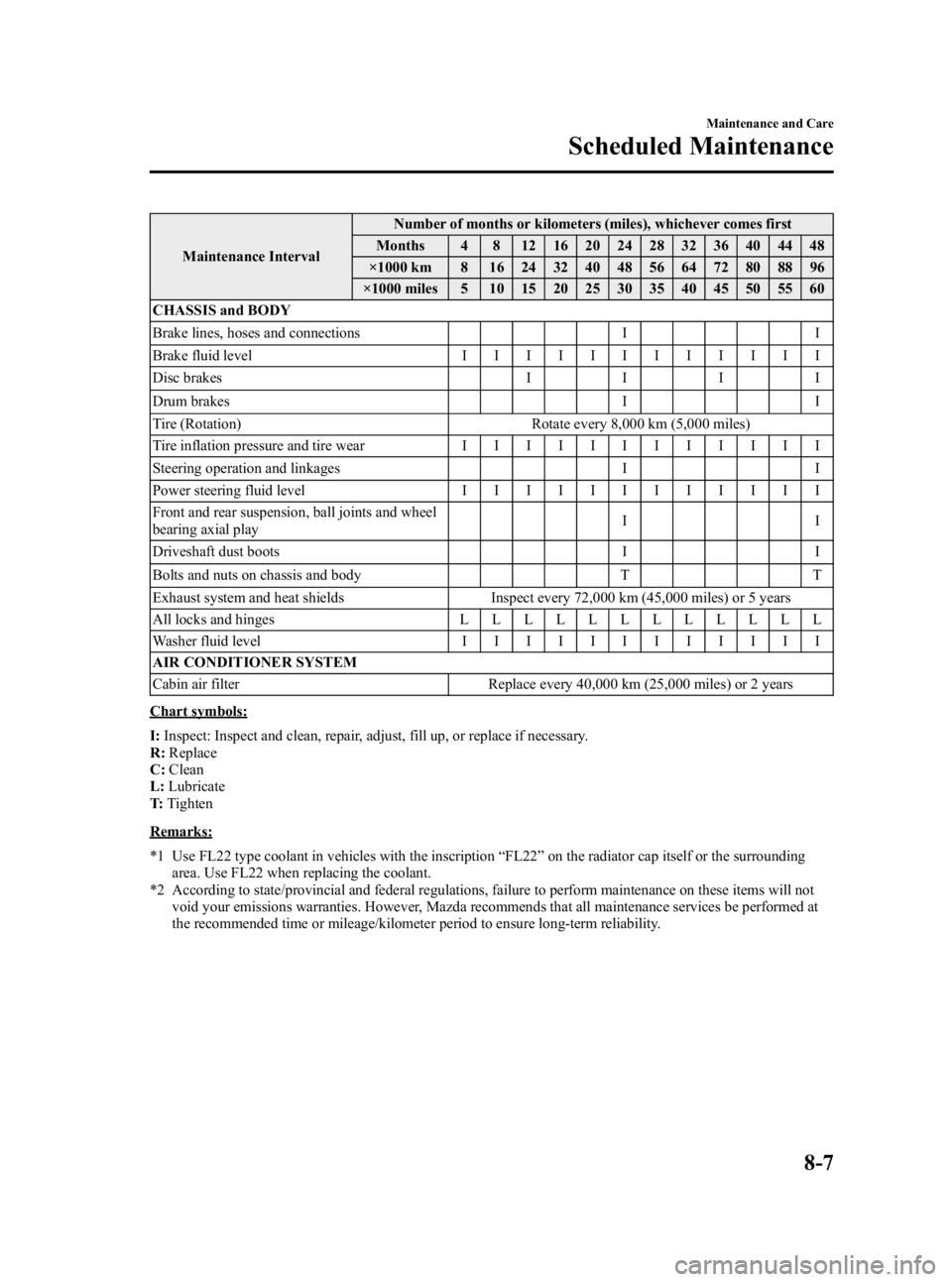
Black plate (241,1)
Maintenance IntervalNumber of months or kilometers (miles), whichever comes first
Months 4 8 12 16 20 24 28 32 36 40 44 48
×1000 km 8 16 24 32 40 48 56 64 72 80 88 96
×1000 miles 5 10 15 20 25 30 35 40 45 50 55 60
CHASSIS and BODY
Brake lines, hoses and connections I I
Brake fluid level IIIIIIIIIIII
Disc brakes IIII
Drum brakes I I
Tire (Rotation) Rotate every 8,000 km (5,000 miles)
Tire inflation pressure and tire wear IIIIIIIIIIII
Steering operation and linkages I I
Power steering fluid level IIIIIIIIIIII
Front and rear suspension, ball joints and wheel
bearing axial play II
Driveshaft dust boots I I
Bolts and nuts on chassis and body T T
Exhaust system and heat shields Inspect every 72,000 km (45,000 miles) or 5 years
All locks and hinges LLLLLLLLLLLL
Washer fluid level IIIIIIIIIIII
AIR CONDITIONER SYSTEM
Cabin air filter Replace every 40,000 km (25,000 miles) or 2 years
Chart symbols:
I: Inspect: Inspect and clean, repair, adjust, fill up, or replace if necessary.
R: Replace
C: Clean
L: Lubricate
T: Tighten
Remarks:
*1 Use FL22 type coolant in vehicles with the inscription “FL22 ”on the radiator cap itself or the surrounding
area. Use FL22 when replacing the coolant.
*2 According to state/provincial and federal regulations, failure to perform maintenance on these items will not void your emissions warranties. However, Mazda recommends that all maintenance services be performed at
the recommended time or mileage/kilometer period to ensure long-term reliability.
Maintenance and Care
Scheduled Maintenance
8-7
Mazda2_8CC7-EA-11H_Edition2 Page241
Monday, September 26 2011 1:55 PM
Form No.8CC7-EA-11H
Page 249 of 346

Black plate (249,1)
NOTE
If the“FL22” mark is shown on or near the
cooling system cap, it is recommended to use
Mazda Genuine FL22 engine coolant (page
8-3).
If the coolant reservoir is empty or new
coolant is required frequently, consult an
Authorized Mazda Dealer.
Brake/Clutch Fluid
qInspecting Brake/Clutch Fluid Level
The brakes and clutch draw fluid from the
same reservoir.
Inspect the fluid level in the reservoir
regularly. It should be kept at MAX.
The level normally drops with
accumulated distance, a condition
associated with wear of brake and clutch
linings. If it is excessively low, have the
brake/clutch system inspected by an
Authorized Mazda Dealer.
MAX fill line
MIN fill line
Maintenance and Care
Owner Maintenance
8-15
Mazda2_8CC7-EA-11H_Edition2 Page249
Monday, September 26 2011 1:55 PM
Form No.8CC7-EA-11H
Page 250 of 346

Black plate (250,1)
qAdding Brake/Clutch Fluid
WARNING
Be careful not to spill brake fluid on
yourself or on the engine:
Spilled brake fluid is dangerous. If it
gets in your eyes, they could be
seriously injured. If this happens,
immediately flush your eyes with
water and get medical attention.
Brake fluid spilled on a hot engine
could cause a fire.
If the brake/clutch fluid level is low,
have the brakes and clutch inspected: Low brake/clutch fluid levels are
dangerous. Low levels could signal
brake lining wear or a brake system
leak. Your brakes could fail and
cause an accident.
If the fluid level is low, add fluid until it
reaches MAX.
Before adding fluid, thoroughly clean the
area around the cap.
CAUTION
Ø Brake and clutch fluid will
damage painted surfaces. If brake
or clutch fluid does get on a
painted surface, wash it off with
water immediately.
Ø Using nonspecified brake and
clutch fluids (page 10-4) will
damage the systems. Mixing
different fluids will also damage
them.
If the brake/clutch system
frequently requires new fluid,
consult an Authorized Mazda
Dealer.
Automatic transaxle Fluid
(ATF)
í
qInspecting Automatic transaxle
Fluid Level
The automatic transaxle fluid level should
be inspected regularly. Measure it as
described below.
The volume of fluid changes with
temperature. Fluid must be checked while
idling the engine without driving at
normal operating temperature.
CAUTION
Ø Low fluid level causes transaxle
slippage. Overfilling can cause
foaming, loss of fluid, and
transaxle malfunction.
Ø Use specified fluid (page 10-4). A
nonspecified fluid could result in
transaxle malfunction and failure.
1. Park on a level surface and set the parking brake firmly.
2. Start the engine and depress the brake pedal.
3. Move the shift lever through all ranges and set it at P.
WARNING
Make sure the brake pedal is applied
before shifting the shift lever: Shifting the shift lever without first
depressing the brake pedal is
dangerous. The vehicle could move
suddenly and cause an accident.
4. With the engine still idling, pull out the dipstick, wipe it clean, and put it back.
8-16
Maintenance and Care
íSome models.
Owner Maintenance
Mazda2_8CC7-EA-11H_Edition2 Page250
Monday, September 26 2011 1:55 PM
Form No.8CC7-EA-11H
Page 282 of 346

Black plate (282,1)
CAUTION
ØDo not use steel wool, abrasive
cleaners, or strong detergents
containing highly alkaline or
caustic agents on chrome-plated
or anodized aluminum parts. This
may damage the protective
coating; also, cleaners and
detergents may discolor or
deteriorate the paint.
Ø To prevent damaging the antenna,
remove it before entering a car
wash facility or passing beneath a
low overhead clearance.
Pay special attention to removing salt,
dirt, mud, and other foreign material from
the underside of the fenders, and make
sure the drain holes in the lower edges of
the doors and rocker panels are clean.
Insects, tar, tree sap, bird droppings,
industrial fallout, and similar deposits can
damage the finish if not removed
immediately. When prompt washing with
plain water is ineffective, use a mild soap
made for use on vehicles.
Thoroughly rinse off all soap with
lukewarm or cold water. Do not allow
soap to dry on the finish.
After washing the vehicle, dry it with a
clean chamois to prevent water spots from
forming.
WARNING
Dry off brakes that have become wet
by driving slowly, releasing the
accelerator pedal and lightly applying
the brakes several times until the brake
performance returns to normal: Driving with wet brakes is
dangerous. Increased stopping
distance or the vehicle pulling to one
side when braking could result in a
serious accident. Light braking will
indicate whether the brakes have
been affected.
When using a high water pressure car
wash
High water temperature and high water
pressure car washers are available
depending on the type of car wash
machine. If the car washer nozzle is put
too close to the vehicle, the force of the
spray could damage or deform the
molding, affect the sealability of parts,
and allow water to penetrate the interior.
Keep a sufficient space (30 cm or more)
between the nozzle and the vehicle. In
addition, do not spend too much time
spraying the same area of the vehicle, and
be very careful when spraying between
gaps in doors and around windows.
Waxing
Your vehicle needs to be waxed when
water no longer beads on the finish.
Always wash and dry the vehicle before
waxing it. In addition to the vehicle body,
wax the metal trim to maintain its luster.
1. Use wax which contains no abrasives. Waxes containing abrasive will remove
paint and could damage bright metal
parts.
8-48
Maintenance and Care
Appearance Care
Mazda2_8CC7-EA-11H_Edition2 Page282
Monday, September 26 2011 1:55 PM
Form No.8CC7-EA-11H